
What do you actually mean when you say values? If you mean the rules you live by the closest synonym for values is principles because it covers the everyday sense of standards that guide choices and behavior.
If you mean how much something is worth, worth fits better, and if you mean a formal code, ethics or standards fits better.
This guide to values synonyms sorts 15 words by meaning, so you can pick the right one for the sentence in front of you.
Top 10 Values Synonyms at a Glance
| # | Synonym | Meaning Difference |
|---|---|---|
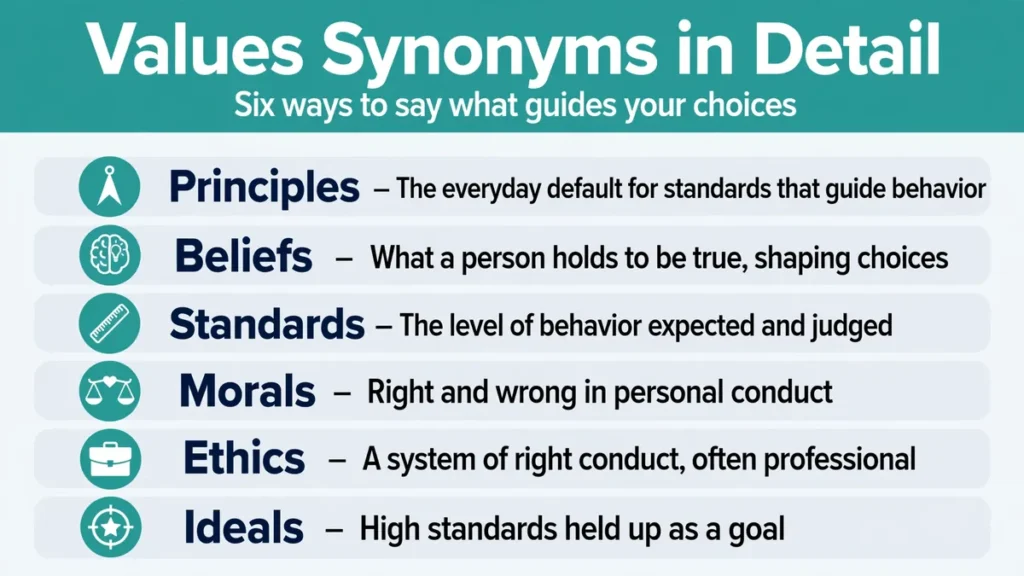
| 1 | Principles | The everyday default for standards that guide behavior |
| 2 | Beliefs | What a person holds to be true, shaping choices |
| 3 | Standards | The level of behavior expected and judged |
| 4 | Morals | Right and wrong in personal conduct |
| 5 | Ethics | A system of right conduct, often professional |
| 6 | Ideals | High standards held up as a goal |
| 7 | Convictions | Strongly held beliefs a person will not easily give up |
| 8 | Virtues | Good qualities of character, praised in a person |
| 9 | Tenets | Formal beliefs held by a group or faith |
| 10 | Creed | A stated set of beliefs, often shared by a group |
Quick Facts About “Values”
- Part of speech: a plural noun. You live by your values or act in line with them. The singular value usually means worth or price.
- Two core meanings: (1) principles and standards of behavior, such as honesty, (2) worth or importance, such as a good education.
- Register: neutral. Values sounds natural in schools, workplaces, and families, and stays neutral in formal writing too.
- Watch out: values promises a standard, not just a preference. If you only like something, preference is more honest.
The Closest Synonym: Principles
Principles is the closest synonym for values because it covers the word’s most common job: naming the standards that guide how a person acts when no one is watching. When parents, companies, or teachers talk about principles, the real point is a rule for living, not a price tag. Principles work in everyday speech, in essays, and in formal reports, which is why they are the safest first choice.
Still, they are not identical. Principles can sound more formal and rule-like, while values can sound warmer and more personal. Use principles as your default, and reach below for faith, character, or worth.
Remember the choice test: if principles still sounds true, it is safe. If the sentence is about money or usefulness, use the worth group below.
Where “Values” Comes From (Etymology)
According to Etymonline, value is first recorded around 1300, meaning “price equal to the intrinsic worth of a thing.” It comes from Old French value, meaning “worth, price, moral worth,” from valoir, “be worth,” from Latin valere, “be strong, be of value.”
Etymonline records the plural sense much later. The meaning “principles regarding what is important or right, standards of a person, group or society” is attested in 1918, from the plural of value in the sense of “properties of a thing which make it useful or essential.” It is perhaps short for social values, attested by 1915 as “moral principles of a people or nation.”
Can You Swap Them Freely?
In short: only inside the same meaning group, and only when the sense matches. A principles word collapses in a sentence about price, and a worth word collapses in a sentence about right and wrong:
- Correct: “Her principles guide every decision.” (standards of behavior)
- Wrong: “Her worth guides every decision she makes.” (worth is about importance or price, not a guiding standard; say principles)
- Correct: “The worth of the course became clear in her first job.” (importance and usefulness)
- Wrong: “The morals of the course became clear in her first job.” (morals are about right and wrong, not usefulness; say worth or value)
Before you substitute, ask: are we talking about how to behave, or about how much something matters? Those take a Group 1 and a Group 2 word in turn.
Values Synonyms in Detail
Group 1: Values as Principles and Standards of Behavior
1. Principles
- Meaning: Basic rules or standards that guide how a person behaves and decides.
- Difference: The closest all-round match for everyday values. Principles are clear, general, and accepted everywhere.
- Best used for: Everyday writing, essays, workplaces, schools, family life.
- Formality: Neutral, CEFR: B2, Frequency: Very common
- Example (Family): “Their family principles include honesty, hard work, and respect.”
- Example (Work): “She refused the deal on principle.”
- When NOT to use it: When you mean a price or measurement of worth.
2. Beliefs
- Meaning: Things a person accepts as true, which then shape choices and actions.
- Difference: Beliefs are wider than principles: a belief can be about the world, while a principle is a rule for action.
- Best used for: Personal writing, essays, discussions of faith and culture.
- Formality: Neutral, CEFR: B1, Frequency: Very common
- Example (Personal): “His beliefs about fairness shape how he treats staff.”
- Example (School): “The class discussed beliefs different cultures share.”
- When NOT to use it: When you need a firm rule, not a held view.
3. Standards
- Meaning: The level of behavior or quality that is expected and used to judge actions.
- Difference: Standards stress measurement and expectation, suiting rules that can be checked.
- Best used for: Workplaces, schools, reports, codes of conduct.
- Formality: Neutral to formal, CEFR: B2, Frequency: Very common
- Example (Work): “The clinic sets high standards for care.”
- Example (School): “Good behavior standards help every class.”
- When NOT to use it: For a private inner conviction, which sounds personal, not testable.
4. Morals
- Meaning: Beliefs about right and wrong that guide personal conduct.
- Difference: Morals focus on right and wrong itself, often in private life.
- Best used for: Essays, debates, discussions of character and conduct.
- Formality: Neutral, CEFR: B2, Frequency: Very common
- Example (Personal): “Her morals would not let her lie.”
- Example (Debate): “The story raises questions about morals.”
- When NOT to use it: For a company policy or a price, not personal conduct.
5. Ethics
- Meaning: A system of moral principles, often shared by a profession or an organization.
- Difference: Ethics sounds systematic and professional, fitting doctors, lawyers, and businesses more than family talk.
- Best used for: Professional writing, academic work, business and medical contexts.
- Formality: Formal, CEFR: C1, Frequency: Very common
- Example (Professional): “The ethics of the firm forbid supplier gifts.”
- Example (Academic): “Medical ethics asks who benefits and who bears risk.”
- When NOT to use it: In casual family talk, where values sounds warmer.
6. Ideals
- Meaning: High standards or perfect goals that a person or group aims for, even if they are hard to reach.
- Difference: Ideals stress aspiration, describing what should be, not only what is practised.
- Best used for: Speeches, essays, mission statements, inspirational writing.
- Formality: Neutral to formal, CEFR: B2, Frequency: Common
- Example (Speech): “The charity was founded on ideals of equality.”
- Example (School): “Students wrote about ideals they hope to live by.”
- When NOT to use it: When you mean a practical daily rule, where ideals sound lofty.
7. Convictions
- Meaning: Strongly held beliefs that a person holds firmly and acts on, even under pressure.
- Difference: Convictions add strength and refusal to bend, suiting a person who will not change a view for convenience.
- Best used for: Biographies, essays, speeches, discussions of conscience.
- Formality: Neutral to formal, CEFR: C1, Frequency: Common
- Example (Biography): “His convictions led him to defend free speech.”
- Example (Everyday): “She spoke from conviction, not habit.”
- When NOT to use it: For a light preference or slogan, where convictions imply depth.
8. Virtues
- Meaning: Good qualities of character, such as honesty, patience, or courage, that are praised in a person.
- Difference: Virtues describe character traits, while values describe standards.
- Best used for: Character writing, essays, philosophy, moral education.
- Formality: Neutral to formal, CEFR: C1, Frequency: Common
- Example (Character): “Patience and honesty were the virtues teachers praised most.”
- Example (Essay): “The novel tests its hero’s virtues under pressure.”
- When NOT to use it: For a written code or a price, not character.
9. Tenets
- Meaning: Formal beliefs or principles held by a group, faith, or movement.
- Difference: Tenets sound official and shared, suiting religions and movements more than one person’s habits.
- Best used for: Academic writing, history, religion, political writing.
- Formality: Formal, CEFR: C1, Frequency: Uncommon
- Example (History): “The movement was built on tenets of freedom and equality.”
- Example (Religion): “The tenets of the faith are taught to every new member.”
- When NOT to use it: In everyday talk, where tenets sounds stiff.
10. Creed
- Meaning: A stated set of beliefs, often shared by a religious group or a community.
- Difference: Creed stresses a declared statement, fitting a formal confession more than a private habit.
- Best used for: Religion, history, formal statements of belief.
- Formality: Formal, CEFR: C1, Frequency: Uncommon
- Example (Religion): “Members recite the creed each Sunday.”
- Example (History): “The school adopted a creed of respect.”
- When NOT to use it: For one person’s private standards, not a shared text.
Group 2: Values as Worth and Importance
11. Worth
- Meaning: How much something matters, or how good or useful it is, sometimes in money terms.
- Difference: Worth is the closest word for the second sense, covering importance, usefulness, and price.
- Best used for: Everyday writing, advice, essays about choices and purchases.
- Formality: Neutral, CEFR: B1, Frequency: Very common
- Example (Advice): “The worth of a mentor shows up years later.”
- Example (Everyday): “She weighed the extra course against its cost.”
- When NOT to use it: When you mean right and wrong, not importance.
12. Importance
- Meaning: How much something matters or how seriously it should be taken.
- Difference: Importance is plain and general, avoiding money talk.
- Best used for: Essays, reports, everyday explanations.
- Formality: Neutral, CEFR: B1, Frequency: Very common
- Example (Essay): “The importance of clean water is clear in clinics.”
- Example (Work): “He stressed listening before deciding.”
- When NOT to use it: For a guiding moral rule, not mere importance.
13. Merit
- Meaning: The quality of deserving praise, reward, or attention, based on goodness or usefulness.
- Difference: Merit stresses judgement and desert, suiting awards and applications.
- Best used for: Academic writing, applications, reviews, formal praise.
- Formality: Formal, CEFR: C1, Frequency: Common
- Example (Academic): “The proposal was judged on merit, not connections.”
- Example (Review): “The film has merit, even if the plot is slow.”
- When NOT to use it: For a personal moral code, not quality.
14. Significance
- Meaning: The importance or meaning of something, often because of its effect or its place in history.
- Difference: Significance adds weight and consequence, suiting events and findings.
- Best used for: History, science, academic essays, news analysis.
- Formality: Formal, CEFR: C1, Frequency: Common
- Example (History): “The significance of the vote was clear.”
- Example (Science): “Researchers explained the significance of the result.”
- When NOT to use it: In light talk, where importance is simpler.
15. Utility
- Meaning: How useful something is in practice, its practical benefit.
- Difference: Utility is the practical end of worth, fitting tools and systems, not moral conduct.
- Best used for: Technical writing, business, economics, practical guides.
- Formality: Formal, CEFR: C1, Frequency: Common
- Example (Practical): “The utility of the app lies in simple dose checks.”
- Example (Business): “Managers judged the system by utility, not looks.”
- When NOT to use it: For moral standards, not practical use.
Best Alternatives by Context
Pick by the situation, not by the word list alone:
- Everyday family or personal writing: principles or beliefs. Both are warm and clear.
- A workplace or school code: standards or ethics, for a testable code or a professional system.
- A speech or mission statement: ideals, pointing to a goal worth reaching.
- A person who will not bend: convictions, when strength and personal cost matter.
- Character in a story or essay: virtues, naming good qualities shown.
- A formal group belief: tenets or creed, for a movement or a stated declaration.
- How much something matters: worth or importance, for usefulness or general importance.
- Judging quality or a result: merit or significance, for praise or effect.
- Practical usefulness: utility, for tools and systems where benefit is the test.
For the wider family, see empathy synonyms when a value is about understanding others, and bravery synonyms when the value is courage. For groups acting on shared standards, coordination synonyms sorts that family.
Which Values Synonym Should I Choose?
| Situation | Best pick | Why it wins |
|---|---|---|
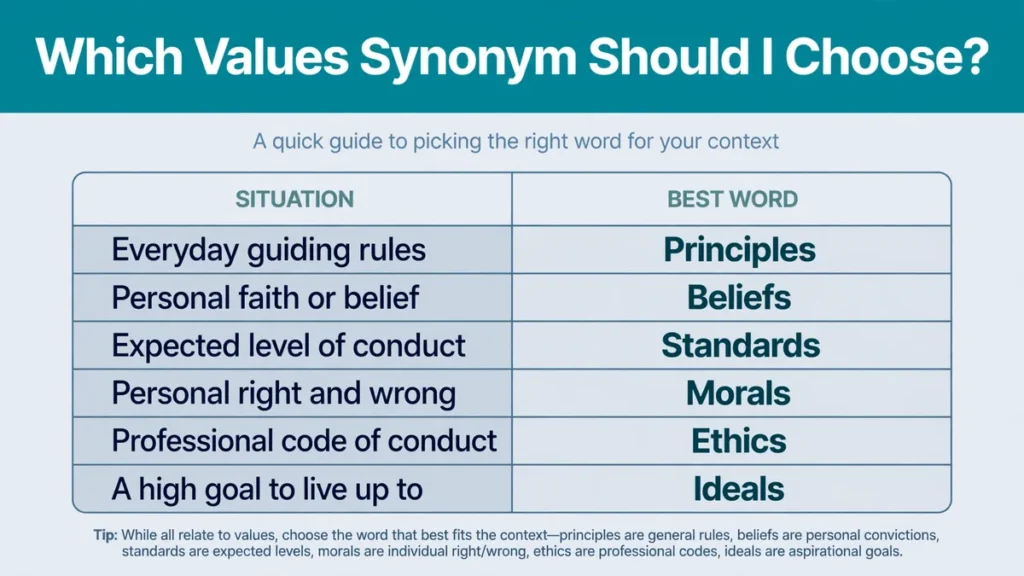
| Everyday guiding standard | Principles | Clear, general, and understood everywhere |
| A view that shapes choices | Beliefs | Covers what a person holds true |
| A testable workplace rule | Standards | States what is expected and judged |
| Right and wrong in conduct | Morals | Focuses on personal right and wrong |
| A professional system | Ethics | Sounds systematic and professional |
| A high goal to aim for | Ideals | Points to what should be |
| A belief held under pressure | Convictions | Carries strength and refusal to bend |
| A good quality of character | Virtues | Names character, not just rules |
| How much something matters | Worth | Covers importance, use, and price |
| Practical benefit of a tool | Utility | Tests usefulness in real use |
Antonyms of Values
Antonyms for values as principles and standards
| Antonym | Meaning Difference |
|---|---|
| Corruption | Dishonest conduct that breaks shared standards |
| Immorality | Conduct against accepted ideas of right and wrong |
| Dishonesty | The opposite of truthful, principled conduct |
| Selfishness | Putting only your own gain above shared standards |
| Lawlessness | Living without respect for rules or order |
| Opportunism | Changing conduct to suit advantage, not principle |
Words Commonly Confused With Values
Value (singular) is the near twin to watch. As a noun it usually means worth or price, as in the value of a house. As a verb it means to rate something highly, as in “she values honesty.” Only the plural, values, normally carries the principles sense. If your sentence is about price, use value or worth, not values.
Price is not a synonym for values in the principles sense at all. Price is only the money asked or paid. A priceless friendship has no price, but it has great value in the importance sense.
Morals versus ethics is the closest pair in Group 1, and the difference is scope. Morals usually describe a person’s own sense of right and wrong, while ethics describes a system shared by a profession or group.
Substitution test failures: “She acted against her worth” fails, because worth is not a guiding standard, so say “against her principles.” “The morals of the machine impressed buyers” fails, because a machine has no conscience, so say “the utility of the machine impressed buyers.” “His price in the team rose after the win” fails as a values sentence, because price is money talk, so say “his worth in the team rose after the win.”
American vs British English
Values is spelled the same in American and British English, and so are principles, beliefs, standards, morals, ethics, ideals, convictions, virtues, tenets, and creed. One point matters: American English writes behavior, while British English writes behaviour. This article uses American spelling throughout. Otherwise the whole set travels unchanged across the Atlantic.
Collocations and Idioms With Values
Only use combinations that native speakers actually use:
- core values: the central principles of a person or organization.
- family values: principles shared in a family.
- shared values: principles held in common by a group.
- moral values: principles about right and wrong.
- traditional values: long-held principles passed down.
- company values: the stated principles of a business.
- live by your values: to act in line with your principles.
- stand by your values: to hold firm under pressure.
- in line with your values: matching your principles.
- at odds with your values: clashing with your principles.
- put a value on something: to judge its worth.
- of great value: very useful or important.
- value for money: good benefit for the price paid.
Use live by, hold, or share with values, and put a value on with the singular value.
Practice Exercises
Exercise 1: Spot the wrong word. Each sentence has one word that does not fit. Name it and fix it.
- “The morals of the software impressed users.” (Hint: software has no conscience.)
- “She acted against her worth when she lied.” (Hint: worth is not a guiding standard.)
- “The price of honesty rose.” (Hint: honesty is a principle, not a price tag.)
Exercise 2: Choose the better sentence. Pick A or B, and say why.
- A: “Our core values include honesty and fair pay.” B: “Our core prices include honesty and fair pay.”
- A: “The utility of the tool saved hours each week.” B: “The morals of the tool saved hours each week.”
- A: “His convictions kept him steady under pressure.” B: “His prices kept him steady under pressure.”
Exercise 3: Rewrite for tone. Rewrite this stiff sentence in friendly, everyday English: “The organization adheres to tenets of transparency.” Then rewrite this casual sentence in formal English: “She sticks to her beliefs, no matter what.”
Answer key
- Exercise 1: (1) morals, use utility; (2) worth, use principles; (3) price, use worth or importance.
- Exercise 2: (1) A, principles, not prices; (2) A, usefulness, not conscience; (3) A, firm beliefs, not money.
- Exercise 3: Friendly: “The team sticks to being open and honest.” Formal: “She acts in accordance with her convictions.”
Frequently Asked Questions
What is the best synonym for values?
Principles is the best all-round synonym, because it fits family life, school, work, and essays without sounding technical or casual. Use it for standards that guide choices and behavior. For worth, choose worth or importance instead, and for a formal code, standards or ethics may fit better.
Can values mean money or price?
Values, in the plural, normally means principles, not a price list. The singular value can mean price or worth, as in the value of a house. If you mean money, say price or worth. If you mean importance without money talk, say importance.
What is the difference between values and morals?
Morals focus on right and wrong in personal conduct, while values cover a wider set of guiding standards, including fairness, honesty, and service. A person can value creativity, which is not a moral question. When the point is conscience, morals is sharper; otherwise values is wider.
Are ethics and values the same thing?
No, though they overlap. Ethics usually means a system of moral principles, often shared by a profession, such as medical ethics. Values is the wider, warmer word for personal or group standards. In a workplace code, ethics sounds professional; in family talk, values sounds natural.
What are core values in a company?
Core values are the central principles a company states and tries to live by, such as honesty, safety, or customer care. They guide hiring, decisions, and daily conduct. A real core value shows up in choices, not only on a poster. If conduct contradicts it, staff and customers notice quickly.
Which synonym should students use in essays?
In essays, prefer principles, standards, or ethics, because all three sound academic and precise. Reserve tenets and creed for religion, history, or formal group beliefs. Match the word to the sense: rules take principles, professional systems take ethics, and worth takes importance or merit.
Conclusion
The right replacement for values depends on the sense in front of you. A guiding standard calls for principles, a testable rule for standards, a professional system for ethics, and a firm belief under pressure for convictions.
Character calls for virtues, worth for worth or importance, and practical use for utility. Ask one question: am I describing how to behave or how much something matters?

About Sajjad Ahmed
Sajjad Ahmed is the author behind Guest Paster, where he writes about English vocabulary, synonyms, word meanings, and practical word usage.
His content is designed to help readers understand the differences between similar words, discover suitable alternatives, and use English vocabulary more effectively in everyday writing and communication.
Before publishing, Sajjad focuses on presenting word choices in a clear and easy-to-understand format, with relevant meanings, context, and examples where helpful.
Through Guest Paster, his goal is to make vocabulary learning simpler and provide useful language resources for students, writers, English learners, and anyone looking to expand their vocabulary.
Areas of Focus: English Vocabulary • Synonyms • Word Meanings • Word Usage • Language Learning
Author: Sajjad Ahmed
Website: Guest Paster