
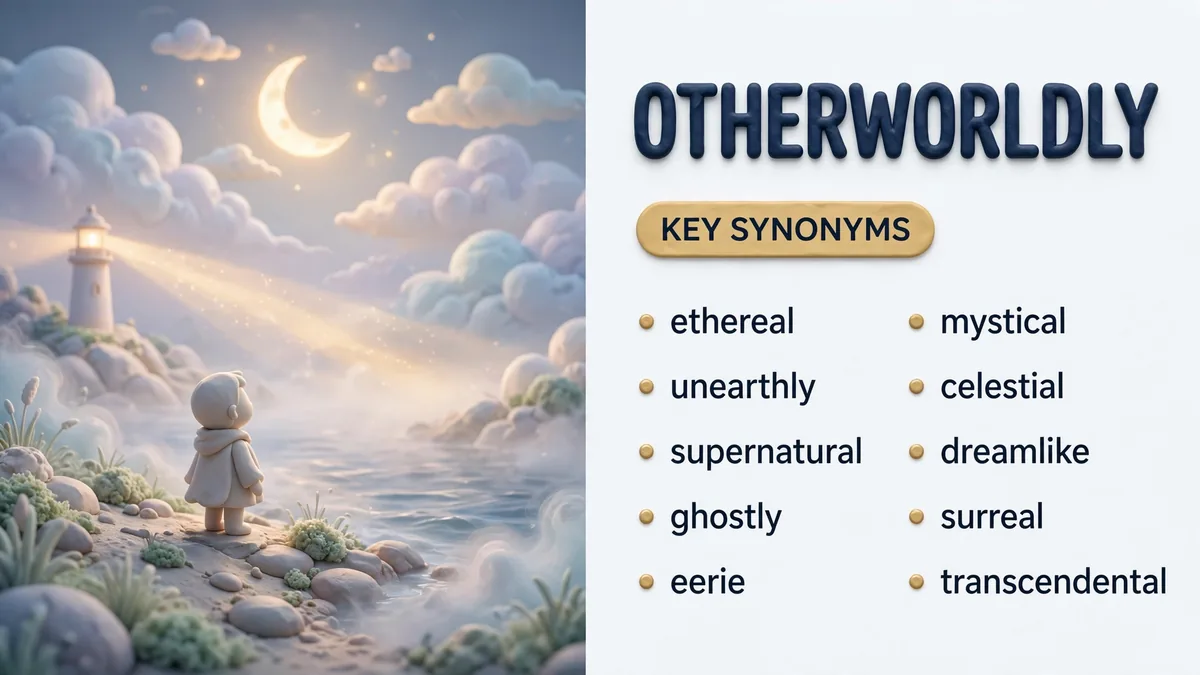
Mist lay low over the shore at dawn, a pale crescent moon still above the water. A choir of voices drifted from the fog, though no singer could be seen and the lighthouse beam swung through the gray. The whole scene felt otherworldly, a word for beauty and strangeness from another place.
Ethereal is the closest synonym and it fits the light, the sound and the silence. This guide gives you 15 otherworldly synonyms with meanings, examples and honest limits so your next sentence names the exact wonder you mean.
10 Otherworldly Synonyms
| # | Synonym | Meaning Difference |
|---|---|---|
| 1 | Ethereal | Light, airy, almost too delicate for earth |
| 2 | Unearthly | Not of this earth, strange or alarming |
| 3 | Supernatural | Beyond nature, outside natural law |
| 4 | Ghostly | Like a ghost, pale and haunting |
| 5 | Eerie | Strange in a way that unsettles |
| 6 | Mystical | Touched by mystery or spiritual power |
| 7 | Celestial | Of the heavens, the sky, or the stars |
| 8 | Dreamlike | Unreal, as if seen in a dream |
| 9 | Surreal | Bizarre, dreamlike, beyond logic |
| 10 | Transcendental | Rising above ordinary human experience |
Quick Facts About “Otherworldly”
- Part of speech: an adjective. The noun is otherworldliness, and the adverb otherworldlily is rare.
- Core meaning: seeming to belong to another world, strange and wonderful, or spiritual.
- Three main senses: (1) a beauty or light that seems not of this earth; (2) a strange, ghostly quality that unsettles; (3) a spiritual quality, concerned with a world beyond this one.
- Register: neutral to literary. Otherworldly fits novels, essays, film reviews, and everyday conversation.
- Common mistake: calling anything pretty otherworldly. The word needs strangeness, wonder, or a sense that ordinary rules have slipped.
The Closest Synonym: Ethereal
Ethereal is the closest synonym for otherworldly, because it covers the same ground in the loveliest form: a beauty so light and delicate that it seems to belong to another world. Test the swap and it holds. “Her otherworldly beauty stopped the room” becomes “Her ethereal beauty stopped the room.” “An otherworldly glow filled the chapel” becomes “An ethereal glow filled the chapel.” “The music had an otherworldly quality” becomes “The music had an ethereal quality.”
Ethereal wins on beauty: it fits light, voices, faces, and music too fine for earth. Unearthly runs second when the strangeness turns alarming, and a profound synonyms silence can feel otherworldly too.
Where “Otherworldly” Comes From (Etymology)
According to Etymonline, otherworldly first appeared in 1854, meaning “governed in this life by motives relating to consideration of an afterlife,” formed from other plus world plus ly. By 1873 it had taken on a wider sense, “of or pertaining to a world of imagination.” The noun otherworldliness is older, recorded from 1819, when Leigh Hunt used it in print in The Examiner on December 19 of that year. The phrase “other world” goes back to around 1200, when it meant “afterlife, spirit land, world to come,” and by around 1300 it also meant “a world of idealism or fantasy.” The first element, other, comes from Old English other, meaning “second, additional, further,” from Proto-Germanic anthera. Merriam-Webster defines the word as relating to or suggestive of another world, and as not of this world.
The history explains the double life of the word. It began with the afterlife, then widened to cover anything that feels like it came from somewhere else.
Can You Swap Them Freely?
In short: only inside the same meaning group.
- ✅ “An ethereal glow lit the chapel windows.” (a light too fine for earth ✔)
- ✅ “The house had an eerie silence after midnight.” (strange and unsettling ✔)
- ❌ “The house had a celestial silence after midnight.” (celestial is about the heavens, not a mood ✘, say eerie)
- ✅ “She believed in supernatural forces beyond science.” (beyond natural law ✔)
- ❌ “She believed in dreamlike forces beyond science.” (dreamlike means unreal, not beyond nature ✘, say supernatural)
- ✅ “A surreal image of melting clocks hung in the gallery.” (bizarre and dreamlike ✔)
- ❌ “A numinous image of melting clocks hung in the gallery.” (numinous is spiritual awe, not bizarre art ✘, say surreal)
- ✅ “The celestial bodies moved across the night sky.” (of the heavens ✔)
Before you substitute, ask which kind of otherness it is: beauty, ghosts, dreams, or spirit.
Otherworldly Synonyms in Detail
Group 1: A Beauty That Seems Not of Earth
1. Ethereal
- Meaning: Extremely light and delicate, too fine for this world.
- Difference: The loveliest swap for otherworldly, with beauty at its centre.
- Best used for: Light, voices, beauty, and music.
- Formality: Neutral to literary · CEFR: C1 · Frequency: Common
- Example (Beauty): “Her ethereal beauty drew every eye.”
- Example (Music): “An ethereal voice rose above the strings.”
- When NOT to use it: For something frightening, use eerie instead.
2. Unearthly
- Meaning: Not of this earth, strange in a way that can alarm.
- Difference: The wonder stays, with a chill added.
- Best used for: Light, silence, beauty, and sounds.
- Formality: Neutral to literary · CEFR: C1 · Frequency: Common
- Example (Glow): “An unearthly glow spilled from the empty house.”
- Example (Silence): “An unearthly silence followed the last note.”
- When NOT to use it: For a warm, heavenly feeling, use heavenly instead.
3. Celestial
- Meaning: Of the heavens, the sky, or the stars.
- Difference: Points upward, to the sky and the stars.
- Best used for: Bodies, light, music, and the night sky.
- Formality: Neutral to formal · CEFR: C1 · Frequency: Common
- Example (Bodies): “Celestial bodies moved across the clear night sky.”
- Example (Music): “The choir sang with a celestial sweetness.”
- When NOT to use it: For a ghost or a haunted place, use ghostly instead.
4. Heavenly
- Meaning: Of heaven, or so lovely it seems to come from heaven.
- Difference: Warmer and more familiar than celestial, often used for delight.
- Best used for: Voices, music, food, and scents.
- Formality: Neutral · CEFR: B2 · Frequency: Very common
- Example (Voice): “Her heavenly voice made the hall fall silent.”
- Example (Scent): “A heavenly scent of jasmine drifted through the window.”
- When NOT to use it: For something strange or frightening, use eerie instead.
5. Transcendental
- Meaning: Rising above ordinary human experience.
- Difference: The most philosophical word here, about going beyond limits.
- Best used for: Experience, meditation, philosophy, and art.
- Formality: Formal · CEFR: C2 · Frequency: Less common
- Example (Experience): “The long walk at dawn became a transcendental experience.”
- Example (Music): “Listeners called the final movement transcendental.”
- When NOT to use it: In plain writing, use ethereal instead.
6. Numinous
- Meaning: Filled with spiritual awe or a sense of divine presence.
- Difference: About sacred feeling, not just strange beauty.
- Best used for: Places, light, silence, and ritual.
- Formality: Formal, literary · CEFR: C2 · Frequency: Less common
- Example (Place): “The old stone circle held a numinous stillness.”
- Example (Light): “A numinous light fell through the chapel windows.”
- When NOT to use it: For a bizarre effect, use surreal instead.
Group 2: Ghosts, Spirits, and the Strange
7. Supernatural
- Meaning: Beyond what nature explains, outside natural law.
- Difference: The widest word for powers science cannot explain.
- Best used for: Powers, beings, events, and stories.
- Formality: Neutral · CEFR: B2 · Frequency: Very common
- Example (Powers): “The novel tells of a girl with supernatural powers.”
- Example (Events): “Villagers blamed the strange lights on the supernatural.”
- When NOT to use it: For a merely dreamlike mood, use dreamlike instead.
8. Ghostly
- Meaning: Like a ghost, pale, faint, and haunting.
- Difference: The most visual word here, tied to apparitions.
- Best used for: Figures, faces, light, and voices.
- Formality: Neutral · CEFR: B2 · Frequency: Common
- Example (Figure): “A ghostly figure crossed the hall and vanished.”
- Example (Light): “Ghostly moonlight fell across the empty bed.”
- When NOT to use it: For a warm spiritual feeling, use numinous instead.
9. Spectral
- Meaning: Like a specter or ghost, shadowy and unreal.
- Difference: More literary than ghostly, with a shadowy quality.
- Best used for: Figures, light, shapes, and apparitions.
- Formality: Formal, literary · CEFR: C2 · Frequency: Less common
- Example (Figure): “A spectral figure stood at the end of the hall.”
- Example (Light): “Spectral light played on the lake at dusk.”
- When NOT to use it: In plain writing, use ghostly.
10. Eerie
- Meaning: Strange and frightening in a quiet, unsettling way.
- Difference: The chill is the point.
- Best used for: Silence, sounds, places, and light.
- Formality: Neutral · CEFR: B2 · Frequency: Very common
- Example (Silence): “An eerie silence hung over the village.”
- Example (Sound): “An eerie sound, like a distant bell, came from the woods.”
- When NOT to use it: For beauty or wonder, use ethereal instead.
11. Uncanny
- Meaning: Strange in a way that feels familiar yet wrong.
- Difference: The unease comes from almost being normal.
- Best used for: Resemblance, voices, and coincidences.
- Formality: Neutral · CEFR: C1 · Frequency: Common
- Example (Resemblance): “The doll had an uncanny resemblance to the girl.”
- Example (Coincidence): “It was uncanny how often their paths crossed.”
- When NOT to use it: For a plain ghost story, use ghostly instead.
12. Phantasmal
- Meaning: Like a phantom, unreal and illusory.
- Difference: The most literary word here, about illusion.
- Best used for: Visions, dreams, figures, and light.
- Formality: Formal, literary · CEFR: C2 · Frequency: Rare
- Example (Vision): “A phantasmal city rose from the desert heat and faded.”
- Example (Figure): “Phantasmal figures moved through the mist at the field’s edge.”
- When NOT to use it: In plain writing, use ghostly instead.
Group 3: Dreams and Mysteries
13. Mystical
- Meaning: Touched by mystery, spiritual power, or hidden meaning.
- Difference: About hidden truth, not just strangeness.
- Best used for: Experiences, traditions, symbols, and places.
- Formality: Neutral to formal · CEFR: C1 · Frequency: Common
- Example (Experience): “She spoke of a mystical experience that changed her.”
- Example (Symbol): “The old symbol carried a mystical meaning.”
- When NOT to use it: For a comic scene, use surreal instead.
14. Dreamlike
- Meaning: Unreal, hazy, or strange in the way of a dream.
- Difference: The softest word here, about unreality rather than fear.
- Best used for: Memories, light, days, and moods.
- Formality: Neutral · CEFR: B2 · Frequency: Very common
- Example (Memory): “The whole summer had a dreamlike quality.”
- Example (Light): “Dreamlike light filtered through the curtains.”
- When NOT to use it: For a real ghost or spirit, use ghostly instead.
15. Surreal
- Meaning: Bizarre and dreamlike, beyond logic.
- Difference: The boldest word here, often with a comic or shocking edge.
- Best used for: Art, scenes, moments, and humor.
- Formality: Neutral · CEFR: B1 · Frequency: Very common
- Example (Scene): “A surreal scene greeted them: a piano in the desert.”
- Example (Moment): “Winning the prize felt surreal, as if it were happening to another person.”
- When NOT to use it: For sacred awe, use numinous instead.
Best Alternatives by Context
A singer’s voice and a haunted house both feel otherworldly, yet they ask for different words.
| Situation | Best pick | Why it wins |
|---|---|---|
| A light or voice too lovely for earth | Ethereal | The beauty |
| A strange glow or silence that alarms | Unearthly | The chill |
| Powers or events beyond nature | Supernatural | Beyond natural law |
| A pale figure that haunts a place | Ghostly | The apparition |
| A silence that unsettles you | Eerie | The quiet fear |
| A hidden spiritual meaning | Mystical | The mystery |
| Stars, sky, or heavenly music | Celestial | The heavens |
| A hazy, unreal memory | Dreamlike | The dream quality |
| A bizarre scene beyond logic | Surreal | The shock |
| An experience beyond ordinary life | Transcendental | Rising above |
Two calls deserve a second look. An extraordinary synonyms guide covers otherworldly beauty in its wider sense, for when the wonder is not quite ghostly.
Which Otherworldly Synonym Should I Choose?
| Situation | Best pick | Why it wins |
|---|---|---|
| Beauty too fine for earth | Ethereal | The loveliest word |
| Strangeness with a chill | Unearthly | Wonder plus alarm |
| Beyond natural law | Supernatural | The widest power word |
| A pale haunting figure | Ghostly | The visual ghost |
| A shadowy literary apparition | Spectral | The poetic ghost |
| Quiet fear in a place | Eerie | The unsettling mood |
| Almost normal, yet wrong | Uncanny | The familiar made strange |
| A phantom vision | Phantasmal | The illusion |
| Hidden spiritual truth | Mystical | The mystery |
| The heavens and the stars | Celestial | The sky |
| Warm, heavenly delight | Heavenly | The warmth |
| A hazy, unreal memory | Dreamlike | The dream |
| Bizarre, beyond logic | Surreal | The shock |
| Above ordinary experience | Transcendental | The philosophy |
| Sacred awe in a place | Numinous | The divine presence |
Words Commonly Confused With Otherworldly
Part 1
Otherworldly versus supernatural matters for scope. Supernatural means beyond nature itself, a matter of powers and laws. Otherworldly is wider and softer: it can also mean simply strange, lovely, or dreamlike. A ghost is supernatural. A misty shore at dawn is otherworldly, not supernatural.
Otherworldly versus eerie matters for fear. Eerie always unsettles, and it always carries a quiet fear. Otherworldly can unsettle, yet it can also delight. An eerie silence frightens the listener. An otherworldly voice may fill the listener with wonder.
Otherworldly versus celestial matters for direction. Celestial points upward, to the heavens, the stars, and the sky. Otherworldly points outward, to another world altogether. A celestial choir sings from the heavens. An otherworldly choir sings from a fog where no singer stands.
Otherworldly versus dreamlike matters for reality. Dreamlike means unreal in the way of a dream, hazy and soft. Otherworldly can be sharp and clear, like a beam of light through fog. A dreamlike afternoon drifts by, while an otherworldly one stops you in your tracks.
Part 2
Otherworldly versus surreal matters for logic. Surreal breaks logic and often shocks or amuses, like a piano in the desert. Otherworldly need not break logic at all: a lighthouse beam in fog follows every law of physics, yet the scene can still feel otherworldly.
Otherworldly versus unearthly matters for tone. The two words overlap so much that writers swap them freely, yet unearthly leans darker, toward alarm and the night. Otherworldly leans wider, covering beauty, spirit, and strangeness alike. When the mood turns frightening, unearthly is sharper.
Otherworldly beings in lore deserve a note of their own. Old stories are full of fairies, spirits, and wandering souls, and our guide to lore synonyms covers the tales that carry them. The beings of folklore are otherworldly by definition, yet lore names the stories, not the beings.
Collocations and Idioms With Otherworldly
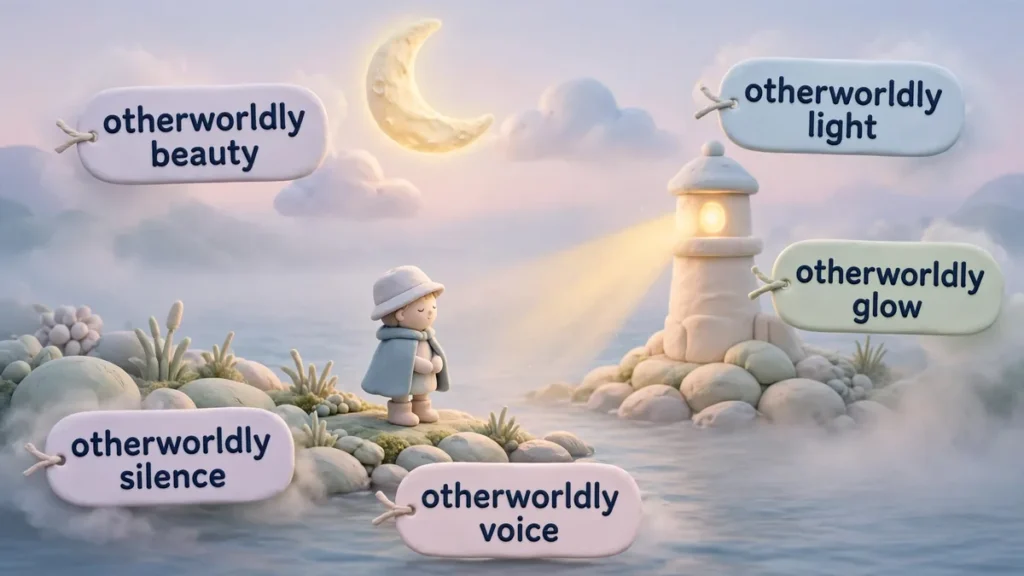
Only combinations native speakers actually use:
- otherworldly beauty: as in “Her otherworldly beauty drew every eye.”
- otherworldly light: as in “An otherworldly light fell across the snow.”
- otherworldly glow: as in “The windows gave off an otherworldly glow.”
- otherworldly silence: as in “An otherworldly silence settled over the valley.”
- otherworldly voice: as in “An otherworldly voice rose from the choir loft.”
- otherworldly beings: as in “Old tales speak of otherworldly beings.”
- an otherworldly quality: as in “The music had an otherworldly quality.”
Otherworldly Opposites: Earthly Words for an Unearthly Word
| Otherworldly word | Opposite | What changes |
|---|---|---|
| Ethereal | Solid | The light gains weight and body |
| Unearthly | Familiar | The strangeness fades into the everyday |
| Supernatural | Natural | Nature explains it after all |
| Ghostly | Living | The figure breathes and casts a shadow |
| Eerie | Comforting | The fear gives way to warmth |
| Mystical | Plain | The hidden meaning turns out to be ordinary |
| Celestial | Earthly | The heavens come down to the ground |
| Dreamlike | Real | The haze clears and the facts stand |
| Surreal | Sensible | Logic returns and the scene makes sense |
| Transcendental | Mundane | The experience drops back to daily life |
Earthly is the plain opposite for everyday writing, while natural suits the supernatural sense and mundane suits the spiritual one.
American vs British English
Otherworldly is spelled and used the same in American and British English, and so are its synonyms here. One small difference sits nearby: Americans write “center” where Britons write “centre.”
A few of the rarer synonyms, like phantasmal and numinous, appear more often in British literary writing, yet they are correct on both sides of the Atlantic. This article uses American spelling throughout.
Practice Exercises
Exercise 1: Pick the best word. Each sentence fits one word from the list. Choose it and say why.
- “A pale figure crossed the hall and vanished through the wall.”
- “The whole summer had a hazy, unreal quality in her memory.”
- “A piano stood in the middle of the desert, and no one could explain it.”
- “The old stone circle felt holy and still at dawn, as if a god were near.”
- “Her voice was so light and lovely that it seemed too fine for this earth.”
Exercise 2: Rewrite the flat sentence. Each sentence below is correct but dull. Rewrite it with a sharper otherworldly synonym, and say why your word fits.
- “The light in the chapel was very pretty.”
- “The house was quiet in a scary way after midnight.”
- “The singer’s voice was strange and hard to explain.”
- “The old stories told of magic creatures from another world.”
- “The trip felt like a dream, and nothing seemed real.”
Answer key
- Exercise 1: (1) ghostly: a pale figure that vanishes is an apparition; (2) dreamlike: a hazy, unreal memory fits a dream; (3) surreal: a piano in the desert breaks logic; (4) numinous: holy stillness and divine presence; (5) ethereal: light, lovely, and too fine for earth.
- Exercise 2: (1) “An ethereal light filled the chapel” fits beauty too fine for earth; (2) “An eerie silence hung over the house” fits quiet fear; (3) “Her otherworldly voice rose above the crowd” fits strangeness with wonder; (4) “The old stories told of supernatural beings” fits powers beyond nature; (5) “The trip had a dreamlike quality” fits unreality without fear.
Frequently Asked Questions
What is the best synonym for otherworldly?
Ethereal is the best synonym for otherworldly in most sentences, because it covers a beauty so light and delicate that it seems to belong to another world. Unearthly fits when the strangeness alarms you, supernatural fits powers beyond nature, and dreamlike fits a hazy mood.
What is the difference between otherworldly and supernatural?
Supernatural means beyond nature itself, a matter of powers and laws that science cannot explain. Otherworldly is wider and softer: it can mean supernatural, but it can also mean simply strange, lovely, or dreamlike. A ghost is supernatural, while a misty shore at dawn is otherworldly, not supernatural.
Can otherworldly describe something beautiful?
Yes, and that is one of its most common uses. Ethereal beauty, an otherworldly glow, or a voice that seems too lovely for earth all carry the word well. The beauty must feel strange or wonderful, though, not merely pretty. A nice sunset is beautiful, while one that stops you cold is otherworldly.
What is the opposite of otherworldly?
It depends on the sense. For a beauty or light that seems not of earth, the opposite is earthly, as in an earthly glow. For powers beyond nature, use natural. And for a spiritual experience, use mundane, and for a dreamlike mood, use real.
Is otherworldly the same as ghostly?
No, though the two words overlap. Ghostly always suggests a ghost, a pale figure or apparition that haunts a place. Otherworldly is wider: it can describe a ghost, but it can also describe a voice, a light, a silence, or a feeling with nothing to do with ghosts. Ghostly is one kind of otherworldly.
Can otherworldly describe a place?
Yes, and places are among its best subjects. A misty shore, an empty chapel, a stone circle at dawn, or a quiet village after midnight can all feel otherworldly. The place needs a quality that seems to belong elsewhere, a light, a silence, or a mood ordinary words cannot name.
Conclusion
Back on the shore, the mist lifts and the moon fades as the sun climbs. The choir is gone, the beam has swung away, and the ordinary world returns with the gulls and the tide.
Yet the feeling stays: some moments belong to another place, and the word you choose decides whether your reader sees the beauty, feels the chill, or hears the silence.

About Sajjad Ahmed
Sajjad Ahmed is the author behind Guest Paster, where he writes about English vocabulary, synonyms, word meanings, and practical word usage.
His content is designed to help readers understand the differences between similar words, discover suitable alternatives, and use English vocabulary more effectively in everyday writing and communication.
Before publishing, Sajjad focuses on presenting word choices in a clear and easy-to-understand format, with relevant meanings, context, and examples where helpful.
Through Guest Paster, his goal is to make vocabulary learning simpler and provide useful language resources for students, writers, English learners, and anyone looking to expand their vocabulary.
Areas of Focus: English Vocabulary • Synonyms • Word Meanings • Word Usage • Language Learning
Author: Sajjad Ahmed
Website: Guest Paster