
If you are searching for synonyms representing “power”, likely you have one specific job in mind, therefore correct term depends solely upon that job. Discussing a president or a supervisor? You’re looking for power. Describing what someone is capable of doing? Do you want ability or capability? Discussing muscles, storms, or engines? You need power, strength or might.
The most commonly used all-around synonym for power is authority. Authority includes having control over people and decisions. But it only makes sense in one context. Below you will find eighteen (18) power synonyms listed by their meanings. Select the correct term according to your sentence, and it will guide you easily.
Another Word For Power at a Glance
| # | Synonym | Meaning Difference |
|---|---|---|
| 1 | Authority | Official right to give orders and make decisions |
| 2 | Control | Ongoing power to direct or restrain something |
| 3 | Ability | The power to do something; skill or capacity |
| 4 | Strength | Physical or mental force; how powerful something is |
| 5 | Command | Military-style authority; orders that must be obeyed |
| 6 | Influence | Power to affect people indirectly, without orders |
| 7 | Capability | Proven ability to perform a specific task well |
| 8 | Force | Physical strength or violence used to achieve something |
| 9 | Dominion | Complete rule over a territory or people (formal, old) |
| 10 | Might | Great strength or force, often literary or dramatic |
Quick Facts About “Power”
- Part of speech: mostly a noun; also a verb (the machine is powered by steam) and an adjective in compounds (power tool, power nap).
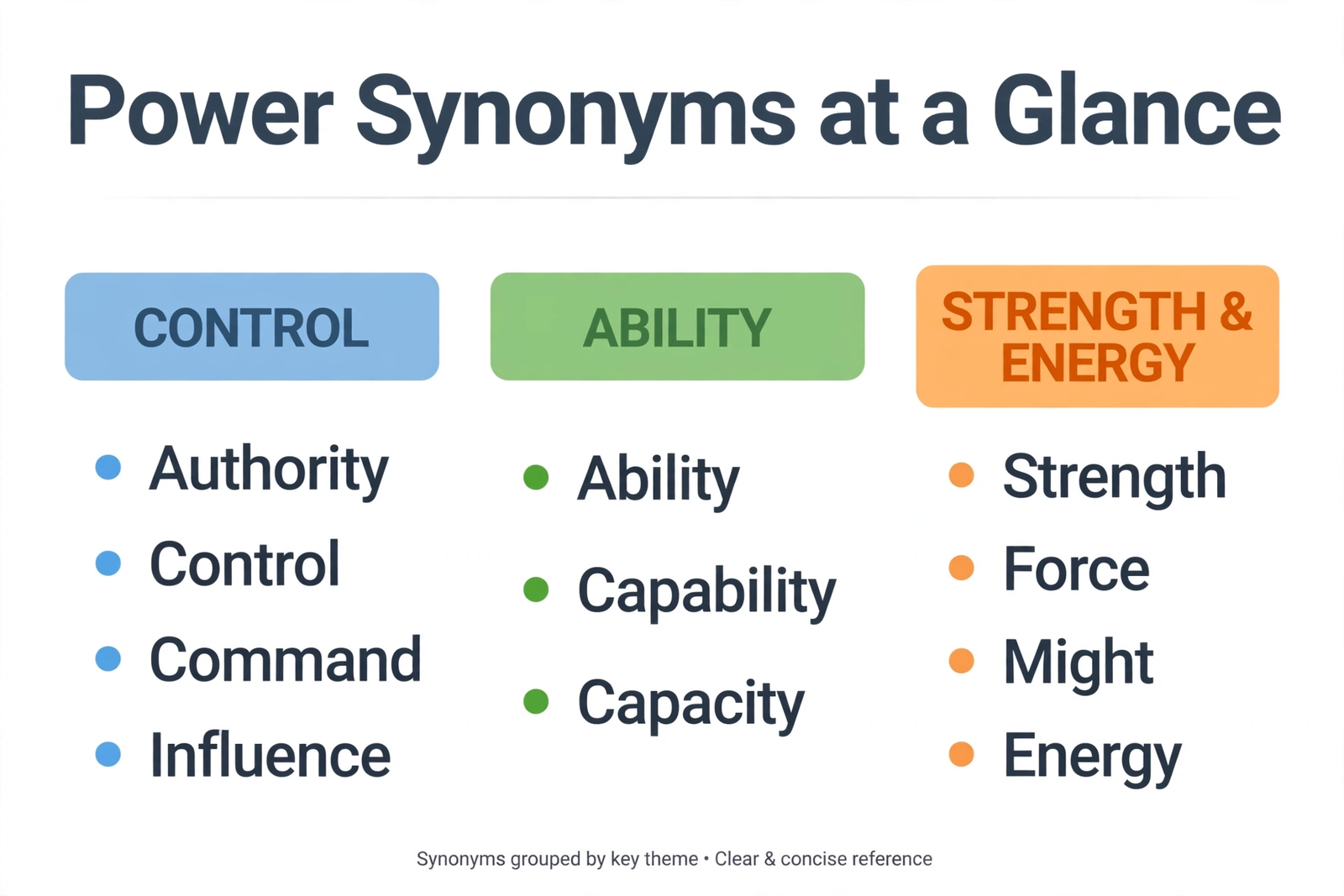
- Three core meanings: (1) control over people, (2) ability to do something, (3) physical strength or energy — including electricity.
- Register: neutral. Power works in essays, news, business, and everyday speech.
- Watch out: power is broader than any single synonym. That is exactly why swapping it blindly goes wrong.
The Closest Synonym Of Power: Authority
Authority is the closest synonym for power because it matches the meaning people reach for most often: the right to make decisions and have others follow them. When a mayor, a manager, or a court “has power,” what they really have is authority — power that comes from a position, a law, or an accepted role, not from physical strength.
Two differences still matter. First, authority is always legitimate power — it is granted, recognized, or written down somewhere. A robber has power over a victim for ten minutes, but nobody would call it authority. Second, authority usually names the right itself, while power can also name the force behind it. So “the manager has the authority to approve refunds” is precise, while “the manager has the power to approve refunds” is correct but slightly looser.
If your sentence is about who is allowed to decide, choose authority. If it is about who can actually make things happen — by strength, money, or personality — power or one of its other synonyms below will fit better.
Where “Power” Comes From (Etymology)
According to Etymonline, power entered English around 1300 as pouer, meaning “ability; ability to act or do; strength, vigor, might” and also “control, mastery, lordship, dominion, ability or right to command or control.” It came from Anglo-French pouair and Old French povoir — literally “to be able” — from Vulgar Latin potere, built on Latin potis, “powerful.”
That origin explains the word’s split personality today. From the very beginning, power meant both being able to do something and having command over others — and English never separated the two. The electricity sense arrived much later: “energy available for work” is recorded from 1727, and “electrical supply” only from 1896.
Can You Swap Them Freely?
Short answer: only inside the same meaning group. Power breaks into three separate jobs, and a synonym from one group will sound wrong in another:
- ✅ “The committee has the authority to reject the plan.” (control → control ✔)
- ❌ “The battery has a lot of authority.” (energy → control word ✘ — say power or capacity)
- ✅ “She has the ability to stay calm under pressure.” (ability → ability ✔)
- ❌ “He seized ability after the election.” (you seize power, control, or command — not ability)
Before you substitute, ask one question: is my sentence about ruling, doing, or forcing? Pick from that group and the swap will work.
Power Synonyms in Detail
Group 1 — Power Over People (Control and Authority)
1. Authority
- Meaning: The official or recognized right to make decisions, give orders, and enforce rules.
- Difference: Power that is granted and accepted. Authority comes from a position, a law, or expertise — never from brute force.
- Best used for: Governments, managers, courts, experts, official documents.
- Formality: Formal to neutral · CEFR: B2 · Frequency: Very common
- Example (Formal): “Only the head teacher has the authority to cancel classes.”
- Example (Everyday): “My team lead doesn’t have the authority to approve overtime.”
- When NOT to use it: For physical strength or electricity — a storm has no authority.
2. Control
- Meaning: The power to direct, manage, or restrain someone or something on an ongoing basis.
- Difference: Authority is the right; control is the actual steering. Control also works for things, not just people (control the temperature).
- Best used for: Managing systems, emotions, machines, situations.
- Formality: Neutral · CEFR: B1 · Frequency: Very common
- Example (Work): “She controls the entire marketing budget.”
- Example (Everyday): “He lost control of the car on the wet road.”
- When NOT to use it: When you mean the right to decide rather than the act of directing — that’s authority. (Compare how “coordination” differs from control: coordinating people is not the same as ruling them.)
3. Command
- Meaning: Authority that expects immediate obedience, especially in the military or in emergencies.
- Difference: Stronger and more one-directional than authority. A command is given, not discussed.
- Best used for: Armies, ships, emergency services, software instructions (a command).
- Formality: Formal · CEFR: B2 · Frequency: Common
- Example (Formal): “The general took command of the troops at dawn.”
- Example (Everyday): “Her command of Spanish impressed the whole panel.” (Note: command of a language = mastery — a fixed phrase.)
- When NOT to use it: In flat, democratic workplaces — it sounds too military.
4. Dominion
- Meaning: Complete, supreme rule over a territory or people.
- Difference: The heaviest word in this group — total ownership-like rule. Today it sounds historical, religious, or literary.
- Best used for: History, religion, fantasy writing, formal political theory.
- Formality: Very formal / literary · CEFR: C1 · Frequency: Rare in daily speech
- Example (Formal): “The empire held dominion over the coastal trade routes.”
- Example (Literary): “Humans claim dominion over the animals of the earth.”
- When NOT to use it: In modern business or school writing — control or authority will sound natural.
5. Sway
- Meaning: Influence or control over people’s opinions and decisions, usually without formal authority.
- Difference: Sway is soft power — people follow because they are persuaded or charmed, not because they must.
- Best used for: Politics, public opinion, persuasion. Almost always in the phrase hold sway (over).
- Formality: Neutral to formal · CEFR: C1 · Frequency: Uncommon
- Example (News): “The union leader holds considerable sway over the negotiations.”
- Example (Everyday): “Don’t let one bad review hold sway over your decision.”
- When NOT to use it: For official rights or physical force — sway is about minds, not muscles.
6. Influence
- Meaning: The power to affect how people think or act, indirectly and often gradually.
- Difference: Influence never commands. It shapes outcomes through respect, fame, money, or example.
- Best used for: Media, celebrities, parents, trends, marketing.
- Formality: Neutral · CEFR: B2 · Frequency: Very common
- Example (Work): “Her research had a huge influence on the new policy.”
- Example (Everyday): “Older brothers have more influence on him than any teacher.”
- When NOT to use it: When a direct order or legal right is meant — that’s authority or command.
7. Clout
- Meaning: Informal power to influence decisions, especially in politics and business.
- Difference: The street-level cousin of influence — clout is practical, behind-the-scenes pull, and the word itself is casual.
- Best used for: Politics, business deals, entertainment industry, journalism.
- Formality: Informal · CEFR: C1 · Frequency: Common in US media
- Example (News): “The senator has enough clout to block the bill.”
- Example (Everyday): “He used his clout to get his nephew an interview.”
- When NOT to use it: In academic essays or official documents — use influence.
Group 2 — Power to Do (Ability and Capacity)
8. Ability
- Meaning: The power or skill to do something; what a person is capable of doing.
- Difference: Ability lives inside a person. Power can come from outside (a position, a weapon); ability cannot be handed to you.
- Best used for: Skills, talents, learning, job descriptions.
- Formality: Neutral · CEFR: B1 · Frequency: Very common
- Example (School): “The test measures your ability to solve problems quickly.”
- Example (Everyday): “She has an amazing ability to remember names.”
- When NOT to use it: For ruling others — a king’s power is not his “ability.” (See the detailed breakdown of “ability-type words” if skill is what you really mean.)
9. Capability
- Meaning: The ability to perform a specific task, often proven or measurable.
- Difference: More technical and task-focused than ability. Companies and machines have capabilities; people have abilities.
- Best used for: Business, technology, military, product specs.
- Formality: Formal to neutral · CEFR: B2 · Frequency: Common
- Example (Work): “The new software has the capability to process 10,000 files an hour.”
- Example (Formal): “The report questioned the team’s capability to deliver on time.”
- When NOT to use it: For natural talents like singing — use ability or talent.
10. Capacity
- Meaning: The maximum amount something can hold, produce, or handle; also a person’s mental or physical limit.
- Difference: Capacity implies a measurable ceiling — of a room, a battery, a factory, or a mind.
- Best used for: Venues, batteries, production, workload, law (legal capacity).
- Formality: Neutral to formal · CEFR: B2 · Frequency: Common
- Example (Everyday): “The hall has a seating capacity of 300.”
- Example (Work): “We’re working at full capacity this month.”
- When NOT to use it: For authority over people — nobody rules “by capacity.”
11. Competence
- Meaning: The ability to do something well enough — reliably and to an acceptable standard.
- Difference: Competence is ability with a quality bar attached. It says “good enough,” not “brilliant.”
- Best used for: Jobs, professional reviews, qualifications.
- Formality: Formal · CEFR: B2 · Frequency: Common
- Example (Work): “The audit raised questions about her competence as a manager.”
- Example (Formal): “Clinical competence is tested before doctors receive a license.”
- When NOT to use it: When you want praise — calling someone “competent” can sound like faint praise. For excellence, use expertise or mastery.
Group 3 — Power as Strength, Force, and Energy
12. Strength
- Meaning: The quality of being physically strong, or the degree of force/intensity of something.
- Difference: Strength is power you can measure in degrees — of a body, a drink, an argument, or a currency.
- Best used for: Bodies, materials, arguments, economies, signals.
- Formality: Neutral · CEFR: B1 · Frequency: Very common
- Example (Everyday): “He doesn’t have the strength to lift that box alone.”
- Example (News): “The strength of the economy surprised analysts.”
- When NOT to use it: For official authority — laws have power/authority, not “strength.”
13. Force
- Meaning: Physical strength or violence used against something; in physics, a push or pull.
- Difference: Force is power in action, often aggressive. Police “use force”; nobody “uses authority” with their hands.
- Best used for: Physics, police/military action, storms, pressure.
- Formality: Neutral · CEFR: B2 · Frequency: Common
- Example (News): “Police used force to break up the fight.”
- Example (Science): “The force of gravity keeps the Moon in orbit.”
- When NOT to use it: For gentle influence — force always suggests pressure or violence.
14. Might
- Meaning: Great strength or power, especially of an army, a nation, or nature.
- Difference: Dramatic and literary. Might is the word of history books and speeches, not office emails.
- Best used for: Epic writing, history, rhetoric (military might, might and main).
- Formality: Formal / literary · CEFR: C1 · Frequency: Uncommon in speech
- Example (Formal): “The empire displayed its military might in the parade.”
- Example (Literary): “She pushed the door with all her might.”
- When NOT to use it: In casual modern prose — strength or power will sound natural.
15. Energy
- Meaning: The power that makes things work or move; also a person’s vitality and enthusiasm.
- Difference: Energy is power as fuel. For electricity specifically, energy is the scientific term; for people, it means liveliness, not authority.
- Best used for: Physics, electricity bills, health, personal productivity.
- Formality: Neutral · CEFR: B1 · Frequency: Very common
- Example (Science): “Solar panels convert sunlight into energy.”
- Example (Everyday): “After lunch I have zero energy for meetings.”
- When NOT to use it: For decision-making authority — a CEO’s power is not “energy.”
16. Potency
- Meaning: The power of something to produce an effect — especially medicine, drink, or an argument.
- Difference: Potency is power per dose. A potent drug is strong in small amounts.
- Best used for: Medicine, chemistry, persuasive writing/speech.
- Formality: Formal · CEFR: C1 · Frequency: Uncommon
- Example (Medical): “The potency of the vaccine drops after six months in storage.”
- Example (Formal): “The potency of her argument silenced the room.”
- When NOT to use it: For people in charge or for electricity — wrong field entirely.
17. Vigor
- Meaning: Active physical strength combined with energetic health and enthusiasm. (BrE spelling: vigour.)
- Difference: Vigor is strength with life in it — power that moves, grows, and pushes.
- Best used for: Health, plants, economies, energetic action.
- Formality: Formal to neutral · CEFR: C1 · Frequency: Uncommon
- Example (Formal): “The economy recovered with surprising vigor.”
- Example (Everyday): “Grandpa still gardens with the vigor of a young man.”
- When NOT to use it: For legal or political authority.
18. Electricity
- Meaning: The form of energy carried by electric current — the thing itself, where power is the supply of it.
- Difference: In the blackout sense the two swap cleanly (“the electricity/power went out”). But electricity names the energy form, while power also covers its rate and supply.
- Best used for: Homes, bills, outages, appliances.
- Formality: Neutral · CEFR: B1 · Frequency: Very common
- Example (Everyday): “The electricity went out during the thunderstorm.”
- Example (Work): “The factory’s electricity bill doubled this winter.”
- When NOT to use it: In physics formulas (there, power is a precise term: energy per second) or for any human authority.
Words Commonly Confused With “Power”
These words show up next to power in thesauruses, but they fail the swap test. Use them carefully:
- Powerful — This is the adjective form (“a powerful leader,” “a powerful engine”). It describes someone or something that has power; it can never replace the noun. “She has powerful” is simply broken English.
- Empowerment — The process of giving power to people who lacked it. A company can run an empowerment program, but a president does not “hold empowerment” — he holds power.
- Superpower — A fictional or extraordinary ability (flight, invisibility), or in politics, a dominant nation like the US or China. It is not a general synonym; your manager does not have superpowers, however impressive she is.
- Willpower — Self-control only: the power to resist temptation and stick to decisions. It belongs to the ability family but covers just one narrow corner of it.
- Power of attorney — A legal document that lets one person act for another. Here power means a specific legal right, and no synonym fits — never rewrite this phrase.
Best Alternatives by Context
Real situations, real fixes — find the one closest to yours:
You’re writing about an election or a government. “The party came into power” is already perfect. For the right to govern, write authority; for day-to-day steering of the country, control; for a ruler who answers to nobody, dominion (formal) fits history essays.
You’re describing a manager at work. A good manager rarely has “power” in good writing — she has authority (the right to decide), influence (people listen to her), or, if everyone fears crossing her, clout. Notice how each choice changes what you’re really saying.
You’re writing a school or job essay about skills. Drop power completely. “The power to communicate well” sounds inflated; “the ability to communicate well” is natural, and “capability” or “competence” sounds more professional. This is also where “teamwork” essays go wrong — teams succeed through ability and coordination, not “power.”
You’re describing a storm, an engine, or a weightlifter. Use strength for how powerful something is, force for the push itself, and might only if you’re writing something dramatic or historical.
The lights just went out. Say “the power went out” (AmE) or “the electricity went out” — both natural. On the bill and in the science lesson, prefer electricity or energy.
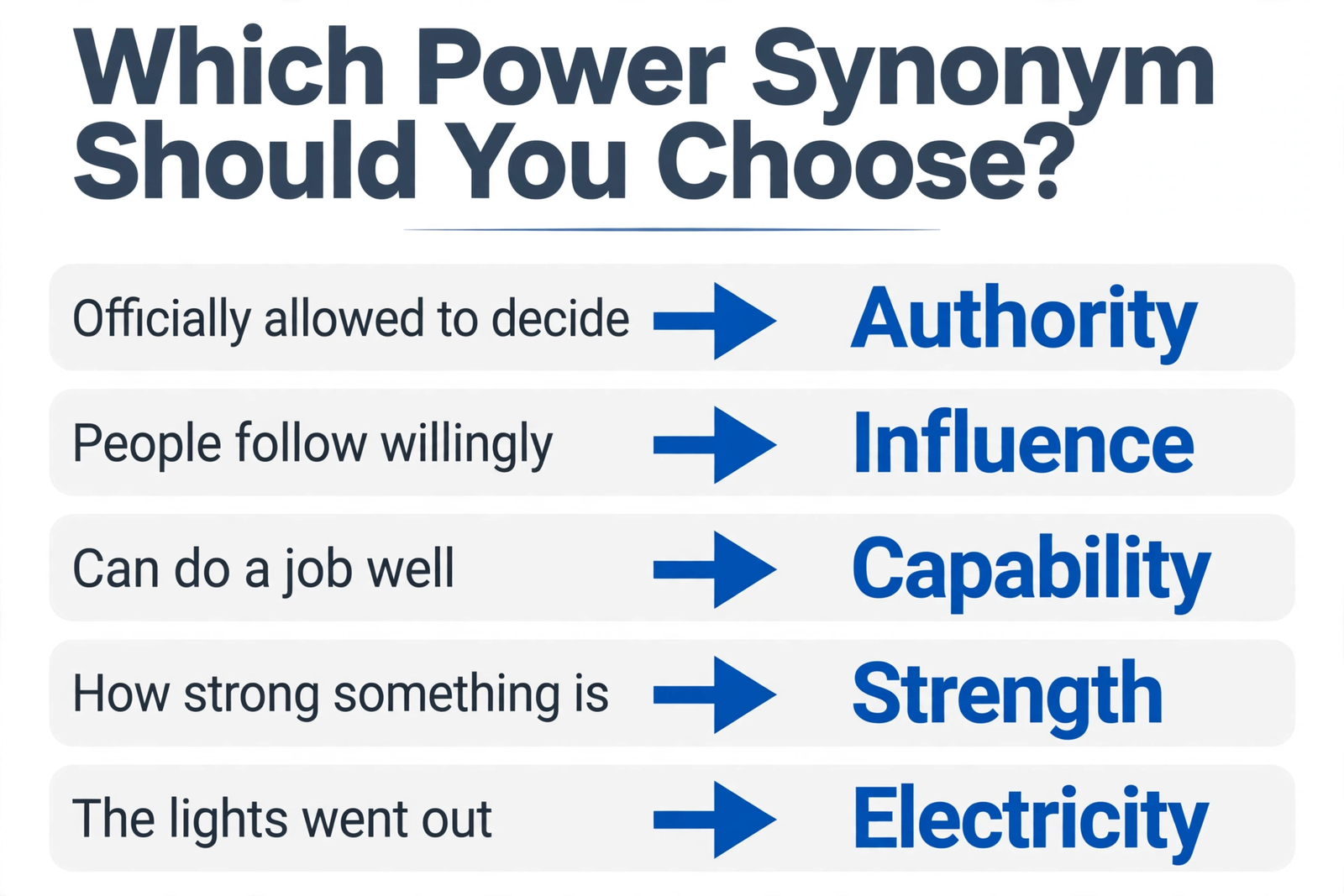
Which Power Synonym Should I Choose?
| Your situation | Best word | Why |
|---|---|---|
| Someone may officially decide or approve | Authority | The right comes from a role or law |
| Someone is actively steering or managing | Control | Ongoing direction, not just the right |
| Orders must be obeyed instantly | Command | Military-grade, one-directional |
| People follow willingly, without orders | Influence / Sway | Soft power over opinions |
| Backstage pull in politics or business (casual) | Clout | Informal, practical influence |
| A person can do something well | Ability | Lives inside the person |
| A team or machine can handle a specific job | Capability | Task-focused and measurable |
| Something has a maximum limit | Capacity | A ceiling you can count |
| Muscles, storms, arguments — how strong? | Strength / Force | Measurable intensity, physical push |
| The supply that runs your home | Electricity / Energy | The energy sense of power |
Antonyms of Power
One word, two opposite families — match the antonym to the meaning you used:
Opposites of power (control sense):
| Antonym | What it means |
|---|---|
| Powerlessness | Having no power or ability to act at all |
| Subordination | Being under someone else’s authority |
| Submission | Yielding to another’s power |
| Dependence | Needing someone else’s support to function |
| Servitude | The condition of being a servant under total control |
| Obedience | Doing what you are told — the follower’s side |
Opposites of power (ability/strength sense):
| Antonym | What it means |
|---|---|
| Weakness | Lack of physical or mental strength |
| Inability | Not being able to do something |
| Incapacity | Being legally or physically unable |
| Impotence | Complete lack of power to act or effect change (formal) |
| Frailty | Weakness from age or poor health |
| Ineffectiveness | Failing to produce the intended result |
American vs British English
Power itself is spelled and used the same in both. Two small differences are worth knowing:
- When the electricity fails, Americans usually say “the power went out” or “a power outage“; Britons more often say “a power cut.”
- Vigor (AmE) is spelled vigour (BrE) — the same pattern as color/colour.
Everything else in this guide — authority, control, clout included — works identically on both sides of the Atlantic.
Collocations and Idioms With “Power”
Common collocations (word partners):
- in power / come to power — ruling: “The party has been in power for a decade.”
- seize power — take control, often by force: “The army seized power overnight.”
- abuse of power — using authority wrongly: “The judge called it a clear abuse of power.”
- balance of power — how strength is shared between rivals
- power outage / power cut — electricity failure
- power-hungry — (adjective) craving control: “a power-hungry executive”
Idioms and famous sayings:
- Knowledge is power — information gives you an advantage.
- The powers that be — the people in charge, whoever they are (from Romans 13:1, per Etymonline): “The powers that be have decided to close the road.”
- More power to you! — “Good luck — I admire what you’re attempting” (recorded since 1842).
- Power tends to corrupt — Lord Acton’s warning (1887) that authority changes people: “…and absolute power corrupts absolutely.”
Practice: Try It Yourself
Part A — Pick the better word.
- The principal has the (power / authority) to suspend a student for three days.
- Years of training gave the gymnast the (strength / sway) to perform the routine.
- The celebrity’s (clout / capacity) convinced the studio to change the ending.
Part B — Rewrite it.
- Rewrite this sentence replacing power with a more precise synonym: “The mayor has a lot of power in this town — everyone listens to what she says.”
- Rewrite this one for a science context: “Wind power is growing fast in Texas.”
Answer key:
- Authority — an official right granted by the role.
- Strength — physical power that can be built and measured.
- Clout — informal influence over decisions.
- Possible answer: “The mayor has a lot of influence in this town — everyone listens to what she says.” (People follow willingly → soft power, not force.)
- Possible answer: “Wind energy is growing fast in Texas.” (In energy contexts, energy is the precise term.)
FAQ
What is the closest synonym for power?
Authority is the closest synonym when power means control over people and decisions, because it names the same thing — the recognized right to decide and be obeyed. It does not cover the other meanings, though: for ability, use ability or capability, and for physical force, use strength or force.
What is another word for power in electricity?
Electricity and energy are the two natural alternatives. Say “the electricity went out” for a blackout, and use energy in science and industry contexts, as in “wind energy.” In technical writing, though, power is a precise measurement (energy per second, in watts), so there it should not be replaced at all.
Is “powerful” a synonym for power?
No. Powerful is an adjective that describes someone or something possessing power, while power is the noun itself. You can write “a powerful engine” or “the engine has power,” but powerful can never take the noun’s place in a sentence, which is why it belongs with commonly confused words, not synonyms.
What is the difference between power and authority?
Authority is power that is legitimate and recognized — granted by a law, a job, or expertise. Power is the wider word: it can be legitimate or not, and it can also mean physical strength or energy. A kidnapper has power over a victim but no authority; a judge has both.
What is a stronger word than power?
For control, dominion and command sound stronger and heavier than power. For influence, clout suggests real behind-the-scenes weight, while for physical force, might is the most dramatic choice. Stronger is not always better, though — in everyday writing these words can sound exaggerated, so save them for formal or literary contexts.
What is the opposite of power?
It depends on the meaning. The opposite of power as control is powerlessness, subordination, or submission. The opposite of power as ability or strength is weakness, inability, or incapacity. English has no single antonym because power itself covers several meanings, and each meaning has its own natural opposite.
Conclusion
Power is really three words wearing one coat — ruling people, being able to do something, and raw strength or energy — and every synonym in this guide belongs to just one of those families.
Match the family first, then fine-tune for formality: authority for the official right, influence for the quiet kind, capability for the provable kind, force for the physical kind.
Do that, and you’ll never write a sentence where a battery has authority or a king has “ability” again. When in doubt, keep power itself — it is a strong, natural word — and reach for a synonym only when it says something power doesn’t.

About Sajjad Ahmed
Sajjad Ahmed is the author behind Guest Paster, where he writes about English vocabulary, synonyms, word meanings, and practical word usage.
His content is designed to help readers understand the differences between similar words, discover suitable alternatives, and use English vocabulary more effectively in everyday writing and communication.
Before publishing, Sajjad focuses on presenting word choices in a clear and easy-to-understand format, with relevant meanings, context, and examples where helpful.
Through Guest Paster, his goal is to make vocabulary learning simpler and provide useful language resources for students, writers, English learners, and anyone looking to expand their vocabulary.
Areas of Focus: English Vocabulary • Synonyms • Word Meanings • Word Usage • Language Learning
Author: Sajjad Ahmed
Website: Guest Paster