
You buy a chair, sit on it and feel whether it was made with care or rushed through a factory. You read a report and in two paragraphs you know whether the writer checked the facts or only filled the page. The word quality covers both judgments and that is why it often says too little on its own.
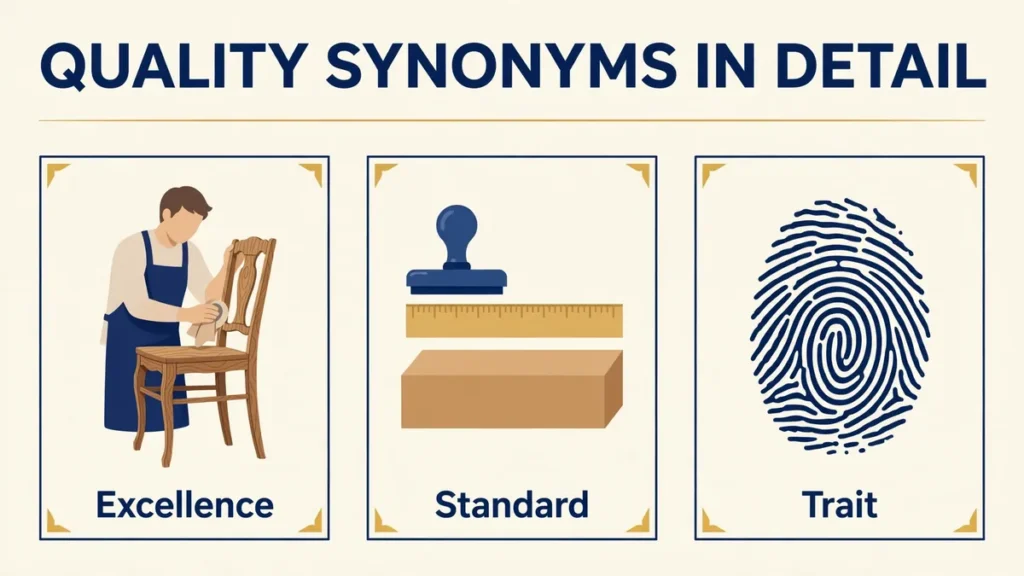
This guide sorts 15 quality synonyms by meaning, so you can name what you trust: the excellence of the work, the standard it meets or the trait that sets it apart. If the work is superb, say excellence. If it meets a measured standard, say grade. And if it is a feature of a person or a thing, say trait.
Another Word For Quality Synonyms
| # | Synonym | Meaning Difference |
|---|---|---|
| 1 | Excellence | Outstanding goodness, the highest level of work |
| 2 | Caliber | The level of ability or worth shown in work |
| 3 | Merit | Worth judged by value or achievement |
| 4 | Worth | Value, usefulness, or importance |
| 5 | Superiority | Being better than others in standard |
| 6 | Standard | A level of quality used as a measure |
| 7 | Grade | A rank given for level of quality |
| 8 | Class | High quality shown with style or polish |
| 9 | Distinction | A mark of special quality or honor |
| 10 | Trait | A feature that marks a person or thing |
Quick Facts About “Quality”
- Part of speech: a noun, and also an adjective, as in “a quality product.” You speak of the quality of a chair, a report, or a service.
- Three core meanings: (1) how good or bad something is, (2) a standard or grade of goodness, such as high quality, (3) a distinguishing feature of a person or thing, such as patience as a quality.
- Common phrases: high quality, top quality, quality control, quality of life.
- Register: neutral. Quality suits everyday talk, business writing, and formal reports alike.
- Watch out: quality alone does not say whether the standard is high or low. Say high quality, poor quality, or a sharper synonym, or the reader must guess.
The Closest Synonym: Excellence
Excellence is the closest synonym for quality, because it names the sense people mean most often: work, service, or character at a very high level. When a school, a clinic, or a workshop is praised for its quality, the praise usually means excellence, not merely an acceptable standard or a neutral feature. It works in formal and business writing, so it is a safe first choice when quality feels vague.
Still, excellence is not identical to quality. Excellence always claims a top level, while quality can be high, low, or simply neutral. A product can have poor quality, but it cannot have poor excellence. Use excellence for superb work, and a Group 2 or 3 word for a standard, grade, or feature.
Choice test: if you mean “outstandingly good,” excellence fits. For “a level” or “a feature,” pick a Group 2 or 3 word.
Where “Quality” Comes From (Etymology)
According to Etymonline, quality entered English around 1300 as qualite, borrowed from Old French qualite, which came from Latin qualitas, a word formed from qualis, meaning “what kind of a” person or thing. By the late 14th century, it had gained the familiar sense of a degree of goodness or excellence, the sense that still drives most modern use. That history explains its double life: kind and goodness.
Can You Swap Them Freely?
In short: only inside the same meaning group, and only when the sense matches. A grade word collapses in a sentence about character, and a feature word in a sentence about rank:
- ✅ “The workshop is known for its excellence.” (outstanding work ✔)
- ❌ “The workshop is known for its grade.” (grade is a rank, not praise ✘, say excellence)
- ✅ “Patience is a trait she values in a nurse.” (a feature of character ✔)
- ❌ “Patience is a standard she values in a nurse.” (a standard is a measure, not a feature ✘, say trait)
Before you substitute, ask: praise, level, or feature? Those take a Group 1, 2, or 3 word.
Quality Synonyms in Detail
Group 1: Excellence and Worth
1. Excellence
- Meaning: Outstanding goodness, work or character at the highest level.
- Difference: The closest all-round match for quality in its praise sense. It always claims a top level, while quality can be high or low.
- Best used for: Awards, reviews, formal praise, business writing.
- Formality: Neutral to formal · CEFR: C1 · Frequency: Very common
- Example (Work): “The clinic won an award for excellence in patient care.”
- Example (School): “Her essay showed real excellence in research and argument.”
- When NOT to use it: For a neutral level or a feature, where standard or trait fits.
2. Caliber
- Meaning: The level of ability, skill, or worth shown by a person or their work.
- Difference: Caliber judges the maker as much as the product.
- Best used for: Hiring, reviews, sports, business.
- Formality: Neutral to formal · CEFR: C1 · Frequency: Common
- Example (Work): “We need writers of this caliber for the new guide.”
- Example (Sports): “The team signed players of championship caliber.”
- When NOT to use it: For a single feature of character, where trait fits.
3. Merit
- Meaning: Worth or value judged by achievement, skill, or good qualities.
- Difference: Merit is earned and judged, and suits decisions and awards where value must be proved.
- Best used for: Awards, hiring, academic writing, law.
- Formality: Formal · CEFR: C1 · Frequency: Common
- Example (Work): “The proposal was accepted on its merit, not on connections.”
- Example (School): “Scholarships are given on merit and need combined.”
- When NOT to use it: For a simple rank, where grade is clearer.
4. Worth
- Meaning: Value, usefulness, or importance, often in money, effort, or time.
- Difference: Worth asks what something is worth, not only how good it is.
- Best used for: Shopping, reviews, finance, everyday writing.
- Formality: Neutral · CEFR: B1 · Frequency: Very common
- Example (Shopping): “The boots cost more, but their worth shows in five winters of use.”
- Example (Work): “The extra training was worth every hour it took.”
- When NOT to use it: For pure praise of craft, where excellence fits.
5. Superiority
- Meaning: Being better than others in standard, skill, or quality.
- Difference: Superiority is comparative. It claims an edge over rivals, not just a high level on its own.
- Best used for: Comparisons, reviews, marketing, sports.
- Formality: Neutral to formal · CEFR: C1 · Frequency: Common
- Example (Review): “Its superiority shows in the stitching, not the price tag.”
- Example (Sports): “Their superiority in defense decided the match.”
- When NOT to use it: When no comparison is intended, where excellence fits.
Group 2: Standard and Grade
6. Standard
- Meaning: A level of quality used as a measure, or the level a thing is expected to reach.
- Difference: Standard is a yardstick for rules and promises, and it can be met, raised, or missed.
- Best used for: Business, manufacturing, education, health care.
- Formality: Neutral · CEFR: B2 · Frequency: Very common
- Example (Work): “Every batch must meet the same safety standard.”
- Example (School): “The school raised its standard for written work.”
- When NOT to use it: For a feature of character, where trait fits.
7. Grade
- Meaning: A rank or level given to show how good something is.
- Difference: Grade is a label on a scale. It suits products, food, exams, and materials sorted into ranks.
- Best used for: Shopping, food, school, manufacturing.
- Formality: Neutral · CEFR: B1 · Frequency: Very common
- Example (Shopping): “This is grade A maple syrup, the clearest and lightest.”
- Example (School): “Her project earned the top grade in the class.”
- When NOT to use it: For praise without a scale, where excellence fits.
8. Class
- Meaning: High quality shown with style, polish, or distinction.
- Difference: Class adds style to goodness, for places and products that feel refined.
- Best used for: Reviews, travel, fashion, hospitality.
- Formality: Neutral · CEFR: B2 · Frequency: Very common
- Example (Travel): “The small hotel had real class, from the lobby to the breakfast room.”
- Example (Sports): “She finished the race with class, thanking every volunteer.”
- When NOT to use it: For a measured standard, where standard fits.
9. Distinction
- Meaning: A mark of special quality, honor, or difference from the ordinary.
- Difference: Distinction singles something out, for honors and work that stands apart.
- Best used for: Awards, academic writing, formal praise.
- Formality: Formal · CEFR: C1 · Frequency: Common
- Example (School): “She graduated with distinction in mathematics.”
- Example (Work): “The report earned distinction for its clear data.”
- When NOT to use it: For an ordinary level, where standard fits.
Group 3: A Distinguishing Feature
10. Trait
- Meaning: A feature or quality that marks a person, animal, or thing.
- Difference: Trait is a feature, not a judgment of goodness. It can be good, bad, or neutral.
- Best used for: Character writing, psychology, hiring, everyday talk.
- Formality: Neutral · CEFR: B2 · Frequency: Very common
- Example (Work): “Patience is the trait every good nurse needs.”
- Example (Daily life): “Curiosity is a trait that makes children great learners.”
- When NOT to use it: For a rank or level, where grade fits.
11. Attribute
- Meaning: A feature or characteristic that belongs to a person or thing.
- Difference: Attribute is the formal cousin of trait. It suits resumes, product lists, and technical writing.
- Best used for: Resumes, product writing, technical reports.
- Formality: Formal · CEFR: C1 · Frequency: Common
- Example (Work): “Attention to detail is her strongest attribute.”
- Example (Shopping): “Its main attributes are light weight and long battery life.”
- When NOT to use it: In casual talk, where trait sounds more natural.
12. Feature
- Meaning: A noticeable part or quality of a product, place, or design.
- Difference: Feature points at something you can see or use. It suits products, homes, and software, not character alone.
- Best used for: Product writing, reviews, real estate, tech.
- Formality: Neutral · CEFR: B2 · Frequency: Very common
- Example (Shopping): “The best feature of this kettle is its quiet pour.”
- Example (Travel): “A rooftop garden is the hotel’s standout feature.”
- When NOT to use it: For a character quality, where trait fits.
13. Character
- Meaning: The set of qualities that make a person, place, or thing what it is.
- Difference: Character sums up the whole, not one feature.
- Best used for: Biographies, reviews, travel, brand writing.
- Formality: Neutral · CEFR: B2 · Frequency: Very common
- Example (Travel): “The old market keeps the character of the town.”
- Example (Work): “Honesty is the core of his character as a manager.”
- When NOT to use it: For one single feature, where trait is sharper.
14. Nature
- Meaning: The basic qualities or kind of a person or thing.
- Difference: Nature is deep and defining, for what something is by kind.
- Best used for: Essays, science, philosophy, formal writing.
- Formality: Neutral to formal · CEFR: B2 · Frequency: Very common
- Example (Work): “The nature of the job changed when clients moved online.”
- Example (Science): “The nature of light puzzled scientists for centuries.”
- When NOT to use it: For a measured level, where standard fits.
15. Craftsmanship
- Meaning: Skill and care shown in making something by hand or with close attention.
- Difference: Craftsmanship names the making, not just the result. It suits furniture, tools, and food.
- Best used for: Reviews, crafts, manufacturing, design.
- Formality: Neutral · CEFR: C1 · Frequency: Common
- Example (Work): “The chair shows real craftsmanship in every joint.”
- Example (Shopping): “Buyers pay more for craftsmanship they can feel.”
- When NOT to use it: For a service or a character feature, where excellence or trait fits.
Best Alternatives by Context
Pick by the situation. Each scenario shows the word in a real workplace or buyer moment:
- A buyer comparing two chairs: the cheaper one wobbles. Say craftsmanship for the joinery, and worth for value over ten years.
- A manager writing a job reference: say caliber for the level of work, and merit when promotion was earned.
- A hotel reviewer praising a stay: say class for the polish, not just a clean standard.
- A factory team checking a batch: say standard for the rule, and grade for the rank stamped on it.
- A teacher describing a student: say trait for patience, and character for the whole person.
- A shopper reading a label: say superiority only if a comparison is real, or excellence for top-level work.
- A student earning an honor: say distinction, and save excellence for the work behind it.
For nearby families, see flawless synonyms for work with no faults, and model synonyms for an example others copy.
Which Quality Synonym Should I Choose?
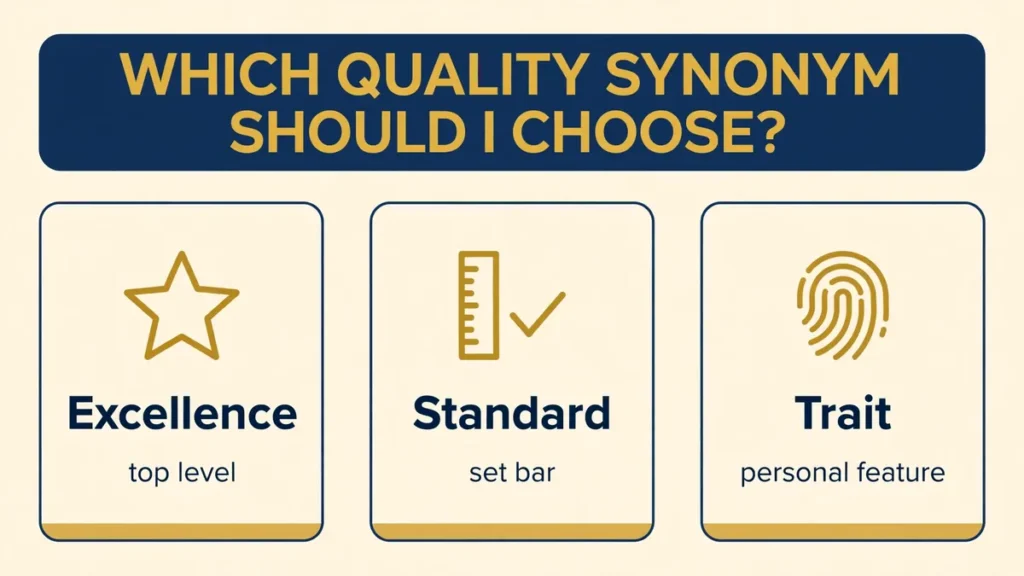
| Situation | Best pick | Why it wins |
|---|---|---|
| Outstanding work, simply superb | Excellence | Claims the top level |
| Level of skill in a person or team | Caliber | Judges the maker |
| Value earned and judged | Merit | Must be proved |
| Value for money or effort | Worth | Asks what it is worth |
| Better than rivals | Superiority | Makes a comparison |
| A level used as a measure | Standard | A yardstick to meet |
| A rank on a scale | Grade | Labels the level |
| High quality with style | Class | Adds polish |
| Work singled out for honor | Distinction | Marks it apart |
| A feature of character | Trait | Names one feature |
| A formal feature or strength | Attribute | Formal and precise |
| A noticeable product part | Feature | You can see or use it |
| The whole identity of a thing | Character | Sums up the whole |
| Deep, defining kind | Nature | What it is by kind |
| Skill shown in the making | Craftsmanship | Names the handwork |
Antonyms of Quality
1. Antonyms for quality as excellence or high standard
| Antonym | Meaning Difference |
|---|---|
| Inferiority | Being lower in standard |
| Mediocrity | Ordinary, uninspiring level |
| Shoddiness | Poor, careless workmanship |
| Worthlessness | Having no value |
| Defect | A fault that lowers quality |
| Flaw | A weakness or imperfection |
2. Antonyms for quality as a distinguishing feature
| Antonym | Meaning Difference |
|---|---|
| Lack | Absence of a feature |
| Absence | A feature simply not present |
| Sameness | No distinguishing mark |
| Uniformity | All alike, nothing standing out |
| Blandness | No strong character |
| Anonymity | No identity to notice |
Words Commonly Confused With Quality
Quality versus excellence is the closest pair to watch. Quality can be high, low, or neutral. Excellence only means outstandingly good. A phone can have poor quality, but not poor excellence. For a level, say quality or standard; for superb work, say excellence.
Standard versus grade is another near miss. A standard is a level to meet, such as a safety rule. A grade is the rank given after judging, such as grade A eggs. You meet a standard and earn a grade.
Trait versus character matters for people talk. A trait is one feature, such as patience. Character is the whole set of qualities that make a person who they are. List traits, but judge character.
Substitution test failures: “The chair is known for its grade” fails, because a grade is a rank, not praise, so say “the chair is known for its excellence.” “Patience is a standard she values in a nurse” fails, because a standard is a measure, not a feature, so say “patience is a trait she values in a nurse.” “The batch earned a high trait” fails, because a trait is a feature, not a rank, so say “the batch earned a high grade.”
American vs British English
Quality is spelled the same in American and British English, and so are most of the 15 synonyms here. One spelling point matters: American English writes caliber, while British English writes calibre.
This article uses American spelling throughout, so caliber appears in the Top 10, the entries, and the tables. All other synonyms here keep the same spelling in both varieties.
Collocations and Idioms With Quality
Only use combinations native speakers actually use:
- high quality: goods or work of a good standard.
- top quality: the best standard available.
- poor quality: work or goods below an acceptable standard.
- quality control: checking products meet a set standard.
- quality of life: how good daily life feels.
- quality time: time spent giving someone full attention.
- quality over quantity: fewer, better things beat many poor ones.
- quality product: a product known for good materials.
- quality service: service meeting a high standard.
- quality assurance: planned checks keeping standards steady.
- quality mark: a label showing a product passed.
Use quality of with a thing judged, and high quality or poor quality when the level is the point.
Practice Exercises
Exercise 1: Fill in the blank. Choose the best word from the brackets.
- The clinic won an award for ______ in patient care. (grade, excellence, trait)
- Every batch must meet the same safety ______. (standard, character, nature)
- Patience is the ______ every good nurse needs. (grade, trait, superiority)
- The chair shows real ______ in every joint. (craftsmanship, distinction, worth)
- She graduated with ______ in mathematics. (distinction, feature, class)
Exercise 2: Rewrite for precision. Replace quality with a sharper word; each sentence gives a hint.
- “This jacket is good quality.” (Hint: value for money over years.)
- “The hotel had real quality.” (Hint: polish and style.)
- “We check the quality of each batch.” (Hint: a level used as a measure.)
- “Curiosity is a quality that makes children great learners.” (Hint: one feature of character.)
Answer key
- Exercise 1: (1) excellence; (2) standard; (3) trait; (4) craftsmanship; (5) distinction.
- Exercise 2: (1) worth; (2) class; (3) standard; (4) trait.
Frequently Asked Questions
What is the best synonym for quality?
Excellence is the closest synonym when you mean high quality, because it names outstanding work, service, or character. Use it for praise, awards, and formal writing. When you mean a level to meet, use standard; when you mean a rank, use grade; when you mean a feature, use trait.
What is the difference between quality and excellence?
Quality is neutral: it can be high, low, or simply a level, and it also names a feature of a person or thing. Excellence always claims the top level, so it cannot be poor or ordinary. If the work is superb, say excellence; if you only report a level, say quality or standard.
Is caliber spelled differently in British English?
Yes. American English writes caliber, and British English writes calibre, with the same meaning and sound. This article uses American spelling throughout, so caliber appears in every table and entry. All other synonyms here, including excellence and craftsmanship, are spelled the same in both varieties.
Can quality describe a person?
Yes, in its feature sense. A quality of a person is a trait, such as patience, honesty, or humor, and the plural “qualities” is common in references and profiles. For one feature, trait is sharper; for the whole person, character fits better. Avoid grade or standard for character, since those name levels, not features.
What is the difference between standard and grade?
A standard is a level to meet, such as a safety rule or a school expectation, and a batch or a student meets it or misses it. A grade is the rank given after judging, such as grade A or a top grade. You meet a standard, and you earn a grade, so the two words are not interchangeable.
Which synonym should students use in essays?
In essays, prefer excellence for praise, merit for judged value, standard for levels to meet, and trait for character features. Reserve caliber for skill level, distinction for honors, and craftsmanship for skilled making. Keep grade for ranks on a scale, and avoid superiority unless a real comparison is being made.
Conclusion
The right replacement for quality depends on which job the word is doing in your sentence. Praise calls for excellence, a judged value for merit, a measure for standard, a rank for grade and a feature for trait. Name the job first, and the sharper word follows.
One last check: read the sentence aloud with the replacement in place. If it claims a rank when you meant a feature or praise when you only meant a level, swap again.

About Sajjad Ahmed
Sajjad Ahmed is the author behind Guest Paster, where he writes about English vocabulary, synonyms, word meanings, and practical word usage.
His content is designed to help readers understand the differences between similar words, discover suitable alternatives, and use English vocabulary more effectively in everyday writing and communication.
Before publishing, Sajjad focuses on presenting word choices in a clear and easy-to-understand format, with relevant meanings, context, and examples where helpful.
Through Guest Paster, his goal is to make vocabulary learning simpler and provide useful language resources for students, writers, English learners, and anyone looking to expand their vocabulary.
Areas of Focus: English Vocabulary • Synonyms • Word Meanings • Word Usage • Language Learning
Author: Sajjad Ahmed
Website: Guest Paster