People use the word ‘unhappy’ to describe someone who feels sad, upset, not content or dissatisfied with something like a service or a relationship.
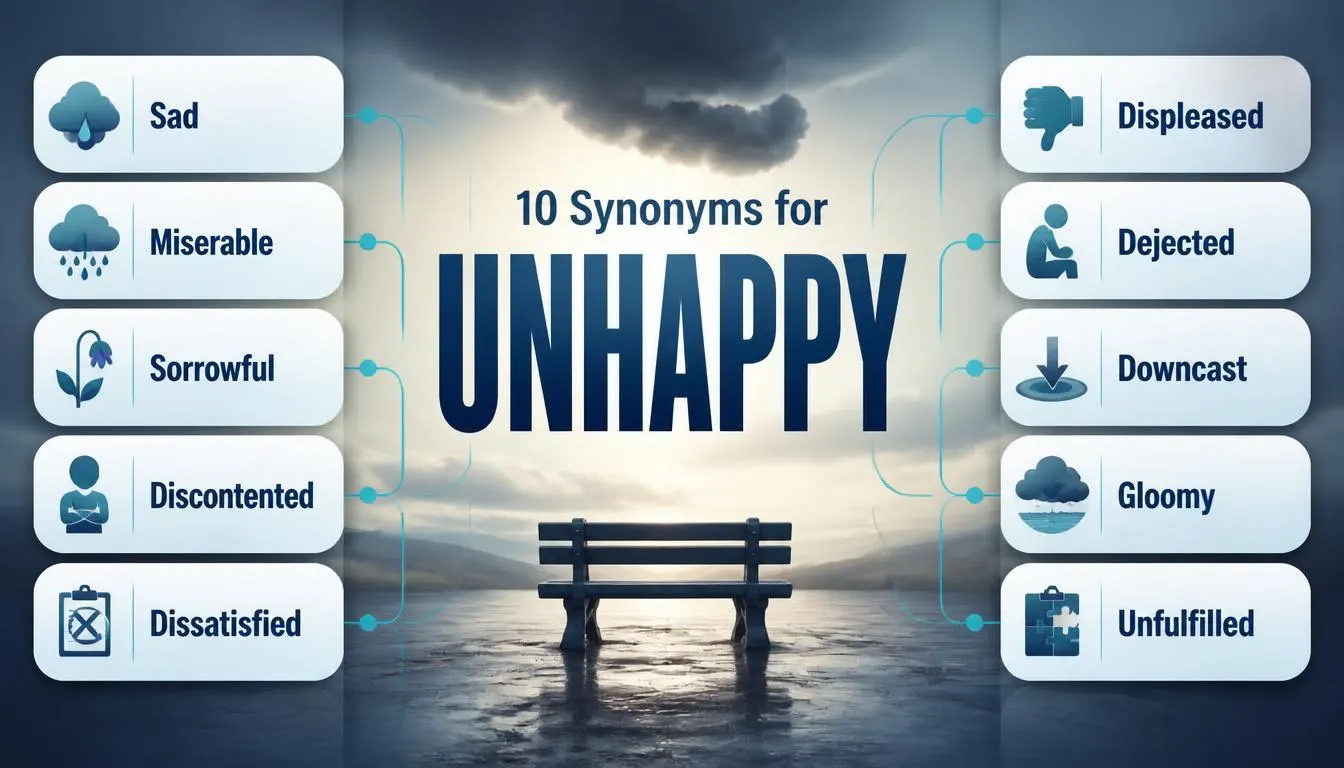
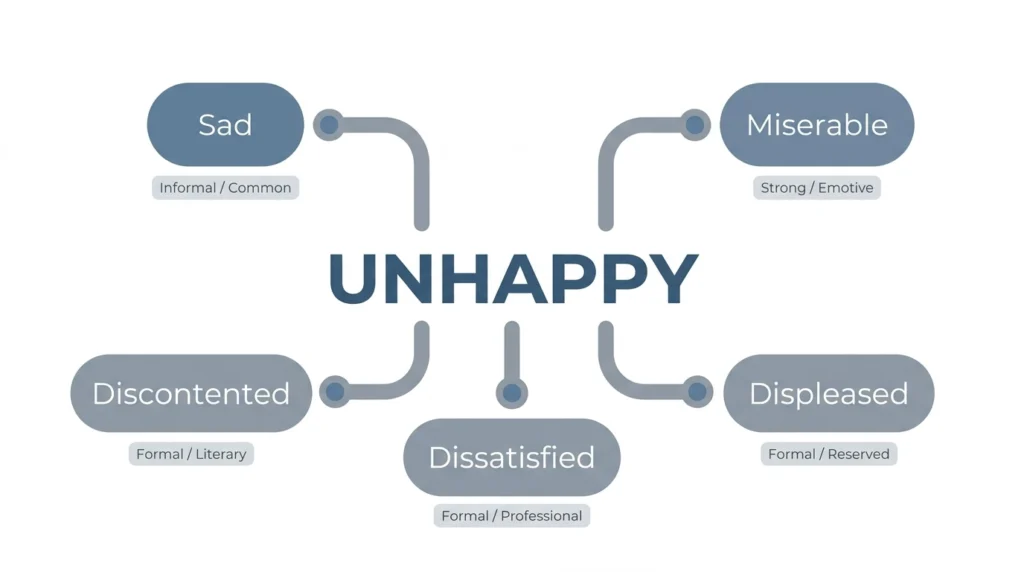
The closest synonyms are sad, miserable, discontented and dissatisfied though the right choice depends on whether you’re describing an emotion or a judgment about something.
For example “She felt unhappy after the news” calls for sad or sorrowful while “He was unhappy with the repair job” calls for dissatisfied or displeased. Context always decides the best replacement.
Best Synonyms for Unhappy
| Synonym | Relationship | Swap Rating | Formality | Best Used For |
|---|---|---|---|---|
| Sad | Exact Synonym | Drop-in | Neutral | Everyday emotional description |
| Miserable | Near Synonym | Drop-in | Neutral | Strong, prolonged unhappiness |
| Sorrowful | Near Synonym | Drop-in | Formal / Literary | Writing and storytelling |
| Discontented | Near Synonym | Minor Rewrite | Neutral | Ongoing dissatisfaction with life or circumstances |
| Dissatisfied | Near Synonym | Drop-in | Neutral / Formal | Dissatisfaction with service, results, or performance |
| Displeased | Near Synonym | Minor Rewrite | Formal | Disapproval, often from someone in authority |
| Dejected | Near Synonym | Drop-in | Neutral | Sadness after disappointment or failure |
| Downcast | Near Synonym | Minor Rewrite | Neutral / Literary | Visible sadness, often shown through body language |
| Gloomy | Contextual Alternative | Minor Rewrite | Informal / Neutral | Low mood, often lingering or general |
| Unfulfilled | Contextual Alternative | Minor Rewrite | Neutral | Lacking satisfaction in life, work, or a relationship |
What Are Synonyms of Unhappy?
Synonyms for “unhappy” are words that express a similar idea of sadness or dissatisfaction, but they rarely mean exactly the same thing. Some, like sad or miserable, describe an emotional state.
Others, like dissatisfied or displeased, describe disapproval of a situation, product, or person’s behavior. Picking the right one depends on tone, strength, and whether you’re talking about feelings or judgments.
Quick Facts About Unhappy
- Word: Unhappy
- Part of Speech: Adjective
- Simple Meaning: Feeling sad, or not satisfied with something
- Pronunciation: un-HAP-ee
- Syllables: 3
- Origin: Formed from the prefix “un-” (not) added to “happy,” a pattern common in English for creating opposites.
- Other Word Forms: unhappiness (noun), unhappily (adverb)
- Formality: Neutral
- Difficulty Level: Beginner
- Common Uses: conversation, creative writing, business writing, everyday communication
- Example Sentence: She looked unhappy after reading the email.
Meaning and Usage of Unhappy
“Unhappy” has two related but distinct uses in modern American English, and knowing which one applies changes which synonym fits best.
Unhappy Meaning: Feeling Sad or Not Content
In its most common sense, “unhappy” describes an emotional state — a lack of joy, contentment, or peace of mind. This can be brief (“He was unhappy about missing the bus”) or long-lasting (“She has felt unhappy for months”). The word is neutral in tone and works in almost any setting, from casual conversation to formal writing. It’s milder than words like miserable or devastated, but stronger than simply saying someone is “not happy.”
Example: The whole team seemed unhappy after losing the final game.
Unhappy Meaning: Dissatisfied or Displeased
People also use the word ‘unhappy’ to express disapproval or dissatisfaction with a situation, decision, product, or a person’s behavior, rather than simply expressing sadness.
This sense appears often in phrases like “unhappy with the service,” “unhappy customer,” or “unhappy relationship.” Here, the word leans closer to dissatisfied than to sad — it’s about judgment, not just emotion.
Example: Many customers were unhappy with the delayed shipping times.
Detailed Synonyms for Unhappy
The words below are grouped by their similarity to ‘unhappy’ and whether they can be used as direct replacements in a sentence. Each entry explains the difference in tone, strength or context so you can pick the right word with confidence.
1. Sad
Relationship: Exact Synonym
Swap Rating: Drop-in
Formality: Neutral
Meaning: Feeling sorrow or low spirits, often for a clear reason.
Difference: “Sad” is simpler and more common in everyday speech, while “unhappy” can sound slightly more formal or describe a longer-lasting state.
Best Used For: Daily conversation and general writing.
Example: He felt sad when his best friend moved away.
2. Miserable
Relationship: Near Synonym
Swap Rating: Drop-in
Formality: Neutral
Meaning: Extremely unhappy, often to an uncomfortable or overwhelming degree.
Difference: “Miserable” is far stronger than “unhappy.” It refers to real suffering, not just feeling a little sad, so people should avoid using it for mild disappointment.
Best Used For: Describing intense or prolonged unhappiness.
Example: The travelers felt miserable after they were stuck at the airport for ten hours.
3. Sorrowful
Relationship: Near Synonym
Swap Rating: Drop-in
Formality: Formal / Literary
Meaning: Filled with sadness, usually connected to grief or loss.
Difference: “Sorrowful” carries a heavier, more literary tone than “unhappy” and often implies grief rather than everyday disappointment.
Best Used For: Storytelling, poetry, and formal or emotional writing.
Example: A sorrowful silence filled the room after the announcement.
4. Discontented
Relationship: Near Synonym
Swap Rating: Minor Rewrite
Formality: Neutral
Meaning: Not satisfied with one’s circumstances, often over a period of time.
Difference: “Discontented” focuses on ongoing dissatisfaction with a situation rather than a passing feeling of sadness.
Best Used For: Describing a lingering sense that something isn’t right in life, work, or routine.
Example: He grew discontented with his job after years of little recognition.
5. Dissatisfied
Relationship: Near Synonym
Swap Rating: Drop-in
Formality: Neutral / Formal
Meaning: Not pleased or content with the quality or result of something.
Difference: “Dissatisfied describes an evaluation rather than an emotion, so people use it when they feel disappointed with a product, service, or result.”
Best Used For: Customer feedback, reviews, and formal complaints.
Example: The client was dissatisfied with the final design and requested some changes.
6. Displeased
Relationship: Near Synonym
Swap Rating: Minor Rewrite
Formality: Formal
Meaning: Annoyed or disapproving, often in response to someone’s actions.
Difference: “Displeased” suggests a more formal or authoritative disapproval than “unhappy,” and it often implies the person has some power over the situation.
Best Used For: Workplace, management, or formal communication.
Example: The manager was displeased because the team missed the deadline.
7. Dejected
Relationship: Near Synonym
Swap Rating: Drop-in
Formality: Neutral
Meaning: Feeling low in spirits, usually after a disappointment or setback.
Difference: “Dejected” points to a specific cause, such as failure or rejection, while “unhappy” can describe a more general or ongoing feeling.
Best Used For: Describing sadness that follows a clear event.
Example: She looked dejected after failing to make the team.
8. Downcast
Relationship: Near Synonym
Swap Rating: Minor Rewrite
Formality: Neutral / Literary
Meaning: Visibly sad, often shown through posture, expression, or lowered eyes.
Difference: “Downcast” usually describes how sadness looks on the outside, while “unhappy” can describe an internal feeling that isn’t necessarily visible.
Best Used For: Describing body language or appearance in narrative writing.
Example: He walked away with downcast eyes after hearing the news.
9. Gloomy
Relationship: Contextual Alternative
Swap Rating: Minor Rewrite
Formality: Informal / Neutral
Meaning: Feeling or showing low spirits, often without a specific cause.
Difference: “People use ‘gloomy’ to describe a mood, a person, weather, or surroundings, but they use ‘unhappy’ mainly to describe a person’s feelings.”
Best Used For: Describing a general low mood or a dreary atmosphere.
Example: She’s been gloomy all week for no particular reason.
10. Unfulfilled
Relationship: Contextual Alternative
Swap Rating: Minor Rewrite
Formality: Neutral
Meaning: Lacking a sense of satisfaction or achievement, especially in life or work.
Difference: “Unfulfilled” points to a deeper, longer-term lack of purpose or satisfaction, rather than a temporary sad feeling.
Best Used For: Describing dissatisfaction with a career, relationship, or life direction.
Example: He felt unfulfilled in a job that never used his real skills.
Best Words to Use Instead of Unhappy
In Everyday Conversation
Sad, upset, and down work well in casual speech. They’re simple, common, and easy to understand without sounding overly formal.
In Formal Writing
Dissatisfied and displeased fit business, academic, or professional contexts, especially when describing disapproval rather than pure emotion.
In Creative Writing
Sorrowful, downcast, and dejected add emotional depth and are common in storytelling, where showing a character’s sadness through detail matters more than stating it plainly.
For Describing People
Miserable and dejected work well for describing how a person feels, especially after a specific event or setback.
For Describing Situations
Discontented and unfulfilled are better for describing an ongoing state, like a job, relationship, or stage of life that isn’t satisfying.
Exact and Near Synonyms: What Is the Difference?
Very few words mean exactly the same thing in every context, and “unhappy” is no exception. An exact synonym like sad can usually replace “unhappy” without changing the meaning much, since both describe a general feeling of sorrow.
A near synonym like miserable shares the same basic idea but adds intensity — calling someone “miserable” suggests much stronger suffering than calling them “unhappy.” Meanwhile, a word like dissatisfied only works as a synonym in the specific sense of “unhappy” that means displeased with a result or situation, not the sense that means sad.
Choosing correctly means paying attention to both the strength of the feeling and which meaning of “unhappy” you intend.
Words Commonly Confused With Unhappy
Upset
Difference: “Upset” often implies a sudden emotional reaction, sometimes including anger or shock, while “unhappy” is calmer and more general.
Example: She was upset when she heard the surprising news, but she has felt unhappy about the situation for weeks.
Depressed
Difference: “Depressed” refers to a clinical mental health condition or a much deeper, persistent state, not a general feeling of sadness. It should not be used casually as a synonym for “unhappy.”
Example: He seemed unhappy after the breakup, but that does not mean he was clinically depressed.
Angry
Difference: “Angry” describes frustration or hostility, not sadness. The two can occur together, but they aren’t interchangeable — someone can be unhappy without being angry, or angry without being unhappy.
Example: She was unhappy with the decision, though she wasn’t angry about it.
Antonyms of Unhappy
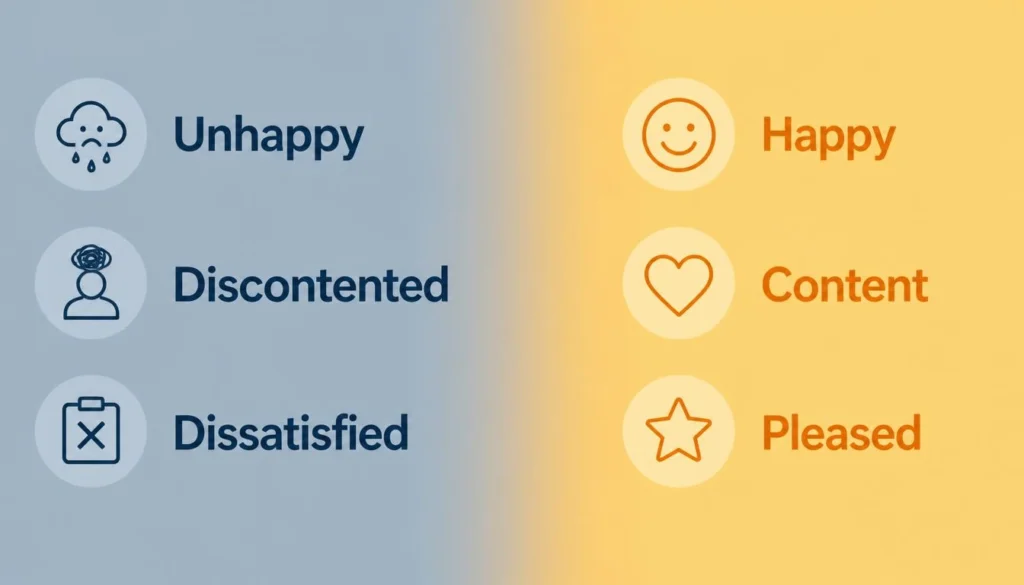
| Antonym | Simple Meaning | Example Sentence |
|---|---|---|
| Happy | Feeling pleasure or contentment | She felt happy after finishing the project. |
| Content | Satisfied with things as they are | He seemed content with his simple daily routine. |
| Pleased | Satisfied or glad about something | The customer was pleased with the quick response. |
| Delighted | Feeling great pleasure or joy | They were delighted by the surprise party. |
| Satisfied | Having one’s expectations met | She was satisfied with the quality of the work. |
| Cheerful | Noticeably happy and positive | He stayed cheerful even during the busy week. |
Common Phrases and Collocations With Unhappy
| Phrase or Collocation | Meaning | Example Sentence |
|---|---|---|
| unhappy with | Dissatisfied or displeased about something | She was unhappy with how the meeting was handled. |
| unhappy customer | A customer who is dissatisfied with a product or service | The company offered a refund to the unhappy customer. |
| unhappy childhood | A childhood marked by sadness or difficulty | He rarely talked about his unhappy childhood. |
| unhappy marriage | A marriage lacking satisfaction or happiness | They stayed in an unhappy marriage for the kids. |
| deeply unhappy | Very sad or dissatisfied | She admitted she’d been deeply unhappy for months. |
| unhappy ending | A conclusion that is sad rather than positive | The film was praised, despite its unhappy ending. |
| make someone unhappy | To cause sadness or dissatisfaction | The constant criticism made her unhappy. |
Frequently Asked Questions
What does unhappy mean?
‘Unhappy’ can mean feeling sad or not content, or it can mean being dissatisfied with a situation, product, or result, depending on the context.
What is another word for unhappy or not satisfied?
“Dissatisfied” is the closest word when “unhappy” means not satisfied with a result, service, or situation rather than describing sadness.
What is the closest synonym for unhappy?
“Sad” is generally the closest synonym when describing emotion, while “dissatisfied” is closest when describing disapproval of something.
Is unhappy formal or informal?
“Unhappy” is neutral. It works comfortably in casual conversation, business writing, and formal contexts alike.
What is an unhappy synonym with 4 letters?
“Sad” is the most common four-letter synonym for “unhappy.”
Can I use unhappy and dissatisfied interchangeably?
Only in the sense of disapproval, such as “unhappy with the service.” In the sense of sadness, “dissatisfied” doesn’t fit, since it doesn’t describe an emotional state.
Conclusion
Choosing the right synonym for “unhappy” depends on whether you’re describing a feeling or a judgment. Words like sad, miserable, and sorrowful work for emotional states, while dissatisfied and displeased fit situations involving disapproval, such as a service, decision, or relationship.
Because these words differ in strength, tone, and formality, matching them carefully to context will always communicate your meaning more clearly than defaulting to “unhappy” every time.

About Sajjad Ahmed
Sajjad Ahmed is the author behind Guest Paster, where he writes about English vocabulary, synonyms, word meanings, and practical word usage.
His content is designed to help readers understand the differences between similar words, discover suitable alternatives, and use English vocabulary more effectively in everyday writing and communication.
Before publishing, Sajjad focuses on presenting word choices in a clear and easy-to-understand format, with relevant meanings, context, and examples where helpful.
Through Guest Paster, his goal is to make vocabulary learning simpler and provide useful language resources for students, writers, English learners, and anyone looking to expand their vocabulary.
Areas of Focus: English Vocabulary • Synonyms • Word Meanings • Word Usage • Language Learning
Author: Sajjad Ahmed
Website: Guest Paster