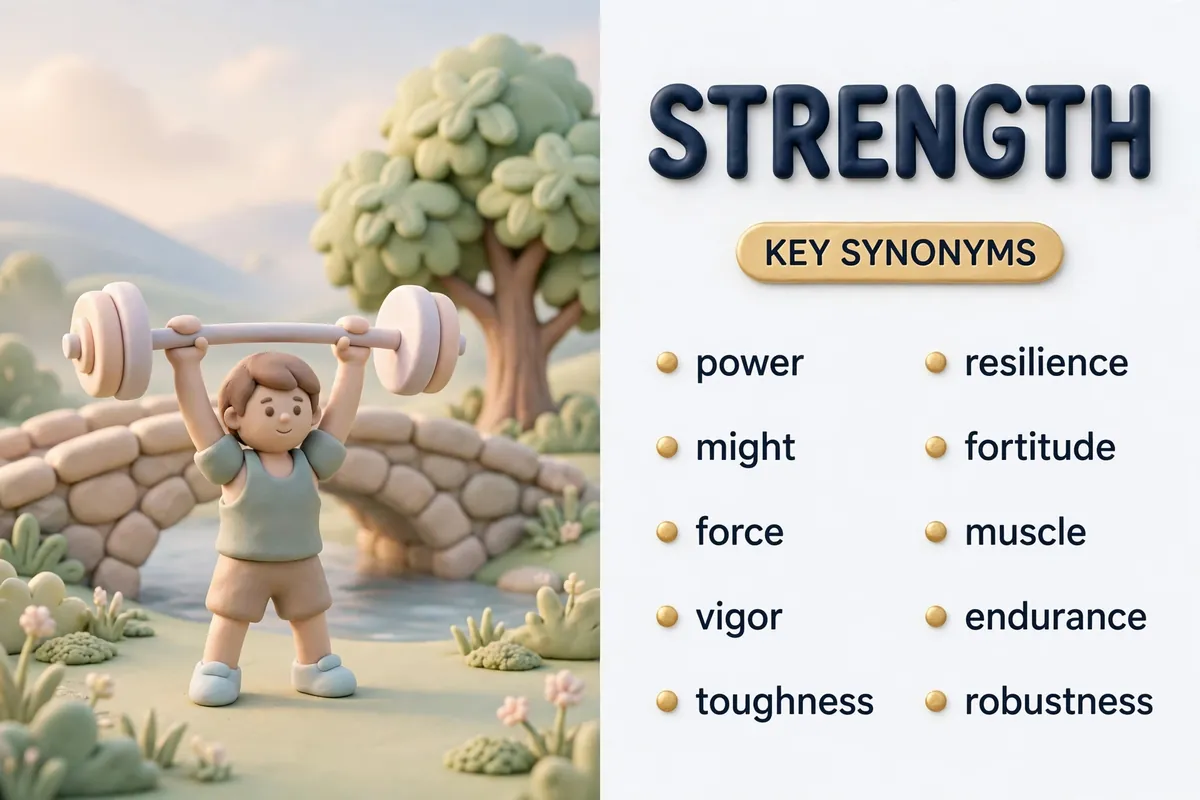
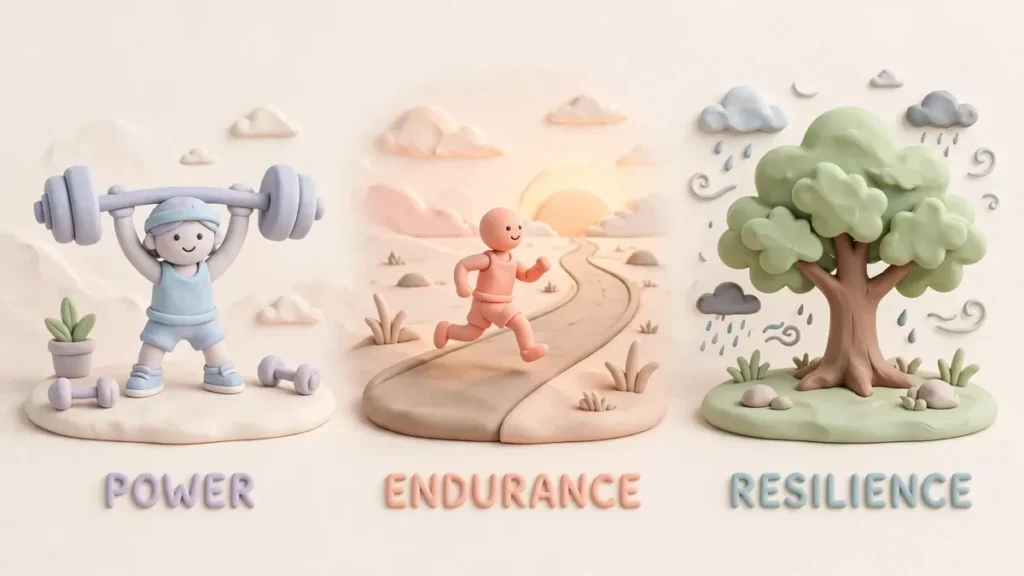
What do you call it when a bridge holds a loaded truck, a runner finishes a marathon on tired legs and a quiet person refuses to quit after a bad year? One word covers all three scenes and that word is strength. Power is the closest synonym and it fits each scene well.
This guide compares 15 strength synonyms, from muscle to fortitude, with plain meanings, real examples and honest limits so you can pick the word that fits your sentence, your tone and your reader.
Top 10 Strength Synonyms
| # | Synonym | Meaning Difference |
|---|---|---|
| 1 | Power | The broadest word: ability to act or hold |
| 2 | Might | Great power, grand or old-fashioned |
| 3 | Force | Power in motion, a push or blow |
| 4 | Vigor | Energy and liveliness |
| 5 | Toughness | Standing up to hard treatment |
| 6 | Resilience | Recovering after a setback |
| 7 | Fortitude | Courage steady through suffering |
| 8 | Muscle | Bodily strength |
| 9 | Endurance | Keeping going over a long time |
| 10 | Robustness | Sound, sturdy health or structure |
Quick Facts About “Strength”
- Part of speech: a noun. The adjective is strong, and the verb strengthen means to make stronger.
- Core meaning: the quality of being physically strong, or the power to hold up, keep going, and have a strong effect.
- Three main senses: (1) bodily power, as in a weightlifter’s strength; (2) the power to keep going, as in finishing a hard week; (3) the force or effect of something, as in an argument or a medicine.
- Register: neutral. Strength fits everyday talk, news, sport, business, and formal writing alike.
- Common mistake: using strength for a single burst of effort. A punch has force, and a marathon needs endurance. Strength covers both, yet the sharper word often says more.
Where “Strength” Comes From (Etymology)
According to Etymonline, strength is the noun built on strong. Old English strang meant physically powerful, and also firm, bold, brave, constant, resolute, having authority, and able to enforce one’s will. It is reconstructed from Proto-Germanic *strangaz, possibly from a PIE root *strenk-, tight or narrow. By the late 12th century, writers used it of feelings and emotions, and of objects and castles as sturdy and firmly fixed. By the 1690s, it described mental impressions and memories, as in a strong memory. Merriam-Webster defines strength as the quality or state of being strong, covering bodily power, toughness, and the power to resist attack or force.
The history explains the stretch. It began with the body, then grew to cover character, feelings, and ideas, because every sense shares one picture: something that holds firm under pressure.
The Closest Synonym: Power
Power is the closest synonym for strength, because it covers the same ground in the widest form: the ability to act, to control, and to hold up under strain. Test the swap and it holds. “She has the strength to lift the beam” becomes “She has the power to lift the beam.” “The strength of the team carried them through” becomes “The power of the team carried them through.” “His argument lacked strength” becomes “His argument lacked power.”
Power wins on range. It fits bodies, machines, armies, arguments, and institutions, while strength stays closer to the body and to character. Our guide to power synonyms covers that wider ground in full, from authority to energy.
One limit matters. Power can sound cold where strength sounds human, so a nurse who works a double shift shows strength, not power.
Where the Swap Breaks Down
In short: only inside the same meaning group.
- ✅ “The bridge held under the full strength of the load.” (bodily power ✔)
- ✅ “The bridge held under the full force of the load.” (power put into motion ✔)
- ❌ “The bridge held under the full resilience of the load.” (resilience is recovery, not load-bearing ✘, say strength or force)
- ✅ “She showed real fortitude through the long illness.” (steady courage ✔)
- ❌ “She showed real muscle through the long illness.” (muscle is bodily, not moral courage ✘, say fortitude)
- ✅ “The medicine lost its potency after a year on the shelf.” (effect that fades ✔)
- ❌ “The medicine lost its stamina after a year on the shelf.” (stamina belongs to living effort ✘, say potency)
- ✅ “His endurance carried him through the final miles.” (keeping going over time ✔)
Before you substitute, ask which kind of strength it is: body, will, or effect.
Strength Synonyms in Detail
Group 1: Raw Physical Power
1. Power
- Meaning: The ability to act, control, or cause an effect.
- Difference: The widest swap, reaching from bodies to institutions.
- Best Used For: Ability, energy, and authority.
- Formality: Neutral · CEFR: B1 · Frequency: Very common
- Example (Sport): “The boxer won with speed and power.”
- Example (Energy): “Solar panels supply half the town’s power.”
- When NOT to Use It: For quiet moral courage, use fortitude.
2. Might
- Meaning: Great power or strength, often large in scale.
- Difference: Might adds grandeur, with an old-fashioned, literary ring.
- Best Used For: Armies, nations, and storms.
- Formality: Neutral to formal · CEFR: B2 · Frequency: Common
- Example (History): “The empire rose on trade and might.”
- Example (Nature): “Waves broke on the rocks with might.”
- When NOT to Use It: For everyday ability, use power.
3. Force
- Meaning: Power in motion, a push, pull, or blow.
- Difference: Force is strength in action, sudden and directed.
- Best Used For: Impacts, pressure, and physics.
- Formality: Neutral · CEFR: B1 · Frequency: Very common
- Example (Physics): “The blast’s force shattered the windows.”
- Example (Effort): “She forced the stuck door with her shoulder.”
- When NOT to Use It: For lasting character, use fortitude.
4. Muscle
- Meaning: Bodily strength, or the tissue behind it.
- Difference: The most concrete word here, tied to the body.
- Best Used For: Athletes, lifting, and fitness.
- Formality: Neutral · CEFR: B1 · Frequency: Very common
- Example (Sport): “Training built the muscle for the lift.”
- Example (Work): “Moving the piano took four people and muscle.”
- When NOT to Use It: For mental or moral strength, use resilience.
5. Brawn
- Meaning: Big, solid bodily strength, often without skill.
- Difference: Brawn stresses size and bulk, and can sound rough.
- Best Used For: Manual labor and strongmen.
- Formality: Informal · CEFR: B2 · Frequency: Less common
- Example (Work): “The job needed brawn, not brains.”
- Example (Sport): “His brawn carried the team through the scrum.”
- When NOT to Use It: In formal writing, use muscle or strength.
Group 2: The Power to Keep Going
6. Toughness
- Meaning: Standing up to hard treatment without breaking.
- Difference: Toughness is strength tested by damage, wear, and use.
- Best Used For: Materials, athletes, and character.
- Formality: Neutral · CEFR: B2 · Frequency: Common
- Example (Material): “The boots proved tough on rocky trails.”
- Example (Character): “Her toughness showed when the project fell apart.”
- When NOT to Use It: For quick recovery after a blow, use resilience.
7. Resilience
- Meaning: Recovering quickly after a setback or shock.
- Difference: Resilience is strength after the hit, the bounce back.
- Best Used For: People, teams, and economies.
- Formality: Neutral to formal · CEFR: C1 · Frequency: Common
- Example (Person): “After the injury, her resilience surprised her doctors.”
- Example (Team): “The team’s resilience turned a bad season.”
- When NOT to Use It: For raw lifting power, use muscle.
8. Endurance
- Meaning: Keeping going through a long effort or hardship.
- Difference: Endurance is strength measured in time, not one burst.
- Best Used For: Runners, soldiers, and long projects.
- Formality: Neutral · CEFR: B2 · Frequency: Common
- Example (Sport): “Marathon training builds endurance.”
- Example (Work): “The night shift tested the crew’s endurance.”
- When NOT to Use It: For a single heavy lift, use power.
9. Stamina
- Meaning: The energy to sustain a long effort.
- Difference: Stamina is the fuel tank; endurance is the journey it allows.
- Best Used For: Sport, singing, and long shifts.
- Formality: Neutral · CEFR: B2 · Frequency: Common
- Example (Sport): “The swimmer built stamina with slow laps.”
- Example (Music): “An opera singer needs stamina for a long role.”
- When NOT to Use It: For the strength of a drug or argument, use potency.
10. Fortitude
- Meaning: Courage steady through pain, danger, or loss.
- Difference: The most moral word here, character under suffering.
- Best Used For: Illness, grief, and duty.
- Formality: Formal, literary · CEFR: C1 · Frequency: Less common
- Example (Illness): “He faced treatment with quiet fortitude.”
- Example (Duty): “The rescuers worked all night with fortitude.”
- When NOT to Use It: For bodily size, use brawn or muscle.
Group 3: Intensity, Effect, and Soundness
11. Vigor
- Meaning: Energy, liveliness, and healthy activity.
- Difference: Vigor adds spark and life to plain strength.
- Best Used For: Health, writing, and debate.
- Formality: Neutral · CEFR: B2 · Frequency: Common
- Example (Health): “After months of rest, he returned with new vigor.”
- Example (Writing): “Her essays argued with vigor.”
- When NOT to Use It: For the load a bridge can bear, use strength.
12. Intensity
- Meaning: The degree of force, feeling, or concentration.
- Difference: Intensity measures how strong a thing is, not the thing.
- Best Used For: Light, sound, emotion, and storms.
- Formality: Neutral · CEFR: B2 · Frequency: Common
- Example (Weather): “The storm grew in intensity overnight.”
- Example (Training): “Short runs at high intensity built speed.”
- When NOT to Use It: For a person’s character, use fortitude.
13. Potency
- Meaning: The power of a drug or argument to have an effect.
- Difference: Potency is strength judged by its result, not its size.
- Best Used For: Medicine, arguments, and persuasion.
- Formality: Formal · CEFR: C1 · Frequency: Less common
- Example (Medicine): “The new dose kept its potency.”
- Example (Argument): “One story gave the speech its potency.”
- When NOT to Use It: For a person’s lifting ability, use power.
14. Robustness
- Meaning: Sound, sturdy health and structure, resisting failure.
- Difference: Robustness is strength built to last, with no weak point.
- Best Used For: Health, systems, and bridges.
- Formality: Formal · CEFR: C1 · Frequency: Less common
- Example (Health): “Good sleep restored the robustness of her health.”
- Example (Systems): “Engineers tested the new network’s robustness daily.”
- When NOT to Use It: For a burst of effort, use force.
15. Solidity
- Meaning: Firmness and soundness, solid and reliable.
- Difference: Solidity is quiet strength, steady rather than showy.
- Best Used For: Buildings, arguments, and finances.
- Formality: Neutral to formal · CEFR: B2 · Frequency: Less common
- Example (Building): “The old house impressed buyers with solidity.”
- Example (Argument): “Her evidence’s solidity won the case.”
- When NOT to Use It: For energy and liveliness, use vigor.
Best Alternatives by Context
A weightlifter, a runner, and a grieving widow all show strength, yet each scene asks for a different word.
| Situation | Best pick | Why it wins |
|---|---|---|
| Lifting a heavy load | Power | The broadest word |
| An army or a storm | Might | The grandeur |
| A sudden push or blow | Force | The motion |
| Muscle built by training | Muscle | The body |
| Rough treatment | Toughness | Tested, not broken |
| Bouncing back | Resilience | The recovery |
| A long effort | Endurance | Over time |
| Energy for a long shift | Stamina | The fuel |
| Courage through suffering | Fortitude | The moral core |
| Energy and liveliness | Vigor | The spark |
| A feeling or storm | Intensity | The measure |
| A drug or argument | Potency | The effect |
| A system under strain | Robustness | Built to last |
| A sound building or case | Solidity | Quiet and steady |
When writers praise strength of character, they often mean a steady mix of courage and patience, and our guide to quality synonyms covers the words that name that worth.
Which Strength Synonym Should I Choose?
| Situation | Best pick | Why it wins |
|---|---|---|
| General ability to act | Power | The closest word |
| Great power, grand scale | Might | The epic tone |
| A push, pull, or blow | Force | The motion |
| Bodily power from training | Muscle | The body |
| Big, solid bodily size | Brawn | The bulk |
| Standing up to hard use | Toughness | The resistance |
| Recovering after a blow | Resilience | The bounce back |
| Keeping going for hours | Endurance | The long haul |
| Sustaining energy | Stamina | The reserves |
| Courage through pain | Fortitude | The steady heart |
| Lively energy | Vigor | The life |
| The degree of a force | Intensity | The scale |
| A drug or argument | Potency | The result |
| Sturdy health or structure | Robustness | The soundness |
| Firm and reliable | Solidity | The quiet firmness |
Words Commonly Confused With Strength
Part 1
Strength versus power matters for scope. Power is the wider word, covering control, authority, energy, and influence, while strength stays close to the body and to character. A king has power, and a farmer who carries water all day has strength. Power also reaches places strength never goes, like a power grid.
Strength versus force matters for motion. Force is strength in action, a push or a blow at one moment, while strength can sit still, like a wall that never moves. A boxer’s punch has force, and the wall that stops it has strength. Use force for the impact, and strength for the capacity behind it.
Strength versus toughness matters for the test. Toughness means surviving rough treatment without breaking, while strength means having the power in the first place. A rope can be strong yet snap under a sharp cut, because it lacks toughness, and a rubber band is tough yet nobody calls it strong.
Strength versus resilience matters for timing. Strength holds the load while it presses down, and resilience shows after the load lifts, in how fast a person or system recovers. A bridge needs strength, while a town after a flood needs resilience.
Part 2
Strength versus endurance matters for duration. Endurance is strength stretched across time: a weightlifter shows strength in one lift, and a marathon runner shows endurance across hours. When the effort lasts, endurance is the sharper word.
Strength of will versus determination matters for the inner life. Strength of will is the power to hold a course, while determination is the fixed decision to do so. Our guide to determine synonyms covers the words around that resolve, from decide to resolve.
Strength versus intensity matters for measurement. Intensity is the degree of something, not the thing itself: a storm’s intensity can rise and fall in an hour, while a building’s strength stays put for decades. Use intensity when you measure, and strength when you name the capacity.
Collocations and Idioms With Strength
Only combinations native speakers actually use:
- physical strength: as in “The job demanded physical strength.”
- inner strength: as in “She found inner strength to start again.”
- strength of character: as in “His strength of character earned trust.”
- strength in numbers: as in “There is strength in numbers.”
- on the strength of: as in “She won the job on the strength of her work.”
- show of strength: as in “The parade was a show of strength.”
- source of strength: as in “Her family was her source of strength.”
- brute strength: as in “The safe resisted brute strength.”
- test of strength: as in “The final climb was a test of strength.”
- sheer strength: as in “He won the tug of war by sheer strength.”
Strength Opposites, Sense by Sense
Physical power
| Strength word | Opposite | What changes |
|---|---|---|
| Power | Weakness | The ability to act drains away |
| Muscle | Frailty | The body loses its bulk |
| Force | Gentleness | The push softens to a touch |
Staying power
| Strength word | Opposite | What changes |
|---|---|---|
| Resilience | Fragility | A setback breaks, not bends |
| Endurance | Exhaustion | The long effort ends early |
| Fortitude | Cowardice | Courage gives way |
Intensity and soundness
| Strength word | Opposite | What changes |
|---|---|---|
| Vigor | Lethargy | Energy sinks to slowness |
| Potency | Impotence | The effect fails |
| Robustness | Delicacy | The structure needs care |
Weakness is the plain opposite for everyday writing, while frailty suits the body, exhaustion suits long effort, and delicacy suits fragile structures.
American vs British English
Strength is spelled and used the same in American and British English, and so are most of its synonyms here. One difference sits nearby: Americans write “vigor” where Britons write “vigour.”
Fortitude and robustness appear a little more often in formal British writing, yet they are correct on both sides. This article uses American spelling throughout.
Practice Exercises
Exercise 1: Fill in the blank. Each sentence fits one word from the list. Choose it and say why.
- “After months of training, her _____ carried her through the final miles of the race.”
- “The old bridge impressed the engineers with its _____.”
- “He faced the long illness with quiet _____.”
- “The new medicine kept its _____ for two years on the shelf.”
- “Years in the gym built the _____ he needed for the heavy lift.”
- “After the flood, the town’s _____ surprised every visitor.”
Exercise 2: Correct the mistake. Each sentence uses the wrong strength word. Fix it and say why.
- “The medicine lost its stamina after a year on the shelf.”
- “She showed real muscle through the long illness.”
- “The bridge held under the full resilience of the load.”
- “Winning the argument took sheer brawn, not evidence.”
Answer key
- Exercise 1: (1) endurance: the final miles need strength over time; (2) solidity: a bridge impresses with firm soundness; (3) fortitude: quiet courage through suffering; (4) potency: a medicine keeps its effect; (5) muscle: a heavy lift needs bodily power; (6) resilience: a town recovers after a flood.
- Exercise 2: (1) “The medicine lost its potency” fits a drug’s effect, while stamina belongs to living effort; (2) “She showed real fortitude” fits moral courage, while muscle is bodily; (3) “The bridge held under the full strength of the load” fits load-bearing, while resilience is recovery; (4) “Winning the argument took sheer force of logic” fits an argument, while brawn is bodily.
Frequently Asked Questions
What is the best synonym for strength?
Power is the best synonym for strength in most sentences, because it covers the same ground in the widest form: the ability to act, to control, and to hold up under strain. Muscle fits the body, endurance fits long efforts, and fortitude fits courage, so the best word follows the sense.
What is the difference between strength and power?
Strength stays close to the body and to character, naming the capacity to hold up or keep going. Power reaches further, covering control, authority, energy, and influence. A weightlifter shows strength, a government holds power, and a storm has power, not strength.
Can strength describe a person’s character?
Yes, and strength of character is one of its most respected uses. It names a steady mix of courage, patience, and honesty that holds firm under pressure. Fortitude fits the courage side, resilience fits recovery, and toughness fits rough treatment without breaking.
What is the Antonym of strength?
It depends on the sense. For bodily power, the opposite is weakness, as in weak knees. For staying power, use exhaustion or fragility. If you use intensity, use lethargy and for sound structure, use delicacy. Weakness is the safe plain opposite when no sense stands out.
Is strength the same as endurance?
No, though the two words overlap. Endurance is strength stretched across time, the ability to keep going through a long effort. Strength can act in a single moment, like one heavy lift. A weightlifter shows strength, a marathon runner shows endurance, and a long project needs both.
Can strength describe an argument or a medicine?
Yes, and both uses are common. The strength of an argument means how convincing its evidence is, while the strength of a medicine means how strong its effect is. Potency is the sharper word for a drug, and solidity fits an argument on firm evidence.
Conclusion
A bridge, a runner, and a quiet person who refuses to quit all point to the same word, yet each scene asks for its own shade. Power covers the widest ground, muscle names the body, endurance names the long road and fortitude names the heart that holds steady.
Pick the word that matches the scene, and your reader will feel the strength you meant.

About Sajjad Ahmed
Sajjad Ahmed is the author behind Guest Paster, where he writes about English vocabulary, synonyms, word meanings, and practical word usage.
His content is designed to help readers understand the differences between similar words, discover suitable alternatives, and use English vocabulary more effectively in everyday writing and communication.
Before publishing, Sajjad focuses on presenting word choices in a clear and easy-to-understand format, with relevant meanings, context, and examples where helpful.
Through Guest Paster, his goal is to make vocabulary learning simpler and provide useful language resources for students, writers, English learners, and anyone looking to expand their vocabulary.
Areas of Focus: English Vocabulary • Synonyms • Word Meanings • Word Usage • Language Learning
Author: Sajjad Ahmed
Website: Guest Paster