A student sits in front of a blank personal statement trying to describe why she chose nursing. She types “my purpose is to help people,” deletes it and wonders whether “aim” “goal” or “mission” would sound stronger.
The closest synonym for purpose is aim because it covers the everyday sense of what someone is trying to do or achieve.
For a formal plan, objective fits better and for why something exists at all function fits better. This guide sorts 15 purpose synonyms by meaning, so you can pick the right word the first time.
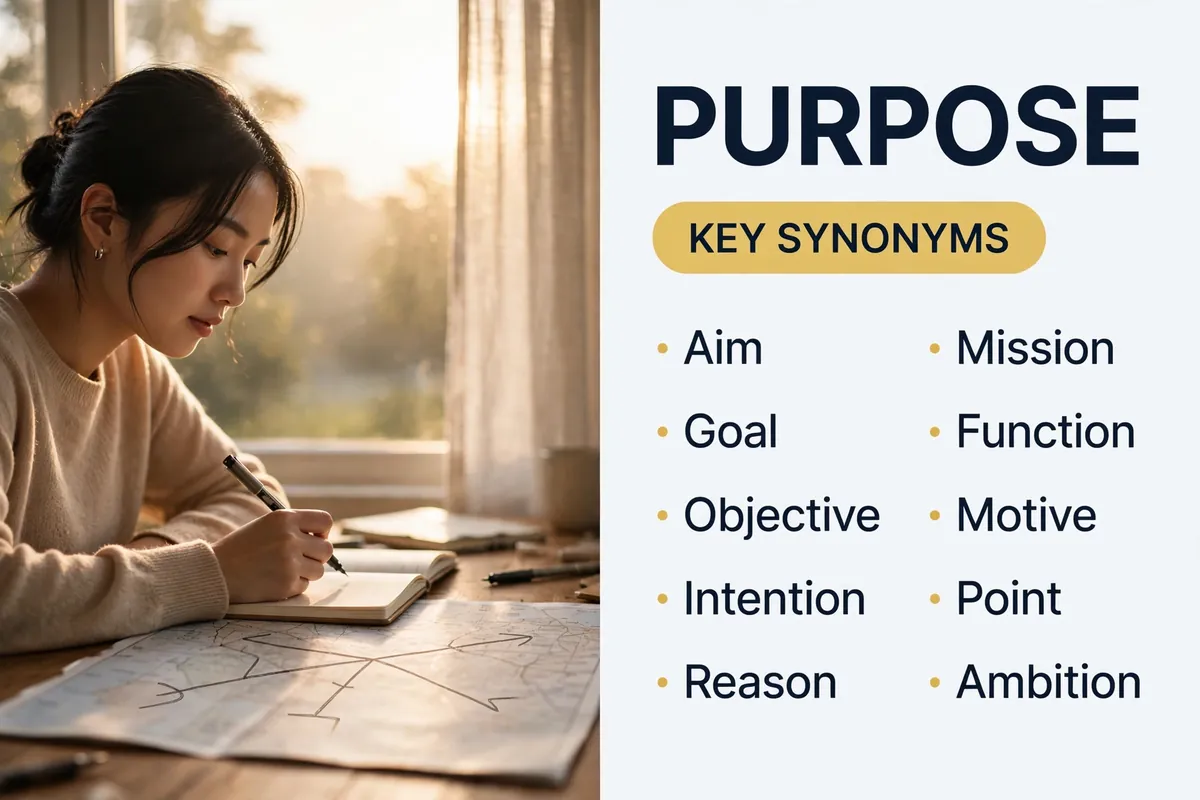
Top 10 Purpose Synonyms at a Glance
| # | Synonym | Meaning Difference |
|---|---|---|
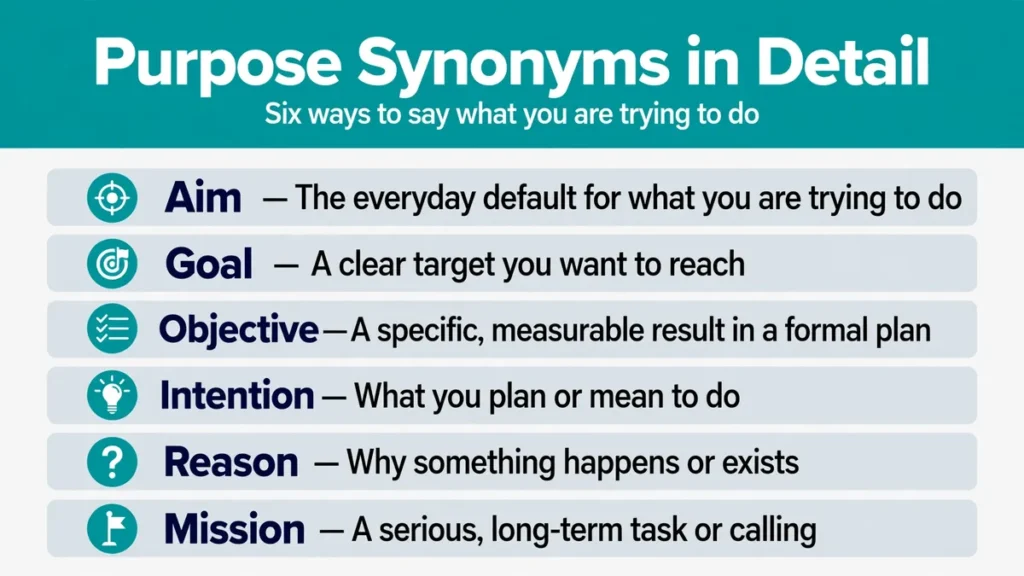
| 1 | Aim | The everyday default for what you are trying to do |
| 2 | Goal | A clear target you want to reach |
| 3 | Objective | A specific, measurable result in a formal plan |
| 4 | Intention | What you plan or mean to do |
| 5 | Reason | Why something happens or exists |
| 6 | Mission | A serious, long-term task or calling |
| 7 | Function | The job something is designed to do |
| 8 | Motive | The inner reason behind an action |
| 9 | Point | The value or sense in doing something |
| 10 | Ambition | A strong desire to achieve something big |
Quick Facts About “Purpose”
- Part of speech: a noun. You have a purpose in life, a purpose for doing something, or do something on purpose.
- Three core meanings: (1) a goal or intention, what you are trying to achieve, (2) the reason something exists or happens, (3) a sense of determination that guides your life.
- Register: neutral to formal. Purpose sounds natural in essays and job applications, but aim or point sounds lighter in casual speech.
- Watch out: purpose promises direction, not just activity. For a bare task, function is more honest.
The Closest Synonym: Aim
Aim is the closest synonym for purpose because it covers the word’s most common job: naming what someone is trying to do or reach. A student’s aim to become a nurse and a charity’s aim to cut food waste both name a target kept in view. Aim works in everyday speech, in essays, and in plans, and it never sounds stiff or grand.
Still, aim is not identical to purpose. Purpose can also mean why a thing exists, or a deep sense of meaning in life, and aim does not carry those senses. Use aim as your default, and reach below for function, motive, or a life calling.
Finally, the direction test: if the sentence means “what I am trying to do,” aim is safe. If it is about why a thing exists, use the reason and function group below.
Where “Purpose” Comes From (Etymology)
According to Etymonline, purpose is first recorded around 1300, in the form purpus, meaning “intention, aim, goal; object to be kept in view; proper function for which something exists.” It comes from Anglo-French purpos and Old French porpos, “an aim, intention” (12th century), from porposer, “to put forth,” which joins por-, “forth,” with poser, “to put, place.” It is equivalent to Latin propositum, “a thing proposed or intended,” but was evidently formed in French from the same elements.
On purpose, meaning “by design, intentionally,” is attested from the 1580s, and the verb purpose, meaning “to intend,” is recorded from the late 14th century.
Can You Swap Them Freely?
In short: only inside the same meaning group, and only when the sense matches. A goal word fails for why a tool exists:
- “Her aim is to pass the exam in June.” (goal or intention — correct)
- “Her function is to pass the exam in June.” (function is for what a thing is designed to do, not a person’s goal — incorrect, say aim or goal)
Before you substitute, ask: is this a target, a reason, or a life direction? Those take a Group 1, Group 2, and Group 3 word in turn.
Purpose Synonyms in Detail
Group 1: Purpose as a Goal or Intention
1. Aim
- Meaning: What you are trying to do or achieve.
- Difference: The closest all-round match for everyday purpose. Aim is simple, neutral, and accepted everywhere.
- Best used for: Essays, job applications, plans, everyday writing.
- Formality: Neutral · CEFR: B1 · Frequency: Very common
- Example (School): “Her aim is to study medicine after graduation.”
- Example (Work): “The aim of the workshop is to teach basic first aid.”
- When NOT to use it: When you mean why a thing exists. A machine has a function, not an aim.
2. Goal
- Meaning: A clear target you want to reach, often with a deadline.
- Difference: Goal is more concrete than purpose. It suggests a finish line you can measure.
- Best used for: Sports, study plans, careers, self-improvement writing.
- Formality: Neutral · CEFR: A2 · Frequency: Very common
- Example (Career): “His goal is to save enough to open a small bakery.”
- Example (Sport): “Her goal for the season is to run a marathon.”
- When NOT to use it: For a deep sense of meaning in life, where goal sounds too small and practical.
3. Objective
- Meaning: A specific result that a plan, project, or lesson is meant to achieve.
- Difference: Objective is the formal, measurable version of purpose. It belongs in plans and reports, where progress can be checked.
- Best used for: Business plans, lesson plans, project proposals, formal reports.
- Formality: Formal · CEFR: B2 · Frequency: Very common
- Example (Work): “The objective of the campaign is to raise recycling rates by ten percent.”
- Example (School): “The lesson objective is to use past tense correctly.”
- When NOT to use it: In personal or emotional writing, where objective sounds cold. Setting a clear objective starts with determining exactly what result you want, and that step matters before you write the plan.
4. Intention
- Meaning: What you plan or mean to do, especially before you act.
- Difference: Intention stresses the plan inside your head, not the result. It suits promises, apologies, and explanations of behavior.
- Best used for: Formal letters, explanations, legal and careful writing.
- Formality: Neutral to formal · CEFR: B2 · Frequency: Very common
- Example (Everyday): “It was never my intention to upset anyone.”
- Example (Work): “She announced her intention to apply for the manager role.”
- When NOT to use it: For the function of a thing, or for a measurable target, where function or goal fits better.
5. Target
- Meaning: A precise number or result to hit, often in sales, fitness, or fundraising.
- Difference: Target is narrower than purpose. It suggests a mark you either hit or miss.
- Best used for: Sales, budgets, fitness, fundraising, data reports.
- Formality: Neutral · CEFR: B2 · Frequency: Very common
- Example (Business): “The team hit its monthly sales target a week early.”
- Example (Health): “His target is to walk ten thousand steps a day.”
- When NOT to use it: For a life direction or a moral reason, where target sounds too cold and numeric.
6. Ambition
- Meaning: A strong desire to achieve something important, often over many years.
- Difference: Ambition adds drive and scale. It suits big careers and big dreams, not small daily tasks.
- Best used for: Career writing, biographies, motivational writing, interviews.
- Formality: Neutral · CEFR: B2 · Frequency: Common
- Example (Career): “Her ambition is to lead a hospital one day.”
- Example (School): “His ambition took him from night classes to a degree.”
- When NOT to use it: For a modest, practical aim, where ambition sounds inflated. Ambition is about drive and achievement, and for the related idea of influence and strength, see the guide to power synonyms.
Group 2: Purpose as a Reason or Function
7. Reason
- Meaning: Why something happens, or why someone does something.
- Difference: Reason is the plainest word for “why.” It covers causes, motives, and explanations alike.
- Best used for: Everyday speech, essays, explanations, arguments.
- Formality: Neutral · CEFR: A2 · Frequency: Very common
- Example (Everyday): “The reason she left early was the train strike.”
- Example (School): “Give one reason why the experiment failed.”
- When NOT to use it: When you mean a goal to reach. A reason looks backward at causes, while a goal looks forward.
8. Function
- Meaning: The job something is designed to do, or the role it plays.
- Difference: Function is for things and systems, not people. A heart, a button, and a department each have a function.
- Best used for: Science, technology, product descriptions, instructions.
- Formality: Neutral to formal · CEFR: B2 · Frequency: Very common
- Example (Science): “The function of red blood cells is to carry oxygen.”
- Example (Tech): “The function of this button is to save your work.”
- When NOT to use it: For a person’s dream or intention. People have aims, not functions.
9. Motive
- Meaning: The inner reason behind an action, often hidden or personal.
- Difference: Motive looks inside a person. It suits crime stories, psychology, and honest self-reflection.
- Best used for: News, crime writing, psychology, character analysis.
- Formality: Neutral to formal · CEFR: C1 · Frequency: Common
- Example (News): “Police are still looking for a motive for the attack.”
- Example (Everyday): “Her motive was simple: she wanted to help her brother.”
- When NOT to use it: For a stated, public goal. A company mission statement is not a motive.
10. Rationale
- Meaning: The set of reasons that explain and justify a decision.
- Difference: Rationale is the formal, argued version of reason. It belongs in reports where a choice must be defended.
- Best used for: Reports, policy writing, academic work, proposals.
- Formality: Formal · CEFR: C1 · Frequency: Common
- Example (Work): “The report explains the rationale behind the price rise.”
- Example (School): “State the rationale for choosing this method.”
- When NOT to use it: In casual conversation, where rationale sounds stiff. Say reason instead.
11. Point
- Meaning: The value, sense, or advantage in doing something.
- Difference: Point is the questioning form of purpose. It appears in “what is the point?” and in defenses of an activity.
- Best used for: Conversation, opinion writing, debates, reviews.
- Formality: Informal to neutral · CEFR: B1 · Frequency: Very common
- Example (Everyday): “What is the point of buying a car if you never drive?”
- Example (Work): “The point of the survey is to hear real customers.”
- When NOT to use it: In a formal mission statement, where point sounds too casual and small.
Group 3: Purpose as a Life Direction or Calling
12. Mission
- Meaning: A serious, long-term task or duty, often shared by a team or organization.
- Difference: Mission adds weight and duty. It suits charities, armies, schools, and companies with a public promise.
- Best used for: Mission statements, charities, teams, speeches.
- Formality: Neutral to formal · CEFR: B2 · Frequency: Very common
- Example (Charity): “The charity’s mission is to end hunger in the city.”
- Example (Work): “Our mission for this year is to make care safer.”
- When NOT to use it: For a small personal task, where mission sounds grand. A mission usually needs shared effort, which is why it pairs naturally with the guide to teamwork synonyms.
13. Cause
- Meaning: A principle, movement, or belief that people serve or support.
- Difference: Cause is bigger than one person. It suggests a shared belief worth working for.
- Best used for: Activism, charity writing, history, speeches.
- Formality: Neutral · CEFR: B2 · Frequency: Very common
- Example (Community): “She gave her weekends to the cause of literacy.”
- Example (History): “Volunteers joined the cause after the flood.”
- When NOT to use it: For a personal career target, where cause sounds political or public.
14. Calling
- Meaning: A strong feeling that a certain work or way of life is right for you.
- Difference: Calling is personal and emotional. It suits nursing, teaching, art, and faith, where work feels like identity.
- Best used for: Personal essays, biographies, reflective writing.
- Formality: Neutral · CEFR: C1 · Frequency: Common
- Example (Career): “Teaching was not just a job for her; it was a calling.”
- Example (Everyday): “He found his calling in repairing old bicycles.”
- When NOT to use it: In a business plan or a technical report, where calling sounds too emotional.
15. Design
- Meaning: The plan or intention behind how something was made.
- Difference: Design points to a maker’s intention. It suits objects, systems, and arguments about whether something happened by chance.
- Best used for: Product writing, philosophy, technology, design discussions.
- Formality: Neutral to formal · CEFR: B2 · Frequency: Very common
- Example (Tech): “By design, the app works without an internet connection.”
- Example (Everyday): “The wide door was part of the design, not an accident.”
- When NOT to use it: For a person’s life goal. A person has an aim, while a product has a design.
Best Alternatives of Purpose by Context
Case 1: A student writing a personal statement. Aim is the safest pick for why she chose nursing. Calling works only if she truly feels it, and mission would sound too grand.
Case 2: A manager writing a project plan. Objective wins, because it promises a measurable result. Goal works in the summary, but purpose alone is too vague.
Case 3: A jobseeker rewriting a resume. Each bullet needs a result, not a feeling. Goal or target fits. Ambition belongs in a cover letter, not a bullet.
Case 4: A charity describing its work. Mission is right, because it signals duty and a shared task. Reason would sound like an excuse.
Case 5: A teacher explaining a tool in class. Function fits, because it describes a job, not a dream. Aim would wrongly give the tool intentions.
Which Purpose Synonym Should I Choose?
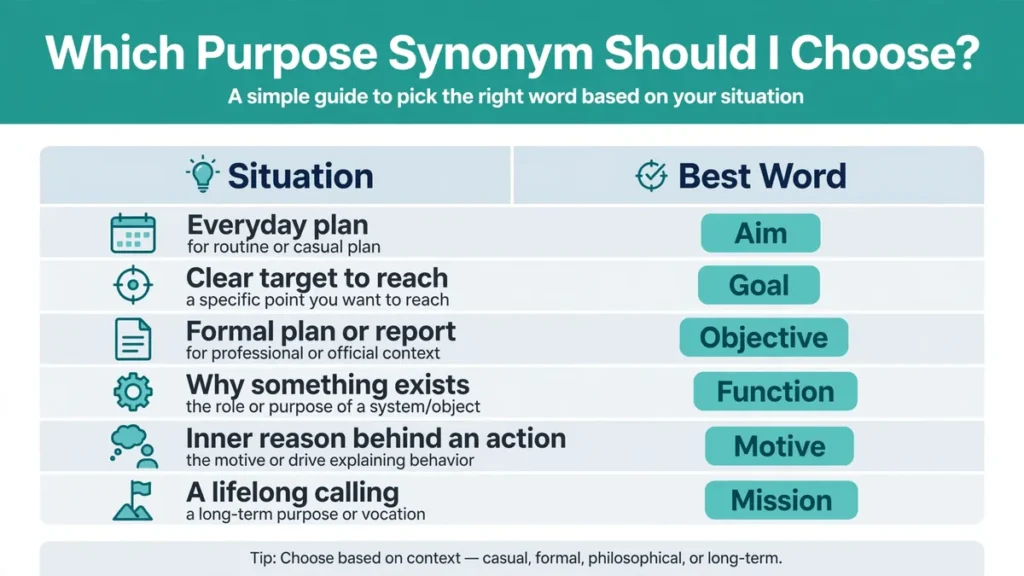
| Situation | Best pick | Why it wins |
|---|---|---|
| Everyday goal or plan | Aim | Simple, neutral, understood everywhere |
| A clear target with a deadline | Goal | Concrete and easy to measure |
| A formal plan or report | Objective | Specific, checkable, professional |
| Why something exists | Function | Describes a designed job, not a dream |
| The hidden reason behind an act | Motive | Looks inside the person, not the plan |
| A serious shared task | Mission | Carries duty and long-term weight |
| A personal life direction | Calling | Emotional and personal, not corporate |
| Defending a decision | Rationale | Gives argued reasons, not just one reason |
Antonyms of Purpose
1. Antonyms for purpose as a goal or intention
| Antonym | Meaning Difference |
|---|---|
| Aimlessness | Having no goal or direction at all |
| Drift | Moving through life without a plan |
| Randomness | Acting without any target or order |
| Indecision | Being unable to choose a direction |
| Purposelessness | The state of having no purpose |
2. Antonyms for purpose as a reason or function
| Antonym | Meaning Difference |
|---|---|
| Pointlessness | Having no value or sense in doing it |
| Uselessness | Serving no practical job at all |
| Futility | Effort that cannot succeed |
| Irrelevance | Having no connection to the matter at hand |
| Meaninglessness | Carrying no sense or significance |
3. Antonyms for purpose as a life direction
| Antonym | Meaning Difference |
|---|---|
| Apathy | Not caring about any direction or cause |
| Indifference | Having no interest in one path over another |
| Despair | Losing hope that any direction matters |
| Emptiness | Feeling that life holds no meaning |
| Disorientation | Not knowing which way to turn |
Words Commonly Confused With Purpose
Aim versus purpose is the closest pair, and the difference is range. Aim covers goals only, while purpose also covers reasons, functions, and life meaning. If the sentence is about why a thing exists, aim fails the substitution test.
Goal versus objective is a formality pair. A goal is a general target, while an objective is a specific, measurable step in a plan.
Motive versus reason is a depth pair. A reason can be public and simple, such as rain, while a motive is personal and often hidden, such as jealousy. Calling a public explanation a motive suggests something secret, so use reason unless secrecy is real.
Function versus purpose is a thing-versus-person pair. A kettle has a function, while its owner has a purpose for buying it. Swapping them gives the kettle intentions it cannot have.
On purpose is an idiom, not a synonym. It means deliberately, as in “she did it on purpose.” Do not use it as a noun replacement.
American vs British English
Purpose is spelled the same in American and British English, and so are aim, goal, objective, and mission. One small difference: British writing sometimes uses purposely where American writing prefers on purpose or deliberately, though both are understood everywhere. Aim is the safest shared default in both varieties.
Collocations and Idioms With Purpose
Only use combinations that native speakers actually use:
- purpose in life: a guiding sense of meaning, as in “she found her purpose in life through teaching.”
- on purpose: deliberately, as in “he broke it on purpose.”
- serve a purpose: be useful, as in “the old map still serves a purpose.”
- defeat the purpose: make an action useless, as in “skipping practice defeats the purpose of joining the team.”
Avoid “purpose of to do something.” Use purpose in doing something.
Practice Exercises
Exercise 1: Match the word to the meaning. Words: (a) aim, (b) function, (c) motive, (d) mission, (e) rationale, (f) target.
- The job something is designed to do.
- The hidden inner reason behind an action.
- A precise number or result to hit.
- The argued reasons that justify a decision.
- A serious, long-term shared task.
- What you are trying to do or achieve.
Exercise 2: Fill in the blank. Choose aim, objective, or calling.
- The ___ of the lesson is to write a clear paragraph.
- Teaching was not just a job for her; it was a ___.
- His ___ is to finish the course by December.
Exercise 3: Rewrite for tone. Rewrite this casual sentence formally: “The point of the meeting is to sort out the rota.” Then rewrite this formal sentence in everyday English: “The objective of the program is to improve literacy rates among adults.”
Answer key
- Exercise 1: (1) b, (2) c, (3) f, (4) e, (5) d, (6) a.
- Exercise 2: (1) objective, (2) calling, (3) aim.
- Exercise 3: Formal: “The purpose of the meeting is to finalize the rota.” Friendly: “The program aims to help more adults read and write better.”
Frequently Asked Questions
What is the best synonym for purpose?
Aim is the best all-round synonym, because it fits school, work, and everyday speech without sounding formal or grand. Use it when someone is trying to do or reach something. For formal plans, choose objective, and for why a thing exists, choose function, so the meaning stays exact.
Is goal the same as purpose?
Not quite. A goal is a specific target you want to reach, often with a deadline, while purpose is wider and can also mean a reason, a function, or a sense of meaning. You can have a purpose without a measurable goal, such as helping others.
Can I use purpose in a job application?
Yes, purpose works well in a personal statement or cover letter when it describes real direction, such as wanting to improve patient care. Keep it honest and specific, since a vague claim about purpose sounds empty. Aim is safer in short resume bullets, where a concrete result matters more than a feeling.
What is the difference between purpose and motive?
Purpose is the open, stated direction behind an action, while motive is the inner, often hidden reason that drives someone. A charity states its purpose in public, but a suspect’s motive is uncovered by investigation. Use motive only when the reason is personal, private, or not yet admitted.
Is “on purpose” the same as having a purpose?
No. “On purpose” is an idiom meaning deliberately, as in doing something intentionally rather than by accident. Having a purpose means having a goal or a reason for living or acting. The two share a root word, but they answer different questions: one asks how, and the other asks why.
Which synonym should students use in essays?
In essays, prefer aim, objective, or rationale, because all three sound academic and precise. Reserve mission and calling for reflective or personal writing, and use function for science and technology topics. Match the word to the sense: a target takes aim or objective, and a reason takes rationale or reason.
Conclusion
The right replacement for purpose depends on which sense you mean. A target calls for aim or goal a formal plan calls for objective, a designed job calls for function, a hidden reason calls for motive and a life direction calls for mission or calling.
Test every swap: is this about a target, a reason, or a direction?

About Sajjad Ahmed
Sajjad Ahmed is the author behind Guest Paster, where he writes about English vocabulary, synonyms, word meanings, and practical word usage.
His content is designed to help readers understand the differences between similar words, discover suitable alternatives, and use English vocabulary more effectively in everyday writing and communication.
Before publishing, Sajjad focuses on presenting word choices in a clear and easy-to-understand format, with relevant meanings, context, and examples where helpful.
Through Guest Paster, his goal is to make vocabulary learning simpler and provide useful language resources for students, writers, English learners, and anyone looking to expand their vocabulary.
Areas of Focus: English Vocabulary • Synonyms • Word Meanings • Word Usage • Language Learning
Author: Sajjad Ahmed
Website: Guest Paster