Bravery is an uncountable noun representing the ability to confront danger, suffering or hardship without being overwhelmed by fear – a quality possessed by firefighters, whistleblowers and anyone who acts in the face of fear.
Because there are dozens of synonyms for “bravery” in English, each conveying a different tone or implication, and some fit medal citations while others fit sports commentary and still others quiet personal struggles. The closest everyday equivalent is courage, which would fit in almost any situation.
When writing formally, for the military or for ceremonies, valor becomes more important. The choice is based upon the register and situation. Is the courage an individual bold action or a prolonged state of calmness?
Top 10 at a Glance
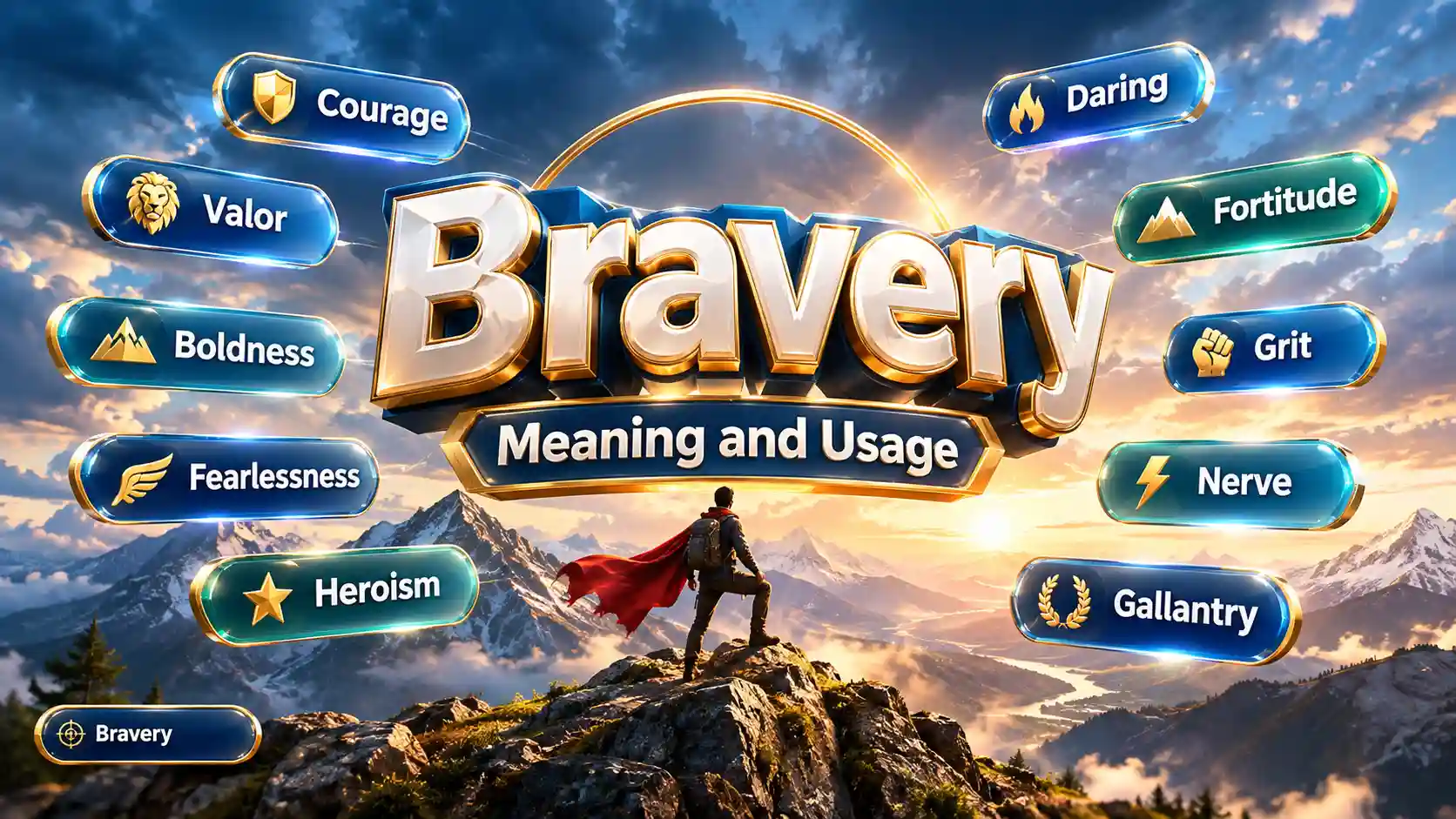
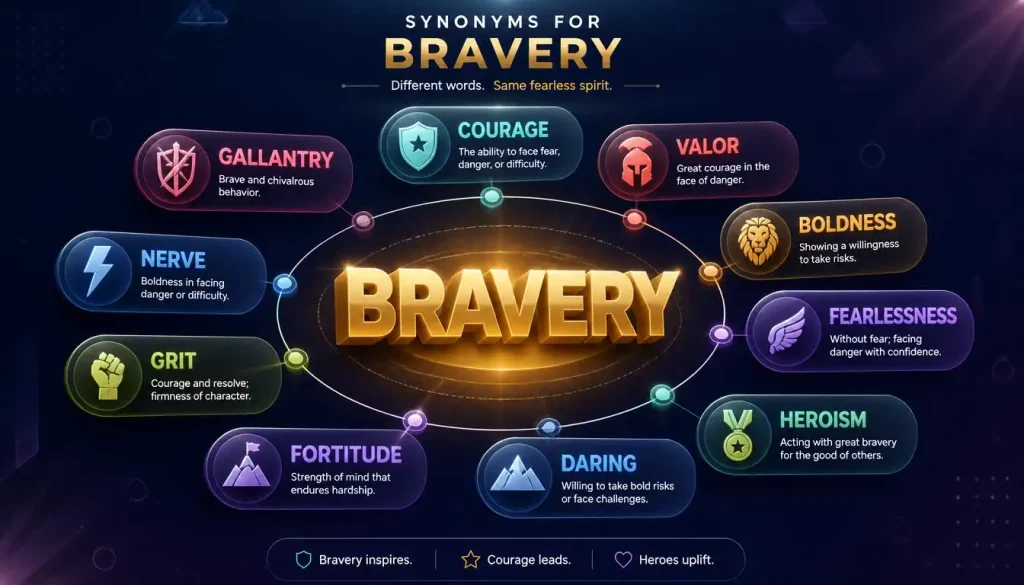
| # | Synonym | Meaning Difference |
| 1 | Courage | Broadest, most natural substitute; works almost anywhere |
| 2 | Valor | Formal; bravery in battle or heroic, decorated acts |
| 3 | Boldness | Confident, visible willingness to take risks |
| 4 | Fearlessness | Absence of fear itself, not acting despite it |
| 5 | Heroism | Exceptional, often self-sacrificing bravery |
| 6 | Daring | Bold, risk-taking action, sometimes adventurous |
| 7 | Fortitude | Calm endurance of pain or hardship over time |
| 8 | Grit | Bravery fused with persistence under pressure |
| 9 | Nerve | Cool-headed boldness in a tense moment |
| 10 | Gallantry | Formal, honorable bravery, often military |
Quick Facts About Bravery
- Part of speech: Noun (uncountable)
- Simple meaning: Facing danger or difficulty without being controlled by fear
- Pronunciation: /ˈbreɪvəri/ (BRAY-vuh-ree)
- Syllables: 3 (brav-er-y)
- Word forms: brave (adjective), bravely (adverb), braver/bravest (comparative/superlative), braveness (rare noun variant)
- Formality: Neutral — works in both casual and formal writing
- Closest synonym: Courage
- Best used for: Praising action taken despite fear — physical, moral, or emotional
What Is the Closest Synonym for Bravery?
Courage is the closest true synonym for bravery, and the word most native speakers reach for first. Both describe acting well in the face of fear, and both cover physical danger (running into a burning building) as well as moral difficulty (admitting a costly mistake).
The nuance is subtle: bravery tends to emphasize the impressiveness of the visible act — “an act of bravery” is a fixed phrase — while courage emphasizes the inner capacity that makes the act possible — “she found the courage to speak.” In everyday speech and most writing, the two are freely interchangeable. If you can only remember one alternative to bravery, make it courage.
Word Origin & Etymology
“Bravery” entered English around the mid-16th century, from the French braverie, itself built on braver (“to brave, to defy”). The word’s earliest sense in English leaned toward “daring display, boasting, or showy defiance” closer to what we’d now call bravado before settling into its modern meaning of genuine courage by the later 1500s.
The deeper root traces to the Italian bravo (“bold, fine, capable”), whose own origin is debated among etymologists. This drift from “showing off” to admired inner courage mirrors how the related adjective brave evolved across the same period.
Can These Synonyms Be Used Interchangeably?
Usually — courage swaps for bravery in almost any sentence without changing the meaning. Sometimes — valor, gallantry, intrepidity, and dauntlessness work only in elevated registers; calling a coworker’s presentation “an act of valor” sounds unintentionally comic.
Rarely grit, pluck, guts, and moxie fit casual praise but would feel out of place in a eulogy or formal citation. No fortitude stresses enduring hardship rather than confronting danger, so it only swaps cleanly when the sentence is about withstanding something over time; and bravado, temerity, and recklessness aren’t safe substitutes at all, since they describe a false or reckless imitation of bravery rather than the real thing (see Section 10).
Match the register to the occasion, and most sentences survive the swap.
Detailed Synonym Meanings and Examples
1. Courage
Meaning: The ability to act rightly, or face fear and danger, by choosing to act anyway.
Difference from Bravery: Nearly identical; courage emphasizes inner resolve, bravery the outward, admirable act.
Best Used For: All-purpose use — speeches, personal struggles, everyday praise.
Formality: Neutral
CEFR Level: B1
Frequency: Very Common
Examples:
- It took courage to admit the mistake in front of the whole team. (workplace)
- He found the courage to leave a job that had made him miserable for years. (personal)
When NOT to Use It: Rarely wrong — but in formal ceremonial citations, valor may carry more weight.
2. Valor
Meaning: Heroic courage, especially in battle or extreme danger.
Difference from Bravery: Formal and ceremonial; strongly tied to combat and decorated heroism.
Best Used For: Military citations, memorials, formal awards.
Formality: Formal
CEFR Level: C1
Frequency: Uncommon
Examples:
- The medal recognized his valor during the rescue mission.
- Ancient epics often glorify the valor of warriors on the battlefield.
When NOT to Use It: Avoid it for small, everyday acts — valor for fixing an office problem is overkill.
3. Boldness
Meaning: Confident, visible willingness to take risks or defy convention.
Difference from Bravery: Highlights confidence and assertiveness rather than actual danger faced.
Best Used For: Leadership, business decisions, public speaking, creative risk-taking.
Formality: Neutral
CEFR Level: B1
Frequency: Common
Examples:
- The startup’s boldness in entering a crowded market paid off within a year.
- The mayor’s boldness in confronting the crisis won public support.
When NOT to Use It: Avoid it when quiet endurance, not confident display, is the real point.
4. Fearlessness
Meaning: A state of having little or no fear when facing danger.
Difference from Bravery: Implies the absence of fear itself, while bravery implies acting despite fear.
Best Used For: Temperament, extreme sports, dramatic narrative.
Formality: Neutral
CEFR Level: B2
Frequency: Common
Examples:
- The climber’s fearlessness on the cliff face unsettled even experienced guides.
- Her fearlessness on the half-pipe stunned the judges.
When NOT to Use It: Avoid it when the person clearly felt afraid but acted anyway — that’s bravery, not fearlessness.
5. Heroism
Meaning: Exceptional courage, especially involving self-sacrifice for others.
Difference from Bravery: Reserved for standout, often public acts rather than everyday courage.
Best Used For: News reporting, tributes, rescue stories.
Formality: Neutral to Formal
CEFR Level: B2
Frequency: Common
Examples:
- Witnesses praised the bystander’s heroism after he pulled the driver from the wreck.
- A plaque honors the teacher’s heroism during the school lockdown.
When NOT to Use It: Avoid it for minor or private acts that don’t involve saving or protecting others.
6. Daring
Meaning: Willingness to take striking, sometimes adventurous risks.
Difference from Bravery: Emphasizes risk-taking flair and adventure over inner resolve.
Best Used For: Adventure writing, entrepreneurial praise, bold decisions.
Formality: Neutral
CEFR Level: B2
Frequency: Common
Examples:
- The pilot’s daring maneuver avoided a collision at the last second.
- The journalist’s daring reporting exposed corruption at the highest level.
When NOT to Use It: Avoid it in solemn contexts — daring sounds exciting, not grave.
7. Fortitude
Meaning: Strength of mind that endures pain or adversity calmly, over time.
Difference from Bravery: About endurance rather than confrontation — withstanding, not charging in.
Best Used For: Illness, grief, long-term hardship, stoic resilience.
Formality: Neutral/Formal
CEFR Level: C1
Frequency: Common
Examples:
- She bore her treatment with remarkable fortitude.
- The community showed fortitude through years of rebuilding.
When NOT to Use It: Avoid it for sudden, dramatic acts of daring — fortitude is a marathon, not a sprint.
8. Grit
Meaning: Courage combined with stubborn persistence under pressure.
Difference from Bravery: Fuses bravery with sustained effort, not a single brave moment.
Best Used For: Sports, entrepreneurship, education, long-term challenges.
Formality: Informal to Neutral
CEFR Level: B2
Frequency: Common
Examples:
- It took grit to finish the marathon after twisting her ankle at mile ten.
- The company survived the recession through sheer grit.
When NOT to Use It: Avoid it for a single, momentary act of bravery rather than sustained struggle.
9. Nerve
Meaning: Cool, steady boldness in a tense, high-pressure moment.
Difference from Bravery: More informal; emphasizes steadiness under pressure rather than fear overcome.
Best Used For: Conversational speech, competition, high-pressure decisions.
Formality: Informal
CEFR Level: B1
Frequency: Common
Examples:
- It took real nerve to negotiate the raise face-to-face.
- He had the nerve to take the final penalty kick.
When NOT to Use It: Avoid it in formal citations — and note that “a nerve” can also mean impudence.
10. Gallantry
Meaning: Brave and often chivalrous conduct, especially toward or on behalf of others.
Difference from Bravery: Adds honor and selflessness, with an old-fashioned connotation.
Best Used For: Historical writing, military honors, formal tributes.
Formality: Formal
CEFR Level: C1
Frequency: Uncommon
Examples:
- He was commended for gallantry in rescuing the trapped miners.
- The regiment was praised for its gallantry under fire.
When NOT to Use It: Avoid it in modern, casual, or workplace contexts — it reads as dated, and its separate sense of “polite attention to women” can cause confusion.
11. Mettle
Meaning: A person’s inner strength and courage, especially when tested.
Difference from Bravery: Focuses on character being proven, not the act itself.
Best Used For: Trials, competition, adversity that tests someone.
Formality: Formal
CEFR Level: C1
Frequency: Uncommon
Examples:
- The crisis tested the new manager’s mettle within her first month.
- She proved her mettle by leading the team through the emergency.
When NOT to Use It: Avoid it for calm, untested everyday life — mettle only appears when something puts it to the test.
12. Intrepidity
Meaning: A formal, literary word for utter fearlessness in the face of danger.
Difference from Bravery: Bookish and elevated, with the same core meaning as fearlessness.
Best Used For: Historical writing, formal tributes, character sketches.
Formality: Formal
CEFR Level: C2
Frequency: Rare
Examples:
- The explorers’ intrepidity carried them through the ice fields.
- Her intrepidity in confronting the regime became legend.
When NOT to Use It: Never in casual conversation — it reads as deliberately literary.
13. Guts
Meaning: Raw, instinctive courage.
Difference from Bravery: Cruder and more visceral; suggests courage from impulse, not reflection.
Best Used For: Casual speech, sports commentary, bold confrontations.
Formality: Informal
CEFR Level: B2
Frequency: Very Common
Examples:
- It takes guts to start over at forty.
- The fighter showed guts by getting up off the canvas.
When NOT to Use It: Never in formal writing, citations, or condolences.
14. Backbone
Meaning: Firmness of character; the courage to stand one’s ground.
Difference from Bravery: Emphasizes refusal to yield or be pushed around, not facing physical danger.
Best Used For: Workplace integrity, defending a position, standing up to pressure.
Formality: Informal to Neutral
CEFR Level: B2
Frequency: Common
Examples:
- It took backbone to tell the CEO the strategy was flawed.
- The union showed real backbone in the negotiations.
When NOT to Use It: Avoid it for rescues or battlefield courage — backbone is about standing firm, not charging in.
15. Spunk
Meaning: Lively, spirited courage.
Difference from Bravery: Energetic and cheeky; American informal register with an old-fashioned flavor.
Best Used For: Casual praise, describing a spirited underdog or character.
Formality: Informal
CEFR Level: C1
Frequency: Uncommon
Examples:
- The young goalkeeper showed real spunk, returning after a brutal collision.
- I love her spunk — she never backs down.
When NOT to Use It: Avoid it entirely in British English, where the word is vulgar slang — and avoid it in any formal setting regardless of dialect.
16. Moxie
Meaning: Bold, energetic courage combined with initiative.
Difference from Bravery: American slang with a sense of swagger and self-starting drive.
Best Used For: American casual speech, profiles of bold entrepreneurs or characters.
Formality: Informal
CEFR Level: C1
Frequency: Uncommon
Examples:
- The startup founder has moxie to spare.
- You need moxie to quit a safe job and travel alone.
When NOT to Use It: Avoid it outside American English — most British readers will find it unfamiliar or affected.
17. Dauntlessness
Meaning: Resolute courage that refuses to be intimidated or discouraged.
Difference from Bravery: Formal, literary; emphasizes persistence in the face of intimidation.
Best Used For: Formal essays, oratory, character analysis.
Formality: Formal
CEFR Level: C2
Frequency: Rare
Examples:
- Her dauntlessness in the face of repeated rejection eventually won the investors over.
- The dauntlessness of the protesters, despite threats, was widely admired.
When NOT to Use It: Never in conversation; even in writing, it draws attention to itself.
18. Valiance
Meaning: A literary term for heroic bravery, especially in combat or a noble cause.
Difference from Bravery: Rarer and more poetic than valor.
Best Used For: Poetry, historical fiction, formal tributes.
Formality: Formal
CEFR Level: C2
Frequency: Rare
Examples:
- The poem celebrates the valiance of those who resisted in silence.
- Historians note the valiance of the small garrison against overwhelming odds.
When NOT to Use It: Avoid it in everyday or business writing — it can sound overly dramatic.
19. Hardihood
Meaning: Bold, rugged courage that pushes through hardship or risk.
Difference from Bravery: Combines courage with physical or mental toughness, sometimes bordering on reckless.
Best Used For: Frontier and historical narratives, survival contexts.
Formality: Formal
CEFR Level: C2
Frequency: Rare
Examples:
- The settlers’ hardihood carried them through a brutal first winter.
- His hardihood in confronting the bandits alone surprised everyone.
When NOT to Use It: Avoid it for emotional or social courage — it fits physical hardship far better.
20. Doughtiness
Meaning: Brave and persistent determination, often admired for its quiet steadiness.
Difference from Bravery: Archaic in tone; implies a tested, reliable courage rather than a single dramatic act.
Best Used For: Historical or literary character description.
Formality: Formal
CEFR Level: C2
Frequency: Rare
Examples:
- The old general’s doughtiness was legendary among his troops.
- Chroniclers wrote of the knight’s doughtiness in every battle.
When NOT to Use It: Avoid it entirely in modern conversational or business English — it will sound out of place.
21. Stout-heartedness
Meaning: Brave, resolute spirit; courage paired with steadfast loyalty.
Difference from Bravery: Literary and warmer in tone, suggesting a loyal, steady heart.
Best Used For: Historical and narrative writing, tributes.
Formality: Formal/Literary
CEFR Level: C2
Frequency: Rare
Examples:
- The captain’s stout-heartedness steadied the whole crew during the storm.
- The villagers’ stout-heartedness outlasted the siege.
When NOT to Use It: Avoid it in modern everyday prose — it belongs to storybooks and memorials.
22. Lion-heartedness
Meaning: Exceptional, almost legendary bravery.
Difference from Bravery: Stronger and figurative; implies heroism on an almost mythic scale.
Best Used For: Tributes, epithets, dramatic or celebratory writing.
Formality: Literary
CEFR Level: C2
Frequency: Rare
Examples:
- The captain’s lion-heartedness inspired the entire crew during the storm.
- Fans admired the athlete’s lion-heartedness in playing through the injury.
When NOT to Use It: Never for ordinary, everyday bravery — the metaphor is reserved for exceptional cases.
23. Derring-do
Meaning: Heroic daring and adventure.
Difference from Bravery: Archaic-literary; evokes knights, swashbuckling, and romance.
Best Used For: Fiction, playful historical writing.
Formality: Literary/Archaic
CEFR Level: C2
Frequency: Rare
Examples:
- The tale recounts the captain’s derring-do on the high seas.
- Few acts of office derring-do rival stealing the boss’s parking spot.
When NOT to Use It: Never in serious modern contexts — it signals deliberate, playful archaism.
24. Pluck
Meaning: Spirited bravery, especially when the odds are against you.
Difference from Bravery: Adds an underdog quality; warm, slightly old-fashioned tone.
Best Used For: Sporting underdogs, children and animals, narrative writing.
Formality: Informal
CEFR Level: C1
Frequency: Uncommon
Examples:
- The rookie showed real pluck against the reigning champions.
- The little dog had the pluck of a lion.
When NOT to Use It: Avoid it in solemn or formal writing — pluck is charming, not grave.
25. Audacity
Meaning: Bold, sometimes shocking courage that defies convention or expectation.
Difference from Bravery: Works as a synonym only when the brave act also carried a defiant or transgressive edge.
Best Used For: Bold defiance, shocking gambits, controversial but courageous decisions.
Formality: Neutral to Formal
CEFR Level: C1
Frequency: Common
Examples:
- Her audacity in challenging the minister made headlines.
- The audacity of the escape plan was its greatest strength.
When NOT to Use It: Avoid it as a neutral substitute — “the audacity of the firefighter” reads as insolence, not heroism, unless defiance is genuinely part of the story.
Best Alternatives by Context
- Everyday Conversation: Courage, guts, nerve, pluck
- Formal Writing: Valor, gallantry, fortitude, dauntlessness
- Academic Writing: Fortitude, courage, intrepidity
- Business Communication: Boldness, backbone, grit, courage
- Creative Writing: Daring, mettle, derring-do, lion-heartedness, stout-heartedness
- Social Media: Guts, nerve, moxie, spunk
Which Synonym Should I Choose?
| Situation | Best Choice | Why |
| Medal or formal citation | Valor | Ceremonial register matches the honor |
| Consoling someone who is ill | Fortitude | Honors endurance, not confrontation |
| Praising a colleague | Courage, backbone | Warm, professional, precise |
| Sports commentary | Grit, guts, nerve | Energetic, natural in live speech |
| Military history writing | Gallantry, intrepidity | Period-accurate, elevated tone |
| Describing a bold, risky gamble | Daring, audacity | Captures both risk and defiance |
| Children’s story or fable | Pluck, lion-heartedness | Warm, narrative-friendly imagery |
Exact and Near Synonyms: Difference
True synonyms words that swap in every sentence with zero change in meaning or tone are rare in English. Courage comes closest to bravery, yet even the two differ in emphasis: courage is the inner resource, bravery the admired act.
Every other word on this list shifts the meaning somewhere: fortitude moves from confrontation to endurance, daring adds an appetite for risk, audacity adds defiance, and grit adds time.
The register gap matters just as much as the meaning gap valor and guts can describe the exact same firefighter, but never comfortably in the same sentence. Choosing among them is precision, not decoration.
Words Commonly Confused with Bravery
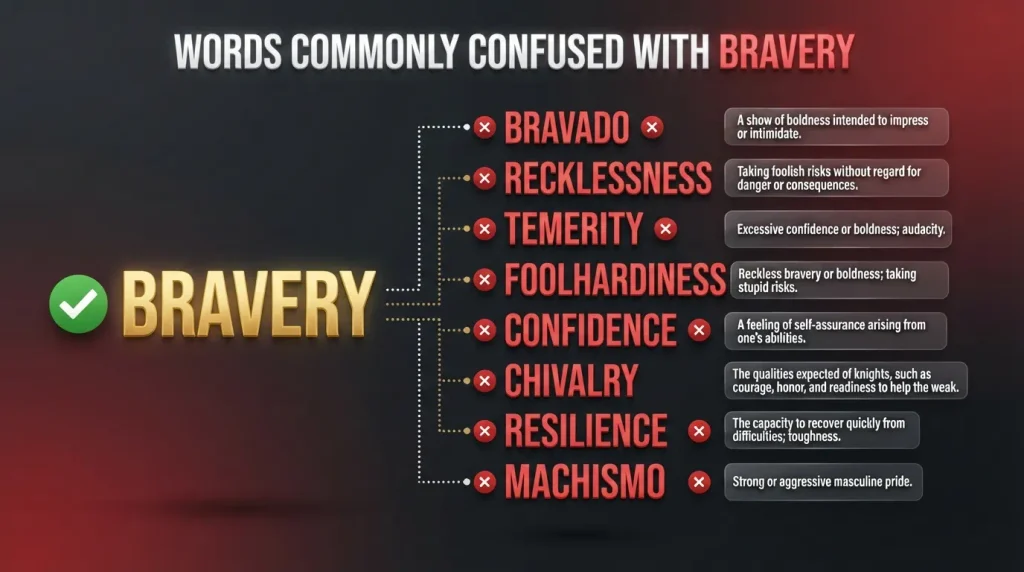
- Bravado — a false or exaggerated display of confidence, often masking fear rather than overcoming it.
- Recklessness — taking risks without judgment or regard for consequences; bravery’s irresponsible cousin.
- Temerity — reckless boldness that ignores danger rather than consciously facing it; carries a negative connotation.
- Foolhardiness — bravery without judgment; acting dangerously with no real justification.
- Confidence — belief in one’s own ability, which can exist without any risk or fear involved at all.
- Chivalry — a broader code of honorable, courteous conduct that includes bravery but isn’t defined by it.
- Resilience — the ability to recover from setbacks, which is about recovery, not facing danger in the moment.
- Machismo — an exaggerated sense of masculine pride, closer to bravado than to genuine bravery.
Common Mistakes
| Mistake | Better | Why |
| “A bravery” / “braveries” | “An act of bravery” / “acts of bravery” | Bravery is uncountable and has no standard plural form |
| Using “valor” for small, everyday acts | “Courage” or “guts” | Valor implies decorated, large-scale heroism |
| Calling a scared hero “fearless” | “Courage” | The person who trembles and still acts is brave, not fearless |
| Using “bravado” as a compliment | “Courage” or “boldness” | Bravado implies a false or showy display, not real bravery |
| Using “guts” in a formal citation | “Gallantry” or “valor” | Guts is slang and out of place in official, formal praise |
Antonyms of Bravery
| # | Antonym | Why It’s the Opposite |
| 1 | Cowardice | Direct opposite; refusing to act because of fear |
| 2 | Timidity | Habitual shrinking from risk or confrontation |
| 3 | Fearfulness | Being governed and controlled by fear |
| 4 | Faint-heartedness | Losing spirit or resolve at the moment of danger |
| 5 | Cravenness | Utter, contemptible cowardice |
| 6 | Spinelessness | Inability to stand firm under pressure |
| 7 | Pusillanimity | Formal term for a petty, timid lack of courage |
American vs British English
Spelling: No difference for bravery itself, but valor (US) vs valour (UK) appears throughout related formal writing in each variety.
Vocabulary: British English uses bottle as informal slang for courage (“She’s got bottle”), which most Americans won’t recognize. Americans favor moxie and spunk in the same slot — but note that in British English, spunk is vulgar slang and should be avoided entirely there.
Usage: Guts and nerve work naturally in both varieties; pluck and gallantry carry the same old-fashioned warmth on both sides of the Atlantic.
Real-World Collocations & Phrases
Verb + Bravery: show bravery, display bravery, demonstrate bravery, summon bravery, recognize bravery
Bravery + Noun: act of bravery, bravery award, bravery medal
Adjective + Bravery: remarkable bravery, quiet bravery, extraordinary bravery, incredible bravery
Bravery + Preposition: bravery in the face of danger, bravery under fire, bravery against the odds
Common phrases:
- “Act of bravery” — a single courageous deed; the standard phrase used in news reporting.
- “Quiet bravery” — courage without display, often used for enduring hardship without complaint.
- “Bravery in the face of…” — a fixed frame for naming exactly what was faced or overcome.
- “A medal for bravery” — the standard phrase for an official award recognizing courageous action.
FAQ
What are 5 strong synonyms for bravery?
Courage, valor, boldness, fortitude, and heroism — five of the strongest, most widely understood alternatives.
What are 5 synonyms for brave?
The adjective has its own set: courageous, fearless, bold, daring, and valiant.
What are three synonyms for courage?
Bravery, valor, and fortitude are three close synonyms for courage; grit and pluck also work in informal contexts.
What is a better word for bravely?
“Courageously” fits most contexts; “valiantly” suits heroic effort, “fearlessly” suits truly fearless action, and “boldly” suits confident action.
What are 10 good synonyms for bravery?
Courage, valor, boldness, fearlessness, heroism, daring, fortitude, grit, nerve, and gallantry — see the Top 10 table above.
Practice Exercises
Fill in the Blanks
- The soldier was decorated for his ______ during the rescue operation. (valor)
- It takes real ______ to change careers at fifty. (courage)
- She bore her diagnosis with quiet ______. (fortitude)
- The rookie’s ______ impressed the entire coaching staff. (grit)
- He didn’t have the ______ to admit his mistake. (nerve/guts)
Rewrite Sentences
- “He received an award for a great bravery.” → He received an award for great bravery.
- “Her bravery in the courtroom won the case.” → Her boldness in the courtroom won the case.
- “The firefighter showed real bravery.” → The firefighter showed real heroism.
Match the Words
- Valor — A. Formal, combat-related courage
- Guts — B. Informal, everyday courage
- Fortitude — C. Endurance through hardship
- Gallantry — D. Chivalrous, honor-driven bravery
- Bravado — E. False display of courage
(Answers: 1-A, 2-B, 3-C, 4-D, 5-E)
Vocabulary Quiz
- Which word implies a false display of courage?
a) Valor b) Bravado c) Grit d) Mettle — Answer: b - Which word best fits a formal military medal citation?
a) Guts b) Moxie c) Valor d) Pluck — Answer: c - Which word emphasizes enduring hardship over time rather than confronting danger?
a) Daring b) Fortitude c) Boldness d) Gallantry — Answer: b - Which word is the closest true synonym for bravery?
a) Recklessness b) Courage c) Bravado d) Temerity — Answer: b - Which is a genuine antonym of bravery?
a) Confidence b) Cowardice c) Boldness d) Grit — Answer: b
Answer Key:
Fill-in: 1. valor 2. courage 3. fortitude 4. grit 5. nerve/guts | Rewrite: as shown above | Match: 1-A, 2-B, 3-C, 4-D, 5-E | Quiz: 1-b, 2-c, 3-b, 4-b, 5-b
Conclusion
Bravery has no one, perfect replacement; it wears a wardrobe. Courage is the everyday suit that fits almost everywhere. It is the ceremonial raiment that is put on for great deeds and gallantry. When courage has to last longer than a moment, grit and fortitude serve.
Guts and moxie work the room at informal gatherings, while derring-do and doughtiness remain on the book shelf. When the author selects precisely, it’s not merely avoiding repetition; it informs readers exactly what type of courage is represented and why it earned that representation.

About Sajjad Ahmed
Sajjad Ahmed is the author behind Guest Paster, where he writes about English vocabulary, synonyms, word meanings, and practical word usage.
His content is designed to help readers understand the differences between similar words, discover suitable alternatives, and use English vocabulary more effectively in everyday writing and communication.
Before publishing, Sajjad focuses on presenting word choices in a clear and easy-to-understand format, with relevant meanings, context, and examples where helpful.
Through Guest Paster, his goal is to make vocabulary learning simpler and provide useful language resources for students, writers, English learners, and anyone looking to expand their vocabulary.
Areas of Focus: English Vocabulary • Synonyms • Word Meanings • Word Usage • Language Learning
Author: Sajjad Ahmed
Website: Guest Paster