If you write the word efficient in every resume, report and email, it soon stops saying anything. The fix is not a fancier word. It is a more exact word.
If a method saves time say streamlined. If a worker gets strong results say productive and if a tool saves money say economical.
This guide sorts 15 efficient synonyms by meaning so the word you pick proves the point instead of repeating it.
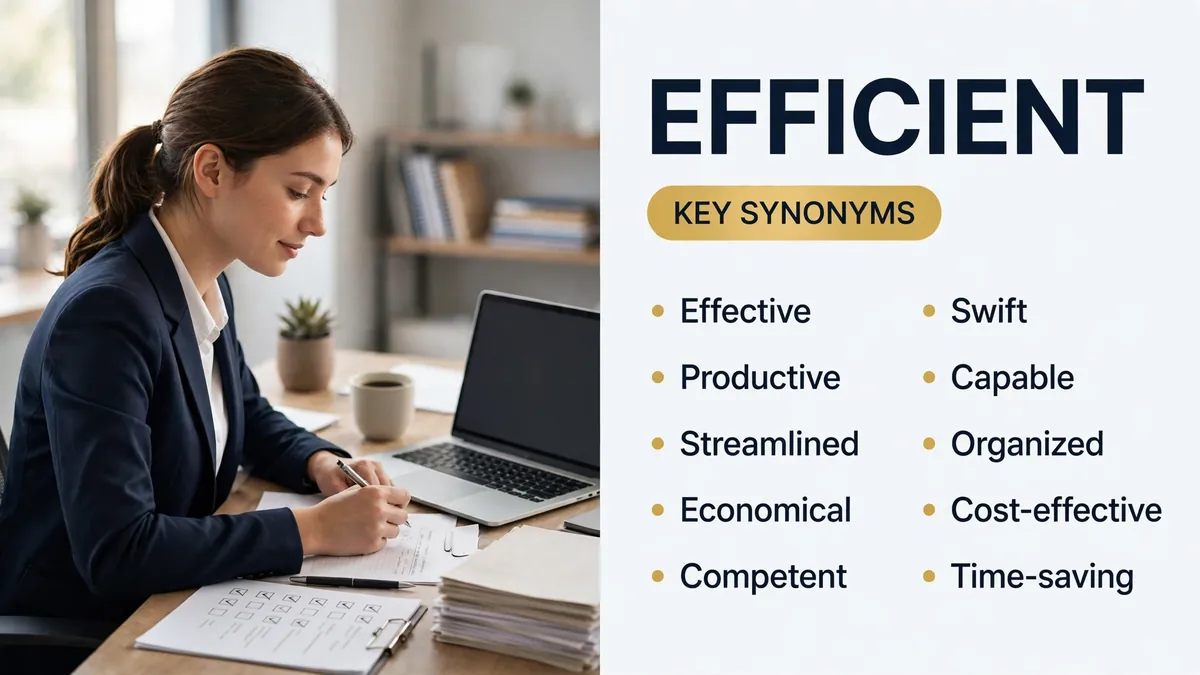
Top 10 Another Word For Efficient Synonyms at a Glance
| # | Synonym | Meaning Difference |
|---|---|---|
| 1 | Effective | Gets the result you wanted |
| 2 | Productive | Produces a lot of useful output |
| 3 | Streamlined | Simplified, with wasted steps removed |
| 4 | Economical | Saves money, or uses little |
| 5 | Competent | Able to do the job well |
| 6 | Swift | Fast, with no wasted time |
| 7 | Capable | Has the skill or power to do it |
| 8 | Organized | Arranged well, so work runs smoothly |
| 9 | Cost-effective | Worth the money it costs |
| 10 | Time-saving | Cuts the time a task takes |
Quick Facts About “Efficient”
- Part of speech: an adjective. You describe a method, a worker, or a machine as efficient.
- Two core meanings: (1) working well with little waste, such as an efficient kitchen, (2) skilled and capable, such as an efficient manager.
- Register: neutral to formal. Efficient sounds natural at work and in reports, and it stays neutral in everyday talk too.
- Watch out: efficient promises little waste, not just a good result. If waste does not matter, effective is more honest.
The Closest Synonym: Effective
Effective is the closest synonym for efficient, because it covers the word’s most common job: saying that something works. When a method, a medicine, or a plan gets the result you wanted, effective names that success plainly. Effective works in everyday speech, in reports, and in academic writing, which is why it is the safest first choice when you are unsure.
Still, effective is not identical to efficient. Effective says the result arrived. Efficient adds a second claim: the result arrived with little waste of time, effort, or money. A method can be effective yet slow and costly. Use effective as your default for results, and reach below when low waste is the real point.
Remember the choice test: if the sentence only claims success, effective still sounds true. If the sentence claims success with little waste, use efficient or a waste word below.
Where “Efficient” Comes From (Etymology)
According to Etymonline, efficient is recorded in the late 1300s, meaning “making, producing immediate effect, active, effective.”
It comes from Old French efficient and directly from Latin efficientem, meaning “effective, efficient, producing, active,” the present participle of efficere, “work out, accomplish,” from ex, “out,” plus facere, “to do.” The sense “productive, skilled” is recorded from 1787.
Do They Swap Cleanly?
In short: only inside the same meaning group, and only when the sense matches. A results word collapses in a sentence about saving money, and a money word collapses in a sentence about skill:
- ✅ “The new route is streamlined and saves an hour.” (wasted steps removed ✔)
- ❌ “The new route is competent and saves an hour.” (competent describes a person or a skill, not a route ✘, say streamlined)
- ✅ “She is a competent manager.” (able to do the job well ✔)
- ❌ “She is an economical manager.” (economical is about saving money, not skill ✘, say competent)
Before you substitute, ask: am I praising the result, the skill, or the saving? Those take a Group 1, Group 2, and Group 3 word in turn.
Efficient Synonyms in Detail
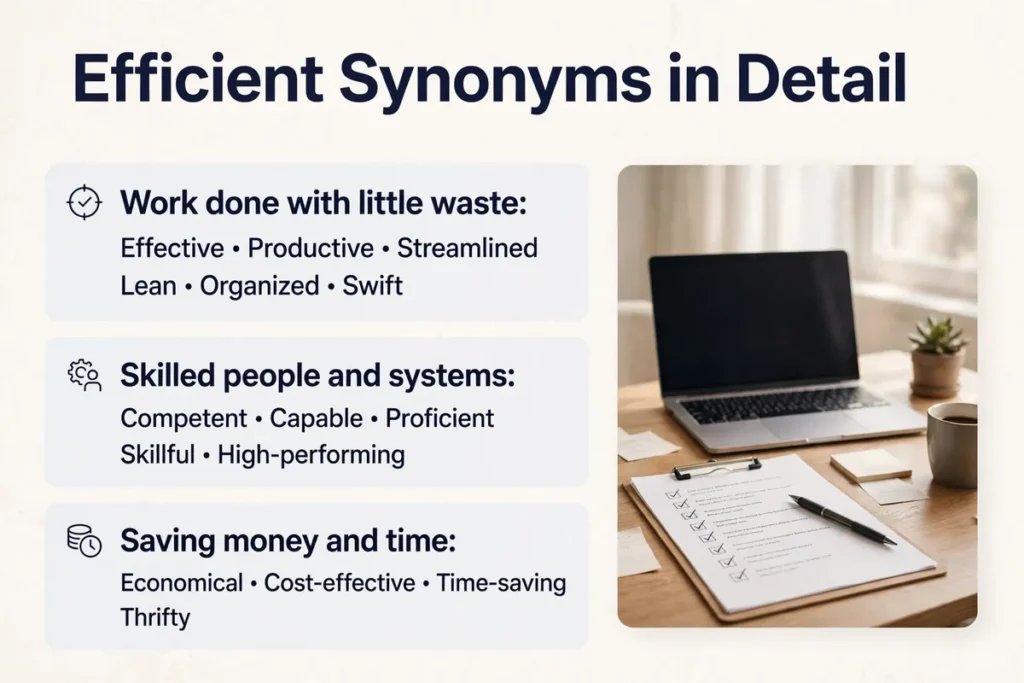
Group 1: Work Done Well, With Little Waste
1. Effective
- Meaning: Producing the result you wanted, or working as intended.
- Difference: The closest all-round match for efficient. Effective claims success, but not low waste.
- Best used for: Reports, reviews, everyday writing, medicine, plans.
- Formality: Neutral · CEFR: B2 · Frequency: Very common
- Example (Work): “The new training was effective, and errors fell fast.”
- Example (Health): “The medicine proved effective within a week.”
- When NOT to use it: When low waste is the point, where streamlined or economical is sharper.
2. Productive
- Meaning: Producing a large amount of useful work or output.
- Difference: Productive stresses output volume, not just one good result.
- Best used for: Workplaces, farms, meetings, study habits.
- Formality: Neutral · CEFR: B2 · Frequency: Very common
- Example (Work): “It was a productive morning, with three reports finished.”
- Example (Meeting): “The meeting was productive and ended on time.”
- When NOT to use it: For a single tool, where streamlined or time-saving fits better.
3. Streamlined
- Meaning: Simplified by removing wasted steps, so a process runs smoothly.
- Difference: Streamlined stresses the process itself, not the person using it.
- Best used for: Business writing, systems, apps, workflows.
- Formality: Neutral to formal · CEFR: C1 · Frequency: Common
- Example (Business): “The streamlined checkout takes half the time.”
- Example (Office): “We streamlined the approval process to one form.”
- When NOT to use it: For a person, where competent or capable is the word.
4. Lean
- Meaning: Using only what is needed, with no extra weight or waste.
- Difference: Lean is the business word for cutting waste, and it can sound technical.
- Best used for: Manufacturing, startups, business writing.
- Formality: Neutral to formal · CEFR: C1 · Frequency: Common
- Example (Business): “The lean team shipped the product in six weeks.”
- Example (Manufacturing): “Lean methods cut stock sitting in the warehouse.”
- When NOT to use it: In casual talk, where simple or streamlined sounds clearer.
5. Organized
- Meaning: Arranged in a clear order, so work runs without confusion.
- Difference: Organized stresses order and planning, which then saves time.
- Best used for: Offices, events, study, personal habits.
- Formality: Neutral · CEFR: B1 · Frequency: Very common
- Example (Office): “Her organized desk makes every file easy to find.”
- Example (Event): “The organized schedule kept the day on track.”
- When NOT to use it: For speed alone, where swift is sharper.
6. Swift
- Meaning: Fast, happening quickly and without delay.
- Difference: Swift stresses speed, not cost or output, and it sounds slightly formal.
- Best used for: News, service, deliveries, formal reports.
- Formality: Neutral to formal · CEFR: B2 · Frequency: Common
- Example (Service): “The shop gave a swift refund, no questions asked.”
- Example (News): “Rescue teams made a swift response to the flood.”
- When NOT to use it: When the point is saving money, where economical fits better.
Group 2: Skilled and Capable People and Systems
7. Competent
- Meaning: Able to do a job well enough, with the needed skill.
- Difference: Competent is a calm, professional judgment, not high praise.
- Best used for: Job references, reviews, professional writing.
- Formality: Formal · CEFR: C1 · Frequency: Very common
- Example (Work): “He is a competent engineer, trusted on every project.”
- Example (Review): “The report was competent, clear, and complete.”
- When NOT to use it: For a process, where streamlined is the word.
8. Capable
- Meaning: Having the skill, power, or equipment needed to do something.
- Difference: Capable stresses potential: the person or machine can do it.
- Best used for: Resumes, job ads, everyday praise.
- Formality: Neutral · CEFR: B1 · Frequency: Very common
- Example (Resume): “She is capable of leading a team of twelve.”
- Example (Machine): “The printer is capable of 40 pages a minute.”
- When NOT to use it: When proven results matter, where effective or productive is stronger.
9. Proficient
- Meaning: Skilled through practice, able to do something well and with ease.
- Difference: Proficient stresses practiced skill, often in a language or a tool.
- Best used for: Resumes, language levels, training reports.
- Formality: Formal · CEFR: C1 · Frequency: Common
- Example (Language): “She is proficient in Spanish after two years abroad.”
- Example (Tools): “He is proficient with spreadsheets and databases.”
- When NOT to use it: For a whole system, where streamlined fits better.
10. Skillful
- Meaning: Showing skill, especially with the hands or in a craft.
- Difference: Skillful stresses deft handling, while proficient stresses practiced ability in general.
- Best used for: Crafts, sports, surgery, cooking, art.
- Formality: Neutral · CEFR: B2 · Frequency: Common
- Example (Craft): “The skillful carpenter finished the chair in a day.”
- Example (Sports): “A skillful pass split the defense wide open.”
- When NOT to use it: For saving time or money, where time-saving or economical fits.
11. High-performing
- Meaning: Producing results well above the usual level.
- Difference: High-performing is strong praise, suited to teams and systems with measured results.
- Best used for: Business reports, sports, school results.
- Formality: Formal · CEFR: C1 · Frequency: Common
- Example (Business): “The high-performing branch beat every target.”
- Example (School): “Her high-performing class topped the district.”
- When NOT to use it: For an ordinary good worker, where competent is more honest.
Group 3: Saving Money and Time
12. Economical
- Meaning: Using little money, time, or fuel, or giving good value.
- Difference: Economical is the general saving word, covering money and resources.
- Best used for: Shopping, cars, heating, household advice.
- Formality: Neutral · CEFR: B2 · Frequency: Very common
- Example (Home): “The economical heater warms one room, not the house.”
- Example (Car): “A small car is the economical choice for city driving.”
- When NOT to use it: For a person’s skill, where competent is the word.
13. Cost-effective
- Meaning: Giving good results for the money spent, worth its cost.
- Difference: Cost-effective judges value against price, not just low price.
- Best used for: Business cases, health care, public spending.
- Formality: Formal · CEFR: C1 · Frequency: Common
- Example (Business): “Email is the most cost-effective way to reach customers.”
- Example (Health): “The clinic chose the cost-effective treatment first.”
- When NOT to use it: For speed alone, where swift or time-saving fits.
14. Time-saving
- Meaning: Reducing the time a task takes.
- Difference: Time-saving names the saving directly, and it suits tools and habits.
- Best used for: Tools, apps, kitchen tips, office habits.
- Formality: Neutral · CEFR: B2 · Frequency: Common
- Example (Kitchen): “A slow cooker is a real time-saving tool.”
- Example (Office): “Templates are a time-saving habit for weekly reports.”
- When NOT to use it: For money savings, where economical or cost-effective fits.
15. Thrifty
- Meaning: Careful with money, avoiding waste in spending.
- Difference: Thrifty describes a person’s spending habit, with a warm, old-fashioned tone.
- Best used for: Household advice, personal finance, character writing.
- Formality: Neutral · CEFR: C1 · Frequency: Common
- Example (Home): “Her thrifty shopping keeps the weekly bill low.”
- Example (Character): “He was thrifty by habit, never wasteful by choice.”
- When NOT to use it: For a machine or process, where economical is clearer.
Best Alternatives by Context
Pick by the situation, not by the word list alone:
- A method that works: effective. It claims success, plainly.
- A busy worker or team: productive or high-performing. Productive says output, high-performing says top results.
- A process with wasted steps: streamlined or lean. Streamlined is general, lean is business talk.
- A skilled person: competent, capable, or proficient. Competent is steady praise, proficient is practiced skill.
- Saving money: economical or cost-effective. Economical says little spent, cost-effective says worth the price.
- Saving time: time-saving or swift. Time-saving names the tool, swift names the speed.
- A tidy system: organized. It says order, which then saves time.
For nearby families, see hard working synonyms when effort is the point, teamwork synonyms when a group works well together, and coordination synonyms when organizing tasks is the skill.
Which Efficient Synonym Should I Choose?
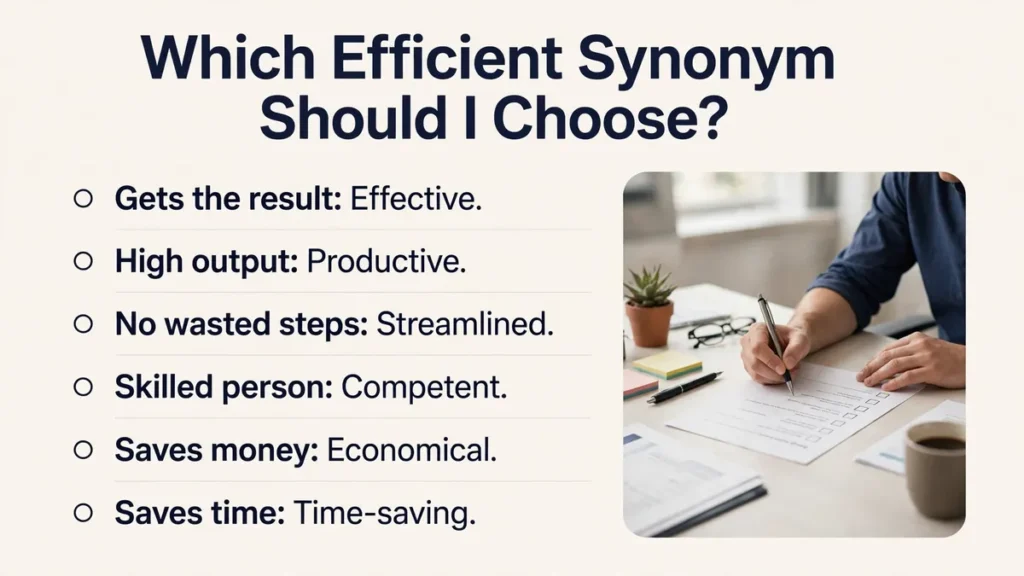
| Situation | Best pick | Why it wins |
|---|---|---|
| A method that works | Effective | Claims success, plainly |
| High output | Productive | Stresses useful volume |
| Wasted steps removed | Streamlined | Names the simpler process |
| A skilled worker | Competent | Steady, professional praise |
| Practiced skill | Proficient | Shows skill through practice |
| Saving money | Economical | Says little is spent |
| Worth its price | Cost-effective | Judges value against cost |
| Saving time | Time-saving | Names the saving directly |
| Fast action | Swift | Says speed, no delay |
| A tidy system | Organized | Order that saves time |
Antonyms of Efficient
1. Antonyms for efficient as working well
| Antonym | Meaning Difference |
|---|---|
| Inefficient | Wasting time, effort, or money |
| Wasteful | Using far more than needed |
| Unproductive | Producing little useful output |
| Ineffective | Failing to get the wanted result |
| Slow | Taking too much time |
| Clumsy | Awkward, wasting effort through poor handling |
2. Antonyms for efficient as skilled and economical
| Antonym | Meaning Difference |
|---|---|
| Incompetent | Lacking the skill to do the job |
| Incapable | Unable to do what is needed |
| Extravagant | Spending far more than needed |
| Costly | High in price, poor value |
| Laborious | Needing great effort for little gain |
| Disorganized | Lacking order, so work stalls |
Words Commonly Confused With Efficient
Effective versus efficient is the closest pair to watch. Effective means it works. Efficient means it works with little waste. A slow, costly cure can be effective. A fast, cheap cure that fails is efficient in effort but not effective. Use both only when both claims are true.
Productive versus busy is another near miss. Productive means useful output resulted. Busy only means much activity happened. A busy day with nothing finished is not productive. If output matters, say productive.
Economical versus cheap matters for money talk. Economical means good value or little waste. Cheap only means low price, and it can hint at low quality. A cheap tool that breaks fast is not economical. If value matters, say economical.
Substitution test failures: “The competent route saved an hour” fails, because routes are not skilled, so say “the streamlined route saved an hour.” “She is an economical manager” fails as praise for skill, because economical is about saving, so say “she is a competent manager.” “The busy team shipped nothing” fails as praise, because busy is not output, so say “the team was busy but unproductive.”
American vs British English
Efficient is spelled the same in American and British English, and so are effective, productive, streamlined, economical, competent, swift, capable, organized, and thrifty.
Two points matter: American English writes organized, while British English writes organised, and American center is British centre. This article uses American spelling throughout. Otherwise the whole set travels unchanged across the Atlantic.
Collocations and Idioms With Efficient
Only use combinations that native speakers actually use:
- efficient use of time: time spent without waste.
- efficient method: a method with little waste.
- efficient worker: a worker who gets much done well.
- efficient system: a system that runs smoothly.
- energy-efficient: using little energy for the result.
- fuel-efficient: using little fuel for the distance.
- cost-efficient: giving good value for money.
- time-efficient: using little time for the task.
- work efficiently: to work with little waste.
- run efficiently: to operate smoothly, as a business.
- efficiently run: managed with little waste.
- more efficient than: a comparison of waste levels.
Use work, run, or use with efficiently, and energy-efficient or fuel-efficient for machines and homes.
Practice Exercises
Exercise 1: Rewrite for precision.
Replace efficient with a sharper word. Each sentence gives a hint.
- “We need a more efficient checkout.” (Hint: wasted steps.)
- “She is an efficient engineer.” (Hint: skill.)
- “This heater is efficient.” (Hint: money and fuel.)
- “The team had an efficient morning.” (Hint: output.)
Exercise 2: Choose the better sentence.
Pick A or B, and say why.
- A: “The streamlined form takes two minutes.” B: “The competent form takes two minutes.”
- A: “He is an economical surgeon.” B: “He is a competent surgeon.”
- A: “A cheap printer is always economical.” B: “A cheap printer is not always economical.”
Exercise 3: Spot the wrong word.
Each sentence has one word that does not fit. Name it and fix it.
- “The busy factory shipped nothing all week.” (Hint: output is the test.)
- “The economical route saved an hour, not a dollar.” (Hint: time, not money.)
- “Her thrifty machine uses little fuel.” (Hint: machines are not thrifty.)
Answer key
- Exercise 1: (1) streamlined; (2) competent; (3) economical or energy-efficient; (4) productive.
- Exercise 2: (1) A, forms are processes, not skilled people; (2) B, surgeons need skill, not saving; (3) B, cheap is price, economical is value.
- Exercise 3: (1) busy, use unproductive; (2) economical, use time-saving or swift; (3) thrifty, use economical or fuel-efficient.
Frequently Asked Questions
What is the best synonym for efficient?
Effective is the closest synonym, because it covers the common sense of something working well. Use it when success is the point. When low waste is the point, choose streamlined for a process, economical for money, or time-saving for time, because each names the saving directly.
What is the difference between efficient and effective?
Effective means it works and gets the wanted result. Efficient means it works with little waste of time, effort, or money. A slow, costly cure can be effective. A fast, cheap method that fails is not effective. Use both words only when both claims are true.
Can efficient describe a person?
Yes, when the person works well with little waste. An efficient manager finishes work on time and without fuss. For pure skill, competent or proficient is sharper, and for output, productive is sharper. Match the word to waste, skill, or output in the sentence.
Is productive a good synonym for efficient?
Productive works when output is the point, such as a productive morning or a productive worker. It fails when the point is saving money or simplifying a process. A productive factory can still waste money. For saving, use economical; for simpler steps, use streamlined.
What is the difference between economical and cheap?
Economical means good value or little waste, while cheap only means low price. A cheap tool that breaks fast costs more in the end, so it is not economical. Use economical when value matters, and cheap only when price alone matters, with no value claim.
Which synonym should students use in essays?
In essays, prefer effective, productive, or competent, because all three sound precise and academic. Reserve lean for business writing, cost-effective for value arguments, and proficient for practiced skill. Match the word to the sense: results take effective, output takes productive, skill takes competent.
Conclusion
The right replacement for efficient depends on what you are really praising. Results call for effective, output calls for productive, a simpler process calls for streamlined, skill calls for competent or proficient, money calls for economical or cost-effective, and time calls for time-saving or swift. Name the praise, and the word follows. Repeating efficient says none of that, so pick the word that proves it.
One last check before you use a new word: read the sentence aloud with the replacement in place. If the sentence still claims exactly what you meant, keep it. If it now claims speed when you meant saving, or skill when you meant output, swap again. That ten-second test catches most wrong swaps, and it keeps every synonym in this guide honest.

About Sajjad Ahmed
Sajjad Ahmed is the author behind Guest Paster, where he writes about English vocabulary, synonyms, word meanings, and practical word usage.
His content is designed to help readers understand the differences between similar words, discover suitable alternatives, and use English vocabulary more effectively in everyday writing and communication.
Before publishing, Sajjad focuses on presenting word choices in a clear and easy-to-understand format, with relevant meanings, context, and examples where helpful.
Through Guest Paster, his goal is to make vocabulary learning simpler and provide useful language resources for students, writers, English learners, and anyone looking to expand their vocabulary.
Areas of Focus: English Vocabulary • Synonyms • Word Meanings • Word Usage • Language Learning
Author: Sajjad Ahmed
Website: Guest Paster