Most people reach for abruptly when they mean suddenly and the swap usually passes unnoticed. The two words share a clock, yet they do not share a temper. Suddenly is about time and warning: something happened sooner than expected.
Abruptly adds a broken edge, a stop that feels unfinished, a sentence cut off mid-thought or an answer that lands like a slammed door. She left suddenly tells you the timing. She left abruptly tells you the timing and the mood.
This guide gives you 15 abruptly synonyms, sorted by time, haste and manner, with meanings, examples and honest limits so your next sentence carries the exact kind of sudden you mean.
Abruptly Synonyms at a Glance
| # | Synonym | Meaning Difference |
|---|---|---|
| 1 | Suddenly | Sudden in time, no warning given |
| 2 | All at once | All at the same moment |
| 3 | Unexpectedly | Against what was expected |
| 4 | Without warning | No notice at all |
| 5 | Curtly | Short and clipped in speech |
| 6 | Bluntly | Direct, with no softening |
| 7 | Brusquely | Short, sharp, and rather rude |
| 8 | Precipitously | Steeply and very suddenly |
| 9 | Hastily | In a rush, with too little care |
| 10 | Unceremoniously | No ceremony or farewell |
Quick Facts About “Abruptly”
- Part of speech: an adverb. The adjective is abrupt, and the noun is abruptness.
- Core meaning: in a sudden way, with no warning, or short and blunt in manner.
- Three main senses: (1) sudden in time, a stop or change with no warning; (2) hasty, done in a rush without enough preparation; (3) blunt in manner, short and rather rude.
- Register: neutral to formal, fitting news reports, novels, essays, and everyday speech.
- Common mistake: using abruptly for any surprise. A surprise party is sudden, not abrupt, unless someone ends it mid-song.
Where “Abruptly” Comes From (Etymology)
According to Etymonline, abrupt entered English in the 1580s meaning sudden and unceremonious, without notice. It was a figurative use of Latin abruptus, broken off, also precipitous or steep, the past participle of abrumpere, to break off, from ab, off or away from, plus rumpere, to break, from a nasalized form of the PIE root *runp-, to snatch. The literal sense, broken off, dates from around 1600. Of writing, having sudden transitions, it dates from the 1630s. Abruptly is the adverb, and abruptness the noun. Merriam-Webster defines abruptly as happening suddenly or unexpectedly, and as speaking curtly or bluntly.
The root still shows: something abrupt feels broken off, not finished, like a rope snapped instead of untied. That image explains all three senses, a stop with no warning, a decision made before the thinking finished, and a reply cut short before politeness could soften it.
The Closest Synonym: Suddenly
Suddenly is the closest synonym for abruptly, because it covers the core sense in the plainest form: something happened with no warning. The swap holds in most time sentences. “The music stopped abruptly” becomes “The music stopped suddenly” with no loss. “She left abruptly” becomes “She left suddenly,” and the timing survives.
Suddenly wins on range: it works for events, weather, news, and feelings, while abruptly adds a broken edge that suddenly never carries. “He answered suddenly” sounds odd: answering is a manner, not an event in time. For that sentence, curtly or bluntly is the honest pick.
Abruptly Synonyms in Detail
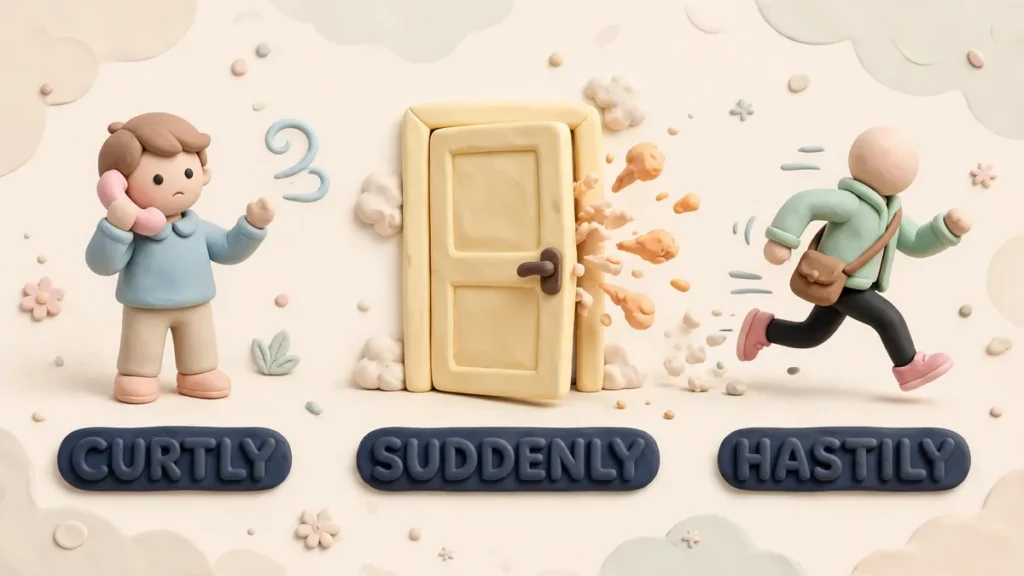
Group 1: Sudden in Time
1. Suddenly
- Meaning: Happening quickly and without warning.
- Difference: The neutral time word.
- Best used for: Events, changes, and stops.
- Formality: Neutral · CEFR: B1 · Frequency: Very common
- Example (Lights): “The lights went out suddenly.”
- Example (Memory): “She suddenly remembered the missed appointment.”
- When NOT to use it: For a rude reply, use curtly.
2. All at Once
- Meaning: Everything happening at the same moment.
- Difference: Stresses the pile-up, not the speed.
- Best used for: Crowds, sounds, and memories.
- Formality: Neutral · CEFR: B2 · Frequency: Very common
- Example (Silence): “All at once, the room fell silent.”
- Example (Memories): “The memories came back all at once.”
- When NOT to use it: For one single action, use suddenly.
3. Unexpectedly
- Meaning: In a way nobody expected.
- Difference: Points at surprise, not speed.
- Best used for: News, results, and visits.
- Formality: Neutral · CEFR: B2 · Frequency: Very common
- Example (Visit): “He arrived unexpectedly, two days early.”
- Example (Results): “The test results came back unexpectedly good.”
- When NOT to use it: For a planned stop, use deliberately.
4. Without Warning
- Meaning: With no notice at all.
- Difference: Names the warning that never came.
- Best used for: Endings and departures.
- Formality: Neutral · CEFR: B2 · Frequency: Common
- Example (Closure): “The factory closed without warning on a Friday.”
- Example (Departure): “She left without warning.”
- When NOT to use it: In a short headline, use suddenly.
5. Sharply
- Meaning: In a sudden and marked way.
- Difference: Adds a hard edge to the change.
- Best used for: Turns, falls, and prices.
- Formality: Neutral · CEFR: B2 · Frequency: Very common
- Example (Turn): “The car turned sharply to the left.”
- Example (Prices): “Prices fell sharply after the news.”
- When NOT to use it: For a rude answer, use curtly.
6. Precipitously
- Meaning: Very suddenly and steeply.
- Difference: The steepness is the point.
- Best used for: Falls and fast decisions.
- Formality: Formal · CEFR: C1 · Frequency: Less common
- Example (Stocks): “Stocks fell precipitously in one afternoon.”
- Example (Resignation): “He resigned precipitously.”
- When NOT to use it: In plain writing, use suddenly.
Group 2: Hasty and Ill-Prepared
7. Hastily
- Meaning: Done in a rush, with too little care.
- Difference: The rush causes the roughness.
- Best used for: Decisions and departures.
- Formality: Neutral · CEFR: B2 · Frequency: Common
- Example (Packing): “She hastily packed a bag and left.”
- Example (Apology): “He hastily apologized.”
- When NOT to use it: For a stop with no warning, use suddenly.
8. Rashly
- Meaning: Done without thinking about the risks.
- Difference: The judgment fails, not just the timing.
- Best used for: Promises and bets.
- Formality: Neutral to formal · CEFR: C1 · Frequency: Less common
- Example (Promise): “He rashly promised money he lacked.”
- Example (Job): “She rashly quit on Monday.”
- When NOT to use it: For a neutral sudden stop, use abruptly itself.
9. Impetuously
- Meaning: Done on impulse, without thinking.
- Difference: Feeling drives the act, not a plan.
- Best used for: Decisions and outbursts.
- Formality: Formal, literary · CEFR: C2 · Frequency: Less common
- Example (Proposal): “He impetuously proposed on their third date.”
- Example (Travel): “She impetuously booked a flight.”
- When NOT to use it: In plain speech, use hastily.
Group 3: Blunt in Manner
10. Curtly
- Meaning: Short and clipped in speech.
- Difference: Few words, coldly delivered.
- Best used for: Replies and refusals.
- Formality: Neutral · CEFR: C1 · Frequency: Common
- Example (Reply): “He answered curtly and turned away.”
- Example (Refusal): “She curtly declined the offer.”
- When NOT to use it: For a sudden event, use suddenly.
11. Bluntly
- Meaning: Directly, with no softening.
- Difference: Honest and plain.
- Best used for: Truths and feedback.
- Formality: Neutral · CEFR: B2 · Frequency: Common
- Example (Truth): “She told him bluntly that the plan would fail.”
- Example (Answer): “He answered bluntly, with no apology.”
- When NOT to use it: For a rude snap, use brusquely.
12. Brusquely
- Meaning: Short, sharp, and rather rude.
- Difference: The rudeness is the point.
- Best used for: Dismissals and orders.
- Formality: Neutral to formal · CEFR: C1 · Frequency: Less common
- Example (Dismissal): “The manager brusquely waved him away.”
- Example (Meeting): “She brusquely ended the meeting.”
- When NOT to use it: For honest directness, use bluntly.
13. Peremptorily
- Meaning: In a way that expects instant obedience.
- Difference: Authority speaks.
- Best used for: Orders and refusals.
- Formality: Formal · CEFR: C2 · Frequency: Rare
- Example (Order): “He peremptorily ordered the room cleared.”
- Example (Refusal): “She peremptorily refused to discuss it.”
- When NOT to use it: In everyday writing, use curtly or bluntly.
14. Unceremoniously
- Meaning: With no ceremony or farewell.
- Difference: The missing goodbye is the whole point.
- Best used for: Departures and dismissals.
- Formality: Neutral to formal · CEFR: C1 · Frequency: Less common
- Example (Removal): “He was shown out unceremoniously after the vote.”
- Example (Ending): “The show ended unceremoniously, with no encore.”
- When NOT to use it: For a quick stop, use suddenly.
15. Offhandedly
- Meaning: Casually, as if the matter were small.
- Difference: The shrug is the point, not the speed.
- Best used for: Remarks and dismissals.
- Formality: Neutral · CEFR: C1 · Frequency: Less common
- Example (Remark): “He mentioned offhandedly that he was leaving.”
- Example (Complaint): “She offhandedly dismissed the complaint.”
- When NOT to use it: For a sharp rude reply, use brusquely.
Words Commonly Confused With Abruptly
Abruptly versus suddenly matters for the edge. Suddenly names the timing, while abruptly names the timing plus a broken or rude edge. A storm can arrive suddenly, yet it cannot arrive abruptly: a storm has no manners and nothing to break off. A conversation can end either way: the choice tells the reader whether it stopped early or stopped badly.
Abruptly versus harshly matters for the target. Harshly describes treatment that hurts, in words, weather, or punishment. Abruptly describes a stop that is short and broken off. A harsh reply wounds by content, an abrupt reply by brevity. Our guide to harsh synonyms covers severity and cruelty, a different scale from suddenness.
Abruptly versus sharply matters for the sense. Sharply suits a marked change in direction, amount, or tone, like a sharp turn or a fall in prices. Abruptly suits a stop or an ending. A road turns sharply and a meeting ends abruptly, and swapping the two blurs the picture.
Abruptly versus immediately matters for the delay. Immediately means with no delay at all, and says nothing about rudeness or surprise. Abruptly means with a broken-off feel. A nurse can respond immediately and kindly, yet nobody responds abruptly and kindly.
Abruptly versus rudely matters for the judgment. Rudely is a verdict on behaviour, while abruptly describes how something happened. An abrupt answer often feels rude, yet the two differ: a surgeon can end a call abruptly to save a life, and nobody would call that rude.
Abrupt versus abruptly matters for grammar. Abrupt is the adjective, as in an abrupt end. Abruptly is the adverb, as in the meeting ended abruptly. Write “an abrupt departure” for the event and “she departed abruptly” for the act.
Substitution test failures:
“The song ended curtly” fails, because a song has no speech. “He answered precipitously” fails, because answering is not a steep fall. “She left peremptorily” fails, because leaving is not an order. “The car stopped hastily” fails, because a car cannot hurry. “The rain began brusquely” fails, because weather has no manners.
Can You Swap Them Freely?
In short: only inside the same meaning group, when the sense matches.
- ✅ “The music stopped suddenly.” (a stop with no warning ✔)
- ✅ “The music stopped abruptly.” (same sense, with a broken edge ✔)
- ✅ “He answered curtly, and turned away.” (short and cold in speech ✔)
- ❌ “He answered suddenly, and turned away.” (suddenly cannot carry a tone ✘, say curtly)
- ✅ “She hastily packed a bag and left.” (a hurried actor ✔)
- ❌ “The car stopped hastily.” (a car cannot hurry ✘, say abruptly)
- ✅ “The factory closed without warning.” (no notice given ✔)
- ❌ “The factory closed unceremoniously.” (a factory closing needs no farewell ✘, say without warning)
- ✅ “He was shown out unceremoniously.” (no farewell, no ritual ✔)
A machine that starts and stops in bursts is not abrupt, it is stop-start: our guide to intermittent synonyms covers that on-off rhythm. Before you substitute, ask whether you mean the time, the rush, or the manner.
Best Alternatives by Context
A novelist ends a chapter mid-sentence. The heroine reaches for the phone, and the line goes dead. Here abruptly is the honest word, because the scene is a break, not a schedule. Suddenly would name the timing and lose the broken edge.
A news report covers a factory closure. Workers learned of it on a Friday morning, with no meeting or letter. Here without warning is accurate, because the story is the missing notice. Unceremoniously would be wrong, since a factory owes no farewell ritual.
A manager dismisses a visitor in two words. The visitor came with a complaint, and the manager waved him away. Here brusquely fits best, because the rudeness is the point. Bluntly would soften it into honesty, and that is not what happened.
A friend tells a hard truth kindly. She says the plan will fail, plainly, with time to explain. Here bluntly is right, because the directness is honest rather than rude. Brusquely would accuse her of a coldness she never showed.
A student quits a job on impulse. She walks out at lunch, with no plan and no savings. Here rashly names the risk she ignored, while hastily would only name the rush. Impetuously fits too, when the feeling drove the act.
A letter ends with no closing line. The writer simply stops, mid-thought, and signs nothing. Here unceremoniously is exact, because the missing farewell is the whole story. Suddenly would say nothing about the ritual that never came.
A guest mentions a move in passing. He drops it into conversation as if it were small news. Here offhandedly fits, because the shrug is the point. Curtly would wrongly suggest he snapped at someone.
Collocations and Idioms With Abruptly
Only combinations native speakers actually use:
- stop abruptly: as in “The train stopped abruptly between stations.”
- end abruptly: as in “The call ended abruptly, mid-sentence.”
- leave abruptly: as in “She left abruptly, without saying goodbye.”
- come to an abrupt end: as in “The holiday came to an abrupt end.”
- an abrupt change: as in “An abrupt change in the weather caught us out.”
- break off abruptly: as in “The speech broke off abruptly when the power failed.”
- cut short: as in “The interview was cut short by the fire alarm.”
- cut someone off: as in “He cut her off mid-sentence.”
Which Abruptly Synonym Should I Choose?

| Situation | Best pick | Why it wins |
|---|---|---|
| A stop with no warning | Suddenly | The plain time word |
| Everything at the same moment | All at once | The pile-up |
| A surprise nobody expected | Unexpectedly | The surprise |
| No notice given at all | Without warning | The missing notice |
| A steep fall or drop | Precipitously | The steepness |
| A rushed, careless act | Hastily | The rush |
| A risky decision, unthought | Rashly | The ignored risk |
| A short, cold reply | Curtly | The clipped speech |
| Honest directness, no softening | Bluntly | The plain truth |
| A rude dismissal | Brusquely | The rudeness |
| A departure with no goodbye | Unceremoniously | The missing farewell |
| A casual shrug of a remark | Offhandedly | The shrug |
Opposites of Abruptly, Sense by Sense
Abruptly has no single opposite: its three senses pull in different directions. Pick the opposite that matches the sense you used.
1: Sudden in time
| Abruptly sense | Opposite | What changes |
|---|---|---|
| Stopping suddenly | Gradually | The stop slows into stages |
| Ending with no warning | With advance notice | Warning comes first |
| Changing all at once | Step by step | The change takes its time |
2: Hasty and ill-prepared
| Abruptly sense | Opposite | What changes |
|---|---|---|
| Acting hastily | Deliberately | Thought comes before the act |
| Deciding rashly | Cautiously | The risks get weighed |
| Leaving in a rush | At leisure | Time stops pressing |
3: Blunt in manner
| Abruptly sense | Opposite | What changes |
|---|---|---|
| Answering curtly | Politely | Warmth returns |
| Speaking brusquely | Graciously | The tone turns kind |
| Refusing peremptorily | Tactfully | The refusal softens |
Gradually is the everyday opposite for time, deliberately for haste, and politely for manner. Slowly suits a pace, while gradually suits a process, so the two are not interchangeable.
American vs British English
Abruptly is spelled and used the same in American and British English, as are its synonyms here. The verb inside can shift, as in travelling with two ls in British spelling against traveling with one l in American spelling, yet abruptly never changes.
Avoid “short” for a person on both sides of the Atlantic: it means something else entirely, so keep it for replies and tempers. This article uses American spelling throughout.
Practice Exercises
Exercise 1: Sort into two groups. Place each sentence in Group A (time sense: sudden, no warning) or Group B (manner sense: short, blunt, or rude in speech). Give the group letter and the best synonym.
- “The lights went out and the hall fell silent.”
- “He waved the visitor away with two cold words.”
- “The factory closed on a Friday, with no letter.”
- “She declined the offer in a few clipped words.”
- “The music stopped in the middle of the song.”
- “He told her the plan would fail, plainly and without apology.”
- “The train halted between stations with a jolt.”
- “The manager refused to discuss it, expecting instant obedience.”
Exercise 2: True or false? Mark each statement true or false, and correct the false ones.
- “Suddenly and abruptly mean exactly the same thing in every sentence.”
- “A storm can arrive abruptly.”
- “Curtly describes a way of speaking, not a way of stopping.”
- “Unceremoniously means a departure with no farewell or ceremony.”
- “Hastily describes a hurried actor, so a car cannot stop hastily.”
Answer key
- Exercise 1: (1) A, suddenly: a stop with no warning; (2) B, brusquely: a rude dismissal; (3) A, without warning: no notice given; (4) B, curtly: a short, clipped refusal; (5) A, abruptly: a broken-off ending; (6) B, bluntly: honest directness; (7) A, abruptly: a sudden halt; (8) B, peremptorily: expecting obedience.
- Exercise 2: (1) False: abruptly adds a broken edge that suddenly lacks; (2) False: a storm has no manners, so say suddenly; (3) True; (4) True; (5) True.
Frequently Asked Questions
What is the best synonym for abruptly?
Suddenly is the best synonym for abruptly in most sentences, because it covers the core sense of happening with no warning. For a short, cold reply, curtly fits better; for honest directness, bluntly wins. Pick the synonym that matches your sense: time, haste, or manner.
What is the difference between abruptly and suddenly?
Suddenly names the timing: something happened sooner than expected. Abruptly adds a broken edge to that timing, a stop that feels unfinished or a reply that lands cold. A storm arrives suddenly, a conversation ends abruptly, and the choice tells the reader which kind of sudden you mean.
Can abruptly describe a person, or only an action?
Abruptly describes an action, never a person directly. You can write that someone spoke abruptly, left abruptly, or ended a call abruptly, but not call a person abrupt the same way. For a person, use abrupt as an adjective, as in an abrupt manager, or pick a manner word like curt or brusque.
Is abruptly always rude?
No, abruptly is not always rude, though it often sounds that way. A train can stop abruptly, a meeting can end abruptly, and a song can break off abruptly, with no rudeness. The rude sense appears only in speech and manner, where a short, clipped reply feels cold to the listener.
What is the opposite of abruptly?
It depends on the sense you used. For a sudden stop, the opposite is gradually, as in a gradual ending with fair warning. For a hasty act, use deliberately, and for a blunt reply, use politely. There is no single opposite: abruptly covers time, haste, and manner in one word.
Can abruptly be used in formal writing?
Yes, abruptly works well in formal writing, in news reports, essays, and history. It suits sudden changes, broken-off talks, and steep falls, and its Latin roots give it a formal feel. In casual writing, suddenly or all at once often reads more naturally, so match the word to your register.
Conclusion
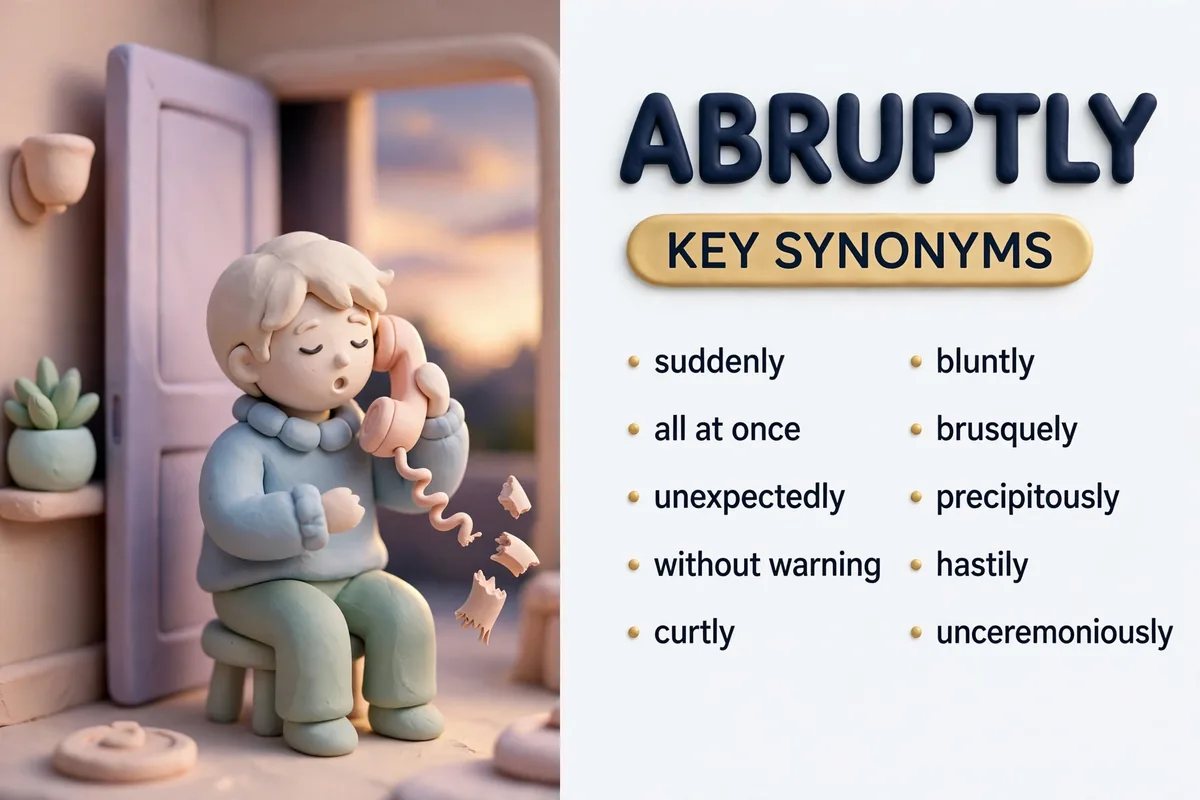
Picture a door left half open, a phone cord snapped in two, and a sentence that never reached its end. That is the world abruptly lives in.
Reach for suddenly when only timing matters, curtly when words turn cold, and hastily when the rush caused the mess. The right synonym does more than fill a gap: it tells the reader exactly how the stop felt.

About Sajjad Ahmed
Sajjad Ahmed is the author behind Guest Paster, where he writes about English vocabulary, synonyms, word meanings, and practical word usage.
His content is designed to help readers understand the differences between similar words, discover suitable alternatives, and use English vocabulary more effectively in everyday writing and communication.
Before publishing, Sajjad focuses on presenting word choices in a clear and easy-to-understand format, with relevant meanings, context, and examples where helpful.
Through Guest Paster, his goal is to make vocabulary learning simpler and provide useful language resources for students, writers, English learners, and anyone looking to expand their vocabulary.
Areas of Focus: English Vocabulary • Synonyms • Word Meanings • Word Usage • Language Learning
Author: Sajjad Ahmed
Website: Guest Paster