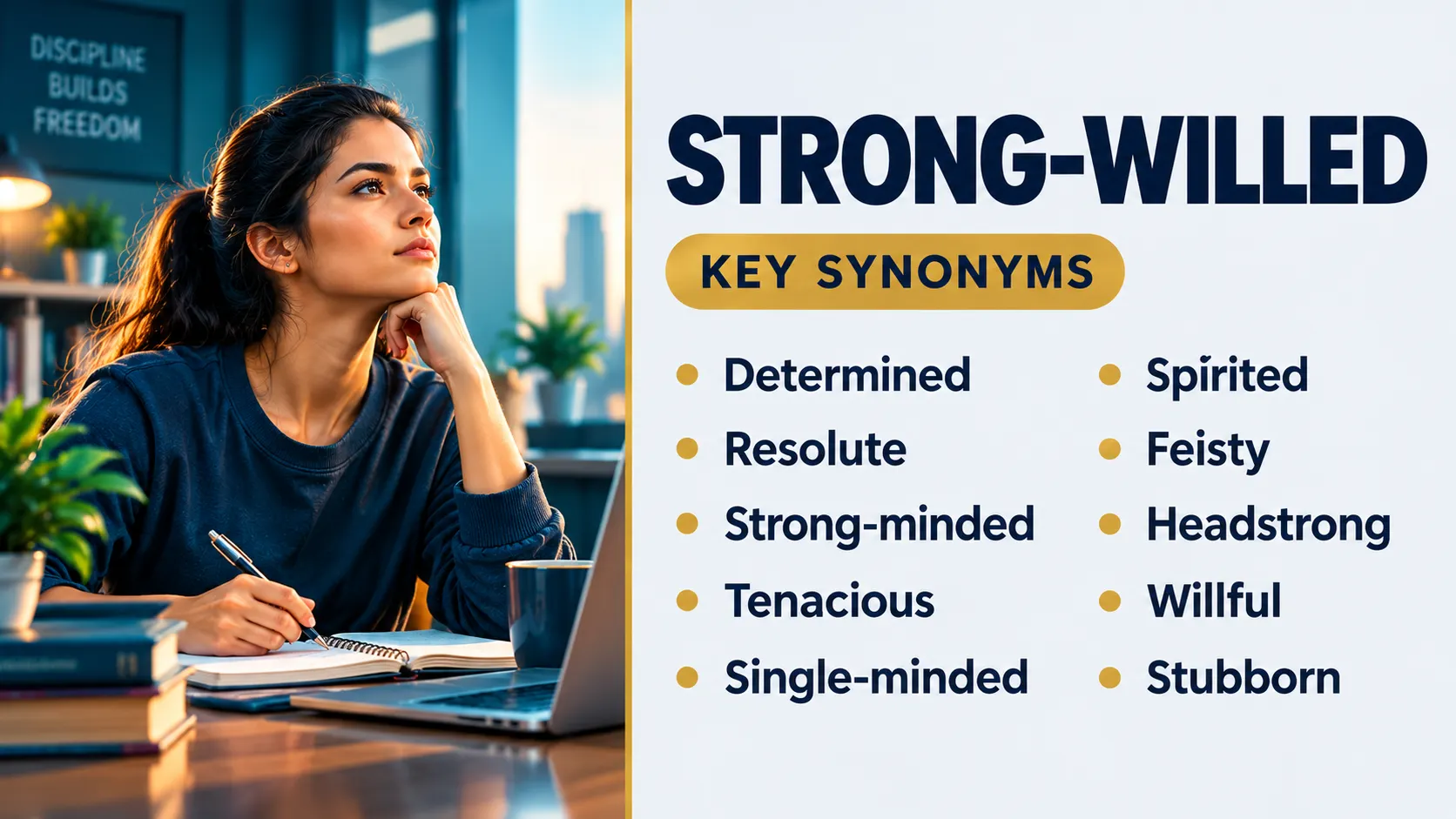
Strong-willed is an adjective that describes someone who has made a firm decision to pursue their own path, regardless of objections from others. In the most cases of positivity or daily life, determined is the safest and the closest change for a child or someone resistant to instructions, headstrong or willful are better alternatives although both contain negative connotations.
Alternatives matter because strong-willed can sound either admiring or like a polite complaint, based upon who is saying it. Choose by asking whether the persistence is admirable, neutral or a problem: resolute or tenacious for praise, strong-minded for opinions, stubborn or obstinate when the resistance is the issue.
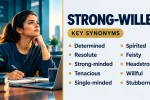
Top 10 at a Glance
| # | Synonym | Meaning Difference |
| 1 | Determined | Neutral or positive; focused on a goal |
| 2 | Resolute | Firmer, formal; admirable under pressure |
| 3 | Strong-minded | Independent opinions; less about stamina |
| 4 | Tenacious | Refuses to let go of a goal |
| 5 | Single-minded | One goal above everything else |
| 6 | Spirited | Energetic and bold; gentle tone |
| 7 | Feisty | Ready to argue; informal, playful |
| 8 | Headstrong | Ignores advice; mildly negative |
| 9 | Willful | Insists on own way; often disapproving |
| 10 | Stubborn | Refuses to change; usually critical |
Quick Facts About Strong-Willed
- Part of speech: Adjective (compound; hyphenated before and after a noun in standard usage)
- Simple meaning: Very determined to act on your own decisions, even against objections
- Pronunciation: UK: /ˌstrɒŋ ˈwɪld/ US: /ˌstrɔːŋ ˈwɪld/
- Syllables: 2 (strong-willed)
- Word forms: strong-willedness (noun, uncommon); the unhyphenated “strong willed” is a common search spelling
- Formality: Neutral
- Closest synonym: Determined
- Best used for: People, children, and personalities that hold their ground
What Is the Closest Synonym for Strong-Willed?
Determined is the closest synonym. It means having made a firm decision and refusing to be turned aside from it. Merriam-Webster’s own definition of strong-willed centers on that same idea: being very determined to do something despite what others say.
Like strong-willed, determined is neutral to positive and works for adults, children, athletes, and characters alike. The main difference is focus: determined usually points at a goal, while strong-willed describes a lasting trait. Choose determined whenever you want a firm will without hinting that the person is difficult to manage. The near runner-up is strong-minded, covered below.
Word Origin and Etymology
Strong-willed is a plain English compound of strong and willed. The key element is will, which Etymonline traces to Old English willa (“mind, determination, desire, wish”), from a Germanic root meaning to wish or choose. Merriam-Webster dates willed itself to the 14th century and self-willed to the 15th. Its entry for the parallel compound strong-minded gives 1788.
A reliable first-use date for strong-willed itself is not cited here because the dictionaries consulted do not give one; what is clear is that the pattern “strong + will” has been part of ordinary English for a long time. The meaning has stayed stable: a strong will, valued in some settings and resisted in others.
Can These Synonyms Be Used Interchangeably?
Rarely without a shift in tone. The deciding factor is whether the word praises, describes, or criticizes. Someone who is independent and strong-willed may be called resolute by an admirer and stubborn by an opponent, and both can be accurate.
| Level | Words | Tone |
| Usually | determined, resolute, strong-minded, single-minded | Neutral to positive |
| Sometimes | tenacious, steadfast, dogged, iron-willed, indomitable, spirited, feisty | Positive; depends on trait |
| Rarely | headstrong, willful, self-willed, stubborn, obstinate | Mildly to clearly critical |
| Rarely | pigheaded, unyielding, uncompromising, intransigent | Harsh or rigid |
| No | assertive, confident, defiant, bossy | Different meaning |
Detailed Synonym Meanings and Examples
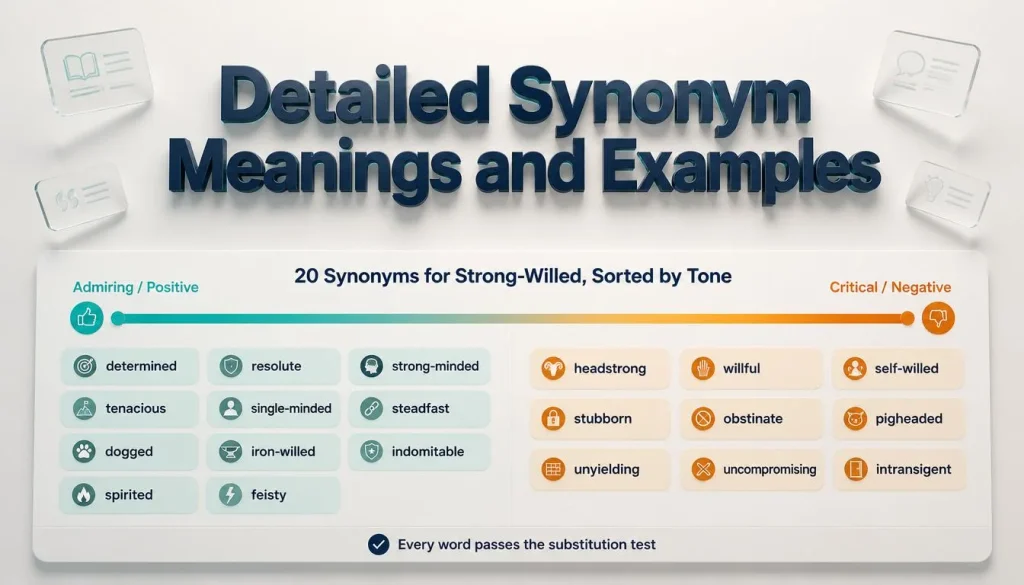
Every word below passes one test: it can replace “strong-willed” in at least one real sentence without changing the core meaning. CEFR levels are approximate teaching estimates, not official ratings.
1. Determined
Meaning: The closest synonym, defined in full in the closest-synonym section above.
Difference from Strong-Willed: Focuses on a specific aim rather than a lasting personality trait.
Best Used For: Everyday praise, sports, school, work. Replaces strong-willed in “a determined young woman.”
Formality: Neutral
CEFR Level: B1
Frequency: Very Common
Examples:
- Even after her third failed driving test, Amara stayed determined to pass. (everyday)
- The volunteer coordinator was determined, and the shelter reopened within a month. (community work)
When NOT to Use It: Skip it when you want to hint that the person is hard to persuade or manage.
2. Resolute
Meaning: Admirably firm in purpose, especially when facing difficulty or opposition.
Difference from Strong-Willed: More serious and admiring, with no hint of difficulty.
Best Used For: Leadership, journalism, formal writing. Replaces strong-willed in “a resolute leader.”
Formality: Formal
CEFR Level: C1
Frequency: Common
Examples:
- The mayor remained resolute despite weeks of protests outside city hall. (politics)
- Her resolute refusal to cut safety checks saved the company from a costly recall. (business)
When NOT to Use It: Avoid it for a toddler’s tantrum, where it sounds oddly grand.
3. Strong-Minded
Meaning: Marked by independence of thought and judgment, with firm views of one’s own.
Difference from Strong-Willed: Points to thinking for oneself rather than pure willpower.
Best Used For: Opinionated, independent thinkers. Replaces strong-willed in “a strong-minded woman.”
Formality: Neutral
CEFR Level: C1
Frequency: Uncommon
Examples:
- My strong-minded aunt ignored every trend and dressed exactly as she pleased. (family)
- The editor was strong-minded enough to reject a story her own publisher liked. (publishing)
When NOT to Use It: Skip it when the point is stamina or persistence rather than independent opinions.
4. Tenacious
Meaning: Holding on to a goal or position and refusing to give it up.
Difference from Strong-Willed: Stresses staying power through a long struggle.
Best Used For: Careers, sports, negotiation, investigation. Replaces strong-willed in “a tenacious reporter.”
Formality: Neutral to formal
CEFR Level: C2
Frequency: Common
Examples:
- A tenacious defense attorney, she appealed the ruling three separate times. (legal)
- The tenacious little striker kept chasing the ball long after the defenders gave up. (sports)
When NOT to Use It: It sounds odd for someone who is opinionated but not persistent.
5. Single-Minded
Meaning: Devoted to one purpose to the exclusion of other concerns.
Difference from Strong-Willed: Narrower; it describes focus on one aim, not general force of character.
Best Used For: Ambition, training, startup culture. Replaces strong-willed in “a single-minded founder.”
Formality: Neutral
CEFR Level: C1
Frequency: Common
Examples:
- With single-minded focus, he rebuilt the engine in his garage every evening for a year. (hobby)
- A single-minded student, she skipped every party before the bar exam. (education)
When NOT to Use It: Skip it when the person holds firm views across many areas of life.
6. Steadfast
Meaning: Firmly loyal to a belief, duty, or course of action.
Difference from Strong-Willed: Emphasizes loyalty and constancy rather than willpower.
Best Used For: Beliefs, friendships, principles. Replaces strong-willed in “steadfast in her convictions.”
Formality: Formal
CEFR Level: C2
Frequency: Common
Examples:
- The nurse stayed steadfast in her insistence on proper hand hygiene. (healthcare)
- He remained steadfast in his support for the project long after others had left. (workplace)
When NOT to Use It: It doesn’t suit a spirited child; it sounds too solemn.
7. Dogged
Meaning: Persisting stubbornly despite obstacles or discouragement.
Difference from Strong-Willed: Gritty and plodding; it describes effort more than character.
Best Used For: Investigations, long projects, sport. Replaces strong-willed in “a dogged reporter.”
Formality: Neutral
CEFR Level: C2
Frequency: Uncommon
Examples:
- Dogged police work finally linked the cold case to a decades-old fingerprint. (crime reporting)
- His dogged follow-ups eventually wore down the client’s purchasing team. (sales)
When NOT to Use It: Skip it when the person is firm in opinion but not especially persistent.
8. Iron-Willed
Meaning: Possessing an exceptionally strong, unbreakable will.
Difference from Strong-Willed: An intensifier; it takes the same idea to an extreme.
Best Used For: Profiles, biography, emphatic praise. Replaces strong-willed in “an iron-willed coach.”
Formality: Neutral
CEFR Level: C2
Frequency: Uncommon
Examples:
- The iron-willed coach rebuilt the program from nothing in three seasons. (sports feature)
- An iron-willed negotiator, she never left the table without a concession. (business profile)
When NOT to Use It: It sounds exaggerated for ordinary, everyday stubbornness.
9. Indomitable
Meaning: Impossible to subdue, defeat, or discourage.
Difference from Strong-Willed: Heroic and literary; it needs real odds to work against.
Best Used For: Tributes, memoir, survival stories. Replaces strong-willed in “an indomitable spirit.”
Formality: Formal
CEFR Level: C2
Frequency: Uncommon
Examples:
- Her indomitable spirit carried the village through the flood. (journalism)
- The memoir follows an indomitable woman from a wartime childhood to parliament. (book review)
When NOT to Use It: It’s too grand for small, everyday stubbornness.
10. Spirited
Meaning: Full of energy, courage, and independence of character.
Difference from Strong-Willed: Lighter and warmer; it suggests liveliness more than resistance.
Best Used For: Gently describing children and lively personalities. Replaces strong-willed in “a spirited child.”
Formality: Neutral
CEFR Level: B2
Frequency: Common
Examples:
- Her spirited daughter negotiated bedtime like a tiny diplomat. (parenting)
- The spirited debate team never backed down from a tough motion. (school)
When NOT to Use It: Avoid it when you must be precise about resistance to rules.
11. Feisty
Meaning: Bold, lively, and quick to stand up for oneself.
Difference from Strong-Willed: More playful and combative; it implies readiness to argue.
Best Used For: Casual speech and affectionate description. Replaces strong-willed in “a feisty grandmother.”
Formality: Informal
CEFR Level: C1
Frequency: Common
Examples:
- The feisty shop owner told the inspector exactly what she thought of his schedule. (retail)
- My feisty little sister has never backed down from an argument, however big the opponent. (family)
When NOT to Use It: Skip it in formal reports or reference letters, where it can sound patronizing.
12. Headstrong
Meaning: Determined to do what you want, ignoring advice or warnings.
Difference from Strong-Willed: Adds recklessness and an impatience with advice.
Best Used For: Children, teenagers, impulsive choices. Replaces strong-willed in “a headstrong teenager.”
Formality: Neutral
CEFR Level: C1
Frequency: Uncommon
Examples:
- Headstrong at sixteen, he quit school against every adult’s advice. (family)
- The headstrong heroine of the novel ignores every warning and rides out alone. (literature)
When NOT to Use It: Skip it when praising someone, because it implies poor judgment.
13. Willful
Meaning: Insisting on having your own way, often against reasonable instruction.
Difference from Strong-Willed: Usually disapproving; it focuses on defiance rather than strength of character.
Best Used For: Resistance to rules, especially in children. Replaces strong-willed in “a willful child.”
Formality: Neutral to formal
CEFR Level: C1
Frequency: Uncommon
Examples:
- The willful toddler dropped her spoon on purpose each time her father looked away. (parenting)
- A willful young princess refuses to marry the suitor chosen for her. (fiction)
When NOT to Use It: Avoid it as praise, and remember it also has a separate sense of “deliberate,” as in willful disobedience.
14. Self-Willed
Meaning: Governed by your own will and unwilling to yield to others.
Difference from Strong-Willed: Older and disapproving; it implies answering to no one.
Best Used For: Literary and historical description. Replaces strong-willed in “a self-willed toddler.”
Formality: Formal
CEFR Level: C2
Frequency: Rare
Examples:
- The novel’s self-willed heroine rejects every suitor and every convention. (literature)
- A self-willed board member stalled the merger for months. (corporate)
When NOT to Use It: It is rare enough that modern readers may pause; prefer headstrong or willful in plain prose.
15. Stubborn
Meaning: Refusing to change your mind or course, even when there are good reasons to.
Difference from Strong-Willed: Focuses on the refusal rather than the strength; usually critical.
Best Used For: Everyday complaints and fair, direct description. Replaces strong-willed in “a stubborn old man.”
Formality: Neutral
CEFR Level: B1
Frequency: Very Common
Examples:
- My stubborn brother still refuses to ask for directions. (family)
- The union called the owner stubborn for rejecting every offer without discussion. (labor relations)
When NOT to Use It: Don’t use it when the persistence is admirable, as it will read as an insult.
16. Obstinate
Meaning: Stubbornly refusing to change opinion or behavior despite argument.
Difference from Strong-Willed: More formal and harsher than stubborn; it implies unreasonable resistance.
Best Used For: Formal criticism, politics, history. Replaces strong-willed in “an obstinate refusal.”
Formality: Formal
CEFR Level: C2
Frequency: Uncommon
Examples:
- The council’s obstinate refusal to repair the bridge frustrated residents for years. (local government)
- An obstinate patient, he skipped every follow-up appointment his doctor recommended. (healthcare)
When NOT to Use It: It sounds stiff in casual speech and too severe for a child.
17. Pigheaded
Meaning: Stupidly stubborn and unwilling to listen to others.
Difference from Strong-Willed: Openly insulting; it implies foolishness as well as resistance.
Best Used For: Informal venting among friends. Replaces strong-willed in “a pigheaded boss.”
Formality: Informal
CEFR Level: C2
Frequency: Uncommon
Examples:
- My pigheaded landlord won’t admit the heater is broken. (housing)
- He was too pigheaded to turn back, even as the road flooded. (travel story)
When NOT to Use It: Never use it in professional writing or about someone you want to respect.
18. Unyielding
Meaning: Not giving way under pressure, criticism, or persuasion.
Difference from Strong-Willed: Describes the result (not bending) rather than the inner trait.
Best Used For: Rules, positions, negotiations. Replaces strong-willed in “an unyielding stance.”
Formality: Neutral to formal
CEFR Level: C2
Frequency: Uncommon
Examples:
- Her unyielding stance on deadlines made her team both anxious and punctual. (workplace)
- The unyielding grandmother in the story never apologized to anyone. (fiction)
When NOT to Use It: Avoid it for lively, friendly personalities; it can sound cold, much like harsh language does.
19. Uncompromising
Meaning: Unwilling to make concessions or lower standards.
Difference from Strong-Willed: Highlights refusal to negotiate, which can be admirable or rigid.
Best Used For: Principles, standards, bargaining. Replaces strong-willed in “an uncompromising critic.”
Formality: Formal
CEFR Level: C2
Frequency: Uncommon
Examples:
- The head chef was uncompromising about freshness, even on slow nights. (hospitality)
- An uncompromising reviewer, she refused to soften her verdict on the film. (media)
When NOT to Use It: It doesn’t fit a child; it implies deliberate refusal to negotiate.
20. Intransigent
Meaning: Refusing to change a position or reach agreement, especially in a dispute.
Difference from Strong-Willed: Formal and negative; it describes blocking compromise.
Best Used For: Politics, labor disputes, diplomacy. Replaces strong-willed in “an intransigent negotiator.”
Formality: Formal
CEFR Level: C2
Frequency: Rare
Examples:
- Talks collapsed because both delegations were intransigent on the border issue. (diplomacy)
- An intransigent shareholder blocked every proposed compromise at the meeting. (business)
When NOT to Use It: Skip it in personal or family settings, where it feels overly stiff.
Best Alternatives by Context
| Context | Best Words | Why |
| Everyday conversation | determined, strong-minded | Natural and easy to say |
| Formal and academic writing | resolute, tenacious, steadfast | Precise and respectful |
| Business communication | determined, single-minded, uncompromising | Professional; shows focus |
| Parenting | spirited, determined, headstrong | From kind to frank |
| Creative writing | iron-willed, indomitable, unyielding | Vivid and character-revealing |
| Slang and social media | feisty, pigheaded, spirited | Short, informal, punchy |
For a strong-willed woman: resolute, determined, and strong-minded read as plain respect, while feisty and headstrong can come across as patronizing or dismissive in professional settings, so reserve them for affectionate, informal use. For a strong-willed child: spirited invites understanding, while willful frames the same behavior as a problem; our guide to synonyms for empathy pairs well with this choice.
Which Synonym Should I Choose?
| Situation | Best Choice | Why |
| Praising a leader | Resolute | Admiring and formal |
| Reference letter or CV | Determined | Safe and positive |
| Describing a toddler kindly | Spirited | Warm, not critical |
| Describing a toddler frankly | Headstrong | Honest about behavior |
| Strong opinions at work | Strong-minded | Focuses on independent thinking |
| Admiring a bold woman, casually | Feisty | Warm and energetic |
| Heroic narrative | Indomitable | Dramatic, larger than life |
| Criticizing refusal to compromise | Intransigent | Formal and precise |
| Venting about a boss | Pigheaded | Informal and blunt |
Exact and Near Synonyms: Difference
True synonyms are rare because words carry more than meaning: they carry attitude, register, and the kind of person they usually describe. Strong-willed, stubborn, and resolute point at the same behavior, yet one is a neutral observation, one a complaint, and one a compliment. Scope also shifts meaning.
Single-minded narrows the idea to one goal, strong-minded widens it to a person’s thinking, and dogged adds the sense of grinding on through difficulty. Treat the list above as a spectrum from admiring to critical rather than a set of equal swaps.
Words Commonly Confused with Strong-Willed
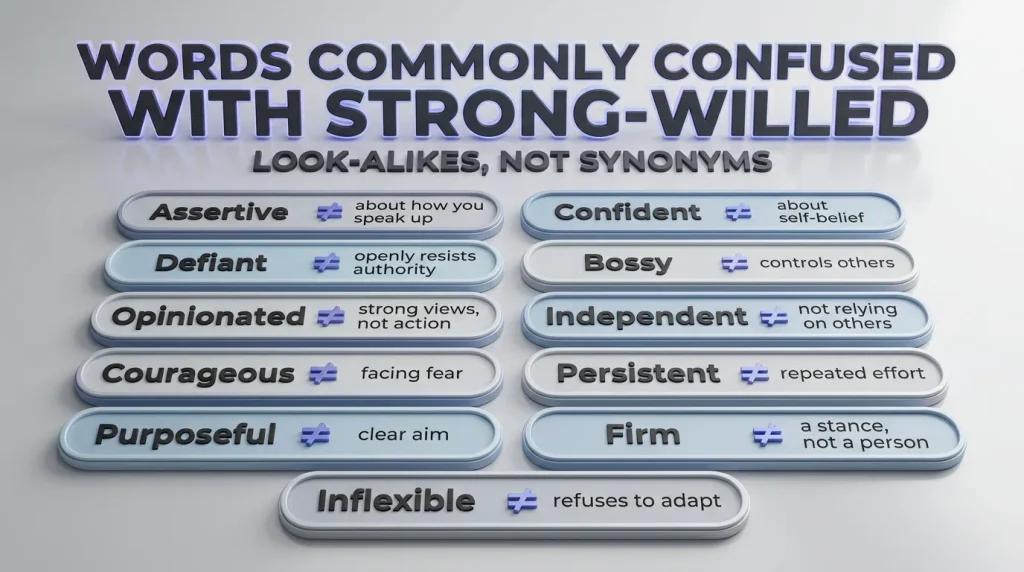
These words are often offered as synonyms, but none can replace strong-willed without changing its core meaning.
| Word | Why It Isn’t a True Synonym |
| Assertive | About how you speak up, not firmness of will |
| Confident | About self-belief, not refusing to yield |
| Defiant | Openly resists authority; strong-willed need not |
| Bossy | Controls others; strong-willed concerns your own choices |
| Opinionated | Holds strong views without necessarily acting on them |
| Independent | About not relying on others, not resisting pressure |
| Courageous | About facing fear, not firm will |
| Persistent | Describes repeated effort, not a personality |
| Purposeful | Describes clear aim, not resistance to others |
| Firm | Describes a stance or decision, not a person’s character |
| Inflexible | About refusing to adapt; omits the idea of strong will |
Common Mistakes
| Mistake | Better | Why |
| “A headstrong CEO” as praise | A resolute CEO | Headstrong implies ignoring advice |
| “An assertive toddler” for a stubborn one | A strong-willed toddler | Assertive is about speaking up |
| “Pigheaded” in a performance review | Uncompromising | Pigheaded is openly insulting |
| “A strong-willed policy” | A firm policy | Strong-willed describes people |
| Mixing “willful” and “wilful” in one article | One spelling throughout | Consistency signals care |
Antonyms of Strong-Willed
| # | Antonym | Why It’s the Opposite |
| 1 | Weak-willed | Lacks firmness to follow decisions |
| 2 | Irresolute | Uncertain and unable to decide |
| 3 | Yielding | Gives way instead of holding firm |
| 4 | Compliant | Goes along with requests |
| 5 | Docile | Easy to teach or control |
| 6 | Submissive | Yields to others’ authority |
| 7 | Pliable | Easily influenced or persuaded |
| 8 | Spineless | Informal, harsh: no firmness at all |
American vs British English
The main difference is the spelling of willful: American English prefers willful, British English wilful, and Merriam-Webster lists both as variants. Keep one spelling throughout an article. Strong-willed itself is spelled the same everywhere.
Real-World Collocations and Phrases
Part A: Common Collocations
| Pattern | Examples |
| Verb + strong-willed | raise a strong-willed child; parent a strong-willed teen |
| Strong-willed + noun | strong-willed child, daughter, woman, personality, leader |
| Adverb + strong-willed | fiercely strong-willed; naturally strong-willed |
| Strong-willed + preposition | strong-willed enough to; strong-willed about |
Part B: Natural Idioms and Set Phrases
- An iron will: exceptional, unbreakable determination.
- Dig in your heels: refuse to change your position.
- Stand your ground: keep your position despite pressure.
- Have a mind of your own: think and decide independently.
- Stubborn as a mule: extremely unwilling to change course.
Practice Exercises
Fill in the Blanks
Word bank: determined, headstrong, intransigent, feisty, strong-minded
- Despite three injuries, the runner stayed ______ and finished the marathon.
- Talks failed because the union leader was ______ on every demand.
- My ______ grandmother argued with the referee at the bingo hall.
- She is a ______ thinker who rarely changes an opinion just to fit in.
- The ______ two-year-old refused every coat, even though it was snowing.
Rewrite the Sentences
- Replace “strong-willed” with a formal word: “The strong-willed minister refused to resign.”
- Replace “strong-willed” with a gentle word: “Our strong-willed daughter loves to lead every game.”
- Replace “strong-willed” with a critical word: “His strong-willed refusal to listen cost the team the match.”
Match the Words
| Word | Meaning (scrambled) |
| 1. Determined | A. Spirited and ready to argue |
| 2. Stubborn | B. Refuses to compromise, formal |
| 3. Feisty | C. Firmly set on a goal |
| 4. Tenacious | D. Refuses to change, often critical |
| 5. Intransigent | E. Holds on and won’t let go |
Vocabulary Quiz
- Which word is the closest, safest synonym for strong-willed? (a) pigheaded (b) determined (c) meek (d) docile
- Which word is most likely to sound insulting? (a) resolute (b) spirited (c) pigheaded (d) steadfast
- Which word is a real antonym of strong-willed? (a) weak-willed (b) feisty (c) tenacious (d) headstrong
- Which word best describes a lively, bold, informal personality? (a) intransigent (b) feisty (c) obstinate (d) uncompromising
- Which is NOT a true synonym of strong-willed? (a) assertive (b) willful (c) strong-minded (d) headstrong
Answer Key
Fill in the blanks: 1 determined; 2 intransigent; 3 feisty; 4 strong-minded; 5 headstrong.
Rewrite (sample answers): 1 “The resolute minister refused to resign.” 2 “Our spirited daughter loves to lead every game.” 3 “His obstinate refusal to listen cost the team the match.”
Match: 1-C, 2-D, 3-A, 4-E, 5-B.
Quiz: 1 b; 2 c; 3 a; 4 b; 5 a.
FAQ
What is the closest synonym for strong-willed?
Determined is the closest everyday synonym for strong-willed. It keeps the core idea of a firm will without suggesting the person is difficult. If you need a word with a similar meaning but more criticism, headstrong or willful fit. If you want praise, choose resolute.
Can strong-willed and stubborn be used interchangeably?
Not reliably. Strong-willed can be a compliment or a neutral description, while stubborn is usually critical. A manager might admire a strong-willed negotiator but complain about a stubborn one. Use stubborn only when you want to stress unreasonable refusal to change, and choose determined or resolute when you mean admirable persistence.
What does strong-willed mean?
Strong-willed describes a person who has a firm will and sticks to their own decisions, even under pressure or disagreement. It can be positive, suggesting determination and independence, or mildly negative, suggesting someone is hard to persuade. Tone and context decide which: a strong-willed leader sounds admirable, while a strong-willed toddler often sounds like a parenting challenge.
Is strong-willed formal or informal?
Strong-willed is neutral in register, so it suits conversation, journalism, parenting advice, and workplace writing. For formal or academic writing, resolute, tenacious, or strong-minded can sound more precise. For casual, affectionate speech, feisty or spirited add personality. Avoid pigheaded in formal settings because it sounds insulting.
What is a good word for a strong-willed child that doesn’t sound negative?
Spirited, determined, and tenacious are the kindest options. Spirited suggests energy, determined stresses persistence, and tenacious suggests sticking with goals. Headstrong and willful tend to sound like complaints, so save them for situations where you’re describing a behavior problem, not a personality strength.
What is the opposite of strong-willed?
The most direct opposite is weak-willed. Other antonyms include irresolute, compliant, docile, submissive, and pliable, each shifting the tone slightly. Weak-willed criticizes lack of resolve, while compliant and docile describe someone who goes along with others, which can sound either cooperative or passive depending on context.
Conclusion
Picking the right synonym for strong-willed is really a decision about attitude. The same child, colleague, or character can be spirited to one listener and stubborn to another and your word choice tells the reader which view you hold.
Match the word to your purpose, whether that is praise, honest description or criticism and your writing will be clearer, fairer and easier to trust.

About Sajjad Ahmed
Sajjad Ahmed is the author behind Guest Paster, where he writes about English vocabulary, synonyms, word meanings, and practical word usage.
His content is designed to help readers understand the differences between similar words, discover suitable alternatives, and use English vocabulary more effectively in everyday writing and communication.
Before publishing, Sajjad focuses on presenting word choices in a clear and easy-to-understand format, with relevant meanings, context, and examples where helpful.
Through Guest Paster, his goal is to make vocabulary learning simpler and provide useful language resources for students, writers, English learners, and anyone looking to expand their vocabulary.
Areas of Focus: English Vocabulary • Synonyms • Word Meanings • Word Usage • Language Learning
Author: Sajjad Ahmed
Website: Guest Paster