

Coordination is a noun referring to the organization of individuals or activities in order that they function effectively together or to the coordinated functioning of body movements.
In organizational environments, collaboration is typically the most natural course of action when people are actively involved in working together while synchronization is stronger when timing becomes important. Body coordination and motor control are typically more precise in terms of accuracy.
Whether you mean teamwork, organizational structure, timeliness, synchrony or physical movement depends on which synonym is the best for your situation.
Other Words For Coordination
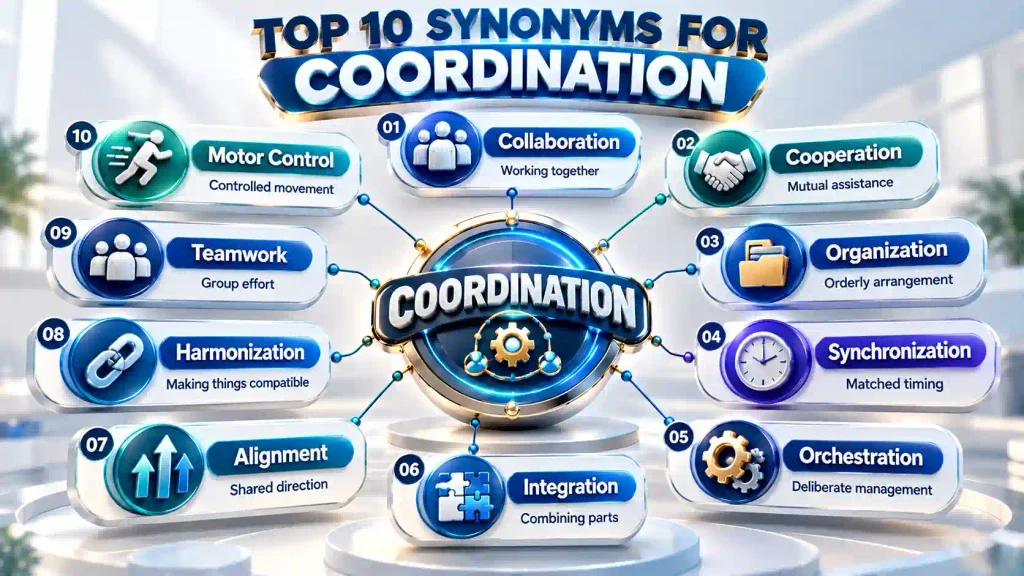
| # | Synonym | Meaning Difference |
| 1 | Collaboration | Emphasizes working together |
| 2 | Cooperation | Stresses mutual assistance |
| 3 | Organization | Focuses on orderly arrangement |
| 4 | Synchronization | Emphasizes matched timing |
| 5 | Orchestration | Suggests deliberate management |
| 6 | Integration | Combines parts into a whole |
| 7 | Alignment | Brings efforts into agreement |
| 8 | Harmonization | Makes elements work compatibly |
| 9 | Teamwork | Emphasizes group effort |
| 10 | Motor control | Refers to controlled movement |
Quick Facts About Coordination
| Fact | Detail |
| Part of speech | Noun |
| Simple meaning | Organized or controlled working together |
| UK pronunciation | /kəʊˌɔː.dɪˈneɪ.ʃən/ |
| US pronunciation | /koʊˌɔːr.dənˈeɪ.ʃən/ |
| Syllables | Five: co-or-di-na-tion |
| Word forms | coordinate, coordinated, coordinating |
| Formality | Neutral |
| Closest synonym | Collaboration |
| Best used for | Joint activity or controlled movement |
Cambridge gives slightly different UK and US pronunciations and treats coordination primarily as an uncountable noun.
The coordination plural question therefore has a simple practical answer: coordination is normally uncountable in its standard organizational and physical-movement senses. In ordinary writing, use coordination, not coordinations.
What Is the Closest Synonym for Coordination?
For the organizational meaning, collaboration is one of the closest everyday alternatives.
Collaboration means people or organizations actively working together toward a shared result. It can replace coordination when the emphasis is on joint work rather than merely arranging separate activities.
Compare:
- The project requires close coordination between engineers and contractors.
- The project requires close collaboration between engineers and contractors.
Both are natural, but the first emphasizes organizing interconnected work. The second puts more emphasis on people working together.
That distinction matters. A logistics manager may coordinate several teams that never directly collaborate with one another.
For a close coordination synonym, therefore, close collaboration works particularly well when genuine joint work is involved. Cambridge also recognizes in close collaboration as an established expression.
Word Origin & Etymology
Coordination entered English around 1600 with the sense of an “orderly combination.” According to the Online Etymology Dictionary, it came through French coordination or directly from Medieval Latin coordinatio, connected with Latin coordinare, meaning to set in order or arrange. The elements ultimately carry the ideas of “together” and “arrangement.”
The meaning later broadened. The sense involving harmonious physical or muscular action is recorded from the nineteenth century.
This history helps explain why modern coordination can refer both to organizing separate activities and to making physical movements work smoothly together.
Can These Synonyms Be Used Interchangeably?
Only sometimes. Coordination covers several overlapping ideas, while most alternatives highlight just one.
Usually: collaboration or cooperation can work when people are jointly pursuing an objective.
Sometimes: alignment, integration, organization, and orchestration can replace it when the surrounding sentence supports their narrower meanings.
Rarely: synchronization works when timing is central but sounds too technical for many general situations.
No: balance, communication, and management are often associated with coordination, but they do not independently express the same concept.
Tone also matters. Teamwork sounds natural and accessible, while harmonization, integration, and orchestration are more common in technical, institutional, or formal contexts.
Different Meanings of Coordination
Cambridge distinguishes two important senses: organizing people or activities to work together effectively and controlling different parts of the body so they move together effectively. These meanings require different synonym sets.
Meaning 1: Organizational Coordination
Useful alternatives include:
collaboration, cooperation, organization, synchronization, orchestration, integration, alignment, harmonization, teamwork, liaison, arrangement, concert, joint action, concerted action, unified action, combined effort, collaborative effort, cooperative effort
Meaning 2: Physical Coordination
More suitable alternatives include:
motor control, bodily control, movement control, dexterity
Words such as balance and agility are related physical abilities, but they should not automatically be treated as synonyms for coordination.
Detailed Synonym Meanings and Examples
1. Collaboration
Meaning: People or groups jointly contribute toward the same result.
Difference from Coordination: It emphasizes shared work rather than the organization of that work.
Best Used For: Projects, research, creative work, organizations
Formality: Neutral
CEFR Level: B2
Frequency: Common
Examples:
- The launch succeeded through close collaboration between the design and engineering teams. — Workplace
- Collaboration between the two laboratories shortened the research process. — Academic
When NOT to Use It: Avoid it when one person is simply organizing independent activities.
2. Cooperation
Meaning: Willing participation in which people assist one another.
Difference from Coordination: It stresses willingness and mutual assistance more than structured organization.
Best Used For: Teams, institutions, international relations
Formality: Neutral
CEFR Level: B2
Frequency: Common
Examples:
- Better cooperation between warehouse staff and drivers reduced loading delays. — Logistics
- The investigation depended on cooperation between several agencies. — Public administration
When NOT to Use It: Do not use it when precise scheduling or control is the main idea.
3. Organization
Meaning: The orderly arrangement of tasks, resources, or activities.
Difference from Coordination: It focuses more broadly on structure and order.
Best Used For: Events, projects, operations
Formality: Neutral
CEFR Level: B1
Frequency: Very Common
Examples:
- Careful organization kept the conference running on schedule. — Events
- The organization of emergency supplies began before the storm arrived. — Emergency planning
When NOT to Use It: It is unsuitable when you specifically mean people cooperating with each other.
4. Synchronization
Meaning: The matching of actions or processes in time.
Difference from Coordination: It specifically emphasizes timing.
Best Used For: Technology, schedules, machinery, timed activities
Formality: Neutral
CEFR Level: C1
Frequency: Common
Examples:
- Precise synchronization kept the automated production stages moving smoothly. — Manufacturing
- Calendar synchronization prevented the regional teams from booking conflicting sessions. — Workplace technology
When NOT to Use It: Avoid it when timing is not an important part of the meaning.
5. Orchestration
Meaning: Deliberate management of several interconnected elements to produce a planned result.
Difference from Coordination: It suggests stronger central direction and control.
Best Used For: Campaigns, systems, complex projects
Formality: Formal
CEFR Level: C1
Frequency: Common
Examples:
- The successful migration required careful orchestration across security, data, and support teams. — Technology
- The festival’s orchestration involved dozens of suppliers and performers. — Events
When NOT to Use It: It can sound unnecessarily elaborate for simple everyday cooperation.
6. Integration
Meaning: The combining of separate components into a functioning whole.
Difference from Coordination: It implies deeper combination rather than merely organized interaction.
Best Used For: Systems, services, departments, technology
Formality: Neutral
CEFR Level: B2
Frequency: Common
Examples:
- Better integration of payment and inventory systems reduced manual work. — Retail
- Service integration gave patients a more consistent route through local care. — Healthcare
When NOT to Use It: Avoid it if the parts remain fully separate and are merely being organized.
7. Alignment
Meaning: A state in which plans, priorities, or actions point in compatible directions.
Difference from Coordination: It emphasizes agreement in goals or direction.
Best Used For: Strategy, business, planning
Formality: Neutral
CEFR Level: C1
Frequency: Common
Examples:
- Stronger alignment between sales and marketing clarified the launch priorities. — Business
- Policy alignment helped the regional offices follow the same standards. — Administration
When NOT to Use It: It is not a good substitute for physical coordination.
8. Harmonization
Meaning: The process of making different systems, practices, or requirements more compatible.
Difference from Coordination: It emphasizes reducing differences or conflicts between elements.
Best Used For: Regulations, standards, policies, systems
Formality: Formal
CEFR Level: C1
Frequency: Uncommon
Examples:
- Harmonization of reporting standards simplified comparisons across markets. — Finance
- The agreement encouraged harmonization of regional safety procedures. — Policy
When NOT to Use It: Avoid it for ordinary teamwork where no standards or systems are being reconciled.
9. Teamwork
Meaning: Combined effort by members of a group pursuing a shared objective.
Difference from Coordination: It emphasizes group participation and collective effort.
Best Used For: Workplaces, sports, everyday conversation
Formality: Neutral
CEFR Level: B1
Frequency: Very Common
Examples:
- Good teamwork helped the restaurant staff handle the unexpected dinner rush. — Hospitality
- The rescue demonstrated exceptional teamwork among the crew members. — Emergency response
When NOT to Use It: Do not use it for automated systems or independent organizations that are simply being coordinated.
10. Liaison
Meaning: Communication and contact maintained between people or groups to support joint activity.
Difference from Coordination: It focuses on maintaining the connection that enables coordinated work.
Best Used For: Government, organizations, formal projects
Formality: Formal
CEFR Level: C1
Frequency: Common
Examples:
- Close liaison between the hospital and ambulance service improved patient transfers. — Healthcare
- The officer maintained liaison with local emergency teams throughout the operation. — Public service
When NOT to Use It: Avoid it when there is no communication role between separate parties.
11. Arrangement
Meaning: The planned ordering of activities or practical details.
Difference from Coordination: It focuses on how something is set up rather than ongoing joint action.
Best Used For: Events, schedules, logistics
Formality: Neutral
CEFR Level: B1
Frequency: Very Common
Examples:
- The arrangement of deliveries prevented trucks from arriving simultaneously. — Logistics
- Careful arrangement of interview times reduced waiting periods. — Recruitment
When NOT to Use It: It is weaker when continuous cooperation is central.
12. Concert
Meaning: Joint or mutually agreed action by several parties.
Difference from Coordination: It emphasizes acting together rather than the process of organizing that action.
Best Used For: Formal writing, institutional action
Formality: Formal
CEFR Level: C2
Frequency: Uncommon
Examples:
- The agencies acted in concert during the emergency response. — Government
- Several departments worked in concert to complete the transition. — Business
When NOT to Use It: Avoid this sense in casual writing, where readers may first associate concert with music.
13. Joint Action
Meaning: Action undertaken together by two or more parties.
Difference from Coordination: It describes the resulting shared activity rather than its organization.
Best Used For: Policy, organizations, formal initiatives
Formality: Neutral
CEFR Level: B2
Frequency: Common
Examples:
- Joint action by the maintenance and safety teams reopened the facility quickly. — Operations
- The agreement created a framework for joint action during future emergencies. — Policy
When NOT to Use It: Do not use it for body movement.
14. Concerted Action
Meaning: Deliberately combined action directed toward a common purpose.
Difference from Coordination: It stresses intentional collective effort.
Best Used For: Formal, legal, policy, organizational contexts
Formality: Formal
CEFR Level: C1
Frequency: Uncommon
Examples:
- The shortage required concerted action from suppliers and transport operators. — Supply chain
- Concerted action across departments resolved the backlog. — Administration
When NOT to Use It: It sounds too formal for routine everyday teamwork.
15. Unified Action
Meaning: Combined action carried out as a coherent whole.
Difference from Coordination: It emphasizes unity in execution rather than the process used to achieve it.
Best Used For: Organizations, response planning
Formality: Formal
CEFR Level: B2
Frequency: Uncommon
Examples:
- The emergency plan enabled unified action across several response teams. — Emergency management
- Unified action helped the departments implement the new procedure consistently. — Administration
When NOT to Use It: Avoid it when groups remain independent or pursue different objectives.
16. Combined Effort
Meaning: Work contributed by several people or groups toward one outcome.
Difference from Coordination: It emphasizes accumulated effort more than organization.
Best Used For: Everyday and workplace contexts
Formality: Neutral
CEFR Level: B1
Frequency: Common
Examples:
- The restoration was a combined effort by volunteers and local tradespeople. — Community
- A combined effort from support and engineering cleared the backlog. — Technology
When NOT to Use It: It is unsuitable when discussing mechanical or bodily coordination.
17. Collaborative Effort
Meaning: Work performed through active participation by multiple contributors.
Difference from Coordination: It emphasizes shared contribution and involvement.
Best Used For: Research, projects, creative work
Formality: Neutral
CEFR Level: B2
Frequency: Common
Examples:
- The report was a collaborative effort involving researchers from three universities. — Academic
- Redesigning the service became a collaborative effort between staff and customers. — Business
When NOT to Use It: Avoid it when activities are centrally organized but not jointly performed.
18. Cooperative Effort
Meaning: Work achieved through people willingly assisting one another.
Difference from Coordination: It highlights cooperation rather than logistical control.
Best Used For: Community, institutional, workplace contexts
Formality: Neutral
CEFR Level: B2
Frequency: Common
Examples:
- Clearing the neighborhood after the storm became a cooperative effort. — Community
- The audit required a cooperative effort from finance and operations. — Workplace
When NOT to Use It: It does not express precise timing or physical control.
19. Motor Control
Meaning: The control and regulation of voluntary bodily movement.
Difference from Coordination: It is a more specific physical and clinical concept.
Best Used For: Movement, rehabilitation, physical development
Formality: Neutral
CEFR Level: C1
Frequency: Common
Examples:
- The exercise requires enough motor control to guide the hand steadily toward the target. — Physical activity
- The therapist selected tasks designed to practise fine motor control. — Rehabilitation
When NOT to Use It: Never substitute it for organizational coordination.
20. Bodily Control
Meaning: The ability to direct and regulate physical movements effectively.
Difference from Coordination: It is broader and more descriptive than the standard term coordination.
Best Used For: General descriptions of physical movement
Formality: Neutral
CEFR Level: B2
Frequency: Uncommon
Examples:
- The routine demands considerable bodily control during slow transitions. — Exercise
- Improved bodily control made the movements more deliberate and stable. — Movement
When NOT to Use It: Avoid it in technical contexts where motor control is more precise.
21. Movement Control
Meaning: The ability or process of regulating how the body moves.
Difference from Coordination: It emphasizes controlling movement rather than different movements working together.
Best Used For: Sports, rehabilitation, movement analysis
Formality: Neutral
CEFR Level: B2
Frequency: Uncommon
Examples:
- Slow drills helped the athlete develop better movement control. — Sports
- The task tests movement control while the participant changes direction. — Assessment
When NOT to Use It: Do not use it for organizational activity.
22. Dexterity
Meaning: Skill and control in performing precise physical actions, especially with the hands.
Difference from Coordination: It is narrower and emphasizes skilled manipulation rather than whole-body coordination.
Best Used For: Hand movements, crafts, fine motor tasks
Formality: Neutral
CEFR Level: C1
Frequency: Common
Examples:
- Repairing the tiny mechanism requires considerable manual dexterity. — Technical work
- The activity develops the dexterity needed to manipulate small objects. — Fine motor activity
When NOT to Use It: Do not use it as a general substitute for coordination between people or organizations.
Best Alternatives by Context
Everyday Conversation
Use teamwork, cooperation, or organization. These are familiar and usually need little explanation.
Formal Writing
Use coordination, collaboration, integration, liaison, or harmonization, depending on the exact relationship involved.
Academic Writing
Use the term that identifies the mechanism precisely: collaboration for shared research, integration for combining components, synchronization for timing, and motor control for physical movement.
Business Communication
Alignment, collaboration, integration, and orchestration can be useful, but they should not be treated as interchangeable corporate buzzwords.
Creative Writing
Orchestration, harmony, or working in concert can create a more vivid effect, provided the surrounding meaning supports the metaphor.
Which Synonym Should I Choose?
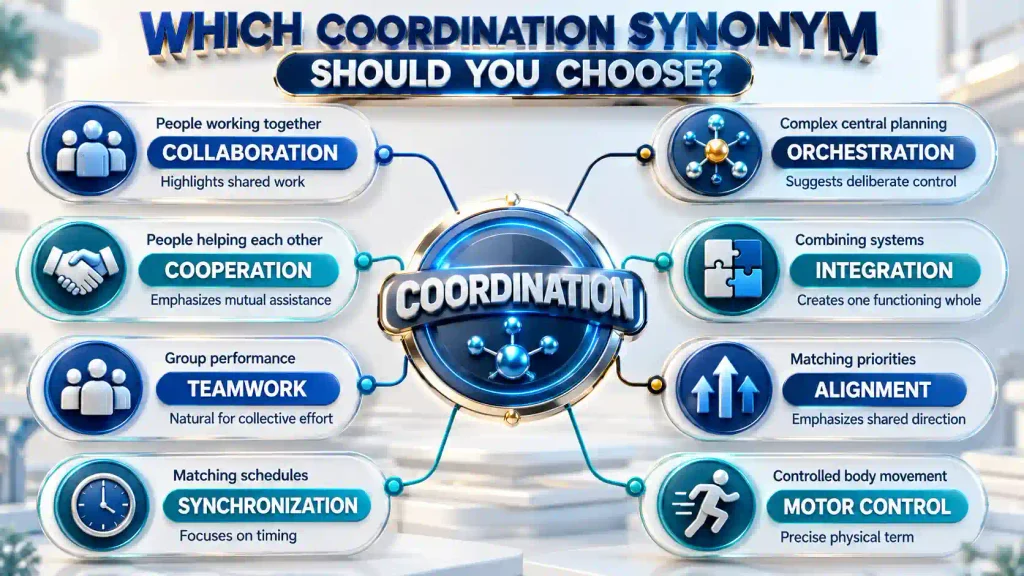
| Situation | Best Choice | Why |
| People working together | Collaboration | Highlights shared work |
| People helping each other | Cooperation | Emphasizes mutual assistance |
| Group performance | Teamwork | Natural and accessible |
| Matching schedules | Synchronization | Focuses on timing |
| Complex central planning | Orchestration | Suggests deliberate control |
| Combining systems | Integration | Creates one functioning whole |
| Matching priorities | Alignment | Emphasizes shared direction |
| Reconciling standards | Harmonization | Reduces incompatibility |
| Intergroup contact | Liaison | Focuses on communication |
| Controlled body movement | Motor control | Precise physical term |
| Precise hand movement | Dexterity | Fits fine motor skill |
Exact and Near Synonyms: What’s the Difference?
True synonyms are rare because words carry differences in scope, register, emphasis, and typical context.
Consider coordination, collaboration, and synchronization. All can describe activities working together, but they answer different questions.
Coordination asks whether separate elements have been organized effectively. Collaboration highlights whether people are actively working together. Synchronization asks whether actions occur at the correct relative times.
That is why replacing a word solely because a thesaurus lists it nearby can weaken a sentence. A useful synonym must preserve the intended meaning in the actual context.
Words Commonly Confused with Coordination
Communication: Good communication supports coordination, but exchanging information does not necessarily mean activities are coordinated.
Management: Management may involve coordination, yet it also includes planning, supervision, decision-making, and control.
Balance: Balance is a physical ability associated with coordination, but the two abilities are not identical.
Agility: Agility involves moving or changing direction quickly and effectively; coordination concerns controlled interaction among movements.
Harmony: Harmony can describe compatible relationships or a pleasing combination, but it does not always imply organized activity.
Planning: Planning establishes what should happen; coordination helps separate people or actions work together while it happens.
Control: Control may be necessary for coordination, particularly movement coordination, but it is a broader concept.
Communication skills: These can improve workplace coordination but are abilities rather than a synonym for coordination itself.
Common Mistakes
| Mistake | Better | Why |
| Coordination = communication | Distinguish them | Communication only exchanges information |
| Coordination = balance | Separate the abilities | Physical skills overlap, not match |
| Use teamwork for systems | Use integration | Systems do not form teams |
| Use synchronization everywhere | Check timing relevance | It specifically stresses timing |
| Use collaboration for control | Use orchestration | Collaboration implies joint contribution |
Antonyms of Coordination
Because coordination has organizational and physical meanings, the opposites also differ by sense.
Opposites of Organizational Coordination
| # | Antonym | Why It’s the Opposite |
| 1 | Disorganization | Lacks orderly arrangement |
| 2 | Disorder | Lacks organized structure |
| 3 | Discord | Indicates disagreement |
| 4 | Conflict | Parties work against each other |
| 5 | Disunity | Lacks unified action |
| 6 | Fragmentation | Breaks activity into disconnected parts |
Opposites of Physical Coordination
| # | Antonym | Why It’s the Opposite |
| 1 | Incoordination | Lack of coordinated movement |
| 2 | Clumsiness | Poor control of movement |
| 3 | Awkwardness | Movement lacks smooth control |
| 4 | Unsteadiness | Movement lacks stability |
| 5 | Instability | Control or steadiness is reduced |
American vs British English
The standard spelling coordination is used in both American and British English. British English also permits co-ordination, although the unhyphenated form is widespread. Cambridge explicitly lists co-ordination as a UK variant.
Pronunciation differs slightly as well. Cambridge gives UK /kəʊˌɔː.dɪˈneɪ.ʃən/ and US /koʊˌɔːr.dənˈeɪ.ʃən/.
These differences do not change the meaning.
Real-World Collocations & Phrases
Corpus-backed dictionary material includes combinations such as better coordination, close coordination, and coordination mechanism. Cambridge’s Business English material also records patterns such as coordination with, coordination between, coordination of resources, and greater/improved coordination.
Verb + Coordination
- improve coordination
- ensure coordination
- require coordination
- strengthen coordination
- facilitate coordination
Adjective + Coordination
- close coordination
- better coordination
- effective coordination
- improved coordination
- greater coordination
- efficient coordination
Coordination + Noun
- coordination mechanism
- coordination meeting
- coordination process
- coordination effort
- coordination problem
For a coordination meeting synonym, useful alternatives depend on its purpose: planning meeting, alignment meeting, team meeting, or interdepartmental meeting may work. They are not universal synonyms because each describes a more specific type of meeting.
Coordination + Preposition
- coordination between departments
- coordination among teams
- coordination with suppliers
- coordination of resources
Established Phrases
Coordination with means acting or organizing something together with another party.
In close coordination with emphasizes particularly strong or continuous coordination.
In concert with is a more formal expression meaning together with another party in coordinated action.
Coordination Examples in Sentences
If you are looking for coordination in a sentence, these examples show how its meaning changes with context:
- Close coordination between the kitchen and serving staff kept orders moving during the dinner rush.
- The construction schedule requires coordination among electricians, plumbers, and inspectors.
- Better coordination with suppliers could prevent another stock shortage.
- The exercise challenges hand-eye coordination by requiring the player to track and catch a moving ball.
- Emergency teams worked in coordination with local hospital staff.
- The project manager scheduled a coordination meeting before the installation began.
These coordination examples demonstrate why context should determine the alternative you choose.
Practice Exercises
Fill in the Blanks
Choose from collaboration, synchronization, alignment, teamwork, motor control.
- The dancers needed precise ______ to begin each movement at the same moment.
- The research project depended on ______ between two universities.
- Better strategic ______ helped the departments pursue the same priorities.
- Successful emergency response requires strong ______ among crew members.
- The exercise challenges ______ by requiring slow, deliberate movement.
Rewrite the Sentences
Replace coordination with a more precise alternative.
- Coordination between the writers and designers produced the final campaign.
- The machines require precise coordination of their operating cycles.
- Coordination of the company’s platforms created a more unified system.
Match the Words
| Word | Meaning |
| A. Collaboration | 1. Matching actions in time |
| B. Synchronization | 2. Combining parts into a whole |
| C. Integration | 3. Shared work |
| D. Alignment | 4. Shared direction |
| E. Dexterity | 5. Skillful precise movement |
Vocabulary Quiz
1. Which word best emphasizes working jointly on a project?
A. Synchronization
B. Collaboration
C. Dexterity
D. Disorder
2. Which alternative focuses most strongly on timing?
A. Cooperation
B. Liaison
C. Synchronization
D. Teamwork
3. Which word best describes combining separate systems?
A. Integration
B. Dexterity
C. Concert
D. Arrangement
4. Which term is most suitable for controlled bodily movement?
A. Liaison
B. Motor control
C. Harmonization
D. Collaboration
5. Which word emphasizes bringing goals or priorities into agreement?
A. Alignment
B. Dexterity
C. Synchronization
D. Arrangement
Answer Key
Fill in the blanks:
- synchronization
- collaboration
- alignment
- teamwork
- motor control
Rewrite:
- Collaboration between the writers and designers produced the final campaign.
- The machines require precise synchronization of their operating cycles.
- Integration of the company’s platforms created a more unified system.
Matching: A–3, B–1, C–2, D–4, E–5.
Quiz: 1–B, 2–C, 3–A, 4–B, 5–A.
FAQ
What Are 5 Good Synonyms for Coordination?
Five useful alternatives are collaboration, cooperation, organization, synchronization, and orchestration. The right choice depends on whether you mean joint work, mutual assistance, orderly arrangement, timing, or deliberate management.
What Is Another Word for Coordinated?
Depending on context, coordinated can mean organized, synchronized, integrated, aligned, harmonized, or collaborative. For clothing or colors, however, matching or complementary may be more appropriate.
What Is Another Word for Service Coordination?
Possible alternatives include service integration, integrated service management, or interagency collaboration, but they are not exact equivalents. Service integration is strongest when separate services are being combined into a more connected system.
What Is Another Word for Coordinate?
As a verb meaning to make different activities work effectively together, alternatives include organize, synchronize, integrate, align, orchestrate, and harmonize. Cambridge defines the verb coordinate as making different things work effectively as a whole.
What Is a Synonym for Coordination?
Collaboration is a strong general alternative when people actively work together. For timing, choose synchronization; for complex centralized organization, choose orchestration; for physical movement, motor control may be more precise.
What Is a Synonym for Uncoordinated?
Depending on meaning, useful alternatives include disorganized, unsynchronized, disconnected, clumsy, awkward, and uncontrolled. Disorganized suits activities or groups, while clumsy and awkward suit physical movement.
What’s a Better Word for Coordinator?
The best alternative depends on the job. Possibilities include organizer, facilitator, administrator, liaison, manager, project lead, or scheduler. These titles are not interchangeable: each implies different responsibilities.
What Is a Close Coordination Synonym?
Close collaboration is often the best alternative when people or organizations work directly together. Cambridge recognizes both close coordination and close collaboration as established combinations.
What Is a Body Coordination Synonym?
For body coordination synonym searches, motor control is often the most precise alternative. Bodily control and movement control may work in less technical writing.
What Is a Hand-Eye Coordination Synonym?
There is no perfect one-word hand-eye coordination synonym that preserves the entire meaning. Depending on context, visual-motor coordination or visual-motor control may be more precise than broader words such as dexterity. Do not automatically replace hand-eye coordination with balance or agility.
Conclusion
Choosing a stronger alternative to coordination is not about replacing one word with something that merely sounds more sophisticated. It is about identifying what the sentence actually needs to express.
Use collaboration when shared work matters, cooperation for mutual assistance, synchronization for timing, alignment for common direction, integration for combining parts, orchestration for deliberate management, and motor control when discussing physical movement.
Precise word choice makes writing clearer because it tells the reader exactly how people, systems, actions, or movements relate to one another.

About Sajjad Ahmed
Sajjad Ahmed is the author behind Guest Paster, where he writes about English vocabulary, synonyms, word meanings, and practical word usage.
His content is designed to help readers understand the differences between similar words, discover suitable alternatives, and use English vocabulary more effectively in everyday writing and communication.
Before publishing, Sajjad focuses on presenting word choices in a clear and easy-to-understand format, with relevant meanings, context, and examples where helpful.
Through Guest Paster, his goal is to make vocabulary learning simpler and provide useful language resources for students, writers, English learners, and anyone looking to expand their vocabulary.
Areas of Focus: English Vocabulary • Synonyms • Word Meanings • Word Usage • Language Learning
Author: Sajjad Ahmed
Website: Guest Paster