Empathy is a noun for the ability to understand and share another person’s feelings, used mostly in caring, workplace, and psychology contexts. Alternatives matter because empathy is often stretched to cover feelings it does not quite name.
For everyday writing, the safest swap is understanding. When you also mean a wish to help, choose compassion, the closest match in emotional depth. If you only mean sorrow from a distance, sympathy is more honest.
To choose, decide whether you are sharing a feeling, recognizing it, or acting on it.
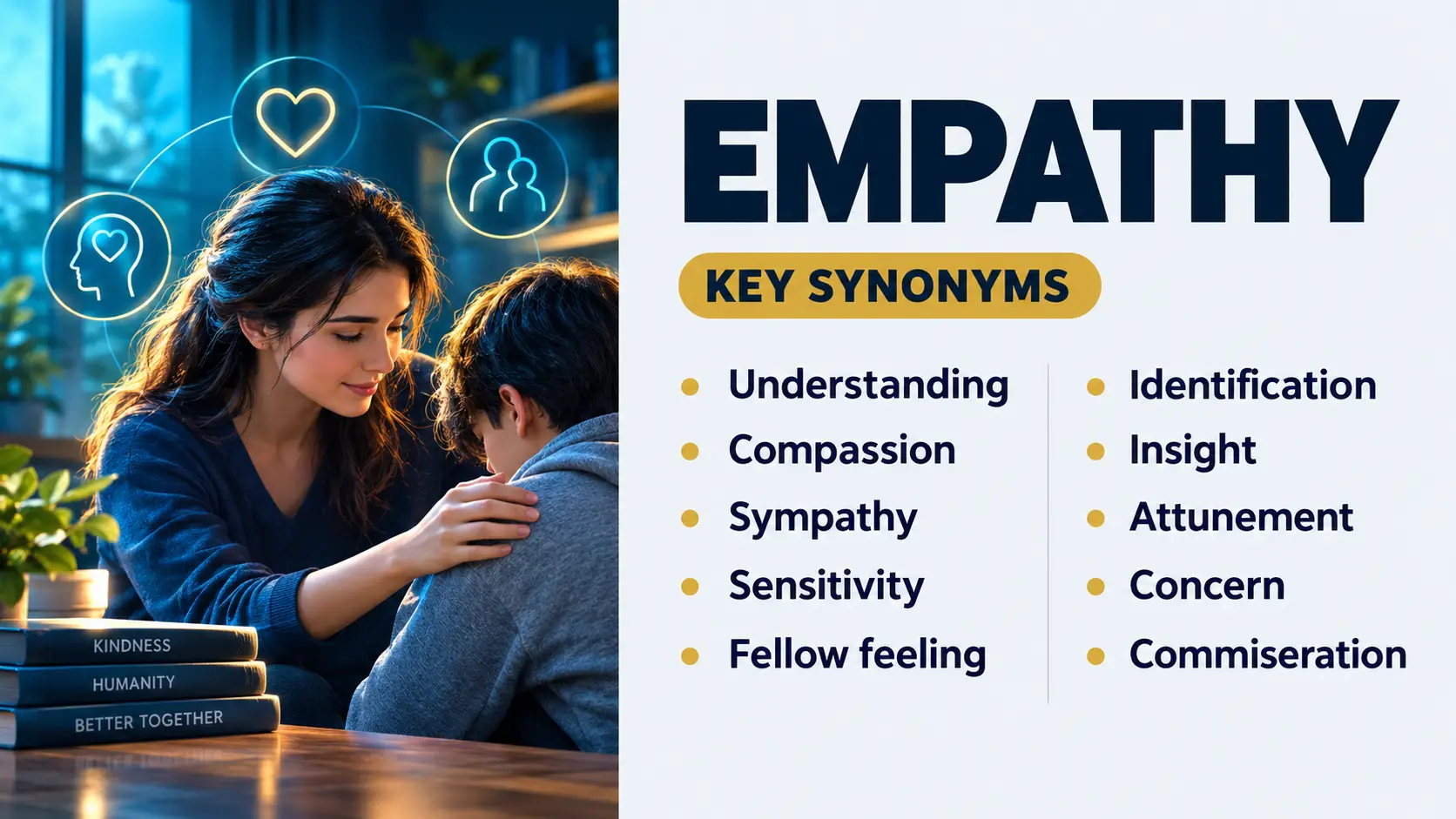
Another Word For Empathy
| # | Synonym | Meaning Difference |
| 1 | Understanding | Broader, softer, can be purely mental |
| 2 | Compassion | Adds a wish to relieve suffering |
| 3 | Sympathy | Feeling for someone, not with them |
| 4 | Sensitivity | Noticing and respecting feelings |
| 5 | Fellow feeling | Shared humanity, often among groups |
| 6 | Identification | Seeing yourself in someone’s situation |
| 7 | Insight | Accurate reading of feelings or motives |
| 8 | Attunement | Ongoing, close emotional responsiveness |
| 9 | Concern | Worry for someone’s wellbeing |
| 10 | Commiseration | Shared sorrow, expressed aloud |
Quick Facts About Empathy
| Feature | Answer |
| Part of speech | Noun |
| Simple meaning | Understanding and sharing another’s feelings |
| Pronunciation | EM-puh-thee |
| Syllables | 3 (em-pa-thy) |
| Word forms | empathic, empathetic, empathize, empathetically |
| Formality | Neutral |
| Closest synonym | Compassion |
| Best used for | Care, leadership, counseling, psychology |
What Is the Closest Synonym for Empathy?
Compassion is the closest synonym in emotional depth. It means deep awareness of another person’s suffering combined with a wish to ease it. That extra step is the whole difference. Picture a nurse who winces when a patient is given a painful injection: that is empathy.
The same nurse who stays late to make sure the patient is comfortable is showing compassion. Because the two overlap so heavily, compassion can replace empathy in most sentences about suffering. Keep empathy when the point is the shared feeling itself, and use compassion when kindness or action is part of the picture.
That said, understanding is the safer everyday choice when no suffering is involved, since it never implies a rescue mission.
Word Origin and Etymology
Etymonline dates English empathy to 1908 and says it was modeled on the German Einfühlung, built from words for “in” and “feeling.” The same source credits the philosopher Rudolf Lotze with coining the German term in 1858, as a rendering of the Greek empatheia, meaning “passion” or “state of emotion,” from en (“in”) and pathos (“feeling”).
The psychologist Edward Titchener wrote in 1909 that he was coining empathy as a rendering of Einfühlung. At that time the idea was tied to art: viewers were said to feel their way into a work. Other writers proposed rival English renderings, including fellow feeling and inner sympathy, but empathy won.
Etymonline dates empathic and empathetic to 1909 and the verb empathize to 1917. The word then moved from aesthetics into the interpersonal sense we use today.
Can These Synonyms Be Used Interchangeably?
| Level | Words | Note |
| Usually | Understanding, compassion | Safe in most neutral sentences |
| Sometimes | Sympathy, sensitivity, concern, fellow feeling | Check distance, tone, and audience |
| Rarely | Attunement, identification, commiseration | Narrow, technical, or momentary |
| No | Pity, rapport, kindness, respect | Different meaning; see confused words |
Tone decides as much as meaning. In clinical settings, empathy itself is the precise term. In casual messages, understanding feels natural, and in formal writing compassion carries moral weight. A thesaurus’s first result rarely respects these differences.
Detailed Synonym Meanings and Examples
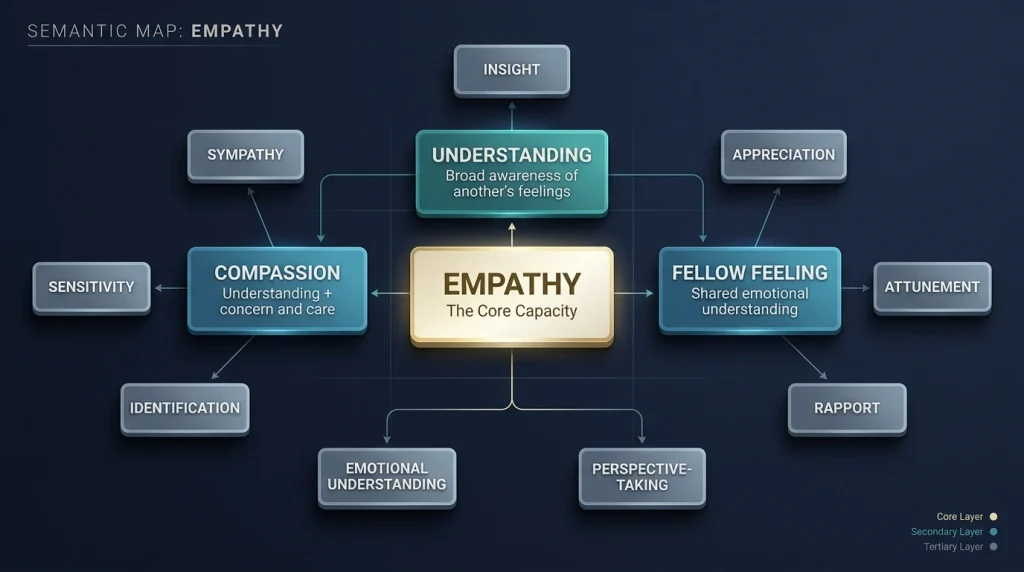
Every word below passed one test: it can replace empathy in at least one real sentence without changing the core meaning. Broader qualities like kindness or respect are covered in the confused-words section instead.
1. Understanding
Meaning: A patient grasp of why someone feels or acts as they do.
Difference from Empathy: Can be intellectual, with no shared feeling required.
Best Used For: Everyday speech, customer service, parenting, school.
Formality: Neutral
CEFR Level: B1
Frequency: Very Common
Examples:
- Thank you for your understanding while we fix the billing error. (customer service)
- My coach showed real understanding when I missed practice after the exam. (school sports)
When NOT to Use It: Skip it when the felt, shared emotion is the whole point of the sentence.
2. Compassion
Meaning: Covered in full in the closest-synonym section above.
Difference from Empathy: Brings action and kindness into the sentence.
Best Used For: Healthcare, charity, ethics, leadership.
Formality: Neutral to formal
CEFR Level: B2
Frequency: Common
Examples:
- The hospice team spoke to every family with quiet compassion. (healthcare)
- She moved the deadline out of compassion, not policy. (workplace)
When NOT to Use It: Avoid it when you only mean recognizing a feeling, with no urge to help.
3. Sympathy
Meaning: Sorrow or concern for someone else’s misfortune.
Difference from Empathy: Stays outside the experience instead of entering it.
Best Used For: Condolences, formal messages of support.
Formality: Neutral
CEFR Level: B2
Frequency: Common
Examples:
- The whole office signed a card of sympathy after his father died. (condolence)
- Local shops showed sympathy for families who lost their homes. (community news)
When NOT to Use It: Avoid it when you want to say you truly share the person’s experience.
4. Sensitivity
Meaning: Quick awareness of other people’s feelings and what might hurt them.
Difference from Empathy: Stresses tactful noticing over deep sharing.
Best Used For: Difficult conversations, management, delicate topics.
Formality: Neutral
CEFR Level: B2
Frequency: Common
Examples:
- The director announced the layoffs with sensitivity to everyone’s fears. (workplace)
- Her sensitivity to the family’s grief shaped how she phrased every question. (journalism)
When NOT to Use It: Avoid it when you mean someone who is easily offended, a different meaning of the word.
5. Fellow Feeling
Meaning: A warm sense of shared humanity with other people.
Difference from Empathy: Wider and more communal, less tied to one person.
Best Used For: Essays, speeches, literary writing.
Formality: Formal
CEFR Level: C1
Frequency: Uncommon
Examples:
- Weeks of shared flood cleanup built a lasting fellow feeling on the street. (community)
- The novel argues that fellow feeling is what keeps a society honest. (literary essay)
When NOT to Use It: Skip it in casual messages, where it can sound old-fashioned.
6. Identification
Meaning: The sense of seeing yourself in another person’s situation.
Difference from Empathy: Usually depends on shared experience or similarity.
Best Used For: Literature, film, psychology.
Formality: Formal
CEFR Level: C1
Frequency: Common
Examples:
- Readers felt strong identification with the young narrator. (literary criticism)
- His identification with the new immigrants came from his own childhood move. (personal essay)
When NOT to Use It: Avoid it when someone understands a stranger they have nothing in common with.
7. Insight
Meaning: A clear, accurate reading of what another person feels or wants.
Difference from Empathy: Works only in the emotional-insight sense, and sounds more analytical.
Best Used For: Counseling, analysis, book reviews.
Formality: Neutral to formal
CEFR Level: C1
Frequency: Common
Examples:
- She wrote about grief with unusual emotional insight. (book review)
- His insight into his sister’s fear helped him choose his words. (family)
When NOT to Use It: Skip it when you mean sharing the feeling rather than reading it.
8. Attunement
Meaning: Close, moment-to-moment responsiveness to another person’s emotional state.
Difference from Empathy: More clinical, and describes an ongoing relationship.
Best Used For: Parenting research, therapy, relationship writing.
Formality: Formal
CEFR Level: C2
Frequency: Rare
Examples:
- Parental attunement helps a baby feel safe. (parenting)
- The therapist’s attunement made the silence in the session feel safe. (counseling)
When NOT to Use It: Avoid it in everyday writing, where it sounds technical.
9. Concern
Meaning: Active worry about another person’s wellbeing.
Difference from Empathy: Centers on worry, not on feeling what they feel.
Best Used For: Care, safety, management.
Formality: Neutral
CEFR Level: B2
Frequency: Very Common
Examples:
- Her manager showed genuine concern when she returned from leave. (workplace)
- Thanks for your concern, but I’m managing fine. (everyday)
When NOT to Use It: Skip it when you mean deep emotional understanding rather than worry.
10. Commiseration
Meaning: Shared sorrow expressed aloud over someone’s bad luck.
Difference from Empathy: Describes a moment of consoling, not a lasting ability.
Best Used For: Setbacks, losses, disappointments.
Formality: Formal
CEFR Level: C2
Frequency: Rare
Examples:
- Fans offered commiseration to the team after the final. (sports)
- Her colleagues shared a round of commiseration over the failed launch. (workplace)
When NOT to Use It: Avoid it for a personality trait, since it names a single moment.
11. Responsiveness
Meaning: Readiness to react to other people’s emotional needs.
Difference from Empathy: Describes visible behavior, not inner feeling.
Best Used For: Leadership, caregiving, performance reviews.
Formality: Formal
CEFR Level: C1
Frequency: Uncommon
Examples:
- Her emotional responsiveness is why the team trusts her. (leadership)
- The study measured how caregivers’ responsiveness changed when a baby cried. (research)
When NOT to Use It: Skip it when you mean the inner experience of feeling someone’s pain.
12. Consideration
Meaning: Thoughtful regard for other people’s feelings.
Difference from Empathy: Leans toward good manners than deep connection.
Best Used For: Shared spaces, etiquette, workplace conduct.
Formality: Neutral
CEFR Level: B2
Frequency: Common
Examples:
- Out of consideration for her long commute, they moved the meeting later. (office)
- Please show consideration for neighbors after 10 p.m. (housing notice)
When NOT to Use It: Avoid it when you mean emotional closeness, since it often just means politeness.
13. Perceptiveness
Meaning: Skill at reading what other people feel.
Difference from Empathy: Praises accuracy, not warmth.
Best Used For: References, reviews, character descriptions.
Formality: Formal
CEFR Level: C2
Frequency: Uncommon
Examples:
- The interviewer’s perceptiveness put nervous candidates at ease. (hiring)
- Her perceptiveness about her students’ moods made her an outstanding teacher. (education)
When NOT to Use It: Avoid it when warmth matters, since it can sound cool and analytical.
14. Kindheartedness
Meaning: A caring nature that responds warmly to others’ feelings.
Difference from Empathy: Describes character, not a specific act of understanding.
Best Used For: Tributes, character descriptions.
Formality: Neutral
CEFR Level: C2
Frequency: Uncommon
Examples:
- Everyone at the school remembered the caretaker’s kindheartedness. (tribute)
- The story celebrates the kindheartedness of ordinary strangers. (storytelling)
When NOT to Use It: Skip it when you mean accurate understanding of one specific feeling.
15. Soft-heartedness
Meaning: A readiness to be moved by other people’s troubles.
Difference from Empathy: Suggests gentleness and sometimes a lack of firmness.
Best Used For: Describing a gentle personality.
Formality: Neutral
CEFR Level: C2
Frequency: Rare
Examples:
- Her soft-heartedness made it hard to turn any stray animal away. (family)
- The shelter depended on its volunteers’ soft-heartedness. (charity)
When NOT to Use It: Avoid it in professional praise, because it can imply poor judgment.
Best Alternatives by Context
- Everyday conversation: understanding or concern sounds natural and warm.
- Formal writing: compassion carries the right weight in letters and statements.
- Academic writing: attunement or identification fits psychology and literature papers. If your argument is about empathy itself, keep the word rather than swapping it for variety.
- Business communication: consideration, sensitivity, or responsiveness suit feedback and reviews.
- Creative writing: fellow feeling or soft-heartedness adds character and tone.
- Describing a person: for another word for an empathetic person, use compassionate, understanding, perceptive, or kindhearted.
- For kids and learners: understanding how someone feels is the clearest easy swap.
Which Synonym Should I Choose?
| Situation | Best Choice | Why |
| Replacing empathy in an essay | Compassion | Closest meaning, formal tone |
| Casual message to a friend | Understanding | Warm and natural |
| Condolence note | Sympathy | Fits grief from a distance |
| Workplace feedback | Consideration | Professional, polite tone |
| Therapy or research writing | Attunement | Precise, technical term |
| Positive tone for a tribute | Kindheartedness | Praises warm character |
| Explaining to a child | Understanding feelings | Simple and easy to say |
| Describing shared humanity | Fellow feeling | Wide, literary, warm |
Exact and Near Synonyms: Difference
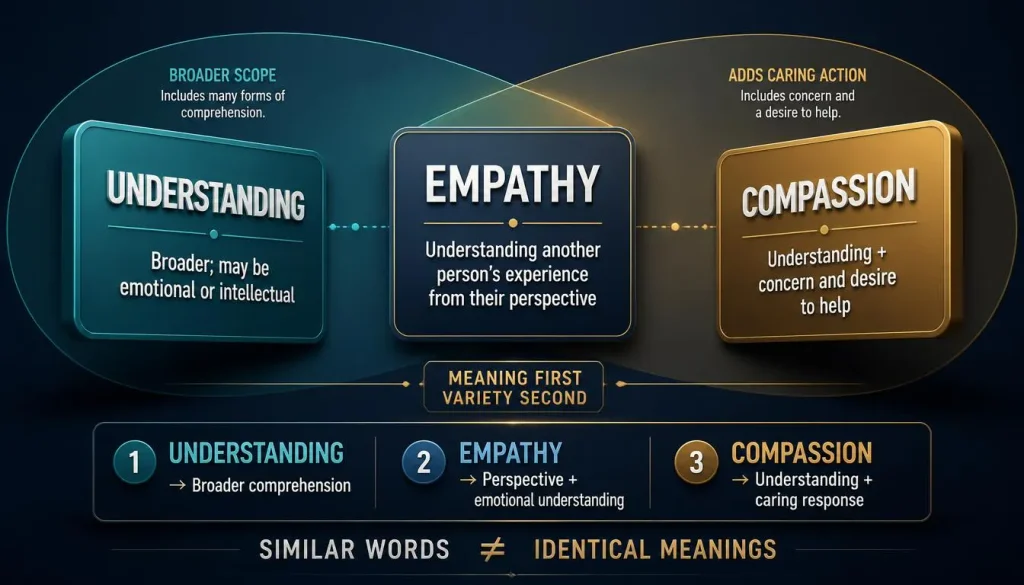
True synonyms are rare because words differ in scope, tone, and emphasis even when their dictionary meanings overlap. Here, the real dividing lines are distance (sympathy sits outside, identification sits inside), action (compassion acts, understanding may not), and time (commiseration is a moment, attunement is a pattern).
Register shifts things too: understanding is casual, attunement clinical. A good writer picks the word whose edge matches the sentence. This is the same skill that makes a word like profound hard to swap without changing the feel of a line.
Words Commonly Confused with Empathy
| Word | Why It Is Not a True Synonym |
| Pity | Looks down on someone; lacks shared feeling |
| Respect | Values someone; does not share feelings |
| Kindness | Describes behavior, not understanding |
| Caring | Concern without perspective-taking |
| Warmth | A friendly manner, not understanding |
| Rapport | A mutual relationship, not a feeling |
| Affinity | Natural liking, not understanding |
| Perspective-taking | Mental skill; one part of empathy |
| Emotional intelligence | Broader skill set that includes empathy |
| Altruism | Selfless action, not emotional understanding |
Searches for synonyms for empathy and respect often combine two different qualities. You can respect someone without understanding their feelings, and understand them without respecting them.
Common Mistakes
| Mistake | Better | Why |
| “I pity your loss” at a funeral | “I’m so sorry” (sympathy) | Pity sounds condescending |
| “Attunement” in a casual text | “Understanding” | Too clinical for casual use |
| Empathy meaning politeness | “Consideration” | Manners are not shared feeling |
| Empathy meaning respect | Use “respect” separately | Valuing is not feeling with |
| Apathy as mild empathy | Treat it as an opposite | Apathy means not caring |
Dismissive wording is another common slip when someone is hurting.
Antonyms of Empathy
| # | Antonym | Why It’s the Opposite |
| 1 | Apathy | No interest in others’ feelings |
| 2 | Indifference | Neither care nor concern |
| 3 | Callousness | Hardened to others’ pain |
| 4 | Insensitivity | Fails to notice others’ feelings |
| 5 | Heartlessness | Lacks warmth and mercy |
| 6 | Coldness | Emotionally distant, unresponsive |
| 7 | Detachment | Deliberate emotional distance |
If you need another word for a lack of empathy, match the failure: insensitivity for not noticing, indifference for not caring, and callousness for being hardened to pain.
American vs British English
The noun is spelled the same in both varieties. The verb differs: American English uses empathize, while British English commonly writes empathise.
Etymonline dates the verb to 1917. Both empathic and empathetic are used on both sides of the Atlantic, with empathetic the more familiar in everyday writing.
Real-World Collocations and Phrases
Part A: Common Collocations
- Verb + empathy: show empathy, feel empathy, lack empathy, build empathy, foster empathy
- Adjective + empathy: genuine empathy, deep empathy, cognitive empathy, emotional empathy
- Empathy + noun: empathy training, empathy gap, empathy skills
- Empathy + preposition: empathy for, empathy with, empathy toward
Part B: Set Phrases
- Put yourself in someone’s shoes: imagine their situation and how it feels.
- Walk a mile in someone’s shoes: understand a person by experiencing their circumstances.
These phrases help most when feelings pull in two directions.
Practice Exercises
Fill in the Blanks
Choose from: understanding, compassion, sympathy, sensitivity, attunement.
- Thank you for your ______ while we fix the billing error.
- The hospice nurse stayed late out of simple ______.
- Please accept our deepest ______ on your loss.
- The editor handled the author’s disappointment with ______.
- Parent-infant studies often describe emotional ______ as responding to a baby’s cues in the moment.
Rewrite the Sentences
Replace empathy with a more precise word.
- He offered empathy over the team’s lost match.
- The nurse acted out of empathy and stayed to help the family.
- Her empathy for readers shaped every chapter.
Match the Words
| Word | Match |
| A. Compassion | 1. Spoken shared sorrow |
| B. Sympathy | 2. Care with a wish to help |
| C. Attunement | 3. Sorrow from a distance |
| D. Commiseration | 4. Sense of shared humanity |
| E. Fellow feeling | 5. Close emotional responsiveness |
Vocabulary Quiz
- Which word is closest to empathy in emotional depth? (a) pity (b) rapport (c) compassion (d) apathy
- Which word means sorrow felt from a distance? (a) sympathy (b) identification (c) attunement (d) insight
- Which is NOT a true synonym? (a) understanding (b) rapport (c) fellow feeling (d) compassion
- Which is a strong antonym of empathy? (a) concern (b) callousness (c) insight (d) sensitivity
- Which suits psychology writing best? (a) pity (b) kindness (c) attunement (d) warmth
Answer Key
Fill in the blanks: 1 understanding, 2 compassion, 3 sympathy, 4 sensitivity, 5 attunement.
Rewrite: 1 commiseration (or sympathy), 2 compassion, 3 understanding.
Match: A-2, B-3, C-5, D-1, E-4.
Quiz: 1 c, 2 a, 3 b, 4 b, 5 c.
FAQ
What is the closest synonym for empathy?
Compassion is the closest synonym in emotional depth, because both involve recognizing another person’s suffering. The difference is that compassion adds a wish to help. For everyday writing, understanding is the safest swap. Neither is perfectly identical, so choose based on whether the sentence needs action.
Are sympathy and empathy synonyms?
They are near synonyms, not exact ones. Sympathy means feeling sorry for someone from a slight distance, while empathy means understanding or sharing what they feel. In casual speech people swap them, but careful writers keep the difference, especially in condolence messages, where sympathy is usually the right word.
What does empathy mean in simple words?
Empathy means understanding how another person feels and imagining what their situation is like. For kids, you can say it is knowing how a friend feels by picturing yourself in their place. It does not require agreeing with someone or having lived the same experience.
Is empathy a formal or informal word?
Empathy is neutral, so it works in essays, workplace reviews, and everyday conversation. Compassion sounds slightly more formal and moral, while understanding sounds more casual. Choose empathy when you mean sharing feelings, and switch only when another word fits your meaning better.
What is another word for empathy in an essay?
Compassion is the safest replacement, while fellow feeling suits reflective or literary essays. In psychology or education papers, attunement or identification can be more precise. Avoid swapping empathy out purely for variety; if your argument is about empathy, repeating the word is clearer than using a near miss.
Is apathy the opposite of empathy?
Apathy is often used as its opposite, since it means lacking interest or concern. It is not exact, though: a person can understand feelings and still not care. Callousness and insensitivity describe a stronger failure to respond. Choose based on whether the problem is not caring or not noticing.
Conclusion
Choosing the right word is mostly about being honest about what you actually mean. A message that names sympathy when you feel distance, or compassion when you plan to act, earns more trust than one that leans on a single all-purpose term.
Before swapping any word for empathy, check the feeling, the distance, and the audience. Even sharp topics, like the ones in our synonyms for horrible guide, land better when your word choice shows you were paying attention to the person on the other end.

About Sajjad Ahmed
Sajjad Ahmed is the author behind Guest Paster, where he writes about English vocabulary, synonyms, word meanings, and practical word usage.
His content is designed to help readers understand the differences between similar words, discover suitable alternatives, and use English vocabulary more effectively in everyday writing and communication.
Before publishing, Sajjad focuses on presenting word choices in a clear and easy-to-understand format, with relevant meanings, context, and examples where helpful.
Through Guest Paster, his goal is to make vocabulary learning simpler and provide useful language resources for students, writers, English learners, and anyone looking to expand their vocabulary.
Areas of Focus: English Vocabulary • Synonyms • Word Meanings • Word Usage • Language Learning
Author: Sajjad Ahmed
Website: Guest Paster