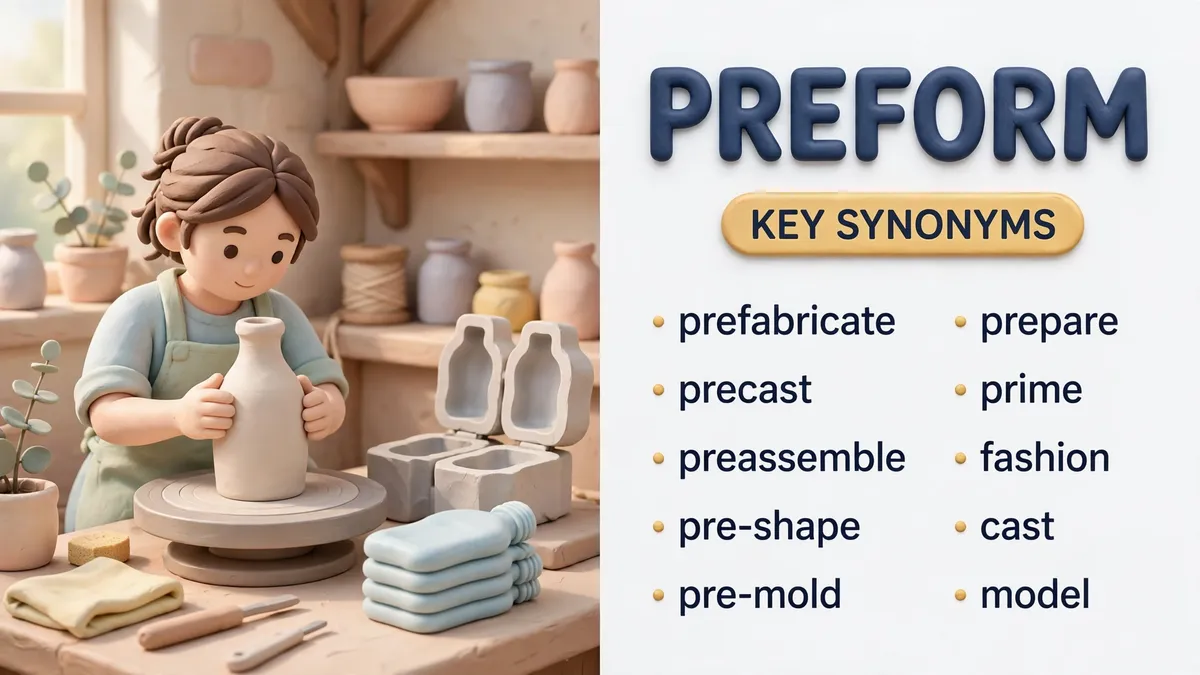
One wrong letter flips the meaning. Perform means to carry out a task or act on a stage. Preform means to shape something beforehand so it arrives ready for its final use. A factory preforms a plastic bottle blank before it is blown.
A dentist preforms a crown before it is fitted. Prefabricate is the closest synonym, carrying the same idea of work done early. This guide compares 15 preform synonyms with meanings, examples and honest limits, so you can pick the word that fits.
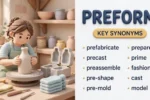
Top 10 Preform Synonyms at a Glance
| # | Synonym | Meaning Difference |
|---|---|---|
| 1 | Prefabricate | A whole part made in a factory |
| 2 | Precast | A concrete piece cast before placing |
| 3 | Preassemble | Parts joined before the final build |
| 4 | Pre-shape | A rough shape before finishing |
| 5 | Pre-mold | Form in a mold ahead of time |
| 6 | Prepare | Ready for use |
| 7 | Prime | A surface made ready for the next step |
| 8 | Fashion | Skilled shaping by hand or tool |
| 9 | Cast | Liquid poured into a mold to set |
| 10 | Model | A small trial version of the shape |
Quick Facts About “Preform”
- Part of speech: a verb, and also a noun in manufacturing, naming the shaped blank, as in a PET bottle preform.
- Core meaning: to shape or form something beforehand, before its final use.
- Three main senses: (1) shape a material before its final use; (2) make a part in advance; (3) as a noun, the preliminary form itself.
- Register: technical and neutral, at home in workshops, factories, labs, and craft, and out of place in everyday small talk.
- Common mistake: swapping it with perform. A singer performs a song, and a mold preforms a bottle.
The Closest Synonym: Prefabricate
Prefabricate is the closest synonym for preform, because it carries the same idea: work finished before the main job, a part made elsewhere and brought in ready to use. Test the swap and it holds. “The crew preformed the wall panels in the yard” becomes “The crew prefabricated the wall panels in the yard.” “The lab preforms each lens blank before grinding” becomes “The lab prefabricates each lens blank before grinding.”
Prefabricate wins on scale. It fits whole sections of a building, a bridge deck, or a bathroom pod, while preform fits smaller blanks and early shapes. Before any part is prefabricated, engineers must fix its exact size, and our guide to determine synonyms covers the words for that decision.
One limit matters. Prefabricate says the part was made off site, and preform says only that its shape came early, so a potter preforms clay by hand without prefabricating anything.
Where “Preform” Comes From (Etymology)
According to Etymonline, preformed means “formed in advance of use or further preparation,” attested around 1600, from Latin praeformare or from pre- plus formed. The verb preform is late and rare in English, and preformation is attested from 1732. Merriam-Webster traces preform to Latin praeformare, from prae-, “before,” plus formare, “to form,” first used as a verb in 1601, and as a noun in 1931.
The history explains the split. The word began as a bookish way to say “formed earlier,” then found a home in factories and labs, where the early shape became a real object.
Preform Synonyms in Detail
Group 1: Built Before the Main Job
1. Prefabricate
Meaning: To make a whole part in a factory before it travels to its final place.
Difference: The closest match, with the strongest off-site sense.
Best Used For: Building sections, bridge decks, bathroom pods.
Formality: Neutral to formal · CEFR: C1 · Frequency: Common
Example (Building): “The firm prefabricated the panels in its yard.”
Example (Bridge): “Workers prefabricated the deck while the piers rose.”
When NOT to Use It: For a hand-shaped pot, use pre-shape.
2. Precast
Meaning: To cast a concrete piece before it is moved and set in place.
Difference: The concrete specialist, tied to one material.
Best Used For: Concrete beams, slabs, wall units.
Formality: Technical · CEFR: C1 · Frequency: Less common
Example (Bridge): “The crew precast the beams beside the river.”
Example (Building): “Precast stairs arrived by truck and were lifted in.”
When NOT to Use It: For wood or plastic, use prefabricate.
3. Preassemble
Meaning: To join the parts of something together before the final build.
Difference: The parts exist already; the early work is joining them.
Best Used For: Furniture kits, machine modules, flat-pack goods.
Formality: Neutral · CEFR: B2 · Frequency: Common
Example (Furniture): “The shop preassembled the doors to save time on site.”
Example (Machine): “Technicians preassembled the pump in the workshop.”
When NOT to Use It: For shaping raw material, use pre-shape.
4. Pre-mold
Meaning: To form material in a mold ahead of its final use.
Difference: The mold shapes it, and the piece waits for its next step.
Best Used For: Plastic blanks, rubber seals, lens blanks.
Formality: Technical · CEFR: C1 · Frequency: Less common
Example (Plastic): “The plant pre-molds bottle blanks in batches of ten thousand.”
Example (Lens): “Each lens blank is pre-molded, then ground to prescription.”
When NOT to Use It: For a hand-made shape, use fashion.
5. Pre-cut
Meaning: To cut material to size before the job needs it.
Difference: The early work is cutting, not shaping.
Best Used For: Timber kits, fabric patterns, tile layouts.
Formality: Neutral · CEFR: B2 · Frequency: Common
Example (Timber): “The joiner pre-cut the frame in the workshop.”
Example (Fabric): “She pre-cut the cloth so the sewing went fast.”
When NOT to Use It: For a molded shape, use pre-mold.
6. Prototype
Meaning: To build an early working model to test a product.
Difference: A prototype tests an idea; a preform is a production blank.
Best Used For: New products, gadgets, design trials.
Formality: Neutral to formal · CEFR: C1 · Frequency: Common
Example (Gadget): “The team prototyped the handle in foam first.”
Example (Design): “They prototyped three chair versions in a week.”
When NOT to Use It: For a blank meant for use, use pre-mold.
Group 2: Shaped by Hand or Tool
7. Pre-shape
Meaning: To give material a rough early shape before finishing.
Difference: The plainest hand-work word, close to the core sense.
Best Used For: Clay, wood, metal, dough.
Formality: Neutral · CEFR: B2 · Frequency: Less common
Example (Clay): “The potter pre-shaped the vase before the wheel slowed.”
Example (Wood): “He pre-shaped the handle with a drawknife.”
When NOT to Use It: For a factory section, use prefabricate.
8. Fashion
Meaning: To shape something skillfully, by hand or with tools.
Difference: Fashion adds craft and care to plain shaping.
Best Used For: Jewelry, sculpture, leather, fine woodwork.
Formality: Neutral to formal · CEFR: B2 · Frequency: Common
Example (Jewelry): “The goldsmith fashioned the ring from a single band.”
Example (Leather): “She fashioned a saddle from thick hides.”
When NOT to Use It: For a mold run, use pre-mold.
9. Cast
Meaning: To pour liquid into a mold so it sets in a shape.
Difference: Cast names the pouring; preform names the timing.
Best Used For: Metal parts, statues, concrete.
Formality: Neutral · CEFR: B2 · Frequency: Very common
Example (Metal): “The foundry cast the gear in bronze.”
Example (Statue): “Workers cast the statue in sections and joined them.”
When NOT to Use It: For hand shaping without a mold, use fashion.
10. Model
Meaning: To build a small trial version that shows the real shape.
Difference: A model shows the idea and may never become the product.
Best Used For: Architects, designers, students.
Formality: Neutral · CEFR: B1 · Frequency: Very common
Example (Architecture): “The student modeled the house in clay at small scale.”
Example (Design): “She modeled the new bottle in foam before the mold was cut.”
When NOT to Use It: For a production blank, use pre-mold.
11. Rough out
Meaning: To cut the basic outline of something, leaving detail for later.
Difference: The roughest word, honest about unfinished edges.
Best Used For: Sculpture, carpentry, first drafts of a shape.
Formality: Informal · CEFR: B2 · Frequency: Less common
Example (Sculpture): “The carver roughed out the figure with a chainsaw.”
Example (Carpentry): “He roughed out the chair legs before sanding.”
When NOT to Use It: In formal writing, use pre-shape.
Group 3: Made Ready in Advance
12. Prepare
Meaning: To get something ready for use or the next step.
Difference: The widest word, and the least specific about shape.
Best Used For: Materials, rooms, meals, plans.
Formality: Neutral · CEFR: A2 · Frequency: Very common
Example (Workshop): “She prepared the clay by kneading out the air.”
Example (Kitchen): “The baker prepared the dough the night before.”
When NOT to Use It: When shape itself matters, use pre-shape.
13. Prime
Meaning: To make a surface or part ready for the next step.
Difference: Prime points at readiness, often one thin layer first.
Best Used For: Painted surfaces, molds, machine parts.
Formality: Neutral · CEFR: B2 · Frequency: Common
Example (Paint): “He primed the wall before the first coat.”
Example (Mold): “Workers primed the mold with release spray.”
When NOT to Use It: For the shaping itself, use pre-mold.
14. Form in advance
Meaning: To give something its shape before it is needed.
Difference: The phrase form of preform, plain and exact.
Best Used For: Explanations, instructions, technical notes.
Formality: Neutral · CEFR: B2 · Frequency: Less common
Example (Glass): “The glass is formed in advance, then reheated and blown.”
Example (Dentistry): “The crown is formed in advance from a tooth scan.”
When NOT to Use It: In tight headlines, use preform.
15. Shape in advance
Meaning: To shape material ahead of time so later work goes fast.
Difference: The everyday phrase for the idea, free of jargon.
Best Used For: Plain speech, teaching, how-to guides.
Formality: Neutral · CEFR: B1 · Frequency: Less common
Example (Pottery): “The clay is shaped in advance and left to firm up.”
Example (Metal): “Blanks are shaped in advance, then pressed into panels.”
When NOT to Use It: In technical specs, use preform.
Words Commonly Confused With Preform
Preform versus perform is the big trap. Perform means to carry out a task or act before an audience, while preform means to shape something before its final use. A singer performs a song on stage, and a factory preforms a bottle blank in a mold. One slipped letter changes the meaning entirely.
Preform versus prefabricate matters for scale. Prefabricate says a whole part was made off site, while preform says only that its shape came early. A bathroom pod is prefabricated, and a lens blank is preformed, yet a hand-shaped clay pot is preformed and never prefabricated.
Preform versus prepare matters for precision. Prepare covers any kind of getting ready, from laying out tools to kneading clay, while preform always involves shape. You prepare a room by cleaning it, and you preform a crown by shaping it.
Preform versus mold matters for the role. Mold can name the form itself or the shaping inside one, while preform names the timing, before the final use. A potter molds clay on a wheel, and the blank she makes is a preform. Clay must yield before it takes a shape, and our guide to soften synonyms covers that step.
Preform versus prototype matters for purpose. A prototype is a trial model built to test an idea, and it may be thrown away, while a preform is a production blank meant to become the real thing. A foam handle is a prototype, and the steel blank pressed from it is a preform.
Preform versus shape matters for time. Shape is the plain verb for giving form at any moment, while preform adds the early timing. A sculptor shapes marble at the bench, and a factory preforms blanks weeks before assembly.
Where the Swap Holds and Where It Breaks
In short: only when the early shape is the point.
- “The plant pre-molds bottle blanks in batches of ten thousand.” (early shaping)
- “The plant preforms bottle blanks in batches of ten thousand.” (the same early shaping)
- “The plant performs bottle blanks in batches of ten thousand.” (perform means to carry out, not to shape, say preforms)
- “The firm prefabricated the wall panels in its yard.” (off-site work before delivery)
- “The firm prototyped the wall panels in its yard.” (a prototype tests an idea, not a panel, say prefabricated)
- “She pre-molded the clay by kneading out the air.” (kneading is not molding, say prepared)
Before you substitute, ask what the sentence needs: an early shape, an off-site build, or readiness.
Best Alternatives by Context
| Situation | Best pick | Why it wins |
|---|---|---|
| A plastic bottle blank | Pre-mold | The mold does the early shaping |
| A concrete beam | Precast | The material and the method |
| A wall section built off site | Prefabricate | The whole part arrives ready |
| A furniture kit | Preassemble | The parts are joined first |
| A clay vase on the wheel | Pre-shape | The hand gives the early form |
| A gold ring | Fashion | The craft and the care |
| A bronze gear | Cast | The pouring sets the shape |
| A wall before paint | Prime | Readiness, one layer deep |
| A dental crown | Form in advance | The exact technical phrase |
| A factory line of blanks | Shape in advance | Plain and clear for any reader |
A preformed part still has to meet the finished product’s standard, and our guide to quality synonyms covers the words that name it.
Collocations and Idioms With Preform
Only combinations native speakers actually use:
- bottle preform: as in “The line turns each preform into a finished bottle.”
- preform mold: as in “The preform mold sets the blank’s neck and thread.”
- preformed in cartilage: as in “The bone is preformed in cartilage before it hardens.”
- preform a blank: as in “The press can preform a blank in under a second.”
- preform before firing: as in “The pot is preformed before firing and glazing.”
- lens preform: as in “Each lens preform is ground to prescription.”
- preformed shape: as in “The preformed shape needs only a final polish.”
- preform the clay: as in “She preforms the clay while it is still soft.”
- preform a crown: as in “The lab preforms a crown from a tooth scan.”
- dental preform: as in “A dental preform saves chair time at the fitting.”
Which Preform Synonym Should I Choose?

| Situation | Best pick | Why it wins |
|---|---|---|
| A part made in a factory first | Prefabricate | The closest word |
| A concrete piece cast early | Precast | The material fits |
| Parts joined before delivery | Preassemble | The joining comes early |
| A rough shape before finishing | Pre-shape | The plain hand-work word |
| A blank formed in a mold | Pre-mold | The mold and the timing |
| Material cut to size first | Pre-cut | The cutting comes early |
| A trial model to test an idea | Prototype | It tests, not produces |
| Skilled shaping by hand | Fashion | The craft shows |
| Liquid poured into a mold | Cast | The pouring is the act |
| A small trial version | Model | It shows the shape |
| A rough outline only | Rough out | Honest about the edges |
| Any kind of getting ready | Prepare | The widest word |
| A surface made ready | Prime | One step before the work |
| A plain explanation of the act | Form in advance | The phrase form of preform |
| Plain speech, no jargon | Shape in advance | Clear for any reader |
Preform Opposites at a Glance: Words That Undo the Early Shape
| Preform word | Opposite | What changes |
|---|---|---|
| Prefabricate | Build on site | The work moves from factory to field |
| Pre-shape | Deform | The careful form loses its outline |
| Prepare | Improvise | Planning gives way to making it up |
| Prime | Leave unready | The surface or part stays raw |
| Fashion | Misshape | Skill gives way to a bad result |
| Cast | Break apart | The molded piece comes undone |
| Preassemble | Disassemble | The joined parts come apart again |
No single word is the plain opposite of preform. Deform fits a ruined shape, improvise fits a skipped plan, and disassemble fits parts taken apart, so the right opposite follows the sense.
American vs British English
Preform is spelled and used the same in American and British English, and so are most of its synonyms. One difference sits nearby: Americans write “mold” where Britons write “mould,” so a pre-mold in Ohio is a pre-mould in Manchester. This article uses American spelling throughout.
Practice Exercises
Exercise 1: Fill in the blank. Choose the best word from the list: prefabricate, precast, pre-shape, prime, fashion, rough out.
- “The firm ______ the wall panels in its yard before delivery.”
- “He ______ the wall before the first coat of paint went on.”
- “The crew ______ the beams beside the river.”
- “The potter ______ the vase before the wheel slowed.”
- “The goldsmith ______ the ring from a single band.”
- “The carver ______ the figure with a chainsaw, leaving detail for later.”
Exercise 2: Correct the mistake. Each sentence uses the wrong word. Fix it.
- “The singer preformed a song on stage last night.”
- “The firm prototyped the wall panels for the new school.”
- “She pre-molded the clay by kneading out the air.”
- “The plant performs bottle blanks in batches of ten thousand.”
Answer key
Exercise 1: (1) prefabricate: whole panels made off site; (2) prime: a surface ready for paint; (3) precast: concrete cast before placing; (4) pre-shape: a rough shape on the wheel; (5) fashion: skilled hand shaping; (6) rough out: a basic outline, detail later.
Exercise 2: (1) “The singer performed a song” fits acting on a stage; preform means to shape in advance. (2) “The firm prefabricated the wall panels” fits production parts; a prototype only tests an idea. (3) “She prepared the clay” fits getting material ready; pre-mold needs a mold. (4) “The plant preforms bottle blanks” fits early shaping; perform means to carry out or act.
Frequently Asked Questions
What is the best synonym for preform?
Prefabricate is the best synonym for preform in most sentences, because it carries the same idea of work finished before the main job. Pre-shape fits hand work, precast fits concrete, and pre-mold fits molded blanks, so the best word follows the material.
What is the difference between preform and perform?
Perform means to carry out a task or act before an audience, while preform means to shape something before use. A singer performs a song, and a factory preforms a bottle blank. The two words share most of their letters, and one slipped letter changes the meaning.
Can preform be used as a noun?
Yes, and the noun sense is common in manufacturing. A preform is a shaped blank or preliminary form, like a PET bottle preform or a lens preform. The noun dates to 1931, while the verb goes back to 1601, so the verb came first.
What is a bottle preform?
A bottle preform is a small plastic tube with a finished neck, molded first and blown into a full bottle later. The preform carries the exact neck and thread, so blowing only stretches the body. Factories make preforms in huge batches for bottling plants.
Is prefabricate the same as preform?
No, though the two words overlap in factories. Prefabricate says a whole part was made off site, while preform says only that its shape came early. A bathroom pod is prefabricated, and a lens blank is preformed, while a hand-shaped clay pot is preformed and never prefabricated.
What is the opposite of preform?
It depends on the sense. For a ruined shape, the opposite is deform, as in a bent panel. For a skipped plan, use improvise, and for parts taken apart, use disassemble. No single word covers every sense, so pick the opposite that matches the sentence.
Conclusion
Walk through a workshop and the lesson sits on every bench: bottle blanks waiting for the blower, a clay vase firming up before the kiln, wall panels ready for the truck.
None of them is finished, yet none starts from nothing. The early shape is already there, and the word you choose says whether it came from a mold, a hand, or a factory floor.

About Sajjad Ahmed
Sajjad Ahmed is the author behind Guest Paster, where he writes about English vocabulary, synonyms, word meanings, and practical word usage.
His content is designed to help readers understand the differences between similar words, discover suitable alternatives, and use English vocabulary more effectively in everyday writing and communication.
Before publishing, Sajjad focuses on presenting word choices in a clear and easy-to-understand format, with relevant meanings, context, and examples where helpful.
Through Guest Paster, his goal is to make vocabulary learning simpler and provide useful language resources for students, writers, English learners, and anyone looking to expand their vocabulary.
Areas of Focus: English Vocabulary • Synonyms • Word Meanings • Word Usage • Language Learning
Author: Sajjad Ahmed
Website: Guest Paster