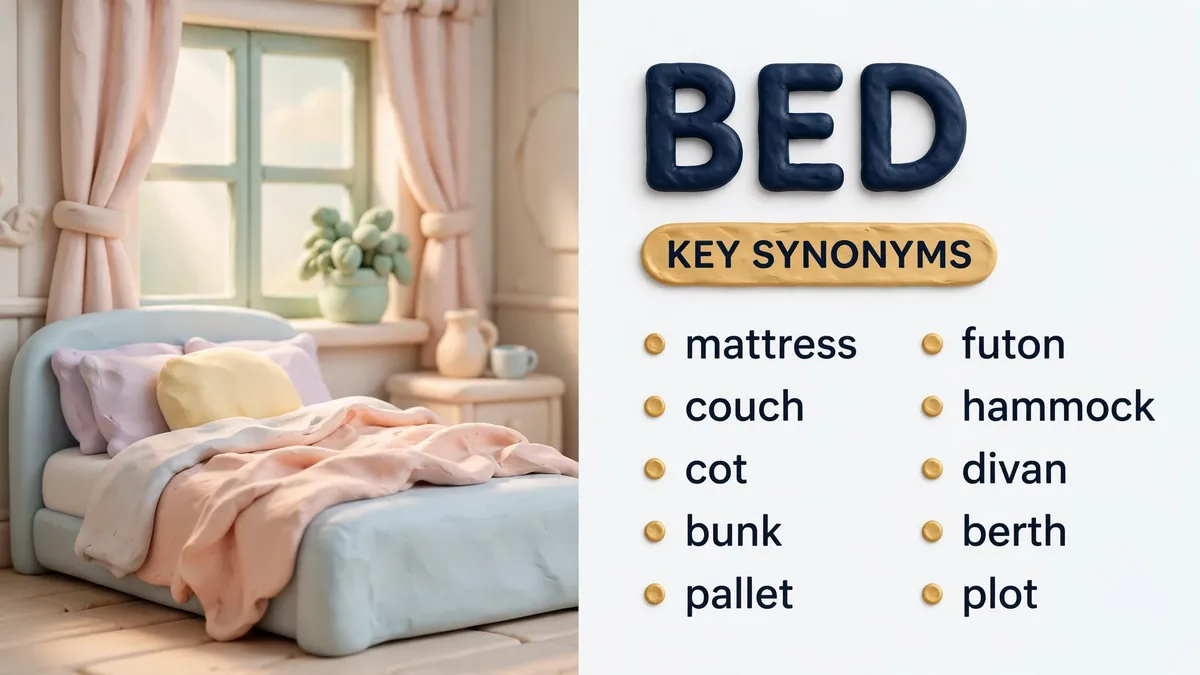
A five-year-old on a river walk stops and points at the water. “Why does a river have a bed?” she asks. Her mother laughs and points at the flower bed beside the path. One small word three pictures: a place to sleep, a patch of garden and the ground under a river.
For the sleeping sense, mattress is the closest synonym though it names only the soft part. This guide compares 15 bed synonyms across all four senses, with meanings, examples and honest limits so you can pick the word that fits.
Top Bed Synonyms
| # | Synonym | Meaning Difference |
|---|---|---|
| 1 | Mattress | The soft part you lie on |
| 2 | Couch | A seat doubling as a bed |
| 3 | Cot | A light folding bed |
| 4 | Bunk | One of a stacked pair |
| 5 | Pallet | A low bed on the floor |
| 6 | Futon | A mattress folding into a seat |
| 7 | Hammock | A sling bed |
| 8 | Divan | A low bed base |
| 9 | Berth | A ship or train bed |
| 10 | Plot | Ground for planting |
Quick Facts About “Bed”
- Part of speech: a noun, and also a verb. As a verb, to bed means to plant or to go to bed. The plural is beds.
- Core meaning: furniture for sleeping, a garden plot, a river bottom, or a rock layer.
- Four main senses: (1) sleep furniture; (2) a garden plot; (3) a river bottom; (4) a rock layer.
- Register: neutral and everyday, fitting home, hotels, gardens, and geology alike.
- Common mistake: calling any soft seat a bed. A couch can serve as a bed for a night, yet it stays a couch first.
The Closest Synonym: Mattress
Mattress is the closest synonym for bed in the sleeping sense, because it names the soft surface you actually lie on. Test the swap and it holds. “She bought a new bed for the spare room” becomes “She bought a new mattress for the spare room.”
Mattress wins on comfort. Shoppers compare mattresses, not beds, when they talk about firmness. Our guide to soften synonyms covers the gentler words for easing a hard surface.
One limit matters. A mattress is only part of a bed, not the whole piece of furniture. You cannot say “make the mattress” when you mean tidy the whole bed, and “go to mattress” is simply wrong.
Where “Bed” Comes From (Etymology)
According to Etymonline, bed comes from Old English bedd, meaning a bed, a couch, or a resting place, and also a garden plot. It traces back to Proto-Germanic *badja-, with cousins in Old Norse, Old High German, and German. Some scholars link it to a PIE root meaning to dig or pierce, as if a sleeping place were dug in the ground, though others doubt it. Both senses already existed in Old English.
The water sense, the bottom of a lake or river, dates from the 1580s, and the geological sense, a thick layer, dates from the 1680s. “Bed and board” is early 13th century, and “bed-and-breakfast” dates from 1838. Merriam-Webster defines bed as furniture for sleep, a plot of ground, the bottom of a body of water, and a layer of material.
The history explains the stretch. A dug-out sleeping hollow grew into anything flat and low: a garden patch, a river floor, and a band of rock.
Bed Synonyms in Detail
Group 1: Beds You Sleep On
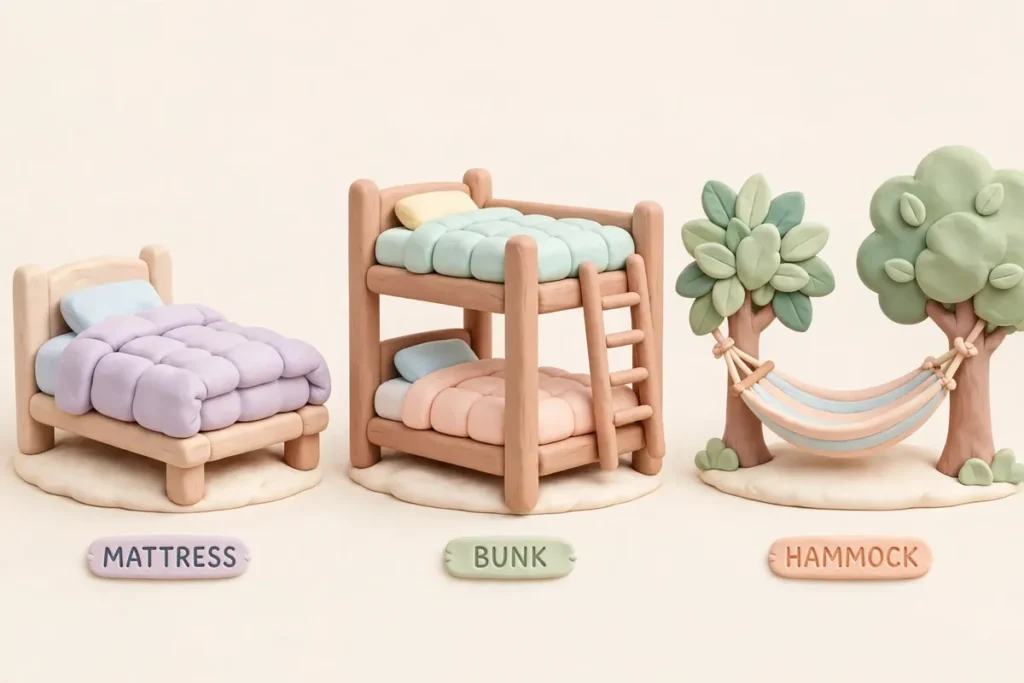
1. Mattress
Meaning: The thick soft pad you lie on.
Difference: The closest swap, yet only part of the bed.
Best Used For: Sleep and bedding shopping.
Formality: Neutral · CEFR: B1 · Frequency: Very common
Example (Sleep): “The new mattress ended her back pain.”
Example (Shopping): “They tested ten mattresses first.”
When NOT to Use It: For the whole piece, use bed.
2. Couch
Meaning: A long soft seat that can serve as a bed.
Difference: Seating first, a bed second, it suits naps and guests.
Best Used For: Living rooms and overnight guests.
Formality: Neutral · CEFR: A2 · Frequency: Very common
Example (Living room): “The couch seats three with room to spare.”
Example (Guest): “Our guest slept on the couch.”
When NOT to Use It: For a bedroom bed, use bed.
3. Cot
Meaning: A light, narrow folding bed for camping or guests.
Difference: Smaller than a bed, built to fold away.
Best Used For: Camps and guest rooms.
Formality: Neutral · CEFR: B1 · Frequency: Common
Example (Camp): “Each camper carried a cot and a sleeping bag.”
Example (Guest): “The hotel sent up a cot for our son.”
When NOT to Use It: For a full-size bed, use bed.
4. Bunk
Meaning: One bed in a stacked pair, reached by a ladder.
Difference: A bunk means sharing a room and saving space.
Best Used For: Dormitories, ships, and cabins.
Formality: Neutral · CEFR: B1 · Frequency: Common
Example (Dorm): “She took the top bunk and hung a curtain.”
Example (Ship): “Sailors slept in bunks stacked three high.”
When NOT to Use It: For a single bed, use bed.
5. Pallet
Meaning: A low bed of straw or blankets on the floor.
Difference: The humblest word here, old-fashioned and makeshift.
Best Used For: Camping and rough sleeping.
Formality: Neutral, old-fashioned · CEFR: B2 · Frequency: Less common
Example (Camp): “They made a pallet of pine branches.”
Example (Story): “The traveler slept on a pallet by the fire.”
When NOT to Use It: For a modern bedroom, use bed.
6. Futon
Meaning: A low mattress that folds away and doubles as a seat.
Difference: A futon blurs the line between bed and couch.
Best Used For: Small flats and studios.
Formality: Neutral · CEFR: B2 · Frequency: Common
Example (Flat): “The futon was a sofa by day, a bed by night.”
Example (Guest): “We unfolded the futon for our weekend guest.”
When NOT to Use It: For a raised frame, use bed.
7. Hammock
Meaning: A sling of cloth or net hung between two trees or posts.
Difference: It hangs in the air, suiting rest outdoors, not a bedroom.
Best Used For: Gardens, porches, and camping.
Formality: Neutral · CEFR: B2 · Frequency: Common
Example (Garden): “She read all afternoon in the hammock.”
Example (Camp): “He strung his hammock between two pines.”
When NOT to Use It: For nightly sleep indoors, use bed.
8. Divan
Meaning: A low bed base without a back or headboard.
Difference: A divan is a base more than a bed.
Best Used For: Bedrooms and guest rooms.
Formality: Neutral · CEFR: C1 · Frequency: Less common
Example (Bedroom): “The divan base came with drawers underneath.”
Example (Guest): “A divan in the study doubles as a spare bed.”
When NOT to Use It: For a framed bed, use bed.
Group 2: Places to Rest and Sleep
9. Berth
Meaning: A sleeping place on a ship or train.
Difference: A berth belongs to travel.
Best Used For: Ships and trains.
Formality: Neutral · CEFR: C1 · Frequency: Less common
Example (Ship): “Her berth on the ferry was small but clean.”
Example (Train): “He booked a sleeper berth for the overnight train.”
When NOT to Use It: For a bed at home, use bed.
10. Cradle
Meaning: A small bed for a baby, often on rockers.
Difference: A cradle is only for infants.
Best Used For: Babies and nurseries.
Formality: Neutral · CEFR: B2 · Frequency: Common
Example (Nursery): “The baby slept in a wooden cradle by the window.”
Example (Song): “Rock-a-bye baby, in the cradle.”
When NOT to Use It: For an adult’s bed, use bed.
11. Daybed
Meaning: A couch-like bed for daytime rest and guests at night.
Difference: It looks like a sofa and works like a bed.
Best Used For: Guest rooms and studies.
Formality: Neutral · CEFR: B2 · Frequency: Less common
Example (Study): “The study daybed holds books by day, guests by night.”
Example (Porch): “She napped on the daybed through the warm afternoon.”
When NOT to Use It: For a main bed, use bed.
12. Sofa Bed
Meaning: A sofa that unfolds or pulls out into a bed.
Difference: A sofa bed hides its second job.
Best Used For: Small flats and guest rooms.
Formality: Neutral · CEFR: B1 · Frequency: Common
Example (Flat): “The sofa bed opens in seconds when friends stay over.”
Example (Office): “A sofa bed in the office saves a hotel bill.”
When NOT to Use It: For nightly sleep, use bed.
Group 3: Ground, Water, and Layers
13. Plot
Meaning: A small piece of ground marked out for planting.
Difference: A plot is the garden sense of bed, a patch of soil.
Best Used For: Gardens and allotments.
Formality: Neutral · CEFR: B1 · Frequency: Very common
Example (Garden): “She planted herbs in the back plot.”
Example (Allotment): “His plot grew tomatoes and beans.”
When NOT to Use It: For a story’s plot, say storyline.
14. Channel
Meaning: The bed of a river or stream, the hollow where water flows.
Difference: A channel names the watercourse, bed the ground beneath it.
Best Used For: Rivers and geography.
Formality: Neutral · CEFR: B2 · Frequency: Very common
Example (River): “The river cut a deep channel through the valley.”
Example (Flood): “Heavy rain pushed the stream beyond its channel.”
When NOT to Use It: For a TV channel, say station.
15. Stratum
Meaning: A layer of rock or soil, one band in a stack.
Difference: Stratum is the formal geological word, plural strata.
Best Used For: Geology and archaeology.
Formality: Formal · CEFR: C1 · Frequency: Less common
Example (Geology): “Each stratum tells a chapter of deep time.”
Example (Dig): “The dig found pottery in a stratum of dark clay.”
When NOT to Use It: For a thin sheet, use layer; for sleep, use bed.
Where the Swap Breaks Down
In short: only inside the same meaning group.
- “She bought a new mattress for the spare room.” (the sleeping surface)
- “She bought a new bed for the spare room.” (the whole piece of furniture)
- “She bought a new hammock for the spare room.” (a hammock hangs outdoors, say bed)
- “They planted roses in the flower plot.” (a garden patch)
- “They planted roses in the flower mattress.” (a mattress is for sleep, say plot)
- “The river ran low over its channel.” (the watercourse)
- “The river ran low over its divan.” (a divan is furniture, say channel)
- “The cliff showed a stratum of red sandstone.” (a layer of rock)
- “The cliff showed a bunk of red sandstone.” (a bunk is a bed, say stratum)
Before you substitute, ask which kind of bed it is.
Words Commonly Confused With Bed
Bed versus bedroom matters for the room. A bedroom is the room where the bed stands, while the bed is the furniture itself. You sleep in both, yet only one of them can be made in the morning. Say “make the bed,” never “make the bedroom.”
Bed versus sleep matters for the act. Sleep is what you do, while bed is where you do it. A good night’s sleep needs a good bed, yet the two words never swap.
Bed versus mattress matters for the part and the whole. A mattress is the soft pad inside the bed, and the bed is frame, mattress, and bedding together.
Bed versus couch matters for the job. A couch is seating that can double as a bed for a night, while a bed is built for sleep every night.
Bed versus plot matters for the garden. A flower bed and a flower plot mean the same patch of soil, yet plot also names the story of a novel. A garden plot grows roses, and a story plot grows twists.
Bed versus layer and seam matters for the ground. A layer is any flat band of material, and a seam is a thin layer, often of coal or ore. Geologists use stratum for a rock layer and keep bed for a broad band, as in a bed of clay.
Best Alternatives by Context
At a hotel. A traveler asks about the mattress first, since it touches the body. Mattress fits best, because hotels sell sleep by softness, and our guide to quality synonyms covers the words that name that good night’s worth.
In a dormitory. Two students share a small room with one tall frame. Bunk fits, because the stacked beds save floor space. Nobody calls a top bunk a mattress.
On a camping trip. A walker sleeps under trees with a light pack. Hammock fits for warm nights, since it needs no ground. When the ground is the only option, pallet fits instead.
In the garden. A gardener marks out a rectangle of soil for herbs. Plot fits best, naming the patch itself, ready for seeds. Flower bed says the same thing with a softer ring.
On a ship. A passenger climbs into a narrow sleeping shelf in a cabin. Berth fits: it belongs to travel by sea and rail. Bed would sound like a hotel room, and a ship is not a hotel.
In a small flat. A studio has one room for sitting, working, and sleeping. Futon fits by day and night, folding from seat to bed. Sofa bed fits too when the room wants a proper sofa look.
With a team on an away trip. A youth team shares a bunk room after a match. Bunk fits the room, while the shared effort needs its own words, and our guide to teamwork synonyms covers the vocabulary for that shared work.
Reading a geology report. A survey describes bands of rock in a cliff face. Stratum fits: the formal word for one layer in a stack. Bed works here too, as in a bed of clay, yet stratum sounds like the report.
Which Bed Synonym Should I Choose?
| Situation | Best pick | Why it wins |
|---|---|---|
| The lying surface | Mattress | The closest word |
| A seat for guests | Couch | The double job |
| A light folding bed | Cot | The portability |
| A stacked bed | Bunk | The saved space |
| A makeshift bed | Pallet | The simplicity |
| A folding mattress | Futon | The two jobs |
| A sling bed | Hammock | The outdoors |
| A low base | Divan | The base |
| A ship berth | Berth | The travel |
| A baby’s bed | Cradle | The tenderness |
| A daytime bed | Daybed | The daytime use |
| A sofa that opens | Sofa bed | The hidden bed |
| A planting patch | Plot | The garden |
| A river hollow | Channel | The watercourse |
| A rock layer | Stratum | The geology |
Collocations and Idioms With Bed
Only combinations native speakers actually use:
- make the bed: as in “She makes the bed every morning.”
- go to bed: as in “The children go to bed at eight.”
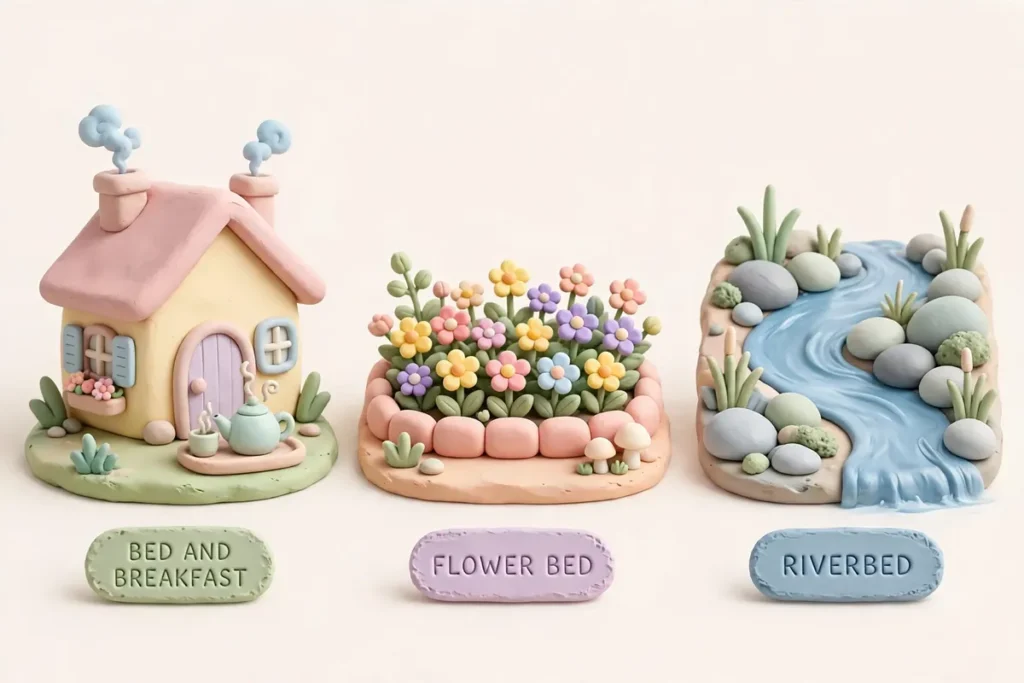
- bed and breakfast: as in “We stayed at a bed and breakfast.”
- flower bed: as in “Tulips filled the flower bed.”
- riverbed: as in “The riverbed showed stones.”
- bed of roses: as in “Running a small shop is no bed of roses.”
- bedtime: as in “Bedtime stories are the best part.”
- stay in bed: as in “He stayed in bed with a cold.”
- get out of bed on the wrong side: as in “She got out of bed on the wrong side.”
- deathbed: as in “He made his peace on his deathbed.”
What Bed Is Not: Opposites for Sleep, Soil, and Water
For the sleeping place. Wakefulness is the state of staying awake, the direct opposite of the sleep a bed promises. A chair is a seat, not a bed, and it points to sitting up, not lying down. For everyday writing, the plain opposite is being awake.
For the garden plot. Bare ground is soil with nothing planted, the empty version of a flower bed. Pavement is stone or concrete where nothing grows. A plot full of flowers has an opposite in bare earth, not in a single word.
For the river bottom. The surface of the water is the top of the river, the far side of the bed below. The banks hold the river in, not the floor it runs over. High water hides the bed, and low water shows it.
For the layer. A single piece with no bands has no strata at all. The surface of a rock is its outer face, not one of the beds inside it. When a writer means the top rather than a band within, surface is the word.
American vs British English
Bed is spelled and used the same in American and British English. In the United States, a cot is a light camp bed, while in Britain a cot is a baby’s bed, and Americans call that a crib.
A divan bed is British; Americans say a platform bed. Twin bed is American for what Britons call a single bed.
Practice Exercises
Exercise 1: Fill in the blank. Choose the best word from the list: mattress, bunk, hammock, plot, berth, stratum.
- “She tested the new ______ and slept better.”
- “The gardener marked out a sunny ______ for tomatoes.”
- “He strung his ______ between two pines.”
- “The sailor climbed into his ______ as the ship left.”
- “She took the top ______ and hung a curtain for privacy.”
- “The cliff showed a ______ of red sandstone.”
Exercise 2: Correct the mistake. Each sentence uses the wrong bed word. Fix it.
- “They planted roses in the flower mattress.”
- “The river ran low over its divan.”
- “Our guest slept on the bedroom and woke up smiling.”
- “The cliff showed a bunk of red sandstone.”
Answer key
Exercise 1: (1) mattress: the soft surface; (2) plot: a garden patch; (3) hammock: a sling bed; (4) berth: a ship’s sleeping place; (5) bunk: a stacked bed; (6) stratum: a rock layer.
Exercise 2: (1) “They planted roses in the flower bed” fits a garden patch, not sleep; (2) “The river ran low over its channel” fits a watercourse, not furniture; (3) “Our guest slept on the couch” fits a seat that doubles as a bed, not a room; (4) “The cliff showed a stratum of red sandstone” fits a rock layer, not a bed.
Frequently Asked Questions
What is the best synonym for bed?
Mattress is the best synonym for bed in most sentences, because it names the soft surface you actually lie on. Couch fits a seat that doubles as a bed, cot fits a light folding bed, and plot fits a garden patch.
What is the difference between bed and mattress?
A bed is the whole piece of furniture: the frame, the mattress, and the bedding together. A mattress is only the thick soft pad inside it. You make a bed, you buy a mattress, and you cannot swap the words when the frame or sheets matter.
Can couch replace bed?
Only for a night, and only in casual speech. A couch is seating first, built for sitting, and it can serve as a bed when a guest stays over. For nightly sleep it fails: backs ache, and nobody keeps a couch as a bed all winter.
What is a riverbed?
A riverbed is the ground at the bottom of a river, the floor the water runs over. It is made of sand, stones, or mud, and it shows when the water runs low. The word keeps the old sense of bed as a low place, now filled with water instead of sleep.
What is the opposite of bed?
Bed has no single one-word opposite, since it covers four senses. For sleep, the opposite is wakefulness. For a garden plot, bare ground is the empty version. And for a riverbed, the surface sits above it, and for a rock layer, the surface is the outer face.
Is bed the same in British and American English?
Yes, bed is spelled and used the same on both sides of the Atlantic. The words around it differ: in the United States a cot is a camp bed, while in Britain a cot is a baby’s bed. A divan bed is British, and Americans often say a platform bed instead.
Conclusion
Back on the river walk, the child gets her answer. A river has a bed because the word began with a low, flat place to lie down, and a river lies down in its hollow.
Mattress covers the sleep, plot the garden, channel the water, and stratum the rock. Pick the word that matches your sentence.

About Sajjad Ahmed
Sajjad Ahmed is the author behind Guest Paster, where he writes about English vocabulary, synonyms, word meanings, and practical word usage.
His content is designed to help readers understand the differences between similar words, discover suitable alternatives, and use English vocabulary more effectively in everyday writing and communication.
Before publishing, Sajjad focuses on presenting word choices in a clear and easy-to-understand format, with relevant meanings, context, and examples where helpful.
Through Guest Paster, his goal is to make vocabulary learning simpler and provide useful language resources for students, writers, English learners, and anyone looking to expand their vocabulary.
Areas of Focus: English Vocabulary • Synonyms • Word Meanings • Word Usage • Language Learning
Author: Sajjad Ahmed
Website: Guest Paster