
Profound is an adjective for something very deep in thought, feeling, or effect, and it appears mostly in formal and reflective writing. Alternatives matter because the word is often used loosely, and a more precise choice sharpens the sentence.
For emotions and general use, deep is the best match: deep gratitude, deep loss. For impact, significant or far-reaching is usually more accurate, and for ideas, insightful or penetrating fits better.
To choose, decide what is actually deep, whether the emotion, the thinking, or the consequences, and use the word that names that quality.
Another Word For Profound
| # | Synonym | Meaning Difference |
| 1 | Deep | Plainer; closest all-purpose match |
| 2 | Significant | Stresses importance, not depth |
| 3 | Intense | Stresses strength of feeling |
| 4 | Far-reaching | Wide, lasting consequences |
| 5 | Insightful | Shows clear understanding |
| 6 | Penetrating | Sharp, probing thought |
| 7 | Heartfelt | Sincerely expressed emotion |
| 8 | Overwhelming | Feeling too strong to manage |
| 9 | Fundamental | Affects the basic foundation |
| 10 | Thought-provoking | Prompts serious reflection |
Quick Facts About Profound
| Detail | Answer |
| Part of speech | Adjective |
| Simple meaning | Very deep, intense, or far-reaching |
| Pronunciation | /prəˈfaʊnd/ |
| Syllables | 2 (pro-found) |
| Word forms | profoundly, profoundness, profundity |
| Formality | Neutral to formal |
| CEFR level | C2 |
| Closest synonym | Deep |
| Best used for | Ideas, feelings, effects, major change |
What Is the Closest Synonym for Profound?
The closest synonym is deep. Both words describe something that reaches well below the surface, whether that is a feeling (“deep sadness”), an understanding (“deep understanding”), or an influence (“a deep influence”). The difference is mainly tone and range.
Profound sounds weightier and more rhetorical, while deep is plainer, warmer, and far more common in everyday English. Deep also has many literal uses, such as deep water or a deep voice, where profound would sound unnatural today.
Deep loses some force in sentences about large-scale change, where “profound change” or “fundamental change” reads more naturally than “deep change.”
Word Origin and Etymology
According to Etymonline, profound dates to around 1300, when it meant “characterized by intellectual depth, very learned.” It came from Old French profont or profund and directly from Latin profundus, meaning “deep, bottomless, vast.”
The Latin word combines pro (“forth”) with fundus (“bottom”). Latin already had both literal and figurative senses, but because English already had deep, profound has been used mainly in a figurative sense.
The sense of “deeply felt, intense” appears from around 1400, and in the 15th century the word was also used of deep lakes and wounds.
Can These Synonyms Be Used Interchangeably?
Sometimes, but not reliably, because the right word depends on the noun that follows.
Usually: deep swaps in for profound with feelings and understanding, as in “deep sadness” or “deep understanding.”
Sometimes: significant, substantial, and far-reaching replace profound in impact and change, but they stress importance or breadth instead of depth.
Rarely: heartfelt works only where sincere emotion is the point, such as thanks or sympathy; insightful and penetrating work only for ideas and questions.
No: words such as philosophical or intellectual are often linked with profound thought, but they do not mean the same thing.
Multiple Meanings: Separate Synonym Sets
Dictionaries describe profound in overlapping senses, so each set below is kept separate. A few words appear in more than one set because they genuinely work in more than one sense.
Meaning 1: Deep understanding or thought
Example: The book offers a profound examination of grief.
deep, insightful, penetrating, thought-provoking, perceptive, weighty.
Meaning 2: Strong feeling or emotion
Example: She felt a profound sense of gratitude.
deep, intense, heartfelt, overwhelming, deep-seated, immense, powerful.
Meaning 3: Major effect, change, or influence
Example: The discovery had a profound impact on the field.
significant, far-reaching, fundamental, transformative, sweeping, substantial, powerful.
Do not mix the sets. “Heartfelt impact,” for example, does not naturally replace “profound impact.”
Detailed Synonym Meanings and Examples
1. Deep
Meaning: Defined in full in the closest-synonym section above; this entry covers where it substitutes.
Difference from Profound: Plainer and more conversational, with less ceremony.
Best Used For: Feelings, understanding, relationships, everyday writing (Meanings 1 and 2).
Formality: Neutral
CEFR Level: A2
Frequency: Very Common
Examples:
- She left a note of deep gratitude for the night nurses. (personal)
- The merger created a deep divide between the sales and support teams. (workplace)
When NOT to Use It: Skip it when you want to signal a large, measurable effect, because it stays vague about scale.
2. Significant
Meaning: Important enough to be clearly noticed or measured.
Difference from Profound: It carries weight but very little emotion.
Best Used For: Impact, change, findings, consequences (Meaning 3).
Formality: Neutral
CEFR Level: B2
Frequency: Very Common
Examples:
- Losing the contract had a significant impact on quarterly revenue. (business)
- The trial reported a significant improvement in recovery times. (research)
When NOT to Use It: Be careful in research writing, where it can be read as “statistically significant.”
3. Intense
Meaning: Experienced with exceptional force or strength.
Difference from Profound: It measures strength, not depth or lasting effect.
Best Used For: Emotions, pressure, scrutiny, reactions (Meaning 2).
Formality: Neutral
CEFR Level: B2
Frequency: Common
Examples:
- He felt intense relief when the surgeon walked out smiling. (hospital)
- The audit put every expense claim under intense scrutiny. (finance)
When NOT to Use It: Do not use it for wisdom or ideas, since “an intense idea” suggests something else.
4. Far-reaching
Meaning: Having effects that spread well beyond the immediate situation.
Difference from Profound: It measures spread, not depth.
Best Used For: Laws, reforms, decisions, technology (Meaning 3).
Formality: Neutral
CEFR Level: C1
Frequency: Common
Examples:
- The new privacy law has far-reaching consequences for app developers. (legal and tech)
- The council’s budget vote had far-reaching effects on local schools. (civic)
When NOT to Use It: Avoid it for personal feelings, because emotions run deep rather than wide.
5. Insightful
Meaning: Showing an accurate grasp of something complex.
Difference from Profound: It praises the quality of thinking, not the weight of an experience.
Best Used For: Analysis, comments, reviews, observations (Meaning 1).
Formality: Neutral
CEFR Level: C1
Frequency: Common
Examples:
- Her insightful comment in the retrospective changed how we planned the next sprint. (workplace)
- The essay makes several insightful observations about memory. (academic)
When NOT to Use It: Do not use it for grief, impact, or change, because only ideas can be insightful.
6. Penetrating
Meaning: Sharp enough to reach what lies hidden beneath appearances.
Difference from Profound: It suggests probing and exposing, where profound suggests depth and weight.
Best Used For: Questions, analysis, criticism (Meaning 1).
Formality: Formal
CEFR Level: C2
Frequency: Uncommon
Examples:
- The journalist asked a penetrating question about the budget gap. (journalism)
- A penetrating analysis of the supply chain exposed hidden delays. (business)
When NOT to Use It: Skip it in warm, personal writing, where it can sound cold or confrontational.
7. Heartfelt
Meaning: Sincerely and warmly meant.
Difference from Profound: It describes how genuine a message is, not how deep an experience goes.
Best Used For: Thanks, condolences, apologies, tributes (Meaning 2).
Formality: Neutral
CEFR Level: C1
Frequency: Common
Examples:
- We owe heartfelt thanks to the volunteers who stayed until midnight. (community event)
- Please accept my heartfelt condolences on your father’s passing. (sympathy card)
When NOT to Use It: Avoid it for analysis or structural change, since it only fits feelings someone expresses.
8. Overwhelming
Meaning: So strong that it becomes hard to resist or manage.
Difference from Profound: It adds a sense of being swamped.
Best Used For: Grief, relief, joy, public response (Meaning 2).
Formality: Neutral
CEFR Level: C1
Frequency: Common
Examples:
- An overwhelming sense of loss followed the news of the plant closure. (community)
- Overwhelming gratitude from patients filled the clinic’s guestbook. (healthcare)
When NOT to Use It: Do not use it in calm, measured writing, because it implies being swamped.
9. Fundamental
Meaning: Relating to the essential basis of something.
Difference from Profound: It points to the root of a change, not its emotional force.
Best Used For: Change, shift, difference, flaw, question (Meaning 3).
Formality: Neutral to formal
CEFR Level: B2
Frequency: Common
Examples:
- The software update caused a fundamental change in how teams log their hours. (workplace)
- The debate raises a fundamental question about fairness. (academic)
When NOT to Use It: Skip it when feeling is the point, since it reads as clinical.
10. Thought-provoking
Meaning: Likely to make people stop and think seriously.
Difference from Profound: It describes the reaction it causes, not the depth itself.
Best Used For: Films, books, lectures, questions (Meaning 1).
Formality: Neutral
CEFR Level: C1
Frequency: Common
Examples:
- The documentary is accessible without being simple, and it is thought-provoking throughout. (media)
- He ended the lecture with a thought-provoking question about privacy. (education)
When NOT to Use It: It cannot replace profound before nouns such as loss or impact.
11. Transformative
Meaning: Producing a lasting change in character or condition.
Difference from Profound: It insists that something actually changed.
Best Used For: Experiences, technologies, programs (Meaning 3).
Formality: Neutral to formal
CEFR Level: C1
Frequency: Common
Examples:
- A year abroad was a transformative experience for her. (personal)
- Digital tools have had a transformative effect on publishing. (industry)
When NOT to Use It: Avoid it when nothing really changed, since it overstates the effect.
12. Deep-seated
Meaning: Firmly rooted and hard to remove.
Difference from Profound: It adds persistence and long-standing roots.
Best Used For: Fears, beliefs, resentment, attitudes (Meaning 2).
Formality: Neutral
CEFR Level: C1
Frequency: Uncommon
Examples:
- The dispute exposed deep-seated mistrust between the two departments. (workplace)
- His reluctance came from a deep-seated fear of failure. (personal)
When NOT to Use It: Do not use it to mean merely clever or important.
13. Powerful
Meaning: Having a strong effect on thoughts, feelings, or events.
Difference from Profound: It stresses force, not depth.
Best Used For: Messages, performances, influence (Meanings 2 and 3).
Formality: Neutral
CEFR Level: B1
Frequency: Very Common
Examples:
- The final scene had a powerful emotional effect on the audience. (film)
- Her testimony delivered a powerful message to the committee. (public speaking)
When NOT to Use It: Skip it in precise academic analysis, where it is too general.
14. Perceptive
Meaning: Quick to notice and understand important details.
Difference from Profound: It highlights judgment and attention, not weight.
Best Used For: Comments, criticism, observations (Meaning 1).
Formality: Neutral
CEFR Level: C1
Frequency: Uncommon
Examples:
- His perceptive comments changed the direction of the meeting. (workplace)
- The reviewer offers a perceptive reading of the protagonist. (literary)
When NOT to Use It: It cannot replace profound for strong emotions.
15. Sweeping
Meaning: Covering a very wide range at once.
Difference from Profound: It emphasizes breadth, not depth.
Best Used For: Reforms, policies, organizational changes (Meaning 3).
Formality: Neutral
CEFR Level: C1
Frequency: Common
Examples:
- The company announced sweeping changes to its leave policy. (HR)
- Parliament approved sweeping reforms to the refund system. (government)
When NOT to Use It: Avoid it for ideas or feelings, since it describes spread.
16. Substantial
Meaning: Large or important enough to matter.
Difference from Profound: It signals scale and seriousness without emotional depth.
Best Used For: Impact, evidence, changes, terms (Meaning 3).
Formality: Formal
CEFR Level: C1
Frequency: Common
Examples:
- The policy had a substantial impact on rural clinics. (healthcare)
- Substantial changes to the lease terms required legal review. (legal)
When NOT to Use It: Skip it for feelings, since it measures amount, not intensity.
17. Immense
Meaning: Extremely large in degree.
Difference from Profound: It stresses sheer size, with no sense of depth.
Best Used For: Pride, relief, gratitude, pressure (Meaning 2).
Formality: Neutral
CEFR Level: C1
Frequency: Common
Examples:
- She felt immense pride watching her daughter cross the stage. (family)
- Immense relief spread through the crowd when the power came back on. (public event)
When NOT to Use It: Do not use it for intellectual depth, because “an immense idea” suggests size.
18. Weighty
Meaning: Serious enough to demand careful thought.
Difference from Profound: It signals gravity, while profound signals depth.
Best Used For: Questions, matters, responsibilities (Meaning 1).
Formality: Formal
CEFR Level: C2
Frequency: Uncommon
Examples:
- The committee faced weighty questions about long-term funding. (governance)
- The case raised weighty matters of conscience for the jury. (legal)
When NOT to Use It: Avoid it in casual writing, where it sounds stiff.
Best Alternatives by Context
Everyday conversation: deep, powerful. They sound natural without making ordinary speech formal.
Formal writing: significant, far-reaching, fundamental.
Academic writing: significant for importance, fundamental for foundational issues, insightful for analysis, and deep when conceptual depth is truly meant.
Business communication: far-reaching, sweeping, substantial, transformative. Each names the type of effect more precisely.
Creative writing: overwhelming, deep-seated, immense, penetrating. They separate force, persistence, size, and sharpness.
Social media: deep, powerful, heartfelt, thought-provoking. They read more clearly than stiff alternatives.
Which Synonym Should I Choose?
| Situation | Best Choice | Why |
| Profound gratitude | Heartfelt | Signals sincerity |
| Profound loss or sadness | Deep | Natural and warm |
| Profound impact (general) | Significant | Safe, precise choice |
| Profound impact (wide) | Far-reaching | Shows broad consequences |
| Profound change (basic) | Fundamental | Points to the foundation |
| Profound change (lasting) | Transformative | Implies real transformation |
| Profound influence | Powerful | Stresses strong effect |
| Profound insight | Insightful | Credits the thinking |
| Profound question | Penetrating | Suggests probing |
| “In profound ways” | “In significant ways” | Clear, formal adverbial phrase |
There is no single answer to “what is another word for profound impact.” Significant impact is the safe general choice, far-reaching impact stresses breadth, and transformative impact implies real change.
Exact and Near Synonyms: Difference
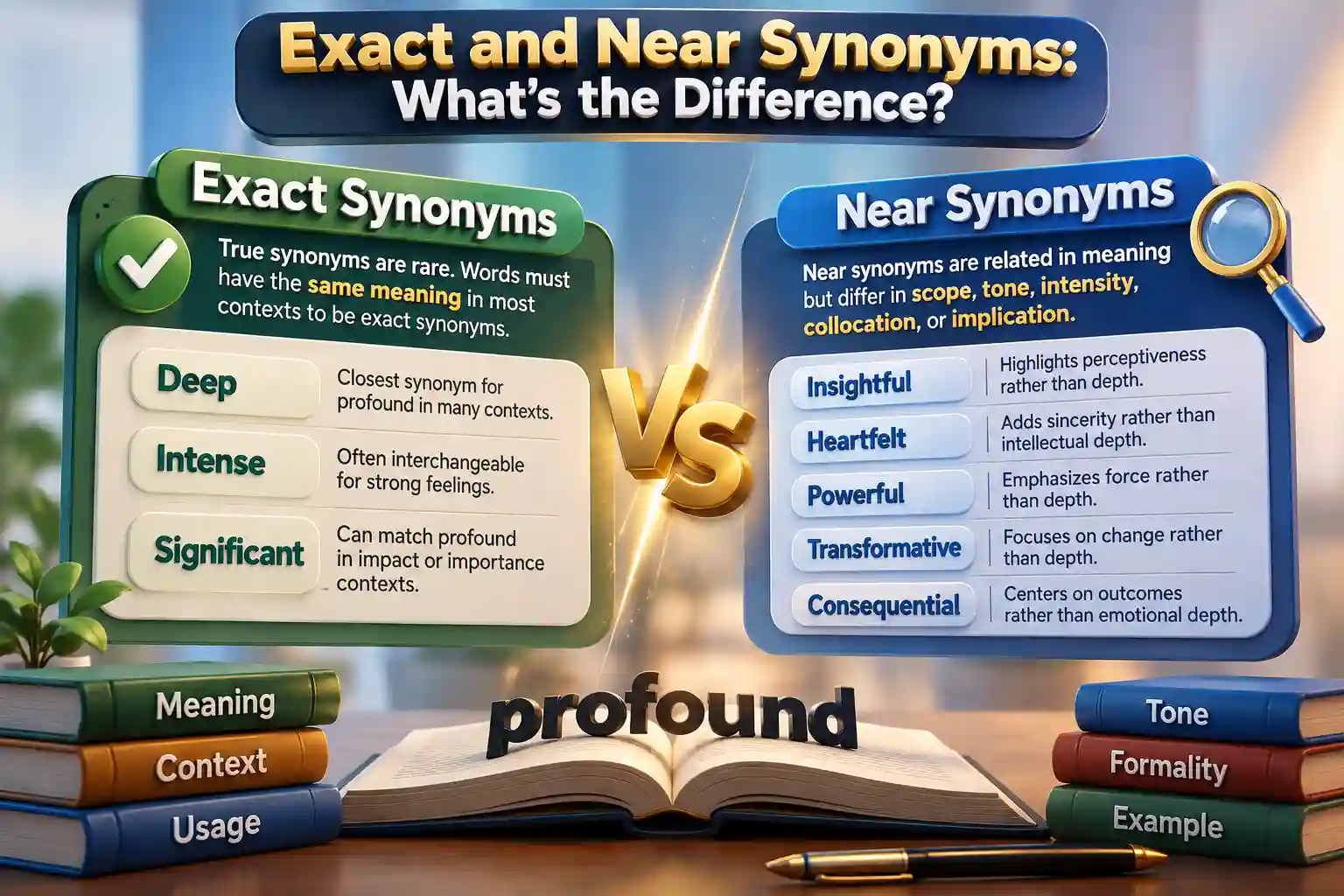
True synonyms are rare because words differ in scope, register, intensity, and the nouns they accept. Profound bundles three ideas: depth, intensity, and reach. Most alternatives keep only one. Deep keeps depth, intense keeps strength, and far-reaching keeps reach.
That is why a substitute can be correct and still change the sentence. A profound influence might be powerful or far-reaching, but those words highlight different qualities: strength in one case, breadth in the other.
Words Commonly Confused with Profound
These words overlap with profound in some contexts but fail the substitution test, so they are not true synonyms.
| Word | Why It Isn’t a Synonym |
| Profuse | Means abundant; looks and sounds similar |
| Abstruse | Means hard to understand |
| Esoteric | Means known by a small group |
| Philosophical | Describes philosophy or a calm outlook |
| Wise | Describes judgment, not depth |
| Complex | Means complicated, not deep |
| Serious | Broader in meaning and tone |
| Meaningful | Means personally significant; milder |
| Thoughtful | Milder; also means considerate |
| Important | Names value, not depth or force |
Words for severity and tone sometimes sit near profound in a thesaurus, so if your sentence is about harshness instead, see synonyms for harsh.
Common Mistakes
| Mistake | Better | Why |
| Profound bleeding | Profuse bleeding | Profuse means abundant |
| Heartfelt analysis | Insightful analysis | Heartfelt means sincere |
| Insightful sadness | Deep sadness | Insightful concerns understanding |
| Transformative gratitude | Heartfelt gratitude | No change is implied |
| Profoundly huge building | Very large building | Profoundly is not a size word |
Another frequent error is assuming significant works in every sentence where profound does. It suits effects and changes well, but it rarely reproduces the emotional or intellectual weight.
Antonyms of Profound
Because profound has more than one meaning, its opposites change by sense.
1. Opposites for Meaning : deep thought or understanding
| # | Antonym | Why It’s the Opposite |
| 1 | Shallow | Lacking depth of thought |
| 2 | Superficial | Stays on the surface |
| 3 | Simplistic | Too simple for the subject |
| 4 | Trite | Worn out by overuse |
| 5 | Banal | Dull and unoriginal |
| 6 | Facile | Too easy, lacking thought |
2. Opposites for Meaning : strong feeling
| # | Antonym | Why It’s the Opposite |
| 1 | Mild | Low in intensity |
| 2 | Slight | Small in degree |
| 3 | Faint | Barely felt |
| 4 | Moderate | Not extreme |
| 5 | Weak | Lacking force |
3. Opposites for Meaning : major effect or change
| # | Antonym | Why It’s the Opposite |
| 1 | Minor | Of little importance |
| 2 | Trivial | Not worth attention |
| 3 | Negligible | So small it can be ignored |
| 4 | Insignificant | Without real importance |
| 5 | Marginal | Barely makes a difference |
| 6 | Cosmetic | Changes only appearance |
| 7 | Superficial | Affects only the surface |
So the best “profound antonym and synonym” pair depends on context: profound/shallow for thought, profound/mild for feeling, and profound/minor for effect.
Real-World Collocations and Phrases
Part A: Common collocations
Verb + profound: have a profound effect on, exert a profound influence on, leave a profound impression, make a profound difference.
Profound + noun: profound impact, profound change, profound insight, profound understanding, profound sadness, profound grief, profound regret, profound shock, profound silence, profound implications.
Adjective + profound: truly profound, deeply profound, both profound and lasting.
Profound + preposition: profound effect on, profound influence on, profound implications for.
Adverb use: profoundly grateful, profoundly moved, profoundly affected, profoundly different.
If you need a synonym for profoundly, deeply is the closest for feelings and reactions, as in “deeply grateful.” For differences and changes, fundamentally or significantly often fits better.
Part B: Set phrases
Profound is not part of many fixed idioms, so only established expressions are listed: “a profound sense of loss,” “with profound gratitude,” “our profound condolences,” “a profound silence,” and “profound sleep.” In clinical writing, profound also means very severe, as in “profound hearing loss.”
Practice Exercises
A. Fill in the blanks
Word bank: heartfelt, far-reaching, penetrating, intense, deep-seated.
- Please accept our ______ condolences.
- The new tax law will have ______ consequences for small shops.
- Her ______ question exposed the flaw in the plan.
- The goalkeeper felt ______ pressure before the penalty.
- Years of neglect had left a ______ mistrust between the neighbors.
B. Rewrite the sentences
- The film had a profound effect on me. (use deep)
- Her profound analysis changed the board’s mind. (use insightful)
- The new regulation had a profound impact on small businesses. (use significant)
C. Match the words
| Word | Meaning |
| 1. Significant | A. Sharp and probing |
| 2. Heartfelt | B. Wide-ranging in scope |
| 3. Sweeping | C. Important and measurable |
| 4. Penetrating | D. Sincerely meant |
| 5. Transformative | E. Producing lasting change |
D. Vocabulary quiz
- Which word best replaces profound in “profound gratitude”? (a) Heartfelt (b) Penetrating (c) Sweeping (d) Fundamental
- Which word fits “a ______ question about the budget”? (a) Overwhelming (b) Penetrating (c) Immense (d) Deep-seated
- Which is an antonym of profound in “a profound thinker”? (a) Insightful (b) Weighty (c) Shallow (d) Perceptive
- Which word best describes a lecture that makes people reflect? (a) Thought-provoking (b) Substantial (c) Intense (d) Immense
- Which word is NOT a synonym of profound? (a) Fundamental (b) Profuse (c) Substantial (d) Deep
Answer key
A: 1 heartfelt, 2 far-reaching, 3 penetrating, 4 intense, 5 deep-seated.
B: 1 “The film had a deep effect on me.” 2 “Her insightful analysis changed the board’s mind.” 3 “The new regulation had a significant impact on small businesses.”
C: 1-C, 2-D, 3-B, 4-A, 5-E.
D: 1 a, 2 b, 3 c, 4 a, 5 b.
FAQ
What is the closest synonym for profound?
Deep is the closest synonym for profound. Both words describe understanding, meaning, and strong feeling that go beyond the surface. Deep is plainer and more common, while profound sounds weightier and more formal. For effects and changes, significant, far-reaching, or fundamental often communicate the meaning more precisely.
Can profound and deep always be used interchangeably?
No. They overlap in figurative phrases such as profound sadness and deep sadness, but deep also has many physical meanings, such as deep water or a deep voice, where profound sounds unusual in modern everyday English. Profound also fits large-scale change better than deep does.
What does profound mean in simple English?
Profound means very deep in thought, very strongly felt, or very large in effect. A profound idea makes you think deeply, profound grief is extremely strong grief, and a profound change alters a situation at its core. In medical writing it can also mean very severe.
Is profound a formal word?
Profound sits between neutral and formal. It is common in essays, speeches, reports, and reflective writing, and it carries a serious tone. In casual conversation, people usually say deep, powerful, or huge instead, so profound in a quick text message can sound slightly stiff.
How do you use profound in a sentence?
Put profound before an abstract noun: “Her teacher’s encouragement had a profound influence on her career.” The adverb profoundly modifies verbs and adjectives, as in “profoundly grateful.” The noun that follows tells the reader whether you mean intellectual depth, emotional intensity, or a major effect.
What is the opposite of profound?
The opposite depends on the meaning. For depth of thought, shallow and superficial are the closest antonyms. For feeling, mild and slight fit better. And if you use for effect or change, minor, trivial, and insignificant work best. Trite and banal also describe ideas that are the reverse of profound.
Conclusion
Choosing the right alternative to profound makes writing clearer and more honest. A thank-you note sounds sincere with heartfelt, a report sounds exact with far-reaching and a review sounds sharp with insightful.
Keep profound for the moments that truly earn its weight, and pick a more specific word everywhere else.

About Sajjad Ahmed
Sajjad Ahmed is the author behind Guest Paster, where he writes about English vocabulary, synonyms, word meanings, and practical word usage.
His content is designed to help readers understand the differences between similar words, discover suitable alternatives, and use English vocabulary more effectively in everyday writing and communication.
Before publishing, Sajjad focuses on presenting word choices in a clear and easy-to-understand format, with relevant meanings, context, and examples where helpful.
Through Guest Paster, his goal is to make vocabulary learning simpler and provide useful language resources for students, writers, English learners, and anyone looking to expand their vocabulary.
Areas of Focus: English Vocabulary • Synonyms • Word Meanings • Word Usage • Language Learning
Author: Sajjad Ahmed
Website: Guest Paster