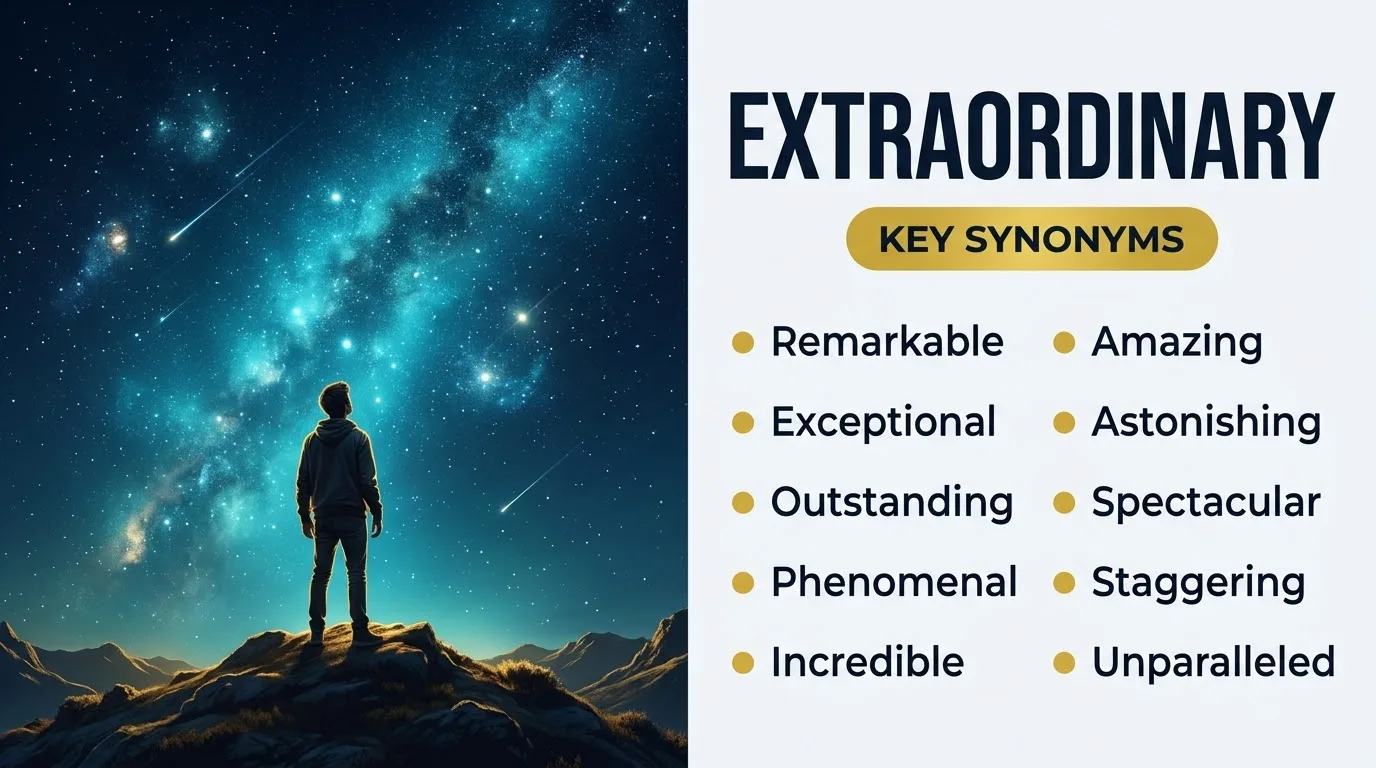
Extraordinary is an adjective meaning far beyond what is ordinary, whether that means impressively good or simply very unusual. People use it for talents, achievements, events, and amounts. Alternatives matter because the word is broad: it can praise, describe, or even warn.
For most everyday writing, choose remarkable; in business or academic writing, choose exceptional or outstanding. If you mean “unusually large,” staggering or prodigious fits better, and for casual speech incredible or awesome sounds natural.
To choose, ask what you are emphasizing (quality, rarity, size, or surprise), then pick the synonym built around it.
Another Word For Extraordinary at a Glance
| # | Synonym | Meaning Difference |
| 1 | Remarkable | Worth noticing; the most flexible all-rounder |
| 2 | Exceptional | Rare and excellent; best for evaluation |
| 3 | Outstanding | Stands above peers; best for performance |
| 4 | Phenomenal | Astonishingly good; suits results and talent |
| 5 | Incredible | Hard to believe; warm, spoken tone |
| 6 | Amazing | Causes wonder; casual and very common |
| 7 | Astonishing | Strong surprise; a little more formal |
| 8 | Spectacular | Visually or dramatically impressive |
| 9 | Staggering | Overwhelming in size or amount |
| 10 | Unparalleled | Nothing else compares; formal and absolute |
Quick Facts About Extraordinary
- Part of speech: Adjective
- Simple meaning: Beyond the ordinary
- Pronunciation: US /ɪkˈstrɔːrdəˌnɛri/ (ik-STROR-duh-nair-ee); UK /ɪkˈstrɔːdnri/ (ik-STRAW-dn-ree). Dictionaries differ slightly on the UK form.
- Syllables: ex-traor-di-nar-y (five in print; often spoken with four in British English)
- Word forms: extraordinarily (adverb), extraordinariness (noun)
- Formality: Neutral, leaning slightly formal
- Closest synonym: Remarkable
- Best used for: Striking achievements, people, events, qualities, and amounts
What Is the Closest Synonym for Extraordinary?
The closest synonym is remarkable. It describes something so unusual or impressive that it is worth remarking on, which matches the double pull extraordinary has: it can mean “unusually good” or just “unusually notable.” That flexibility is why remarkable survives in almost any sentence where extraordinary appears, from a news report to a thank-you note.
The main difference is intensity. Extraordinary points to something outside the normal order, so it can feel a touch larger or more dramatic. Remarkable points to something that earns attention, so it feels slightly more measured. When you need a safe swap and know nothing else about tone, remarkable is the one to pick. When the sentence is an evaluation of skill or performance, exceptional is the sharper choice.
Word Origin and Etymology
According to Etymonline, extraordinary dates to the early 15th century, from Latin extraordinarius (“out of the common order”), which comes from extra ordinem (“out of order,” especially the usual order). The pieces are extra (“out”) and ordinem, the accusative of ordo (“row, rank, series, arrangement”).
Two senses are recorded from the 1580s: one for officials “outside of or in addition to the regular staff,” often hired for a specific purpose, and the broader sense of “remarkable, uncommon, rare, wonderful.” The first explains why the word still appears in envoy extraordinary and extraordinary general meetings.
Etymonline also notes that the noun extra, as in a minor performer in a play (1777) and a special newspaper edition (1793), probably grew out of shortenings of extraordinary.
Can These Synonyms Be Used Interchangeably?
Usually. Remarkable, exceptional, outstanding, and phenomenal can replace extraordinary in most positive sentences with little change in meaning. Exceptional and outstanding sound more evaluative; phenomenal sounds more energetic.
Sometimes. Incredible, amazing, astonishing, and spectacular depend on topic and audience. “An incredible discovery” works in conversation, but a research paper usually says “a remarkable discovery.”
Rarely. Wondrous, singular, peerless, uncommon, and prodigious carry a strong register or a narrower scope. They suit literary or formal writing and can sound affected in ordinary speech.
No. Words that only share a theme with extraordinary, such as exemplary, momentous, or unprecedented, change the meaning when swapped in. They are covered in the confusion section below. Also note that extraordinary is neutral by itself: “extraordinary kindness” and “extraordinary cruelty” are both natural, so the surrounding noun decides whether it praises or criticizes.
Multiple Meanings: Separate Synonym Sets
Extraordinary has three distinct uses. The detailed list in the next section covers the first. The other two are kept apart so the sets never blur.
Sense A: exceptional, remarkable (positive). See the detailed list below.
Sense B: very unusual, strange, or excessive, not necessarily good. This covers “an extraordinary coincidence,” the excessive reading in “extraordinary costs,” and the negative reading in “extraordinary cruelty,” which is how people search for extraordinary in a bad way.
| Synonym | Shade | Example |
| Unusual | Neutral | An unusual coincidence brought them together. |
| Strange | Neutral to uneasy | A strange silence filled the room. |
| Bizarre | Odd, often negative | The ending of the story was bizarre. |
| Peculiar | Mildly odd, slightly formal | A peculiar smell drifted through the hall. |
| Uncanny | Eerie, mysterious | She bore an uncanny resemblance to her mother. |
| Inordinate | Excessive, often negative | The project took an inordinate amount of time. |
| Shocking | Negative | The shocking cruelty horrified readers. |
| Outrageous | Negative | He told an outrageous lie. |
| Appalling | Strongly negative | Conditions at the site were appalling. |
Sense C: special, additional, or called for a purpose (formal). This is the older meaning, used in titles, meetings, and legal language.
| Synonym | Works In | Example |
| Special | Meetings, sessions | A special session of the board began at noon. |
| Emergency | Urgent meetings, measures | Emergency measures took effect on Monday. |
| Unscheduled | Meetings outside the calendar | An unscheduled meeting was called for Friday. |
| Ad hoc | Committees, panels | An ad hoc committee reviewed the proposal. |
| Drastic | Extreme measures | The council took drastic measures. |
Detailed Synonym Meanings and Examples (Sense A: Exceptional, Remarkable)
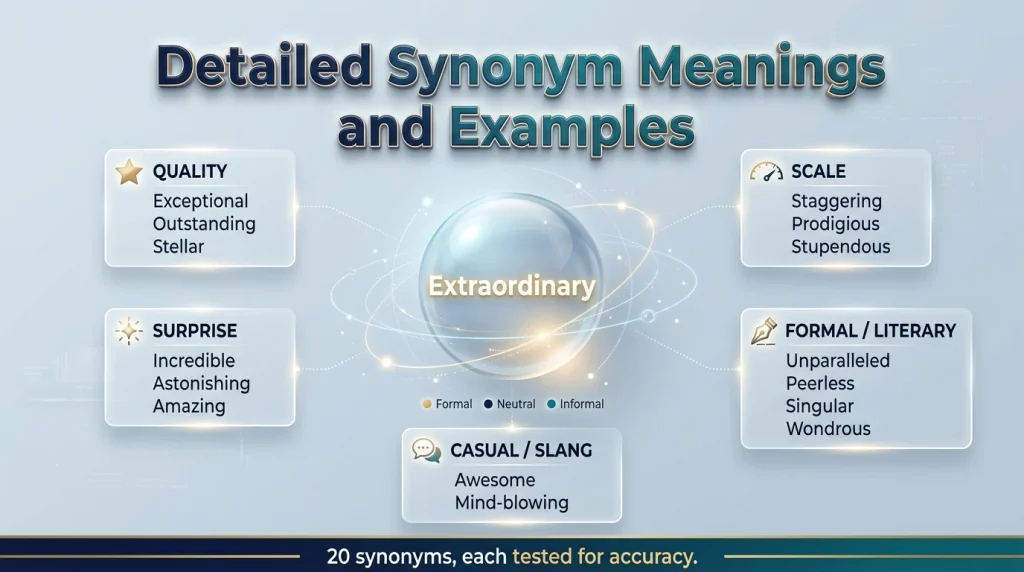
Every word below passed a substitution test: it can replace extraordinary in at least one real sentence without changing the core meaning. CEFR levels are approximate estimates based on typical learner-dictionary placement.
1. Remarkable
Meaning: Covered in full in the closest-synonym section above.
Difference from extraordinary: Gentler and more flexible; works for both praise and neutral observation.
Best Used For: Everyday writing, reviews, profiles, reports.
Formality: Neutral
CEFR Level: B2
Frequency: Common
Examples:
- The team’s remarkable turnaround surprised even the investors. — business
- The museum’s collection is remarkable for its range of early maps. — travel guide
When NOT to Use It: Skip it when you want loud, unreserved enthusiasm, because it can sound restrained.
2. Exceptional
Meaning: Far above the usual standard, like an exception to the rule.
Difference from extraordinary: Focuses on quality and rarity rather than surprise.
Best Used For: Performance reviews, grades, hiring, recommendation letters.
Formality: Neutral to formal
CEFR Level: C1
Frequency: Common
Examples:
- Her exceptional attention to detail kept the audit on schedule. — workplace
- Applicants with exceptional grades may be considered for the scholarship. — academic
When NOT to Use It: Avoid it when you mean odd or strange without implying anything good.
3. Outstanding
Meaning: Clearly better than others in the same group.
Difference from extraordinary: Comparative, because it places something above its peers.
Best Used For: Awards, evaluations, achievements.
Formality: Neutral
CEFR Level: B2
Frequency: Common
Examples:
- He was named outstanding employee of the quarter. — workplace
- Her outstanding contribution to the research is noted in the preface. — academic
When NOT to Use It: Avoid it in finance contexts, where “outstanding” can also mean unpaid.
4. Phenomenal
Meaning: So good that it seems almost beyond normal limits.
Difference from extraordinary: More energetic, and it usually praises results or talent.
Best Used For: Sports, sales, performances.
Formality: Neutral to informal
CEFR Level: C1
Frequency: Common
Examples:
- The startup posted phenomenal growth in its second year. — business
- Her phenomenal voice filled the entire hall. — music
When NOT to Use It: Avoid it in strict academic or legal writing, where it can sound promotional.
5. Incredible
Meaning: So impressive that it is hard to believe.
Difference from extraordinary: Stresses disbelief and emotional reaction.
Best Used For: Conversation, storytelling, reviews.
Formality: Neutral to informal
CEFR Level: B2
Frequency: Very Common
Examples:
- The view from the summit was incredible. — travel
- We raised an incredible amount in one weekend. — community fundraiser
When NOT to Use It: Avoid it in formal reports, where it can be read literally as “not credible.”
6. Amazing
Meaning: Causing strong wonder or pleasure.
Difference from extraordinary: More casual and warmer, and less about being unusual.
Best Used For: Friendly messages, reviews, social posts.
Formality: Informal
CEFR Level: B1
Frequency: Very Common
Examples:
- The staff were amazing and fixed our booking within minutes. — hospitality review
- That was an amazing goal! — sports chat
When NOT to Use It: Avoid it in formal or academic writing, where it reads as overused.
7. Astonishing (and Astounding)
Meaning: Surprising enough to leave you briefly stunned.
Difference from extraordinary: Stresses surprise more than quality. Astounding pushes further, suggesting your assumptions have been overturned.
Best Used For: News, data, discoveries.
Formality: Neutral
CEFR Level: C1
Frequency: Common
Examples:
- The final results showed an astonishing improvement. — education
- An aerial survey revealed an astounding network of ancient roads beneath the forest. — archaeology
When NOT to Use It: Skip it when something is impressive but not surprising, such as steady, expected excellence.
8. Spectacular
Meaning: Strikingly impressive to look at or watch.
Difference from extraordinary: Visual and dramatic, whereas extraordinary can be quiet.
Best Used For: Scenery, events, performances.
Formality: Neutral
CEFR Level: C1
Frequency: Common
Examples:
- The fireworks over the harbor were spectacular. — events
- He made a spectacular save in the final minute. — sports
When NOT to Use It: Avoid it for quiet or intellectual achievements; it also pairs with failures (“a spectacular flop”), so watch the tone.
9. Stellar
Meaning: Of the highest quality, like a star performer.
Difference from extraordinary: Carries a performance and results flavor, with less surprise.
Best Used For: Track records, ratings, reviews.
Formality: Neutral
CEFR Level: C2
Frequency: Common
Examples:
- Her stellar sales record earned her the regional director role. — workplace
- The bakery has a stellar reputation among locals. — retail
When NOT to Use It: Avoid it when you mean unusual rather than good; “stellar” is always positive.
10. Unparalleled
Meaning: Having no equal; nothing else matches it.
Difference from extraordinary: An absolute, comparative claim. Its close cousin unrivaled (US) / unrivalled (UK) adds a competitive flavor.
Best Used For: Formal writing, history, marketing.
Formality: Formal
CEFR Level: C2
Frequency: Uncommon
Examples:
- The library holds an unparalleled collection of medieval manuscripts. — academic
- The company enjoyed unparalleled customer loyalty in its region. — business
When NOT to Use It: Avoid it unless you can defend the claim, because it asserts that nothing else compares.
11. Peerless
Meaning: Matchless, with no equal in skill or quality.
Difference from extraordinary: Names a single undisputed top and sounds more poetic than unparalleled.
Best Used For: Art, craft, tributes to masters.
Formality: Formal (literary)
CEFR Level: C2
Frequency: Rare
Examples:
- Her peerless touch on the harpsichord defined the festival. — music
- The watchmaker’s peerless finishing is visible even without a loupe. — craft
When NOT to Use It: Avoid it when real rivals exist, because the claim will sound inflated.
12. Prodigious
Meaning: Remarkably great in size, amount, or power.
Difference from extraordinary: About scale and force, not just quality.
Best Used For: Effort, memory, output.
Formality: Formal
CEFR Level: C2
Frequency: Rare
Examples:
- He had a prodigious memory for names and dates. — biography
- The factory’s prodigious output surprised the auditors. — business
When NOT to Use It: Avoid it when you are praising quality rather than size or power.
13. Staggering
Meaning: So large or shocking that it is hard to take in.
Difference from extraordinary: Built around overwhelming magnitude, and often used for costs and losses.
Best Used For: Numbers, costs, scale.
Formality: Neutral
CEFR Level: C2
Frequency: Common
Examples:
- She completed a staggering amount of work in one week. — workplace
- The staggering cost of the overruns forced a review of the project. — public works
When NOT to Use It: Avoid it for quiet quality or small-scale achievements.
14. Stupendous
Meaning: Astonishingly large or grand in scope.
Difference from extraordinary: Theatrical and monumental, with an emphasis on sweeping scale.
Best Used For: Engineering feats, stage productions, landscapes.
Formality: Neutral
CEFR Level: C2
Frequency: Uncommon
Examples:
- The railway was celebrated as a stupendous feat of engineering. — history
- The festival closed with a stupendous choral finale. — arts review
When NOT to Use It: Avoid it for subtle or delicate achievements; it can also sound old-fashioned or playful.
15. Marvelous (US) / Marvellous (UK)
Meaning: Causing delighted admiration.
Difference from extraordinary: Warmer and slightly old-fashioned.
Best Used For: Friendly praise, travel writing.
Formality: Neutral
CEFR Level: C1
Frequency: Common
Examples:
- We had a marvelous afternoon at the botanical garden. — leisure
- The orchestra sounded marvelous in the old hall. — arts
When NOT to Use It: Avoid it in modern business writing, where it sounds dated or theatrical.
16. Wondrous
Meaning: Inspiring awe, as if touched by magic.
Difference from extraordinary: Poetic, with an emphasis on enchantment.
Best Used For: Poetry, fantasy, storytelling.
Formality: Formal (literary)
CEFR Level: C2
Frequency: Rare
Examples:
- A wondrous light spilled over the frozen lake. — creative writing
- The explorers described wondrous gardens beyond the mountains. — adventure fiction
When NOT to Use It: Avoid it in everyday speech, where it sounds affected.
17. Singular
Meaning: Unique or remarkable in a way unlike anything else.
Difference from extraordinary: Stresses the one-of-a-kind quality rather than size. For related ideas, see our guide to synonyms for unique.
Best Used For: Literary or formal descriptions of talent or vision.
Formality: Formal
CEFR Level: C2
Frequency: Rare
Examples:
- She possessed a singular gift for languages. — biography
- The architect’s singular vision shaped the entire campus. — design writing
When NOT to Use It: Avoid it in casual contexts, where readers will likely take it to mean “single.”
18. Uncommon
Meaning: Not often found, especially said of admirable qualities.
Difference from extraordinary: Understated, almost a deliberate understatement.
Best Used For: Courage, kindness, talent.
Formality: Neutral to formal
CEFR Level: C1
Frequency: Common
Examples:
- The nurse showed uncommon patience with every family. — healthcare
- He had an uncommon gift for explaining complex ideas. — teaching
When NOT to Use It: Avoid it for large or dramatic events, where it is too mild.
19. Awesome
Meaning: Excellent or very impressive, in casual speech.
Difference from extraordinary: Very casual, with much of its original sense of awe worn away.
Best Used For: Texting, social media, friendly talk.
Formality: Informal
CEFR Level: B2
Frequency: Very Common
Examples:
- That concert was awesome, so we’re going again next year. — social
- Your new design looks awesome. — workplace chat
When NOT to Use It: Avoid it in formal writing or in serious situations.
20. Mind-blowing
Meaning: So impressive that it overwhelms your sense of what is possible.
Difference from extraordinary: Informal and emphatic.
Best Used For: Social posts, tech and science headlines.
Formality: Informal
CEFR Level: C2 (idiomatic)
Frequency: Common
Examples:
- The effects in that film are mind-blowing. — entertainment
- The amount of data a single phone can store is mind-blowing. — tech chat
When NOT to Use It: Avoid it in formal writing, where the compound looks casual.
Best Alternatives by Context
| Tone | Words That Fit |
| Positive, everyday | remarkable, incredible, amazing |
| Positive, formal | exceptional, unparalleled, singular |
| Poetic | wondrous, marvelous, peerless |
| Slang | awesome, mind-blowing, incredible |
| Negative or critical | shocking, outrageous, appalling |
| Neutral “unusual” | unusual, strange, peculiar |
Everyday Conversation
Remarkable, incredible, and amazing sound natural out loud. Use remarkable for a calm observation and incredible when you want to express surprise.
Formal Writing
Exceptional, unparalleled, singular, and prodigious (for size or power) carry the right weight. Reserve unparalleled for claims you can support.
Academic Writing
Remarkable and exceptional work best because they sound measured. Back any strong claim with evidence instead of relying on a bigger adjective.
Business Communication
Outstanding and stellar suit performance and results, while staggering fits numbers and scale.
Creative Writing and Poetic Use
Wondrous and marvelous add enchantment, peerless adds a tribute-like finality, and stupendous adds theatrical scale.
Social Media and Slang
Awesome, mind-blowing, and incredible match the energy of casual posts.
Which Synonym Should I Choose?
| Situation | Best Choice | Why |
| Everyday praise | Remarkable | Works almost anywhere |
| Employee performance review | Exceptional | Objective praise, no informal exaggeration |
| Praising a colleague’s work | Outstanding | Signals performance above peers |
| Reacting to huge numbers | Staggering | Stresses overwhelming scale |
| Poetic or literary tone | Wondrous | Adds a sense of enchantment |
| Claiming no equal | Unparalleled | Absolute, so use carefully |
| Casual chat or posts | Awesome | Matches a relaxed tone |
| Unusual but not good | Strange | Removes accidental praise |
| Extreme in a bad way | Shocking | Carries the criticism |
| Formal meeting or title | Special | Matches the set-phrase sense |
Exact and Near Synonyms: Difference
True synonyms are rare because two words almost never match on every dimension at once. Most synonym pairs differ along four lines.
Register is how formal the word feels. Awesome and exceptional can describe the same talent, but they belong to different rooms.
Scope is what the word is really about. Staggering and prodigious focus on size, spectacular on appearance, and exceptional on quality.
Attitude is whether the word praises, surprises, or merely observes. Incredible leans toward reaction, remarkable toward noticing, and unusual toward neutral description.
Claim is what the word promises beyond “unusual.” Unprecedented is the clearest example: it says something has never happened before, which is a historical claim, not a synonym. Likewise unparalleled asserts that nothing else compares.
That is why the “closest” synonym changes with the sentence. In “an extraordinary amount of work,” staggering is closest. “an extraordinary sunset,” spectacular is closest. In “an extraordinary employee,” exceptional is closest. For more ways to praise quality, see our guide to synonyms for excellent.
Words Commonly Confused with Extraordinary
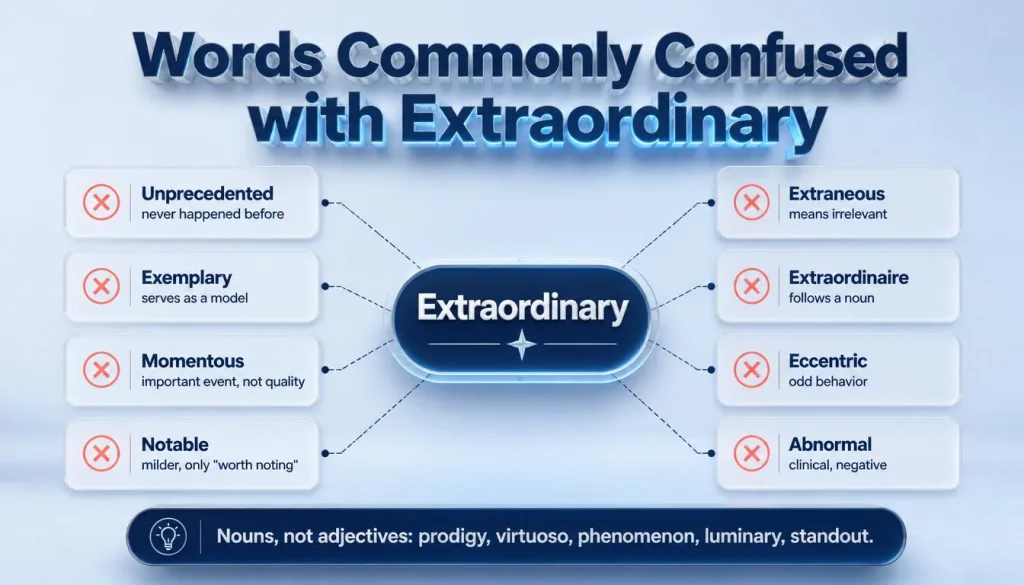
These words failed the substitution test, so they are not true synonyms.
- Unprecedented: means never having happened before, which is a historical claim rather than a quality.
- Exemplary: means serving as a model, not rare or impressive.
- Momentous: describes how important an event is, not how good it is.
- Notable: a milder “worth noting” that does not signal anything beyond the ordinary.
- Extraneous: looks similar but means irrelevant or not essential.
- Extraordinaire: a borrowed French form that follows a noun (“chef extraordinaire”) and cannot sit before it.
- Unwonted: means unaccustomed or out of habit, and sounds archaic outside fiction.
- Eccentric: describes odd behavior or personality, not quality or scale.
- Abnormal: a clinical or negative word for deviating from a norm.
- Extravagant: describes excessive spending or luxury, not talent.
- Supernatural: applies to events beyond nature; extraordinary events stay within it.
- Great: too general to carry the sense of “beyond the ordinary.”
- Prodigy, virtuoso, phenomenon, luminary, standout: common answers for another word for extraordinary person, but these are nouns, so they name the person rather than describing them. To describe a person, use remarkable, exceptional, or outstanding.
Common Mistakes
| Mistake | Better | Why |
| The board held an exceptional meeting. | The board held an extraordinary meeting. | Bylaws use “extraordinary” for off-calendar meetings |
| The audit was an outstanding catastrophe. | The audit was a colossal disaster. | “Outstanding” praises, so it clashes with failure |
| He is an extraordinary chef. | He is a chef extraordinaire. | After a noun, “extraordinary” is a formal title form |
| It was very extraordinary. | It was truly extraordinary. | Strong adjectives pair better with “truly” or “absolutely” |
| An unparalleled lunch. | An excellent lunch. | “Unparalleled” claims nothing else compares |
Antonyms of Extraordinary
1. Sense A (exceptional, remarkable):
| # | Antonym | Why It’s the Opposite |
| 1 | Ordinary | Nothing sets it apart |
| 2 | Commonplace | Seen everywhere, no distinction |
| 3 | Mediocre | Only average quality |
| 4 | Unremarkable | Not worth noticing |
| 5 | Undistinguished | Lacks anything special |
| 6 | Pedestrian | Dull and lacking flair |
| 7 | Middling | Neither good nor bad |
2.Sense B (very unusual, strange):
| # | Antonym | Why It’s the Opposite |
| 1 | Usual | Happens as expected |
| 2 | Normal | Follows the standard pattern |
| 3 | Common | Found everywhere |
| 4 | Typical | Fits the usual type |
| 5 | Familiar | Already well known |
| 6 | Conventional | Follows accepted habits |
| 7 | Expected | Surprises no one |
3.Sense C (special, additional, formal):
| # | Antonym | Why It’s the Opposite |
| 1 | Ordinary | Part of the usual order |
| 2 | Regular | Occurs on a set pattern |
| 3 | Routine | Done as normal practice |
| 4 | Scheduled | Planned in advance |
| 5 | Standard | Follows normal procedure |
American vs British English
The spelling of extraordinary is the same in both varieties. Pronunciation differs: American speakers usually say it with five beats (ik-STROR-duh-nair-ee), while many British speakers compress it to four (ik-STRAW-dn-ree). Dictionaries also record British variants with a fuller middle, so treat the compressed form as common rather than universal.
Tone shifts too. In British English the word is often used with a raised eyebrow, as in “What an extraordinary thing to say,” where it signals disbelief or mild disapproval. American usage leans more toward straightforward praise or surprise. Extraordinary general meeting (EGM) is common in British and Commonwealth business English, while American companies usually say special meeting. Among the synonyms, unrivaled/unrivalled and marvelous/marvellous follow the usual single-L and double-L spellings.
Real-World Collocations and Phrases
Part A: Natural combinations
- Adverb + extraordinary: truly extraordinary, quite extraordinary, simply extraordinary, absolutely extraordinary
- Extraordinary + noun: extraordinary talent, extraordinary courage, extraordinary measures, extraordinary circumstances, extraordinary costs, extraordinary success, extraordinary effort, extraordinary story, extraordinary general meeting
- Verb + extraordinary: seem extraordinary, prove extraordinary, find something extraordinary, sound extraordinary
- Extraordinary + preposition: extraordinary for (its time), extraordinary in (its scope), extraordinary to (watch)
Part B: Established phrases
- “Extraordinary claims require extraordinary evidence”: a well-known principle in science and critical thinking, popularized by Carl Sagan.
- “Out of the ordinary”: a set phrase meaning unusual, often used as a near-equivalent.
- “Extraordinary measures” / “extraordinary circumstances”: standard in legal, news, and policy writing.
- “Extraordinary rendition”: a political and legal term for transferring a detainee to another country outside normal legal process.
- “Envoy extraordinary” / “minister extraordinary and plenipotentiary”: formal diplomatic titles, where the word means “special,” not “amazing.”
Practice Exercises
Fill in the blanks (word bank: outstanding, staggering, wondrous, awesome, special)
- The poem described a ______ garden where lanterns floated in the air.
- The final invoice showed a ______ increase, more than triple the estimate.
- Her ______ record in customer service earned her a promotion.
- “That was ______!” he texted after the concert.
- After the unexpected takeover offer, the shareholders called a ______ meeting.
Rewrite the sentence (replace extraordinary with a better fit for the context)
- The committee praised his extraordinary leadership during the merger. (formal)
- Due to sudden supply disruptions, management authorized extraordinary measures to protect inventory. (corporate memo)
- An extraordinary light covered the valley at dawn. (poetic)
Match the word to its best context
| Word | Best context |
| 1. Prodigious | a. Casual texting |
| 2. Spectacular | b. A huge memory or output |
| 3. Awesome | c. Dramatic fireworks |
| 4. Peerless | d. A literary one-of-a-kind talent |
| 5. Singular | e. No equal in craft or art |
Vocabulary quiz
- Which word best fits a formal report saying no other archive comes close?
A) Awesome B) Unparalleled C) Mind-blowing D) Amazing - Which word best describes an overwhelming amount of money?
A) Staggering B) Wondrous C) Uncommon D) Singular - Which word is NOT a synonym of extraordinary?
A) Remarkable B) Unprecedented C) Exceptional D) Phenomenal - Which word is the opposite of extraordinary?
A) Outstanding B) Stellar C) Ordinary D) Singular - In “extraordinary general meeting,” extraordinary most nearly means:
A) Brilliant B) Special, called for a purpose C) Enjoyable D) Enormous
Answer key
- Fill in the blanks: 1 wondrous, 2 staggering, 3 outstanding, 4 awesome, 5 special
- Rewrite (sample answers): 1 exceptional or outstanding leadership; 2 emergency or drastic measures; 3 a wondrous or marvelous light
- Match: 1-b, 2-c, 3-a, 4-e, 5-d
- Quiz: 1 B, 2 A, 3 B (unprecedented means never having happened before), 4 C, 5 B
FAQ
What is the closest synonym for extraordinary?
The closest synonym for extraordinary is remarkable. Both words describe something that goes beyond the ordinary and deserves attention, and both work for praise or neutral observation. If you want a stronger tone for performance or quality, choose exceptional or outstanding. For scale, staggering is usually a better fit.
Can I use remarkable and extraordinary interchangeably?
Often, yes. Remarkable, exceptional, and outstanding can replace extraordinary in most positive sentences. Be careful with strong or casual words such as unparalleled, wondrous, and awesome, because they change the tone. Also avoid swapping in praise words when extraordinary means strange or when it appears in set phrases like extraordinary general meeting.
What does extraordinary mean?
Extraordinary is an adjective meaning far beyond what is usual or ordinary. It can describe something impressively good, such as an extraordinary talent, or something very unusual, such as an extraordinary coincidence. In some formal titles and phrases, it means special or additional, as in extraordinary general meeting.
Is extraordinary formal or informal?
Extraordinary is neutral to slightly formal. It appears comfortably in business reports, essays, news, and everyday speech. Casual alternatives like awesome or incredible suit friendly conversation, while exceptional, unparalleled, and prodigious fit formal writing. Choose extraordinary when you want a dependable, middle-register word that works for almost any audience.
Does extraordinary always mean something good?
No. Extraordinary means beyond the ordinary, so it can describe admirable things like courage or terrible things like extraordinary cruelty. Context decides the tone. If you want clear praise, choose exceptional or outstanding; if you want to signal something negative, use shocking, outrageous, or appalling. In formal titles, it carries no praise at all.
What is the opposite of extraordinary?
The opposite of extraordinary is ordinary. When you mean the opposite of impressive, use mediocre or unremarkable. When you mean the opposite of strange, use usual, normal, or typical. For the formal meeting sense, regular or scheduled is the natural contrast, as in a regular meeting versus an extraordinary one.
Conclusion
The right word does more than decorate a sentence; it tells the reader exactly what kind of impressive you mean. A staggering figure, an outstanding colleague, and a spectacular view all go beyond the ordinary, but each in a different way, and naming that difference makes your writing sharper and more credible.
Choose what you want the reader to notice, match the register to your audience, and save your strongest words for the moments that truly earn them. If you enjoyed this guide, you may also like our articles on synonyms for profound.

About Sajjad Ahmed
Sajjad Ahmed is the author behind Guest Paster, where he writes about English vocabulary, synonyms, word meanings, and practical word usage.
His content is designed to help readers understand the differences between similar words, discover suitable alternatives, and use English vocabulary more effectively in everyday writing and communication.
Before publishing, Sajjad focuses on presenting word choices in a clear and easy-to-understand format, with relevant meanings, context, and examples where helpful.
Through Guest Paster, his goal is to make vocabulary learning simpler and provide useful language resources for students, writers, English learners, and anyone looking to expand their vocabulary.
Areas of Focus: English Vocabulary • Synonyms • Word Meanings • Word Usage • Language Learning
Author: Sajjad Ahmed
Website: Guest Paster