
You are driving through a town you have never visited when the phone signal drops and the map on the screen freezes. Do you steer by the road signs or do you navigate by memory and luck? Later, a new colleague asks you to navigate the company website to find a form.
Navigate is one verb with three jobs: steering a course, traveling across a place and finding your way through a system or a tricky situation.
This guide sorts 15 navigate synonyms by meaning so you can pick the word that fits. If you are steering, say steer. If you are leading someone somewhere, say guide. And if you are finding a page online say find your way.
10 Navigate Synonyms
| # | Synonym | Meaning Difference |
|---|---|---|
| 1 | Steer | Turn and control direction |
| 2 | Guide | Lead someone to a place |
| 3 | Pilot | Steer a ship or plane |
| 4 | Direct | Show or tell the way |
| 5 | Maneuver | Move skillfully in tight space |
| 6 | Chart | Plan a route |
| 7 | Drive | Control a vehicle |
| 8 | Cross | Go from one side to the other |
| 9 | Traverse | Travel across difficult ground |
| 10 | Explore | Travel to discover new places |
Quick Facts About “Navigate”
- Part of speech: a verb. You navigate a river, a website, or a difficult conversation. The noun is navigation.
- Three core meanings: (1) steer the course of a ship, plane, or vehicle, (2) travel across a place, (3) find your way through a system or a tricky situation.
- Transitive use: navigate takes an object: a road, a river, a menu, or a problem.
- Register: neutral. Navigate suits everyday speech, travel writing, business, and formal reports.
The Closest Synonym: Steer
Steer is the closest synonym for navigate, because it covers the word’s oldest and most basic job: controlling the direction of something that moves. When a driver turns a wheel or a sailor holds a course, steer names that act of control directly.
Still, steer is not identical to navigate. Steer covers only the act of directing. You can steer a car, but you cannot steer a website menu, and steer says nothing about finding your way across unknown ground. Navigate is broader: it covers steering, traveling across, and finding a way through.
Choice test: hands on the wheel means steer. Leading a person means guide. Crossing difficult ground means traverse. A website or a hard problem means find your way or negotiate.
Where “Navigate” Comes From (Etymology)
According to Etymonline, navigate is recorded in the 1580s meaning “move from place to place in a ship, sail.” It was a back-formation from navigation, or else from Latin navigatus, the past participle of navigare, “to sail, sail over, go by sea, steer a ship,” built from navis, “ship,” plus the root of agere, “to set in motion, drive, drive forward.”
The transitive sense, “to pass over in a ship or ships, sail on,” is from the 1640s, and the sense “to steer, direct, or manage in sailing” is from the 1660s. The word later extended to balloons in 1784 and to aircraft in 1901. Merriam-Webster lists the same core senses: to travel by water, to steer a craft, and to find your way.
Can You Swap Them Freely?
In short: only inside the same meaning group, and only when the sense matches.
- ✅ “She steered the boat into the harbor.” (steering a course ✔)
- ❌ “He steered the website to find the form.” (steer is hands on a control ✘, say navigated)
- ✅ “They traversed the desert in three days.” (traveling across ✔)
- ❌ “She traversed the new software with ease.” (traverse is physical ground ✘, say navigated)
Before you substitute, ask which sense you mean: steering, crossing ground, or finding a way through.
Navigate Synonyms in Detail
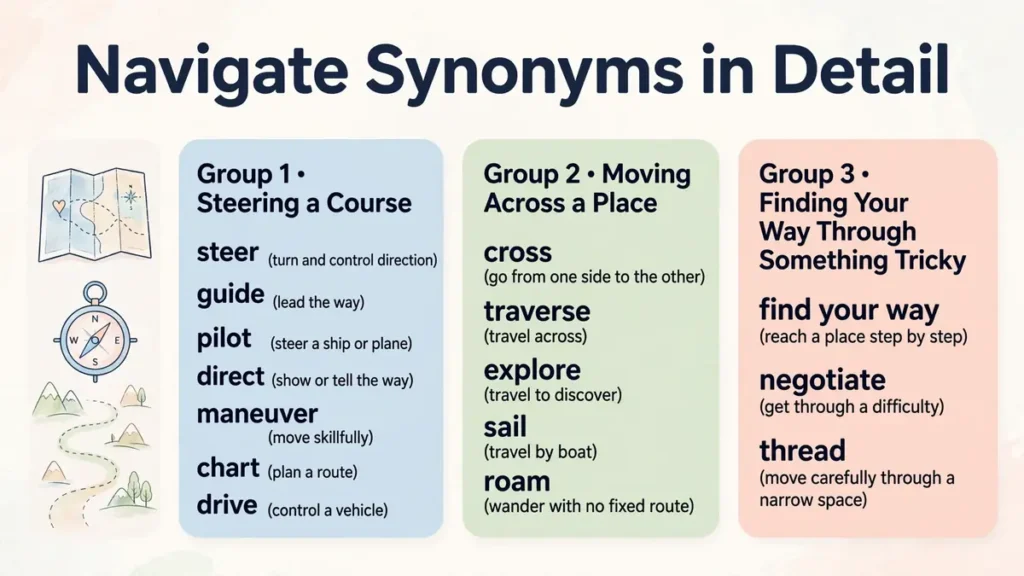
Group 1: Steering and Directing a Course
1. Steer
- Meaning: To turn and control the direction of a vehicle, a boat, or a moving thing.
- Difference: The closest match for navigate in its steering sense.
- Best used for: Driving, sailing, everyday speech, fiction.
- Formality: Neutral · CEFR: B1 · Frequency: Very common
- Example (Driving): “He steered the truck around the fallen tree.”
- Example (Sailing): “She steered the boat toward the lighthouse.”
- When NOT to use it: For a website or a problem, where navigate fits better.
2. Guide
- Meaning: To lead someone to a place, or show someone the way.
- Difference: Guide adds a person being led, while steer controls a vehicle.
- Best used for: Travel, tours, teaching, mentoring.
- Formality: Neutral · CEFR: A2 · Frequency: Very common
- Example (Travel): “The ranger guided the hikers to the waterfall.”
- Example (Museum): “A volunteer guided us through the old house.”
- When NOT to use it: For steering a vehicle yourself, where steer or drive fits better.
3. Pilot
- Meaning: To steer a ship or an aircraft through a difficult course.
- Difference: Pilot is the specialist word for ships and planes.
- Best used for: Aviation, sailing, business, news.
- Formality: Neutral to formal · CEFR: B2 · Frequency: Common
- Example (Aviation): “She piloted the small plane through the storm.”
- Example (Business): “He piloted the new program through its first year.”
- When NOT to use it: For an ordinary car journey, where drive or steer sounds more natural.
4. Direct
- Meaning: To show or tell someone the way.
- Difference: Direct often means giving directions rather than doing the steering yourself.
- Best used for: Giving directions, management, school writing.
- Formality: Neutral to formal · CEFR: B1 · Frequency: Very common
- Example (Directions): “The guard directed us to the north gate.”
- Example (Work): “She directed the team toward the new target.”
- When NOT to use it: For the physical act of turning a wheel, where steer fits better.
5. Maneuver
- Meaning: To move something skillfully in a tight space.
- Difference: Maneuver is control under pressure in a tight spot, while steer is plain control.
- Best used for: Driving, parking, business, politics.
- Formality: Neutral to formal · CEFR: B2 · Frequency: Common
- Example (Parking): “He maneuvered the van into the narrow garage.”
- Example (Office): “She maneuvered the proposal past three committees.”
- When NOT to use it: For a simple straight road, where steer is simpler.
Group 2: Moving Across a Place
6. Chart
- Meaning: To plan a route on a map before traveling.
- Difference: Chart stresses planning before the journey, the map work that comes first.
- Best used for: Sailing, aviation, planning, business strategy.
- Formality: Neutral to formal · CEFR: C1 · Frequency: Less common
- Example (Sailing): “The captain charted a course around the storm.”
- Example (Career): “They charted a path to the new market.”
- When NOT to use it: For the journey itself, where navigate or travel fits better.
7. Drive
- Meaning: To control and move a vehicle, usually a car.
- Difference: Drive is the everyday word for operating a car, and it says nothing about maps or routes.
- Best used for: Everyday speech, driving, travel.
- Formality: Neutral · CEFR: A2 · Frequency: Very common
- Example (Road trip): “We drove across the state in a single day.”
- Example (City): “She drives to work through the old town each morning.”
- When NOT to use it: For a ship or a plane, where pilot or sail fits better.
8. Cross
- Meaning: To go from one side of something to the other.
- Difference: Cross is the plainest word for getting to the other side, shorter and simpler than traverse.
- Best used for: Everyday speech, travel, school writing.
- Formality: Neutral · CEFR: A2 · Frequency: Very common
- Example (River): “They crossed the river on a narrow wooden bridge.”
- Example (Border): “The bus crossed the border just after dawn.”
- When NOT to use it: For steering a vehicle, where steer or drive fits better.
9. Traverse
- Meaning: To travel across a large or difficult area with effort.
- Difference: Traverse adds difficulty and scale over rough ground, where cross can be quick.
- Best used for: Travel writing, hiking, geography.
- Formality: Formal · CEFR: C1 · Frequency: Less common
- Example (Hiking): “The climbers traversed the ridge in high wind.”
- Example (Desert): “Caravans once traversed this desert in weeks.”
- When NOT to use it: In plain everyday speech, where cross sounds more natural.
10. Explore
- Meaning: To travel through a place to discover what is there.
- Difference: Explore adds discovery. Navigate aims at a destination; explore aims at learning.
- Best used for: Travel, science, history, school writing.
- Formality: Neutral · CEFR: B1 · Frequency: Very common
- Example (Travel): “They explored the old city on foot all afternoon.”
- Example (Science): “The team explored the cave system for the first time.”
- When NOT to use it: When you already know the route and just need to reach it, where navigate fits better.
11. Sail
- Meaning: To travel by boat or ship across water.
- Difference: Sail is specific to water and boats, the natural word for sea journeys.
- Best used for: Travel, sailing, fiction, history.
- Formality: Neutral · CEFR: A2 · Frequency: Very common
- Example (Sea): “They sailed from the harbor at first light.”
- Example (Holiday): “We sailed around the islands for a week.”
- When NOT to use it: For travel on land or in the air, where drive or pilot fits better.
12. Roam
- Meaning: To wander through a place with no fixed route or destination.
- Difference: Roam is wandering without a goal, while navigate implies a destination.
- Best used for: Travel writing, fiction, nature writing.
- Formality: Neutral · CEFR: B2 · Frequency: Common
- Example (Hills): “Sheep roamed the hills above the village.”
- Example (City): “On Sundays they roamed the markets with no plan.”
- When NOT to use it: When a set destination matters, where navigate fits better.
Group 3: Finding Your Way Through Something Tricky
13. Find Your Way
- Meaning: To reach a place step by step without a clear map.
- Difference: Find your way is the plainest phrase for the modern, figurative sense of navigate.
- Best used for: Everyday speech, websites, apps, new places.
- Formality: Neutral · CEFR: B1 · Frequency: Very common
- Example (Website): “Visitors can find their way to the form in two clicks.”
- Example (New city): “By the second week, she could find her way around town.”
- When NOT to use it: In formal reports, where navigate sounds more precise.
14. Negotiate
- Meaning: To get through something difficult, such as a bend, a problem, or a deal.
- Difference: Negotiate adds difficulty overcome: bends, hard talks, and tricky rules.
- Best used for: Driving, business, law, politics.
- Formality: Neutral to formal · CEFR: B2 · Frequency: Common
- Example (Road): “The truck negotiated the hairpin bend slowly.”
- Example (Rules): “Small shops must negotiate a maze of permits each year.”
- When NOT to use it: For a simple, easy route, where cross fits better.
15. Thread
- Meaning: To move carefully through a narrow or crowded space.
- Difference: Thread is the picture word for tight spaces: crowds, traffic, and narrow lanes.
- Best used for: Fiction, travel writing, driving.
- Formality: Neutral · CEFR: C1 · Frequency: Less common
- Example (Crowd): “He threaded his way through the festival crowd.”
- Example (Traffic): “The cyclist threaded between the parked cars.”
- When NOT to use it: For open ground or a wide road, where cross fits better.
Best Alternatives by Context
Here are five everyday situations, each with the word that fits best.
Situation 1: You are behind the wheel. Say you steered through the bends, or maneuvered the car into the last parking space. If you planned the route on a map first, say you charted it.
Situation 2: You are showing someone around. Say you will guide them through the old streets, or direct them to the station. If you walk with them, guide is warmer; if you only point the way, direct is enough.
Situation 3: You are crossing rough ground. A river is crossed. A desert or a mountain ridge is traversed. A new valley you want to learn about is explored.
Situation 4: You are on a website or an app. A help page tells readers how to reach a setting. Say they can find their way to it, or that they can navigate the menu. For the goal that drives the journey, see purpose synonyms, and for the effort that keeps you moving, see strive synonyms. To work out where you stand first, see determine synonyms.
Situation 5: You are in a tricky situation. Say you negotiated the rules, threaded through the crowd, or maneuvered through the meeting.
Words Commonly Confused With Navigate
Navigate versus drive is the pair to watch. Drive means operating a vehicle, usually a car. Navigate means finding and following a route, on the road or on a screen. You drive a car to work, but you navigate the detour on the way.
Steer versus pilot matters for the steering sense. Steer is the plain everyday word for turning a wheel or a tiller. Pilot is the specialist word for ships and planes. A sailor steers a small boat, but a captain pilots a ship into port.
Explore versus roam matters for the travel sense. Explore aims at discovery: you explore a cave to learn what is inside. Roam has no goal: you roam a market on a free afternoon. Both are slow and open, but only explore has a purpose behind it.
Traverse versus cross matters for the crossing sense. Cross is quick and plain: you cross a street. Traverse is long and hard: you traverse a desert or a mountain range. Use cross for the everyday crossing and traverse for the journey that takes effort.
Substitution test failures: “He steered the website to find the form” fails, because steer is hands on a control, so say “he navigated the website.” “She traversed the new software with ease” fails, because traverse is physical ground, so say “she navigated the software.” “They roamed to the hospital” fails, because roam has no destination, so say “they found their way there.”
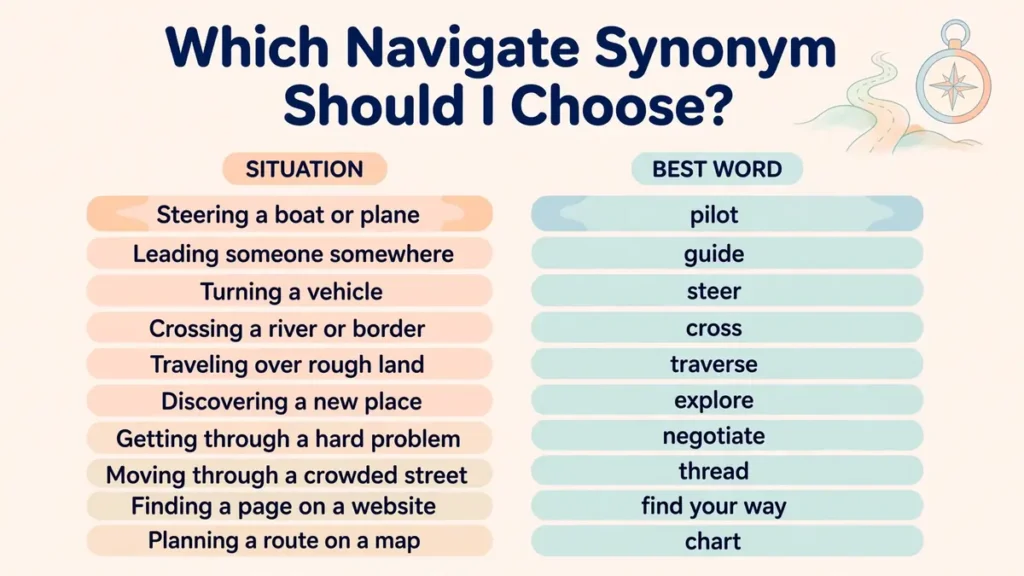
Which Navigate Synonym Should I Choose?
| Situation | Best pick | Why it wins |
|---|---|---|
| Steering a boat or plane | Pilot | Skilled, professional steering |
| Leading someone somewhere | Guide | A person is led |
| Turning a vehicle | Steer | Plain control of direction |
| Crossing a river or border | Cross | Plain, quick, to the other side |
| Traveling over rough land | Traverse | Difficulty and scale |
| Discovering a new place | Explore | Curiosity and learning |
| Traveling by boat | Sail | Water and wind |
| Wandering with no plan | Roam | Free and aimless |
| Finding a page on a website | Find your way | Plain, modern, figurative |
| Getting through a hard problem | Negotiate | Difficulty overcome |
| Moving through a crowd | Thread | Careful, narrow space |
| Planning a route on a map | Chart | Planning before the trip |
| Driving a car | Drive | Everyday vehicle control |
| Moving skillfully in a tight spot | Maneuver | Skill under pressure |
| Showing someone the way | Direct | Giving directions |
Antonyms of Navigate
1. Antonyms for navigate as steering or directing a course
| Antonym | Meaning Difference |
|---|---|
| Drift | Move with no control |
| Stray | Wander off course |
| Lose your way | Fail to keep the route |
| Go astray | Leave the right path |
| Wander off | Drift away from the route |
2. Antonyms for navigate as traveling across a place
| Antonym | Meaning Difference |
|---|---|
| Stay put | Not move at all |
| Remain | Stay in one place |
| Linger | Delay and stay behind |
| Halt | Stop moving |
| Stand still | Not move forward |
3. Antonyms for navigate as finding your way through a system or situation
| Antonym | Meaning Difference |
|---|---|
| Get lost | Fail to find the way |
| Get stuck | Stop making progress |
| Flounder | Struggle without direction |
| Stall | Stop and make no headway |
| Back out | Give up and withdraw |
American vs British English
Navigate is spelled the same in American and British English, and so are most of its synonyms here. One real difference is maneuver: American spelling is maneuver, while British spelling is manoeuvre.
This article uses American spelling throughout. British speakers often say find your way around.
Collocations and Idioms With Navigate
Only combinations native speakers actually use:
- navigate the streets: find your way around a town or city.
- navigate a website: move through the pages and menus of a site.
- navigate through traffic: drive through busy roads with care.
- navigate a difficult conversation: handle a sensitive talk with care.
- navigate your way home: find the route back, often in a new place.
- navigate a maze of rules: work through many complicated rules.
- navigate the waters: handle a tricky or sensitive situation.
Use navigate with an object, as in “navigate the city.” Use navigate your way through when the route itself is the story.
Practice Exercises
Exercise 1: Match the situation to the word. Write the letter of the best word next to each number.
- Steering a small plane through a storm
- Crossing a river on a narrow bridge
- Wandering through a market with no plan
- Moving carefully through a packed crowd
- Planning a sea route on a chart before sailing
- a. cross
- b. roam
- c. thread
- d. chart
- e. pilot
Exercise 2: Choose the best word. Pick the best word from the brackets.
- The captain ___ the ferry into the harbor as the wind rose. (steered, explored, roamed)
- New students need a week to ___ the campus and find their classes. (traverse, find their way around, sail)
- The hikers ___ the mountain ridge in high wind and reached the hut by dusk. (crossed, traversed, drove)
- She ___ the new booking system in one afternoon and showed the team how it worked. (navigated, threaded, roamed)
- The cyclist ___ between the parked cars and the bus lane. (piloted, threaded, charted)
Answer key
- Exercise 1: (1) e; (2) a; (3) b; (4) c; (5) d.
- Exercise 2: (1) steered; (2) find their way around; (3) traversed; (4) navigated; (5) threaded.
Frequently Asked Questions
What is the best synonym for navigate?
Steer is the closest synonym when navigate means controlling direction, because it names the act of turning and holding a course. For leading someone, guide fits best. For crossing rough ground, traverse fits. And for a website or a tricky problem, find your way or negotiate is the natural choice.
Can navigate mean finding your way on a website?
Yes. Navigate has a common modern sense: to move through a website, an app, or a menu to reach what you need. You navigate a site by clicking links and menus, and the same sense covers a new job or a set of rules. The word keeps its old travel meaning, now applied to screens.
What is the difference between navigate and steer?
Navigate is broader. It covers steering, traveling across a place, and finding your way through a system or a problem. Steer covers only the act of controlling direction, usually with your hands on a wheel or a tiller. You steer a car, but you navigate a city, a river, or a website.
Is pilot or steer better for a boat?
Pilot is better for a large ship or a plane, because it sounds skilled and professional, and it covers guiding a craft through a difficult course. Steer is better for a small boat or a car, where the act is plain and everyday. A captain pilots a ship into port, while a sailor steers a dinghy.
What is the opposite of navigate?
It depends on the meaning. For steering, the opposites are drift, stray, and lose your way. For traveling across a place, the opposites are stay put, remain, and turn back. And for finding your way through a system, the opposites are get lost, get stuck, and flounder. Pick the antonym from the same meaning group.
Which synonym should students use in essays?
In essays, prefer navigate itself for systems and situations, traverse for long journeys over difficult ground, and pilot for ships and planes in a formal tone. Use guide for leading people and explore for discovery. Reserve roam and thread for travel writing and fiction, where their color earns its place.
Conclusion
Steering calls for steer, pilot, direct, or maneuver. Crossing ground calls for cross, traverse, explore, or sail. A tricky system calls for find your way, negotiate, or thread.
One last check: read the sentence aloud with the replacement. If it says what you meant, keep it.

About Sajjad Ahmed
Sajjad Ahmed is the author behind Guest Paster, where he writes about English vocabulary, synonyms, word meanings, and practical word usage.
His content is designed to help readers understand the differences between similar words, discover suitable alternatives, and use English vocabulary more effectively in everyday writing and communication.
Before publishing, Sajjad focuses on presenting word choices in a clear and easy-to-understand format, with relevant meanings, context, and examples where helpful.
Through Guest Paster, his goal is to make vocabulary learning simpler and provide useful language resources for students, writers, English learners, and anyone looking to expand their vocabulary.
Areas of Focus: English Vocabulary • Synonyms • Word Meanings • Word Usage • Language Learning
Author: Sajjad Ahmed
Website: Guest Paster