You write “we strive” in a mission statement, and it sounds grand. You write it again in a cover letter and it sounds empty.
The problem is not the word: strive covers too much ground at once, trying, struggling, aiming and refusing to quit. This guide sorts 15 strive synonyms by meaning so you can name the exact effort you mean. If the effort is formal, say endeavor. If it is a fight, say struggle. And if it is a goal you keep chasing, say aspire.
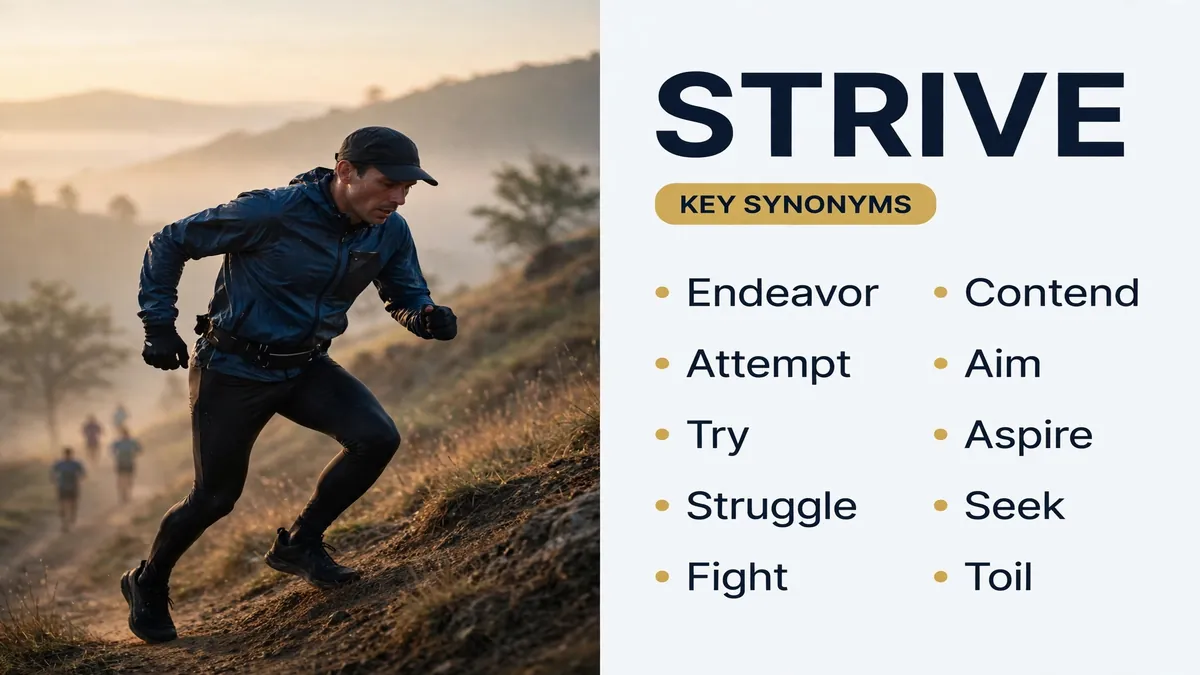
Top 10 Strive Synonyms at a Glance
| # | Synonym | Meaning Difference |
|---|---|---|
| 1 | Endeavor | A serious, formal effort to achieve |
| 2 | Attempt | A try, with no promise of success |
| 3 | Try | A plain, everyday effort to do something |
| 4 | Struggle | Effort against difficulty or opposition |
| 5 | Fight | Active resistance or competition to win |
| 6 | Contend | Compete against rivals or problems |
| 7 | Aim | Direct effort toward a target or goal |
| 8 | Aspire | Reach upward toward a high ambition |
| 9 | Seek | Try to find, get, or achieve something |
| 10 | Toil | Long, hard, tiring work |
Quick Facts About “Strive”
- Part of speech: a verb. You strive for a goal, toward a standard, or against an opponent.
- Three core meanings: (1) make a great effort to achieve something, (2) struggle or compete against opposition, (3) aspire toward something higher, such as striving for excellence.
- Past forms: strove and striven, as in “she strove” and “they have striven.” The weak form “strived” also appears, but strove is usual.
- Register: neutral to formal. Strive suits speeches, essays, and mission statements, and sounds slightly formal in everyday talk.
- Watch out: strive promises sustained effort, not a quick try. If the effort was brief, attempt or try is more honest.
The Closest Synonym: Endeavor
Endeavor is the closest synonym for strive, because it covers the word’s most common job: a serious effort to achieve something worthwhile. When a team, a student, or a company makes a determined effort toward a goal, endeavor names that effort plainly and with dignity. It works in formal writing, in business, and in speeches, so it is the safest first choice when strive feels overused.
Still, endeavor is not identical to strive. Endeavor stresses the attempt itself, and it sounds formal and planned. Strive adds pushing on through difficulty over a longer struggle. Use endeavor as your default for a serious attempt, and reach below when struggle, competition, or ambition is the real point.
Choice test: if the sentence only claims a serious attempt, endeavor still sounds true. If it claims effort pushing through resistance, use strive or a struggle word below.
Where “Strive” Comes From (Etymology)
According to Etymonline, strive is recorded around 1200 as striven, meaning “quarrel, contend; make an endeavor, try.”
It comes from Old French estriver, “to quarrel, dispute, resist, struggle, put up a fight, compete,” from estrif or estrit, “quarrel.” Rare for a French verb, it took a strong conjugation, past tense strove, by rhyming association with drive and dive, and the strong forms have always been more usual than the weak forms.
Can You Swap Them Freely?
In short: only inside the same meaning group, and only when the sense matches. An aiming word collapses in a sentence about fighting, and a fighting word in a sentence about ambition:
- ✓ “The team will endeavor to finish by Friday.” (serious attempt)
- ✗ “The team will aspire to finish by Friday.” (aspire is high ambition, not a deadline, say endeavor)
- ✓ “She struggled against the champion for three sets.” (effort against opposition)
- ✗ “She sought against the champion for three sets.” (seek takes a goal, not an opponent, say struggled)
Before you substitute, ask: am I describing an attempt, a fight, or an ambition? Those take a Group 1, 2, or 3 word in turn.
Strive Synonyms in Detail
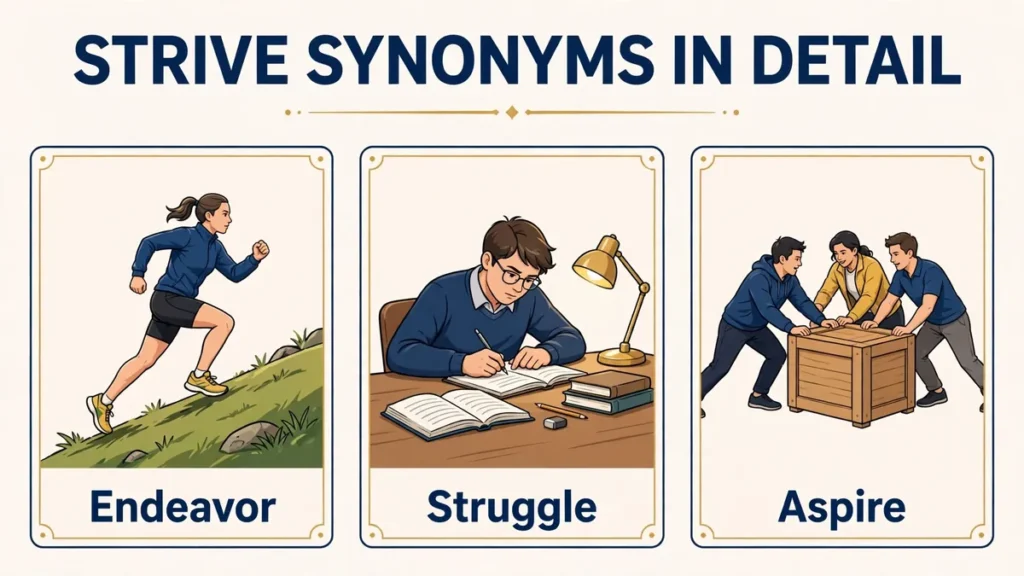
Group 1: Making a Great Effort to Achieve Something
1. Endeavor
- Meaning: To make a serious, determined effort to achieve something, often formal.
- Difference: The closest all-round match for strive. It stresses the attempt, while strive stresses pushing through difficulty.
- Best used for: Business writing, speeches, formal reports.
- Formality: Formal, CEFR: C1, Frequency: Common
- Example (Work): “We endeavor to answer every customer within one day.”
- Example (School): “Students endeavor to complete the project before the deadline.”
- When NOT to use it: In casual talk, where try is more natural.
2. Attempt
- Meaning: To try to do something, with no promise that it will succeed.
- Difference: Attempt is neutral about effort and outcome. It can name one quick try, while strive implies sustained effort.
- Best used for: News, reports, exams.
- Formality: Neutral, CEFR: B1, Frequency: Very common
- Example (Exam): “He attempted all ten questions, even the hardest one.”
- Example (Sports): “She attempted the jump twice before she cleared it.”
- When NOT to use it: When sustained effort is the point, where persevere fits better.
3. Try
- Meaning: To make an effort to do or achieve something.
- Difference: Try is the plain, everyday word. It covers any effort, large or small, with no formal or heroic tone.
- Best used for: Everyday speech, instructions, casual writing.
- Formality: Neutral, CEFR: A2, Frequency: Very common
- Example (Daily life): “Try the new route if the highway is closed.”
- Example (Work): “We tried a shorter meeting format this week.”
- When NOT to use it: In formal writing, where endeavor carries more weight.
Group 2: Struggling or Competing Against Opposition
4. Struggle
- Meaning: To make a strong effort against difficulty, resistance, or an opponent.
- Difference: Struggle names difficulty itself. It says the task is hard, not just that someone tried.
- Best used for: Stories, news, health, sports.
- Formality: Neutral, CEFR: B2, Frequency: Very common
- Example (Health): “He struggled with the illness for two years before recovering.”
- Example (Sports): “The team struggled to hold its lead in the final minutes.”
- When NOT to use it: For a calm, planned attempt, where endeavor fits.
5. Fight
- Meaning: To resist, oppose, or compete actively in order to win or survive.
- Difference: Fight is stronger and more direct than struggle. It implies an opponent or a threat, not just a hard task.
- Best used for: News, sports, campaigns.
- Formality: Neutral, CEFR: B1, Frequency: Very common
- Example (Campaign): “Residents fought to save the local library from closure.”
- Example (Sports): “Both boxers fought hard until the final bell.”
- When NOT to use it: For a quiet personal goal, where aim or aspire fits.
6. Contend
- Meaning: To compete against rivals, or to deal with a difficult problem.
- Difference: Contend covers competition and coping. You contend with rivals for a prize, and with problems such as bad weather.
- Best used for: Sports, politics, business, formal writing.
- Formality: Formal, CEFR: C1, Frequency: Common
- Example (Sports): “Four teams contend for the title this season.”
- Example (Business): “Small shops contend with rising rent every year.”
- When NOT to use it: In casual talk, where compete sounds clearer.
Group 3: Aiming at a Goal You Want
7. Aim
- Meaning: To direct your effort toward a target, goal, or result.
- Difference: Aim stresses direction: where the effort points, while strive stresses how hard it is.
- Best used for: Plans, goals, resumes, everyday writing.
- Formality: Neutral, CEFR: B1, Frequency: Very common
- Example (Career): “She aims to finish her degree by next spring.”
- Example (Business): “The shop aims to open a second branch this year.”
- When NOT to use it: When the struggle itself matters, where struggle fits.
8. Aspire
- Meaning: To want and work toward something high or admirable, such as a career, a standard, or a better life.
- Difference: Aspire is the upward word. It implies ambition and a high goal, not just any target.
- Best used for: Essays, speeches, biographies.
- Formality: Neutral to formal, CEFR: C1, Frequency: Common
- Example (Career): “He aspires to become a doctor, like his mother.”
- Example (School): “Students who aspire to top grades study a little every day.”
- When NOT to use it: For a short-term deadline, where aim fits better.
9. Seek
- Meaning: To try to find, get, or achieve something.
- Difference: Seek stresses the search. You seek a job, advice, or approval, and the effort lies in looking and asking.
- Best used for: Formal writing, job ads, advice columns, reports.
- Formality: Neutral to formal, CEFR: B2, Frequency: Very common
- Example (Work): “She seeks a role with more responsibility.”
- Example (Advice): “Seek medical help if the pain does not ease.”
- When NOT to use it: Against an opponent, where fight fits.
Group 4: Hard Work That Keeps Going
10. Toil
- Meaning: To work very hard for a long time, often at tiring or repetitive work.
- Difference: Toil stresses long, wearying labor. It sounds literary and slightly old-fashioned, and suits physical work best.
- Best used for: Literature, history, farming.
- Formality: Neutral to formal, CEFR: C1, Frequency: Less common
- Example (Farm): “Farmers toiled in the fields from dawn until dark.”
- Example (History): “Workers toiled for years to build the canal.”
- When NOT to use it: For a mental goal, where aspire fits better.
11. Labor
- Meaning: To work hard, especially at a difficult or long task.
- Difference: Labor is the general hard-work word, less literary than toil, covering both physical and mental effort.
- Best used for: Workplaces, reports, history.
- Formality: Neutral to formal, CEFR: B2, Frequency: Very common
- Example (Work): “The team labored over the report for three weeks.”
- Example (Garden): “They labored all weekend to clear the garden.”
- When NOT to use it: For a quick try, where attempt is honest.
12. Pursue
- Meaning: To keep chasing a goal, a career, or a course of action over time.
- Difference: Pursue stresses steady continuation. You pursue a degree, a career, or a complaint, and the effort lasts.
- Best used for: Careers, education, law.
- Formality: Neutral to formal, CEFR: B2, Frequency: Very common
- Example (Career): “She pursued a career in nursing after college.”
- Example (Law): “The company pursued the claim through the courts.”
- When NOT to use it: For a fight against a person, where fight fits.
13. Battle
- Meaning: To fight hard and persistently against a problem, illness, or opponent.
- Difference: Battle is fight stretched over time. It suits long campaigns, illnesses, and causes, and sounds dramatic.
- Best used for: News, health stories, campaigns, history.
- Formality: Neutral, CEFR: B2, Frequency: Common
- Example (Health): “She battled cancer with remarkable courage.”
- Example (Campaign): “The town battled for years to keep its hospital open.”
- When NOT to use it: For a calm, planned attempt, where endeavor fits.
14. Strain
- Meaning: To push yourself to the limit of your strength or ability.
- Difference: Strain stresses effort at the edge of what you can do. It often hints at tension or risk, such as a strained muscle or budget.
- Best used for: Sports, health, work, finance.
- Formality: Neutral, CEFR: B2, Frequency: Common
- Example (Sports): “Runners strain every muscle in the final stretch.”
- Example (Work): “The small team strained to meet the holiday deadline.”
- When NOT to use it: For ambition alone, where aspire fits.
15. Persevere
- Meaning: To keep going despite difficulty, failure, or opposition, until you succeed or finish.
- Difference: Persevere is the never-quit word. It stresses continuation after setbacks, the heart of strive at its strongest.
- Best used for: Essays, speeches, biographies, motivational writing.
- Formality: Neutral to formal, CEFR: C1, Frequency: Common
- Example (School): “She persevered through three failed exams and passed on the fourth.”
- Example (Sports): “The marathon runner persevered through cramps to finish the race.”
- When NOT to use it: For a first, untested try, where attempt fits.
Best Alternatives by Context
Pick by the situation, not by the word list alone:
- A serious formal attempt: endeavor, a determined effort stated plainly.
- A quick or uncertain try: attempt (neutral) or try (everyday).
- Effort against difficulty: struggle, which names the difficulty itself.
- Active competition or resistance: fight (direct) or contend (formal).
- A target or plan: aim, showing where the effort points.
- A high ambition: aspire, reaching upward.
- Looking for something: seek, stressing the search.
- Long, tiring work: toil (literary) or labor (general).
- Chasing a goal over time: pursue, stressing steady continuation.
- A long fight: battle, suited to campaigns and illnesses.
- Effort at your limit: strain, hinting at tension and risk.
- Never giving up: persevere, the strongest never-quit word here.
For nearby families, see teamwork synonyms for a group pushing toward a shared goal, hard working synonyms for steady labor, and coordination synonyms for organizing joint effort.
Which Strive Synonym Should I Choose?
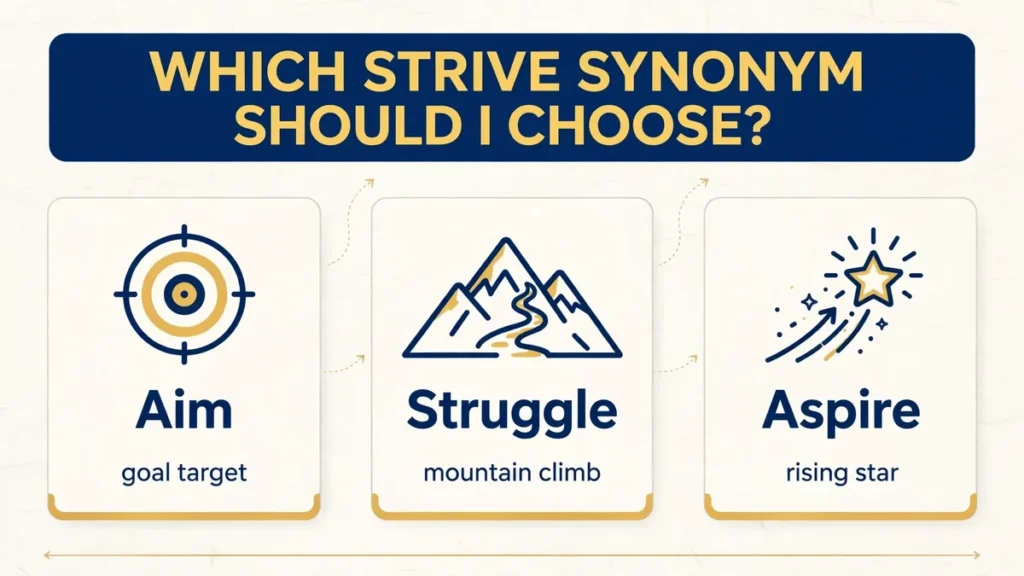
| Situation | Best pick | Why it wins |
|---|---|---|
| A serious formal attempt | Endeavor | A determined effort |
| A quick or uncertain try | Attempt | Neutral about outcome |
| Everyday effort | Try | Plain and natural |
| Effort against difficulty | Struggle | Names the difficulty |
| Active resistance | Fight | Direct and strong |
| Competition or coping | Contend | Rivals and problems |
| A target or plan | Aim | Shows direction |
| A high ambition | Aspire | Reaches upward |
| Looking for something | Seek | The search itself |
| Long tiring work | Toil | Says the work wearies |
| Steady chasing of a goal | Pursue | Stresses continuation |
| Never giving up | Persevere | The never-quit word |
Antonyms of Strive
Antonyms for strive as making a great effort
| Antonym | Meaning Difference |
|---|---|
| Quit | Give up the effort |
| Abandon | Leave a goal unfinished |
| Neglect | Give no effort or care |
| Idle | Do nothing |
| Coast | Move with little effort |
| Slack off | Work with less effort |
Strive as struggling, competing or aspiring
| Antonym | Meaning Difference |
|---|---|
| Surrender | Yield to opposition |
| Give in | Stop resisting |
| Settle | Accept less than aimed for |
| Stagnate | Stop growing |
| Back down | Withdraw from a contest |
| Underachieve | Perform below your ability |
Words Commonly Confused With Strive
Strive versus try is the closest pair to watch. Try covers any effort, even a brief one. Strive implies sustained, determined effort. You try a new recipe once, but you strive for a degree over four years. If the effort was brief, say try.
Struggle versus fight is another near miss. Struggle names effort against difficulty, whether a task, an illness, or an opponent. Fight names active resistance or competition, usually against a person or a cause. You struggle with a heavy load, but you fight a rival team. With no opponent, struggle is usually the word.
Aspire versus aim matters for goal talk. Aspire means reaching toward something high or admirable, such as a career or a standard. Aim only means directing effort at a target, high or low. You aim to finish by Friday, but you aspire to lead the company one day. If the goal is high, say aspire.
Substitution test failures: “She aspired to finish the form by Friday” fails, because a deadline is not a high ambition, so say “she aimed to finish the form by Friday.” “He sought against the champion for three sets” fails, because seek takes a goal, not an opponent, so say “he struggled against the champion.” “The team persevered on its first try” fails, because persevere needs setbacks, so say “the team attempted it.”
American vs British English
Strive is spelled the same in American and British English, and so are all 15 synonyms here. One spelling point matters: American English writes endeavor and labor, while British English writes endeavour and labour.
This article uses American spelling throughout.
Collocations and Idioms With Strive
Only use combinations native speakers actually use:
- strive for success: work hard to succeed.
- strive for excellence: aim at the highest standard.
- strive to improve: keep working to get better.
- strive toward a goal: direct sustained effort at a goal.
- strive against the odds: keep going despite bad chances.
- strive hard: make a very strong effort.
- strive for perfection: aim at a flawless result.
- strive to win: compete with full effort.
- strive for a better life: work toward better living conditions.
- strive to understand: work hard to grasp something.
- strive and thrive: effort leads to success.
- strive with all your might: give your full strength.
Use strive for with a goal, strive to with a verb, and strive against with opposition or odds.
Practice Exercises
Exercise 1: Scenario match. Read each scenario and pick the best word from the brackets.
- A student fails twice, studies again, and passes on the third try. (attempt, persevere, aim)
- A mayor promises to protect a park from developers. (fight, seek, aspire)
- A young nurse dreams of running her own clinic one day. (aspire, strain, contend)
- A company states a new safety goal in a formal letter. (try, endeavor, battle)
Exercise 2: Rewrite for precision. Replace strive with a sharper word; each sentence gives a hint.
- “We strive to answer every email within a day.” (Hint: formal attempt.)
- “She strives against the champion in every match.” (Hint: opposition.)
- “He strives to become a surgeon one day.” (Hint: high ambition.)
- “The team strives through the night to finish the harvest.” (Hint: long, tiring work.)
Exercise 3: Spot the wrong word. Each sentence has one word that does not fit; name it and fix it.
- “She aspired to finish the form by Friday.” (Hint: a deadline is not a high ambition.)
- “He sought against the champion for three sets.” (Hint: seek takes a goal, not an opponent.)
- “The team persevered on its very first try.” (Hint: persevere needs setbacks first.)
Answer key
- Exercise 1: (1) persevere, kept going after failure; (2) fight, resists the developers; (3) aspire, a high future goal; (4) endeavor, a formal statement.
- Exercise 2: (1) endeavor; (2) struggles or contends; (3) aspires; (4) toils.
- Exercise 3: (1) aspired, use aimed; (2) sought, use struggled; (3) persevered, use attempted.
Frequently Asked Questions
What is the best synonym for strive?
Endeavor is the closest synonym, because it covers the common sense of a serious effort to achieve something. Use it for formal attempts, plans, and mission statements. When struggle is the point, choose struggle; for a high ambition, choose aspire; for never quitting, choose persevere.
What is the difference between strive and try?
Try covers any effort, even a single brief one, such as trying a new recipe. Strive implies sustained, determined effort over time, such as striving for a degree. If the effort lasted and pushed through difficulty, strive is honest. If it was one quick attempt, try is better.
Is strive a formal word?
Strive sits between neutral and formal. It sounds natural in speeches, essays, mission statements, and motivational writing, and slightly grand in everyday talk. In casual conversation, try or work hard sounds more natural. In formal writing, endeavor often replaces it.
Can strive describe a fight or competition?
Yes, when the fight involves sustained effort against opposition. Athletes strive against rivals, and campaigns strive against strong resistance. For a direct clash, fight is stronger, and for formal competition, contend is sharper. Sustained effort takes strive; a direct clash takes fight.
What is the difference between aspire and aim?
Aspire means reaching toward something high or admirable, such as a career or a standard. Aim only means directing effort at a target, whether high or low. You aim to finish a report by Friday; you aspire to lead a hospital one day. Use aspire only when the goal is high.
Which synonym should students use in essays?
In essays, prefer endeavor, struggle, aspire, or persevere, because all four sound precise and academic. Reserve contend for formal competition, pursue for long-term goals such as careers, and toil for literary or historical writing. Attempts take endeavor, difficulty takes struggle, ambition takes aspire.
Conclusion
The right replacement for strive depends on what kind of effort you really mean. A formal attempt calls for endeavor, a quick try for attempt or try, difficulty for struggle, competition for fight or contend, a target for aim, a high ambition for aspire, and never giving up for persevere. Name the effort, and the word follows.
One last check: read the sentence aloud with the replacement in place. If it still claims exactly what you meant, keep it. If it now claims ambition when you meant a deadline or a fight when you meant a search, swap again. That tenkey-second test catches most wrong swaps.

About Sajjad Ahmed
Sajjad Ahmed is the author behind Guest Paster, where he writes about English vocabulary, synonyms, word meanings, and practical word usage.
His content is designed to help readers understand the differences between similar words, discover suitable alternatives, and use English vocabulary more effectively in everyday writing and communication.
Before publishing, Sajjad focuses on presenting word choices in a clear and easy-to-understand format, with relevant meanings, context, and examples where helpful.
Through Guest Paster, his goal is to make vocabulary learning simpler and provide useful language resources for students, writers, English learners, and anyone looking to expand their vocabulary.
Areas of Focus: English Vocabulary • Synonyms • Word Meanings • Word Usage • Language Learning
Author: Sajjad Ahmed
Website: Guest Paster