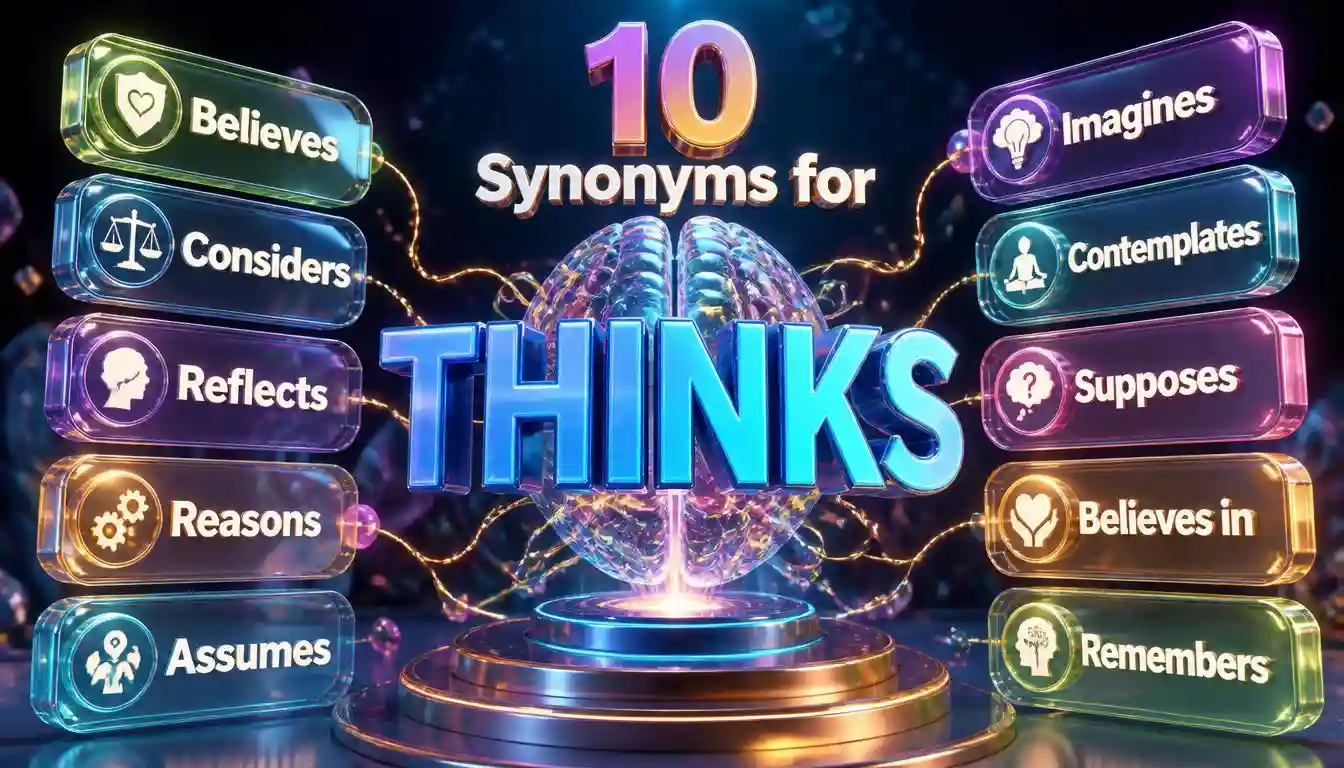
Thinks means to use your mind to consider an idea, form an opinion, remember something, imagine a possibility, or carefully consider a situation. The closest synonyms for thinks include believes, considers, reflects, reasons, assumes, imagines, contemplates, and supposes, but the best replacement depends on the meaning and context.
For example, “She thinks the plan will work” can become “She believes the plan will work,” while “He thinks deeply about life” is better replaced with “He reflects on life” or “He contemplates life.”
Choosing the right synonym improves clarity because different words show different levels of certainty, depth, formality, and emotion.
Best Synonyms for Thinks at a Glance
| Synonym | Relationship | Swap Rating | Formality | Best Used For |
| Believes | Near Synonym | Drop-in | Neutral | Opinions, confidence, personal views |
| Considers | Near Synonym | Drop-in | Neutral/Formal | Careful thought or evaluation |
| Reflects | Near Synonym | Minor rewrite | Neutral/Formal | Deep personal thinking |
| Reasons | Near Synonym | Minor rewrite | Formal/Academic | Logical thinking |
| Assumes | Contextual Alternative | Drop-in | Neutral | Accepting something as true |
| Imagines | Contextual Alternative | Minor rewrite | Neutral | Creative or possible ideas |
| Contemplates | Near Synonym | Minor rewrite | Formal | Deep consideration |
| Supposes | Near Synonym | Drop-in | Neutral | Uncertain opinions |
| Believes in | Contextual Alternative | Minor rewrite | Neutral | Trust or faith |
| Remembers | Contextual Alternative | New sentence needed | Neutral | Thinking about the past |
Quick Facts About “Thinks”
Word: Thinks
Part of speech: Verb (third-person singular form of think)
Simple meaning: Uses the mind to form ideas, opinions, judgments, or possibilities.
Pronunciation: thinks (THINKS)
Syllables: 1
Other forms: think, thought, thinking
Formality: Neutral; commonly used in everyday and academic English
Difficulty: Beginner–Intermediate
Common uses:
- Expressing opinions: “She thinks the movie is good.”
- Mental activity: “He thinks about his future.”
- Careful consideration: “The team thinks through every option.”
Example sentence:
“Maria thinks the new policy will improve workplace communication.”
Thinks Meaning and Usage
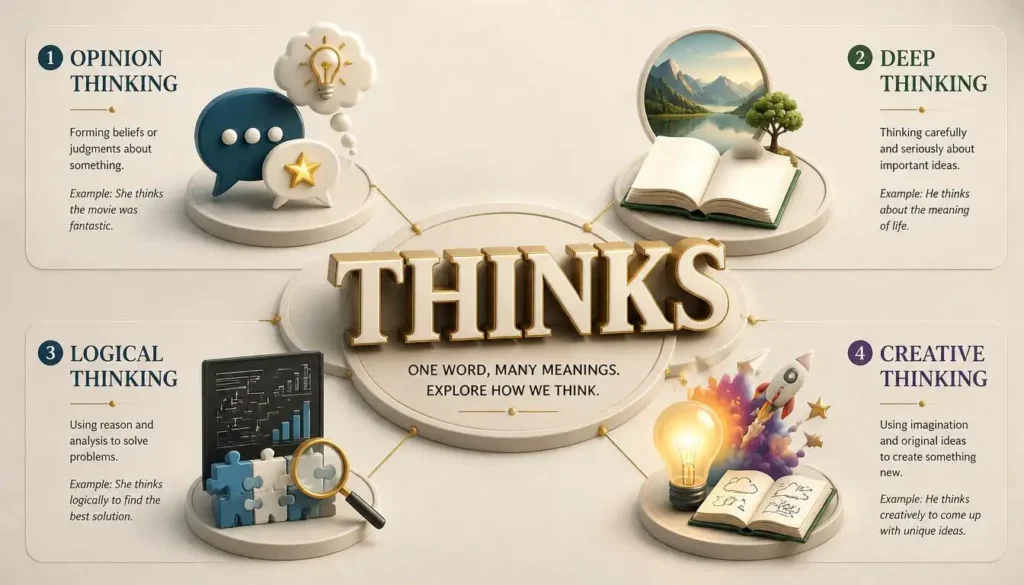
The verb thinks comes from the base verb think, which has several related meanings. It does not always mean the same type of mental activity.
1. Thinks = Has an Opinion
This is the most common modern use.
Example:
“I think this restaurant is excellent.”
Here, thinks means “has the opinion that.”
Useful alternatives:
- believes
- feels
- considers
- supposes
2. Thinks = Uses the Mind to Analyze Something
When someone carefully studies information or solves a problem, thinks refers to mental processing.
Example:
“The engineer thinks about different solutions before making a decision.”
Better alternatives:
- reasons
- analyzes
- considers
- evaluates
3. Thinks = Reflects Deeply
Sometimes thinks describes serious or emotional mental activity.
Example:
“She thinks about her childhood memories.”
Better alternatives:
- reflects
- contemplates
- meditates on
4. Thinks = Imagines or Predicts
The word can also describe expectations or possibilities.
Example:
“He thinks it might rain tomorrow.”
Better alternatives:
- predicts
- expects
- assumes
- guesses
Synonyms for Thinks
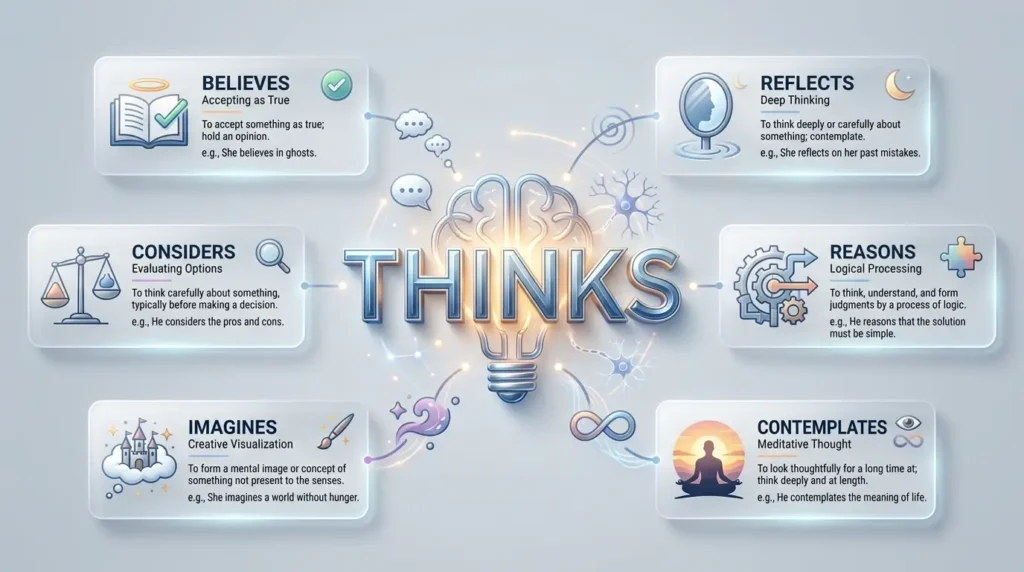
The following alternatives are organized from the closest meanings to more contextual choices.
1. Believes
Relationship: Near Synonym
Swap Rating: Drop-in
Formality: Neutral
Meaning:
To accept something as true or to have an opinion about something.
Nuance:
Believes usually shows stronger confidence than thinks. When someone says “I think,” they may simply have an opinion. When they say “I believe,” they often suggest personal conviction or trust.
Best Used For:
- Personal opinions
- Strong viewpoints
- Professional statements
- Academic arguments
Example:
“Many scientists believe that continued research will lead to better treatments.”
2. Considers
Relationship: Near Synonym
Swap Rating: Drop-in
Formality: Neutral/Formal
Meaning:
To think carefully about something before making a judgment or decision.
Nuance:
Considers suggests deliberate thought. It is often more careful than ordinary thinks.
Compare:
- “She thinks about buying a car.”
- “She considers buying a car.”
The second sentence suggests she is seriously evaluating the decision.
Best Used For:
- Decision-making
- Evaluating options
- Formal writing
Example:
“The committee considers several factors before approving new projects.”
3. Reflects
Relationship: Near Synonym
Swap Rating: Minor rewrite
Formality: Neutral/Formal
Meaning:
To think carefully, often about experiences, feelings, or lessons.
Nuance:
Reflections involve deeper and more thoughtful thinking than thinks. It often connects with memories, personal growth, or understanding.
Best Used For:
- Personal writing
- Essays
- Life experiences
- Emotional topics
Example:
“After the trip, she reflects on how much she learned from different cultures.”
4. Reasons
Relationship: Near Synonym
Swap Rating: Minor rewrite
Formality: Formal/Academic
Meaning:
To think logically and use evidence to reach a conclusion.
Nuance:
Reasons focus on logic and problem-solving. It is not usually used for simple opinions.
Compare:
“John thinks the answer is correct.”
“John reasons that the answer is correct based on the evidence.”
The second sentence emphasizes logical analysis.
Best Used For:
- Academic writing
- Philosophy
- Scientific discussions
- Problem-solving
Example:
“The lawyer reasons carefully before presenting the argument in court.”
5. Assumes
Relationship: Contextual Alternative
Swap Rating: Drop-in
Formality: Neutral
Meaning:
To accept something as true without complete proof or certainty.
Nuance:
Assumption is similar to thinking when someone has an opinion or expectation, but it often suggests that the person has not fully verified the information.
Compare:
- “She thinks the meeting starts at 10.”
- “She assumes the meeting starts at 10.”
The second sentence suggests she believes it without checking.
Best Used For:
- Expectations
- Predictions
- Situations with incomplete information
- Academic discussions about beliefs
Example:
“The manager assumes that the team understands the new procedure.”
6. Imagines
Relationship: Contextual Alternative
Swap Rating: Minor rewrite
Formality: Neutral
Meaning:
To create an idea, picture, or possibility in your mind.
Nuance:
Imagines focus on creativity or mental pictures rather than ordinary opinions. It is useful when someone thinks about something that does not currently exist.
Compare:
- “She thinks about her future.”
- “She imagines her future.”
The second sentence suggests she creates a mental picture of what her future could look like.
Best Used For:
- Creative writing
- Dreams
- Possibilities
- Future scenarios
Example:
“The designer imagines a world where technology makes daily tasks easier.”
7. Contemplates
Relationship: Near Synonym
Swap Rating: Minor rewrite
Formality: Formal/Literary
Meaning:
To think about something carefully and deeply for a period of time.
Nuance:
Contemplates is a stronger and more formal version of thinks about. It suggests serious reflection rather than a quick thought.
Compare:
- “He thinks about changing careers.”
- “He contemplates changing careers.”
The second sentence suggests a major decision requiring deep consideration.
Best Used For:
- Formal writing
- Literature
- Serious decisions
- Philosophy
Example:
“She contemplates the consequences before making a difficult choice.”
8. Supposes
Relationship: Near Synonym
Swap Rating: Drop-in
Formality: Neutral
Meaning:
To believe something is probably true, although you are not certain.
Nuance:
It shows uncertainty. It is often used when someone makes a guess or accepts a possibility.
Compare:
- “I think he is busy.”
- “I suppose he is busy.”
The second sentence sounds less certain.
Best Used For:
- Opinions with uncertainty
- Casual conversation
- Making guesses
Example:
“I suppose we could try a different approach if this one fails.”
9. Predicts
Relationship: Contextual Alternative
Swap Rating: Minor rewrite
Formality: Neutral/Formal
Meaning:
To say what you think will happen in the future.
Nuance:
Predicts are not a general replacement for things. It only works when the thought involves a future event or result.
Compare:
- “She thinks the company will grow.”
- “She predicts the company will grow.”
The second sentence suggests a forecast or informed expectation.
Best Used For:
- Forecasts
- Research
- Business reports
- Weather and trends
Example:
“The analyst predicts that online shopping will continue to increase.”
10. Expects
Relationship: Contextual Alternative
Swap Rating: Minor rewrite
Formality: Neutral
Meaning:
To think something is likely to happen.
Nuance:
Expectations focus on anticipation rather than general thinking. It often involves a future event.
Compare:
- “He thinks she will arrive soon.”
- “He expects her to arrive soon.”
The second sentence shows stronger anticipation.
Best Used For:
- Future situations
- Plans
- Predictions
Example:
“The company expects sales to improve next year.”
11. Evaluates
Relationship: Contextual Alternative
Swap Rating: Minor rewrite
Formality: Formal/Academic
Meaning:
To carefully judge the quality, value, or importance of something.
Nuance:
Evaluates is a more specific form of thinking. It involves examining information and making a judgment.
Compare:
- “The teacher thinks about the students’ work.”
- “The teacher evaluates the students’ work.”
The second sentence means the teacher assesses it.
Best Used For:
- Education
- Business decisions
- Research
- Reviews
Example:
“The committee evaluates each proposal before selecting the winner.”
12. Analyzes
Relationship: Contextual Alternative
Swap Rating: Minor rewrite
Formality: Academic/Technical
Meaning:
To examine something carefully by studying its parts or details.
Nuance:
Analysis involves detailed examination. It is not a direct replacement for simple thoughts or opinions.
Compare:
- “She thinks about the problem.”
- “She analyzes the problem.”
The second sentence suggests a systematic investigation.
Best Used For:
- Research
- Data
- Literature
- Problem-solving
Example:
“The researcher analyzes the results to identify important patterns.”
Best Words to Use Instead of Thinks
In Everyday Conversation
For casual speech, these alternatives sound natural:
Believes
Use when sharing an opinion.
Example:
“I believe this restaurant has the best pizza in town.”
Supposes
Use when you are unsure.
Example:
“I suppose we can leave a little earlier.”
Feels
Use when the thought is based on personal opinion or emotion.
Example:
“She feels that the decision was unfair.”
In Formal Writing
Better choices for professional or formal writing include:
Considers
Shows careful evaluation.
Example:
“The report considers several possible solutions.”
Maintains
Used when someone strongly expresses or defends an opinion.
Example:
“The author maintains that education plays a key role in development.”
Argues
Used when someone presents a reasoned position.
Example:
“The researcher argues that technology has changed communication.”
In Academic Writing
Academic alternatives should show reasoning and evidence.
Suggests
Used when evidence indicates a possibility.
Example:
“The study suggests that sleep affects memory.”
Demonstrates
Used when evidence clearly shows something.
Example:
“The experiment demonstrates the effect of temperature on reaction speed.”
Concludes
Used when someone reaches a final judgment.
Example:
“The researcher concludes that the method is effective.”
In Professional Emails
Natural professional replacements:
I believe
A polite way to express an opinion.
Example:
“I believe this approach will improve efficiency.”
I suggest
Used for recommendations.
Example:
“I suggest reviewing the proposal before approval.”
I recommend
Used when giving professional advice.
Example:
“I recommend updating the software regularly.”
For Thinking Deeply
When thinks means serious reflection, use:
- reflects
- contemplates
- considers
- meditates on
Example:
“After many years, he reflects on the choices he made.”
Exact and Near Synonyms: What’s the Difference?
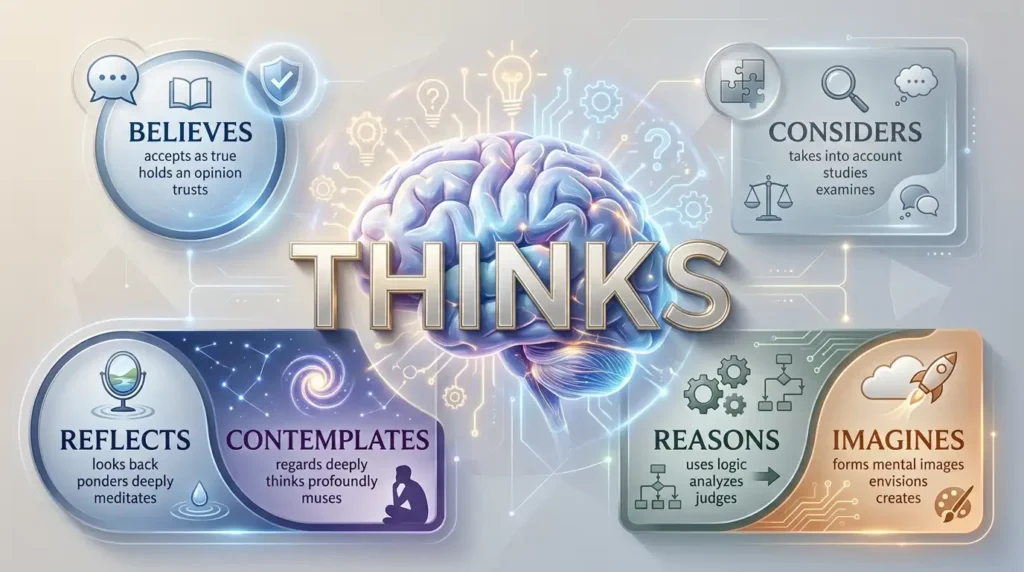
Most synonyms for thinks are not perfectly interchangeable. The right choice depends on what kind of thinking you mean.
Believes focuses on accepting an idea as true. Consider suggesting careful evaluation. Reflects shows deep personal thought, while analysis focuses on detailed examination.
For English learners, the key question is: What type of thinking is happening? A person can think casually, logically, creatively, emotionally, or carefully. Each situation requires a slightly different word.
Words Commonly Confused With “Thinks”
Some words are related to thinking, but they do not always work as synonyms. Understanding the difference helps you choose a more accurate language.
1. Knows
Difference:
Knows means having information, certainty, or understanding. Thinks suggests an opinion or possibility while knows suggests confidence based on facts or experience.
Example:
❌ “She thinks the Earth revolves around the Sun.”
(This sounds like only an opinion.)
✅ “She knows the Earth revolves around the Sun.”
(This shows factual knowledge.)
2. Remembers
Difference:
Remembers means bringing information from the past back into your mind. It is a type of mental activity, but it is not the same as thinking.
Example:
“She remembers her first day at school.”
This means she recalls a past event, not simply that she thinks about it.
3. Wonders
Difference:
Wonders means thinking with curiosity or asking yourself a question. It often involves uncertainty.
Example:
“He wonders why the company changed its policy.”
This means he is curious, not that he has formed an opinion.
4. Decides
Difference:
Decides is the result of thinking, not a replacement for thinking itself.
Example:
“She thinks about different options before she decides.”
Thinking happens first; deciding happens afterward.
Antonyms of Thinks
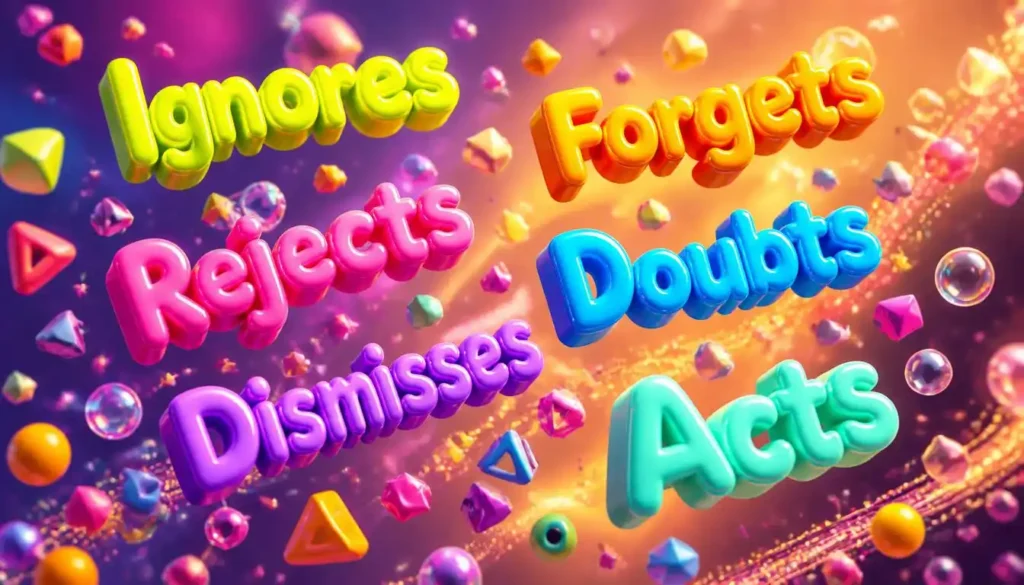
The opposite of thinks depends on the meaning being used. Since thinking involves mental activity, there is no single perfect opposite in every situation.
| Antonym | Simple Meaning | Example Sentence |
| Ignores | Pays no attention to something | He ignores the advice he receives. |
| Forgets | Fails to remember something | She forgets important details sometimes. |
| Rejects | Refuses to accept an idea | The committee rejects the proposal. |
| Doubts | Does not believe something is true | He doubts the accuracy of the report. |
| Dismisses | Decides something is not important | She dismisses the suggestion too quickly. |
| Acts | Does something instead of only thinking | He acts quickly instead of overthinking. |
Common Phrases and Collocations With Thinks
Native speakers commonly use think in several expressions. These phrases often cannot be replaced by a single synonym.
Think about
Meaning: To consider or focus your mind on something.
Example:
“I need some time to think about your offer.”
Think of
Meaning: To create an idea, remember something, or have an opinion.
Example:
“What do you think of this design?”
Think through
Meaning: To carefully consider all possible results before acting.
Example:
“She thinks through every decision before making a commitment.”
Think deeply
Meaning: To spend serious time considering something.
Example:
“Great leaders think deeply about the effects of their decisions.”
Think critically
Meaning: To analyze information carefully instead of accepting it immediately.
Example:
“Students should learn to think critically about online information.”
Think highly of
Meaning: To have great respect or admiration for someone.
Example:
“The team thinks highly of their coach.”
Think twice
Meaning: To reconsider something before doing it.
Example:
“You should think twice before making such an expensive purchase.”
Frequently Asked Questions
What is another word for thinks?
Common alternatives for thinks include believes, considers, reflects, supposes, assumes, contemplates, and reasons. The best choice depends on whether you mean having an opinion, analyzing something, imagining a possibility, or thinking deeply.
What is the closest synonym for thinks?
The closest general synonym is usually believes when “thinks” means having an opinion. However, considers may be closer when the meaning involves careful evaluation.
Is thinks formal or informal?
Thinks is a neutral word used in both everyday speech and formal writing. It is common and acceptable, but more specific alternatives can make academic or professional writing clearer.
What is another word for “I think” in formal writing?
Formal alternatives include:
- I believe
- I suggest
- I argue
- I maintain
- I consider
- It appears that
- The evidence suggests
Example:
Informal:
“I think this method is effective.”
Formal:
“The evidence suggests that this method is effective.”
What is another word for thinking deeply?
Words that express deep thinking include:
- reflecting
- contemplating
- considering
- analyzing
- pondering
- reasoning
Example:
“He reflects on his experiences.”
Can believe replace think?
Sometimes. Believe works when think expresses an opinion or personal judgment. It does not work when think means analyzing, remembering, or imagining.
Example:
✅ “I think she is honest.”
✅ “I believe she is honest.”
But:
❌ “I believe about the problem.”
✅ “I think about the problem.”
Conclusion
The best synonyms for thinks depend on the type of mental activity being described. Words such as believes, considers, reflects, reasons, and contemplates can make writing more precise by showing different levels of confidence, depth, and formality. Instead of replacing thinks with any similar-looking word, choose an alternative that matches the exact meaning and situation.
Using accurate synonyms for thinks helps your writing sound more natural, professional and clear.

About Sajjad Ahmed
Sajjad Ahmed is the author behind Guest Paster, where he writes about English vocabulary, synonyms, word meanings, and practical word usage.
His content is designed to help readers understand the differences between similar words, discover suitable alternatives, and use English vocabulary more effectively in everyday writing and communication.
Before publishing, Sajjad focuses on presenting word choices in a clear and easy-to-understand format, with relevant meanings, context, and examples where helpful.
Through Guest Paster, his goal is to make vocabulary learning simpler and provide useful language resources for students, writers, English learners, and anyone looking to expand their vocabulary.
Areas of Focus: English Vocabulary • Synonyms • Word Meanings • Word Usage • Language Learning
Author: Sajjad Ahmed
Website: Guest Paster