
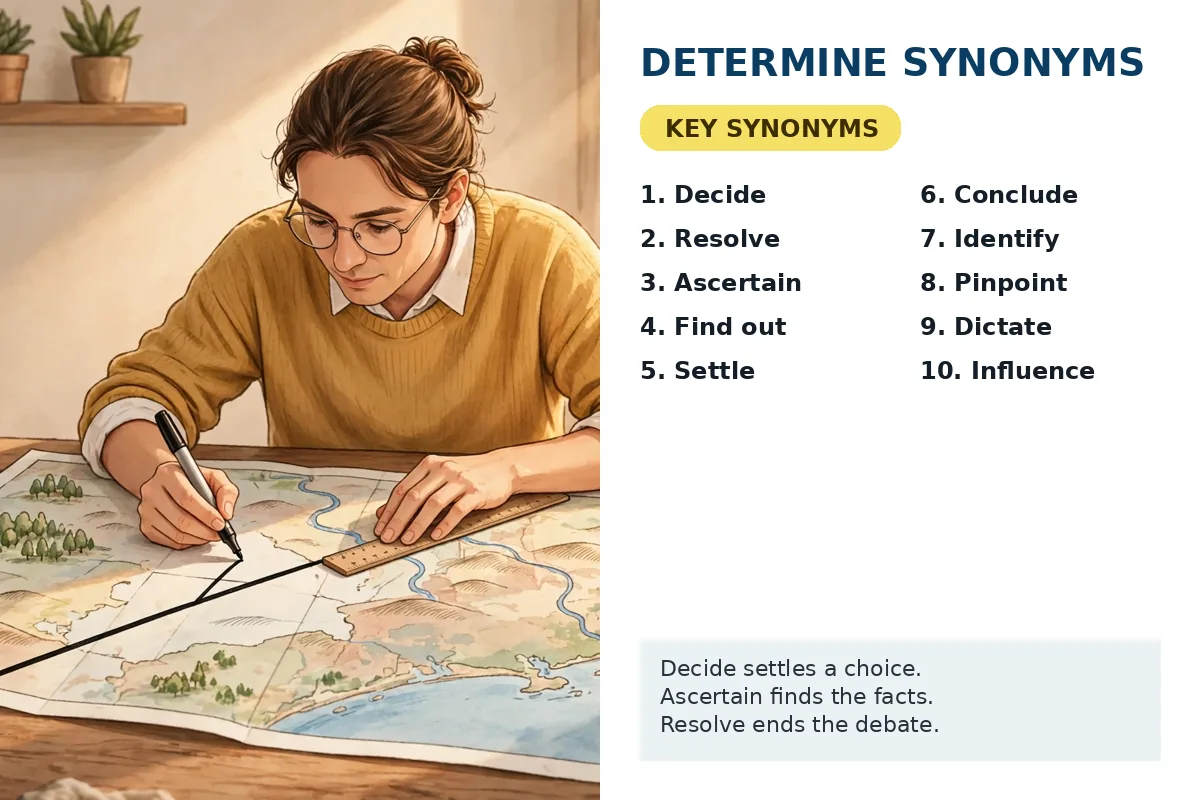
Finding good determine synonyms is trickier than it looks because determine covers three jobs in English. It can mean making a decision as in “we need to determine a date.” It can mean finding something out as in “tests will determine the cause.” And it can mean shaping an outcome as in “price determines demand.” Each job needs a different replacement.
The closest synonym for determine is decide it covers the everyday sense of settling a question or a choice. When determine means discovering a fact, ascertain or find out fits better. This guide sorts 18 determine synonyms by meaning so you can pick the right word first time.
Another Word For Determine Synonym at a Glance
| # | Synonym | Meaning Difference |
|---|---|---|
| 1 | Decide | To settle a choice or question (verb) |
| 2 | Resolve | To settle a problem or dispute firmly |
| 3 | Ascertain | To find out something for certain, formally |
| 4 | Find out | To discover a fact, in everyday language |
| 5 | Settle | To fix something finally, after discussion |
| 6 | Conclude | To reach a decision after reasoning |
| 7 | Identify | To recognize exactly what something is |
| 8 | Pinpoint | To locate or name something exactly |
| 9 | Dictate | To control or decide an outcome strongly |
| 10 | Influence | To shape an outcome without deciding it alone |
Quick Facts About “Determine”
- Part of speech: a verb (determine the winner). The adjective determined means resolute, as in “a determined student.”
- Three core meanings: (1) decide or settle something, (2) find out or discover a fact, (3) cause or shape an outcome.
- Register: neutral to formal. Determine works in reports, science, law, and business, and in everyday speech when the tone is serious.
- Watch out: determine often sounds formal. In casual conversation, decide or find out usually sounds more natural.
The Closest Synonym: Decide
Decide is the closest synonym for determine because it covers the word’s most familiar job: settling a question so action can follow. When a committee decides a date, a family decides a holiday, or a judge decides a case, the real action is determination in plain clothes. A choice is made, uncertainty ends, and everyone knows what happens next.
Still, the two words are not identical. Decide stresses the human act of choosing. Determine can also stress the process of finding out, or the force that shapes a result, neither of which is choosing at all. A test determines a cause, it does not decide it. Weather determines a harvest, it does not choose it. Use decide for choices made by people, and keep determine (or a word below) when facts are discovered or outcomes are shaped.
Finally, remember the outcome trap. Decide always needs a chooser. A price does not “decide” demand, it determines or influences it. For that job, skip ahead to dictate and influence in Group 3 below.
Where “Determine” Comes From (Etymology)
According to Etymonline, determine began as a word about drawing boundaries. In the late 14th century, determinen meant “to settle, decide upon, state definitely, fix the bounds of, limit in time or extent.” It came from Old French determiner (12th century) and directly from Latin determinare, “to enclose, bound, set limits to,” built from de, “off,” plus terminare, “to mark the end or boundary,” from terminus, “end, limit.”
The sense of “render judgment” arrived in the early 15th century, and the sense of “give direction or tendency to” arrived in the same period. The meaning “to find, as the solution of a problem,” is recorded from the 1640s. That history explains the word’s range today. To determine something is still, at heart, to draw a line around it: this is the decision, this is the fact, this is the limit.
Can You Swap Them Freely?
In short: only inside the same meaning group. A deciding word collapses in a discovering sentence, and a shaping word collapses in a choice sentence:
- ✅ “The committee decided the date.” (verb, a choice ✔)
- ❌ “The committee ascertained the date.” (ascertain means found out, not chose ✘, unless the date was already fixed and they merely learned it)
- ✅ “Tests ascertained the cause of the fault.” (verb, discovering ✔)
- ❌ “Tests decided the cause of the fault.” (tests do not choose ✘, say ascertained or identified)
Determine Synonyms in Detail
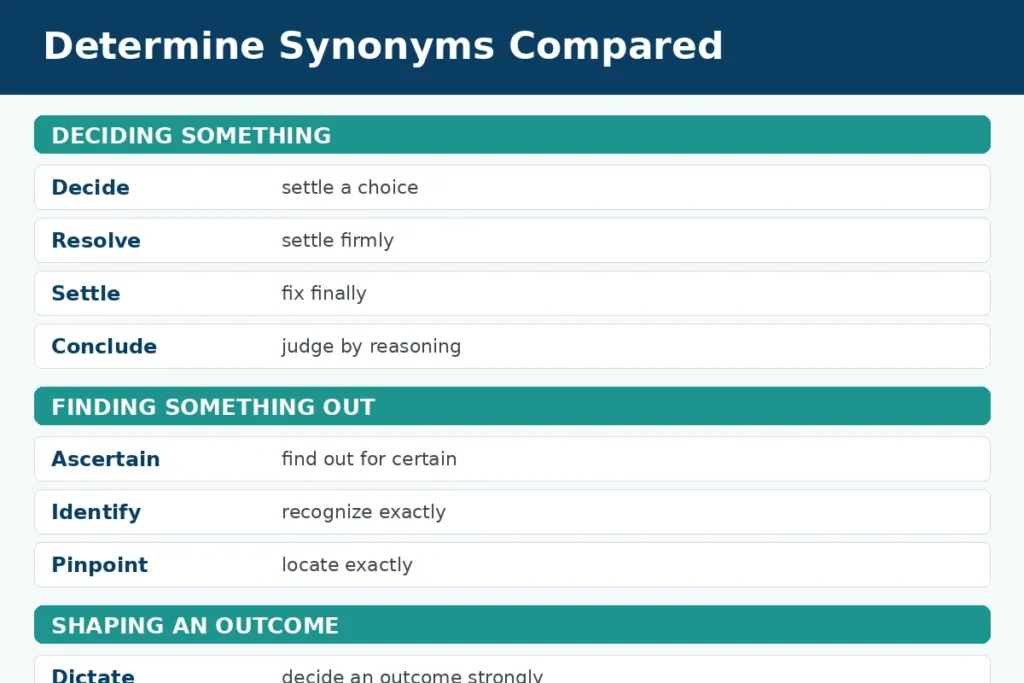
Group 1: Determine as Deciding or Settling Something
1. Decide
- Meaning: To make a choice or settle a question, after thought or discussion.
- Difference: The closest all-round match for everyday determination. Decide stresses the chooser, not the evidence or the force behind the choice.
- Best used for: Meetings, plans, purchases, everyday choices.
- Formality: Neutral · CEFR: A2 · Frequency: Very common
- Example (Work): “The team decided to launch in March, not February.”
- Example (Everyday): “We decided on pizza after ten minutes of debate.”
- When NOT to use it: For discovering a fact. A scientist does not “decide” a blood type, she ascertains or identifies it.
2. Resolve
- Meaning: To settle a problem, dispute, or doubt firmly, so it no longer troubles anyone.
- Difference: Resolve adds firmness and finality. You resolve a conflict, you merely decide a lunch venue.
- Best used for: Disputes, problems, committees, formal statements.
- Formality: Neutral to formal · CEFR: B2 · Frequency: Common
- Example (Formal): “The two sides resolved the contract dispute in one meeting.”
- Example (Work): “She resolved to finish the report before the weekend.”
- When NOT to use it: For light, everyday choices, where resolve sounds far too grand.
3. Settle
- Meaning: To fix something finally, often after discussion, negotiation, or delay.
- Difference: Settle suggests an end to back and forth. A settled date, price, or argument stays put.
- Best used for: Agreements, dates, prices, arguments.
- Formality: Neutral · CEFR: B1 · Frequency: Very common
- Example (Work): “They settled the price after a week of emails.”
- Example (Everyday): “Let us settle the holiday dates tonight, once and for all.”
- When NOT to use it: For scientific discovery. You settle a question by agreement, you ascertain a fact by evidence. (Note the overlap with coordination: settling a shared plan usually takes coordination between everyone involved.)
4. Conclude
- Meaning: To reach a decision or judgment after reasoning about evidence or discussion.
- Difference: Conclude stresses the reasoning path. A conclusion follows from what came before it, it is not just a pick.
- Best used for: Reports, essays, investigations, meetings.
- Formality: Formal · CEFR: B2 · Frequency: Common
- Example (Formal): “The inquiry concluded that safety checks had failed.”
- Example (Work): “After reviewing the bids, we concluded that only one firm could deliver on time.”
- When NOT to use it: For quick, personal choices. Nobody “concludes” to have tea.
5. Fix
- Meaning: To set something firmly, such as a date, a price, or a limit, so it will not change.
- Difference: Fix is short and practical. It names the act of pinning something down, without any talk of reasoning or debate.
- Best used for: Dates, prices, schedules, limits.
- Formality: Neutral · CEFR: B1 · Frequency: Very common
- Example (Work): “The venue fixed the ticket price at twenty dollars.”
- Example (Everyday): “We fixed Sunday for the family visit.”
- When NOT to use it: For judgments about facts. You fix a date, you do not fix a cause.
6. Choose
- Meaning: To pick one option from several, by preference.
- Difference: Choose stresses preference, not authority. A committee determines a policy, a shopper chooses a shirt.
- Best used for: Shopping, menus, personal preference, options.
- Formality: Neutral · CEFR: A2 · Frequency: Very common
- Example (Everyday): “She chose the blue dress over the red one.”
- Example (Work): “The client chose the simpler design.”
- When NOT to use it: For outcomes forced by facts or rules. Data does not “choose” a result, it determines it.
Group 2: Determine as Finding Something Out
7. Ascertain
- Meaning: To find out something for certain, usually by checking, testing, or asking.
- Difference: Ascertain is the formal twin of find out. It promises certainty, earned by effort.
- Best used for: Reports, law, science, formal inquiries.
- Formality: Formal · CEFR: C1 · Frequency: Uncommon
- Example (Formal): “Police are still trying to ascertain the exact time of the accident.”
- Example (Work): “First, ascertain whether the customer received the refund.”
- When NOT to use it: In casual speech, where find out sounds human and ascertain sounds like a legal form.
8. Find Out
- Meaning: To discover or learn a fact, in plain everyday language.
- Difference: Find out is the friendly version of ascertain. Same job, no formality.
- Best used for: Conversation, emails, school, everyday writing.
- Formality: Neutral, informal · CEFR: A2 · Frequency: Very common
- Example (Everyday): “Let me find out if the shop is open on Sunday.”
- Example (Work): “We need to find out why deliveries are late.”
- When NOT to use it: In a formal report, where ascertain or establish carries more authority.
9. Identify
- Meaning: To recognize exactly what something is, or who someone is.
- Difference: Identify stresses recognition. You identify a bird, a problem, or a suspect, you do not merely learn about them in general.
- Best used for: Science, medicine, police work, troubleshooting.
- Formality: Neutral · CEFR: B2 · Frequency: Very common
- Example (Work): “Engineers identified a faulty valve as the cause.”
- Example (Everyday): “Can you identify this plant from the photo?”
- When NOT to use it: For decisions. Identifying a winner is not the same as choosing one.
10. Pinpoint
- Meaning: To locate or name something exactly, with no vagueness left.
- Difference: Pinpoint is identify with a sharp point. It suits maps, causes, and moments in time.
- Best used for: Troubleshooting, research, directions, analysis.
- Formality: Neutral · CEFR: B2 · Frequency: Common
- Example (Work): “The team pinpointed the bug to one line of code.”
- Example (News): “Experts pinpointed the outbreak to a single market.”
- When NOT to use it: For broad judgments. You pinpoint a cause, you conclude a verdict.
11. Calculate
- Meaning: To work something out by numbers, measurement, or careful reasoning.
- Difference: Calculate stresses the working out. A result is computed, not guessed or chosen.
- Best used for: Maths, finance, science, planning.
- Formality: Neutral · CEFR: B1 · Frequency: Very common
- Example (Work): “Calculate the total cost before you approve the order.”
- Example (Everyday): “She calculated that the trip would take four hours.”
- When NOT to use it: For human choices or moral judgments, where numbers are not the point.
12. Measure
- Meaning: To find the size, amount, or degree of something by a standard method.
- Difference: Measure is determine by instrument or scale. It gives a number, not a verdict.
- Best used for: Science, cooking, building, surveys.
- Formality: Neutral · CEFR: B1 · Frequency: Very common
- Example (Work): “Measure the room before ordering furniture.”
- Example (Science): “Researchers measured stress levels before and after the program.”
- When NOT to use it: For decisions or causes. You measure rainfall, you do not measure a decision.
Group 3: Determine as Shaping an Outcome
13. Dictate
- Meaning: To control or decide an outcome strongly, leaving little room for other factors.
- Difference: Dictate is determination with force. Weather dictates a harvest in a way that advice never does.
- Best used for: Economics, policy, rules, strong causal claims.
- Formality: Neutral to formal · CEFR: B2 · Frequency: Common
- Example (News): “Fuel prices dictate transport costs across the country.”
- Example (Work): “The deadline dictates how much testing we can do.”
- When NOT to use it: For gentle influence. Dictating leaves no choice, influencing leaves some.
14. Influence
- Meaning: To shape an outcome or a decision, without deciding it alone.
- Difference: Influence is softer than dictate. Many factors influence a result, only one or two dictate it.
- Best used for: Marketing, politics, health, everyday causation.
- Formality: Neutral · CEFR: B2 · Frequency: Very common
- Example (Work): “Price influences demand, but quality decides repeat sales.” (Note the overlap with power: market influence is one form of power, but influence alone rarely decides a market.)
- Example (Everyday): “Her advice influenced my choice of university.”
- When NOT to use it: When one factor truly decides the outcome. Then dictate or determine is honest, influence is vague.
15. Shape
- Meaning: To give form to an outcome over time, gradually.
- Difference: Shape suggests slow molding, not a single decision. Experience shapes judgment the way hands shape clay.
- Best used for: Careers, opinions, culture, long term effects.
- Formality: Neutral · CEFR: B2 · Frequency: Very common
- Example (Work): “Early jobs shaped her approach to management.”
- Example (Everyday): “Travel shaped his taste in food.”
- When NOT to use it: For a single, dated decision. A meeting decides a date, it does not shape it.
16. Govern
- Meaning: To control how something works, by rules or by a dominant principle.
- Difference: Govern is determination by a system. Laws govern trade the way gravity governs falling objects, steadily and without exception.
- Best used for: Law, science, systems, formal writing.
- Formality: Formal · CEFR: C1 · Frequency: Common
- Example (Formal): “Supply and demand govern prices in a free market.”
- Example (Science): “Simple rules govern how ants find food.”
- When NOT to use it: For personal choices, where govern sounds far too grand.
17. Decide the Outcome (Phrase)
- Meaning: The plain phrase for the shaping sense, used when a single word feels too strong or too vague.
- Difference: Phrases buy clarity. “This will decide the outcome” is clearer than forcing determine into every sentence.
- Best used for: Sports, elections, negotiations, plain explanations.
- Formality: Neutral · CEFR: B1 · Frequency: Common
- Example (Sports): “The final match will decide the outcome of the season.”
- Example (Work): “Customer feedback will decide the outcome of the redesign.”
- When NOT to use it: In tight, formal prose, where determine or dictate is shorter.
18. Set the Course (Phrase)
- Meaning: To fix the direction that later events will follow.
- Difference: Setting a course is determination as navigation. The decision points forward, and everything after it follows.
- Best used for: Strategy, careers, projects, stories.
- Formality: Neutral · CEFR: B2 · Frequency: Common
- Example (Work): “The pilot project set the course for the whole rollout.”
- Example (Everyday): “One good teacher set the course of his career.”
- When NOT to use it: For discovering facts. A course is set for the future, not found in the past.
Words Commonly Confused With “Determine”
These words sit close to determine in lists of determine synonyms, but each one fails the swap test in an important way:
- Determined, The adjective, not the verb: a determined person refuses to give up. “She determined the race” and “she is determined” are different words doing different jobs.
- Predetermine, To fix something in advance, often by fate or by an earlier decision. It is narrower than determine, and it always adds the idea of “already decided before.”
- Undermine, To weaken something secretly. It sounds a little like determine, but it means the opposite direction: taking power away, not settling a question.
- Terminate, To end something. The shared termin root (an end, a limit) explains the lookalike, but terminate ends a contract, determine settles a question.
- Discriminate, To tell things apart, or unfairly to treat people differently. In its neutral sense it is close to identify, but it never means decide or shape an outcome.
Best Alternatives by Context
The right choice among determine synonyms depends on your situation, match yours to the row below. This section uses short case stories, not just a table, so the pattern is easier to remember:
Case 1, a meeting must end with a date. Choose decide or settle. The group is choosing, not discovering. “We settled on Tuesday” ends the debate.
Case 2, a lab must name the cause. Choose ascertain, identify, or pinpoint. Evidence is doing the work, not preference. “Tests pinpointed the fault” is honest, “tests decided the fault” is not.
Case 3, a budget must be worked out. Choose calculate or measure. Numbers are involved, so the verb should say so.
Case 4, a market force is shaping prices. Choose dictate, govern, or influence, depending on strength. Dictate leaves no room, influence leaves some, govern names a system.
Case 5, a career is taking shape over years. Choose shape or set the course. Slow molding, not a single vote.
A final tip: if the determination also involves teamwork, say so directly. A decision that everyone helped to reach is easier to defend than a decision handed down in silence, and a team that helped to ascertain the facts will trust the conclusion more.
Which Determine Synonym Should I Choose?
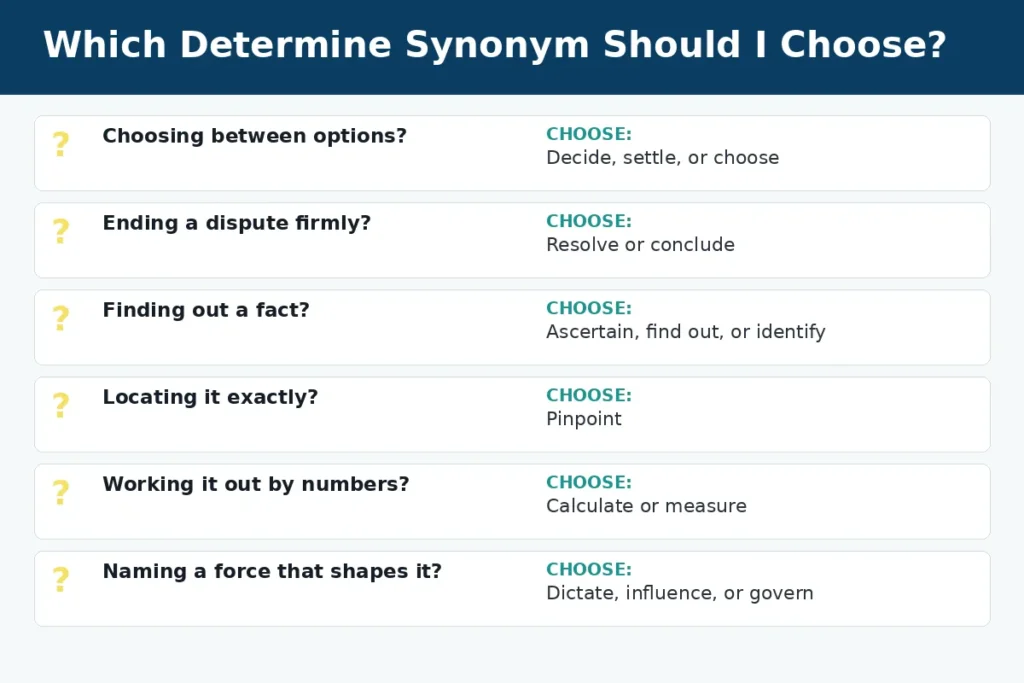
| Ask yourself | If yes, choose |
|---|---|
| Am I choosing between options? | Decide, settle, or choose |
| Am I ending a dispute firmly? | Resolve or conclude |
| Am I finding out a fact? | Ascertain, find out, or identify |
| Am I locating it exactly? | Pinpoint |
| Am I working it out by numbers? | Calculate or measure |
| Am I naming a force that shapes it? | Dictate, influence, govern, or shape |
Antonyms of Determine
Match the opposite to the sense you used, because the verb’s senses have different enemies:
Opposites of determine (verb, to decide):
| Antonym | What it means |
|---|---|
| Postpone | To put a decision off to a later time |
| Defer | To delay a decision formally |
| Waver | To hesitate between choices |
| Hesitate | To pause before deciding, from doubt |
| Leave open | To deliberately not settle a question |
| Abdicate | To give up the right to decide |
Opposites of determine (verb, to find out or to shape):
| Antonym | What it means |
|---|---|
| Obscure | To hide a fact so it cannot be found out |
| Confuse | To make a cause or result unclear |
| Mislead | To point investigation in the wrong direction |
| Free | To release an outcome from a shaping force |
| Randomize | To remove a fixed pattern from results |
| Leave to chance | To let no factor settle the outcome |
Collocations With “Determine”
Finally, a short set of fixed phrases rounds out your determine synonyms toolkit. These are the partners the word keeps in real writing:
- determine the cause, “Tests will determine the cause of the failure.”
- determine whether, “We need to determine whether the offer is still open.”
- determine the outcome, “The final vote will determine the outcome.”
- determine the price, “Supply and demand determine the price.”
- determined effort, the adjective sense: “Her determined effort finally paid off.”
- determine eligibility, “The form determines eligibility for the grant.”
One honest note: determine has no famous idiom of its own. The phrases above are collocations, the word’s regular partners, and they are the ones worth memorizing.
Practice: Fill in the Blank
Now it is your turn. Fill each blank with the best word from the bank, then check the key. Word bank: decide, ascertain, pinpoint, dictate, calculate.
- Before signing, we must ___ whether the refund was actually received.
- The committee will ___ the launch date at tomorrow’s meeting.
- Engineers ___ the fault to a single broken sensor.
- Fuel prices ___ transport costs in every region.
- Please ___ the total before you submit the expense claim.
Answer key:
- Ascertain, a fact must be found out for certain, not merely chosen.
- Decide, a group is making a choice.
- Pinpoint, an exact location of the fault, with no vagueness.
- Dictate, a strong force leaving little room for other factors.
- Calculate, a total worked out by numbers.
FAQ
What is the closest synonym for determine?
Decide is the closest synonym for the verb determine, because both mean settling a question so action can follow. The catch is that decide needs a chooser and a choice. When determine means discovering a fact, ascertain or find out is closer, and when it means shaping an outcome, dictate or influence is closer.
What is another word for determine the cause?
Ascertain, identify, and pinpoint are the three natural choices, in order of formality and precision. Ascertain is formal and stresses certainty, identify stresses recognition, and pinpoint stresses exactness. For everyday speech, find out covers the same job without any formality.
What is the difference between determine and decide?
Both verbs settle a question, but they settle different kinds of questions. Decide settles a choice made by a person or group. Determine also settles facts by evidence, and outcomes by forces, where no one is choosing at all. A jury decides a verdict, a test determines a cause, and demand determines a price.
Is determined a synonym for determine?
No. Determined is the adjective form, meaning resolute or firm in purpose, as in “a determined student.” It describes a person’s attitude, while determine is the verb for settling, discovering, or shaping. The two share a root, the Latin idea of a boundary, but they do different jobs in a sentence.
What is the opposite of determine?
For the deciding sense, the opposites are postpone, defer, waver, and hesitate, words for not settling a question. For the discovering and shaping senses, the opposites are obscure, confuse, mislead, and leave to chance. English needs both sets because determine itself carries choosing, discovering, and shaping meanings.
Which word works for determining a price?
Calculate works when you work the price out by numbers, and dictate works when one force, such as supply or a monopoly, fixes it. In general, economists say supply and demand determine prices, which is the neutral statement. For a shop setting a price, fix or set is the practical choice.
Conclusion
Determine rewards anyone who checks which of its jobs a sentence needs. If you are choosing, decide is your default, and resolve, settle, and conclude sharpen it for disputes, agreements, and reasoned judgments. If you are discovering, ascertain, identify, and pinpoint each name a different level of certainty and precision.
And if you are shaping, dictate, influence, and govern say honestly how much force is really at work. In the end, choose by job, not by habit, and determine synonyms will stop feeling like a guessing game, each replacement will say exactly what you meant, only sharper.

About Sajjad Ahmed
Sajjad Ahmed is the author behind Guest Paster, where he writes about English vocabulary, synonyms, word meanings, and practical word usage.
His content is designed to help readers understand the differences between similar words, discover suitable alternatives, and use English vocabulary more effectively in everyday writing and communication.
Before publishing, Sajjad focuses on presenting word choices in a clear and easy-to-understand format, with relevant meanings, context, and examples where helpful.
Through Guest Paster, his goal is to make vocabulary learning simpler and provide useful language resources for students, writers, English learners, and anyone looking to expand their vocabulary.
Areas of Focus: English Vocabulary • Synonyms • Word Meanings • Word Usage • Language Learning
Author: Sajjad Ahmed
Website: Guest Paster