Your teacher circles the word made in your essay, again. Your report says the team made a plan, the factory made a part and the rain made a mess and every sentence sounds the same. Made is the past tense of make and it does three jobs: it creates something new, it puts parts together and it causes an effect.
This guide sorts 15 made synonyms by meaning so you can pick the word that fits. If something is new, say created. If it was put together from parts, say assembled. And if it caused a result, say caused.
Another Word For Made Synonyms
| # | Synonym | Meaning Difference |
|---|---|---|
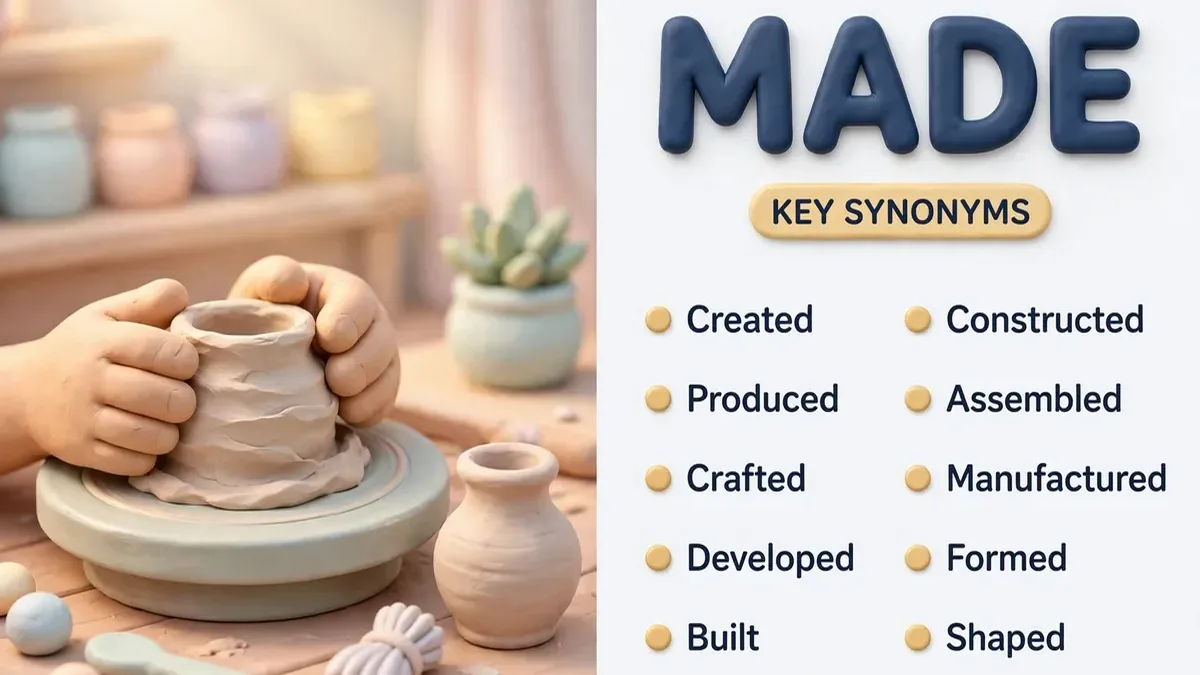
| 1 | Created | Brought something new into being |
| 2 | Produced | Made something, often in quantity |
| 3 | Crafted | Made by hand with skill and care |
| 4 | Developed | Made something grow over time |
| 5 | Built | Made something solid by putting it up |
| 6 | Constructed | Built something large or complex |
| 7 | Assembled | Put ready parts together |
| 8 | Manufactured | Made in a factory, in large numbers |
| 9 | Formed | Gave shape to something |
| 10 | Shaped | Gave form by cutting, molding, or pressing |
Quick Facts About “Made”
- Part of speech: a verb, the past tense and past participle of make, as in “she made a cake.”
- Three core meanings: (1) created something new, as in “she made a painting,” (2) put parts together, (3) caused something to happen, as in “the rain made the road slippery.”
- Transitive use: made takes an object, as in made a chair, made a plan, or made a mess.
- Register: neutral. Made suits everyday speech, school writing, news, and reports, but formal writing often prefers a sharper verb.
The Closest Synonym: Created
Created is the closest synonym for made, because it covers the word’s best known job: bringing something new into being. A writer creates a story, an artist creates a painting, and a team creates a plan, and each time the real action is making something new.
Still, created is not identical to made. It suits new things, ideas, and works of art, but it sounds odd for factory goods or simple physical jobs: a factory made a thousand chairs, it did not create them, and a builder made a wall, not created one.
Choice test: for something new, an idea, or a work of art, created works. For parts joined together, use assembled or constructed. For an effect or a result, use caused.
Where “Made” Comes From (Etymology)
According to Etymonline, made is the past tense of make, from Old English macian, “to give being to, bring into existence; construct, produce; prepare, arrange, cause.” It came from West Germanic *makojanan, “to fashion, fit,” the source also of Dutch maken and German machen, from the Proto-Indo-European root *mag-, “to knead, fashion, fit.” The sense may have grown from prehistoric houses built of mud, kneaded and shaped by hand.
Over time, make replaced the main Old English word gewyrcan, the ancestor of work. Its broad use survives in phrases we still say: make friends is from the late 14th century and make do is attested by 1867.
The arrival sense, “to arrive at a place,” is first attested in the 1620s and was originally nautical, as in “made port before the storm.” Merriam-Webster lists the same three core senses: to bring into being by forming or shaping material, to put together from components, and to cause to happen.
Can You Swap Them Freely?
In short: only inside the same meaning group, and only when the job matches.
- ✅ “She created a painting for the school fair.” (something new ✔)
- ❌ “The factory created ten thousand screws.” (factory goods need manufactured or produced ✘, say manufactured)
- ✅ “The storm caused a power cut.” (an effect ✔)
- ❌ “The carpenter caused a table.” (caused needs an effect, not an object ✘, say built or made)
Before you substitute, ask which job made is doing: a new thing takes a Group 1 word, parts joined together take a Group 2 word, and an effect takes a Group 3 word.
Made Synonyms in Detail

Group 1: Creating Something New
1. Created
- Meaning: Brought something new into being, such as an idea, a work of art, or a plan.
- Difference: The closest all-round match for made in its creative sense: created stresses newness, made stays neutral.
- Best used for: Art, writing, ideas, plans, music.
- Formality: Neutral · CEFR: B1 · Frequency: Very common
- Example (Art): “She created a mural for the library wall.”
- Example (Work): “The team created a new plan for the spring term.”
- When NOT to use it: For factory goods or simple physical jobs, where manufactured or built fits better.
2. Produced
- Meaning: Made something, often in quantity, by work or by a process.
- Difference: Produced suits output and volume: created suits one new thing, produced suits many.
- Best used for: Factories, farms, films, food, energy.
- Formality: Neutral · CEFR: B1 · Frequency: Very common
- Example (Farm): “The farm produced two tons of wheat this year.”
- Example (Film): “The studio produced three films in one year.”
- When NOT to use it: For a single handmade object, where crafted or created fits better.
3. Crafted
- Meaning: Made something by hand with skill, care, and attention to detail.
- Difference: Crafted adds the human hand and the quality of the work, while made stays neutral.
- Best used for: Handmade goods, furniture, jewelry, writing, speeches.
- Formality: Neutral to formal · CEFR: B2 · Frequency: Common
- Example (Workshop): “He crafted the chair from a single piece of oak.”
- Example (Writing): “She crafted her speech over three quiet evenings.”
- When NOT to use it: For factory goods or rough work, where manufactured or built fits better.
4. Developed
- Meaning: Made something grow or take shape over time, step by step.
- Difference: Developed adds time and stages: created can happen in a moment, developed takes weeks or months.
- Best used for: Software, products, plans, photos, skills.
- Formality: Neutral to formal · CEFR: B2 · Frequency: Very common
- Example (Technology): “The team developed a new app for bus riders.”
- Example (Photo): “She developed the film in her small darkroom.”
- When NOT to use it: For a finished object made in one sitting, where created or made fits better.
5. Built
- Meaning: Made something solid by putting materials together, often by construction.
- Difference: Built suits solid, standing things, and it is the plain word for making with your hands or with tools.
- Best used for: Houses, furniture, walls, models, teams.
- Formality: Neutral · CEFR: A2 · Frequency: Very common
- Example (Home): “They built a treehouse for the children last summer.”
- Example (Work): “She built a strong team from new graduates.”
- When NOT to use it: For an idea or a feeling, where created or caused fits better.
Group 2: Putting Parts Together
6. Constructed
- Meaning: Built something large or complex, often to a plan or a design.
- Difference: Constructed is the formal twin of built, and it suits bridges, roads, and buildings in reports.
- Best used for: Buildings, bridges, roads, formal writing.
- Formality: Formal · CEFR: B2 · Frequency: Very common
- Example (City): “The bridge was constructed in eighteen months.”
- Example (Report): “The engineers constructed a model of the new station.”
- When NOT to use it: For a small everyday object, where built or made sounds more natural.
7. Assembled
- Meaning: Put ready-made parts together to form a whole.
- Difference: Assembled stresses joining parts that already exist: built can start from raw wood, assembled starts from a kit.
- Best used for: Furniture, machines, teams, kits, models.
- Formality: Neutral · CEFR: B2 · Frequency: Common
- Example (Home): “He assembled the bookshelf in twenty minutes.”
- Example (Work): “She assembled a team of five for the project.”
- When NOT to use it: For something shaped from raw material, where formed or built fits better.
8. Manufactured
- Meaning: Made something in a factory, usually in large numbers, by machine.
- Difference: Manufactured is the word for factory production at scale, while made says nothing about scale.
- Best used for: Factories, products, cars, clothes, electronics.
- Formality: Neutral to formal · CEFR: B2 · Frequency: Very common
- Example (Industry): “The shoes were manufactured in a factory near the port.”
- Example (Business): “The company manufactured ten thousand phones a week, using an efficient line that rarely stopped.”
- When NOT to use it: For one handmade item, where crafted or created fits better.
9. Formed
- Meaning: Gave shape to something, or brought it into a shape or a group.
- Difference: Formed stresses the shape or the group that results, while built stresses the work.
- Best used for: Clay, metal, groups, teams, habits, plans.
- Formality: Neutral · CEFR: B1 · Frequency: Very common
- Example (Craft): “She formed the clay into a small bowl.”
- Example (School): “The students formed a club for young writers.”
- When NOT to use it: For a finished building, where built or constructed fits better.
10. Shaped
- Meaning: Gave something a form by cutting, molding, or pressing it.
- Difference: Shaped is the hands-on twin of formed, and it suits clay, wood, dough, and ideas shaped over time.
- Best used for: Pottery, woodwork, cooking, metal, ideas.
- Formality: Neutral · CEFR: B1 · Frequency: Very common
- Example (Pottery): “The potter shaped the vase on her wheel.”
- Example (Life): “Hard years shaped his view of the world.”
- When NOT to use it: For a large building, where built or constructed fits better.
Group 3: Causing Something to Happen
11. Caused
- Meaning: Made something happen, such as an event, a change, or a feeling.
- Difference: Caused is the plain word for the effect sense of made, and it needs a result after it, never a physical object.
- Best used for: Accidents, weather, news, science, everyday speech.
- Formality: Neutral · CEFR: B1 · Frequency: Very common
- Example (Weather): “Heavy rain caused flooding in the valley.”
- Example (News): “The fault caused delays across the network.”
- When NOT to use it: For a physical object. A carpenter does not “cause” a table, he builds it. For the cause phrase itself, see due to synonyms.
12. Brought about
- Meaning: Caused something to happen, often a change, over time.
- Difference: Brought about has a slow, deliberate feel: caused can be instant, brought about suggests a process.
- Best used for: Change, reform, results, history, essays.
- Formality: Neutral to formal · CEFR: B2 · Frequency: Common
- Example (History): “The new law brought about safer roads.”
- Example (Work): “The redesign brought about shorter queues at the clinic.”
- When NOT to use it: For a sudden accident, where caused sounds more natural.
13. Led to
- Meaning: Caused something as a later result, often step by step.
- Difference: Led to stresses the chain: one thing leads to the next, while caused can name a single direct hit.
- Best used for: Essays, science, history, business.
- Formality: Neutral to formal · CEFR: B2 · Frequency: Very common
- Example (Science): “The warm winter led to an early spring.”
- Example (Business): “The price cut led to a rise in sales.”
- When NOT to use it: For a direct physical effect, where caused fits better.
14. Triggered
- Meaning: Caused something to start suddenly, like a switch being flipped.
- Difference: Triggered adds a sudden start, while caused is neutral about speed.
- Best used for: Science, medicine, news, alarms, essays.
- Formality: Neutral to formal · CEFR: C1 · Frequency: Common
- Example (Health): “Pollen triggered her sneezing all morning.”
- Example (News): “The report triggered a debate in the town hall.”
- When NOT to use it: For a slow change over months, where brought about or led to fits better.
15. Prompted
- Meaning: Caused someone to act, or caused a reply, a question, or a change.
- Difference: Prompted suits human reactions: one thing moved a person to do another.
- Best used for: Questions, replies, decisions, letters, essays.
- Formality: Neutral to formal · CEFR: B2 · Frequency: Common
- Example (School): “The story prompted a long class discussion.”
- Example (Work): “The complaint prompted a quick reply from the manager.”
- When NOT to use it: For a physical effect like a flood, where caused fits better.
Words Commonly Confused With “Made”
These words sit close to made, but each one fails the swap test in an important way.
- Make, The present tense, not the past: “she makes a cake every week” is present, “she made a cake yesterday” is past.
- Maid, A homophone: a maid is a person who cleans or serves in a house. It sounds like made, a classic spelling trap, not a synonym at all.
- Create, Only for new things: a factory does not “create” ten thousand screws, and a builder does not “create” a wall.
- Cause, Only for effects: a carpenter does not “cause” a table, and a potter does not “cause” a vase.
- Build, Only for solid things: you cannot “build” a mess or “build” someone happy.
- Made up, A different phrasal verb: it means invented (“a made up story”) or reconciled (“they made up after the row”), not simply made.
Substitution test failures: “The factory created ten thousand screws” fails, because created suits new ideas, not factory volume, so say manufactured. “The carpenter caused a table” fails, because caused needs an effect, so say built. “The storm built a power cut” fails, because built needs a solid object, so say caused.
Best Alternatives by Context
The right choice depends on your scene. Match yours to the workshop below:
Scene 1, the potter’s wheel. A potter shapes wet clay into a vase. Use formed or shaped for the clay itself, and crafted for the finished vase.
Scene 2, the factory floor. A line turns out ten thousand phones a week. Use manufactured or produced, because scale and machines are the story. The same team collaborates on the design first.
Scene 3, the building site. A crew raises a bridge over eighteen months. Use constructed in a report, or built in everyday speech.
Scene 4, the classroom. A teacher writes a song for the school play. Use created for the song.
Scene 5, the garden after rain. Heavy rain turns the path to mud and starts a debate about drainage. Use caused for the mud, triggered for the debate, and led to for the slow change.
Which Made Synonym Should I Choose?

| Ask yourself | If yes, choose |
|---|---|
| Is it something new, an idea or a work of art? | Created |
| Is it made in quantity, by a process or a machine? | Produced or manufactured |
| Is it a solid thing put up by building? | Built or constructed |
| Was it made by hand with skill and care? | Crafted |
| Were ready parts joined together? | Assembled |
| Is it a shape given to clay, metal, or a group? | Formed or shaped |
| Did it grow or take shape over time? | Developed |
| Is it an effect, a result, or a feeling? | Caused |
| Did it start suddenly, like a switch? | Triggered |
| Did it move a person to act or reply? | Prompted |
| Did it happen step by step over time? | Led to or brought about |
Antonyms of Made
1. Antonyms for made as creating something new
| Antonym | Meaning Difference |
|---|---|
| Destroyed | Broke something so it no longer exists |
| Demolished | Tore a building down |
| Unmade | Took something apart or undid it |
| Ruined | Spoiled something so it is useless |
| Dismantled | Took a thing apart piece by piece |
2. Antonyms for made as putting parts together
| Antonym | Meaning Difference |
|---|---|
| Disassembled | Took the parts apart |
| Took apart | Separated the parts by hand |
| Broke down | Fell apart into pieces |
| Undid | Reversed the making |
| Unbuilt | Took a structure down (rare, formal) |
3. Antonyms for made as causing something to happen
| Antonym | Meaning Difference |
|---|---|
| Prevented | Stopped an effect before it happened |
| Avoided | Kept an effect from happening |
| Stopped | Brought an effect to an end |
| Blocked | Kept a result from passing |
| Undid | Reversed a result already made |
American vs British English
Made is spelled the same in American and British English, and so are all 15 synonyms here. One small point: American writing also uses made in the USA as a label for origin. This article uses American spelling throughout.
Collocations and Idioms With Made
Only combinations native speakers actually use:
- made of wood / stone / glass, the material: “The table is made of oak.”
- made by hand, handmade: “The shoes are made by hand in a small shop.”
- made in Japan / made in Italy, the place of origin: “The watch was made in Japan.”
- made a mess, caused disorder: “The dog made a mess of the kitchen.”
- made a mistake, did something wrong: “She made a mistake in the last sum.”
- made my day, made someone very happy: “Your letter made my day.”
Use made of for the material, made by for the maker, and made in for the place. Do not mix them: a table is made of oak, made by a carpenter, and made in a workshop.
Practice Exercises
Exercise 1: Pick the best word. Choose the best replacement for made in each sentence.
- The potter ___ a vase from wet clay on her wheel. (caused, shaped, triggered)
- The factory ___ ten thousand phones a week. (crafted, manufactured, prompted)
- Heavy rain ___ flooding in the valley. (built, caused, assembled)
- She ___ a new song for the school play. (manufactured, created, assembled)
- He ___ the bookshelf in twenty minutes, following the kit. (assembled, caused, developed)
Exercise 2: Spot the wrong word. Each sentence uses a made synonym wrongly. Name the mistake and fix it.
- “The factory created ten thousand screws.”
- “The carpenter caused a table.”
- “The storm built a power cut.”
- “The writer manufactured a poem about the sea.”
- “The potter triggered a vase on her wheel.”
Answer key
- Exercise 1: (1) shaped; (2) manufactured; (3) caused; (4) created; (5) assembled.
- Exercise 2: (1) created is wrong, say manufactured; (2) caused is wrong, say built; (3) built is wrong, say caused; (4) manufactured is wrong, say created; (5) triggered is wrong, say shaped.
Frequently Asked Questions
What is the closest synonym for made?
Created is the closest synonym when made means bringing something new into being. For parts joined together, assembled or constructed fits better. For an effect, caused is the plain choice. Pick the word from the same meaning group as your sentence.
What is another word for made by hand?
Crafted is the best word for something made by hand with skill and care, such as a chair, a ring, or a speech. For clay or dough shaped by hand, formed or shaped fits better. For a simple handmade item, handmade is the plain adjective, as in a handmade scarf.
What is the difference between made and created?
Made is the plain, general word for producing anything, from a cake to a mess. Created stresses newness: the thing did not exist before, and it often carries art or ideas. A factory makes phones, but a writer creates a story.
Can made mean caused?
Yes. Made has a common cause sense: “the rain made the road slippery” means the rain caused the road to be slippery. In that sense, caused is the direct replacement. But caused needs an effect after it, so you cannot say a carpenter caused a table. Keep the object and the effect apart.
What is the opposite of made?
It depends on the meaning. For creating something new, the opposites are destroyed, demolished, and ruined. For putting parts together, the opposites are disassembled and took apart. And for causing an effect, the opposites are prevented, avoided, and stopped. Pick the antonym from the same meaning group.
Which synonym should students use in essays?
In essays, prefer created for new ideas and works, developed for things that grew over time, and caused for effects. Use constructed for large projects, and triggered only for a sudden start. Keep made itself for plain sentences where no sharper word fits.
Conclusion
The right replacement depends on which of its three jobs you mean. Something new calls for created, crafted, or developed. Parts joined together call for assembled, constructed, or manufactured. An effect or a result calls for caused, triggered, or prompted.
Read the sentence aloud with the replacement. If it says what you meant, keep it. If it sounds wrong, swap again, and let made itself do the plain jobs it does best.

About Sajjad Ahmed
Sajjad Ahmed is the author behind Guest Paster, where he writes about English vocabulary, synonyms, word meanings, and practical word usage.
His content is designed to help readers understand the differences between similar words, discover suitable alternatives, and use English vocabulary more effectively in everyday writing and communication.
Before publishing, Sajjad focuses on presenting word choices in a clear and easy-to-understand format, with relevant meanings, context, and examples where helpful.
Through Guest Paster, his goal is to make vocabulary learning simpler and provide useful language resources for students, writers, English learners, and anyone looking to expand their vocabulary.
Areas of Focus: English Vocabulary • Synonyms • Word Meanings • Word Usage • Language Learning
Author: Sajjad Ahmed
Website: Guest Paster