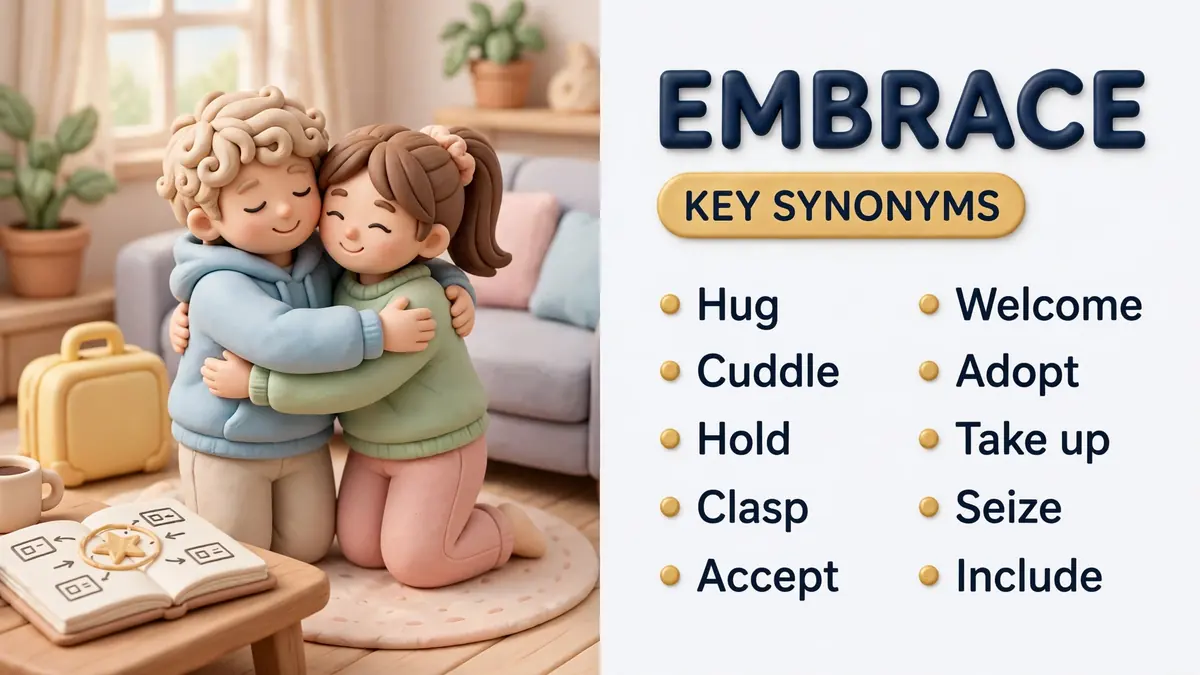
Your friend arrives after a long trip, and you step forward. Do you hug her, or do you embrace her? Later, your manager asks the team to embrace a new way of working. No arms are involved, and the choice is just as real. Embrace is one word with two jobs: a warm hold, and a willing yes to an idea or a change.
This guide sorts 15 embrace synonyms by meaning, so you can pick the word that fits. If the moment is physical, say hug. If it is a new idea, say accept or adopt. And if it is a whole group, say include.
Embrace Synonyms at a Glance
| # | Synonym | Meaning Difference |
|---|---|---|
| 1 | Hug | A warm hold |
| 2 | Cuddle | A close, tender hold |
| 3 | Hold | Arms around someone |
| 4 | Clasp | A firm, tight hold |
| 5 | Accept | Say yes to an idea or change |
| 6 | Welcome | Greet a change gladly |
| 7 | Adopt | Take up an idea or method |
| 8 | Take up | Start using something |
| 9 | Seize | Take a chance eagerly |
| 10 | Include | Take in as part of a whole |
Quick Facts About “Embrace”
- Part of speech: a verb, and a noun for a hug. You embrace a friend or a new idea, or give someone an embrace.
- Three core meanings: (1) hold someone closely, as in “she embraced her son,” (2) accept or adopt something willingly, as in “the school embraced the new timetable,” (3) include or contain something, as in “the course embraces all ages.”
- Transitive use: embrace takes an object: you embrace someone, or embrace a plan.
- Register: neutral to warm. Embrace suits everyday speech, fiction, speeches, and formal writing, warmer than accept and more formal than hug.
The Closest Synonym: Hug
Hug is the closest synonym for embrace, because it covers the word’s most basic and best known job: holding someone closely. When two people meet, part, or comfort each other, hug names that hold directly, and most people reach for it first.
Still, hug is not identical to embrace. Hug covers only the physical meaning. You can hug a friend, but you cannot hug a new policy or a change of plan. Embrace crosses from the body to the mind; hug stays with the body.
Choice test: for arms around a person, hug works. For a yes to an idea, use accept, welcome, or adopt. For a group taken in, use include.
Where “Embrace” Comes From (Etymology)
According to Etymonline, the verb is recorded in the mid-14th century as “clasp in the arms.” It came from Old French embracier (12th century, modern French embrasser), “clasp in the arms, enclose,” built from en-, “in,” plus brace or braz, “the arms,” from Latin bracchium, “an arm,” and Greek brakhion, also “an arm.” It replaced Old English clyppan, which covered the same sense of clasping.
The noun embrace, meaning “a hug,” is recorded from the 1590s. The figurative sense, accepting an idea willingly, grew from the physical picture: taking something to yourself, as if holding it close. Merriam-Webster lists the same three senses: to clasp in the arms, to take up something readily or gladly, and to take in as part of a whole.
Can You Swap Them Freely?
In short: only inside the same meaning group, and only when the sense matches.
- ✅ “She hugged her daughter at the airport.” (physical hold ✔)
- ❌ “The school hugged the new timetable.” (hug is physical only ✘, say adopted)
- ✅ “The team adopted the new software.” (accept meaning ✔)
- ❌ “He adopted his grandmother at the station.” (adopt is not a hug ✘, say hugged or embraced)
Before you substitute, ask which sense you mean: arms, a yes, or a group taken in.
Embrace Synonyms in Detail
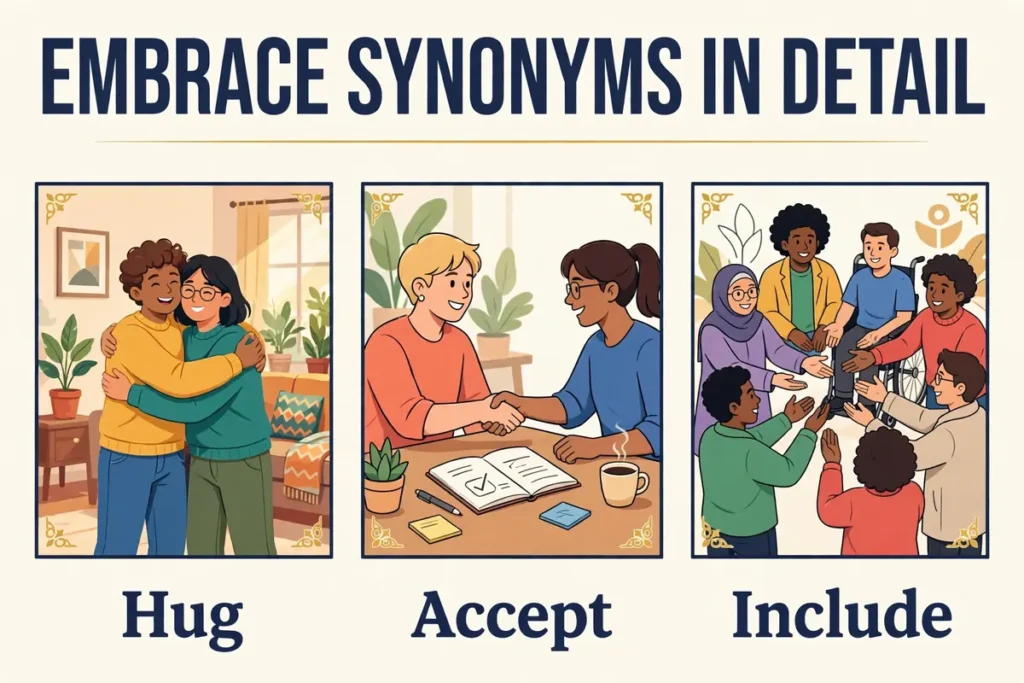
Group 1: Holding Someone Closely in Your Arms
1. Hug
- Meaning: To hold someone closely in your arms to show love, comfort, or joy.
- Difference: The closest match for embrace in its physical sense, and the plainest everyday word for it.
- Best used for: Everyday speech, fiction, greetings, farewells, comfort.
- Formality: Informal to neutral · CEFR: A2 · Frequency: Very common
- Example (Family): “He hugged his mother before he left for college.”
- Example (Friends): “They hugged at the door and laughed.”
- When NOT to use it: For an idea or a policy, where accept or adopt fits better.
2. Cuddle
- Meaning: To hold someone close in a tender way, often for comfort or warmth.
- Difference: Cuddle adds tenderness. A hug can be quick and public; a cuddle is close, quiet, and often longer.
- Best used for: Children, pets, partners, bedtime, comfort, fiction.
- Formality: Informal · CEFR: B1 · Frequency: Very common
- Example (Home): “She cuddled the baby until he fell asleep.”
- Example (Winter): “They cuddled under a blanket and watched the snow fall.”
- When NOT to use it: In formal writing, or for a brief greeting, where hug sounds more natural.
3. Hold
- Meaning: To keep someone in your arms, often to comfort or protect them.
- Difference: Hold is the plainest word of the group. It states the physical fact without the warmth hug and cuddle carry.
- Best used for: Fiction, news, everyday speech, comfort, protection.
- Formality: Neutral · CEFR: A2 · Frequency: Very common
- Example (Comfort): “She held him until his breathing slowed.”
- Example (Care): “The nurse held the child while the doctor checked his arm.”
- When NOT to use it: When warmth is the point, where hug or cuddle fits better.
4. Clasp
- Meaning: To hold someone tightly, often with hands or arms, and not let go.
- Difference: Clasp stresses grip. A hug can be loose; a clasp is firm, and it often carries urgency or relief.
- Best used for: Fiction, drama, formal writing, farewells, reunions.
- Formality: Neutral to formal · CEFR: B2 · Frequency: Common
- Example (Reunion): “He clasped his brother and would not let go.”
- Example (Drama): “She clasped the letter to her heart and read it twice.”
- When NOT to use it: For a casual greeting, where hug sounds warmer and simpler.
Group 2: Accepting or Adopting Something Willingly
5. Accept
- Meaning: To agree to take something, such as an idea, a change, or an offer, willingly.
- Difference: Accept is the broadest, most neutral word for the willing yes. It can be quiet and resigned, while embrace sounds warm and eager.
- Best used for: Business, school writing, everyday speech, news.
- Formality: Neutral · CEFR: B1 · Frequency: Very common
- Example (Work): “The team accepted the new schedule after discussion.”
- Example (Life): “In time, she accepted the move and liked the new town.”
- When NOT to use it: When eager support is the point, where embrace or welcome fits better.
6. Welcome
- Meaning: To greet an idea, a change, or a person gladly, with pleasure.
- Difference: Welcome adds gladness. Accept can be neutral; welcome is positive, and it suits speeches and announcements.
- Best used for: Speeches, announcements, business, essays.
- Formality: Neutral to formal · CEFR: B1 · Frequency: Very common
- Example (Work): “The company welcomed the new safety rules.”
- Example (Community): “Residents welcomed the plan for a new library on Main Street.”
- When NOT to use it: For a private decision with no gladness in it, where accept fits better.
7. Adopt
- Meaning: To take up and start using an idea, a method, or a plan.
- Difference: Adopt stresses the start of use. It suits policies, methods, and habits, and sounds practical rather than emotional.
- Best used for: Business, policy, technology, school writing, reports.
- Formality: Neutral to formal · CEFR: B2 · Frequency: Very common
- Example (Technology): “The clinic adopted a new booking system in January.”
- Example (School): “Teachers adopted short daily quizzes.”
- When NOT to use it: For a person in your arms, where hug or embrace fits better.
8. Take up
- Meaning: To start doing something, or start using an idea, a hobby, or a challenge.
- Difference: Take up is a plain, everyday phrasal verb. It suits hobbies and challenges, and sounds less formal than adopt.
- Best used for: Everyday speech, hobbies, challenges, school writing.
- Formality: Neutral · CEFR: B1 · Frequency: Very common
- Example (Hobby): “He took up gardening after he retired.”
- Example (Challenge): “She took up the challenge and finished the course.”
- When NOT to use it: In very formal writing, where adopt or embrace sounds more measured.
9. Seize
- Meaning: To take an opportunity or a challenge eagerly and at once.
- Difference: Seize adds speed and energy. Accept is calm; seize is bold, and it often appears with opportunity and chance.
- Best used for: Speeches, essays, business, fiction.
- Formality: Neutral to formal · CEFR: B2 · Frequency: Common
- Example (Career): “She seized the chance to lead the project.”
- Example (Sport): “The team seized the moment and scored twice before half time.”
- When NOT to use it: For a slow, careful decision, where accept or adopt fits better.
10. Include
- Meaning: To take someone or something in as part of a group or a whole.
- Difference: Include is the plain word for the third embrace sense: taking in. It is neutral and practical, and works for people, items, and ideas alike.
- Best used for: Reports, menus, lists, school writing.
- Formality: Neutral · CEFR: B1 · Frequency: Very common
- Example (School): “The course includes students of all ages.”
- Example (Menu): “The ticket includes lunch and a guided tour.”
- When NOT to use it: For a warm physical hold, where hug or embrace fits better.
Group 3: Including or Containing as a Whole
11. Squeeze
- Meaning: To hold someone tightly in your arms, often in a quick, warm hug.
- Difference: Squeeze stresses pressure and brevity. It is the word for a tight, affectionate hug.
- Best used for: Everyday speech, fiction, family writing.
- Formality: Informal to neutral · CEFR: B1 · Frequency: Very common
- Example (Family): “Grandma squeezed him before he got on the bus.”
- Example (Friends): “She gave his arm a quick squeeze.”
- When NOT to use it: For an idea or a policy, where accept or adopt fits better.
12. Enfold
- Meaning: To hold someone closely within your arms, as if wrapping them up.
- Difference: Enfold is literary and gentle. It suggests surrounding and protecting, and sounds more poetic than hug.
- Best used for: Fiction, poetry, formal writing, speeches.
- Formality: Formal · CEFR: C1 · Frequency: Less common
- Example (Fiction): “The old house enfolded them in warmth.”
- Example (Poetry): “Night enfolded the valley, and the lights came on.”
- When NOT to use it: In plain everyday speech, where hug or hold sounds more natural.
13. Espouse
- Meaning: To adopt and support an idea, a cause, or a belief openly and with conviction.
- Difference: Espouse adds public support and belief. Adopt can be practical; espouse is principled, and suits essays and speeches.
- Best used for: Essays, speeches, politics, formal writing.
- Formality: Formal · CEFR: C1 · Frequency: Less common
- Example (Politics): “The candidate espoused reform at every rally.”
- Example (Essay): “The writer espoused the view that small towns deserve libraries.”
- When NOT to use it: For a casual change of habit, where adopt or take up fits better.
14. Encompass
- Meaning: To include or contain something within a larger whole, or cover a wide range.
- Difference: Encompass stresses breadth and completeness. Include is plain; encompass sounds fuller, and suits whole systems.
- Best used for: Reports, essays, formal writing, science, business.
- Formality: Formal · CEFR: C1 · Frequency: Common
- Example (Science): “The study encompasses ten years of weather data.”
- Example (Business): “The new plan encompasses training, safety, and customer care.”
- When NOT to use it: For a simple list item, where include is clearer and simpler.
15. Cover
- Meaning: To include or deal with a subject or a topic within a course, a book, or a plan.
- Difference: Cover is the everyday word for the include sense in learning and media. It suits topics, not people in your arms.
- Best used for: School writing, courses, books, news, reports.
- Formality: Neutral · CEFR: B1 · Frequency: Very common
- Example (School): “This term the course covers plants and animals.”
- Example (News): “The report covers jobs and housing in the city.”
- When NOT to use it: For a physical hold, where hug or embrace fits better.
Best Alternatives by Context
Ask two questions.
First, which meaning do you need? If arms are involved, stay in Group 1. If the sentence is about an idea or a challenge, move to Group 2. And if it is about a whole that takes things in, move to Group 3. This one choice removes most mistakes at once.
Second, which situation is it? A quick greeting calls for hug. A child who needs comfort calls for cuddle or hold. An urgent farewell calls for clasp. A policy the team supports warmly calls for embrace or welcome. A method the office starts using calls for adopt. A hobby begun calls for take up. A rare chance calls for seize. A course for all ages calls for include or encompass.
For nearby families, see strive synonyms for effort toward a goal, empathy synonyms for understanding how another person feels, and collaborate synonyms for working together with others.
Which Embrace Synonym Should I Choose?

| Situation | Best pick | Why it wins |
|---|---|---|
| A warm greeting | Hug | Plain, warm hold |
| Comfort for a child | Cuddle | Tender and close |
| Plain comfort | Hold | Plain and factual |
| An urgent farewell | Clasp | Grip and tightness |
| A quiet yes | Accept | Broad and neutral |
| A glad yes | Welcome | Gladness |
| A new method or policy | Adopt | Starting to use it |
| A hobby begun | Take up | Plain, everyday start |
| A rare chance | Seize | Speed and boldness |
| A group taken in | Include | Plain taking in |
| A tight hug | Squeeze | Pressure and warmth |
| A literary hold | Enfold | Poetic and surrounding |
| A belief held openly | Espouse | Conviction |
| A wide range | Encompass | Breadth and completeness |
| A course topic | Cover | Everyday include sense |
Antonyms of Embrace
1.Antonyms for embrace as a physical hold
| Antonym | Meaning Difference |
|---|---|
| Release | Let go of someone held |
| Let go | Stop holding |
| Push away | Move someone off |
| Shove | Push roughly |
| Avoid | Keep away |
2. Antonyms for embrace as accepting or adopting
| Antonym | Meaning Difference |
|---|---|
| Reject | Refuse an idea or offer |
| Refuse | Say no to a change |
| Resist | Push back against a change |
| Oppose | Stand against an idea |
| Shun | Avoid and refuse |
3. Antonyms for embrace as including or containing
| Antonym | Meaning Difference |
|---|---|
| Exclude | Leave something out |
| Omit | Leave out |
| Leave out | Not take in |
| Bar | Keep out |
| Ban | Forbid entry |
Words Commonly Confused With Embrace
Embrace versus hug is the pair to watch. Hug covers only the physical hold, and it is the plain everyday word for it. Embrace is broader: it also covers a willing yes to an idea and a group taken in as a whole. You hug a friend at the station, but you embrace a new policy.
Accept versus adopt matters for the yes meaning. Accept is broad and neutral: you agree to take something. Adopt stresses starting to use it: a method or a habit. A team accepts a delay, but it adopts a new booking system.
Include versus encompass matters for the whole meaning. Include is the plain word for taking something in. Encompass stresses breadth and completeness, and suits whole systems. A ticket includes lunch; a study encompasses ten years of data.
Substitution test failures: “The school hugged the new timetable” fails, because hug is physical only, so say “the school embraced the new timetable.” “He adopted his grandmother at the station” fails, because adopt is not a hug, so say “he hugged her.” “The course hugged students of all ages” fails, because hug cannot mean include, so say “the course includes them.”
American vs British English
Embrace is spelled the same in American and British English, and so are all 15 synonyms here. One small point: in British English, take up is very common for hobbies, while American speakers also say pick up for a hobby. This article uses American spelling throughout.
Collocations and Idioms With Embrace
Only combinations native speakers actually use:
- embrace change: accept a change willingly, often in business and speeches.
- embrace a challenge: take on a hard task with energy.
- embrace new technology: start using new tools willingly.
- embrace diversity: accept and value many different people and ideas.
- a warm embrace: a loving, close hug.
- embrace someone tightly: hold someone close with firm arms.
- in someone’s embrace: held in someone’s arms.
- with open arms: a welcome given gladly, as in “they welcomed her with open arms.”
Use embrace with an object, as in “embrace the plan.” Use a warm embrace as the noun form for the hug itself.
Practice Exercises
Exercise 1: Fill in the blank. Choose the best word from the brackets.
- At the airport, Mia ___ her brother and would not let go. (hugged, adopted, included)
- The school ___ a new reading program after a term of tests. (hugged, adopted, cuddled)
- The baby slept while her father ___ her gently. (seized, cuddled, espoused)
- The festival program ___ singers and dancers from every part of town. (encompasses, squeezes, clasped)
- The startup ___ the chance to show its work at the fair. (seized, hugged, covered)
Exercise 2: Rewrite with a better word. Each sentence uses embrace where a sharper word fits.
- “The committee embraced the new budget after a long debate.” (Calm, not eager.)
- “She embraced her old friend when they met at the cafe.” (A quick greeting.)
- “The textbook embraces the history of the whole region.” (A course topic.)
- “He embraced the idea that small shops deserve fair rent.” (A belief held with conviction.)
Answer key
- Exercise 1: (1) hugged; (2) adopted; (3) cuddled; (4) encompasses; (5) seized.
- Exercise 2: (1) accepted; (2) hugged; (3) covers; (4) espoused.
Frequently Asked Questions
What is the best synonym for embrace?
Hug is the closest synonym when embrace means holding someone in your arms, because it names that warm hold. For accept, accept is safest, adopt fits a new method, and welcome fits a glad yes. For include, include is plain and encompass fits a wide range.
Can embrace mean to accept an idea?
Yes. Embrace has a common figurative meaning: to accept or adopt an idea or a change willingly and with warmth. A team can embrace a new timetable, and a writer a fresh style. The word sounds warmer and more eager than accept, so use it when support is wholehearted.
What is the difference between embrace and hug?
Embrace is broader. It covers a physical hold, a willing yes, and a group taken in as a whole. Hug covers only the physical hold, and it is the plainer word for it. You hug a friend at the station, but you embrace a policy. When arms are the story, hug is simpler.
Is hug or embrace more formal?
Embrace is more formal than hug, and it also carries more warmth in writing. Hug is the everyday word for a greeting, a farewell, or comfort between friends and family. In a speech or essay, embrace sounds measured and warm. In a text to a friend, hug sounds natural.
What is the opposite of embrace?
It depends on the meaning. For the physical hold, the opposites are release, let go, and push away. For the accept meaning, the opposites are reject, refuse, and resist. And for the include meaning, the opposites are exclude, omit, and leave out. Pick the antonym from the same meaning group.
Which synonym should students use in essays?
In essays, prefer accept for a neutral yes, adopt for a new method, and encompass for a wide range covered fully. Use welcome for glad support, and espouse only for a belief held with conviction. Reserve hug, cuddle, and squeeze for the physical sense.
Conclusion
The right replacement depends on which of its two jobs you mean. Arms around a person call for hug, cuddle, hold, or clasp. A willing yes calls for accept, welcome, adopt, or seize. A whole that takes things in calls for include, encompass, or cover.
One last check: read the sentence aloud with the replacement. If it says what you meant, keep it. If not, swap again.

About Sajjad Ahmed
Sajjad Ahmed is the author behind Guest Paster, where he writes about English vocabulary, synonyms, word meanings, and practical word usage.
His content is designed to help readers understand the differences between similar words, discover suitable alternatives, and use English vocabulary more effectively in everyday writing and communication.
Before publishing, Sajjad focuses on presenting word choices in a clear and easy-to-understand format, with relevant meanings, context, and examples where helpful.
Through Guest Paster, his goal is to make vocabulary learning simpler and provide useful language resources for students, writers, English learners, and anyone looking to expand their vocabulary.
Areas of Focus: English Vocabulary • Synonyms • Word Meanings • Word Usage • Language Learning
Author: Sajjad Ahmed
Website: Guest Paster