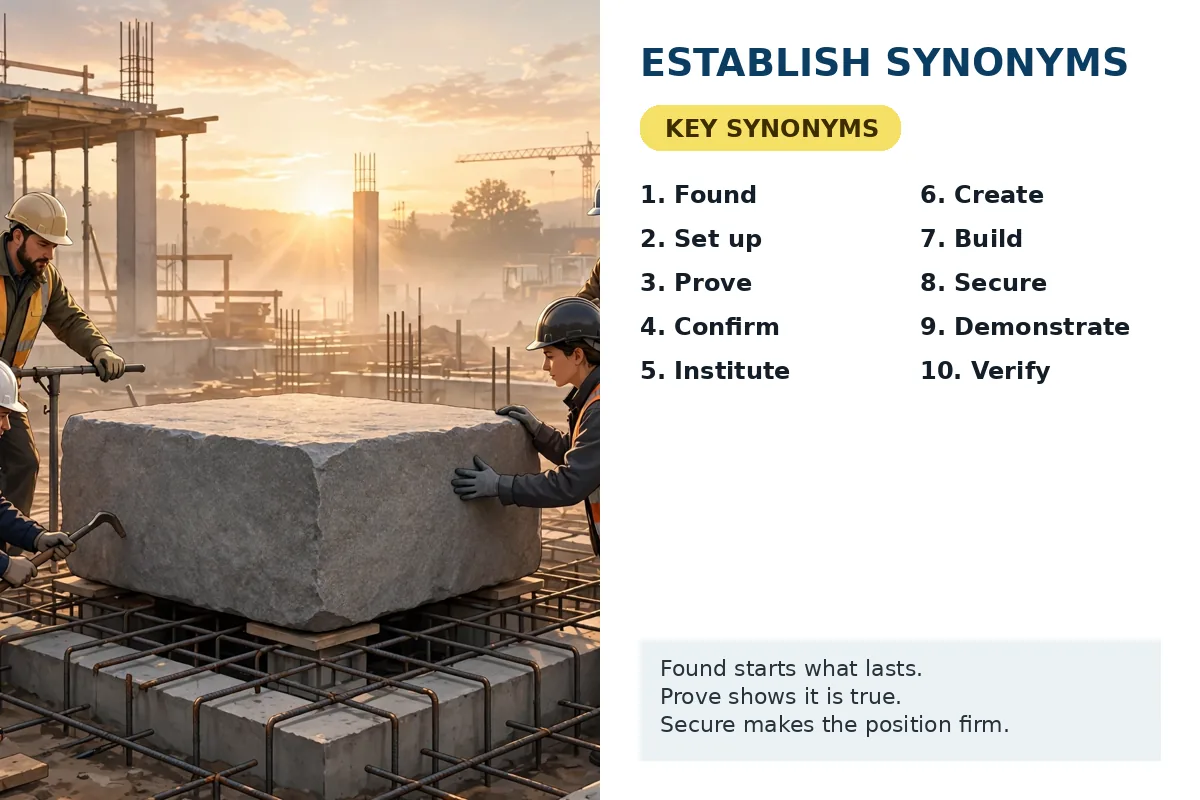
Finding good establish synonyms is harder than it looks because establish does three different jobs in English. It can mean founding something as in “they established a school.” It can mean proving something as in “the study established a link.” And it can mean settling yourself into a firm position as in “she established herself as a writer.”
The closest synonym for establish is found it covers starting something that is meant to last. When establish means proving a fact, prove or confirm fits better.
This guide sorts 18 establish synonyms by meaning, so you can pick the right word first time.
Another Word For Establish Synonyms at a Glance
| # | Synonym | Meaning Difference |
|---|---|---|
| 1 | Found | To start something meant to last (verb) |
| 2 | Set up | To start or arrange something, in everyday language |
| 3 | Prove | To show something is true, with evidence |
| 4 | Confirm | To show an earlier claim or result is correct |
| 5 | Institute | To start a system, rule, or organization formally |
| 6 | Create | To bring something new into being |
| 7 | Build | To develop something gradually, step by step |
| 8 | Secure | To make a position firm and safe |
| 9 | Demonstrate | To show something clearly, often by evidence |
| 10 | Verify | To check that something is true or accurate |
Quick Facts About “Establish”
- Part of speech: a verb (establish a company). The noun is establishment, and the adjective established means well known and accepted.
- Three core meanings: (1) found or set up something, (2) prove or show something is true, (3) settle into a firm, recognized position.
- Register: neutral to formal. Establish works in law, business, science, and history, and it sounds serious in everyday speech too.
- Watch out: establish promises permanence. A pop-up stall is opened, a university is established. Using establish for something temporary sounds overblown.
The Closest Synonym: Found
Found is the closest synonym for establish because it covers the word’s most lasting job: bringing something into being that is meant to stand. When founders found a company, a charity, or a school, the real action is establishment in plain clothes. Something did not exist before, now it does, and it is built to last.
Still, the two words are not identical. Found stresses the beginning moment, the act of creation. Establish can also stress what follows: recognition, proof, and a firm place in the world. A school can be founded in a day and established over decades. Use found for the start, and keep establish (or a word below) when proof or a settled position is the point.
Finally, remember the proof trap. Found can never replace establish in “the study established a link.” A study does not found a link, it proves or demonstrates it. For that job, skip ahead to prove and demonstrate in Group 2 below.
Where “Establish” Comes From (Etymology)
According to Etymonline, establish began as a word about making things stand firm. In the late 14th century, it came from Old French establiss-, the present participle stem of establir, “cause to stand still, establish, stipulate, set up, erect, build” (12th century, modern French établir), from Latin stabilire, “make stable,” from stabilis, “stable.” The e- at the start is unetymological, an extra letter that joined the word on its journey into English.
That history explains the word’s character today. Everything establish touches is meant to stand: a law, a school, a reputation, a fact. An established church, in the older sense noted by Etymonline, is one sanctioned by the state, given a firm, official standing. The root is the same one behind stable and stability, and it still shows in every modern use.
Can You Swap Them Freely?
In short: only inside the same meaning group. A founding word collapses in a proving sentence, and a proving word collapses in a founding sentence:
- ✅ “They founded a charity in 1998.” (verb, starting something ✔)
- ❌ “They proved a charity in 1998.” (prove means show true, not start ✘, say founded or set up)
- ✅ “The study proved the link between sleep and memory.” (verb, proving ✔)
- ❌ “The study founded the link between sleep and memory.” (a link is shown, not started ✘, say proved or demonstrated)
Before you substitute, ask one question: am I starting something, proving something, or settling into a position? Starting takes a Group 1 word, proving takes a Group 2 word, and settling takes a Group 3 word.
Establish Synonyms in Detail
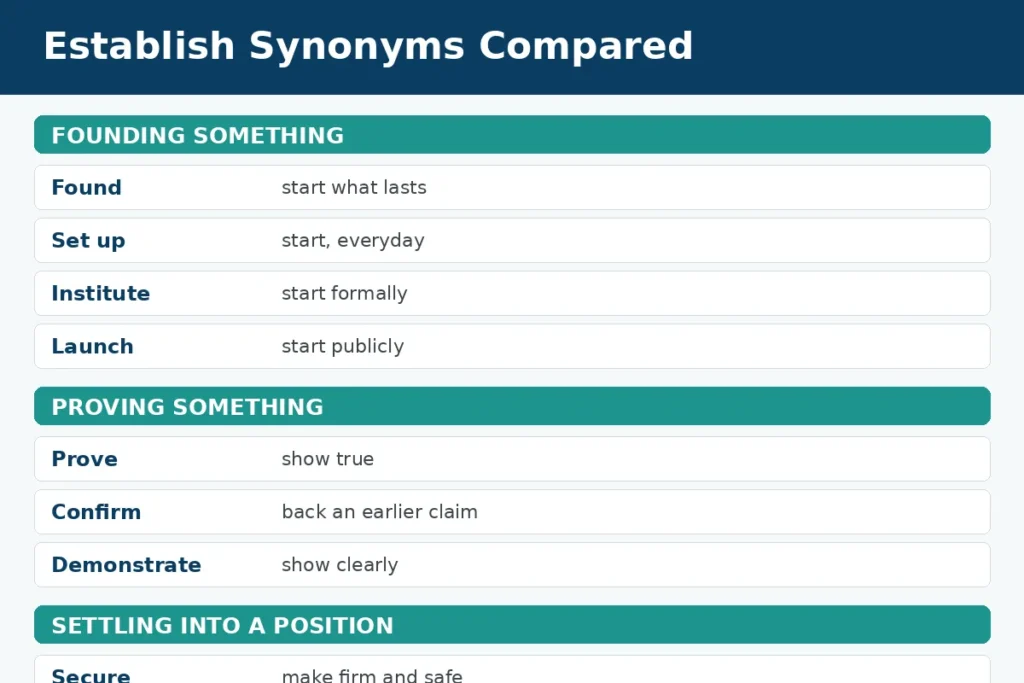
Group 1: Establish as Founding or Setting Something Up
1. Found
- Meaning: To start an organization, institution, or system that is meant to last.
- Difference: The closest all-round match for the founding sense. Found stresses the beginning, establish can stress the lasting result too.
- Best used for: Companies, charities, schools, movements, towns.
- Formality: Neutral · CEFR: B2 · Frequency: Common
- Example (Work): “She founded a coding school for teenagers in 2019.”
- Example (History): “The town was founded by traders in the 1700s.”
- When NOT to use it: For proving facts. A study never “founds” a result, it proves it.
2. Set Up
- Meaning: To start or arrange something, in plain everyday language.
- Difference: Set up is the friendly twin of found and establish. It works for a stall, a meeting, or a system, with no promise of permanence.
- Best used for: Meetings, businesses, systems, everyday plans.
- Formality: Neutral, informal · CEFR: A2 · Frequency: Very common
- Example (Work): “We set up a shared folder for the project.”
- Example (Everyday): “He set up a small vegetable stall at the market.”
- When NOT to use it: In formal history or law, where found or establish carries the weight of permanence.
3. Institute
- Meaning: To start a system, rule, organization, or practice formally, often by an authority.
- Difference: Institute is establish with official weight. Governments institute policies, companies institute procedures.
- Best used for: Law, policy, procedures, organizations.
- Formality: Formal · CEFR: C1 · Frequency: Common
- Example (Formal): “The university instituted a new admissions policy.”
- Example (Work): “Managers instituted weekly safety checks.”
- When NOT to use it: For small, informal starts. Nobody “institutes” a lemonade stand.
4. Create
- Meaning: To bring something new into being, whether a thing, a role, or a system.
- Difference: Create is wider than found. You create art, jobs, and problems, you found only institutions.
- Best used for: Art, jobs, products, roles, systems.
- Formality: Neutral · CEFR: A2 · Frequency: Very common
- Example (Work): “The grant created twenty new jobs in the town.”
- Example (Everyday): “She created a reading corner in her classroom.”
- When NOT to use it: When official permanence matters. A law is established or instituted, not merely created, in formal writing.
5. Launch
- Meaning: To start something publicly, often with publicity and a clear start date.
- Difference: Launch stresses the public beginning. A product launches, a school is founded, a policy is instituted.
- Best used for: Products, campaigns, programs, books.
- Formality: Neutral · CEFR: B2 · Frequency: Very common
- Example (Work): “The charity will launch its winter appeal next week.”
- Example (Everyday): “He launched a podcast about local history.”
- When NOT to use it: For proving a fact or settling a reputation, where launch says nothing at all.
6. Build
- Meaning: To develop something gradually, step by step, until it stands on its own.
- Difference: Build is establish as a process. A reputation is built over years, a company is founded in a day.
- Best used for: Reputations, teams, audiences, systems.
- Formality: Neutral · CEFR: A2 · Frequency: Very common
- Example (Work): “She built a team of trusted volunteers over five years.”
- Example (Everyday): “He built a loyal audience by posting every week.”
- When NOT to use it: For a single legal act. A law is not “built” in one vote, it is passed or established. (Note the overlap with coordination: building a team that lasts usually takes coordination, not just hiring.)
Group 2: Establish as Proving Something
7. Prove
- Meaning: To show something is true, with evidence or argument.
- Difference: Prove is the strongest proving word. It promises certainty, not just a suggestion.
- Best used for: Science, law, maths, debates.
- Formality: Neutral · CEFR: B1 · Frequency: Very common
- Example (Science): “The experiment proved that the new drug works.”
- Example (Everyday): “Her results proved the old theory wrong.”
- When NOT to use it: For starting institutions. Proving and founding are different jobs entirely.
8. Confirm
- Meaning: To show that an earlier claim, result, or expectation is correct.
- Difference: Confirm looks backward. Something was already claimed or suspected, and new evidence backs it up.
- Best used for: Bookings, results, reports, arrangements.
- Formality: Neutral · CEFR: B1 · Frequency: Very common
- Example (Work): “Please confirm the meeting time by email.”
- Example (Science): “A second study confirmed the first result.”
- When NOT to use it: For a brand new discovery with no earlier claim. Then prove or demonstrate fits better.
9. Demonstrate
- Meaning: To show something clearly, often by evidence, example, or experiment.
- Difference: Demonstrate stresses showing, not just stating. A chart demonstrates a trend, a paragraph merely claims it.
- Best used for: Science, teaching, presentations, reports.
- Formality: Neutral to formal · CEFR: B2 · Frequency: Common
- Example (Work): “The pilot demonstrated that the system saves time.”
- Example (Teaching): “She demonstrated the method with a simple example.”
- When NOT to use it: For founding. Demonstrating a school is showing it, not starting it.
10. Verify
- Meaning: To check that something is true, accurate, or as claimed.
- Difference: Verify is prove by checking. It suits documents, identities, and measurements, where a check is possible.
- Best used for: Documents, accounts, identities, data.
- Formality: Neutral to formal · CEFR: B2 · Frequency: Common
- Example (Work): “Verify the customer’s address before sending the parcel.”
- Example (Science): “Independent labs verified the measurements.”
- When NOT to use it: For broad truths that cannot be checked in one step. A philosophy is argued, not verified like a passport.
11. Show
- Meaning: To make something clear or evident, in the plainest possible language.
- Difference: Show is the everyday twin of demonstrate. It is shorter, warmer, and less formal, but it does the same proving job in most sentences.
- Best used for: Everyday writing, school, journalism, conversation.
- Formality: Neutral · CEFR: A1 · Frequency: Very common
- Example (Everyday): “The photos show how much the town has changed.”
- Example (Work): “Sales data show a clear rise in spring.”
- When NOT to use it: In formal legal or scientific claims, where prove or demonstrate carries more authority.
12. Validate
- Meaning: To confirm that something is valid, sound, or officially acceptable.
- Difference: Validate adds an official stamp. A method is validated when experts accept it, a ticket is validated when it is stamped.
- Best used for: Science, software, tickets, methods.
- Formality: Formal · CEFR: C1 · Frequency: Common
- Example (Work): “The team validated the new testing method.”
- Example (Everyday): “Remember to validate your parking ticket.”
- When NOT to use it: In casual speech, where confirm or prove sounds far more natural.
Group 3: Establish as Settling Into a Firm Position
13. Secure
- Meaning: To make a position, job, deal, or reputation firm and safe from loss.
- Difference: Secure is establish as safety. A secured contract will not slip away, a secured reputation will not collapse easily.
- Best used for: Jobs, contracts, funding, positions.
- Formality: Neutral to formal · CEFR: B2 · Frequency: Very common
- Example (Work): “She secured funding for a second year.”
- Example (Everyday): “He secured a place on the course.”
- When NOT to use it: For proving facts. Securing a result is not the same as proving it.
14. Cement
- Meaning: To make a position, relationship, or reputation firm and lasting, like cement setting.
- Difference: Cement is vivid and final. A win cements a reputation the way concrete sets a post.
- Best used for: Reputations, deals, relationships, positions.
- Formality: Neutral · CEFR: B2 · Frequency: Common
- Example (News): “The award cemented her reputation as a serious writer.”
- Example (Work): “The deal cemented the partnership between the two firms.”
- When NOT to use it: In formal legal writing, where secure or establish is cleaner.
15. Entrench
- Meaning: To settle something so firmly that it is hard to change, often a system or a habit.
- Difference: Entrench can be positive or negative. An entrenched right is protected, an entrenched habit is hard to break.
- Best used for: Rights, systems, habits, positions.
- Formality: Formal · CEFR: C1 · Frequency: Uncommon
- Example (Formal): “The right to free speech is entrenched in the constitution.”
- Example (Work): “Old routines became entrenched in the office.”
- When NOT to use it: For a fresh start. Entrenching is the opposite of beginning, it is settling in deep.
16. Root
- Meaning: To settle something deeply, like a plant taking root, so it grows and lasts.
- Difference: Root stresses depth and growth. A rooted tradition grows with a community, a founded office merely opens.
- Best used for: Traditions, communities, values, habits.
- Formality: Neutral · CEFR: B2 · Frequency: Common
- Example (Work): “The festival is now rooted in town life.”
- Example (Everyday): “Good habits rooted in childhood last longest.”
- When NOT to use it: As a direct verb for a person in formal writing. “She rooted herself” sounds odd, “she established herself” is standard. (Note the overlap with power: a rooted position is a form of quiet power, influence that lasts.)
17. Settle In (Phrase)
- Meaning: To become comfortable and accepted in a new place, job, or role.
- Difference: Settle in is the human, everyday version of establishing yourself. It stresses comfort, not authority.
- Best used for: New jobs, homes, schools, roles.
- Formality: Neutral, informal · CEFR: B1 · Frequency: Common
- Example (Everyday): “She settled in quickly at her new school.”
- Example (Work): “It took a month for the new manager to settle in.”
- When NOT to use it: For institutions or laws, where found or institute is the right register.
18. Make a Name (Phrase)
- Meaning: To become known and respected in a field, by your work.
- Difference: Making a name is establishing yourself as a person, not a thing. It is earned, not declared.
- Best used for: Artists, writers, athletes, professionals.
- Formality: Neutral, informal · CEFR: B2 · Frequency: Common
- Example (Work): “She made a name for herself with honest food writing.”
- Example (Everyday): “He made a name as the town’s best baker.”
- When NOT to use it: In formal biographies, where established herself is cleaner than the idiom.
Words Commonly Confused With “Establish”
These words sit close to establish in lists of establish synonyms, but each one fails the swap test in an important way:
- Establishment, The noun, not the verb: a shop, an institution, or, in politics, the ruling system. “She establishment a school” is broken English.
- Established, The adjective: well known and accepted. “An established writer” is a person with a reputation, not an action.
- Stabilize, To make something steady, often after a crisis. It shares the Latin root, but stabilizing a patient is not founding a hospital.
- Station, To place someone somewhere, often soldiers or staff. Stationing is placement, establishing is creation or proof.
- Enact, To make a law official by passing it. A law can be enacted and then established in practice, but the two steps are different.
Best Alternatives by Context
The right choice among establish synonyms depends on your situation, match yours to the row below. This section uses a timeline, not just a table, because establishment itself happens over time:
Step 1, the beginning. Choose found, set up, or launch. Something starts, publicly or quietly.
Step 2, the proof. Choose prove, demonstrate, or confirm. Evidence shows the thing works, or the claim holds.
Step 3, the settling. Choose secure, cement, or root. The thing gains a firm place that will not easily move.
Step 4, the person. Choose settle in or make a name. A person, not an institution, finds a lasting place.
A final tip: if the establishment also took teamwork, say so directly. Schools, companies, and reputations are rarely established alone, and naming the team behind the start makes the story honest and human.
Which Establish Synonym Should I Choose?
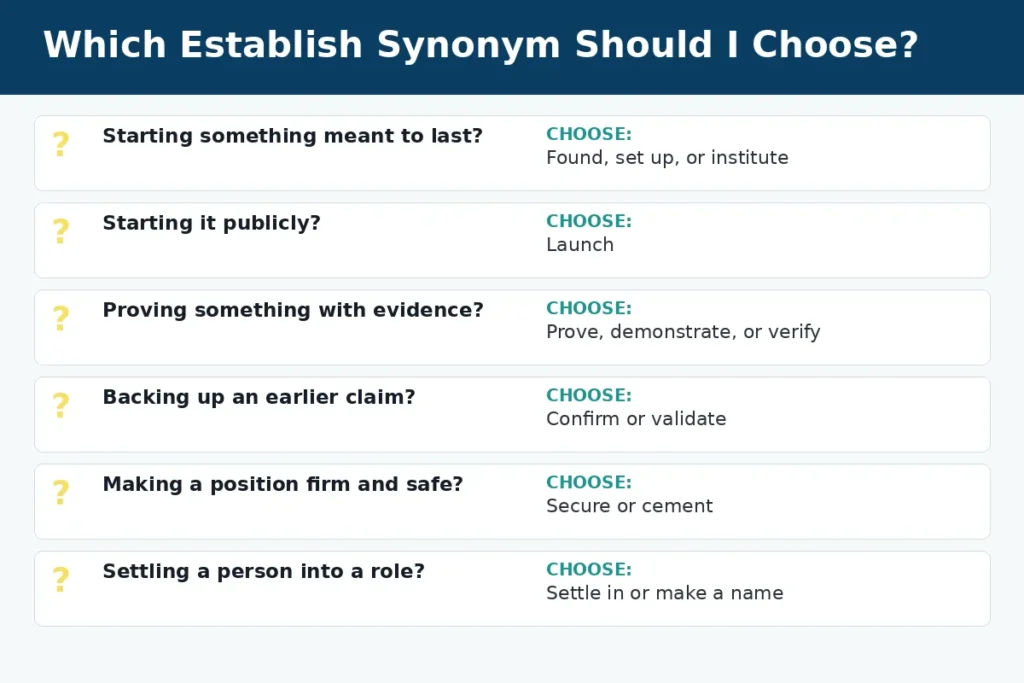
| Ask yourself | If yes, choose |
| Am I starting something meant to last? | Found, set up, or institute |
| Am I starting it publicly? | Launch |
| Am I proving something with evidence? | Prove, demonstrate, or verify |
| Am I backing up an earlier claim? | Confirm or validate |
| Am I making a position firm and safe? | Secure or cement |
| Am I settling a person into a role? | Settle in or make a name |
Antonyms of Establish
Match the opposite to the sense you used, because the verb’s senses have different enemies:
Opposites of establish (verb, to found):
| Antonym | What it means |
|---|---|
| Dissolve | To formally end an organization |
| Disband | To break up a group or team |
| Close down | To shut a business or institution |
| Abolish | To formally end a law, system, or practice |
| Dismantle | To take a system apart piece by piece |
| Abandon | To give up a project or plan |
Opposites of establish (verb, to prove or to settle):
| Antonym | What it means |
|---|---|
| Disprove | To show a claim is false |
| Refute | To argue against a claim successfully |
| Undermine | To weaken a position or claim gradually |
| Destabilize | To make a settled system unsteady |
| Uproot | To remove something deeply settled |
| Dislodge | To force something out of a firm position |
Collocations With “Establish”
Finally, a short set of fixed phrases rounds out your establish synonyms toolkit. These are the partners the word keeps in real writing:
- establish a company, “She established a company that repairs old bicycles.”
- establish a link, “The study established a link between exercise and sleep.”
- establish yourself, “It took years to establish herself as a trusted editor.”
- establish contact, “The team established contact with local schools.”
- well established, the adjective: “It is a well established festival, running for forty years.”
- establish a precedent, “The ruling established a precedent for later cases.”
One honest note: establish has no famous idiom of its own. The phrases above are collocations, the word’s regular partners, and they are the ones worth memorizing.
Practice: True or False, With a Reason
Now it is your turn. Each statement below is true or false. Say which, and give one short reason, then check the key. This format differs from the earlier articles, it tests judgment, not just word choice.
- “They proved a charity in 1998” is correct English for starting a charity.
- A second study that backs up a first result confirms it.
- “She founded a link between sleep and memory” is the right verb for a research finding.
- An award can cement a writer’s reputation.
- “He instituted a lemonade stand” sounds formal enough for a small stall.
Answer key:
- False, prove shows a claim is true, it does not start an institution. Use founded or set up.
- True, confirm looks backward to an earlier claim and backs it up with new evidence.
- False, a link is proved or demonstrated, not founded. Founding is for institutions.
- True, cement means making a reputation firm and lasting, like cement setting.
- False, institute carries official weight for policies and organizations, not small stalls. Use set up.
FAQ
What is the closest synonym for establish?
Found is the closest synonym for the verb establish, because both mean starting something that is meant to last. The catch is that found stresses the beginning moment. When establish means proving a fact, prove or demonstrate is closer, and when it means settling into a firm position, secure or cement is closer.
What is another word for establish a company?
Found and set up are the two natural choices. Found sounds serious and lasting, as in “she founded a company in 2019.” Set up sounds everyday and practical, as in “we set up a company last month.” Institute sounds too official for a small business, unless a formal body is behind it.
What is the difference between establish and found?
Both verbs start something, but they stress different moments. Found stresses the act of creation, the day something begins. Establish can stress that beginning, but it can also stress what follows: proof, recognition, and a firm, lasting place. A school is founded in a day and established over years.
Is establishment a synonym for establish?
No. Establishment is the noun form, meaning an institution, a business, or, in politics, the ruling system. Establish is the verb for creating, proving, or settling. The two share a root, the Latin idea of making something stand, but they do different jobs in a sentence.
What is the opposite of establish?
For the founding sense, the opposites are dissolve, disband, close down, and abolish, words for ending an organization or system. For the proving and settling senses, the opposites are disprove, refute, undermine, and destabilize. English needs both sets because establish itself carries founding, proving, and settling meanings.
Which word works for establishing yourself as a writer?
Secure and cement work for a reputation, as in “she secured her reputation” or “the award cemented her reputation.” For a person settling into a role, settle in is the everyday choice, and make a name is the idiom for becoming known. The plain verb establish yourself remains the cleanest formal choice of all.
Conclusion
Establish rewards anyone who checks which of its jobs a sentence needs. If you are starting something meant to last, found is your default, and set up, institute, and launch sharpen it for different levels of formality and publicity.
If you are proving something, prove, demonstrate, and confirm each name a different kind of evidence. And if you are settling into a position, secure, cement, and root say honestly how firm that place has become.
In the end, choose by job, not by habit, and establish synonyms will stop feeling like a guessing game, each replacement will say exactly what you meant, only sharper.

About Sajjad Ahmed
Sajjad Ahmed is the author behind Guest Paster, where he writes about English vocabulary, synonyms, word meanings, and practical word usage.
His content is designed to help readers understand the differences between similar words, discover suitable alternatives, and use English vocabulary more effectively in everyday writing and communication.
Before publishing, Sajjad focuses on presenting word choices in a clear and easy-to-understand format, with relevant meanings, context, and examples where helpful.
Through Guest Paster, his goal is to make vocabulary learning simpler and provide useful language resources for students, writers, English learners, and anyone looking to expand their vocabulary.
Areas of Focus: English Vocabulary • Synonyms • Word Meanings • Word Usage • Language Learning
Author: Sajjad Ahmed
Website: Guest Paster