
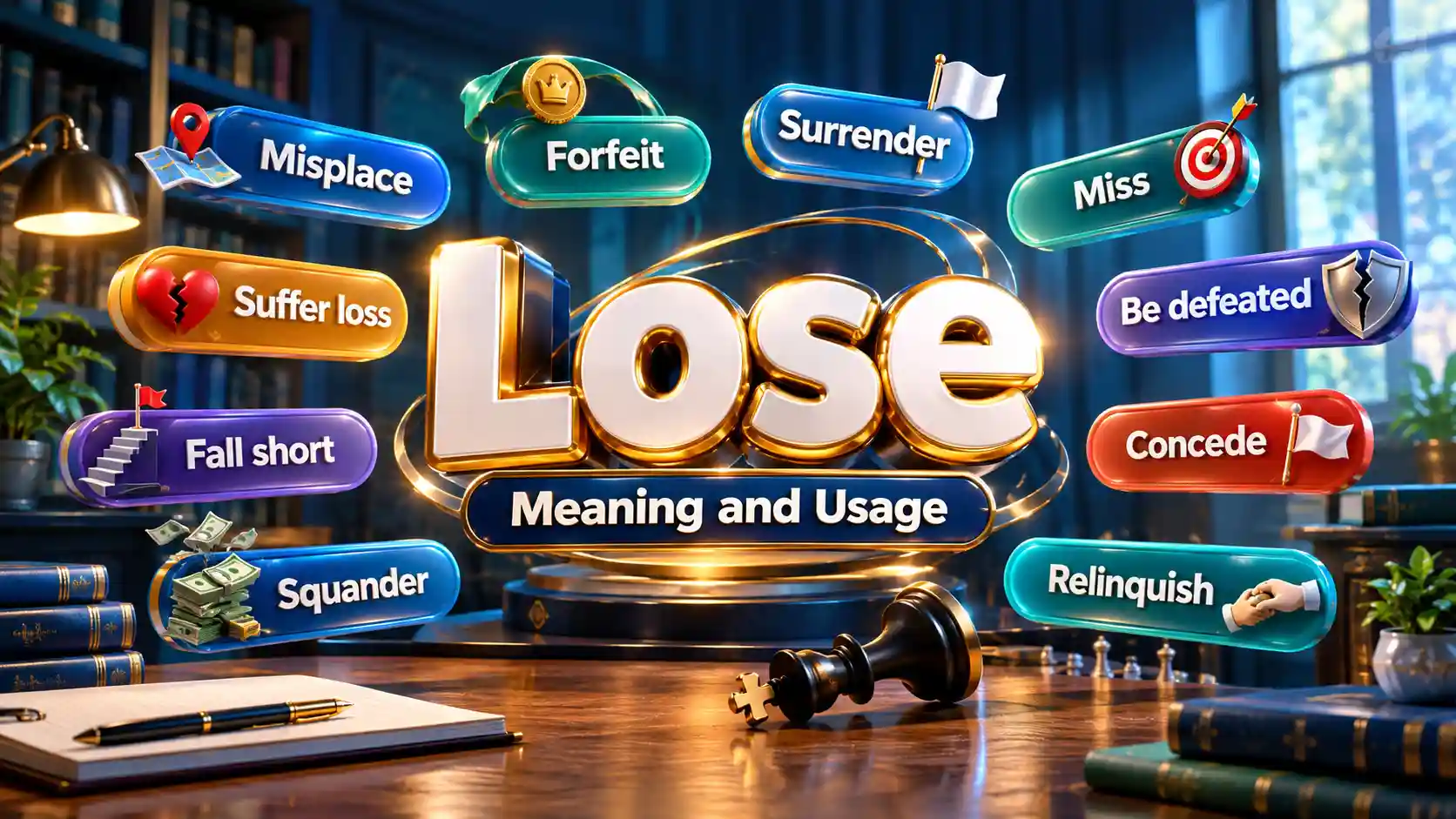
What Does “Lose” Mean?
Lose is a verb that implies losing something or failing to retain something, getting defeated at something important, and separation from an essential person or item. It’s one of the most frequently used English verbs, and it could apply to a wide variety of situations (losing an object, losing a game, losing an opportunity, losing your grip on things, etc).
Due to lose having several meanings, the best synonym will depend on context. For example you would use misplace if your phone was lost, be defeated if you lose a game, forfeit if you lose something due to the rules and suffer loss for severe personal or financial losses.
10 Best Synonyms for Lose
| # | Synonym | Meaning Difference | Best Used For | Formality |
| 1 | Misplace | Lose something temporarily because you cannot find it | Keys, documents, belongings | Neutral |
| 2 | Forfeit | Lose something because of rules, mistakes, or conditions | Rights, games, rewards | Formal |
| 3 | Surrender | Give up control or possession after resistance | Power, conflicts, negotiations | Formal |
| 4 | Miss | Fail to get, catch, or experience something | Opportunities, chances, events | Neutral |
| 5 | Be defeated | Lose against an opponent | Sports, competitions, battles | Neutral/Formal |
| 6 | Concede | Admit defeat or accept that you cannot win | Debates, elections, matches | Formal |
| 7 | Relinquish | Give something up willingly | Authority, rights, responsibilities | Formal |
| 8 | Squander | Lose something valuable through careless use | Money, time, talent | Neutral/Formal |
| 9 | Fall short | Fail to achieve a goal or standard | Targets, expectations, performance | Neutral |
| 10 | Suffer loss | Experience damage, reduction, or serious loss | Business, finance, personal situations | Formal |
Quick Facts About Lose
| Feature | Information |
| Part of Speech | Verb |
| Pronunciation | /luːz/ |
| Syllables | One |
| Word Forms | Lose, loses, losing, lost, loser, loss |
| Meaning | To no longer have, keep, or win something |
| Formality | Neutral |
| Closest Synonyms | Misplace (objects), be defeated (competitions), forfeit (formal situations) |
| Common Uses | Objects, games, opportunities, relationships, control |
What Is the Closest Synonym for Lose?
There is no single perfect synonym for lose because the word covers many situations.
For Physical Objects: Misplace
Example:
- I lost my wallet.
- I misplaced my wallet.
Misplace suggests that the object still exists and may be found.
For Competitions: Be Defeated
Example:
- The team lost the final.
- The team was defeated in the final.
Be defeated clearly shows that another person or team won.
For Rules or Penalties: Forfeit
Example:
- He lost his chance.
- He forfeited his chance because he missed the deadline.
Forfeit suggests that the loss happened because of a condition, mistake, or rule.
For Control: Surrender
Example:
- The leader lost control.
- The leader surrendered control.
Surrender suggests a voluntary decision to give something up.
Can Lose Synonyms Be Used Interchangeably?
Not completely. Most synonyms share a similar idea but have different meanings, emotions, or levels of formality.
Usually Similar
Lose / Misplace
Both work for objects.
Example:
- I lost my glasses.
- I misplaced my glasses.
However, misplace suggests temporary loss.
Sometimes Similar
Lose / Miss
Example:
- I lost an opportunity.
- I missed an opportunity.
Both can work, but miss focuses on failing to take a chance.
Different Meaning
Lose / Surrender
Example:
- He lost control of the company.
This may happen accidentally.
- He surrendered control of the company.
This suggests a deliberate decision.
Not Interchangeable
Lose / Loose
These words are completely different.
Lose:
To no longer have something.
Example:
- I don’t want to lose my phone.
Loose:
Not tight or not fixed.
Example:
- My shoes are loose.
Detailed Synonym of Lose Meanings and Examples
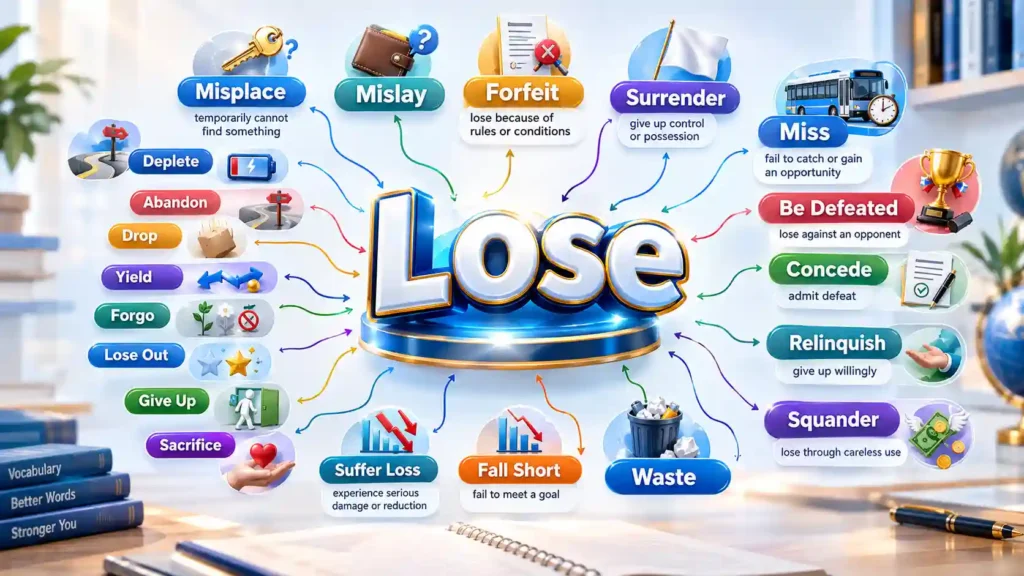
1. Misplace
Meaning:
To lose something temporarily by putting it somewhere and forgetting its location.
Difference from Lose:
Misplace usually suggests the item can be found again.
Best Used For:
Keys, phones, documents, personal belongings.
Formality: Neutral
Examples:
- I misplaced my passport before the trip.
- She misplaced the report on her desk.
2. Mislay
Meaning:
To lose something accidentally by forgetting where it was placed.
Difference from Lose:
Very close to misplace, but slightly more formal.
Best Used For:
Small objects and documents.
Formality: Neutral/Formal
Examples:
- He mislaid his office keys.
- She mislaid the important letter.
3. Forfeit
Meaning:
To lose something because of a rule, mistake, or condition.
Difference from Lose:
Forfeit usually involves a reason behind the loss.
Best Used For:
Rights, money, games, opportunities.
Formality: Formal
Examples:
- The team forfeited the match because they arrived late.
- He forfeited his chance by ignoring the deadline.
4. Surrender
Meaning:
To give up control, possession, or victory.
Difference from Lose:
Surrender often happens intentionally after pressure or struggle.
Best Used For:
Power, conflicts, negotiations.
Formality: Formal
Examples:
- The army surrendered after a long battle.
- She surrendered control of the project.
5. Miss
Meaning:
To fail to get, catch, or experience something.
Difference from Lose:
Miss focuses on an opportunity or timing.
Best Used For:
Chances, events, transport.
Formality: Neutral
Examples:
- I missed the opportunity to apply.
- She missed the last train.
6. Be Defeated
Meaning:
To lose against an opponent in a competition, conflict, or challenge.
Difference from Lose:
Be defeated specifically highlights that another person or group won. It is more direct than the general word lose.
Best Used For:
Sports, elections, battles, competitions.
Formality: Neutral/Formal
Examples:
- The defending champion was defeated in the final match.
- The team lost confidence after being defeated by a stronger opponent.
7. Concede
Meaning:
To admit that you have lost or accept that you cannot win.
Difference from Lose:
Concede is usually a conscious decision. A person accepts defeat rather than simply experiencing a loss.
Best Used For:
Debates, elections, negotiations, competitions.
Formality: Formal
Examples:
- The candidate conceded defeat after the final results.
- After a long debate, he conceded that his opponent had a stronger argument.
8. Relinquish
Meaning:
To voluntarily give up ownership, power, responsibility, or a right.
Difference from Lose:
Relinquish suggests a deliberate choice, while lose may happen accidentally.
Best Used For:
Authority, leadership, rights, control.
Formality: Formal
Examples:
- The CEO relinquished control of the company after the merger.
- She decided to relinquish her position to focus on her family.
9. Squander
Meaning:
To lose something valuable because it is used carelessly or foolishly.
Difference from Lose:
Squander includes the idea of poor judgment or wasted potential.
Best Used For:
Money, time, talent, opportunities.
Formality: Neutral/Formal
Examples:
- He squandered his savings on unnecessary expenses.
- The player squandered a great opportunity to score.
10. Waste
Meaning:
To lose the value or benefit of something by using it poorly.
Difference from Lose:
Waste suggests that the person caused the loss through ineffective use.
Best Used For:
Time, money, resources, opportunities.
Formality: Neutral
Examples:
- Don’t waste your valuable time on distractions.
- The company wasted resources on an unsuccessful campaign.
11. Fall Short
Meaning:
To fail to reach a desired level, target, or expectation.
Difference from Lose:
Fall short does not mean something disappeared; it means the result was not enough.
Best Used For:
Goals, performance, business targets.
Formality: Neutral
Examples:
- The company fell short of its yearly sales target.
- His performance fell short of expectations.
12. Suffer Loss
Meaning:
To experience damage, reduction, or the removal of something valuable.
Difference from Lose:
This phrase sounds more serious and formal. It often describes financial, emotional, or personal losses.
Best Used For:
Business, finance, disasters, personal tragedy.
Formality: Formal
Examples:
- The company suffered significant financial losses.
- Many families suffered losses after the flood.
13. Sacrifice
Meaning:
To give something up intentionally for a greater purpose.
Difference from Lose:
Sacrifice usually has a positive reason behind giving something up.
Best Used For:
Time, comfort, money, personal benefits.
Formality: Neutral/Formal
Examples:
- She sacrificed her weekends to complete her research.
- Athletes often sacrifice comfort to achieve success.
14. Give Up
Meaning:
To stop trying or stop holding onto something.
Difference from Lose:
Give up usually involves a personal decision.
Best Used For:
Efforts, goals, control, habits.
Formality: Informal/Neutral
Examples:
- He refused to give up on his dream.
- She gave up her old habits.
15. Lose Out
Meaning:
To miss a benefit, advantage, or opportunity.
Difference from Lose:
Lose out focuses on missing something valuable compared with others.
Best Used For:
Opportunities, deals, competitions.
Formality: Informal
Examples:
- Small businesses can lose out to larger competitors.
- Apply early so you don’t lose out on this opportunity.
16. Forgo
Meaning:
To choose not to have or do something.
Difference from Lose:
Forgo is a voluntary choice rather than an unwanted loss.
Best Used For:
Benefits, rewards, opportunities.
Formality: Formal
Examples:
- She decided to forgo the vacation to save money.
- The company chose to forgo short-term profits.
17. Yield
Meaning:
To give way, surrender, or stop resisting.
Difference from Lose:
Yield often happens because of pressure, negotiation, or circumstances.
Best Used For:
Arguments, control, negotiations.
Formality: Formal
Examples:
- The leader refused to yield control.
- After several hours, he yielded to their demands.
18. Drop
Meaning:
To lose something suddenly, reduce something, or let something fall.
Difference from Lose:
Drop is usually more casual and often describes a sudden change.
Best Used For:
Objects, rankings, points, connections.
Formality: Informal/Neutral
Examples:
- I dropped my phone on the floor.
- The team dropped three positions in the rankings.
19. Abandon
Meaning:
To leave something completely and stop continuing it.
Difference from Lose:
Abandon is intentional, while lose is often accidental.
Best Used For:
Plans, projects, places, responsibilities.
Formality: Formal
Examples:
- The company abandoned the project because of high costs.
- He abandoned his previous career path.
20. Deplete
Meaning:
To gradually reduce something until little or none remains.
Difference from Lose:
Deplete focuses on reduction of supply or resources.
Best Used For:
Energy, money, resources, supplies.
Formality: Formal
Examples:
- Years of overuse depleted natural resources.
- The long journey depleted his energy.
Synonyms for Losing Someone
The phrase “lose someone” can have different meanings. The best alternative depends on the situation.
When Someone Dies
Use:
- Suffer the loss of
- Grieve the loss of
- Be bereaved
- Be deprived of
Examples:
- She lost her father last year.
- She suffered the loss of her father last year.
When People Separate
Use:
- Part from
- Drift apart
- Become separated from
- Lose touch with
Examples:
- We lost touch after university.
- We drifted apart over the years.
When Losing an Important Relationship
Use:
- Say goodbye to
- Part ways with
- Move away from
Examples:
- He had to say goodbye to his old life.
- They decided to part ways peacefully.
Another Word for Losing a Game
When talking about sports or competitions, these alternatives work better than simply saying lose:
| Alternative | Meaning |
| Be defeated | Lose against an opponent |
| Be beaten | Lose to a stronger competitor |
| Concede | Accept defeat |
| Suffer defeat | Formal way to describe losing |
| Fall behind | Lose advantage during a competition |
| Bow out | Leave a competition after losing |
Examples:
- The team lost the final.
Better alternatives:
- The team was defeated in the final.
- The team suffered defeat in the championship.
- The team bowed out after a close match.
Synonyms for Loser
The word loser can have different meanings depending on the context. It may describe someone who does not win a competition, or it can be used as an insult. Choosing a more precise alternative helps avoid negative or unclear language.
Neutral Alternatives
| Word/Phrase | Meaning | Best Used For |
| Non-winner | Someone who did not win | Competitions |
| Runner-up | Person who finishes second | Sports, contests |
| Defeated competitor | Someone who lost against another person | Formal writing |
| Second-place finisher | Someone below the winner | Rankings |
| Underdog | Person/team expected to struggle | Sports, storytelling |
Examples:
- The runner-up received a special award after the competition.
- Every defeated competitor gained valuable experience.
Negative Alternatives
These words can sound insulting and should be used carefully:
| Word | Meaning |
| Failure | Someone who did not succeed |
| Underachiever | Someone performing below expectations |
| Quitter | Someone who gives up easily |
Example:
- Calling someone a “loser” may sound disrespectful, while “non-winner” is more neutral.
Formal Synonyms for Lose
In professional, academic, or business writing, stronger alternatives can make your message more precise.
| Common Phrase | Formal Alternative |
| Lose money | Suffer financial losses |
| Lose a right | Forfeit a right |
| Lose control | Relinquish control |
| Lose an opportunity | Miss an opportunity / fail to secure an opportunity |
| Lose resources | Deplete resources |
| Lose a competition | Suffer defeat |
Examples:
Informal:
The company lost millions.
Formal:
The company suffered significant financial losses.
Informal:
He lost his position.
Formal:
He relinquished his position.
Best Alternatives for Lose by Context
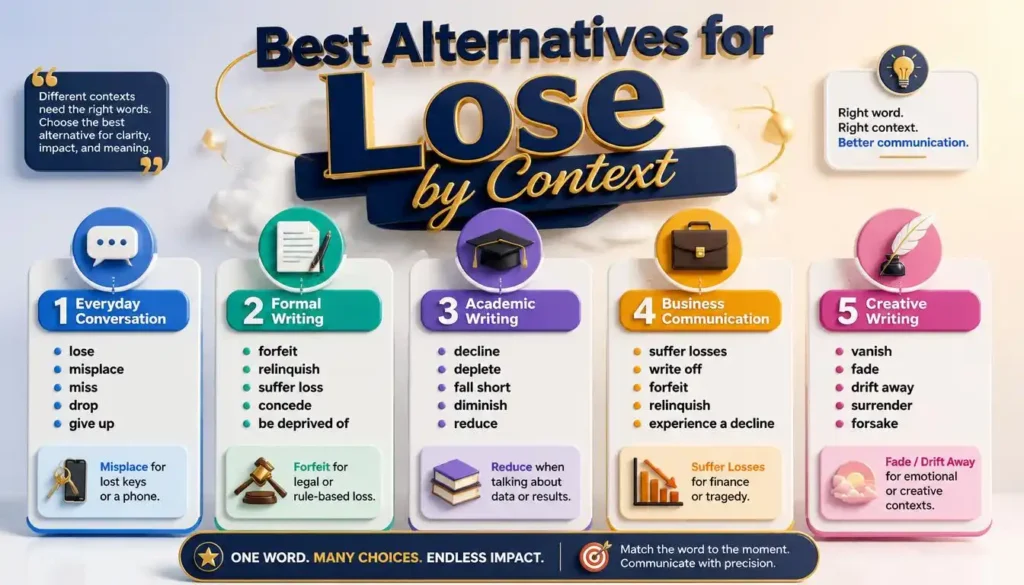
Everyday Conversation
Use simple and natural words:
- Lose
- Misplace
- Miss
- Drop
- Give up
Examples:
- I misplaced my keys.
- I missed the bus.
- I gave up trying.
Formal Writing
Better choices:
- Forfeit
- Relinquish
- Suffer loss
- Concede
- Be deprived of
Examples:
- The organization forfeited its legal rights.
- The company suffered financial losses.
Academic Writing
Useful alternatives:
- Decline
- Deplete
- Fall short
- Diminish
- Reduce
Example:
The research showed that motivation declined after repeated failures.
Business Communication
Recommended words:
- Experience a decline
- Suffer losses
- Write off
- Forfeit
- Relinquish
Examples:
The company experienced a decline in market share.
Creative Writing
More emotional alternatives:
- Vanish
- Fade
- Drift away
- Surrender
- Forsake
Example:
The memories slowly faded with time.
Lose vs Lost vs Loss vs Loose
These four words are often confused but have different meanings.
Lose
Verb: To no longer have something or fail.
Examples:
- I don’t want to lose this opportunity.
- Our team may lose the match.
Lost
Past form of lose.
Examples:
- She lost her phone yesterday.
- He lost confidence after the failure.
Loss
Noun: The result or experience of losing.
Examples:
- The company reported a financial loss.
- The loss was difficult to accept.
Loose
Different word completely.
Meaning:
Not tight, free, or not fixed.
Examples:
- My shoes are loose.
- The dog was running loose.
Remember:
Lose = no longer have
Loose = not tight
Antonyms of Lose
The opposite of lose depends on the situation.
1st. Losing an Object
| Antonym | Example |
| Find | I found my missing wallet. |
| Recover | She recovered her lost files. |
| Retrieve | He retrieved the document. |
2nd. Losing a Competition
| Antonym | Example |
| Win | They won the final match. |
| Triumph | The athlete triumphed after years of training. |
| Succeed | The team succeeded in reaching its goal. |
3rd. Losing Something Valuable
| Antonym | Example |
| Gain | She gained experience. |
| Keep | He kept his position. |
| Retain | The company retained its customers. |
| Secure | They secured the contract. |
Common Phrases With Lose
Lose Track Of
Meaning: Stop knowing where something is or what is happening.
Examples:
- I lost track of time while studying.
- She lost track of her old classmates.
Lose Touch
Meaning: Stop communicating with someone.
Examples:
- We lost touch after graduation.
- They never lost touch with their childhood friends.
Lose Hope
Meaning: Stop believing something positive will happen.
Examples:
- Never lose hope during difficult times.
- He refused to lose hope.
Lose Confidence
Meaning: Become less confident.
Examples:
- Failure can make people lose confidence.
- She lost confidence after repeated mistakes.
Lose Sight Of
Meaning: Forget the importance of something.
Examples:
- Don’t lose sight of your goals.
- The company lost sight of customer needs.
Lose Interest
Meaning: Stop being interested.
Examples:
- Many users lose interest in outdated content.
- He lost interest in the project.
Frequently Asked Questions
1. What can I say instead of losing?
The best alternative depends on the context:
- Losing an object → misplacing
- Losing a game → being defeated
- Losing an opportunity → missing out
- Losing something because of rules → forfeiting
- Losing something valuable → suffering a loss
2. What is the synonym of lost?
The synonym depends on meaning.
For an object:
- Missing
- Misplaced
- Gone
A confused person:
- Confused
- Disoriented
- Uncertain
For emotional loss:
- Bereaved
- Grieving
- Heartbroken
3. What is the synonym of loose?
Loose is not related to lose.
Synonyms for loose:
- Slack
- Free
- Unfastened
- Relaxed
- Baggy
Example:
- The shirt is loose.
- The rope is slack.
4. What are synonyms for losing?
Depending on context:
Competition:
- Being defeated
- Being beaten
- Suffering defeat
Objects:
- Misplacing
- Mislaying
Opportunities:
- Missing
- Losing out
Resources:
- Wasting
- Squandering
5. What to say instead of lose?
Use:
- Misplace → objects
- Miss → opportunities
- Forfeit → rules or rights
- Relinquish → authority
- Be defeated → competitions
- Suffer loss → serious situations
6. What is a poetic word for “lost”?
Poetic alternatives include:
- Adrift
- Forsaken
- Vanished
- Faded
- Forgotten
- Wandering
Examples:
- “A soul adrift searching for meaning.”
- “A forgotten dream hidden in memories.”
Conclusion
Lose is a straightforward word but a highly adaptable one. The term can be used to describe a range of things such as losing something, an opportunity or someone you know. Because one word can cover many different circumstances, selecting a more specific synonym typically produces clearer and stronger communication.
Be defeated for competitions, forfeit for rule-based losses, relinquish for voluntary decisions, and suffer loss for serious situations. When writing for emotions, words like “fade,” “forsake” or “drift away” can help convey these feelings.
Not always is the most complicated word the best synonym, but rather the word that fits your meaning, audience and situation.

About Sajjad Ahmed
Sajjad Ahmed is the author behind Guest Paster, where he writes about English vocabulary, synonyms, word meanings, and practical word usage.
His content is designed to help readers understand the differences between similar words, discover suitable alternatives, and use English vocabulary more effectively in everyday writing and communication.
Before publishing, Sajjad focuses on presenting word choices in a clear and easy-to-understand format, with relevant meanings, context, and examples where helpful.
Through Guest Paster, his goal is to make vocabulary learning simpler and provide useful language resources for students, writers, English learners, and anyone looking to expand their vocabulary.
Areas of Focus: English Vocabulary • Synonyms • Word Meanings • Word Usage • Language Learning
Author: Sajjad Ahmed
Website: Guest Paster