Do you keep writing regarding at the start of every email, then wonder if it sounds stiff? Regarding works but it often sounds like a form letter. Pick the replacement that matches your sentence.
The closest synonym for regarding is about, because it covers the everyday topic sense in almost every sentence. When the tone is formal, concerning or with regard to fits better and when you want a new structure, as for fits better. This guide sorts 15 regarding synonyms by use.
10 Another Word For Regarding Synonyms
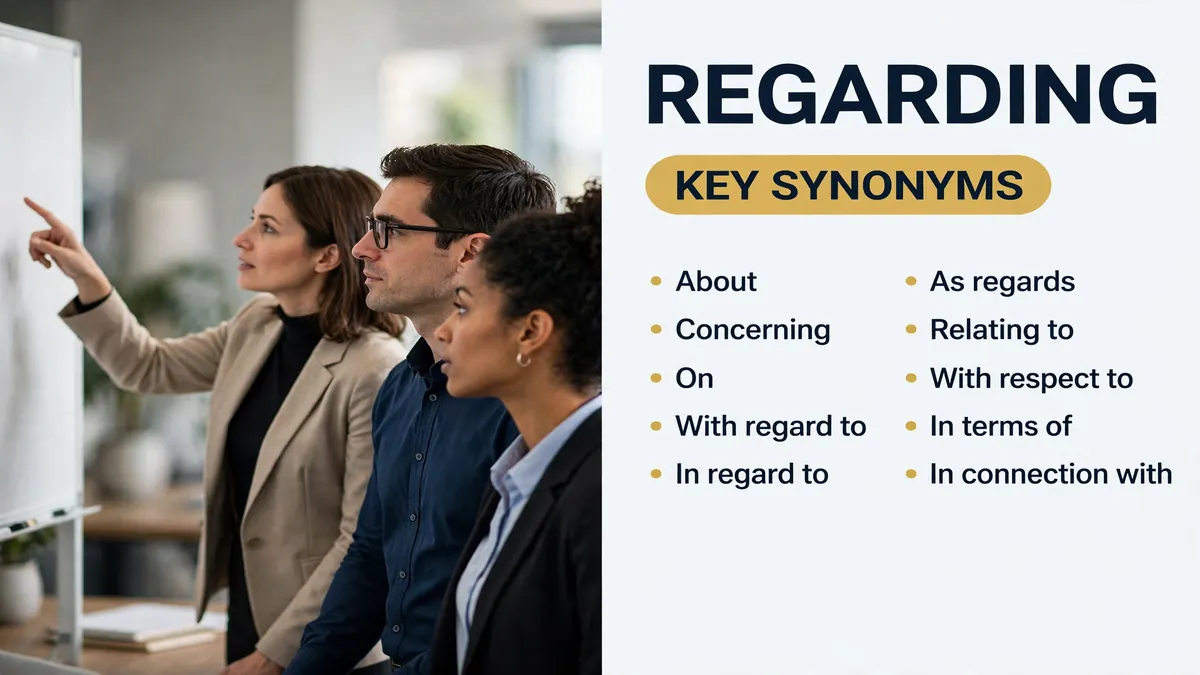
| # | Synonym | Meaning Difference |
|---|---|---|
| 1 | About | The everyday default for a topic |
| 2 | Concerning | The formal version of about, for written topics |
| 3 | On | A short topic word, needs a noun phrase after it |
| 4 | With regard to | A formal phrase for a stated subject |
| 5 | In regard to | A formal variant, common in business writing |
| 6 | As regards | A formal phrase, often at the start of a sentence |
| 7 | Relating to | A topic linked to something else |
| 8 | With respect to | A formal phrase for one part of a subject |
| 9 | In terms of | A topic framed by one angle or measure |
| 10 | In connection with | A topic linked to an event or case |
Quick Facts About “Regarding”
- Part of speech: a preposition, used before a noun phrase, as in “regarding the budget.”
- Core sense: about a subject, topic, or matter. It points to what a message or decision is about.
- Register: neutral to formal. Regarding suits business emails and reports, but in casual talk about sounds more natural.
- Watch out: regarding always needs a topic after it. Every replacement here also needs a topic, but some change the sentence shape.
The Closest Synonym: About
About is the closest synonym for regarding because it covers the word’s most common job: naming the topic of a message, question, or decision. “A question about the budget,” “news about the school,” and “a meeting about hiring” all point to a subject plainly. About works in speech, emails, and reports, so it is the safest first choice when unsure.
Still, about is not identical to regarding. About is shorter and warmer, while regarding sounds more careful and distant, suiting a formal letter. About also fits questions better: “What is this about?” sounds natural, while “What is this regarding?” sounds like a script.
Finally, remember the formality trap. About can sound too casual in a very formal notice. For that job, see concerning or with regard to in Group 2 below.
Where “Regarding” Comes From (Etymology)
According to Etymonline, regard began in the mid-14th century as “a consideration; a judgment,” from Old French regard, from regarder, “take notice of,” from re- plus garder, “look, heed.” Senses such as “respect, esteem, favor” are recorded in the late 14th century. The phrase in regard to is from the mid-15th century.
Regarding is the present participle form from that verb, used as a preposition meaning “with respect to” or “about.” It still carries that careful quality: it points at a topic and holds it in view, which is why formal writers like it, and why everyday writers often swap it for about.
Can You Swap Them Freely?
In short: only inside the same use group, and only with the right grammar. A neutral topic word collapses in a formal legal sentence, and a structure-changing phrase collapses if you keep the old sentence shape:
- ✓ “I have a question about the budget.” (neutral topic, full replacement)
- × “I have a question as for the budget.” (as for changes the structure, it does not fit neatly after “a question”, say about or concerning)
- ✓ “As for the budget, we will review it on Friday.” (structure-changing opener)
- × “A lecture with respect to the budget.” (grammatically possible, but stiff and wordy for a simple topic, say about or on)
Before you substitute, ask: is my sentence everyday, formal, or in need of a new shape? Those take a Group 1, Group 2, and Group 3 replacement in turn. Also check what follows: on needs a noun phrase, as for needs a comma and a new clause, and re needs a short label.
Regarding Synonyms in Detail
Group 1: Neutral Everyday Replacements
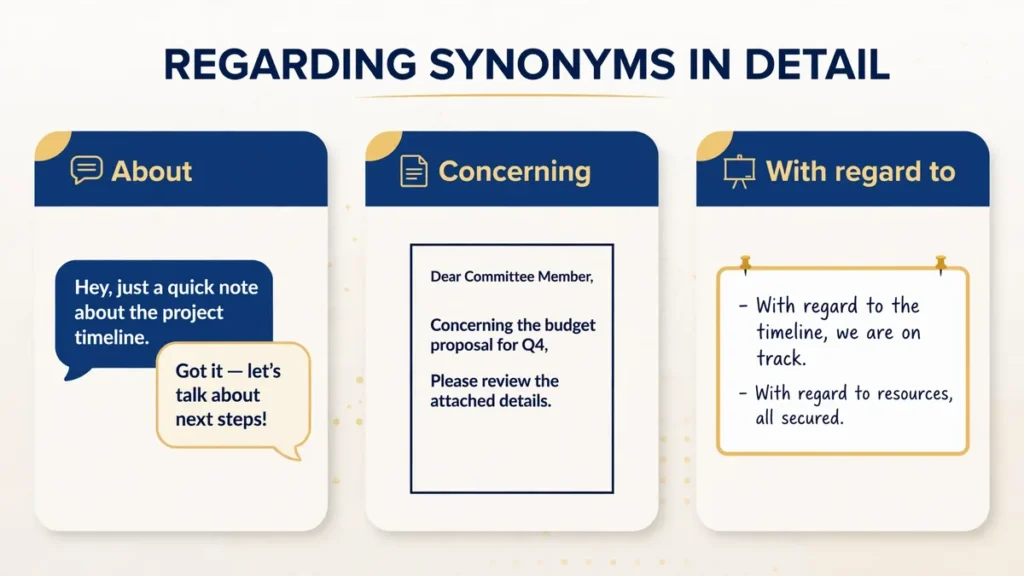
1. About
- Meaning: On the subject of, in plain language.
- Difference: The closest match for regarding: short, warm, and accepted everywhere.
- Best used for: Conversation, emails, school, news.
- Formality: Neutral, CEFR: A1, Frequency: Very common
- Example (Email): “I am writing about the delivery date.”
- Example (Everyday): “She asked about library hours.”
- When NOT to use it: In a very formal legal notice, where concerning sounds more careful.
2. Concerning
- Meaning: About a subject, in formal language.
- Difference: The formal twin of about, with the same topic sense and a more serious tone.
- Best used for: Business emails, reports, news.
- Formality: Formal, CEFR: B2, Frequency: Common
- Example (Work): “We received a complaint concerning refunds.”
- Example (News): “The report raised questions concerning safety.”
- When NOT to use it: In casual chat, where concerning can sound stiff. “A chat concerning lunch” is too grand for lunch.
3. On
- Meaning: About a subject, short and direct.
- Difference: The shortest topic word, best before a clear noun phrase, such as a book on gardening.
- Best used for: Titles, talks, books, courses.
- Formality: Neutral, CEFR: A2, Frequency: Very common
- Example (Title): “She gave a talk on healthy eating.”
- Example (Course): “He teaches a course on photography.”
- When NOT to use it: Before a long clause. “A question on how we should proceed” is awkward; use about instead. On needs a noun phrase: “on the budget” works, “on to review the budget” does not.
Group 2: Formal Written Replacements
4. With Regard To
- Meaning: About a stated subject, in formal writing.
- Difference: Regarding in its most formal dress, naming the topic with care and distance.
- Best used for: Formal emails and reports.
- Formality: Formal, CEFR: C1, Frequency: Common
- Example (Formal): “With regard to your application, we need one document.”
- Example (Work): “Note the change with regard to office hours.”
- When NOT to use it: In everyday speech, where it sounds wordy. About does the same job in half the words.
5. In Regard To
- Meaning: About a subject, a formal variant of with regard to.
- Difference: The same as with regard to, though some style guides prefer with regard to. Both are formal and longer than about.
- Best used for: Business writing and formal emails.
- Formality: Formal, CEFR: C1, Frequency: Common
- Example (Business): “In regard to the contract, the start date moves to May.”
- Example (Formal): “In regard to your request, we approved the change.”
- When NOT to use it: In casual writing, where about is cleaner.
6. As Regards
- Meaning: About a subject, often opening a sentence.
- Difference: Opens a topic and then comments on it, often with a comma, in formal writing.
- Best used for: Formal emails and reports.
- Formality: Formal, CEFR: C1, Frequency: Common
- Example (Formal): “As regards the budget, spending stays flat.”
- Example (Work): “As regards hiring, two posts are open.”
- When NOT to use it: In the middle of a noun phrase. “A question as regards the budget” sounds clumsy; use about there.
7. Relating To
- Meaning: Connected with a subject linked to something else.
- Difference: Stresses a link: the topic relates to another matter, not just that it is the topic.
- Best used for: Reports, policies, research.
- Formality: Neutral to formal, CEFR: B2, Frequency: Common
- Example (Policy): “These rules cover complaints relating to billing.”
- Example (Research): “She studies data relating to child health.”
- When NOT to use it: For a simple topic with no link to stress. “A question relating to lunch” adds a link nobody needs.
8. With Respect To
- Meaning: About one part of a subject.
- Difference: Narrows the topic to one part, not the whole subject.
- Best used for: Formal reports and contracts.
- Formality: Formal, CEFR: C1, Frequency: Common
- Example (Formal): “With respect to safety, the plan meets every rule.”
- Example (Work): “With respect to cost, the smaller option wins.”
- When NOT to use it: For a whole topic with no part to narrow. “A book with respect to gardening” is wordy; use about.
9. In Terms Of
- Meaning: About a subject seen from one angle or measure.
- Difference: Frames the topic by one lens, such as cost, time, or quality, rather than simply naming it.
- Best used for: Business writing and analysis.
- Formality: Neutral to formal, CEFR: B2, Frequency: Very common
- Example (Business): “In terms of cost, the bus is cheaper.”
- Example (Review): “In terms of taste, the new recipe wins.”
- When NOT to use it: As a plain topic label. “A question in terms of the budget” is vague; use about unless you name the angle.
10. In Connection With
- Meaning: About a subject linked to an event or case.
- Difference: Ties the topic to an event, suiting official contexts, and sounds heavier than about.
- Best used for: Official notices and investigations.
- Formality: Formal, CEFR: C1, Frequency: Common
- Example (Official): “Two people were questioned in connection with the fire.”
- Example (Work): “Send documents in connection with the audit.”
- When NOT to use it: For ordinary topics with no event behind them. “Lunch in connection with Friday” is not natural English.
11. Pertaining To
- Meaning: About a subject, in formal or legal language.
- Difference: The most legal-sounding replacement here: the matter belongs to a subject area.
- Best used for: Law, contracts, policies.
- Formality: Formal, CEFR: C1, Frequency: Uncommon
- Example (Legal): “All records pertaining to the case must be kept.”
- Example (Policy): “Questions pertaining to visas go to the front desk.”
- When NOT to use it: In everyday emails or speech, where it sounds like a contract.
Group 3: Structure-Changing Replacements
12. As For
- Meaning: About a subject, turning to a new topic.
- Difference: Changes the sentence shape: it usually opens a clause, takes a comma, then comments on the topic.
- Best used for: Emails, essays, topic shifts.
- Formality: Neutral, CEFR: B2, Frequency: Very common
- Example (Email): “As for the budget, we review it Friday.”
- Example (Everyday): “As for lunch, I prefer something simple.”
- When NOT to use it: Inside a noun phrase. “A question as for the budget” fails; use about after a noun like question.
13. Covering
- Meaning: Dealing with a subject, as a talk or book does.
- Difference: Changes the verb shape: a piece of work covers a topic, rather than simply being about it.
- Best used for: Course lists, agendas, reviews.
- Formality: Neutral, CEFR: B2, Frequency: Common
- Example (Course): “This session covers safety in plain language.”
- Example (Agenda): “The meeting will cover hiring and each open post.”
- When NOT to use it: As a plain topic preposition for a single point, where about is clearer. Covering needs a subject that does the covering, such as a session or a book.
14. Touching On
- Meaning: Mentioning a subject briefly, not in full.
- Difference: Adds a limit: the topic gets a brief mention, not a full treatment.
- Best used for: Talks, essays, meetings.
- Formality: Neutral, CEFR: B2, Frequency: Common
- Example (Talk): “Her talk touched on hiring and two open posts.”
- Example (Meeting): “We will touch on the budget, on costs only.”
- When NOT to use it: When the topic needs full coverage. If you will discuss the budget in depth, do not say you will touch on it.
15. Re
- Meaning: About a subject, in short label form, from Latin.
- Difference: The shortest formal label, suited to subject lines and file notes, but clipped in full sentences.
- Best used for: Subject lines, memos, file notes.
- Formality: Formal, CEFR: C1, Frequency: Common
- Example (Subject): “Re: the budget, see the attached note.”
- Example (Memo): “Re: hiring, two interviews are set Thursday.”
- When NOT to use it: In flowing prose or speech. “I called re the budget” sounds like a memo, not a conversation.
Words Commonly Confused With “Regarding”
These words sit close to regarding, but each fails the swap test in an important way:
- Regard, Alone, the noun or verb: respect (“hold in high regard”) or look at (“regard the painting”). Neither is the topic preposition regarding.
- Regardless, An adverb: “regardless of cost” means cost does not matter, the opposite of naming cost as the topic.
- Disregarding, Ignoring a subject on purpose: “disregarding the warning” means it was ignored, not named as the topic.
- Respecting, A formal topic word in legal writing, but rare elsewhere: “respecting the claim” works in law, yet sounds dated in normal writing, so use concerning.
- In regards to, A common error: the correct phrase is in regard to (no final s). It appears often, but careful editors mark it wrong.
- Regarding to, A grammar error: regarding already includes the direction, so never add to. Say “regarding the budget,” never “regarding to the budget.”
Best Alternatives by Context
Pick by the situation, not by the word list alone. Good teamwork means the same habit: choose the word that fits the job.
Story 1, an everyday email.
You write to a shop about a late order. Use about. “I am writing about my order” is clear and direct. Concerning would sound stiff here.
Story 2, a formal complaint.
You write to a council about safety. Use concerning or with regard to. “A complaint concerning public safety” carries weight. Good coordination often starts with this kind of careful note.
Story 3, a topic shift in a meeting note.
You move from hiring to money. Use as for. “As for the budget, we will review it on Friday” turns cleanly to the new topic.
Story 4, a narrow angle.
You compare options by cost only. Use in terms of or with respect to. “In terms of cost, the smaller option wins” names the lens, so the reader knows you judge cost only. Clear topic words keep debate about facts, much like empathy synonyms help writers name feelings.
Story 5, a short label.
You write a subject line or a file note. Use re or on. “Re: the budget” is a clean label, and “a talk on hiring” is a clean title.
A final tip: when in doubt, test about first. If it fits, keep it.
Which Regarding Replacement Should I Choose?
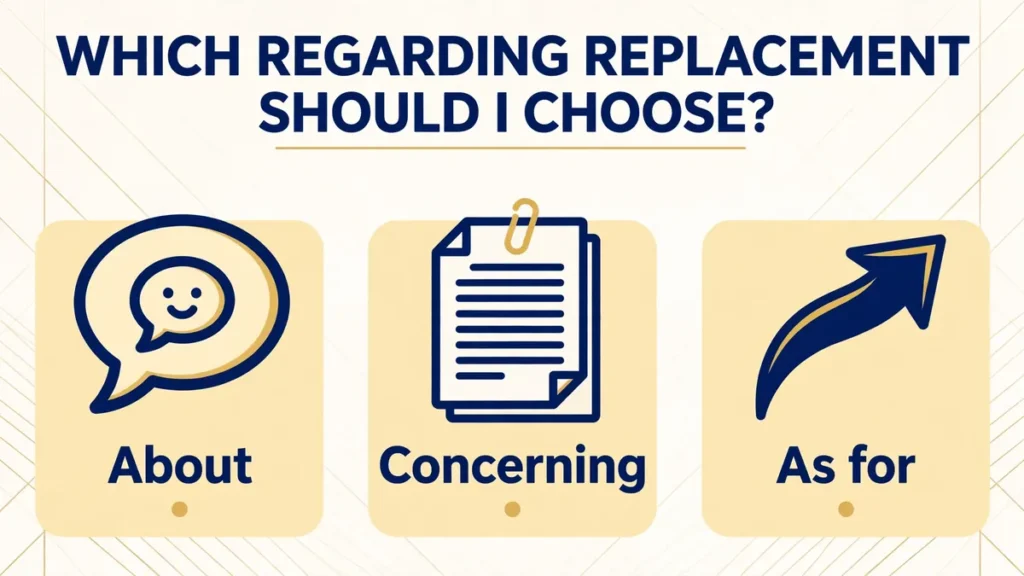
| Ask yourself | If yes, choose |
|---|---|
| Is it an everyday email or chat? | About |
| Is it formal or official? | Concerning, with regard to, or in regard to |
| Is it a title, talk, or course? | On |
| Is it one part or one angle only? | With respect to, or in terms of |
| Is it linked to an event or case? | In connection with, or pertaining to |
| Am I turning to a new topic? | As for |
| Am I covering it briefly only? | Touching on |
| Is it a subject line or short label? | Re |
Antonyms of Regarding
Regarding has no single opposite word, because it is a topic preposition. The opposites below are grouped by sense:
Opposites for naming a topic (ignoring it instead):
| Antonym phrase | What it means |
|---|---|
| Ignoring | Paying no attention to the subject |
| Disregarding | Setting the subject aside on purpose |
| Overlooking | Missing the subject by mistake |
| Unrelated to | Having no link to the subject |
| Apart from | Setting the subject aside |
| Regardless of | Unaffected by the subject |
Opposites for a topic link (breaking the link):
| Antonym phrase | What it means |
|---|---|
| Irrespective of | Without regard to the subject |
| Despite | In spite of the subject |
| Excluding | Leaving the subject out on purpose |
| Omitting | Leaving the subject out by mistake |
| Unconnected with | Having no connection to the subject |
| Notwithstanding | Formally, in spite of the subject |
American vs British English
Regarding, about, concerning, and on are spelled and used the same in American and British English. Two points matter. First, in regard to is preferred in careful writing on both sides, while in regards to is widely seen as an error in both.
Second British formal writing uses as regards a little more often, while American writers lean more toward concerning and with regard to. This article uses American spelling throughout.
Collocations and Idioms With Regarding
Only use combinations native speakers actually use:
- regarding your application, “Regarding your application, we need one document.”
- regarding your order, “I am writing regarding your order.”
- a question regarding, “She asked a question regarding the refund.”
- with regard to, “With regard to cost, we chose the smaller plan.”
- in regard to, “In regard to hiring, two posts are open.”
- as regards, “As regards the budget, spending stays flat.”
- in connection with, “He was questioned in connection with the case.”
- with respect to, “With respect to safety, the plan passes.”
- re: the budget, “Re: the budget, see the note.”
- a talk on, “A talk on healthy eating drew a full room.”
One honest note: regarding has no famous idiom of its own beyond these collocations. These are the partners worth memorizing.
Practice Exercises
Exercise 1: Sentence rewrite. Rewrite each sentence with a better replacement for regarding, noting where the shape must change.
- “I am writing regarding the delivery date.”
- “Regarding the budget, we will review it on Friday.”
- “She gave a talk regarding healthy eating.”
- “Regarding your application, one document is missing.”
Exercise 2: Formality sort. Sort these into Everyday, Formal, or Label only: about, concerning, with regard to, as for, re, on, pertaining to, touching on. This tests tone and shape.
Answer key
- Exercise 1: (1) about the delivery date; (2) as for the budget, it already opens the sentence; (3) on healthy eating, a title word; (4) concerning your application, or with regard to your application.
- Exercise 2: Everyday: about, as for, touching on. Formal: concerning, with regard to, pertaining to. Label or title only: re, on.
Frequently Asked Questions
What can I say instead of regarding in an email?
About is the best everyday choice for most emails, because it is clear and direct. For a formal email, use concerning or with regard to instead, since both carry more weight. For a subject line, use re plus a short topic label.
Is concerning a good synonym for regarding?
Yes, concerning is a strong formal synonym, and it keeps the same topic sense as regarding. Use it in business emails, reports, and formal letters where about would sound too casual. Avoid it in casual chat, where it can sound stiff for a simple topic.
What is the difference between regarding and about?
Both name a topic, but they differ in tone and length. About is short, warm, and natural in speech and everyday writing. Regarding is longer and more formal, so it suits official emails and reports. For most everyday sentences, about is clearer.
Can I start a sentence with regarding?
Yes, you can start a sentence with regarding plus a topic, as in “Regarding the budget, we will meet on Friday.” The topic must follow at once, and a comma usually follows it. For a cleaner topic turn, as for often works better.
Is in regards to correct English?
No, in regards to is widely seen as an error in careful writing, even though it appears often. The correct formal phrase is in regard to, with no final s on regard. Use with regard to for the safest formal choice, or about for everyday writing.
What is the opposite of regarding?
There is no single opposite word, because regarding is a topic preposition, not a quality word. The natural opposites are phrases such as ignoring, disregarding, unrelated to, and regardless of, all of which say the topic was set aside. Choose by sense: ignoring is attention, unrelated to is linkage.
Conclusion
Regarding rewards anyone who checks what a sentence really needs. For a plain topic about is your default and on sharpens it for titles. For a formal setting, concerning, with regard to, and in regard to add weight without changing the meaning. And for a new shape, as for turns to a new topic, touching on limits coverage honestly, and re labels a subject line. Choose by tone and shape, not habit.
One last check: read the sentence aloud with the replacement in place. If it still names the same topic, in the same tone, keep it. If it sounds stiff or vague, swap again.

About Sajjad Ahmed
Sajjad Ahmed is the author behind Guest Paster, where he writes about English vocabulary, synonyms, word meanings, and practical word usage.
His content is designed to help readers understand the differences between similar words, discover suitable alternatives, and use English vocabulary more effectively in everyday writing and communication.
Before publishing, Sajjad focuses on presenting word choices in a clear and easy-to-understand format, with relevant meanings, context, and examples where helpful.
Through Guest Paster, his goal is to make vocabulary learning simpler and provide useful language resources for students, writers, English learners, and anyone looking to expand their vocabulary.
Areas of Focus: English Vocabulary • Synonyms • Word Meanings • Word Usage • Language Learning
Author: Sajjad Ahmed
Website: Guest Paster