You text a friend a photo of your new jacket and she replies, “I like it.” The words are kind but they feel flat. Did she love it or was it just fine? The same small word does a second job at home: “She looks like her sister” you say and now like means resemble not enjoy.
Like has three jobs: enjoying something, resembling something and preferring something. This guide sorts 15 like synonyms by meaning so you can say exactly what you mean. If you enjoy a meal, say enjoy. If a friend resembles her sister, say resemble. And if you would pick tea over coffee, say prefer.
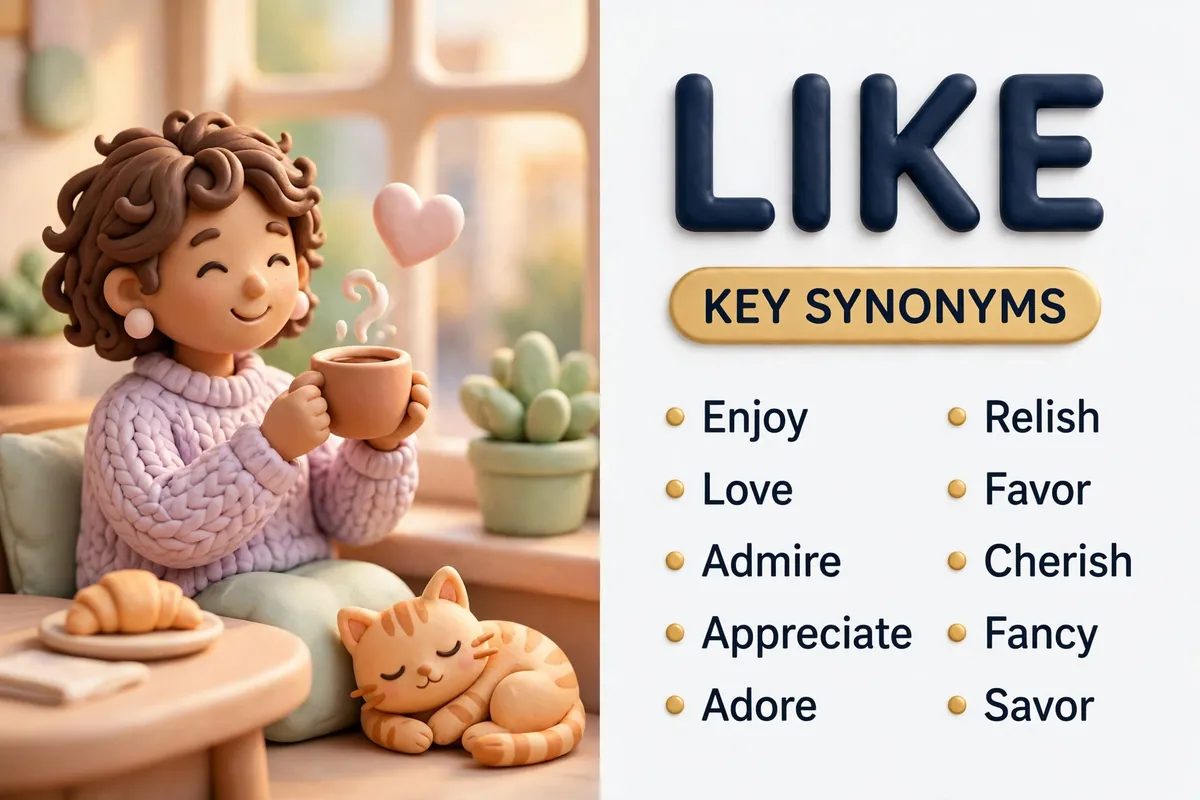
Top 10 Synonyms Table For Like
| # | Synonym | Meaning Difference |
|---|---|---|
| 1 | Enjoy | Taking pleasure |
| 2 | Love | Deep affection |
| 3 | Admire | Respect a good quality |
| 4 | Appreciate | Value with gratitude |
| 5 | Adore | Love warmly, with delight |
| 6 | Relish | Enjoy slowly and fully |
| 7 | Favor | Like one thing more |
| 8 | Cherish | Hold dear over time |
| 9 | Fancy | Like, in casual British speech |
| 10 | Savor | Slow, full attention |
Quick Facts About “Like”
- Part of speech: a verb in this guide; like also works as a noun, an adjective, a preposition, and an adverb.
- Three core meanings: (1) enjoy, (2) resemble, (3) prefer.
- Transitive use: like takes an object: a food, a film, or a person.
- Register: neutral and very common. Like suits everyday speech, school writing, and casual emails; formal writing often needs a stronger word.
The Closest Synonym: Enjoy
Enjoy is the closest synonym for like: it covers the word’s most common job, taking pleasure in something. When you like a meal, a song, or a walk, enjoy names that pleasure directly, and it works in almost every sentence where like means pleasure.
Still, enjoy is not identical to like. Enjoy is stronger and warmer, and it points to the feeling itself rather than a mild opinion. You can like a coworker in a polite, distant way, but if you enjoy their company, you actually have fun with them. Like can also mean resemble or prefer, and enjoy covers neither sense.
Choice test: pleasure means enjoy, deep feeling means love, admiration means admire, a lookalike means resemble, a choice means prefer.
Where “Like” Comes From (Etymology)
According to Etymonline, like as an adjective appears around 1200 as “lik,” short for “y-lik,” from Old English “gelic,” meaning “like” or “similar.” It came from Proto-Germanic “(ga)leika-,” meaning “having the same form,” literally “with a corresponding body,” from “ga-,” meaning “with” or “together,” plus the root “lik-,” meaning “body,” “form,” “like,” or “same.”
The verb is older still. Old English “lician” meant “to please” or “to be sufficient,” from Proto-Germanic “likjan.” At first, like and dislike were impersonal, and the liking flowed the other way: Shakespeare wrote “The music likes you not” in The Two Gentlemen of Verona, where the music, not the listener, does the liking. The modern flow began in the late 14th century. “Feel like,” meaning “want to” or “be in the mood for,” is recorded from 1863 and was originally American English. Merriam-Webster lists the same core senses: to enjoy, to be similar, and to prefer.
Can You Swap Them Freely?
In short: only inside the same meaning group, and only when the sense matches.
- ✅ “We enjoyed the concert last night.” (enjoying something ✔)
- ❌ “She enjoyed her sister.” (enjoy is pleasure, not resemblance ✘, say resembled)
- ✅ “He resembles his father.” (looking similar ✔)
- ❌ “I resemble pizza.” (resemble is looks, not taste ✘, say like)
- ✅ “I prefer tea to coffee.” (choosing one thing ✔)
- ❌ “I prefer my sister.” (prefer is a choice, not a family likeness ✘, say am like)
Before you substitute, ask which job like is doing: enjoying, resembling, or preferring. The trap: like as similar and like as enjoy are never interchangeable.
Like Synonyms in Detail
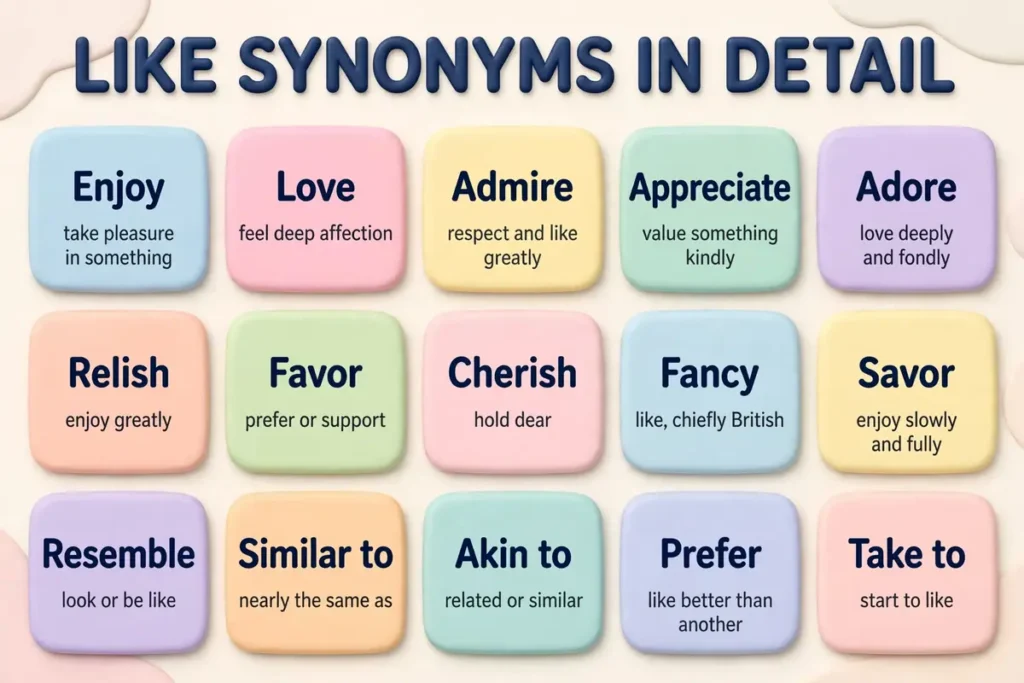
Group 1: Enjoying Something
1. Enjoy
- Meaning: To take pleasure in something you do, eat, or watch.
- Difference: The closest match for like in its enjoying sense, warmer and more definite.
- Best used for: Food, music, movies, everyday speech.
- Formality: Neutral · CEFR: A2 · Frequency: Very common
- Example (Food): “We enjoyed the spicy noodles downtown.”
- Example (Music): “She enjoys old jazz records on Sundays.”
- When NOT to use it: For a person you resemble, where resemble fits better.
2. Love
- Meaning: To feel deep affection or strong pleasure.
- Difference: Love is far stronger than like: mild approval against deep feeling.
- Best used for: Family, close friends, favorite foods, hobbies, songs.
- Formality: Neutral · CEFR: A1 · Frequency: Very common
- Example (Food): “He loves his grandmother’s chicken soup.”
- Example (Movies): “They love comedies on Friday nights.”
- When NOT to use it: For a mild opinion, where like is honest.
3. Admire
- Meaning: To respect something or someone for a good quality.
- Difference: Admire adds respect from a distance. You can admire a singer you have never met.
- Best used for: People, art, skill, school writing.
- Formality: Neutral to formal · CEFR: B2 · Frequency: Common
- Example (School): “Students admire their science teacher’s patience.”
- Example (Art): “Visitors admire the bright murals on the wall.”
- When NOT to use it: For simple pleasure in food or fun, use enjoy.
4. Appreciate
- Meaning: To value something and be glad it exists or happened.
- Difference: Appreciate adds gratitude for a gift or a kind act.
- Best used for: Thank-you notes, work emails, polite speech.
- Formality: Neutral to formal · CEFR: B2 · Frequency: Very common
- Example (Work): “I appreciate your help with the report.”
- Example (School): “She appreciates her tutor’s extra time.”
- When NOT to use it: For a favorite song or food, where enjoy sounds more natural.
5. Adore
- Meaning: To love something or someone very much, with warmth and delight.
- Difference: Adore is stronger than like and softer than love, playful and warm.
- Best used for: Pets, children, favorite foods, casual speech.
- Formality: Neutral · CEFR: B2 · Frequency: Common
- Example (Pets): “She adores her small rescue dog.”
- Example (Food): “He adores warm cinnamon rolls.”
- When NOT to use it: In formal writing, where love sounds more serious.
6. Relish
- Meaning: To enjoy something slowly and fully.
- Difference: Relish adds slow, full enjoyment: you relish a meal, not rush it.
- Best used for: Food, holidays, quiet moments, writing.
- Formality: Neutral to formal · CEFR: C1 · Frequency: Less common
- Example (Food): “They relished the slow Sunday breakfast.”
- Example (Music): “He relished every note of the live concert.”
- When NOT to use it: In plain everyday speech, use enjoy
7. Favor
- Meaning: To like one thing more than another, or to treat it with preference.
- Difference: Favor sits between like and prefer: a gentle leaning, not a firm choice.
- Best used for: Comparisons, polite speech, school writing.
- Formality: Neutral to formal · CEFR: B2 · Frequency: Common
- Example (Food): “She favors mild salsa over the spicy kind.”
- Example (Movies): “He favors old comedies over action films.”
- When NOT to use it: For strong feeling, where love or adore fits better.
8. Cherish
- Meaning: To hold something dear over time.
- Difference: Cherish adds time and care: a memory kept for years, not minutes.
- Best used for: Memories, family, friendships, keepsakes.
- Formality: Neutral to formal · CEFR: B2 · Frequency: Common
- Example (Family): “They cherish summers at their grandmother’s house.”
- Example (School): “She cherishes her classmates’ letters.”
- When NOT to use it: For a new song or a snack, use enjoy.
9. Fancy
- Meaning: To like or want something, in casual British speech.
- Difference: Fancy is chiefly British and informal. Americans rarely use it this way.
- Best used for: British conversation, casual invitations, light fiction.
- Formality: Informal · CEFR: B2 · Frequency: Common in British English
- Example (Food): “Do you fancy a cup of tea?”
- Example (Movies): “I fancy watching a comedy tonight.”
- When NOT to use it: In American or formal writing, where like fits better.
10. Savor
- Meaning: To enjoy something slowly, tasting every part.
- Difference: Savor stresses slow attention to a meal, a song, or a free evening.
- Best used for: Food writing, travel, reflective writing.
- Formality: Neutral to formal · CEFR: C1 · Frequency: Less common
- Example (Food): “She savored the first bite of chocolate cake.”
- Example (Travel): “They savored the quiet morning by the lake.”
- When NOT to use it: For quick everyday likes, use enjoy.
Group 2: Looking Similar
11. Resemble
- Meaning: To look or seem similar to someone or something.
- Difference: Resemble is the formal word for looking alike; like as a verb never means this.
- Best used for: Family likeness, descriptions, formal writing.
- Formality: Neutral to formal · CEFR: B2 · Frequency: Common
- Example (Family): “The twins resemble their mother.”
- Example (School): “His painting resembles a famous mural.”
- When NOT to use it: For enjoyment, use enjoy or like.
12. Similar to
- Meaning: Nearly the same in looks, nature, or quality.
- Difference: Similar to is a plain phrase for sameness, softer than identical.
- Best used for: Comparisons, school writing, everyday speech.
- Formality: Neutral · CEFR: B1 · Frequency: Very common
- Example (Movies): “This film is similar to last year’s.”
- Example (Food): “The taste is similar to fresh lemonade.”
- When NOT to use it: As a verb for enjoyment, use like or enjoy.
13. Akin to
- Meaning: Related to or similar in nature to something.
- Difference: Akin to is formal and abstract, for ideas, not faces.
- Best used for: Formal essays, academic writing.
- Formality: Formal · CEFR: C1 · Frequency: Less common
- Example (School): “Her argument is akin to last week’s.”
- Example (Music): “The song’s mood is akin to a rainy evening.”
- When NOT to use it: For family faces or everyday looks, use resemble.
Group 3: Preferring Something
14. Prefer
- Meaning: To choose one thing over another, liking it more.
- Difference: Prefer is the choice word: like states a feeling, prefer states a ranking.
- Best used for: Choices, comparisons, polite requests.
- Formality: Neutral · CEFR: B1 · Frequency: Very common
- Example (Food): “I prefer tea to coffee in the morning.”
- Example (Movies): “She prefers comedies to horror films.”
- When NOT to use it: For simple enjoyment with no comparison, use enjoy.
15. Take to
- Meaning: To start liking someone or something quickly.
- Difference: Take to adds a beginning: liking a new hobby the first time you try it.
- Best used for: New hobbies, new people, casual speech.
- Formality: Neutral · CEFR: B2 · Frequency: Common
- Example (School): “He took to the guitar within a week.”
- Example (Exercise): “She took to morning walks with her neighbor.”
- When NOT to use it: For a long-held favorite, use love or cherish.
Best Alternatives by Context
Five everyday situations, each with the word that fits best.
Situation 1: You are tasting food. Say you enjoyed the meal, relished dinner, or savored dessert. If it is a new favorite, say you adore it; if you would pick it over the other dish, say you prefer it.
Situation 2: You are talking about music. Say you love the band, adore the album, or enjoy the show. If the singer reminds you of an old star, say she resembles her. To describe what makes one performance better than another, see quality synonyms.
Situation 3: You are describing a movie. Say you enjoyed the story, loved the ending, or fancied a comedy in British English. If the plot feels close to another film, say it is similar to that film. When the film’s message moved you, see purpose synonyms for words that name a goal or an aim.
Situation 4: You are at school or work. Say you appreciate a teacher’s help, admire a classmate, or favor one method. If a new subject clicks at once, say you took to it. For study routines that save time, see efficient synonyms.
Situation 5: You are choosing between two things. Say you prefer tea to coffee, favor the quiet route, or would like the window seat, the polite form when someone asks what you want.
Which Like Synonym Should I Choose?

| Situation | Best pick | Why it wins |
|---|---|---|
| Taking pleasure in a meal | Enjoy | Warm pleasure |
| Deep affection for a person | Love | Strongest feeling |
| Respecting a good quality | Admire | Respect from a distance |
| Valuing help or a gift | Appreciate | Gratitude |
| Warm delight in a pet or food | Adore | Playful and warm |
| Slow, full enjoyment | Relish | Slow pleasure |
| A gentle leaning in a comparison | Favor | Soft preference |
| A memory kept dear for years | Cherish | Time and care |
| A casual British invitation | Fancy | Informal, British |
| Slow attention to taste or feeling | Savor | Full attention |
| A family lookalike | Resemble | Formal likeness |
| Two things nearly the same | Similar to | Plain sameness |
| Two ideas alike in nature | Akin to | Formal, abstract |
| Choosing one thing over another | Prefer | Clear ranking |
| Liking something new at once | Take to | Fresh beginning |
Antonyms of Like
Antonyms for like as enjoying something
| Antonym | Meaning Difference |
|---|---|
| Dislike | Not enjoy something |
| Hate | Strong dislike |
| Detest | Dislike intensely |
| Despise | Dislike with contempt |
| Loathe | Hate strongly |
| Disapprove of | Judge it as wrong |
For like as resembling something
| Antonym | Meaning Difference |
|---|---|
| Differ from | Not be the same |
| Unlike | Not similar to |
| Contrast with | Stand out different |
| Bear no resemblance to | Look nothing alike |
| Be nothing like | No likeness at all |
Antonyms for like as preferring something
| Antonym | Meaning Difference |
|---|---|
| Reject | Refuse to accept |
| Avoid | Keep away on purpose |
| Shun | Stay away deliberately |
| Turn down | Say no to an offer |
| Pass on | Skip politely |
Words Commonly Confused With Like
Like versus love is the pair to watch. Like is mild approval; love is deep feeling. You like a new cafe; you love your grandmother’s cooking. Love for a mild opinion overstates it; like for a deep feeling understates it.
Enjoy versus like matters for the pleasure sense. Enjoy is warmer and points to the feeling itself, while like is cooler and often just an opinion. You enjoy a concert; you like the band in general. “I enjoy your sister” sounds wrong.
Resemble versus like matters for the likeness sense. Resemble is the verb for looking alike: “She resembles her sister.” Like needs “looks” or “tastes” beside it: “She looks like her sister.” Never swap resemble into a pleasure sentence.
Fancy versus like matters across the Atlantic. Fancy means like in casual British English: “Do you fancy a cup of tea?” In American English it sounds odd, and in formal writing it sounds out of place.
Prefer versus like matters for choices. Prefer ranks one thing above another: “I prefer tea to coffee.” Like states a feeling with no ranking: “I like tea.” Use prefer only when a comparison is there.
Substitution test failures: “She enjoyed her sister” fails, because enjoy is pleasure, so say “she resembles her sister.” “I resemble pizza” fails, because resemble is looks, so say “I like pizza.” “I fancy a coffee” in an American business email fails, because fancy is British and informal, so say “I would like a coffee.” And “I prefer my sister” fails, because prefer is a choice, so say “I am like my sister.”
American vs British English
Like is spelled and used the same in American and British English, and so are most of its synonyms here. Three real differences matter. First, fancy as a verb meaning like is chiefly British and informal; Americans say “would like” instead. Second, favor is American spelling, while British spelling is favour.
This article uses American spelling throughout. Third, like as a filler word (“It was, like, amazing”) is casual speech in both countries, and it has no place in formal writing on either side.
Collocations and Idioms With Like
Only combinations native speakers actually use:
- feel like: want to, or be in the mood. “I feel like pizza tonight.”
- look like: resemble in looks. “You look like your mother.”
- would like: the polite way to ask. “I would like a window seat.”
- like father, like son: a son takes after his father.
- the likes of: people or things of that kind. “We have never seen the likes of this storm.”
- like it or not: whether you approve. “Like it or not, the exam is tomorrow.”
- like-minded: sharing the same tastes, as in “a like-minded book club.”
Use feel like with a noun or a verb ending in ing, as in “feel like dancing,” and look like with a noun, as in “look like rain.”
Practice Exercises
Exercise 1: Fill in the blank. Choose the best word from the bank: enjoy, resemble, prefer, adore, savor.
- We ___ the spicy noodles at the new restaurant.
- The twins ___ their mother, and teachers mix them up.
- I ___ tea to coffee in the morning.
- She ___ her small rescue dog and takes him everywhere.
- He ___ every note of the live concert.
Exercise 2: True or false? Write T or F, then fix the false ones.
- “I resemble pizza” correctly says you like pizza.
- Fancy is a formal American word for like.
- “She looks like her sister” means the sisters resemble each other.
- Prefer is the right word when you choose one thing over another.
- Cherish fits a song you heard once and liked.
Answer key
- Exercise 1: (1) enjoy; (2) resemble; (3) prefer; (4) adore; (5) savor.
- Exercise 2: (1) F, say “I like pizza”; (2) F, fancy is informal British English; (3) T; (4) T; (5) F, cherish is for long-held favorites, say “enjoy.”
Frequently Asked Questions
What is the best synonym for like?
Enjoy is the best synonym when like means taking pleasure in something, because it matches the most common use and works in almost every sentence about food, music, movies, and free time. For a lookalike, resemble fits best. For a choice between two things, prefer fits best. Match the synonym to the job like is doing.
What is the difference between like and love?
Like is mild approval, while love is deep feeling. You like a new restaurant; you love your grandmother’s cooking. Love also covers people, pets, and lifelong favorites, while like suits casual opinions. Using love for a mild opinion overstates it, and using like for a deep feeling understates it, so pick the strength you truly mean.
Can like mean resemble?
Yes. Like also means to resemble. You say “She looks like her sister” or “This tastes like lemonade,” and like means similar, not enjoy. The clue is the verb form: “looks like” and “tastes like” point to likeness, while “I like it” points to pleasure. Need one verb? Use resemble for people, similar to for things.
Is fancy the same as like?
Fancy means like in informal British English, as in “Do you fancy a cup of tea?” It is chiefly British, so Americans rarely use it this way and it can sound odd in American writing. Fancy also means to imagine or want something, a second sense. In formal or American text, use like or would like instead.
What is the opposite of like?
It depends on the meaning. For enjoying, the opposites are dislike, hate, and detest. For resembling, the opposites are differ from and unlike. And for preferring, the opposites are reject and avoid. Each antonym belongs to one meaning group, so pick the one that matches the sense you used, not just any word that feels negative.
Which synonym should students use in essays?
In essays, prefer enjoy for pleasure, admire for respect, and appreciate for gratitude, because all three sound clear and academic. Use resemble for likeness and prefer for choices. Save adore, relish, and savor for creative or food writing, and avoid fancy unless you write British English. Keep like itself for simple, honest opinions.
Conclusion
Next time “I like it” feels flat, reach for the sharper word: the one that names the pleasure, the likeness or the choice. Your reader will know exactly what you meant, and your sentence will finally say it.

About Sajjad Ahmed
Sajjad Ahmed is the author behind Guest Paster, where he writes about English vocabulary, synonyms, word meanings, and practical word usage.
His content is designed to help readers understand the differences between similar words, discover suitable alternatives, and use English vocabulary more effectively in everyday writing and communication.
Before publishing, Sajjad focuses on presenting word choices in a clear and easy-to-understand format, with relevant meanings, context, and examples where helpful.
Through Guest Paster, his goal is to make vocabulary learning simpler and provide useful language resources for students, writers, English learners, and anyone looking to expand their vocabulary.
Areas of Focus: English Vocabulary • Synonyms • Word Meanings • Word Usage • Language Learning
Author: Sajjad Ahmed
Website: Guest Paster