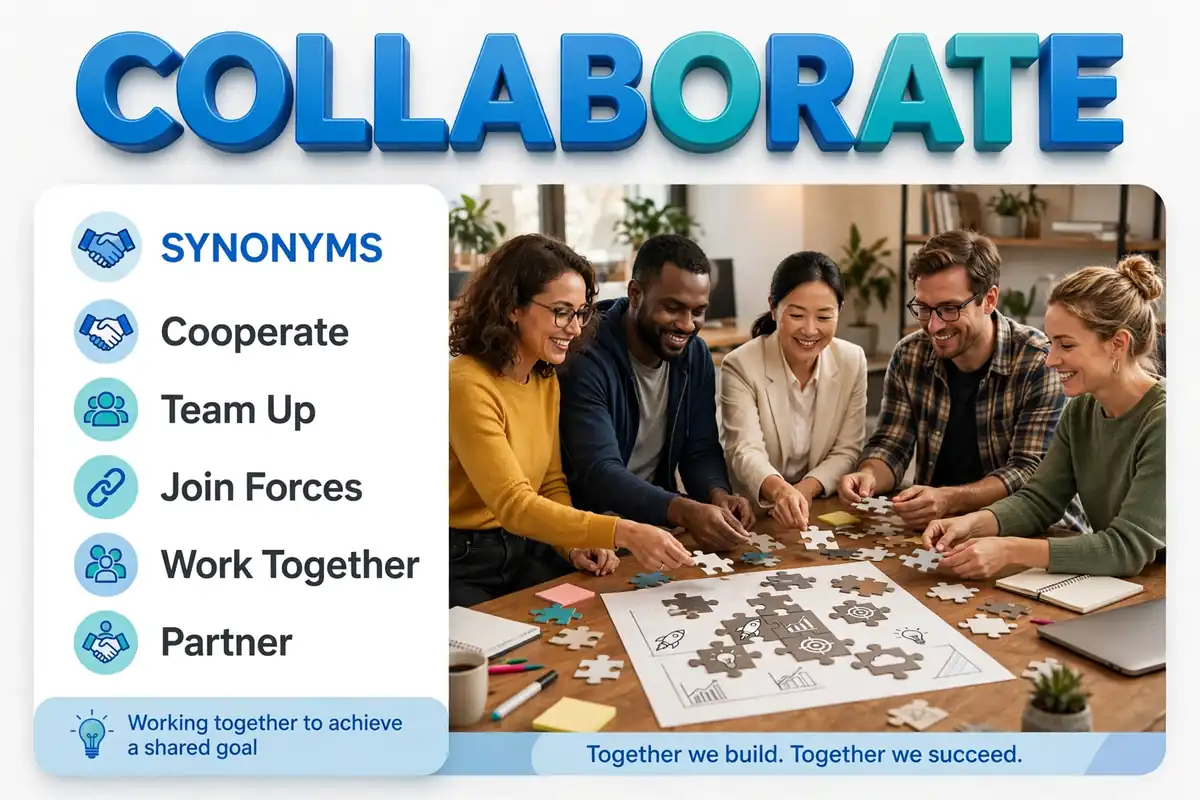
If you need a fresh word for working with other people ask one question: are we sharing the work the credit or just information? The closest synonym for collaborate is cooperate because it covers the everyday sense of working together toward a shared goal.
For a short energetic project, team up fits better and for a formal plan coordinate fits better.
This guide sorts 16 collaborate synonyms by meaning, so you can pick the right word the first time.
10 Another Word For Collaborate Synonyms at a Glance
| # | Synonym | Meaning Difference |
|---|---|---|
| 1 | Cooperate | The everyday default for working together |
| 2 | Work together | The plain, friendly version of collaborate |
| 3 | Team up | A short, energetic partnership, often informal |
| 4 | Join forces | Two sides combining strength for one goal |
| 5 | Partner | A business or project partnership |
| 6 | Coordinate | Organizing who does what, and when |
| 7 | Co-create | Making something new together |
| 8 | Co-author | Writing a book, paper, or report together |
| 9 | Pool efforts | Combining time, skill, or resources |
| 10 | Band together | A group uniting, often against a problem |
Quick Facts About “Collaborate”
- Part of speech: a verb. You collaborate with someone on a project, a paper, or a plan.
- Three core meanings: (1) work together on a shared task, (2) create something together, such as a book or a product, (3) cooperate between teams, departments, or organizations.
- Register: neutral to formal. Collaborate sounds natural in offices, schools, and research, but in casual speech work together or team up sounds warmer.
- Watch out: collaborate promises shared work, not just talk. If two people only exchange emails, coordinate or liaise may be more honest.
The Closest Synonym: Cooperate

Cooperate is the closest synonym for collaborate because it covers the word’s most common job: working with other people instead of against them, or instead of alone. When nurses cooperate on a ward, when rival firms cooperate on a safety standard, or when classmates cooperate on a presentation, the real action is shared effort toward a shared result. No special project, no publication, just people pulling in the same direction.
Still, they are not identical. Cooperate can mean simply not blocking someone, while collaborate usually means actively building something together. Use cooperate as your default, and reach below when the work is creative or formal.
Finally, remember the effort test: if cooperate still sounds true, it is safe. If the sentence is about writing or inventing together, use the creative group below.
Where “Collaborate” Comes From (Etymology)
According to Etymonline, collaborate is first recorded in 1845, in the form collaborating, meaning “to work with another or others.” It is a back-formation from collaborator, or was modeled on French collaborer, or came directly from Late Latin collaboratus, the past participle of collaborare, “to work with.” That verb joins com, “with,” and laborare, “to work.”
The related noun collaborator is older, recorded in 1802 as “an associate in labor, one who works with another.” Etymonline also notes a darker wartime sense that grew up during World War II: “cooperate traitorously with an occupying enemy.” That negative sense survives in collude, covered below. In normal modern use, collaborate is positive: shared work, shared skill, shared result.
Can You Swap Them Freely?
In short: only inside the same meaning group, and only when the work matches. A general teamwork word collapses in a writing credit, and a formal organizing word collapses in a casual chat:
- ✅ “The two labs will cooperate on the trial.” (general joint work ✔)
- ❌ “The two labs will co-author the trial.” (co-author is for writing, not for running a trial ✘, say cooperate or work together)
- ✅ “She teamed up with a designer for the pop-up shop.” (short, informal project ✔)
- ❌ “She liaised with a designer for the pop-up shop.” (liaise is about exchanging information between groups, not building a shop together ✘, say teamed up)
Before you substitute, ask: are we doing a task, making something, or organizing between groups? Those take a Group 1, Group 2, and Group 3 word in turn. If only one side does the work, none of these words is honest.
Collaborate Synonyms in Detail
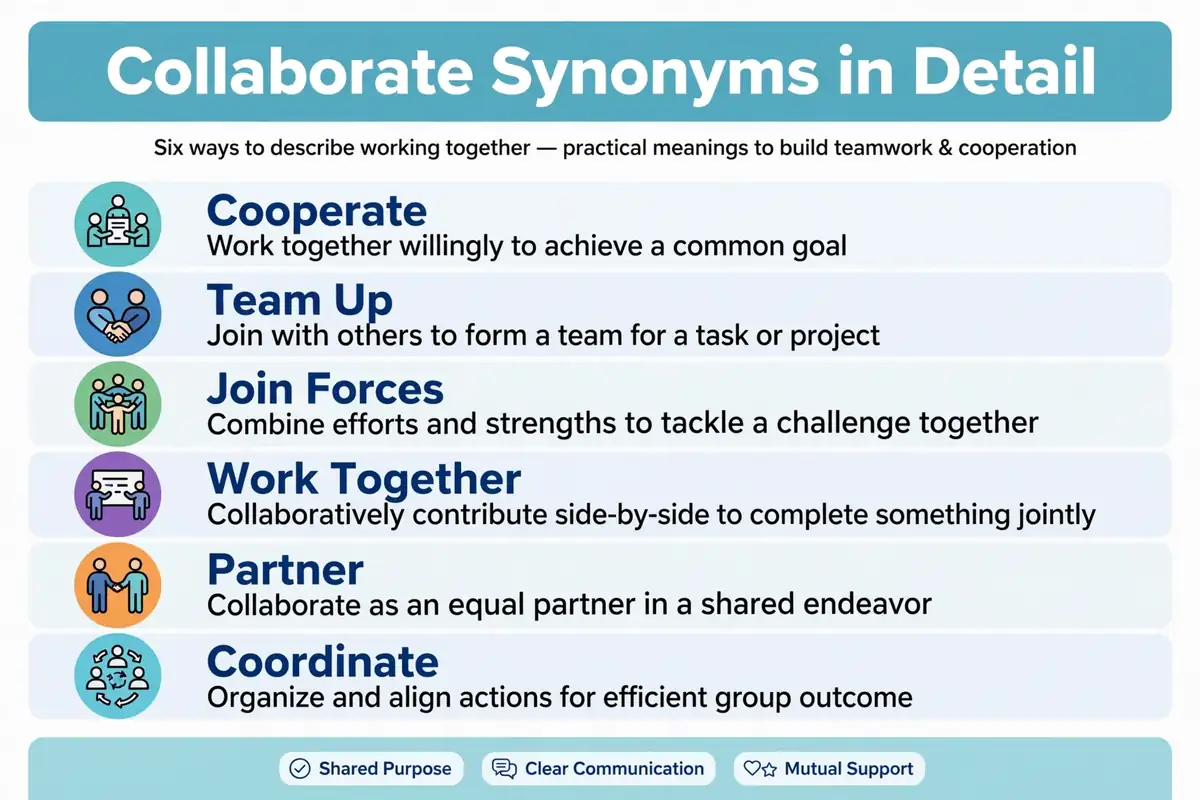
Group 1: Collaborate as Working Together on a Task
1. Cooperate
- Meaning: Work together with others, or help a shared effort succeed.
- Difference: The closest all-round match for everyday collaborate. Cooperate is neutral, flexible, and accepted everywhere.
- Best used for: Work, school, community projects, everyday writing.
- Formality: Neutral · CEFR: B1 · Frequency: Very common
- Example (Work): “The two departments agreed to cooperate on the safety review.”
- Example (Everyday): “Neighbors cooperated to clear the snow from the whole street.”
- When NOT to use it: When you mean writing or inventing together. Cooperate hides the creative part, so use co-author or co-create instead.
2. Work Together
- Meaning: Do a job jointly, with each person taking part.
- Difference: The plainest, warmest version of collaborate. It says nothing about formality, and it suits any age group.
- Best used for: Conversation, teaching, friendly emails, simple instructions.
- Formality: Informal to neutral · CEFR: A2 · Frequency: Very common
- Example (School): “The students work together on one science poster each term.”
- Example (Work): “We work together with the kitchen team every Friday.”
- When NOT to use it: In a formal report or a publication credit, where collaborate or partner sounds more professional.
3. Team Up
- Meaning: Join together as a team, usually for one project or event.
- Difference: Team up is short, energetic, and slightly informal. It suggests a new pairing, not a long-standing department.
- Best used for: Sports, startups, events, social media, casual business writing.
- Formality: Informal · CEFR: B1 · Frequency: Very common
- Example (Business): “The cafe teamed up with a local bakery for the weekend market.”
- Example (School): “Maya teamed up with Jon to build the robot.”
- When NOT to use it: For a formal treaty or a research program, where partner or cooperate fits better.
4. Join Forces
- Meaning: Combine strength, resources, or influence for a shared goal.
- Difference: Join forces stresses power in numbers. It suits rivals, charities, or firms that become stronger together.
- Best used for: News, campaigns, business stories, community action.
- Formality: Neutral · CEFR: B2 · Frequency: Common
- Example (News): “Two charities joined forces to open a food bank.”
- Example (Work): “The firms joined forces to bid for the city contract.”
- When NOT to use it: For a small everyday task, where join forces sounds grand and overblown.
5. Partner
- Meaning: Work with someone as a partner, sharing responsibility and reward.
- Difference: Partner implies a named, ongoing relationship, often with a contract or a public announcement.
- Best used for: Business, nonprofits, schools, formal announcements.
- Formality: Neutral to formal · CEFR: B2 · Frequency: Very common
- Example (Business): “The clinic partnered with the university on nurse training.”
- Example (Community): “We partnered with the library for summer reading clubs.”
- When NOT to use it: For a one-off favor between friends, where partner sounds too official.
6. Pull Together
- Meaning: Work hard as a group, often in a difficult moment.
- Difference: Pull together adds effort and spirit. It fits a team under pressure, not a routine meeting.
- Best used for: Speeches, sports, community stories, motivational writing.
- Formality: Informal to neutral · CEFR: B2 · Frequency: Common
- Example (Community): “After the flood, the whole town pulled together.”
- Example (Work): “The team pulled together to finish before the deadline.”
- When NOT to use it: In a formal contract or report, where cooperate is cleaner and less emotional.
Group 2: Collaborate as Creating Something Together
7. Co-author
- Meaning: Write a book, article, paper, or report together, sharing authorship.
- Difference: Co-author is a credit word. It says both names belong on the work, not just that both people helped.
- Best used for: Academic papers, books, reports, journalism.
- Formality: Formal · CEFR: C1 · Frequency: Common
- Example (Academic): “She co-authored the study with two colleagues in Oslo.”
- Example (Publishing): “They co-authored a guide to urban gardening.”
- When NOT to use it: When someone only edited or advised. That person is a contributor or an editor, not a co-author.
8. Co-write
- Meaning: Write something together, often a song, script, or article.
- Difference: Co-write is looser than co-author. It fits songs and scripts where credit rules are less strict than in research.
- Best used for: Music, film, television, blogs, songwriting.
- Formality: Neutral · CEFR: B2 · Frequency: Common
- Example (Music): “The pair co-wrote three songs for the new album.”
- Example (Media): “They co-wrote the script during one long summer.”
- When NOT to use it: For a peer-reviewed paper, where co-author is the standard term.
9. Co-create
- Meaning: Make or design something new together, from the first idea onward.
- Difference: Co-create stresses shared invention. It suits products, brands, and workshops where users or clients help shape the result.
- Best used for: Design, product work, workshops, brand projects.
- Formality: Neutral · CEFR: C1 · Frequency: Common
- Example (Design): “The studio co-created the packaging with its customers.”
- Example (Work): “Teachers and students co-created the new timetable.”
- When NOT to use it: When one side only gives feedback at the end. That is consultation, not co-creation.
10. Co-produce
- Meaning: Produce a film, show, event, or program together, sharing cost and control.
- Difference: Co-produce is an industry term. It implies shared funding or shared production duties, not just shared ideas.
- Best used for: Film, television, theatre, festivals, media projects.
- Formality: Formal · CEFR: C1 · Frequency: Uncommon
- Example (Film): “Two studios co-produced the documentary.”
- Example (Events): “The festival was co-produced by the city and a charity.”
- When NOT to use it: For ordinary office work, where co-produce sounds like film jargon.
11. Co-develop
- Meaning: Develop a product, drug, course, or system together, step by step.
- Difference: Co-develop stresses a long build, with testing and revision, not a single meeting.
- Best used for: Technology, medicine, education, product teams.
- Formality: Formal · CEFR: C1 · Frequency: Common
- Example (Tech): “The firms co-developed a payment app for small shops.”
- Example (Education): “Two colleges co-developed an online nursing course.”
- When NOT to use it: For a short creative piece, where co-create or co-write is simpler.
Group 3: Collaborate as Organized Cooperation Between Groups
12. Coordinate
- Meaning: Organize people, tasks, and timing so a shared effort runs smoothly.
- Difference: Coordinate is about planning, not just goodwill. It answers who does what, and when.
- Best used for: Projects, events, logistics, management writing.
- Formality: Neutral to formal · CEFR: B2 · Frequency: Very common
- Example (Work): “She coordinates the rota for three hospital wards.”
- Example (Events): “Volunteers coordinated transport for the whole festival.”
- When NOT to use it: When the point is shared creativity. Coordination alone does not mean people invented together.
13. Liaise
- Meaning: Exchange information and keep in touch between two groups.
- Difference: Liaise is about the link between groups. It does not promise shared work, only good communication.
- Best used for: Government, health care, large organizations, British business writing.
- Formality: Formal · CEFR: C1 · Frequency: Common
- Example (Work): “He liaises with the council on road closures.”
- Example (Health): “Nurses liaise with social workers before discharge.”
- When NOT to use it: When groups truly build something together. Liaising is talking, collaborating is doing.
14. Ally
- Meaning: Join with another person, group, or country for mutual support.
- Difference: Ally stresses loyalty and a shared side, often in politics, campaigns, or social causes.
- Best used for: Politics, campaigns, advocacy, history writing.
- Formality: Neutral to formal · CEFR: B2 · Frequency: Common
- Example (Politics): “Small parties allied to block the new bill.”
- Example (Campaigns): “Parents allied with teachers to save the school pool.”
- When NOT to use it: For a neutral office project, where ally sounds political or military.
15. Band Together
- Meaning: Unite as a group, often to face a problem or an opponent.
- Difference: Band together stresses unity under pressure. It suits communities and workers more than boardrooms.
- Best used for: Community stories, labor history, speeches, journalism.
- Formality: Neutral · CEFR: B2 · Frequency: Common
- Example (Community): “Shopkeepers banded together to revive the high street.”
- Example (Work): “Freelancers banded together to share studio costs.”
- When NOT to use it: In a formal business memo, where partner or cooperate is more restrained.
Best Alternatives by Context
Pick by the situation, not by the word list alone:
- Everyday office task: cooperate or work together. Both are safe, warm, and free of jargon.
- A short, punchy project: team up. It signals energy and a clear start, such as a market stall or a hackathon.
- A formal partnership: partner. Use it when the relationship is named, public, and likely to last.
- A shared creation: co-create for a product, co-author for a paper, co-write for a song or script.
- Organizing many people: coordinate. When timing, rotas, or deliveries matter most, coordination is the real job.
- A group under pressure: pull together or band together. Both carry the spirit of a team facing one problem.
For the wider family, see the guide to teamwork synonyms. For planning, the guide to coordination synonyms sorts that family. And for effort, the guide to hard working synonyms covers that angle.
Which Collaborate Synonym Should I Choose?

| Situation | Best pick | Why it wins |
|---|---|---|
| Everyday shared task | Cooperate | Neutral and understood everywhere |
| Casual or short project | Team up | Friendly energy, clear start and finish |
| Formal business deal | Partner | A lasting, named relationship |
| Writing together | Co-author | Gives a proper shared credit |
| Inventing a product together | Co-create | Stresses shared invention from day one |
| Running a complex plan | Coordinate | Focuses on timing and task order |
| Linking two departments | Liaise | Focuses on communication between groups |
| A community in difficulty | Band together | Carries unity and shared resolve |
Antonyms of Collaborate
For working together on a task
| Antonym | Meaning Difference |
|---|---|
| Work alone | Do the task without any help or partner |
| Compete | Try to beat the other side, not help it |
| Oppose | Stand against a plan or a group |
| Obstruct | Block or slow down a shared effort |
| Go it alone | Rely only on yourself, by choice |
| Work independently | Do your part separately, with no joint effort |
For creating something together
| Antonym | Meaning Difference |
|---|---|
| Work solo | Create without a partner or co-creator |
| Write alone | Be the only author of a text |
| Create alone | Invent or design without shared input |
| Keep separate | Keep projects, teams, or credit apart |
| Withhold help | Refuse the cooperation others expected |
| Take sole credit | Claim a shared result as your own work |
Antonyms for organized cooperation
| Antonym | Meaning Difference |
|---|---|
| Refuse to cooperate | Decline to take part in a shared effort |
| Sabotage | Damage a joint effort from inside |
| Ignore | Fail to liaise or respond to the other group |
| Split | Break a partnership into separate parts |
| Undermine | Weaken a partner quietly, instead of helping |
| Act unilaterally | Decide alone, without consulting partners |
Words Commonly Confused With Collaborate
Collude is the dangerous lookalike. Collude means to cooperate secretly for a dishonest purpose, such as fixing prices or rigging a result. Never use collude as a positive synonym. If the cooperation is open and honest, use collaborate or cooperate.
Conspire is similar: it means to plan secretly, usually to do something harmful or unlawful, so keep it far from collaborate.
Coordinate is not a perfect swap either. You can coordinate a timetable without ever building anything together. Coordination is the plan; collaboration is the shared work inside the plan.
Cooperate versus collaborate is the closest pair, and the difference is effort plus creation. Cooperation can be passive, such as following rules so others can work. Collaboration is active, such as shaping the work together. When in doubt, test the sentence: if removing one person removes part of the result, collaborate is honest.
American vs British English
Collaborate is spelled the same in American and British English, and so are cooperate, partner, and coordinate. Two small differences are worth noting. First, the hyphen: British writing often keeps co-author and co-operate with a hyphen, while American writing often drops it, giving coauthor and cooperate.
Second, liaise began as a British term and still feels slightly more British. For a US audience, prefer coordinate when liaise sounds stiff.
Collocations and Idioms With Collaborate
Only use combinations that native speakers actually use:
- collaborate with someone: “She collaborates with engineers in Berlin.”
- collaborate on a project, paper, or album: “They collaborated on a cookbook.”
- collaborate closely: for a tight, hands-on partnership.
- collaborate to develop, design, or produce: for a stated outcome.
- join forces: an idiom for combining strength for one goal.
- pull together: an idiom for a group working hard in difficulty.
- work hand in hand: an idiom for two people or groups working very closely.
- two heads are better than one: a proverb for why shared thinking helps.
Avoid “collaborate about a project” or “collaborate to a person.” Use with for people and on for work.
Practice Exercises
Exercise 1: Fill in the blank. Choose cooperate, team up, or co-author.
- The two professors will ___ the textbook next year.
- Rival clinics agreed to ___ on vaccine outreach.
- The bakery will ___ with a florist for weddings.
Exercise 2: Spot the wrong word. Each sentence has one word that does not fit. Name it and fix it.
- “The labs liaised to invent a new battery.” (Hint: inventing is creative work.)
- “She co-authored the delivery rota.” (Hint: a rota is a plan, not a book.)
- “The firms colluded on a charity fundraiser.” (Hint: the fundraiser is honest and public.)
Exercise 3: Rewrite for tone. Rewrite this formal sentence in friendly, everyday English: “The departments will collaborate on the induction program.” Then rewrite this casual sentence in formal English: “The two shops teamed up for the sale.”
Answer key
- Exercise 1: (1) co-author, (2) cooperate, (3) team up.
- Exercise 2: (1) liaised, use co-developed; (2) co-authored, use coordinated; (3) colluded, use cooperated.
- Exercise 3: Friendly: “The departments will work together on the induction program.” Formal: “The two shops partnered for the sale.”
Frequently Asked Questions
What is the best synonym for collaborate?
Cooperate is the best all-round synonym, because it fits work, school, and community life without sounding formal or casual. Use it when people share effort toward one goal. For creative work, choose a more specific word, such as co-author for writing or co-create for design, so the credit is clear.
Is team up too informal for work emails?
Team up is friendly, not rude, so it suits internal emails and startup culture well. Avoid it in legal documents, grant applications, and formal reports, where partner or cooperate reads as more professional. In a client email, team up works if your relationship is already relaxed and informal.
What is the difference between collaborate and cooperate?
Cooperation can be passive, such as following a plan so others can succeed. Collaboration is active: people shape the work together and share the result. If removing one person would change what gets made, collaborate is the honest word. If people only avoid blocking each other, cooperate is enough.
Can I use collaborate for two companies?
Yes, companies collaborate when they share work, research, or development, not just a press release. Partner is better when the deal is formal and long term, and join forces is better when two firms combine strength for one bid or campaign. Check that real shared work exists before using collaborate.
Is collude a synonym for collaborate?
No. Collude always means secret cooperation for a dishonest purpose, such as fixing prices or cheating. Using collude for honest teamwork is a serious error, and readers will notice it. For open, honest joint work, use collaborate, cooperate, or join forces instead, depending on the context.
Which synonym should students use in essays?
In essays, prefer collaborate, cooperate, or coordinate, because all three sound academic and precise. Reserve team up for reflective or informal writing, and use co-author only when discussing shared writing credit. Match the verb to the action: writing takes co-author, planning takes coordinate, and general effort takes cooperate.
Conclusion
The right replacement for collaborate depends on what the people are actually doing together. A shared task calls for cooperate, a short burst of energy calls for team up, a lasting deal calls for partner, and a shared invention calls for co-create or co-author.
When the real job is planning, say coordinate, and when it is only keeping groups in touch, say liaise. Test every swap: would the result change if one person left? If yes, pick a word that shows true collaboration.

About Sajjad Ahmed
Sajjad Ahmed is the author behind Guest Paster, where he writes about English vocabulary, synonyms, word meanings, and practical word usage.
His content is designed to help readers understand the differences between similar words, discover suitable alternatives, and use English vocabulary more effectively in everyday writing and communication.
Before publishing, Sajjad focuses on presenting word choices in a clear and easy-to-understand format, with relevant meanings, context, and examples where helpful.
Through Guest Paster, his goal is to make vocabulary learning simpler and provide useful language resources for students, writers, English learners, and anyone looking to expand their vocabulary.
Areas of Focus: English Vocabulary • Synonyms • Word Meanings • Word Usage • Language Learning
Author: Sajjad Ahmed
Website: Guest Paster