What synonyms can we use instead of through?
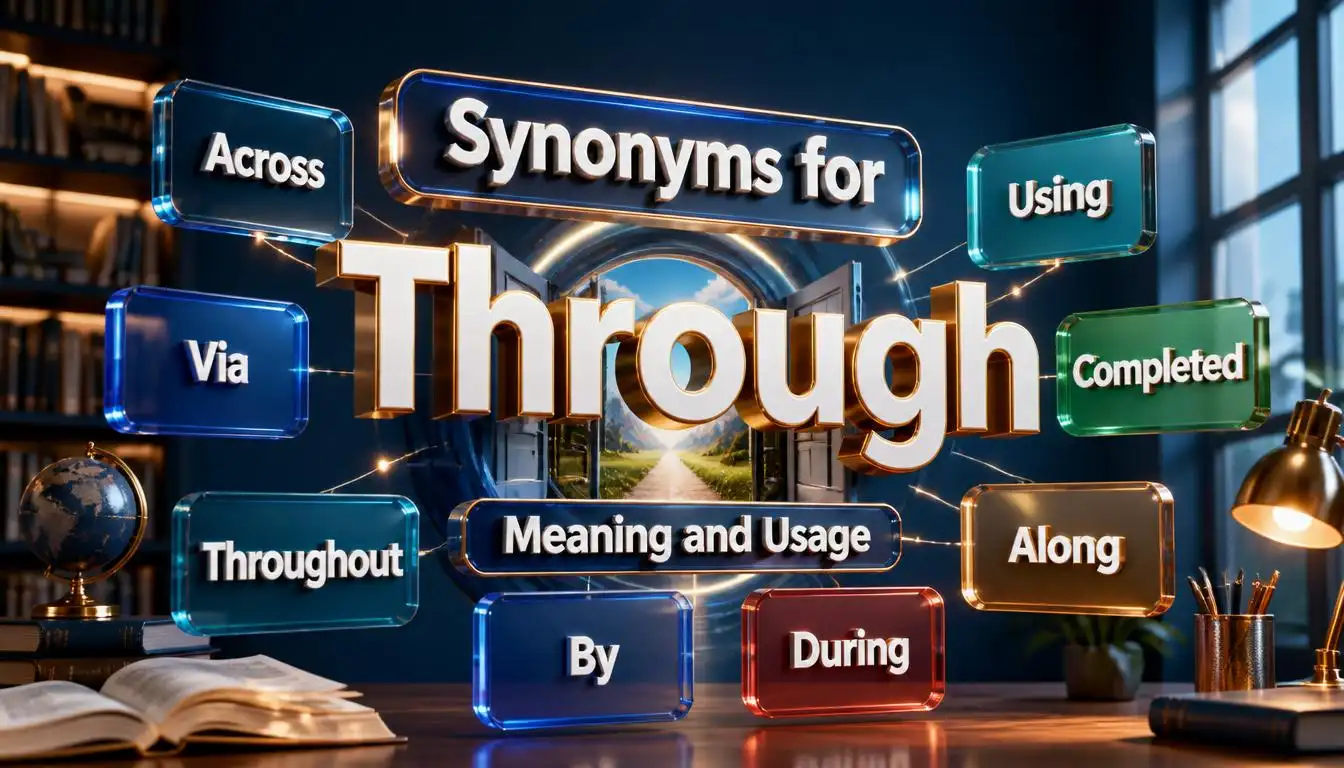
The term through has multiple definitions and therefore its the best definition will dependon the context in which it is used. It can describe the movement, time, completion or a way in which something is done. Alternatives include across, via, by, throughout, during, along and finished. However, they are not always interchangeable.
For example, across is used for movement between sides, via indicates a route or path taken, throughout means an entire time frame or period and by tells you how something happens. Here in “walk through the door,” “door” implies a movement from one place to another, and therefore, “improve through practice” can become “improve by practice” since it indicates the way. The right synonym should be selected according to the meaning of sentence.
Best Synonyms for Through
| Synonym | Relationship | Swap Rating | Formality | Best Used For |
| Across | Near Synonym | Drop-in | Neutral | Movement from one side to another |
| Via | Near Synonym | Drop-in | Formal | Routes and methods |
| Throughout | Near Synonym | Drop-in | Neutral | Entire time periods |
| By | Contextual Alternative | Minor Rewrite | Neutral | Methods and processes |
| During | Contextual Alternative | Minor Rewrite | Neutral | Time-related situations |
| Along | Contextual Alternative | Minor Rewrite | Neutral | Movement following a path |
| Using | Contextual Alternative | Minor Rewrite | Neutral | Tools or methods |
| Completed | Contextual Alternative | New Sentence Needed | Formal | Finished processes |
Quick Facts About Through
Word: Through
Part of Speech:
- Preposition
- Adverb
- Adjective
Simple Meaning:
From one point to another; from beginning to end; by means of something.
Pronunciation:
“throo”
Syllables:
1 syllable
Formality:
Neutral
Difficulty Level:
Beginner
Common Uses:
- Everyday conversation
- Academic writing
- Business communication
- Storytelling
- Technical explanations
Example Sentence:
The students worked through the difficult chapter before the exam.
Common Word Forms:
Through does not have many common derived forms, but it appears in phrases such as:
- throughout
- breakthrough
- go-through (informal noun use)
Meaning and Usage of Through
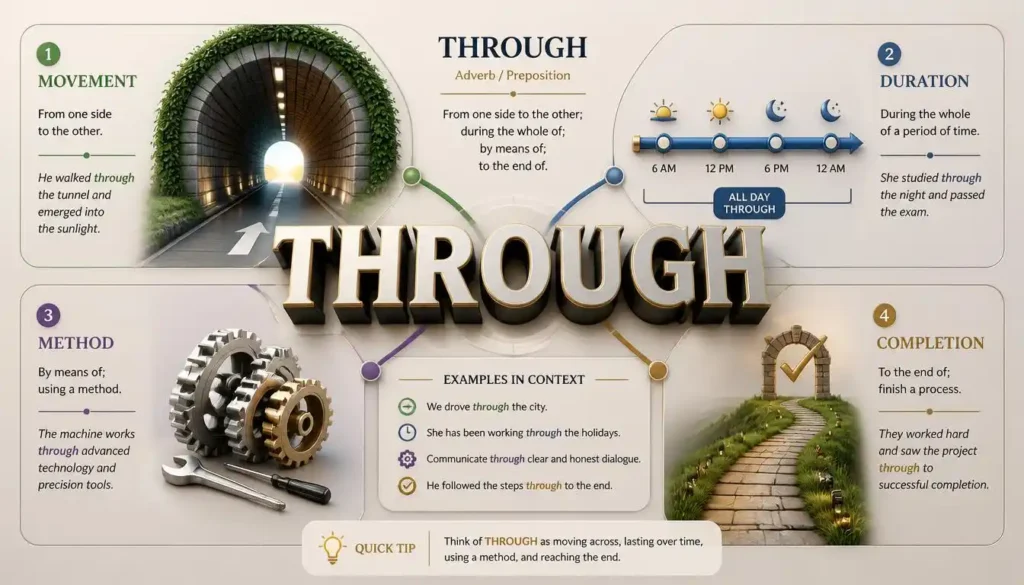
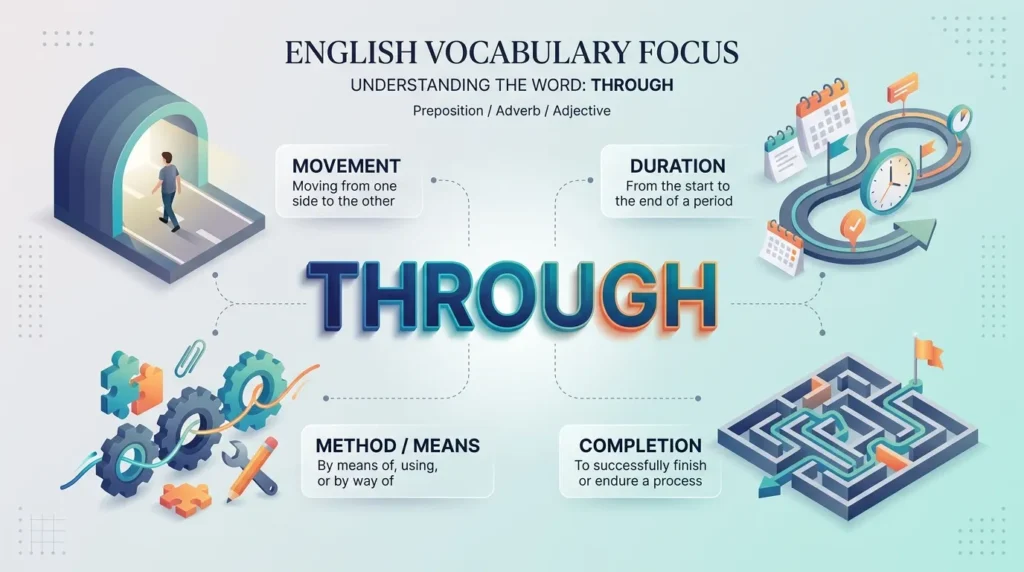
The word through has multiple meanings. These meanings should be separated because the correct synonym changes depending on the sense.
Through Meaning 1: Movement From One Side to Another
In this meaning, through describes passing inside something, entering one side and leaving another side.
Examples:
- The car drove through the tunnel.
- She walked through the crowd.
Possible alternatives:
- across
- along
- via (for routes)
However, these words are not identical.
Through often suggests movement inside something.
Example:
The train went through the tunnel.
Across usually suggests movement over a surface or open space.
Example:
The child ran across the field.
Through Meaning 2: Completing Something
Through can describe reaching the end of an activity, situation, or difficult experience.
Examples:
- I am through with my work.
- She got through the difficult year.
Possible alternatives:
- finished
- completed
- ended
- survived
These replacements depend on the exact sentence.
Example:
“I am through with my homework.”
can become:
“I have finished my homework.”
But:
“I walked through the park.”
cannot become:
“I walked finished the park.”
Through Meaning 3: Using a Method or Means
Through can explain how something happens or the method used to achieve a result.
Examples:
- He learned English through practice.
- The company gained customers through advertising.
Possible alternatives:
- by
- via
- using
- with the help of
Example:
“She improved her skills through training.”
can become:
“She improved her skills by training.”
The meaning remains similar.
Through Meaning 4: During an Entire Period
Through can describe something continuing during a period of time.
Examples:
- It rained through the night.
- The store remained open through the weekend.
Possible alternatives:
- throughout
- during
- over
Example:
“The festival continued through the week.”
can become:
“The festival continued throughout the week.”
The second sentence emphasizes the whole period.
Detailed Synonyms for Through
The following alternatives are grouped according to how closely they match through. Some can replace it directly, while others only work in specific contexts. Always check the meaning of the sentence before making a substitution.
1. Across
Relationship: Near Synonym
Swap Rating: Drop-in
Formality: Neutral
Meaning:
Moving from one side of a place, object, or area to the other side.
Difference:
Across and through are similar when describing movement, but they create different images. Through usually suggests entering and passing inside something, while across usually suggests moving over a surface or open space.
Compare:
- She walked through the forest.
(She moved inside the forest.) - She walked across the field.
(She moved from one side of the field to the other.)
Best Used For:
- Roads
- Fields
- Bridges
- Open spaces
- Distances
Example:
The children ran across the playground before the rain started.
2. Via
Relationship: Near Synonym
Swap Rating: Drop-in
Formality: Formal
Meaning:
Using a particular route, person, system, or method.
Difference:
Via is one of the closest alternatives when through means “by way of.” However, it usually sounds more formal and is common in professional or technical writing.
Compare:
- The message was sent through email.
- The message was sent via email.
Both are correct, but via sounds more concise and formal.
Best Used For:
- Business communication
- Travel routes
- Research writing
- Technology
Example:
The application was submitted via the online portal.
3. Throughout
Relationship: Near Synonym
Swap Rating: Drop-in
Formality: Neutral
Meaning:
During the entire time or in every part of something.
Difference:
Throughout is closely related to through when discussing time or an area. It emphasizes that something continues from beginning to end.
Compare:
- The music played through the night.
- The music played throughout the night.
Both are correct, but throughout gives stronger emphasis to the complete period.
Best Used For:
- Time periods
- Events
- Locations
- Reports
Example:
The company maintained high standards throughout the year.
4. By
Relationship: Contextual Alternative
Swap Rating: Minor Rewrite
Formality: Neutral
Meaning:
Using a method, process, or way of achieving something.
Difference:
By can replace through when explaining a method, but it cannot replace movement meanings.
Compare:
Correct:
- She learned French through practice.
- She learned French by practice.
Incorrect:
- The train moved by the tunnel.
Best Used For:
- Learning methods
- Processes
- Actions
- Achievements
Example:
He improved his writing by reading more books.
5. During
Relationship: Contextual Alternative
Swap Rating: Minor Rewrite
Formality: Neutral
Meaning:
At some time within a particular period.
Difference:
During only refers to time. It cannot replace through when talking about movement or methods.
Compare:
- She stayed awake through the night.
- She stayed awake during the night.
Both work, but through often suggests the entire duration, while during simply identifies the time period.
Best Used For:
- Events
- Seasons
- Experiences
- Time references
Example:
Many students feel nervous during exams.
6. Along
Relationship: Contextual Alternative
Swap Rating: Minor Rewrite
Formality: Neutral
Meaning:
Moving in a line beside or following a route.
Difference:
Along works when through describes movement following a path, but it does not usually mean entering and passing inside something.
Compare:
- We walked through the forest.
- We walked along the forest path.
The second sentence focuses on the route, not the inside area.
Best Used For:
- Roads
- Rivers
- Paths
- Borders
Example:
They walked along the beach at sunset.
7. Using
Relationship: Contextual Alternative
Swap Rating: Minor Rewrite
Formality: Neutral
Meaning:
Doing something with the help of a tool, resource, or method.
Difference:
Using is more direct than through when describing a tool or technique.
Compare:
- The problem was solved through technology.
- The problem was solved using technology.
Both are natural, but the focus changes slightly.
Best Used For:
- Technology
- Tools
- Skills
- Methods
Example:
The artist created the design using digital software.
8. By Means Of
Relationship: Near Synonym
Swap Rating: Minor Rewrite
Formality: Formal
Meaning:
With the help of a particular method or instrument.
Difference:
This phrase is a formal replacement for through when describing a process. It is more common in academic or legal writing.
Example:
- The samples were analyzed through advanced equipment.
- The samples were analyzed by means of advanced equipment.
Best Used For:
- Academic writing
- Scientific writing
- Formal explanations
Example:
The issue was resolved by means of careful planning.
9. Over
Relationship: Contextual Alternative
Swap Rating: Minor Rewrite
Formality: Neutral
Meaning:
During a period of time or from one side above something.
Difference:
Over can replace through in some time-related sentences, but not all.
Compare:
- The company grew through several years.
- The company grew over several years.
The second sentence is more natural.
Best Used For:
- Time periods
- Changes
- Development
Example:
The city changed dramatically over the past decade.
10. Inside
Relationship: Contextual Alternative
Swap Rating: New Sentence Needed
Formality: Neutral
Meaning:
Within the interior of something.
Difference:
Inside describes location, while through describes movement from one side to another.
Compare:
- The dog ran through the house.
- The dog stayed inside the house.
The meanings are different.
Best Used For:
- Locations
- Objects
- Buildings
Example:
The keys were hidden inside the drawer.
11. Past
Relationship: Contextual Alternative
Swap Rating: Minor Rewrite
Formality: Neutral
Meaning:
Moving beyond a person, place, or point.
Difference:
Past focuses on passing beyond something, while through often focuses on passing within something.
Compare:
- She walked past the school.
- She walked through the school.
The first means she went by it; the second means she entered it.
Best Used For:
- Directions
- Movement
- Locations
Example:
The runner moved past the finish line.
12. Completed
Relationship: Contextual Alternative
Swap Rating: New Sentence Needed
Formality: Formal
Meaning:
Finished successfully.
Difference:
Completed can replace through only when through means reaching the end of something.
Example:
- She got through the assignment.
- She completed the assignment.
However:
- Walk through the park.
cannot become:
- Walk completed the park.
Best Used For:
- Tasks
- Projects
- Academic work
Example:
The team completed the research project on time.
13. Finished
Relationship: Contextual Alternative
Swap Rating: New Sentence Needed
Formality: Neutral
Meaning:
Brought to an end.
Difference:
Finished is common in everyday speech and works when through means completion.
Example:
- I am through with my homework.
- I am finished with my homework.
Best Used For:
- Daily conversation
- Tasks
- Activities
Example:
She finished her report before the deadline.
14. Past
Relationship: Near Synonym (Movement Sense)
Swap Rating: Minor Rewrite
Formality: Neutral
Meaning:
Beyond a certain point or location.
Difference:
Past often focuses on leaving something behind, while through focuses on passing within or across something.
Best Used For:
- Directions
- Travel
- Physical movement
Example:
The bus drove past the old station.
15. Finished With
Relationship: Contextual Alternative
Swap Rating: New Sentence Needed
Formality: Informal/Neutral
Meaning:
No longer working on or dealing with something.
Difference:
This phrase replaces through only when it means completed or done with something.
Example:
- I am through with this project.
- I am finished with this project.
Best Used For:
- Conversations
- Personal situations
Example:
I am finished with my assignment now.
Best Synonyms for Through by Context
The best replacement for through depends on the purpose of the sentence. A word that works well in conversation may not be the best choice for academic or professional writing.
Best Words to Use Instead of Through
In Everyday Conversation
| Alternative | Best Used When | Example |
| By | Explaining how something happens | I learned cooking by watching videos. |
| Across | Talking about movement | We walked across the street. |
| During | Talking about a time period | She called me during lunch. |
| Finished | Talking about completion | I am finished with my homework. |
In Formal Writing
Formal writing often benefits from more precise alternatives.
| Alternative | Best Used When | Example |
| Via | Explaining a route or method | The report was submitted via email. |
| Throughout | Showing an entire period | The policy remained effective throughout the year. |
| By means of | Explaining a formal method | The results were obtained by means of testing. |
| Through the use of | Explaining a tool or technique | The issue was solved through the use of technology. |
In Academic Writing
In research and academic contexts, through often describes methods, processes, or analysis.
Better alternatives include:
- via
- by
- using
- by means of
- through the application of
Examples:
Original:
The data was collected through surveys.
Alternatives:
- The data was collected via surveys.
- The data was collected using surveys.
- The data was collected by means of surveys.
The best choice depends on the level of formality.
In Business Communication
Professional writing often uses:
- via
- by
- throughout
- using
Examples:
Through collaboration, the team achieved success.
Possible alternatives:
- By collaboration, the team achieved success.
- Through teamwork, the team achieved success.
- Via effective collaboration, the team achieved success.
For Describing Actions
When describing actions, choose based on the action type:
| Meaning | Better Alternative |
| Moving inside something | Into, across, along |
| Passing from one side to another | Across |
| Using a method | By, via, using |
| Completing something | Finished, completed |
| Experiencing something | During, throughout |
Exact and Near Synonyms: What Is the Difference?
Synonyms are often similar but rarely identical. The word through changes meaning depending on the situation, so its replacements must match the intended sense.
For example:
| Word | Meaning | Difference |
| Through | Passing inside, completing, or using a method | Broad meaning with many uses |
| Across | Moving from one side to another | Usually involves a surface or open space |
| Via | By way of a route or method | More formal and precise |
| Throughout | During the entire time or every part | Focuses on continuation |
A native speaker chooses between these words based on the picture they want to create. Saying “walk through the forest” gives the idea of entering and moving inside it. Saying “walk across the forest” suggests moving from one side to another.
Words Commonly Confused With Through
Across
Difference:
Across is not always a direct synonym of through. It usually describes movement over a surface or distance, while through suggests movement inside or within something.
Correct Examples:
✅ She walked across the road.
✅ She walked through the tunnel.
Throughout
Difference:
Throughout is related to through when discussing time or coverage, but it emphasizes the complete duration or every part.
Correct Examples:
✅ The store was open throughout the day.
✅ The store was open through the day.
Between
Difference:
Between describes a position separating two things. It does not mean passing inside or completing something.
Correct Example:
✅ The house is between two buildings.
Incorrect:
❌ The car drove between the tunnel.
During
Difference:
During only relates to time. It cannot describe movement or a method.
Correct:
✅ She studied during the night.
Incorrect:
❌ She walked during the tunnel.
Antonyms of Through
Because through has multiple meanings, its opposite changes depending on context.
| Antonym | Simple Meaning | Example Sentence |
| Outside | Not inside | The children waited outside the building. |
| Around | Avoiding the inside path | We walked around the lake. |
| Before | Earlier than something | Finish this before dinner. |
| Stop | End movement or action | The machine stopped suddenly. |
| Begin | Start something | The project will begin tomorrow. |
| Incomplete | Not finished | The report is incomplete. |
Common Phrases and Collocations With Through
| Phrase or Collocation | Meaning | Example Sentence |
| Go through | Experience or examine something | She went through a difficult situation. |
| Get through | Successfully finish or survive something | He got through the final exam. |
| Look through | Examine something carefully | I looked through the old files. |
| Work through | Deal with a problem gradually | They worked through their differences. |
| Read through | Read completely | Please read through the document before signing. |
| Follow through | Complete an action or promise | She followed through with her plan. |
| Break through | Make an important discovery or progress | Scientists made a breakthrough. |
Frequently Asked Questions
What does through mean?
Through means moving from one side to another, continuing during an entire period, completing something, or using a method to achieve a result. The exact meaning depends on the sentence.
What is another word for through?
Common alternatives include across, via, by, throughout, during, along, and using. However, each word fits different situations and cannot always replace through.
What is the closest synonym for through?
There is no single closest synonym because through has several meanings. For movement across may work. And for methods, via or by may be better. For time, throughout is often closest.
Is through formal or informal?
Through is a neutral English word. It is commonly used in everyday conversation, academic writing, business communication, and professional documents.
Can I replace through with via?
Sometimes. Via is a good replacement when through means “by way of” or “using a route/method.” It does not replace through when describing physical movement inside something.
What is the difference between through and throughout?
Through can describe movement, completion, methods, or time. Throughout mainly focuses on something continuing during an entire period or existing in every part of an area.
Conclusion
The word through is useful because it can express several ideas, including movement, completion, time, and methods. However, choosing the right synonym improves clarity. Words such as across, via, by, throughout, and during may look similar, but each has its own purpose.
Understanding the context helps writers select the most accurate alternative instead of using a word that only seems similar.

About Sajjad Ahmed
Sajjad Ahmed is the author behind Guest Paster, where he writes about English vocabulary, synonyms, word meanings, and practical word usage.
His content is designed to help readers understand the differences between similar words, discover suitable alternatives, and use English vocabulary more effectively in everyday writing and communication.
Before publishing, Sajjad focuses on presenting word choices in a clear and easy-to-understand format, with relevant meanings, context, and examples where helpful.
Through Guest Paster, his goal is to make vocabulary learning simpler and provide useful language resources for students, writers, English learners, and anyone looking to expand their vocabulary.
Areas of Focus: English Vocabulary • Synonyms • Word Meanings • Word Usage • Language Learning
Author: Sajjad Ahmed
Website: Guest Paster