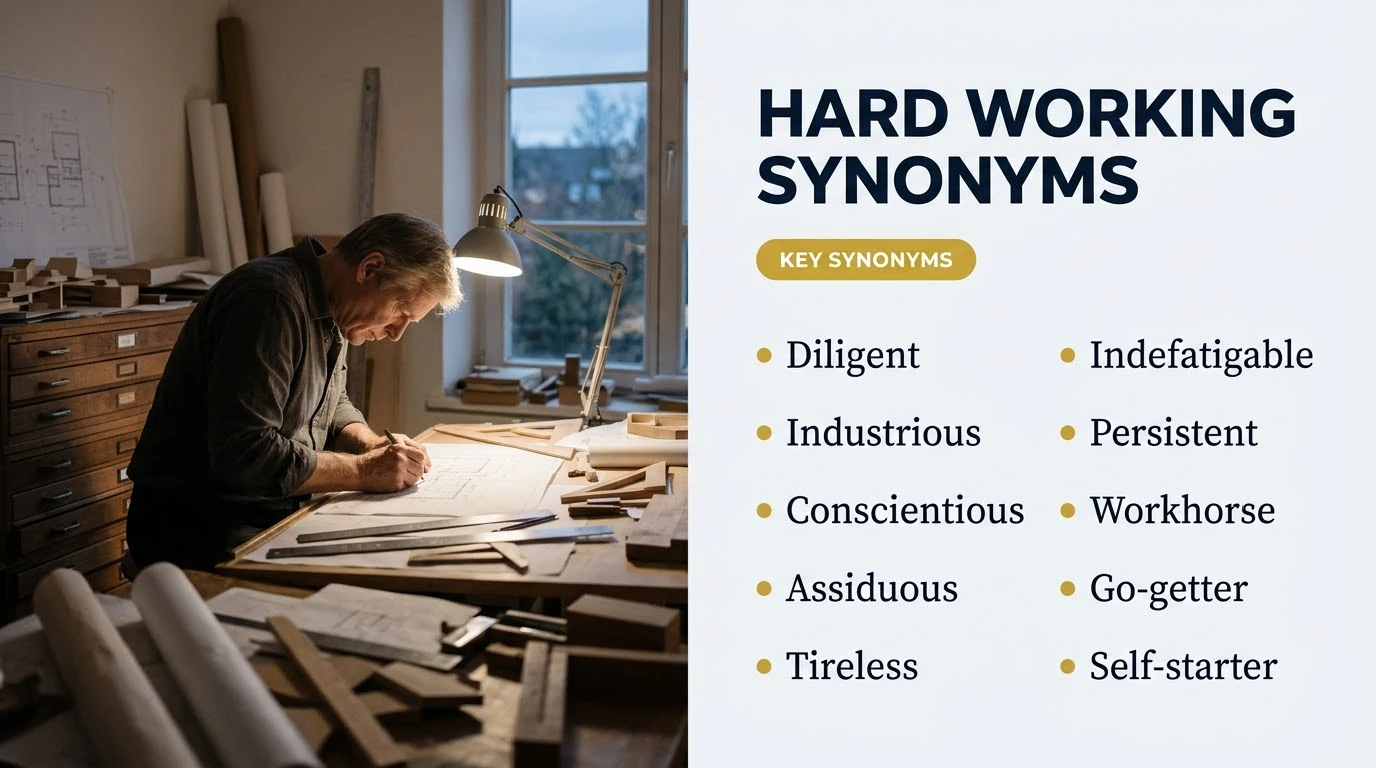
Looking for a hard working synonym? The best choice depends on what you want to express. Diligent is the closest general synonym, describing someone who works with steady effort, care, and reliability. Industrious suits someone who consistently works long and productively, while self-starter or workhorse can describe a highly motivated hard worker.
Because hard-working can suggest effort, persistence, productivity, or reliability, not every synonym fits every sentence. This guide covers the best synonyms for hard working, their meanings, and examples to help you choose the right word for any context.
Another Word for Hard Working at a Glance
| # | Synonym | Meaning Difference |
|---|---|---|
| 1 | Diligent | Steady, careful effort over time; the closest all-round match |
| 2 | Industrious | Constantly busy and productive; stresses output |
| 3 | Conscientious | Works thoroughly and feels a duty to do the job right |
| 4 | Assiduous | Formal word for constant, careful attention to a task |
| 5 | Tireless | Keeps going without seeming to need rest |
| 6 | Indefatigable | Very formal tireless; used for campaigners and researchers |
| 7 | Persistent | Keeps going despite obstacles; stresses not giving up |
| 8 | Workhorse | A person who does heavy, steady work without complaint |
| 9 | Go-getter | Ambitious and energetic; chases results and promotions |
| 10 | Self-starter | Starts work without being told; the resume favorite |
Quick Facts About “Hard Working”
- Part of speech: an adjective (a hard-working team). For the person as a noun, English uses workhorse, self-starter, or go-getter.
- Three things it praises: (1) effort, (2) stamina over time, (3) reliability. Every synonym in this guide leans on a different one of the three.
- Register: neutral and warm. Hard-working suits essays, references, news, and everyday speech alike.
- Spelling: both hardworking (solid) and hard-working (hyphenated) are standard in US English; see the FAQ for the practical rule.
The Closest Synonym: Diligent
Diligent is the closest synonym for hard-working because it matches the full package: effort, care, and staying power. A diligent nurse checks every chart twice. Diligent student revises a little every day instead of cramming. A diligent clerk catches the error everyone else scrolled past. In each case the praise is not about one heroic burst of effort; it is about work done properly, again and again.
The two words are still not identical. Hard-working is the warmer, plainer compliment, the one people use about parents, farmers, and teammates. Diligent sounds a touch more formal and adds a note of carefulness: a person can be hard-working and sloppy, rushing through tasks, but diligent rules the sloppiness out. If your sentence is about effort plus accuracy, diligent is not just the closest swap, it is the more precise one.
One grammar note before we go further: diligent is an adjective only, just like hard-working. If your sentence needs a noun for the person, neither word works, and you need Group 3 below, where workhorse and self-starter live.
Where “Hard Working” Comes From
The phrase is a straightforward compound: hard plus working. According to Etymonline, the compound adjective hard-working is recorded from 1774, built from the adverb hard in its old sense of “with energy and effort” (the same hard in work hard and try hard) joined to the present participle of work. English has always liked this pattern: compare hard-headed, hard-hearted, and hard-wearing.
The closest synonym has a warmer origin than most people expect. Diligent reached English through Old French from the Latin verb diligere, which meant “to value highly, to take delight in” (Etymonline). In other words, the diligent person was originally someone who loved the task enough to give it care. That is why diligent still carries a hint of attention and pleasure in the work, where hard-working stresses the sweat.
Industrious comes from the Latin noun industria, “diligence, activity” (Etymonline). Keep that root in mind, because it explains the most common confusion in this whole area: industrial (about factories and industry) and industrious (about a busy, productive person) share ancient roots but parted ways in meaning centuries ago. There is a full warning about that pair in the Confused Words section below.
Can You Swap Them Freely?
In short: only when the sentence is praising the same quality. Test every swap by asking what exactly is being praised: the effort, the output, the stamina, or the reliability.
- ✔ “She is a diligent bookkeeper; nothing slips past her.” (effort plus care, swap works)
- ✔ “The night shift is full of tireless nurses.” (stamina, swap works)
- ✘ “He is a real go-getter, he quietly double-checks every invoice.” (go-getter means ambitious chasing, not quiet care; say diligent)
- ✘ “Our most industrious machine runs all night.” (industrious describes people, not equipment; say hard-working or reliable)
There is also a shape test. Adjectives from Groups 1 and 2 swap for hard-working directly: “a tireless volunteer” works exactly like “a hard-working volunteer”. The person words in Group 3 cannot do that job; “a workhorse volunteer” changes the sentence structure, because workhorse is a noun. Match the shape first, then match the meaning.
Hard Working Synonyms in Detail
Group 1: Everyday Adjectives (Effort With Care)
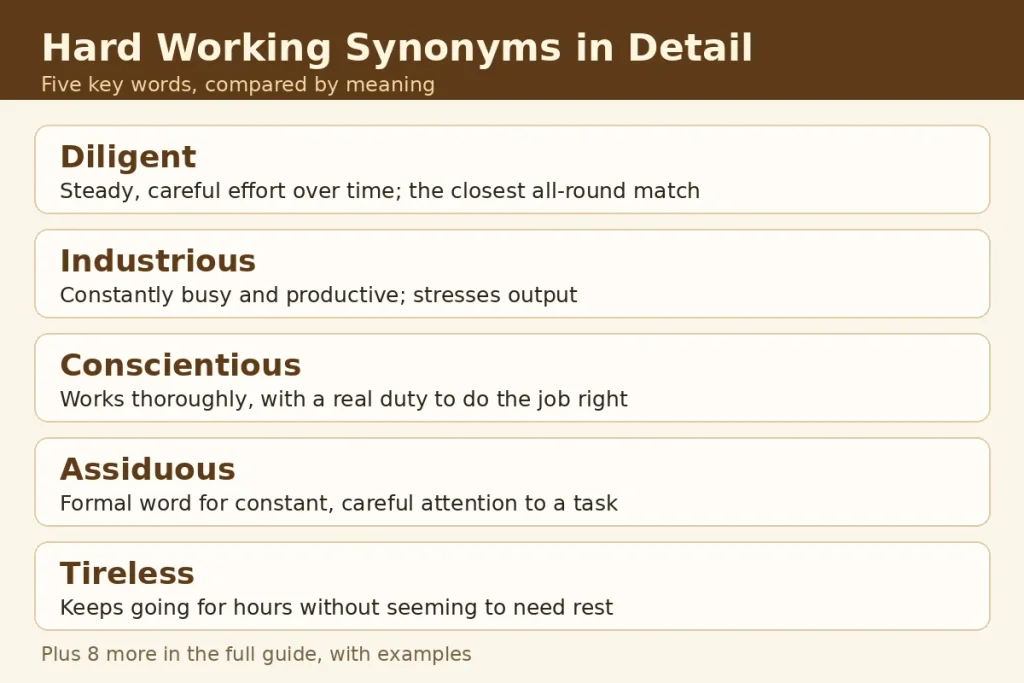
1. Diligent
- Meaning: Working steadily and carefully over a long period, with real attention to doing the job well.
- Difference: The closest all-round match for hard-working, with an extra note of care and accuracy built in.
- Best used for: Essays, reports, references, and performance reviews.
- Formality: Neutral to formal · CEFR: B2 · Frequency: Common
- Example (Formal): “The diligent researcher cross-checked every source before publishing.”
- Example (Everyday): “He is a diligent saver who tracks every dollar.”
- When NOT to use it: For one short burst of effort. Diligence is a habit, not a sprint.
2. Industrious
- Meaning: Constantly busy and productive; always getting things done.
- Difference: Stresses output and activity more than care. An industrious person produces a lot; a diligent person produces it carefully.
- Best used for: Describing busy teams, bees, workshops, and anyone with visible results.
- Formality: Neutral to formal · CEFR: B2 · Frequency: Common
- Example (Work): “The industrious crew finished the harvest two days early.”
- Example (Everyday): “My grandmother was industrious; her kitchen never sat idle.”
- When NOT to use it: About machines, software, or systems. It praises people and, by extension, animals like bees.
3. Conscientious
- Meaning: Working thoroughly because you feel a duty to do the job right.
- Difference: Adds conscience to the effort. The conscientious worker is not just busy; cutting corners would bother them.
- Best used for: Job references, healthcare, teaching, and any role built on trust.
- Formality: Formal · CEFR: C1 · Frequency: Common
- Example (Work): “A conscientious pharmacist questions any prescription that looks off.”
- Example (Everyday): “She is too conscientious to leave a group project half done.”
- When NOT to use it: When the point is speed or volume. Conscientious praises thoroughness, not pace.
4. Assiduous
- Meaning: Showing constant, careful attention to a task over time.
- Difference: A more formal, bookish cousin of diligent, often used about scholars, collectors, and diarists.
- Best used for: Academic and literary writing, formal profiles.
- Formality: Formal · CEFR: C1 · Frequency: Uncommon
- Example (Formal): “The assiduous diarist recorded the weather every day for forty years.”
- Example (Everyday): “He is assiduous about watering the seedlings, morning and night.”
- When NOT to use it: In casual speech or on a resume. Most readers find it stiff, and some will not know it.
5. Sedulous
- Meaning: Diligent and persevering, with careful attention to the task in hand.
- Difference: The rarest word in this group. It passes the substitution test (“a sedulous editor” really does mean a hard-working one), but many readers meet it for the first time in your sentence.
- Best used for: Deliberately formal or literary writing where a precise, uncommon word is the point.
- Formality: Very formal · CEFR: C2 · Frequency: Rare
- Example (Formal): “Sedulous note-taking turned her lectures into a publishable book.”
- Example (Everyday): “He kept a sedulous record of every repair the old car needed.”
- When NOT to use it: Anywhere clarity matters more than flavor, including resumes, reports, and school essays.
Group 2: Effort and Stamina (Keeping Going)
6. Tireless
- Meaning: Working for long stretches without appearing to get tired or lose energy.
- Difference: Praises stamina above everything. A tireless campaigner may be careless with details; the word does not promise care, only energy.
- Best used for: Volunteers, campaigners, caregivers, coaches, and community organizers.
- Formality: Neutral · CEFR: B2 · Frequency: Common
- Example (Work): “The tireless volunteer restocked the food bank shelves every weekend.”
- Example (Everyday): “Dad is tireless; he painted the whole fence in one day.”
- When NOT to use it: For careful, detail-heavy work. Use diligent when accuracy is the praise.
7. Indefatigable
- Meaning: Impossible to tire out; never giving up or slowing down.
- Difference: The grand, formal version of tireless. It praises almost superhuman persistence and is often used with admiration or gentle humor.
- Best used for: Speeches, biographies, and writing about campaigners, explorers, and advocates.
- Formality: Very formal · CEFR: C2 · Frequency: Uncommon
- Example (Formal): “The indefatigable advocate petitioned the council for a decade until the law changed.”
- Example (Everyday): “Our indefatigable coach somehow runs drills, drives the bus, and still makes practice fun.”
- When NOT to use it: In plain workplace writing. It sounds like a speech, and it is easy to misspell.
8. Unflagging
- Meaning: Not weakening or fading; staying at the same strength over time.
- Difference: Usually describes the quality, not the person directly: unflagging energy, unflagging enthusiasm, unflagging support. The focus is that nothing has dropped.
- Best used for: Reports, journalism, and formal praise of long projects.
- Formality: Formal · CEFR: C1 · Frequency: Uncommon
- Example (Work): “Her unflagging attention kept the archive project error-free for years.”
- Example (Everyday): “His unflagging good humor makes night shifts bearable.”
- When NOT to use it: As a direct swap in “a hard-working employee.” You cannot say “an unflagging employee” and mean the same thing.
9. Persistent
- Meaning: Continuing firmly despite difficulty, opposition, or repeated failure.
- Difference: Stresses not quitting rather than working hard in general. A persistent salesperson knocks again; a diligent one prepares better notes.
- Best used for: Sales, job hunting, research, training, and any story with obstacles.
- Formality: Neutral · CEFR: B2 · Frequency: Very common
- Example (Work): “Persistent follow-up emails finally landed the meeting.”
- Example (Everyday): “She was persistent with her piano practice and passed the exam.”
- When NOT to use it: It can sound negative (a persistent problem, a persistent caller). Check the tone of the whole sentence.
Group 3: Describing a Person (The Hard Worker Angle)
10. Workhorse
- Meaning: A person who does a great deal of steady, heavy work reliably and without complaint.
- Difference: A noun, not an adjective, and slightly informal. It praises dependability and volume, the player every team leans on.
- Best used for: Sports writing, workplaces, farms, and family praise.
- Formality: Informal to neutral · CEFR: B2 · Frequency: Common
- Example (Work): “Every warehouse has a workhorse like Marta, who trains every new hire.”
- Example (Everyday): “Grandpa was the workhorse of the family farm for fifty years.”
- When NOT to use it: In formal references or anywhere the person might hear it as “only good for labor.” Tone matters.
11. Go-Getter
- Meaning: An energetic, ambitious person who actively chases success.
- Difference: A noun for ambition, not diligence. A go-getter wants the promotion, the client, the win; a diligent person may want none of those things.
- Best used for: Business profiles, sales teams, and startup writing.
- Formality: Informal · CEFR: B2 · Frequency: Common
- Example (Work): “The ad asked for a go-getter who could build a client list from zero.”
- Example (Everyday): “She is a go-getter; she started her bakery while working nights.”
- When NOT to use it: For quiet, careful, behind-the-scenes effort. That is diligent territory, and go-getter changes the story.
12. Self-Starter
- Meaning: A person who begins work on their own initiative, without needing instructions or supervision.
- Difference: Praises initiative rather than effort itself. A self-starter might still need to build a skill before the work is good; a hard worker may have the skill and the stamina both.
- Best used for: Resumes, cover letters, and job descriptions, where it is the standard term.
- Formality: Neutral, businesslike · CEFR: B2 · Frequency: Common
- Example (Work): “Remote roles suit self-starters who plan their own day.”
- Example (Everyday): “He is a self-starter who taught himself bookkeeping before applying.”
- When NOT to use it: About children or family members in casual praise. It belongs to the workplace register.
13. High Achiever
- Meaning: A person who consistently reaches a high standard of success.
- Difference: Praises results, not effort. Some high achievers work smart rather than hard, and some hard workers never get the results, so the two labels can come apart.
- Best used for: School and career writing, awards, and profiles.
- Formality: Neutral · CEFR: B2 · Frequency: Common
- Example (Work): “The scholarship went to a high achiever from a small rural school.”
- Example (Everyday): “Not every high achiever is happy, but she seems to be both.”
- When NOT to use it: When the sentence is really about effort. Praising an unseen grind with a results word misleads the reader.
Words Often Confused with Hard Working
Hardly working. This reversed phrase is a joke, and it means the opposite: someone who is barely working at all. (“Nice of you to join us, hardly working as usual.”) Never use it as a synonym, and never write it by accident in a reference or review; it turns praise into an insult.
Industrial vs. industrious. Industrial describes factories, manufacturing, and industry: “an industrial estate”, “industrial output”. Industrious describes a busy, productive person: “an industrious student”. Swapping them produces sentences like “an industrial student”, which reads as either a joke or an error. The shared Latin root (industria, diligence) is the reason people mix them up, and the reason the mix-up is worth avoiding: today the two words have almost nothing to do with each other.
Hard work (noun phrase) vs. hard-working (adjective). Hard work names the effort itself: “Hard work pays off”, “the project took months of hard work”. Hard-working describes a person or group: “a hard-working team”. The trap: saying “she is hard work” does not mean she works hard. In everyday speech it means she is difficult to deal with. Keep the hyphenated adjective for people and the two-word noun phrase for the effort.
Which Synonym Should I Choose?
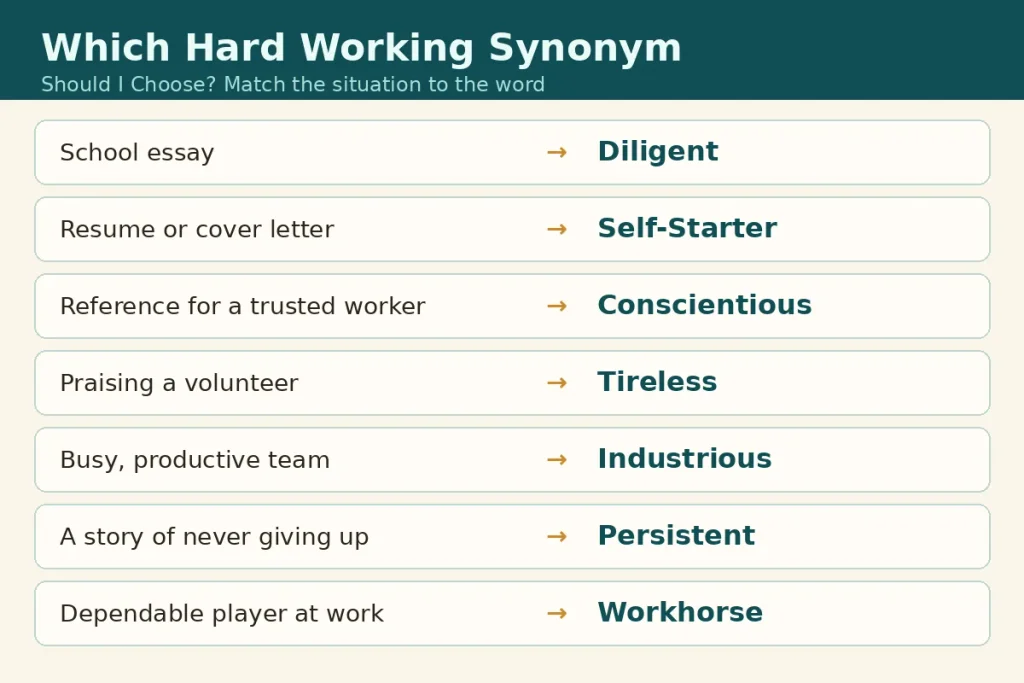
| Your Situation | Best Choice | Why |
|---|---|---|
| School essay about a character or historical figure | Diligent | Formal enough for essays, and it praises care as well as effort |
| Resume or cover letter | Self-starter (or diligent) | Self-starter is the term recruiters scan for; diligent suits the summary line |
| Job reference for a careful employee | Conscientious | It tells the reader the person can be trusted to do things right |
| Praising a volunteer or caregiver | Tireless | Stamina and generosity are the praise here, not output |
| Describing a busy, productive team | Industrious | It stresses visible output across a whole group |
| Telling a story about someone who never quits | Persistent | It makes the obstacle part of the compliment |
| Sports report about a dependable player | Workhorse | The standard sports word for steady, heavy contribution |
| Everyday speech about family or friends | Hard-working itself | The plain word is warmest; synonyms can sound like a report card |
Two of these choices deserve one extra sentence. In a reference letter, the word carries weight beyond the sentence: a manager called conscientious is being trusted, and a team praised for how well it pulls together may deserve a look at teamwork synonyms too, since shared effort is a different compliment from individual effort. And when the sentence is really about how a group stays in step on a shared schedule, coordination words fit better than any word on this page. Choose the compliment your sentence is actually paying.
Antonyms of Hard Working
The direct opposite is lazy, the everyday word for someone who avoids effort. Around it sits a small family, each with its own flavor:
- Idle: not working or active at the moment; can be neutral about machines and people between tasks.
- Indolent: formal word for habitually avoiding activity; common in older writing and medical contexts.
- Slothful: literary and slightly old-fashioned; names laziness as a character trait (from the deadly sin, sloth).
- Slack: careless about effort and standards; a slack worker cuts corners rather than refusing outright.
- Unmotivated: the modern workplace word; it blames drive, not character, and is gentler in reports.
- Lethargic: sluggish and low on energy, often for physical reasons; it invites sympathy more than blame.
Common Collocations with Hard Working
Hard-working pairs most naturally with people and the groups they form: a hard-working employee, a hard-working team, hard-working staff, a hard-working nurse, hard-working farmers, a hard-working mother of two (a staple of news profiles), and hard-working students.
The phrase that carries the same idea as a noun is work ethic: “a strong work ethic” is what most people mean when they praise someone’s attitude rather than their hours. Verbs that keep company with the adjective are be known as (“she is known as a hard-working lawyer”), describe someone as, and regard someone as.
You will rarely see hard-working with objects or abstract nouns; “a hard-working machine” is only possible as a joke or an advertisement.
Practice Sentences
Pick the better word in each pair, then check the note.
- “The _____ auditor found three errors that everyone else had missed.” (diligent: care and accuracy are the point)
- “Our _____ night porter has not missed a shift in six years.” (tireless or workhorse: stamina and reliability)
- “The job ad seeks a _____ who can manage projects without supervision.” (self-starter: initiative is the requirement)
- “Bees are famously _____ insects.” (industrious: the classic collocation, and a person word borrowed for animals)
- “After four rejections, the _____ applicant rewrote her portfolio and applied again.” (persistent: the obstacle makes the word)
Frequently Asked Questions
What is the best synonym for hard working?
Diligent is the best all-round synonym, because it covers steady effort, care, and reliability together. Choose industrious when output matters most, tireless when stamina matters most, and conscientious when doing the job properly matters most.
Is it “hardworking” or “hard-working”?
Both are standard, and this is a genuine spelling split. Major US dictionaries, including Merriam-Webster, list the solid form hardworking as the headword, while the hyphenated hard-working remains very common and is never wrong, especially before a noun (“a hard-working nurse”). The practical rule: pick one form and stay consistent within a document. Before a noun, the hyphen helps readers; at the end of a sentence (“she is hardworking”), the solid form is the more common American choice.
What do you call a hard-working person?
The common nouns are workhorse for steady, heavy contribution, self-starter for someone who needs no supervision, and go-getter for someone ambitious. There is no single everyday noun that means exactly “hard worker”; English usually reaches for one of these three depending on the quality being praised.
What is the difference between diligent and industrious?
Diligent praises care: steady effort with attention to doing things well. Industrious praises activity: constant busyness and visible output. A diligent editor catches every error slowly; an industrious editor clears a tall stack of pages. Many good workers are both, but the words point at different virtues.
Which word should I use on a resume instead of hard-working?
Self-starter is the strongest resume swap, because it claims initiative, not just effort, and it is a term recruiters actively scan for. Diligent works well in a summary line (“diligent analyst with five years of experience”). Whichever you choose, back it with a result; a bare claim of hard work, in any wording, is the weakest line on most resumes.
What is the opposite of hard working?
The plain opposite is lazy. Softer or more specific options are idle (temporarily inactive), unmotivated (the gentle workplace term), and slack (careless about standards). Formal writing may use indolent.
Conclusion
Hard-working is a generous compliment, and its synonyms let you aim that compliment precisely. Reach for diligent when care travels with the effort, industrious for output, tireless for stamina, and workhorse or self-starter when the sentence needs a person, not an adjective.
Keep the joke phrase hardly working out of your references, keep industrial for factories, and your praise will say exactly what you meant it to say.

About Sajjad Ahmed
Sajjad Ahmed is the author behind Guest Paster, where he writes about English vocabulary, synonyms, word meanings, and practical word usage.
His content is designed to help readers understand the differences between similar words, discover suitable alternatives, and use English vocabulary more effectively in everyday writing and communication.
Before publishing, Sajjad focuses on presenting word choices in a clear and easy-to-understand format, with relevant meanings, context, and examples where helpful.
Through Guest Paster, his goal is to make vocabulary learning simpler and provide useful language resources for students, writers, English learners, and anyone looking to expand their vocabulary.
Areas of Focus: English Vocabulary • Synonyms • Word Meanings • Word Usage • Language Learning
Author: Sajjad Ahmed
Website: Guest Paster