
Promote is a versatile verb that can mean help something progress, raise someone to a higher rank, or make a product, service, idea, or event better known.
Because these meanings are different, no single synonym for promote works in every sentence.
For general progress, advance is one of the strongest all-purpose alternatives. For gradual development, foster is often more precise. In marketing, market, advertise, or publicize may be better choices. When talking about rank or status, elevate or advance may fit.
The key is simple: first identify what promote means in your sentence, then choose a synonym that matches the context, tone, and level of formality.
Top 10 Other Words For Promote
| # | Synonym | Meaning Difference |
|---|---|---|
| 1 | Advance | Move something forward toward a goal |
| 2 | Further | Help something continue to progress |
| 3 | Foster | Encourage gradual development |
| 4 | Encourage | Give support or motivation |
| 5 | Support | Help something succeed or continue |
| 6 | Champion | Actively support a cause or idea |
| 7 | Boost | Increase strength, success, or effectiveness |
| 8 | Elevate | Raise rank, status, or importance |
| 9 | Advertise | Publicize something to attract attention or customers |
| 10 | Publicize | Make something widely known |
Quick Facts About Promote
Part of speech: Verb
Simple meaning: To advance, support, raise, or publicize.
US pronunciation: /prəˈmoʊt/
UK pronunciation: /prəˈməʊt/
Syllables: 2 — pro-mote
Word forms: promotes, promoted, promoting
Related words: promotion, promoter, promotional
Formality: Neutral
Closest general synonym: Advance
Commonly used for: Progress, support, careers, rank, products, ideas, causes, and publicity.
What Is the Closest Synonym for Promote?
Advance is one of the closest general synonyms for promote when the intended meaning is to help something move forward, develop, or make progress.
For example:
“The program promotes scientific research.”
“The program advances scientific research.”
Both sentences communicate the idea of helping scientific research progress.
Advance is particularly useful in academic, professional, policy, and formal writing because it expresses forward movement without automatically suggesting advertising or sales.
However, advance is not a universal replacement for promote.
A company may promote a new product, but it would usually market or advertise that product rather than advance it.
Similarly, an employee is normally promoted to manager, while advanced to manager is less common and depends on context.
Therefore, advance is a strong general alternative, but the intended meaning of promote should always determine the final word choice.
Word Origin and Etymology of Promote
The word promote entered English during the late Middle English period.
It ultimately comes from the Latin word promovere, formed from pro- meaning “forward” and movere meaning “to move.”
Its underlying meaning is therefore essentially “to move forward.”
Early uses of promote were associated with advancing someone to a higher office, position, or rank. Over time, the meaning expanded to include helping causes, activities, ideas, and conditions progress.
Commercial and publicity-related uses developed later.
This history helps explain why the modern meanings of promote can appear so different. Whether someone is promoted at work, a program promotes development, or a company promotes a product, the underlying concept is still connected with moving something forward.
Can Synonyms for Promote Be Used Interchangeably?
Sometimes, but not always.
Most synonyms for promote overlap with only one of its meanings.
For example, advance, further, and foster can all replace promote in certain sentences about development or progress, but each adds a slightly different meaning.
Advance emphasizes forward movement.
Further emphasizes helping existing progress continue.
Foster suggests gradual and sustained development.
Marketing words form another group.
Advertise, market, and publicize can replace promote when publicity is involved, but they normally cannot replace it when discussing career advancement or personal development.
Likewise, elevate may replace promote when someone moves to a higher status, but it cannot naturally replace promote in a phrase such as “promote a sale.”
The safest rule is:
Synonyms for promote are interchangeable only when they belong to the same meaning and context.
Three Main Meanings of Promote
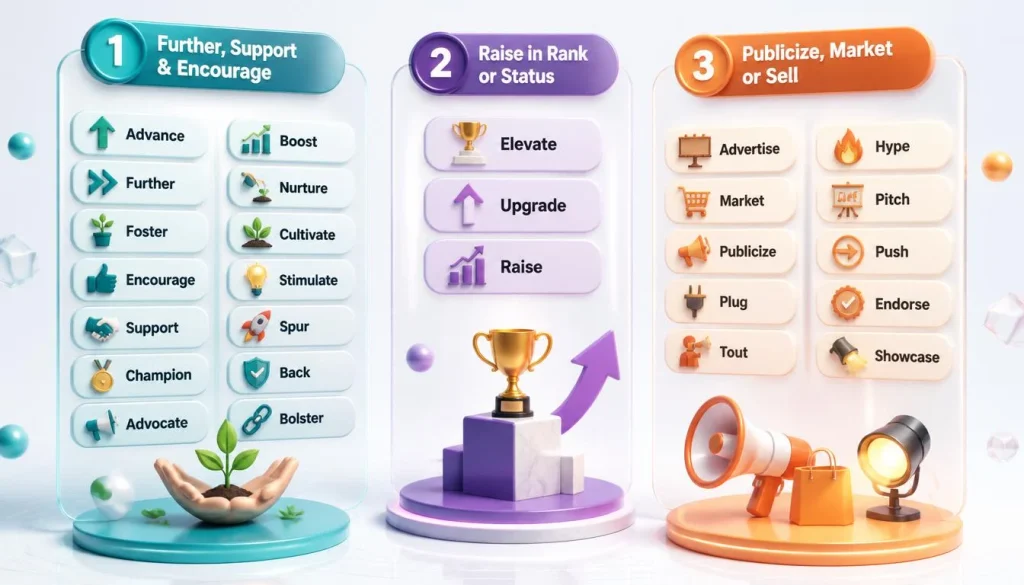
Promote has three major meanings, and each meaning has its own group of synonyms.
Meaning 1: To Further, Support, or Encourage
This meaning appears in expressions such as:
- promote growth
- promote health
- promote understanding
- promote inclusivity
- promote awareness
- promote education
- promote development
- promote the general welfare
Useful synonyms include:
advance, further, foster, encourage, support, champion, advocate, boost, nurture, cultivate, stimulate, spur, back, and bolster.
Meaning 2: To Raise Someone in Rank or Status
This meaning is common in workplace, military, organizational, and institutional contexts.
Useful alternatives include:
elevate, advance, raise, and, in some contexts, upgrade.
Meaning 3: To Publicize, Market, or Sell
This meaning applies when promoting products, services, businesses, books, events, films, campaigns, or online content.
Useful alternatives include:
advertise, market, publicize, plug, tout, hype, pitch, push, endorse, and showcase.
Detailed Synonyms for Promote with Meanings and Examples
1. Advance
Meaning: To move an activity, cause, field, or objective toward a more developed state.
Difference from promote: Advance focuses specifically on forward progress rather than publicity.
Best used for: Research, policy, careers, knowledge, and objectives.
Formality: Neutral
CEFR level: B2
Frequency: Very common
Examples:
The fellowship will advance research into renewable materials.
The partnership was created to advance shared business goals.
When not to use it: Avoid advance when promote specifically means advertising a product or event.
2. Further
Meaning: To help something make additional progress.
Difference from promote: Further often suggests continuing or extending an existing objective.
Best used for: Research, careers, causes, negotiations, and policy.
Formality: Formal
CEFR level: C1
Frequency: Common
Examples:
The scholarship helped her further her career in engineering.
The agreement is intended to further cooperation between the institutions.
When not to use it: Avoid it for ordinary product advertising or casual publicity.
3. Foster
Meaning: To create conditions in which something can develop gradually.
Difference from promote: Foster emphasizes patient and sustained development rather than an immediate push.
Best used for: Understanding, inclusivity, creativity, cooperation, and workplace culture.
Formality: Neutral to formal
CEFR level: C1
Frequency: Common
Examples:
The exchange program fosters understanding between students from different backgrounds.
Regular feedback can foster a healthier workplace culture.
When not to use it: Do not use foster for advertising or raising someone in rank.
4. Encourage
Meaning: To give support, confidence, or favorable conditions for an action or behavior.
Difference from promote: Encourage places more emphasis on motivation and willingness.
Best used for: Behavior, participation, learning, and healthy habits.
Formality: Neutral
CEFR level: B1
Frequency: Very common
Examples:
The city encourages residents to use public transportation.
Teachers should encourage students to ask difficult questions.
When not to use it: Encourage cannot normally replace promote when the meaning is to advertise or raise someone in rank.
5. Support
Meaning: To provide assistance, resources, or approval that helps something continue or succeed.
Difference from promote: Support is generally broader and may sound less active than promote.
Best used for: Causes, policies, programs, welfare, and development.
Formality: Neutral
CEFR level: B1
Frequency: Very common
Examples:
The fund supports small businesses in rural areas.
These measures support healthier eating among schoolchildren.
When not to use it: Avoid it when active publicity or career advancement is intended.
6. Champion
Meaning: To actively and visibly support a cause, idea, person, or initiative.
Difference from promote: Champion suggests stronger personal commitment and energetic support.
Best used for: Causes, reforms, innovation, and initiatives.
Formality: Neutral to formal
CEFR level: C1
Frequency: Common
Examples:
The director championed flexible working across the organization.
Local volunteers championed the restoration project for years.
When not to use it: Avoid it for routine advertising or formal rank changes.
7. Advocate
Meaning: To publicly argue or speak in favor of a cause, policy, person, or course of action.
Difference from promote: Advocate specifically involves active support or argument.
Best used for: Policy, law, education, health, and social causes.
Formality: Formal
CEFR level: C1
Frequency: Common
Examples:
Physicians advocate early screening for high-risk patients.
The organization advocates greater access to education.
When not to use it: Do not use advocate merely to mean commercial advertising.
8. Boost
Meaning: To increase the strength, level, effectiveness, or success of something.
Difference from promote: Boost emphasizes the increase produced rather than the process of supporting it.
Best used for: Sales, confidence, performance, visibility, and growth.
Formality: Neutral
CEFR level: B2
Frequency: Very common
Examples:
The weekend campaign boosted ticket sales.
Mentoring can boost a new employee’s confidence.
When not to use it: Do not use boost for formal rank advancement.
9. Nurture
Meaning: To give sustained care or encouragement that helps something develop.
Difference from promote: Nurture sounds more gradual, protective, and personal.
Best used for: Talent, relationships, creativity, and early-stage projects.
Formality: Neutral
CEFR level: C1
Frequency: Common
Examples:
The academy nurtures young musical talent.
Strong managers nurture promising ideas before judging them.
When not to use it: Avoid it for publicity campaigns or job promotions.
10. Cultivate
Meaning: To deliberately develop a quality, relationship, habit, or ability over time.
Difference from promote: Cultivate implies careful and sustained development.
Best used for: Skills, relationships, trust, habits, and reputation.
Formality: Neutral to formal
CEFR level: C1
Frequency: Common
Examples:
The workshops help students cultivate critical-thinking skills.
She spent years cultivating relationships with international clients.
When not to use it: It is normally unsuitable for straightforward advertising.
11. Stimulate
Meaning: To cause an activity, process, interest, or system to become more active.
Difference from promote: Stimulate focuses on triggering increased activity.
Best used for: Growth, demand, economies, research, and discussion.
Formality: Formal
CEFR level: C1
Frequency: Common
Examples:
Lower borrowing costs may stimulate investment.
The opening question stimulated a lively discussion.
When not to use it: Do not use it for rank advancement or ordinary advertising.
12. Spur
Meaning: To prompt or drive something toward action or faster progress.
Difference from promote: Spur suggests a catalyst or sudden push.
Best used for: Innovation, investment, reform, and action.
Formality: Neutral to formal
CEFR level: C1
Frequency: Common
Examples:
Rising demand spurred investment in new production facilities.
The discovery spurred further research into the disease.
When not to use it: Avoid it when the intended meaning is publicity.
13. Back
Meaning: To give support or approval to a person, proposal, project, or cause.
Difference from promote: Back suggests standing behind something rather than actively moving it forward.
Best used for: Projects, proposals, campaigns, and business ideas.
Formality: Neutral
CEFR level: B2
Frequency: Common
Examples:
Several investors backed the project during its first funding round.
Most department heads backed the revised training plan.
When not to use it: It may sound too conversational for highly formal writing.
14. Bolster
Meaning: To strengthen or reinforce something so it becomes more secure or effective.
Difference from promote: Bolster focuses on strengthening something that already exists.
Best used for: Confidence, credibility, economies, arguments, and institutions.
Formality: Formal
CEFR level: C1
Frequency: Common
Examples:
The new evidence bolstered the case for additional research.
Strong export demand bolstered manufacturing activity.
When not to use it: Avoid it for product publicity or rank advancement.
Synonyms for Promote Meaning “Raise in Rank”
15. Elevate
Meaning: To raise someone or something to a higher position, status, or level.
Difference from promote: Elevate sounds more formal and may imply increased prestige or importance.
Best used for: Senior positions, status, and ceremonial contexts.
Formality: Formal
CEFR level: C1
Frequency: Common
Examples:
She was elevated to partner after years of strong performance.
The appointment elevated him to a senior leadership position.
When not to use it: Avoid it for routine advertising.
16. Upgrade
Meaning: To move something, and occasionally someone, to a higher grade, class, or level.
Difference from promote: Upgrade is more technical and impersonal than promote.
Best used for: Grades, classifications, memberships, and service levels.
Formality: Neutral
CEFR level: B2
Frequency: Common
Examples:
The airline upgraded her to business class.
His membership was upgraded to the premium tier.
When not to use it: It is usually a poor choice for formal personnel or military promotion.
17. Raise
Meaning: To move someone or something to a higher level, grade, amount, or position.
Difference from promote: Raise is much broader, so the surrounding context must establish the intended meaning.
Best used for: Rank, status, levels, and formal constructions.
Formality: Neutral
CEFR level: A2
Frequency: Very common
Examples:
He was raised to the rank of captain.
The appointment raised her to one of the organization’s most senior positions.
When not to use it: It is not a general substitute for promoting causes, products, or growth.
Synonyms for Promote Meaning “Publicize or Market”
18. Advertise
Meaning: To make a product, service, vacancy, or event publicly known to attract attention or customers.
Difference from promote: Advertise is narrower and more directly connected with publicity.
Best used for: Products, services, vacancies, sales, and events.
Formality: Neutral
CEFR level: B1
Frequency: Very common
Examples:
The retailer advertised its winter sale online.
The company advertised the vacancy on several recruitment sites.
When not to use it: It cannot replace promote in expressions such as promote health or promote understanding.
19. Market
Meaning: To present and sell a product or service to a chosen audience.
Difference from promote: Market refers to a broader commercial process involving positioning and customers.
Best used for: Products, services, brands, and destinations.
Formality: Neutral
CEFR level: B2
Frequency: Common
Examples:
The company markets its software to small medical practices.
The region is marketed as a year-round tourist destination.
When not to use it: Avoid it for noncommercial goals such as promoting mutual understanding.
20. Publicize
Meaning: To spread information so that something becomes widely known.
Difference from promote: Publicize focuses on visibility rather than sales or persuasion.
Best used for: Events, announcements, findings, and campaigns.
Formality: Neutral to formal
CEFR level: C1
Frequency: Common
Examples:
The museum publicized the exhibition through local media.
The university publicized the study after publication.
When not to use it: Avoid it when no public communication is involved.
21. Plug
Meaning: To give something deliberate publicity in an informal way.
Difference from promote: Plug is conversational and often refers to a brief promotional mention.
Best used for: Books, podcasts, shows, and personal projects.
Formality: Informal
CEFR level: B2
Frequency: Common
Examples:
The author used the interview to plug her new novel.
He plugged the podcast at the end of the livestream.
When not to use it: Avoid it in formal academic or institutional writing.
22. Tout
Meaning: To praise or promote something enthusiastically.
Difference from promote: Tout may suggest aggressive promotion or overselling.
Best used for: Products, achievements, benefits, and media coverage.
Formality: Neutral
CEFR level: C1
Frequency: Common
Examples:
The manufacturer touted the device’s longer battery life.
The hotel touts its rooftop view in promotional materials.
When not to use it: Avoid it when understated or strictly neutral wording is required.
23. Hype
Meaning: To promote something with intense or exaggerated excitement.
Difference from promote: Hype often suggests manufactured or exaggerated enthusiasm.
Best used for: Entertainment, launches, social media, and pop culture.
Formality: Informal
CEFR level: B2
Frequency: Common
Examples:
The studio hyped the sequel for months before release.
The brand hyped the launch across its social channels.
When not to use it: Avoid it in serious, measured, or formal communication.
24. Pitch
Meaning: To present an idea, proposal, product, or service in order to gain approval or make a sale.
Difference from promote: Pitch seeks a specific decision rather than general awareness.
Best used for: Sales, startups, proposals, and media ideas.
Formality: Neutral
CEFR level: B2
Frequency: Common
Examples:
The founder pitched the product to potential investors.
She pitched the campaign concept to the client.
When not to use it: Avoid it for gradual social or educational development.
25. Push
Meaning: To promote something persistently or forcefully.
Difference from promote: Push suggests greater pressure or intensity.
Best used for: Sales, releases, campaigns, and initiatives.
Formality: Neutral to informal
CEFR level: B1
Frequency: Very common
Examples:
The retailer is pushing its subscription service this quarter.
The label pushed the single heavily before the album launch.
When not to use it: Avoid it where pressure or resistance is not part of the intended meaning.
26. Endorse
Meaning: To publicly express approval or recommendation for a product, person, proposal, or idea.
Difference from promote: Endorse centers on approval rather than the broader work of promotion.
Best used for: Products, proposals, and professional recommendations.
Formality: Neutral to formal
CEFR level: C1
Frequency: Common
Examples:
Several professional organizations endorsed the new guidelines.
The athlete endorsed the company’s running shoes.
When not to use it: Do not use it when the intended meaning is simply to encourage development.
27. Showcase
Meaning: To present something prominently so its qualities, features, or value can be seen.
Difference from promote: Showcase emphasizes demonstration and display rather than direct persuasion.
Best used for: Talent, products, portfolios, features, and events.
Formality: Neutral
CEFR level: B2
Frequency: Common
Examples:
The festival showcases independent filmmakers.
The demonstration showcases the software’s offline features.
When not to use it: It does not work for rank advancement or abstract social goals.
Best Alternatives for Promote by Context

Everyday Conversation
Use encourage, support, back, boost, or push, depending on what you want to say.
These alternatives generally sound natural without making ordinary conversation unnecessarily formal.
For example:
“I encouraged her to apply.”
This sounds more natural in everyday speech than:
“I advocated for her application.”
Formal Writing
Useful alternatives include:
- advance
- further
- foster
- support
- stimulate
Examples include:
- advance an objective
- further cooperation
- foster understanding
- support development
- stimulate economic activity
Academic Writing
If you need synonyms for promote in an essay or research paper, consider:
advance, foster, facilitate, encourage, stimulate, support, and further.
For example:
“Education promotes social mobility.”
Possible alternatives include:
“Education supports social mobility.”
And “Education facilitates social mobility.”
“Education advances social mobility.”
These sentences are not completely identical. The replacement should reflect the relationship your evidence actually supports.
Business Communication
For internal initiatives, useful alternatives include:
champion, advance, support, foster, and boost.
For external marketing, consider:
market, advertise, publicize, pitch, showcase, and push.
Creative Writing
Words such as nurture, champion, spur, cultivate, foster, and elevate provide more specific imagery and emotional meaning than repeatedly using promote.
Social Media
Useful alternatives include:
plug, hype, push, showcase, boost, and promote itself.
These are particularly useful when the tone is direct, energetic, and audience-focused.
Which Synonym for Promote Should I Choose?
| # | Context | Best Synonym | Meaning Difference |
|---|---|---|---|
| 1 | Promote a general goal | Advance | Broad forward movement |
| 2 | Promote growth | Foster or stimulate | Emphasizes development or increased activity |
| 3 | Promote understanding | Foster | Suggests gradual mutual development |
| 4 | Promote inclusivity | Foster | Emphasizes supportive conditions |
| 5 | Promote awareness | Raise awareness | Often the most natural expression |
| 6 | Promote healthy habits | Encourage | Focuses on behavior |
| 7 | Promote health | Support or foster | Fits health development |
| 8 | Promote research | Advance | Emphasizes progress |
| 9 | Promote cooperation | Foster | Suggests ongoing development |
| 10 | Promote the general welfare | Further or advance | Formal and goal-focused |
| 11 | Promote a product | Market | Commercially precise |
| 12 | Promote a sale | Advertise | Focuses on publicity |
| 13 | Promote an event | Publicize | Increases public awareness |
| 14 | Promote a proposal | Champion | Signals active support |
| 15 | Promote an employee | Elevate or advance | Relates to higher position or status |
| 16 | Promoted in the military | Raised or advanced | Fits rank-related contexts |
| 17 | Promote something online casually | Plug | Informal publicity |
| 18 | Promote with exaggerated excitement | Hype | Suggests intense publicity |
Promote vs. Advocate
Promote is broader than advocate.
You can promote health, growth, a product, an event, an employee, cooperation, or awareness.
Advocate is more specific. It usually means actively supporting or arguing for a cause, position, policy, or course of action.
Therefore, advocate is a good synonym for promote only when active support or argument is part of the intended meaning.
Promote vs. Encourage
Promote and encourage overlap when behavior or development is involved.
For example:
“Policies that promote recycling.”
“Policies that encourage recycling.”
Both can work, but encourage focuses more directly on motivating people to perform the behavior.
Promote vs. Foster
Promote and foster can both describe development, but foster implies gradual nurturing.
For example:
“A school should promote creativity.”
“A school should foster creativity.”
The second sentence more strongly suggests creating an environment in which creativity can develop over time.
Promote vs. Advertise
Promote is broader than advertise.
A company can promote a product through advertising, social media, demonstrations, public relations, influencer partnerships, discounts, events, or other methods.
Advertising is therefore one method of promotion rather than a perfect synonym in every marketing context.
Exact Synonyms vs. Near Synonyms
Perfect synonyms are rare in English.
Most words described as synonyms for promote are actually near synonyms. They share part of the meaning but differ in tone, scope, intensity, or context.
For example:
Advance emphasizes progress.
Foster emphasizes gradual development.
Encourage emphasizes motivation.
Champion emphasizes committed support.
Boost emphasizes an increase.
Elevate emphasizes higher status.
Market emphasizes commercial strategy.
Advertise emphasizes publicity.
Hype suggests intense or exaggerated excitement.
All of these words can overlap with promote, but none reproduces every meaning of the word.
Good synonym choice therefore requires matching not only the dictionary definition but also the meaning, object, intensity, register, and context of the sentence.
Words Commonly Confused with Promote
Several related words are sometimes listed as synonyms for promote even though they are not direct replacements in most contexts.
Motivate
Motivate means to create willingness or desire to act.
Motivation may encourage behavior, but it is not the same as promoting something.
Inspire
Inspire means to produce enthusiasm, ideas, or emotional influence.
Inspiration can lead to development without being promotion itself.
Recommend
Recommend means to suggest something as suitable or desirable.
A recommendation may support something, but it does not necessarily advance or publicize it.
Sponsor
Sponsor usually means to provide financial or official backing.
Sponsorship can help promotion, but funding and promotion are different activities.
Announce
Announce means to make information known.
An announcement can be part of a promotional strategy, but one announcement is not necessarily promotion.
Celebrate
Celebrate means to honor, praise, or publicly recognize something.
Celebration may attract attention, but its core purpose is different from promotion.
Persuade
Persuade means to cause a person to accept an idea or take an action.
Promotion may attempt to persuade people, but the two concepts are not identical.
Sell
Sell refers to exchanging something for money or persuading someone to buy it.
Promotion can help generate sales, but promotion and selling are separate activities.
Inform
Inform means to provide information.
Informing people may increase awareness without necessarily promoting the subject.
Praise
Praise means to express approval or admiration.
Word Praise can contribute to promotion, but it does not inherently mean moving something forward.
Common Mistakes When Using Synonyms for Promote
Incorrect: Advertise healthy habits.
Better: Encourage healthy habits.
Why: Healthy habits are behaviors, not commercial products.
Incorrect: She was boosted to director.
Better: She was promoted or elevated to director.
Why: Boost does not normally describe official rank advancement.
Incorrect: Foster a new sale.
Better: Promote or advertise a new sale.
Why: Foster normally implies gradual development.
Incorrect: Hype safety guidelines.
Better: Promote or publicize safety guidelines.
Why: Hype can imply exaggeration.
Incorrect: Market understanding between communities.
Better: Foster understanding between communities.
Why: Market carries a commercial meaning.
One particularly common mistake is assuming that promote and foster can always replace one another.
They overlap in phrases such as promote understanding and foster understanding, but only promote naturally extends to advertising and rank-related meanings.
Antonyms of Promote
Because promote has several meanings, its antonyms also depend on context.
Antonyms of Promote Meaning “Further or Encourage”
Hinder — make progress more difficult.
Impede — create obstacles that slow progress.
Obstruct — block forward movement.
Discourage — reduce willingness or motivation.
Suppress — prevent development or expression.
Undermine — weaken something gradually or indirectly.
Stifle — prevent something from developing freely.
Antonyms of Promote Meaning “Raise in Rank”
Demote — lower someone in official rank.
Downgrade — move something or someone to a lower grade or status.
Relegate — move someone or something to a lower position.
Reduce — lower in rank in certain formal contexts.
Degrade — lower status, rank, or dignity.
Of these, demote is the clearest direct opposite of promote when discussing an employee’s or officer’s rank.
Antonyms of Promote Meaning “Publicize”
Conceal — keep something hidden.
Suppress — prevent information or publicity from spreading.
Withhold — keep information back.
Downplay — deliberately reduce attention or importance.
Hide — keep something out of public view.
Bury — deliberately make information difficult to notice.
Promote in American vs. British English
The spelling promote is the same in both American and British English.
The main pronunciation difference appears in the stressed vowel:
American English: /prəˈmoʊt/
British English: /prəˈməʊt/
The fundamental meanings of the word are shared across both varieties.
One notable contextual use occurs in British sports terminology, where a football club can be promoted to a higher league or division.
Workplace, marketing, career, and general-development uses of promote are familiar in both American and British English.
Common Collocations with Promote
Adverb + Promote
- actively promote
- heavily promote
- widely promote
- strongly promote
- vigorously promote
- aggressively promote
Promote + Noun
- promote awareness
- promote growth
- promote health
- promote understanding
- promote inclusivity
- promote equality
- promote cooperation
- promote development
- promote innovation
- promote education
- promote tourism
- promote trade
- promote competition
- promote a product
- promote a service
- promote an event
- promote a business
- promote a campaign
Common Promote Constructions
- promote someone to manager
- promote someone to the rank of captain
- promote from within
- promote something as a safer alternative
- promote a product through social media
Common Phrases with Promote
Promote Awareness
To increase public knowledge or recognition of an issue.
Example:
“The campaign aims to promote awareness of online safety.”
A more idiomatic alternative is often raise awareness.
Promote From Within
To fill higher-level positions by advancing existing employees instead of recruiting outsiders.
Example:
“The company prefers to promote from within whenever possible.”
Promoted to the Rank of
A common construction for advancement in military and similar hierarchical organizations.
Example:
“He was promoted to the rank of captain.”
Self-Promotion
The act of drawing attention to your own abilities, achievements, work, or interests.
Example:
“Professional networking sometimes requires a degree of self-promotion.”
Sales Promotion
A marketing activity designed to encourage short-term customer response or purchasing.
Examples include discounts, coupons, limited-time offers, contests, and special deals.
Practice Exercises
Fill in the Blanks
Choose the best synonym for promote.
- The new research center was established to ______ scientific discovery.
- Good teachers ______ students to question assumptions.
- The organization uses workshops to ______ understanding between communities.
- The retailer will ______ the sale through local newspapers.
- Lower interest rates may ______ business investment.
Rewrite the Sentences
Replace promote with a more precise synonym.
- The program promotes creativity among young students.
- The company is promoting its new software to small businesses.
- The grant was created to promote medical research.
Match the Words
Match each word with the correct context.
Words:
A. Foster
B. Elevate
C. Market
D. Publicize
E. Advance
Contexts:
- Commercial strategy
- Gradual development
- Higher status
- Public awareness
- Forward progress
Vocabulary Quiz
1. Which word best replaces “promote” in “promote understanding”?
A. Advertise
B. Foster
C. Upgrade
D. Plug
2. Which word is most precise for commercially presenting a product to customers?
A. Market
B. Nurture
C. Elevate
D. Bolster
3. Which synonym emphasizes public support or argument for a cause?
A. Boost
B. Advocate
C. Upgrade
D. Showcase
4. Which word best completes “_____ economic activity”?
A. Elevate
B. Plug
C. Stimulate
D. Tout
5. Which word is the clearest opposite of promote when discussing rank?
A. Discourage
B. Suppress
C. Demote
D. Conceal
Answer Key
Fill in the Blanks
- Advance
- Encourage
- Foster
- Advertise
- Stimulate
Rewrite
- The program fosters creativity among young students.
- The company is marketing its new software to small businesses.
- The grant was created to advance medical research.
Matching
A — 2
B — 3
C — 1
D — 4
E — 5
Vocabulary Quiz
- B — Foster
- A — Market
- B — Advocate
- C — Stimulate
- C — Demote
Frequently Asked Questions
What is another word for promote?
Advance is one of the strongest broad alternatives when promote means helping something progress.
Depending on context, other useful synonyms include foster, encourage, support, further, advocate, market, advertise, publicize, and elevate.
What is another word for promoting?
Depending on the intended meaning, promoting can be replaced with:
advancing, fostering, encouraging, supporting, championing, marketing, advertising, publicizing, or elevating.
Examples:
Promoting cooperation → fostering cooperation
The word promoting research → advancing research
Promoting a product → marketing a product
Promoting an event → publicizing an event
What is another word for promotion?
The best noun depends on context.
Career promotion → advancement
Product promotion → marketing or publicity
Promotion of a cause → advocacy or support
Promotion of an objective → furtherance
What is another word for promoter?
The correct alternative depends on what is being promoted.
A promoter of a cause may be an advocate or champion.
Someone promoting products may be a marketer or publicist.
A person providing financial support may be a backer or sponsor, although those terms describe somewhat different roles.
What word should I use instead of promote?
Match the replacement to the intended meaning:
Progress → advance
Gradual development → foster
Continued progress → further
Behavior → encourage
Active support → champion
Public argument for a cause → advocate
Higher rank → elevate
Commercial strategy → market
Direct publicity → advertise
Public awareness → publicize
What are five good synonyms for promote?
Five broadly useful synonyms are:
- Advance
- Foster
- Further
- Encourage
- Support
These are particularly useful when promote means helping an activity, objective, condition, or idea develop.
What is the best synonym for “promote growth”?
Foster and stimulate are strong choices.
Use foster growth when you want to emphasize gradual development.
Use stimulate growth when you want to emphasize increased activity.
What is the best synonym for “promote awareness”?
Raise awareness is often the most natural alternative.
Depending on context, increase awareness, build awareness, publicize, or highlight may also work.
What is the best synonym for “promote understanding”?
Foster understanding is one of the most natural alternatives because it suggests helping understanding develop over time.
What is the best synonym for “promote inclusivity”?
Foster inclusivity is usually a strong choice when describing an environment or culture.
Depending on context, encourage inclusivity or support inclusivity may also work.
What is the best synonym for “promote a product”?
Market is often the most precise broad alternative.
If you specifically mean paid or organized publicity, use advertise.
If the goal is simply to make the product better known, publicize may work.
Conclusion
Choosing the best synonym for promote is not simply about finding another word with a similar dictionary definition. The strongest replacement is the one that preserves the intended meaning while making the sentence more precise.
Use advance when the central idea is progress, foster for gradual development, encourage for behavior, champion or advocate for active support, elevate for higher status, market for commercial strategy, advertise for direct publicity, and publicize when the goal is to make something widely known.
The distinction matters because promote covers several different semantic areas at once. Choosing a context-specific alternative can remove ambiguity, reduce repetition, improve tone, and make academic, professional, business, and everyday writing more precise and natural.

About Sajjad Ahmed
Sajjad Ahmed is the author behind Guest Paster, where he writes about English vocabulary, synonyms, word meanings, and practical word usage.
His content is designed to help readers understand the differences between similar words, discover suitable alternatives, and use English vocabulary more effectively in everyday writing and communication.
Before publishing, Sajjad focuses on presenting word choices in a clear and easy-to-understand format, with relevant meanings, context, and examples where helpful.
Through Guest Paster, his goal is to make vocabulary learning simpler and provide useful language resources for students, writers, English learners, and anyone looking to expand their vocabulary.
Areas of Focus: English Vocabulary • Synonyms • Word Meanings • Word Usage • Language Learning
Author: Sajjad Ahmed
Website: Guest Paster