
What Is the Best Synonym for Admonish?
The best substitute for admonish is reprimand as they both refer to criticizing or correcting someone for something they have done incorrectly. Nevertheless, admonish is generally less harsh than reprimand and may include advice or warnings, whereas reprimand sounds more severe and formal.
The words you could use are “warning“, “advise“, “caution“, or “scold” based on the circumstances. For example, “The teacher admonished the student for talking during class” indicates that the teacher corrected the student with a warning.
When you select the right synonym your writing will seem to have a more exact tone because each word has its own degree of seriousness and feeling.
Best Synonyms for Admonish
| # | Synonym | Relationship | Main Difference | Best Used For |
| 1 | Reprimand | Exact Synonym | Stronger and more formal correction | Official criticism |
| 2 | Rebuke | Near Synonym | Shows strong disapproval | Serious mistakes |
| 3 | Scold | Near Synonym | More emotional and informal | Everyday situations |
| 4 | Warn | Near Synonym | Focuses on future consequences | Advice and prevention |
| 5 | Caution | Contextual Alternative | Gentle warning | Safety situations |
| 6 | Criticize | Near Synonym | General expression of disapproval | Opinions and feedback |
| 7 | Chide | Near Synonym | Mild verbal correction | Gentle criticism |
| 8 | Reprove | Exact Synonym | Formal expression of disapproval | Professional writing |
| 9 | Tell Off | Contextual Alternative | Informal strong criticism | Casual speech |
| 10 | Lecture | Near Synonym | Long explanation or correction | Teaching situations |
Quick Facts About Admonish
Word: Admonish
Part of speech: Verb
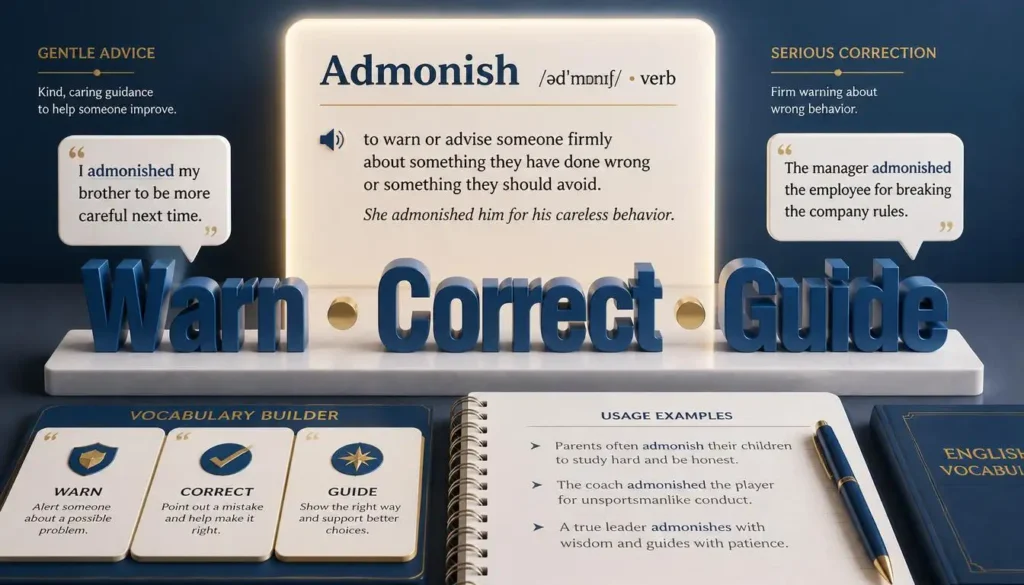
Meaning: To warn, advise, or criticize someone because of their behavior or actions.
Pronunciation: ad-MON-ish
IPA: /ədˈmɑːnɪʃ/
Syllables: Three (ad-mon-ish)
Origin: From Latin admonere (“to warn, remind”).
Word forms: admonish, admonished, admonishing, admonishment
Formality level: Medium to formal
Common usage: Used in education, workplaces, literature, and formal conversations.
Exact vs Similar Synonyms

Synonyms for admonish are not always identical. Some words match the meaning closely but differ in tone, seriousness, or situation.
For example, reprove and reprimand are close synonyms because they both describe correcting someone. However, reprimand sounds more official, while reprove sounds more formal and literary. Scold is also similar but feels more emotional and personal.
Choosing the right alternative depends on whether you want to sound gentle, serious, professional, or casual.
Meaning and Usage of Admonish
Basic Meaning
To admonish means to tell someone that their behavior is wrong and encourage them to improve.
Example:
- The coach admonished the players for ignoring the rules.
Different Meanings
1. To warn someone
- The doctor admonished him to stop smoking.
2. To correct someone’s behavior
- The manager admonished the employee for being late.
3. To give serious advice
- Parents often admonish children to make good choices.
How People Use It
Everyday conversation:
People usually use simpler words like warn, advise, or scold.
Formal writing:
Admonish works well in reports, articles, and professional writing.
Academic writing:
It is useful when discussing rules, behavior, or historical events.
Creative writing:
Writers use admonish to create serious or emotional moments.
Admonish in a Sentence
The word admonish is used when someone gives a warning, correction, or serious advice because of a mistake or inappropriate behavior. It is often used in formal situations, such as schools, workplaces, or professional discussions.
Examples:
- The teacher admonished the students for talking during the exam.
- The manager admonished the employee for ignoring company rules.
- The doctor admonished him to follow a healthier lifestyle.
- The coach admonished the players to stay focused during the match.
- The judge admonished the witness for providing false information.
- Her parents admonished her to be more careful with her decisions.
- The leader admonished the team after repeated mistakes.
- The professor admonished students to complete their assignments on time.
In many sentences, admonish suggests more than simple criticism. It usually carries the idea of helping someone improve by pointing out what they did wrong.
Synonyms and Alternatives for Admonish

1. Reprimand
Relationship: Exact Synonym
Meaning: To officially criticize someone for a mistake.
Difference: More formal and stronger than admonish.
Best Used For: Workplace or official situations.
Examples:
- The supervisor reprimanded the worker for breaking safety rules.
- The player was reprimanded after violating team policies.
2. Rebuke
Relationship: Near Synonym
Meaning: To express strong disapproval.
Difference: Usually carries more anger.
Best Used For: Serious mistakes.
Examples:
- The leader rebuked the dishonest official.
- She rebuked her friend for lying.
3. Scold
Relationship: Near Synonym
Meaning: To speak angrily to someone about wrongdoing.
Difference: More emotional and informal.
Best Used For: Family and everyday situations.
Examples:
- The mother scolded her son for breaking the vase.
- The teacher scolded the students for making noise.
4. Warn
Relationship: Near Synonym
Meaning: To tell someone about possible danger or problems.
Difference: Focuses on prevention.
Best Used For: Advice and safety.
Examples:
- The officer warned drivers about the storm.
- She warned him not to repeat the mistake.
5. Caution
Relationship: Contextual Alternative
Meaning: To advise someone to be careful.
Difference: Softer than admonish.
Best Used For: Safety advice.
Examples:
- The guide cautioned visitors about slippery rocks.
- He cautioned his friend before making a decision.
6. Criticize
Relationship: Near Synonym
Meaning: To point out faults.
Difference: Does not always include advice.
Best Used For: Feedback.
Examples:
- The editor criticized the article.
- The coach criticized the team’s performance.
7. Chide
Relationship: Near Synonym
Meaning: To gently criticize.
Difference: Usually mild and sometimes affectionate.
Best Used For: Friendly correction.
Examples:
- She chided him for forgetting her birthday.
- The teacher chided the student politely.
8. Reprove
Relationship: Exact Synonym
Meaning: To express disapproval.
Difference: More formal.
Best Used For: Formal writing.
Examples:
- The judge reproved the witness.
- The teacher reproved the student’s behavior.
9. Lecture
Relationship: Near Synonym
Meaning: To give a long warning or explanation.
Difference: Focuses on the speech itself.
Best Used For: Teaching moments.
Examples:
- His father lectured him about responsibility.
- The coach lectured the team after the loss.
10. Tell Off
Relationship: Contextual Alternative
Meaning: To criticize someone angrily.
Difference: Very informal.
Best Used For: Casual speech.
Examples:
- She told him off for being rude.
- The manager told the worker off.
11. Advise
Relationship: Contextual Alternative
Meaning: To give helpful guidance.
Difference: Less negative.
Best Used For: Friendly advice.
Examples:
- The doctor advised him to rest.
- She advised her brother to study harder.
12. Counsel
Relationship: Contextual Alternative
Meaning: To give serious advice.
Difference: More supportive than critical.
Best Used For: Professional guidance.
Examples:
- The mentor counseled the student.
- The lawyer counseled his client.
13. Correct
Relationship: Near Synonym
Meaning: To fix wrong behavior or information.
Difference: Focuses on improvement.
Examples:
- The teacher corrected the student’s mistake.
- Parents corrected his bad habits.
14. Discipline
Relationship: Contextual Alternative
Meaning: To train or punish for improvement.
Difference: Involves consequences.
Examples:
- The school disciplined the student.
- The coach disciplined the team.
15. Warn Against
Relationship: Contextual Alternative
Meaning: To advise someone not to do something.
Examples:
- Doctors warn against unhealthy diets.
- They warned against risky decisions.
16. Urge
Relationship: Near Synonym
Meaning: To strongly encourage.
Difference: More positive than admonish.
Examples:
- She urged him to be careful.
- The teacher urged students to work harder.
17. Remind
Relationship: Contextual Alternative
Meaning: To help someone remember a duty.
Examples:
- He reminded them to follow the rules.
- She reminded him about the deadline.
18. Scold Mildly
Relationship: Near Synonym
Meaning: Gentle criticism.
Examples:
- She mildly scolded her child.
- The coach mildly scolded the players.
19. Express Disapproval
Relationship: Contextual Alternative
Meaning: Show disagreement with an action.
Examples:
- The community expressed disapproval.
- He expressed disapproval of the decision.
20. Object
Relationship: Contextual Alternative
Meaning: To disagree with something.
Examples:
- They objected to the unfair rule.
- She objected to his behavior.
21. Protest
Relationship: Contextual Alternative
Meaning: To show strong disagreement.
Examples:
- Citizens protested the decision.
- He protested against unfair treatment.
22. Call Out
Relationship: Contextual Alternative
Meaning: To publicly point out wrongdoing.
Examples:
- The journalist called out corruption.
- She called him out for his mistake.
23. Denounce
Relationship: Near Synonym
Meaning: To strongly criticize.
Examples:
- Leaders denounced violence.
- The group denounced unfair actions.
24. Condemn
Relationship: Near Synonym
Meaning: To strongly express disapproval.
Examples:
- They condemned the illegal activity.
- The organization condemned the behavior.
25. Warn Off
Relationship: Contextual Alternative
Meaning: To tell someone to stay away.
Examples:
- Police warned people off the area.
- He warned his friend off the dangerous path.
26. Admonish Gently
Relationship: Exact Synonym
Meaning: To correct with kindness.
Examples:
- She gently admonished her child.
- The teacher gently admonished the class.
Best Alternatives by Context
Everyday Use
Warn, scold, advise, tell off
These words sound natural in daily conversations.
Formal Writing
Reprimand, rebuke, reprove, admonish
These work well in professional documents.
Academic Writing
Criticize, condemn, caution, reprimand
These are useful when discussing behavior or policies.
Words Commonly Confused with Admonish
Punish
Difference:
Punish means giving a penalty. Admonish means correcting through words.
Example:
- The teacher admonished the student before giving punishment.
Praise
Difference:
Praise means showing approval, which is the opposite of admonish.
Example:
- The coach praised the team after success.
Advise
Difference:
Advise is usually helpful guidance and may not involve criticism.
Example:
- The doctor advised him to exercise.
Insult
Difference:
Insult means hurting someone with offensive words, not correcting behavior.
Example:
- He insulted his coworker during the argument.
Antonyms of Admonish
| Antonym | Simple Meaning | Example Sentence |
| Praise | Show approval | The teacher praised her effort. |
| Encourage | Give support | Parents encourage their children. |
| Approve | Accept positively | The manager approved the plan. |
| Compliment | Express admiration | She complimented his work. |
| Support | Help someone | Friends supported him. |
| Reward | Give something for success | The company rewarded employees. |
| Accept | Agree with something | They accepted the decision. |
Common Collocations with Admonish
| Collocation | Meaning | Example Sentence |
| Admonish someone for something | Correct someone’s mistake | The teacher admonished him for cheating. |
| Gently admonish | Give mild correction | She gently admonished her son. |
| Publicly admonish | Correct openly | The leader publicly admonished the official. |
| Admonish against | Warn about something | Experts admonished people against risky actions. |
| Strongly admonish | Give serious warning | The coach strongly admonished the players. |
| Admonish repeatedly | Correct many times | The manager repeatedly admonished him. |
Frequently Asked Questions
What is the closest synonym for admonish?
The closest synonym for admonish is reprimand. Both words mean correcting someone for doing something wrong, but reprimand is usually more formal and serious.
Is admonish positive or negative?
Admonish is usually negative because it involves criticism, but it can also show care when someone gives advice to help another person improve.
What is a simple synonym for admonish?
Simple synonyms include warn, advise, scold, and criticize. The best choice depends on the situation.
Is admonish a formal word?
Yes. Admonish is more common in formal writing, education, workplaces, and serious conversations.
What is the noun form of admonish?
The noun form is admonishment, which means a warning or expression of disapproval.
How do you use admonish in a sentence?
Example: “The teacher admonished the students for arriving late.”
Conclusion
Choosing the right synonym for admonish helps you communicate the exact level of warning or criticism you want to express.
Words like reprimand, rebuke, and reprove sound formal, while warn and advise feel softer. Understanding context allows you to choose vocabulary that sounds natural and accurate.

About Sajjad Ahmed
Sajjad Ahmed is the author behind Guest Paster, where he writes about English vocabulary, synonyms, word meanings, and practical word usage.
His content is designed to help readers understand the differences between similar words, discover suitable alternatives, and use English vocabulary more effectively in everyday writing and communication.
Before publishing, Sajjad focuses on presenting word choices in a clear and easy-to-understand format, with relevant meanings, context, and examples where helpful.
Through Guest Paster, his goal is to make vocabulary learning simpler and provide useful language resources for students, writers, English learners, and anyone looking to expand their vocabulary.
Areas of Focus: English Vocabulary • Synonyms • Word Meanings • Word Usage • Language Learning
Author: Sajjad Ahmed
Website: Guest Paster