
What do you call a group of people who work together and what do you call a group of things that belong together? The answer changes with the sentence because group covers both people and things.
If the people share a job the closest synonym for group is team. If the things simply sit together, collection or cluster fits better. This guide sorts 15 group synonyms by meaning so you can pick the word that fits the gathering in front of you.
Top 10 Group Synonyms at a Glance
| # | Synonym | Meaning Difference |
|---|---|---|
| 1 | Team | People working together toward a shared goal |
| 2 | Crew | A small working group, often on a job or a vessel |
| 3 | Gathering | People who have come together, often informally |
| 4 | Crowd | A large number of people in one place |
| 5 | Band | A small group with a shared purpose, often music |
| 6 | Cluster | Things grouped closely together |
| 7 | Collection | Things gathered for a purpose or kept together |
| 8 | Set | A complete group of related things |
| 9 | Category | A class of things that share a feature |
| 10 | Assembly | People gathered formally for a meeting or event |
Quick Facts About “Group”
Part of speech: a noun, and also a verb. You join a group, and you can group chairs together.
Two core meanings: (1) a number of people together, such as a study group, (2) a number of things together, such as a group of islands.
Register: neutral. Group sounds natural in school, at work, and in everyday talk, and it stays neutral in formal writing too.
Watch out: group says little about purpose or size. If the people share a task, say team. If they are just many, say crowd.
The Closest Synonym: Team
Team is the closest synonym for group when the group is made of people, because it covers the word’s most common job: naming people who act together. When coworkers, players, or students work toward one goal, team names both the people and their shared purpose. Team works in everyday speech, in offices, and in sports reports, which is why it is the safest first choice for a people group.
Still team is not identical to group. Team implies cooperation and a shared goal, while group can describe people who merely happen to be together, such as passengers on a bus. Use team as your default for people who work together, and reach below for things, crowds, or formal meetings.
Remember the choice test: if the people share a task, team still sounds true. If they only share a place, use gathering or crowd instead
Where “Group” Comes From (Etymology)
According to Etymonline, group is first recorded in the 1690s, originally as an art term for “an assemblage of figures or objects forming a harmonious whole in a painting or design.”
It comes from French groupe, meaning “cluster, group,” from Italian gruppo, meaning “group, knot,” probably from a Germanic source meaning a round mass or lump. The wider sense, “any assemblage, a number of individuals related in some way,” is recorded by 1736.
Can You Swap Them Freely?
In short: only inside the same meaning group, and only when the sense matches. A people word collapses in a sentence about things, and a things word collapses in a sentence about people:
“Our team finished the report on Friday.” (people working together – correct)
“Our cluster finished the report on Friday.” (a cluster is things bunched together, not coworkers – incorrect, say team)
“A cluster of grapes hung over the fence.” (things grouped closely – correct)
“A team of grapes hung over the fence.” (grapes do not work together – incorrect, say cluster)
Before you substitute, ask: am I naming people, or am I naming things? Those take a Group 1 and a Group 2 word in turn.
Group Synonyms in Detail
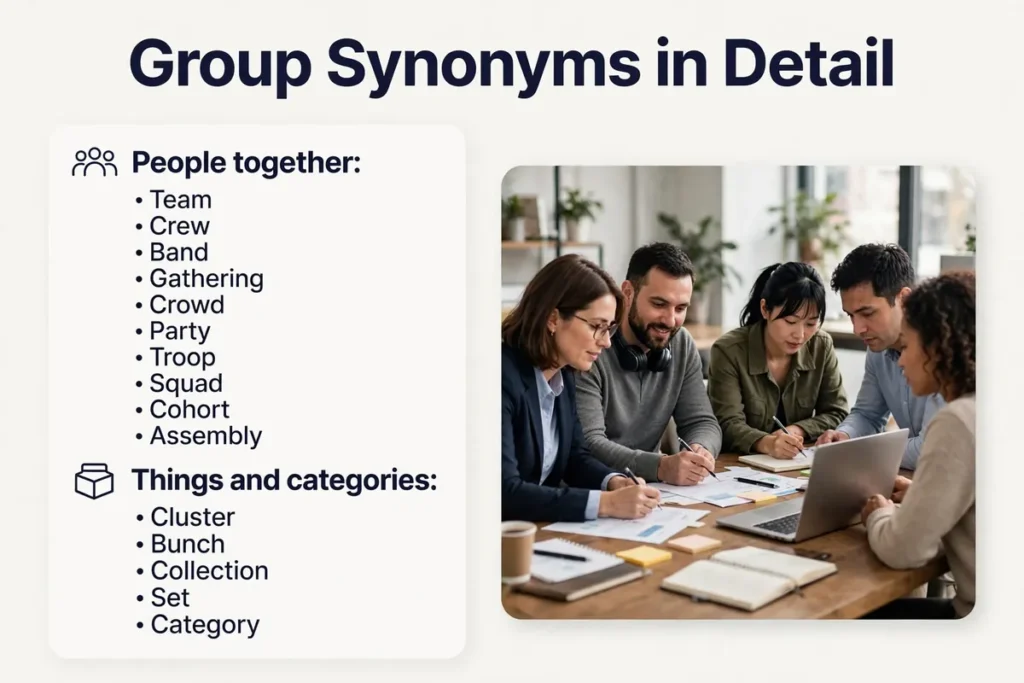
Group 1: Groups of People
1. Team
Meaning: A number of people working together toward a shared goal.
Difference: The closest all-round match for a people group. Team adds cooperation and purpose.
Best used for: Workplaces, sports, schools, projects.
Formality: Neutral · CEFR: A2 · Frequency: Very common
Example (Work): “The whole team stayed late to finish the launch.”
Example (Sports): “She plays on the school soccer team.”
When NOT to use it: For people who merely share a place, with no shared task.
2. Crew
Meaning: A small group of people who work together on a job, a ship, or a plane.
Difference: Crew is smaller and more hands-on than team, and it suits workers rather than managers.
Best used for: Film sets, ships, planes, building sites, restaurants.
Formality: Neutral · CEFR: B1 · Frequency: Very common
Example (Work): “The film crew arrived before sunrise.”
Example (Travel): “The cabin crew welcomed passengers aboard.”
When NOT to use it: For a large audience or a casual social meeting.
3. Band
Meaning: A small group of people with a shared purpose, most often musicians.
Difference: Band stresses a tight, small unit, and in music it is the standard word.
Best used for: Music, small teams, informal groups with a shared aim.
Formality: Neutral · CEFR: B1 · Frequency: Very common
Example (Music): “The band played three songs at the school fair.”
Example (Everyday): “A small band of volunteers cleaned the park.”
When NOT to use it: For a large company department or a formal assembly.
4. Gathering
Meaning: People who have come together, often for a social or informal occasion.
Difference: Gathering stresses the meeting itself, not a shared job or a lasting unit.
Best used for: Family events, social occasions, community meetings.
Formality: Neutral · CEFR: B2 · Frequency: Very common
Example (Family): “The gathering at her house lasted until midnight.”
Example (Community): “A small gathering waited outside the library.”
When NOT to use it: For a permanent work unit, where team is clearer.
5. Crowd
Meaning: A large number of people together in one place.
Difference: Crowd stresses size and number, and it can feel anonymous or uncontrolled.
Best used for: Concerts, stadiums, streets, festivals.
Formality: Neutral · CEFR: A2 · Frequency: Very common
Example (Event): “A crowd filled the square before the concert.”
Example (Everyday): “She pushed through the crowd to reach the gate.”
When NOT to use it: For a small working team, where crowd sounds far too large.
6. Party
Meaning: A group of people traveling, working, or celebrating together.
Difference: Party can mean a celebration, but as a group word it means a traveling or working party.
Best used for: Trips, tours, search teams, formal agreements.
Formality: Neutral · CEFR: A2 · Frequency: Very common
Example (Travel): “The hiking party reached the summit by noon.”
Example (Formal): “Both parties signed the agreement.”
When NOT to use it: When you mean a crowd at a concert, where crowd is clearer.
7. Troop
Meaning: A group of soldiers, scouts, or performers who act together.
Difference: Troop suits uniformed or organized units, and it often sounds military or scout-like.
Best used for: Military writing, scouts, theater and dance groups.
Formality: Neutral · CEFR: B2 · Frequency: Common
Example (Military): “The troop marched through the town at dawn.”
Example (Scouts): “Her scout troop camped by the lake.”
When NOT to use it: For an office team, where troop sounds military.
8. Squad
Meaning: A small team, often in sports or police work, with a clear task.
Difference: Squad is smaller and more task-focused than team, and it sounds energetic and modern.
Best used for: Sports, police work, gaming, small project teams.
Formality: Neutral to informal · CEFR: B2 · Frequency: Common
Example (Sports): “The coach named a squad of twenty players.”
Example (Work): “A small squad fixed the outage overnight.”
When NOT to use it: In very formal writing, where team sounds safer.
9. Cohort
Meaning: A group of people who share an experience, such as a class year or a study group.
Difference: Cohort stresses a shared time or stage, such as starting school in the same year.
Best used for: Education, research, training programs.
Formality: Formal · CEFR: C1 · Frequency: Common
Example (Education): “The new cohort starts classes in September.”
Example (Research): “The study followed one cohort for ten years.”
When NOT to use it: In casual talk, where class or group sounds simpler.
10. Assembly
Meaning: A group of people gathered together for a formal meeting, ceremony, or event.
Difference: Assembly stresses a formal occasion, often with a set time and place.
Best used for: Schools, legislatures, ceremonies, formal meetings.
Formality: Formal · CEFR: C1 · Frequency: Common
Example (School): “The whole school met for morning assembly.”
Example (Formal): “The assembly voted on the new rules.”
When NOT to use it: For a casual friends meetup, where gathering is warmer.
Group 2: Groups of Things and Categories
11. Cluster
Meaning: A number of similar things grouped closely together.
Difference: Cluster stresses closeness and bunching, often in a small space.
Best used for: Nature, data, objects, small collections.
Formality: Neutral · CEFR: B2 · Frequency: Very common
Example (Nature): “A cluster of stars filled the night sky.”
Example (Everyday): “Grapes grow in clusters on the vine.”
When NOT to use it: For people working together, where team is the word.
12. Bunch
Meaning: A number of things held, tied, or growing together.
Difference: Bunch is casual and concrete, suiting flowers, keys, and grapes.
Best used for: Everyday talk, shopping, gardening.
Formality: Informal · CEFR: A2 · Frequency: Very common
Example (Shopping): “She bought a bunch of bananas.”
Example (Everyday): “He carried a bunch of keys.”
When NOT to use it: In formal writing, where cluster or collection sounds better.
13. Collection
Meaning: A number of things gathered together, often kept for a purpose.
Difference: Collection stresses deliberate gathering, such as stamps or books.
Best used for: Hobbies, museums, libraries, data.
Formality: Neutral · CEFR: B1 · Frequency: Very common
Example (Hobby): “His collection of coins fills three albums.”
Example (Library): “The library added a new collection of maps.”
When NOT to use it: For people, where collection can sound cold.
14. Set
Meaning: A complete group of related things that belong together.
Difference: Set stresses completeness, such as all the pieces needed for a task.
Best used for: Tools, dishes, books, games, math.
Formality: Neutral · CEFR: A2 · Frequency: Very common
Example (Home): “She bought a new set of plates.”
Example (Tools): “The toolbox holds a full set of wrenches.”
When NOT to use it: For a loose pile of unrelated things, where bunch is closer.
15. Category
Meaning: A class of things that share a feature, used to sort or organize.
Difference: Category stresses sorting by a shared trait, not physical closeness.
Best used for: Reports, shops, databases, exams.
Formality: Neutral to formal · CEFR: B2 · Frequency: Very common
Example (Shop): “Shoes fall into a different category from hats.”
Example (Report): “Each expense went into its own category.”
When NOT to use it: For people standing together, where gathering is the word.
Best Alternatives by Context
Pick by the situation, not by the word list alone:
People sharing a job: team or crew. Team is general, crew is small and hands-on.
People meeting socially: gathering. It names the occasion, not a job.
A large audience: crowd. It says size at once.
Musicians or a small unit: band. It is the standard word in music.
A formal meeting: assembly. It suits schools and legislatures.
Things bunched close: cluster or bunch. Cluster is neutral, bunch is casual.
Things kept on purpose: collection. It implies deliberate gathering.
A complete kit: set. It says nothing is missing.
Sorting by a trait: category. It organizes, it does not describe a pile.
For nearby families, seeteamwork synonyms when the point is working together, and coordination synonyms when the point is organizing people and tasks. For a people group that shares feelings, empathy synonyms sorts that family.
Which Group Synonym Should I Choose?

| Situation | Best pick | Why it wins |
|---|---|---|
| People sharing a job | Team | Names cooperation and a shared goal |
| Small hands-on workers | Crew | Small, practical, and job-focused |
| Casual social meeting | Gathering | Names the meeting, not a job |
| Large audience | Crowd | Says size at once |
| Musicians | Band | The standard word in music |
| Formal meeting | Assembly | Suits schools and ceremonies |
| Things bunched close | Cluster | Stresses closeness in a small space |
| Things kept on purpose | Collection | Implies deliberate gathering |
| A complete kit | Set | Says the group is complete |
| Sorting by a trait | Category | Organizes by a shared feature |
Antonyms of Group
1. Antonyms for group as people together
| Antonym | Meaning Difference |
|---|---|
| Individual | One person, not part of a group |
| Loner | A person who prefers to be alone |
| Outsider | A person not accepted in the group |
| Soloist | A person who performs alone |
| Hermit | A person who lives apart from others |
| Single | One alone, rather than a pair or group |
2. Antonyms for group as things together
| Antonym | Meaning Difference |
|---|---|
| Single item | One thing alone, not part of a set |
| Lone thing | A thing standing apart from others |
| Odd one | One item left without a match |
| Unit | One whole thing, counted on its own |
| Fragment | A broken-off piece, not a whole group |
| Stray | One item separated from its group |
Words Commonly Confused With Group
Team versus group is the closest pair to watch. Every team is a group, but not every group is a team. Passengers waiting at a bus stop form a group, but they are not a team, because they share no goal. Use team only when cooperation is real.
Crowd versus audience is another near miss. A crowd is simply many people in a place while an audience watches or listens to something. A crowd at a station is not an audience. And a crowd at a concert becomes an audience once the show starts.
Set versus group matters for things. A set is complete, like a set of six glasses. A group of glasses may be any number, complete or not. If completeness matters, say set.
Substitution test failures: “A team of grapes hung over the fence” fails, because grapes do not cooperate, so say “a cluster of grapes.” “The crowd finished the report” fails, because a crowd has no shared task, so say “the team finished the report.” “Her bunch of coworkers met daily” fails as a work sentence, because bunch is for things, so say “her team of coworkers met daily.”
American vs British English
Group is spelled the same in American and British English, and so are team, crew, band, gathering, crowd, cluster, collection, set, category, and assembly. One point matters: American English writes organize, while British English writes organise, and American center is British centre. This article uses American spelling throughout. Otherwise the whole set travels unchanged across the Atlantic.
Collocations and Idioms With Group
Only use combinations that native speakers actually use:
| Collocation | Meaning |
|---|---|
| group of friends | friends who spend time together. |
| group project | school or work done by a team. |
| group chat | a message thread with several people. |
| group effort | work done together by several people. |
| group discussion | talk among several people. |
| study group | students who learn together. |
| focus group | people asked for opinions on a product. |
| age group | people of a similar age. |
| blood group | a blood type category. |
| group together | to form a group, as a verb. |
| in a group | as part of a group, not alone. |
| group hug | several people hugging at once. |
Use join, lead, or form with group, and in a group for being part of one.
Practice Exercises
Exercise 1: Fill in the blank. Choose team, crowd, cluster, o
- The soccer ___ trained every morning. (Hint: players share a goal.)
- A ___ filled the stadium before kickoff. (Hint: size is the point.)
- She bought a ___ of six glasses. (Hint: completeness is the point.)
- A ___ of stars shone above the hills. (Hint: things bunched close.)
Exercise 2: Fix the wrong word. Each sentence has one word that does not fit. Name it and fix it.
- The bunch of engineers finished the bridge. (Hint: engineers cooperate.)
- A team of grapes hung over the fence. (Hint: grapes do not work.)
- The crowd signed the contract. (Hint: a crowd has no shared task.)
Exercise 3: Match the situation to the word. Match each situation to team, gathering, assembly, or category.
- A school meets in the hall each morning.
- Friends meet for dinner on Friday.
- A shop sorts shoes apart from hats.
- Coworkers build one report together.
Answer key
- Exercise 1: (1) team; (2) crowd; (3) set; (4) cluster.
- Exercise 2: (1) bunch, use team; (2) team, use cluster; (3) crowd, use team or party in the formal sense.
- Exercise 3: (1) assembly; (2) gathering; (3) category; (4) team.
Frequently Asked Questions
What is the best synonym for group?
Team is the best synonym when the group is people who work together, because it covers cooperation and a shared goal. For people who only meet socially, gathering fits better, and for things grouped together, cluster or collection fits better. Match the word to people or things first.
Can group mean things as well as people?
Yes. Group covers both a number of people together and a number of things together. A group of students and a group of islands are both correct. When the things are kept on purpose, collection is sharper, and when they are bunched close, cluster is sharper.
What is the difference between team and group?
Every team is a group, but not every group is a team. A team shares a goal and cooperates to reach it, while a group may share only a place or a trait. Passengers at a bus stop form a group, not a team. Use team only when real cooperation is present.
Is crowd a good synonym for group?
Crowd works only for a large number of people in one place. It fails for small teams, for formal meetings, and for things. A crowd fills a stadium, but a crowd does not finish a report. For size, crowd wins; for work, team wins.
What is the difference between set and category?
A set is a complete group of related things, like a set of plates, while a category is a class used for sorting, like shoes in a shop. A set says nothing is missing. A category says things share a trait. Use set for kits, category for sorting.
Which synonym should students use in essays?
In essays, prefer team, assembly, or category, because all three sound precise and academic. Reserve cohort for research and education writing, and troop for military or scout contexts. Match the word to the sense: work takes team, formal meetings take assembly, sorting takes category.
Conclusion
The right replacement for group depends on one question first: people or things? People who share a job call for team, people who meet socially call for gathering, a large audience calls for crowd, and a formal meeting calls for assembly.
Things bunched close call for cluster, things kept on purpose call for collection, a complete kit calls for set, and sorting calls for category. Start with that split, and the rest of the choice gets easy.

About Sajjad Ahmed
Sajjad Ahmed is the author behind Guest Paster, where he writes about English vocabulary, synonyms, word meanings, and practical word usage.
His content is designed to help readers understand the differences between similar words, discover suitable alternatives, and use English vocabulary more effectively in everyday writing and communication.
Before publishing, Sajjad focuses on presenting word choices in a clear and easy-to-understand format, with relevant meanings, context, and examples where helpful.
Through Guest Paster, his goal is to make vocabulary learning simpler and provide useful language resources for students, writers, English learners, and anyone looking to expand their vocabulary.
Areas of Focus: English Vocabulary • Synonyms • Word Meanings • Word Usage • Language Learning
Author: Sajjad Ahmed
Website: Guest Paster