Finding good due to synonyms is trickier than it looks because due to is a phrase, not a single word. Most often it names a cause as in “the match was cancelled due to rain.” Sometimes it carries a positive cause as in “we won due to hard work.” Each job needs a different replacement.
The closest synonym for due to is because of. it covers the everyday cause sense in almost every sentence. When the cause is positive, thanks to fits better and when the tone is formal, owing to fits better. This guide sorts 18 due to synonyms by meaning, so you can pick the right phrase first time.
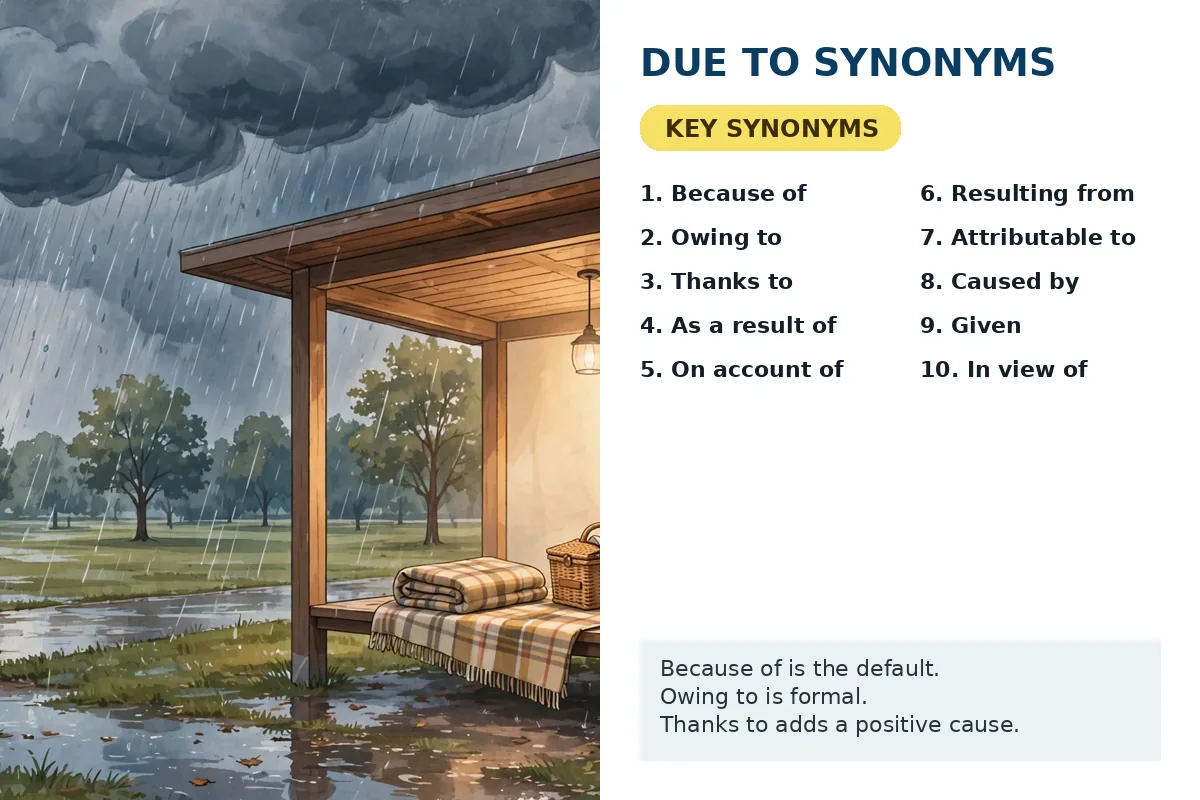
Top 10 Due To Synonyms at a Glance
| # | Synonym | Meaning Difference |
|---|---|---|
| 1 | Because of | The everyday default for a cause (phrase) |
| 2 | Owing to | The formal version of because of |
| 3 | Thanks to | A cause that is positive or helpful |
| 4 | As a result of | A cause stated as the reason for a result |
| 5 | On account of | A formal cause, often in reports |
| 6 | Resulting from | A cause that leads directly to a result |
| 7 | Attributable to | A cause that can be assigned to a source, formal |
| 8 | Caused by | A direct, physical or factual cause |
| 9 | Given | A cause taken as a known background fact |
| 10 | In view of | A cause considered before a decision |
Quick Facts About “Due To”
- Part of speech: a prepositional phrase (due to rain), built from the adjective due, meaning owed or deserved.
- Three core meanings: (1) because of a cause, (2) a positive cause that deserves credit, (3) a formal attribution, as in “the delay was due to a fault.”
- Register: neutral to formal. Due to works in reports and news, but in casual speech because of is more natural.
- Watch out: traditional grammar prefers due to after a noun (“the delay was due to rain”) and because of before a verb phrase (“we left because of rain”). Most modern writing accepts both, but formal editors still notice the difference.
The Closest Synonym: Because Of
Because of is the closest synonym for due to because it covers the word’s most common job: naming the cause of something, plainly and without fuss. When a match is cancelled because of rain, a shop closes because of repairs, or a student succeeds because of practice, the real action is causation in plain clothes. No formality, no judgment, just cause and result.
Still, the two phrases are not identical. Because of is the safer default in speech and in most writing, while due to can sound slightly more formal or written. Because of also handles verb phrases more naturally: “we stayed home because of the storm” sounds smoother than “we stayed home due to the storm” to many editors. Use because of as your default, and keep due to (or a phrase below) when the tone, the grammar, or the positive or negative feeling calls for something else.
Finally, remember the positive-cause trap. Because of is neutral, it works for good and bad causes alike. When the cause deserves thanks, because of hides that feeling. For that job, skip ahead to thanks to in Group 2 below.
Where “Due To” Comes From (Etymology)
According to Etymonline, due began as a word about what is owed. In the mid-14th century, due meant “customary, regular, right, proper,” and by the late 14th century it meant “owed, payable as an obligation, owing by right of circumstance or condition.” It came from Old French deu, the past participle of devoir, “to owe,” from Latin debere, “to owe,” originally “keep something away from someone,” from de-, “away,” plus habere, “to have.”
The phrase due to is recorded from the early 15th century as “deserved by, merited by,” and also “owing to.” It is attested from the 1660s as “attributable to as a cause or origin.” Its use as a prepositional phrase, the use grammarians long maligned, is recorded by 1897. That history explains the phrase’s double life today. Due to still carries a hint of “deserved” behind its cause meaning, which is why thanks to feels like its positive cousin, and why formal writing still treats it with care.
Can You Swap Them Freely?
In short: only inside the same meaning group, and only with the right grammar. A neutral cause phrase collapses in a positive-cause sentence, and a noun phrase collapses after a verb in formal writing:
- ✅ “The match was cancelled because of rain.” (phrase, neutral cause ✔)
- ❌ “The match was cancelled thanks to rain.” (thanks to credits a good cause, rain that cancels a match is not one ✘, say because of or owing to)
- ✅ “We won thanks to her hard work.” (phrase, positive cause ✔)
- ❌ “We won owing to her hard work.” (grammatically fine, but it hides the gratitude ✘, say thanks to)
Before you substitute, ask one question: is the cause neutral, positive, or formal, and does my sentence need a noun or a clause? Neutral takes a Group 1 phrase, positive takes a Group 2 phrase, and formal or result-focused takes a Group 3 phrase. If your cause is a full clause (“because it rained”), use because, not because of or due to, both of which need a noun after them.
Due To Synonyms in Detail

Group 1: Due To as a Neutral Cause
1. Because Of
- Meaning: For the reason of, naming the cause of something in plain language.
- Difference: The closest all-round match for everyday due to. Because of is neutral, flexible, and accepted everywhere.
- Best used for: Conversation, emails, school, news, everyday writing.
- Formality: Neutral · CEFR: A2 · Frequency: Very common
- Example (Work): “The meeting moved because of a clash with another event.”
- Example (Everyday): “We stayed home because of the storm.”
- When NOT to use it: Before a full clause. “Because of it rained” is wrong, use because it rained instead.
2. Owing To
- Meaning: Because of, in formal language, with a hint of debt to a cause.
- Difference: Owing to is the formal twin of because of. It keeps the old “owed” flavor of due, and it suits reports and official writing.
- Best used for: Reports, formal letters, academic writing, news.
- Formality: Formal · CEFR: C1 · Frequency: Common
- Example (Formal): “Owing to staff shortages, the office will close early.”
- Example (News): “Flights were delayed owing to fog.”
- When NOT to use it: In casual speech, where owing to can sound stiff or old fashioned.
3. On Account Of
- Meaning: Because of, in formal or legal language, naming the reason for an action.
- Difference: On account of stresses the reason as an account to be settled. It is longer and more formal than because of.
- Best used for: Law, formal reports, official explanations.
- Formality: Formal · CEFR: C1 · Frequency: Uncommon
- Example (Formal): “He was excused on account of illness.”
- Example (Work): “The claim was refused on account of missing documents.”
- When NOT to use it: In everyday conversation, where it sounds like a legal form.
4. As a Result Of
- Meaning: As the outcome or consequence of a cause, stated from the result side.
- Difference: As a result of looks backward from the result to its cause. It is longer than because of, and it suits explanations.
- Best used for: Reports, essays, science, explanations.
- Formality: Neutral to formal · CEFR: B2 · Frequency: Very common
- Example (Work): “As a result of the redesign, sales rose by a fifth.”
- Example (Everyday): “As a result of the rain, the garden looks wonderful.”
- When NOT to use it: In short, punchy sentences, where because of is cleaner and faster.
5. Resulting From
- Meaning: Coming from a cause, as a direct consequence.
- Difference: Resulting from is tighter than as a result of, and it often follows a noun: “delays resulting from fog.”
- Best used for: Reports, news, technical writing.
- Formality: Neutral to formal · CEFR: B2 · Frequency: Common
- Example (News): “Delays resulting from the strike will continue tomorrow.”
- Example (Work): “Costs resulting from the move were higher than expected.”
- When NOT to use it: At the start of a casual sentence, where because of sounds more natural.
6. Caused By
- Meaning: Directly produced by a cause, often physical or factual.
- Difference: Caused by is the most direct cause phrase. It promises a clear chain: this caused that, with no softening.
- Best used for: Science, medicine, engineering, accident reports.
- Formality: Neutral · CEFR: B1 · Frequency: Very common
- Example (Science): “The flood was caused by heavy rain upstream.”
- Example (Work): “The fault was caused by a loose cable.”
- When NOT to use it: For human reasons or decisions, where because of or given sounds more human than mechanical.
Group 2: Due To as a Positive Cause
7. Thanks To
- Meaning: Because of a helpful, positive, or creditable cause.
- Difference: Thanks to adds gratitude. It says the cause deserves credit, not just blame or neutrality.
- Best used for: Speeches, thanks, success stories, friendly writing.
- Formality: Neutral · CEFR: B1 · Frequency: Very common
- Example (Work): “Thanks to her hard work, the project finished early.”
- Example (Everyday): “Thanks to the rain, the garden is green again.”
- When NOT to use it: For bad causes. “Thanks to the accident” sounds wrong unless you are being ironic, and irony needs a clear signal.
8. With the Help Of
- Meaning: Because of someone’s assistance or something’s support.
- Difference: With the help of names the helper explicitly. It is warmer and more personal than because of.
- Best used for: Acknowledgements, teamwork stories, instructions.
- Formality: Neutral · CEFR: B1 · Frequency: Common
- Example (Work): “With the help of the new software, we finished in half the time.”
- Example (Everyday): “With the help of her neighbors, she moved house in a day.”
- When NOT to use it: For impersonal causes like weather or prices, where no helper exists.
9. Through
- Meaning: By means of, or as a result of, a process or a person’s effort.
- Difference: Through stresses the path. Success through practice means practice was the road, not just the trigger.
- Best used for: Careers, learning, effort, processes.
- Formality: Neutral · CEFR: B1 · Frequency: Very common
- Example (Work): “She got the job through years of steady work.”
- Example (Everyday): “He learned English through films and songs.”
- When NOT to use it: For a single, sudden cause. A match is not cancelled “through rain” in natural English, it is cancelled because of rain.
Group 3: Due To as a Formal Attribution or Background Reason
10. Attributable To
- Meaning: Able to be assigned to a particular cause or source, in formal language.
- Difference: Attributable to is due to in its most formal, careful form. It is used when the cause is being assigned, not just stated.
- Best used for: Science, law, audits, formal reports.
- Formality: Formal · CEFR: C1 · Frequency: Uncommon
- Example (Formal): “The rise is attributable to higher fuel costs.”
- Example (Science): “The effect is attributable to a single gene.”
- When NOT to use it: In conversation or short writing, where it sounds like a committee wrote the sentence.
11. Given
- Meaning: Taking something as a known background fact, and reasoning from it.
- Difference: Given does not just name a cause, it frames a decision: given X, we do Y.
- Best used for: Decisions, arguments, explanations, business writing.
- Formality: Neutral to formal · CEFR: B2 · Frequency: Very common
- Example (Work): “Given the delay, we should tell customers today.”
- Example (Everyday): “Given the heat, let us meet indoors.”
- When NOT to use it: As a simple cause in a past event. “The match was cancelled given rain” is unnatural, use because of.
12. In View Of
- Meaning: Considering something, especially before making a decision.
- Difference: In view of looks forward to a decision, while because of looks backward to a cause.
- Best used for: Formal decisions, letters, meetings, policy.
- Formality: Formal · CEFR: C1 · Frequency: Common
- Example (Formal): “In view of the forecast, the event was moved indoors.”
- Example (Work): “In view of rising costs, we will review prices.”
- When NOT to use it: For a simple past cause with no decision attached. A cancelled match needs because of, not in view of.
13. Considering
- Meaning: Taking something into account as a reason.
- Difference: Considering is the everyday twin of in view of. It is shorter, warmer, and more flexible.
- Best used for: Decisions, advice, everyday reasoning.
- Formality: Neutral · CEFR: B2 · Frequency: Very common
- Example (Work): “Considering the budget, the simpler plan wins.”
- Example (Everyday): “Considering the traffic, we should leave early.”
- When NOT to use it: For a direct physical cause. A flood is not “considering rain,” it is caused by rain.
14. Following
- Meaning: After, or as a result of, an event, often in news and official writing.
- Difference: Following adds a time order to the cause. The result comes after the cause, and the link is often official.
- Best used for: News, announcements, official statements.
- Formality: Neutral to formal · CEFR: B2 · Frequency: Common
- Example (News): “Following the storm, schools reopened on Monday.”
- Example (Work): “Following the review, three posts were created.”
- When NOT to use it: For a cause with no time order, such as a general reason or a price. (Note the overlap with since: following an event often shades into the time sense that since carries.)
15. In Light Of
- Meaning: Considering new information or a new situation, before acting.
- Difference: In light of stresses new light on an old question. It suits decisions changed by fresh facts.
- Best used for: Formal decisions, reviews, policy changes.
- Formality: Formal · CEFR: C1 · Frequency: Common
- Example (Formal): “In light of the new evidence, the case was reopened.”
- Example (Work): “In light of feedback, we changed the design.”
- When NOT to use it: For ordinary past causes with no new information. A rainy cancellation needs because of.
16. By Virtue Of
- Meaning: Because of a quality, right, or position that makes something true.
- Difference: By virtue of is due to for status and qualities. A person acts by virtue of office, a thing holds by virtue of design.
- Best used for: Law, formal writing, status and rights.
- Formality: Formal · CEFR: C1 · Frequency: Uncommon
- Example (Formal): “By virtue of her office, she chairs the committee.”
- Example (Work): “The firm leads by virtue of its patents, not its size.”
- When NOT to use it: For weather, accidents, or everyday causes, where it sounds absurdly grand.
17. On the Basis Of (Phrase)
- Meaning: Using something as the reason or foundation for a decision or judgment.
- Difference: On the basis of is due to for decisions built on evidence. It names the foundation, not just the trigger.
- Best used for: Law, hiring, grading, formal decisions.
- Formality: Formal · CEFR: C1 · Frequency: Common
- Example (Work): “Candidates were chosen on the basis of experience.”
- Example (Formal): “The claim was judged on the basis of the documents.”
- When NOT to use it: In casual speech, where because of or given is far more natural.
18. Down To (Phrase)
- Meaning: Caused by, in informal British English, often for a final, simple explanation.
- Difference: Down to is the informal, punchy twin of because of. “It is down to the weather” sounds like a shrug and an answer at once.
- Best used for: Conversation, journalism, informal writing.
- Formality: Informal · CEFR: B2 · Frequency: Common
- Example (Everyday): “The delay is down to a signal failure.”
- Example (Work): “In the end, it came down to price.”
- When NOT to use it: In formal American writing, where down to can sound too casual, and because of is safer.
Words Commonly Confused With “Due To”
These words and phrases sit close to due to in lists of due to synonyms, but each one fails the swap test in an important way:
- Because, A conjunction, not a phrase: it needs a clause after it (“because it rained”), while because of and due to need a noun (“because of rain”).
- Due, Alone, the adjective or noun: a due date, dues to pay, or “give credit where credit is due.” None of these is the cause phrase due to.
- Dew, A homophone: morning moisture on grass. It sounds like due and is spelled differently, a classic spelling trap, not a synonym at all.
- Do, Another homophone in some accents, and the verb for actions. “Do to rain” is not English for a cause.
- Owing, Alone, without to: “owing money” means money owed, a different construction from the cause phrase owing to.
Best Alternatives by Context
The right choice among due to synonyms depends on your situation, match yours to the row below. This section uses short cause stories, so the feeling behind each phrase is clear:
Story 1, a neutral cancellation. A match is cancelled because of rain. Use because of or owing to in a formal notice. No gratitude, no blame, just cause.
Story 2, a success to celebrate. A team wins thanks to hard work, or with the help of a new coach. Use thanks to or with the help of. The cause deserves credit, so the phrase should say so. Due to strong teamwork, the project finished early, and that sentence works precisely because teamwork is a positive cause.
Story 3, a formal explanation. A report says a rise is attributable to fuel costs, or a delay resulted from a fault. Use attributable to, resulting from, or caused by. Precision matters more than warmth.
Story 4, a decision changed by facts. In light of new evidence, a case is reopened. In view of the forecast, an event moves indoors. Use in light of, in view of, or given. The phrase frames a decision, not just a past cause.
Story 5, a time-ordered announcement. Following the storm, schools reopen. Use following. The cause is also the clock, and the phrase says both at once.
A final tip: when the cause is also a time, check whether since fits better than any cause phrase. “Since the rain started, we have stayed inside” is a time sentence first and a cause sentence second, and forcing due to into it sounds stiff.
Which Due To Synonym Should I Choose?

| Ask yourself | If yes, choose |
|---|---|
| Is it a plain, neutral cause? | Because of or owing to |
| Does the cause deserve thanks? | Thanks to or with the help of |
| Am I explaining a result formally? | As a result of, attributable to, or caused by |
| Am I framing a decision? | Given, in view of, or in light of |
| Is there a time order too? | Following |
| Is it informal and punchy? | Down to |
Antonyms of Due To
A cause phrase has no single opposite word, so the opposites below are grouped by the job the phrase does:
Opposites for a cause (what removes or reverses a cause):
| Antonym phrase | What it means |
|---|---|
| In spite of | Despite a cause, the result did not follow |
| Regardless of | Without being affected by a cause |
| Notwithstanding | Formally, in spite of a stated reason |
| Irrespective of | Without regard to a cause or condition |
| Despite | In spite of, the everyday opposite of because of |
| Apart from | Setting a cause aside, not counting it |
Opposites for a result (what happens without the cause):
| Antonym phrase | What it means |
|---|---|
| For no reason | With no cause at all |
| By chance | Without a planned or assigned cause |
| At random | Without a pattern or reason |
| Uncaused | Having no cause, in formal or philosophical use |
| Spontaneously | Happening on its own, without an outside cause |
| Without cause | Plainly, with no reason given |
Collocations With “Due To”
Finally, a short set of fixed phrases rounds out your due to synonyms toolkit. These are the partners the phrase keeps in real writing:
- due to rain / weather, “The match was cancelled due to rain.”
- due to illness, “She missed school due to illness.”
- due to demand, “Prices rose due to demand.”
- due to a fault, “The delay was due to a fault in the system.”
- due to circumstances, “Due to circumstances beyond our control, the event is postponed.”
- give credit where credit is due, the adjective sense, not the cause phrase: “Give credit where credit is due, she did the hard work.”
One honest note: due to has no famous idiom of its own beyond these collocations and the credit phrase above. The phrases listed are the word’s regular partners, and they are the ones worth memorizing.
Practice: Rewrite the Cause, Three Ways
Now it is your turn. Each sentence below uses due to. Rewrite it three ways: once neutrally, once formally, and once (where it fits) positively, then check the key. This format differs from the earlier articles, it tests tone, not just word choice.
- The picnic was moved indoors due to rain.
- The team won due to practice.
- The price rose due to demand.
- The office closed due to a power cut.
Answer key:
- Neutral: because of rain. Formal: owing to rain, or on account of rain. Positive: not suitable, rain that moves a picnic deserves no thanks.
- Neutral: because of practice. Formal: as a result of practice. Positive: thanks to practice, the natural choice, practice deserves credit.
- Neutral: because of demand. Formal: attributable to demand, or as a result of demand. Positive: not suitable, a price rise is not a cause to thank.
- Neutral: because of a power cut. Formal: owing to a power cut, or resulting from a power cut. Positive: not suitable, a power cut is not a helpful cause.
FAQ
What is the closest synonym for due to?
Because of is the closest synonym for due to, because both name a cause in plain language, and because of works in almost every sentence where due to works. The catch is tone and grammar: because of is more natural in speech and before verb phrases, while due to can sound slightly more formal, and traditional grammar prefers due to after a noun.
What is another word for due to rain?
Because of rain is the natural everyday choice, and owing to rain is the formal choice for notices and reports. In a news headline, following the rain also works when time order matters. Thanks to rain only works when the rain is welcome, as in a garden after a drought, not when it cancels a match.
What is the difference between due to and because of?
Both phrases name a cause, but they differ in tone and in traditional grammar. Because of is the safer default in speech and in most writing. Due to is slightly more formal, and traditional grammar prefers it after a noun, as in “the delay was due to rain,” while because of is preferred before an action, as in “we left because of rain.” Most modern writing accepts both in both positions.
Is thanks to a synonym for due to?
Only for positive causes. Thanks to means because of a helpful or creditable cause, so it works for “thanks to hard work” and fails for “thanks to the accident,” unless irony is clearly intended. For neutral or bad causes, because of or owing to is the honest choice.
What is the opposite of due to?
There is no single opposite word, because due to is a phrase, not a word. The natural opposites are phrases: in spite of, despite, regardless of, and irrespective of, all of which say a cause did not control the result. For a result with no cause at all, for no reason or by chance is the honest opposite.
Which word works for due to in formal writing?
Owing to, on account of, and attributable to are the three formal choices, in order of increasing formality. Owing to suits most formal reports, on account of suits legal and official explanations, and attributable to suits science and audits where a cause is being carefully assigned. For a formal decision, in view of or in light of may fit better than any of the three.
Conclusion
Due to rewards anyone who checks which of its jobs a sentence needs. If you are naming a plain cause, because of is your default, and owing to and on account of sharpen it for formal writing. If the cause deserves credit, thanks to and with the help of say so honestly, instead of hiding gratitude behind a neutral phrase.
And if you are framing a decision or assigning a cause carefully, given, in view of, attributable to, and caused by each name a different kind of reason. In the end, choose by job and by feeling, not by habit, and due to synonyms will stop feeling like a guessing game, each replacement will say exactly what you meant, only sharper.

About Sajjad Ahmed
Sajjad Ahmed is the author behind Guest Paster, where he writes about English vocabulary, synonyms, word meanings, and practical word usage.
His content is designed to help readers understand the differences between similar words, discover suitable alternatives, and use English vocabulary more effectively in everyday writing and communication.
Before publishing, Sajjad focuses on presenting word choices in a clear and easy-to-understand format, with relevant meanings, context, and examples where helpful.
Through Guest Paster, his goal is to make vocabulary learning simpler and provide useful language resources for students, writers, English learners, and anyone looking to expand their vocabulary.
Areas of Focus: English Vocabulary • Synonyms • Word Meanings • Word Usage • Language Learning
Author: Sajjad Ahmed
Website: Guest Paster