Which Word Should You Use Instead of “Independent”?
An adjective (and a noun) Independent implies not dependent upon or influenced by anybody else. It covers people, countries, companies and opinions, which is why it has a synonym that covers none of the uses perfectly. If managing independently, use self reliant.
Use sovereign for a country and autonomous for a region, team or agency that has its own decision making authority. Impartial or unaffiliated will be use for a fair review, or voter without party.
An easy way to decide: Just ask yourself “Independent of what?”, then take the word which describes that specific freedom.
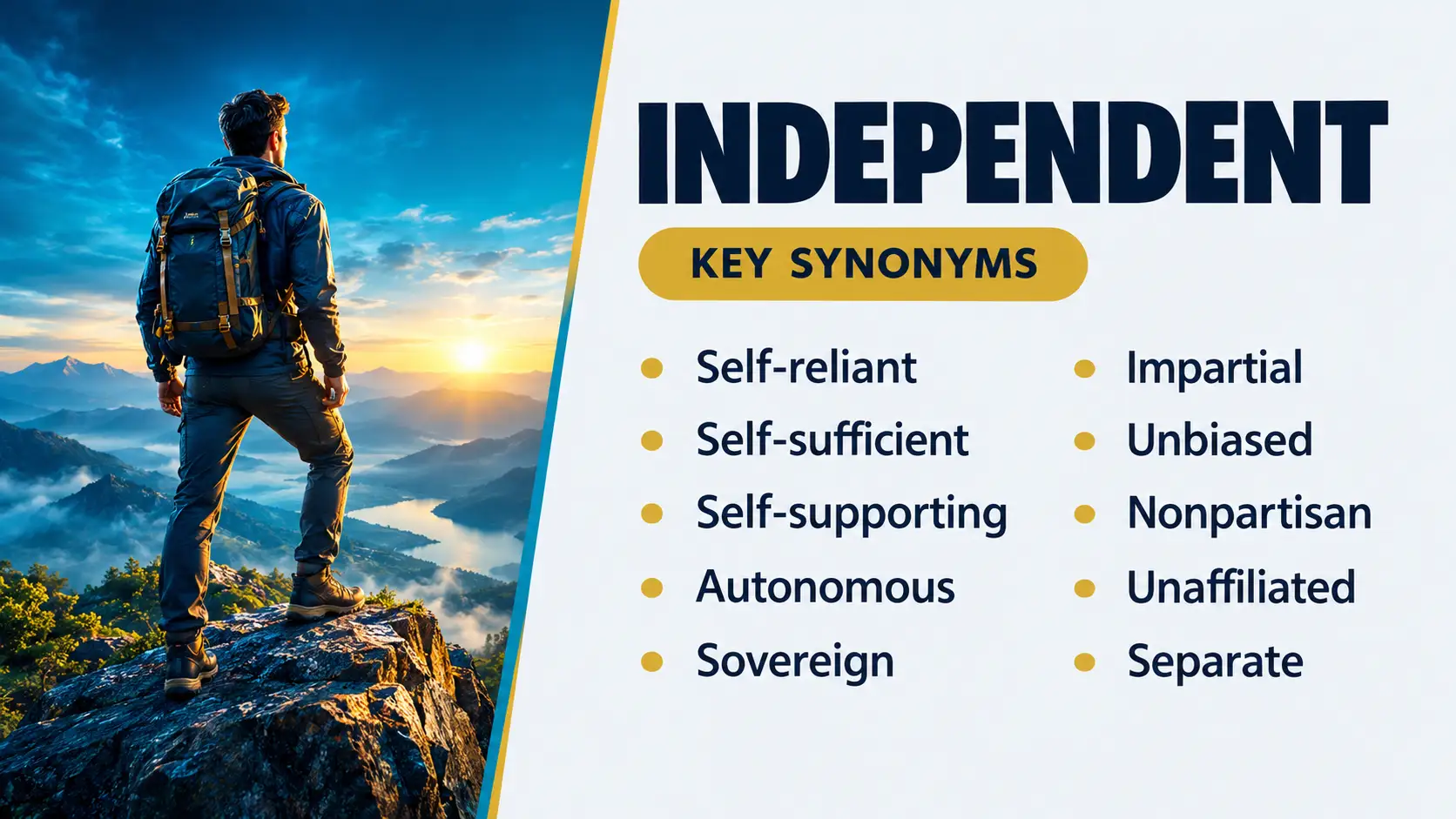
Another Word For Independent at a Glance
These are the ten strongest picks from the full list of 20 further down.
| # | Synonym | Meaning Difference |
| 1 | Self-reliant | Trusts its own skills to cope |
| 2 | Self-sufficient | Meets every need without outside supply |
| 3 | Self-supporting | Pays its own way; money only |
| 4 | Autonomous | Makes its own decisions, often inside a bigger group |
| 5 | Sovereign | Final authority; full national independence |
| 6 | Impartial | Fair to all sides |
| 7 | Unbiased | No personal leaning; everyday fairness |
| 8 | Nonpartisan | Tied to no political party |
| 9 | Unaffiliated | No official link to any group |
| 10 | Separate | Kept apart; not joined |
Quick Facts About Independent
| Fact | Detail |
| Part of speech | Adjective; also a noun (an independent) |
| Simple meaning | Free from control, help, or influence |
| Pronunciation | /ˌɪndɪˈpɛndənt/ |
| Syllables | 4 (in-de-pen-dent) |
| Word forms | independently, independence, independents |
| Formality | Neutral |
| Closest synonym | Self-reliant |
| Best used for | People, nations, institutions, reviews |
What Is the Closest Synonym for Independent?
The closest synonym for the most common everyday sense is self-reliant. It describes someone who trusts their own skills and judgment and solves problems without waiting for others to step in.
A self-reliant person is not someone who refuses help. They simply do not need it to get through the day. That is why the word sounds warm and admiring, closer to “capable” than to “stubborn.”
The difference from independent is one of focus. Independent can name a status (legally, financially, or politically independent). Self-reliant names a habit and an ability. A teenager may still depend on her parents for rent and yet be very self-reliant, because she cooks, budgets, and gets herself to school.
Try the swap test: “an independent traveler” becomes “a self-reliant traveler” with almost no change in meaning. But “an independent country” does not become “a self-reliant country,” because that talks about its economy, not its freedom. For countries and institutions, jump to sovereign or autonomous.
Word Origin and Etymology
Independent is built from in- (not) plus dependent. According to Etymonline, dependent comes from Old French and Latin dependere, “to hang from” (de-, down, plus pendere, to hang). So the picture behind the word is something that does not hang from something else.
Etymonline dates the English adjective to the 1610s, with the meaning “not dependent on something else.” French independant is recorded from around 1600 and Italian independente from the 1590s. In English the word was first used for churches and nations, and for people from the 1660s.
The meaning kept growing. By 1732 it could mean able to live well without working (the root of “independent means” in British English). By 1790 it also meant unbiased and unaffected by outside influence, which explains phrases like “independent review.” As a noun, it appears from the 1640s for a member of an independent congregational church, and from 1808 for a person who is not part of a political party. Source: Etymonline.
Can These Synonyms Be Used Interchangeably?
Usually: self-reliant, self-sufficient, and self-supporting can replace independent when you describe how well a person copes. Self-sufficient is stricter (every need is met), and self-supporting is about money only.
Sometimes: autonomous, self-governing, and self-directed work when the subject is a team, a body, or a choice. Autonomous and self-governing sound formal, so they feel stiff in casual talk.
Rarely: sovereign (states and rulers only), free, private, indie, and freelance each cover one narrow area. Use them only when that area is your point.
No: impartial and unbiased cannot replace independent when you mean self-reliant. “An impartial woman” and “an independent woman” say very different things.
Tone: for people, self-reliant, self-sufficient, self-directed, and autonomous all sound positive. Unaffiliated, neutral, and separate are simply descriptive; they do not praise or criticize.
Independent Has Several Meanings: Separate Synonym Sets
Dictionaries list several senses of independent. Keep the word sets apart, because mixing them is the most common way to choose the wrong word.
Sense 1: Able to manage without help (people and groups). Self-reliant, self-sufficient, self-supporting, self-directed. Tip: “self-independent” is redundant, because independent already means “on its own.”
Sense 2: Free from outside control or ownership (nations, institutions, businesses). Autonomous, self-governing, sovereign, free, private, indie, freelance.
Sense 3: Fair and unaffiliated (reviews, voters, sources, research). Impartial, unbiased, neutral, nonpartisan, unaffiliated, objective.
Sense 4: Separate or not connected (events, systems, products). Separate, unconnected, standalone.
Technical senses: “independent clause” (grammar) and “independent variable” (research and maths) are fixed terms with no everyday synonyms, so leave them as they are.
Detailed Synonym Meanings and Examples
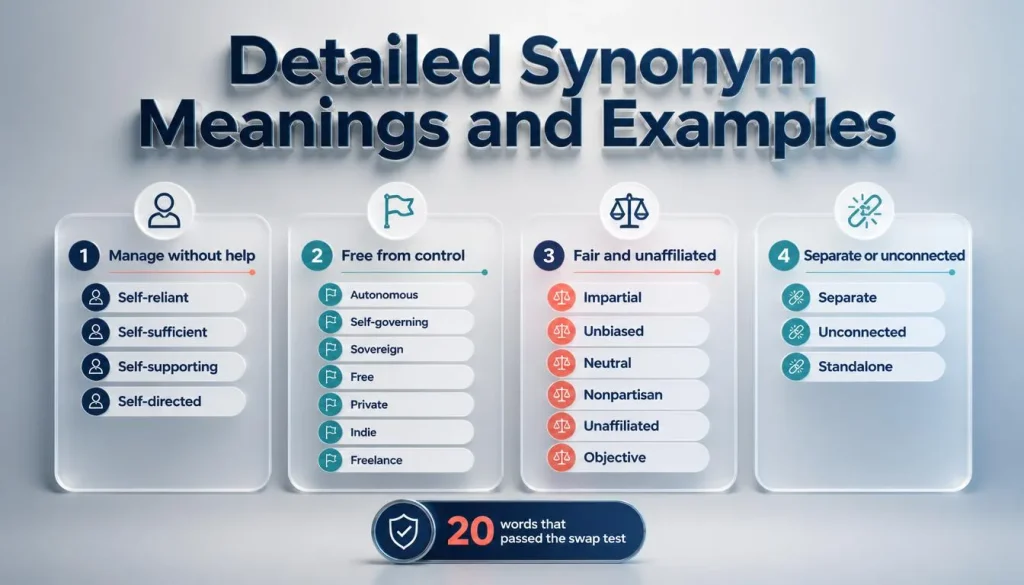
Every word below passed one test: it can replace independent in at least one real sentence without changing the core meaning. CEFR levels are approximate guides.
1. Self-reliant
Meaning: Covered in full in the closest-synonym section above.
Difference from Independent: Explained in that section; it centers on personal ability.
Best Used For: People and small groups that cope on their own.
Formality: Neutral
CEFR Level: B2
Frequency: Common
Examples:
- Living alone in a new city made Anaya more self-reliant: she learned to cook, repair, and budget for herself. (everyday life)
- The job ad asked for a self-reliant person who could run the shop without daily instructions. (workplace)
When NOT to Use It: Don’t use it for countries or fair reviews, because it only describes what one person or a small group can do.
2. Self-sufficient
Meaning: Able to provide everything it needs without buying from or asking others.
Difference from Independent: Stronger and more practical; it means every need is met, not just that nobody is in charge.
Best Used For: Farms, homes, communities, food, and energy.
Formality: Neutral
CEFR Level: C1
Frequency: Common
Examples:
- The family farm is almost self-sufficient: it grows its own vegetables, keeps hens, and cuts its own firewood. (farming)
- With solar panels and a battery, the cabin no longer needs the grid, so it is self-sufficient in power. (home energy)
When NOT to Use It: Don’t use it when you only mean free from control, since someone can be independent and still buy most of what they use.
3. Self-supporting
Meaning: Earning enough to pay one’s own way.
Difference from Independent: It is only about money; it says nothing about freedom of choice or character.
Best Used For: Personal finances, charities, and projects that must cover their costs.
Formality: Neutral
CEFR Level: C2
Frequency: Uncommon
Examples:
- After his first year as a plumber, Omar was self-supporting and no longer needed help with rent. (personal finance)
- The community theater hopes to become self-supporting through ticket sales within three years. (nonprofit)
When NOT to Use It: Don’t use it when the point is fairness or political freedom.
4. Self-directed
Meaning: Choosing one’s own goals and methods instead of following someone else’s orders.
Difference from Independent: It is about who sets the plan, not who pays the bills.
Best Used For: Learning, work habits, and personal development.
Formality: Neutral
CEFR Level: C1
Frequency: Uncommon
Examples:
- Online courses work best for self-directed learners who can set their own weekly schedule. (education)
- Our editors are self-directed: each one chooses their own stories every month. (workplace)
When NOT to Use It: Leave it out when you describe countries, judges, or reviewers.
5. Autonomous
Meaning: Free to make its own decisions and run its own affairs.
Difference from Independent: More formal; it often means self-rule inside a bigger group rather than total separation.
Best Used For: Regions, agencies, departments, and decision-making. In technology it also means “self-operating,” as in autonomous vehicles, so check the context.
Formality: Formal
CEFR Level: C1
Frequency: Common
Examples:
- Catalonia is an autonomous community of Spain with its own parliament. (politics)
- The research unit is autonomous: it chooses its own topics, even though the university pays its bills. (academia)
When NOT to Use It: It sounds stiff in casual talk, so don’t call your capable friend “an autonomous guy.”
6. Self-governing
Meaning: Making and enforcing its own rules.
Difference from Independent: Narrower and political; it says nothing about personal ability.
Best Used For: Territories, communities, and cooperatives.
Formality: Formal
CEFR Level: C2
Frequency: Uncommon
Examples:
- The island is self-governing in health and education but shares defense with the larger state. (politics)
- Residents run the housing cooperative as a self-governing group, voting on every major cost. (community)
When NOT to Use It: Never use it for one person.
7. Sovereign
Meaning: Having final authority over its own land and laws, with no higher power above it.
Difference from Independent: It signals full legal independence; a region that answers to a central government does not qualify.
Best Used For: Nations, states, and international law.
Formality: Formal
CEFR Level: C2
Frequency: Uncommon
Examples:
- Iceland has been a sovereign republic since 1944. (history)
- Under international law, every sovereign state can sign its own treaties. (international law)
When NOT to Use It: Don’t use it for ordinary people, businesses, or regions that sit under a central government.
8. Free
Meaning: Not ruled, held back, or controlled by someone else.
Difference from Independent: Wider and more emotional; it speaks about liberty and does not suggest self-reliance.
Best Used For: Political freedom, personal liberty, and contract-free status.
Formality: Neutral
CEFR Level: A1
Frequency: Very Common
Examples:
- After decades of foreign rule, citizens voted to become a free nation. (history)
- She is a free agent now: her contract has ended and no team owns her rights. (sport)
When NOT to Use It: Avoid it when you mean practical self-sufficiency, because “free” can also be read as “costing nothing.”
9. Impartial
Meaning: Fair to every side and favoring none.
Difference from Independent: It shifts the focus from freedom to fairness.
Best Used For: Judges, mediators, investigations, and official reviews.
Formality: Formal
CEFR Level: C1
Frequency: Uncommon
Examples:
- The judge was impartial because she had no link to either company. (legal)
- Teachers asked for an impartial review of the new grading rules. (education)
When NOT to Use It: Don’t use it for self-reliance or political freedom.
10. Unbiased
Meaning: Not leaning toward one side because of personal feelings.
Difference from Independent: Warmer and more everyday than impartial; it describes a person’s attitude or a study’s method.
Best Used For: Advice, opinions, samples, and data.
Formality: Neutral
CEFR Level: C1
Frequency: Common
Examples:
- Before you sign, get an unbiased opinion from someone who earns nothing from the deal. (consumer advice)
- The survey picked people at random to keep the sample unbiased. (research)
When NOT to Use It: Don’t use it for nations, businesses, or people who simply manage alone.
11. Neutral
Meaning: Not taking either side in a fight or disagreement.
Difference from Independent: It means staying out of it, while independent suggests real freedom from influence.
Best Used For: Mediators, countries during conflicts, and observers.
Formality: Neutral
CEFR Level: B2
Frequency: Very Common
Examples:
- Switzerland stayed neutral during both World Wars. (history)
- A neutral third person led the meeting so neither manager felt outvoted. (workplace)
When NOT to Use It: Avoid it when the point is self-rule or ability; neutral only says nobody is being favored.
12. Nonpartisan
Meaning: Not connected to or in favor of any political party.
Difference from Independent: It is strictly political.
Best Used For: Election guides, commissions, civic groups, and policy analysis.
Formality: Formal
CEFR Level: C2
Frequency: Uncommon
Examples:
- A nonpartisan group explains every ballot question in plain language. (civic)
- The cost estimates come from a nonpartisan office that serves both parties. (government)
When NOT to Use It: Don’t use it for business, personal, or financial independence.
13. Unaffiliated
Meaning: Having no official link to a group, party, or organization.
Difference from Independent: It states the lack of ties but does not promise fairness.
Best Used For: Voters, researchers, and groups with no parent body.
Formality: Neutral
CEFR Level: C2
Frequency: Uncommon
Examples:
- In some states, unaffiliated voters can choose which party’s primary ballot to use. (elections)
- The article was written by an unaffiliated researcher who works outside any university. (academic publishing)
When NOT to Use It: Don’t assume it means unbiased; a person with no affiliation can still hold strong views.
14. Objective
Meaning: Based on facts rather than feelings.
Difference from Independent: It describes how a conclusion is reached, not who controls the source.
Best Used For: Reports, assessments, and evaluations.
Formality: Formal
CEFR Level: C1
Frequency: Common
Examples:
- The inspector gave an objective report that listed each crack with a photo. (engineering)
- It’s hard to stay objective when your friend is one of the candidates. (workplace)
When NOT to Use It: Don’t use it to describe a person’s lifestyle or a country’s freedom.
15. Separate
Meaning: Kept apart rather than joined.
Difference from Independent: It stresses division; two separate things may still share the same boss or budget source.
Best Used For: Budgets, studies, departments, and accounts.
Formality: Neutral
CEFR Level: A2
Frequency: Very Common
Examples:
- Each team has a separate budget. (business)
- Two separate studies, using different people, found the same result. (research)
When NOT to Use It: Don’t use it to praise someone’s self-reliance; “a separate teenager” makes no sense.
16. Unconnected
Meaning: Not linked in any way.
Difference from Independent: It points to a missing link or shared cause.
Best Used For: Incidents, events, and investigations.
Formality: Neutral
CEFR Level: C1
Frequency: Uncommon
Examples:
- Police said the two thefts were unconnected. (news)
- The two server outages were unconnected: one was a storm, the other a software update. (IT operations)
When NOT to Use It: Don’t use it for self-reliance or fairness.
17. Standalone
Meaning: Able to work without any other product or system.
Difference from Independent: Technical and commercial rather than personal or political.
Best Used For: Devices, software, books, and services.
Formality: Neutral
CEFR Level: C1
Frequency: Common
Examples:
- This is a standalone speaker; it needs no app or hub. (consumer tech)
- You can read the last book as a standalone story. (publishing)
When NOT to Use It: Don’t use it for people or governments.
18. Freelance
Meaning: Working for yourself and getting paid job by job.
Difference from Independent: It describes how someone works, not what they are like.
Best Used For: Writers, designers, translators, and consultants.
Formality: Neutral
CEFR Level: B2
Frequency: Common
Examples:
- She is a freelance translator who takes projects from three agencies. (work)
- The magazine hires freelance photographers for its travel stories. (media)
When NOT to Use It: Don’t use it for institutions, opinions, or countries.
19. Private
Meaning: Owned and paid for by individuals or companies, not the government.
Difference from Independent: It focuses on ownership and funding; in British English, “independent school” and “private school” overlap.
Best Used For: Schools, clinics, and businesses outside the public sector.
Formality: Neutral
CEFR Level: B1
Frequency: Very Common
Examples:
- Her parents chose a private school with small classes. (education)
- The scans were done at a private clinic, not the state hospital. (healthcare)
When NOT to Use It: Avoid it when you mean fair or unbiased, because “private” can also mean secret.
20. Indie
Meaning: Made or run outside the big companies in its field.
Difference from Independent: An informal label from creative industries; it suggests a small, self-funded operation.
Best Used For: Music, film, games, publishing, and small shops.
Formality: Informal
CEFR Level: C2
Frequency: Common
Examples:
- The indie bookshop on the corner stocks local authors. (retail)
- Their first single came out on an indie label. (music)
When NOT to Use It: Keep it out of formal documents, and don’t assume it says anything about quality.
Best Alternatives by Context
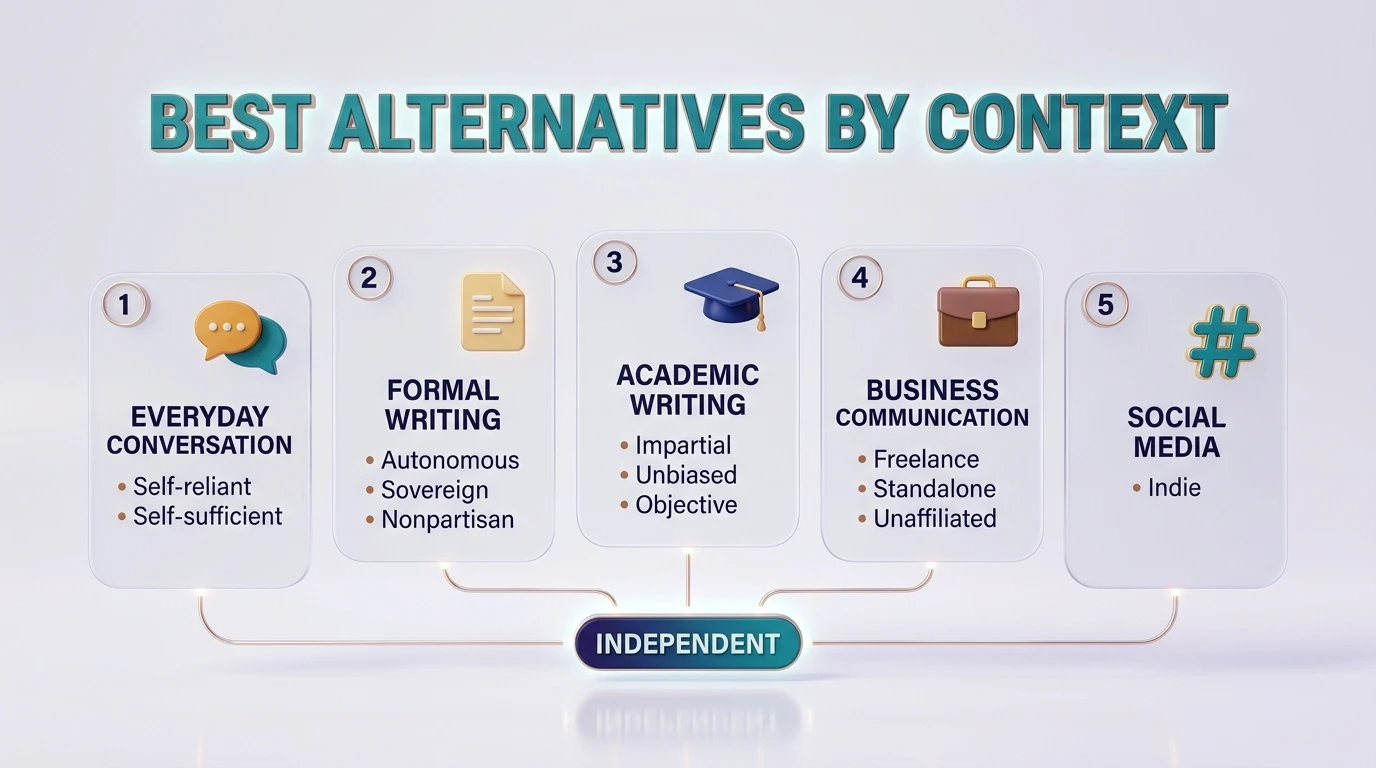
Everyday conversation: Self-reliant is the natural pick for a capable person, including an independent woman. Self-sufficient fits someone who truly covers all their own needs. To praise strongly, add a power word such as extraordinary: “extraordinary self-reliance” reads well.
Formal writing: Use autonomous or self-governing for institutions, sovereign for nations, and nonpartisan for political neutrality.
Academic writing: In research, there is no single synonym. Use impartial, unbiased, or objective for fair reviewers and methods, and separate or unconnected for independent samples or events. The phrase “independent variable” is a fixed term; fields use labels such as explanatory variable or predictor variable, but these are technical terms, not everyday synonyms.
Business communication: Freelance for individual contractors, standalone for products, self-sufficient for operations that need no outside supplier, and unaffiliated when you must state that no parent organization is involved.
Social media: Indie, as in indie shop, indie artist, or indie game.
Which Synonym Should I Choose?
| Situation | Best Choice | Why |
| A capable adult | Self-reliant | Highlights coping without help |
| A home or farm that needs nothing | Self-sufficient | Every need is met |
| Earning your own living | Self-supporting | Focuses on income |
| A region deciding for itself | Autonomous | Self-rule inside a larger whole |
| A fully recognized nation | Sovereign | Final authority over its territory |
| A review with no stake | Impartial | Signals fairness to all sides |
| A voter with no party | Unaffiliated | States there are no formal ties |
| A commission or news source | Nonpartisan | No party leaning |
| Two events with no link | Unconnected | Points to no relationship |
| Software that runs alone | Standalone | Needs no other product |
| A self-employed worker | Freelance | Paid job by job |
| Crossword answer, five letters | Indie | The only strong five-letter match |
Exact and Near Synonyms: What Is the Difference?
True synonyms are rare because words rarely share the same scope, tone, and attitude. Independent is a good example: it is one word doing four jobs, and each synonym handles only one of them. Self-reliant covers personal ability. Sovereign covers political power. Impartial covers fairness. Separate covers distance.
Scope changes meaning, too. Self-sufficient asks for more than self-reliant, because every need must be met. Tone changes the effect: autonomous sounds official, while self-reliant sounds personal. Even a review can show the gap. An independent review may be impartial, but an independent variable can never be called an “impartial variable.” Treat synonyms as close neighbors and choose the one that fits your sentence.
Words Commonly Confused with Independent
These words often appear near independent, but they failed the swap test, so they are not true synonyms.
| Word | Why It Isn’t a True Synonym |
| Individualistic | Puts self above the group |
| Headstrong | Means stubborn, not capable |
| Rebellious | Resists authority; independence needs no rebellion |
| Nonconformist | Breaks norms; says nothing about self-reliance |
| Free-spirited | Describes mood and lifestyle only |
| Isolated | Means cut off, often lonely |
| Solitary | Means being alone, not coping alone |
| Aloof | Emotionally distant, not self-reliant |
| Confident | Self-assured but may still rely on others |
| Unattached | Usually means not in a relationship |
| Self-made | Means success without inherited help |
| External | Says “from outside,” not “free of bias” |
Independence also does not mean being cold. A person can be fully self-reliant and still show deep empathy toward others.
Common Mistakes
| Mistake | Better | Why |
| “She’s a self-independent woman.” | “She’s independent.” or “self-reliant.” | “Self” is already built in |
| “Independent people prefer to be isolated.” | “…prefer to be self-reliant.” | Independent doesn’t mean alone |
| “The country became self-reliant in 1960.” | “…became sovereign.” | Self-reliant is about ability, not status |
| “The inspector was self-sufficient.” | “The inspector was impartial.” | Fairness, not supplies, is meant |
| “He’s so independent, he’s aloof.” | “He’s so aloof…” | Distance is not independence |
One more point: feeling conflicted about asking for help does not make someone dependent. They can still be perfectly self-reliant.
Antonyms of Independent
1st Sense : Self-reliant (people and groups)
| # | Antonym | Why It’s the Opposite |
| 1 | Dependent | Relies on others for support |
| 2 | Reliant | Leans on someone or something |
| 3 | Helpless | Cannot cope without help |
| 4 | Needy | Constantly needs support or attention |
| 5 | Clingy | Won’t cope without another’s presence |
| 6 | Codependent | Each person relies on the other |
2nd Sense : Free from outside control
| # | Antonym | Why It’s the Opposite |
| 1 | Dependent | Answers to a higher authority |
| 2 | Subordinate | Ranks beneath another body |
| 3 | Subject | Lives under another’s rule |
| 4 | Controlled | Managed by an outside party |
| 5 | Subservient | Obeys another’s wishes |
| 6 | Dominated | Overpowered by a stronger party |
3rd Sense : Fair and unaffiliated
| # | Antonym | Why It’s the Opposite |
| 1 | Biased | Leans toward one side |
| 2 | Partisan | Backs a party or cause |
| 3 | Partial | Favors one side unfairly |
| 4 | Prejudiced | Judges before weighing facts |
| 5 | Affiliated | Officially tied to a group |
| 6 | One-sided | Shows only one view |
4th Sense : Separate or unconnected
| # | Antonym | Why It’s the Opposite |
| 1 | Dependent | Result hinges on something else |
| 2 | Interdependent | Each part relies on the other |
| 3 | Connected | Joined by a link |
| 4 | Related | Shares a relationship or cause |
| 5 | Linked | Tied together directly |
| 6 | Interconnected | Linked in many directions |
American vs British English
Spelling and pronunciation are the same in both. The differences are in use. In British English, independent school usually means a fee-paying private school, while Americans more often say private school. In politics, an independent in the United States is often a voter with no party registration; in Britain the word more often describes a candidate or member of parliament who stands without a party.
British dictionaries, such as the ones summarized on Dictionary.com, also record independent means or independent income: a private income large enough to live on without working. Indie is understood on both sides of the Atlantic.
Real-World Collocations and Phrases
Part A: Common collocations
| Pattern | Examples |
| Verb + independent | remain independent, become independent, stay independent |
| Independent + noun | independent study, research, review, investigation, adviser, auditor, contractor, business, school, voter |
| Adverb + independent | fully, completely, financially, politically, fiercely independent |
| Independent + preposition | independent of, independent from |
| Adverb forms | think independently, work independently, live independently, independently owned |
Part B: Idioms and set phrases
- Stand on your own two feet: to support yourself without help.
- Fend for yourself: to manage on your own with no one looking after you.
- Cut the apron strings: to stop relying on a parent.
- Go it alone: to do something without partners or support.
- Be your own person: to think and act by your own judgment.
- Independent means: a private income big enough to live on (British).
- Free and independent states: wording from the United States Declaration of Independence, which marked its 250th anniversary in 2026.
Practice Exercises
Fill in the blanks (5)
Word bank: self-reliant, autonomous, impartial, sovereign, unaffiliated, standalone.
- After two years of cooking, budgeting, and fixing things alone, Zara felt truly ______.
- The design team is ______: it picks its own projects, even though the company pays for it.
- Both firms agreed to hire an ______ judge with no link to either side.
- The treaty recognized the republic as a ______ state.
- Many ______ voters decide which candidate to support only in the final week.
Rewrite the sentences (3)
Replace independent with a more exact word.
- She is an independent teenager who manages her own time and chores.
- We need an independent inspector who has no stake in the sale.
- The two departments are independent of each other and keep their own files.
Match the words (5)
| Word | Best Situation |
| 1. Self-sufficient | A. A designer taking projects from many clients |
| 2. Freelance | B. Two events with no link |
| 3. Nonpartisan | C. A farm that grows all its own food |
| 4. Sovereign | D. An election guide with no party leaning |
| 5. Unconnected | E. A recognized nation with its own government |
Vocabulary quiz (5)
- Which word best fits “an independent country that rules itself fully”? (a) impartial (b) sovereign (c) freelance (d) standalone
- Which word suits “an independent review with no stake in the result”? (a) autonomous (b) impartial (c) self-reliant (d) private
- In British English, “independent school” most nearly means: (a) private school (b) unconnected school (c) neutral school (d) nonpartisan school
- Which is NOT a synonym of independent? (a) self-sufficient (b) autonomous (c) aloof (d) unaffiliated
- Which is the opposite of independent in the self-reliant sense? (a) dependent (b) neutral (c) sovereign (d) separate
Answer key
Fill in the blanks: 1. self-reliant; 2. autonomous; 3. impartial; 4. sovereign; 5. unaffiliated.
Rewrite: 1. self-reliant teenager; 2. impartial (or unbiased) inspector; 3. separate from each other.
Match: 1-C, 2-A, 3-D, 4-E, 5-B.
Quiz: 1-b, 2-b, 3-a, 4-c, 5-a.
FAQ
What is the closest synonym for independent?
Self-reliant is the closest everyday synonym when you mean a person who can manage without help. If you mean a country, sovereign fits better, and for a region or team that makes its own decisions, use autonomous. For a fair review, impartial is best. The right word depends on what the thing is free from.
Can independent and autonomous be used interchangeably?
Sometimes. Both fit a department, region, or agency that makes its own choices. Autonomous usually means self-rule inside a larger group, while independent can mean fully separate. Autonomous also sounds formal, so it feels stiff when you describe a person in everyday speech. For people, self-reliant or independent usually sounds more natural.
What does independent mean in simple words?
Independent means not controlled, helped, or influenced by someone else. For a person, it means you can manage on your own. For a country, it means it rules itself. A review or voter, it means no side or party. For two things, it means they have no link. Context tells you which meaning is used.
Is independent a formal or informal word?
Independent is neutral, so you can use it in emails, essays, and daily conversation. Some synonyms are more formal: autonomous, sovereign, nonpartisan, and impartial suit reports and legal or academic writing. Self-reliant and freelance sit in the middle, and indie is informal. Choose the word that matches your audience.
What is a good word for an independent woman?
Self-reliant is a warm, clear choice: it praises a woman who handles life on her own terms. Self-sufficient stresses meeting all her own needs, and self-directed suits someone who sets her own goals. Avoid unattached or solitary, because those words describe relationship status or being alone, not independence.
What is the opposite of independent?
The most common opposite is dependent, which means relying on others for support. Other opposites depend on the meaning: subordinate or subject for something controlled by others, biased or partisan for a fair reviewer, and interdependent or connected for separate things. Pick the opposite that matches the sense you are using.
Conclusion
The best synonym for independent is the one that answers a single question: free from what? Once you know whether you mean help, rule, bias, or connection, the right word is easy to find, and your reader understands you at once.
That small choice can make a profound difference to how clear and trustworthy your writing feels.

About Sajjad Ahmed
Sajjad Ahmed is the author behind Guest Paster, where he writes about English vocabulary, synonyms, word meanings, and practical word usage.
His content is designed to help readers understand the differences between similar words, discover suitable alternatives, and use English vocabulary more effectively in everyday writing and communication.
Before publishing, Sajjad focuses on presenting word choices in a clear and easy-to-understand format, with relevant meanings, context, and examples where helpful.
Through Guest Paster, his goal is to make vocabulary learning simpler and provide useful language resources for students, writers, English learners, and anyone looking to expand their vocabulary.
Areas of Focus: English Vocabulary • Synonyms • Word Meanings • Word Usage • Language Learning
Author: Sajjad Ahmed
Website: Guest Paster