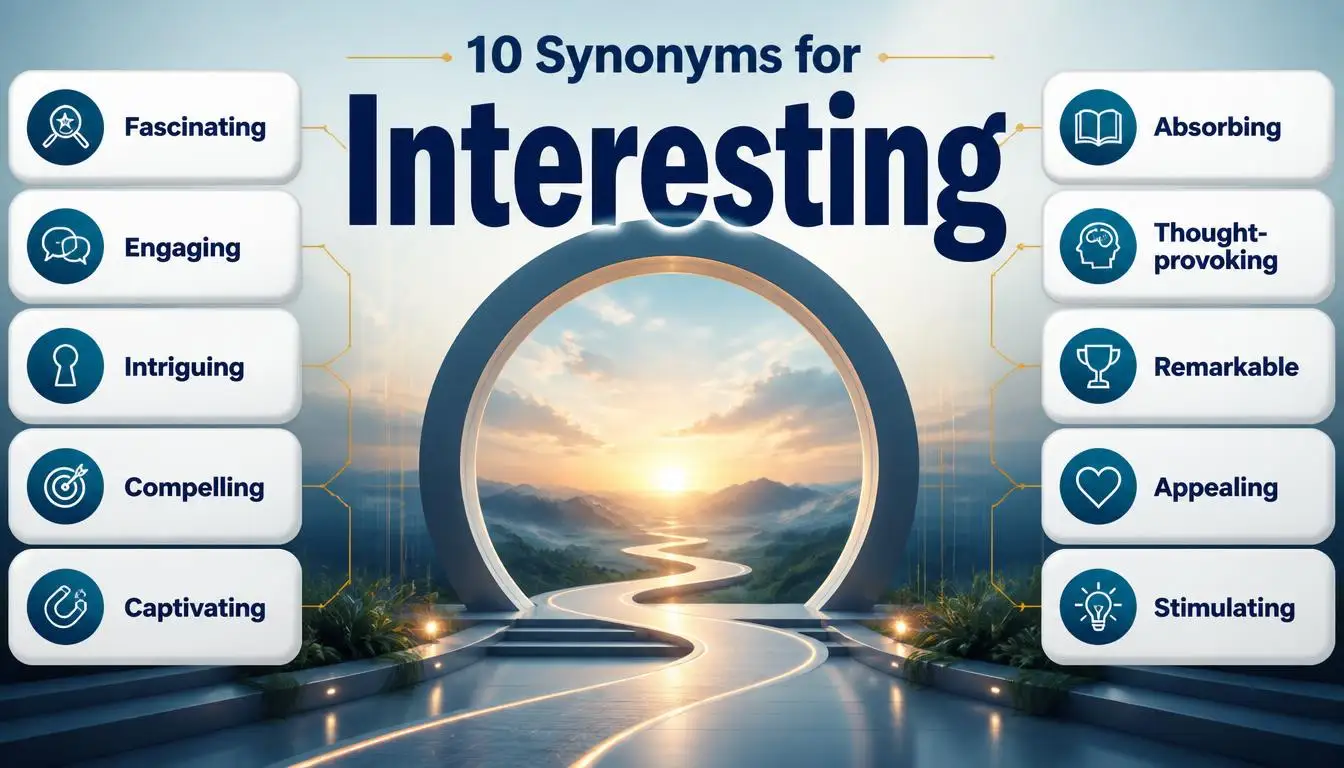
“Interesting” means attracting attention because something is unusual, engaging, important, surprising, or worth thinking about. The closest synonyms for interesting include fascinating, engaging, intriguing, compelling, absorbing, captivating, and thought-provoking. However, the best replacement depends on the exact meaning you want: a person can be fascinating, an idea can be thought-provoking, and a story can be captivating.
For example, “The documentary was interesting” could mean it was informative, exciting, surprising, or emotionally powerful. Choosing a more specific synonym makes your writing clearer and more expressive.
Best Synonyms for Interesting
| Synonym | Relationship | Swap Rating | Formality | Best Used For |
| Fascinating | Near Synonym | Drop-in | Neutral | Ideas, stories, discoveries |
| Engaging | Near Synonym | Drop-in | Neutral | Conversations, books, presentations |
| Intriguing | Near Synonym | Drop-in | Neutral | Mysteries, questions, unusual topics |
| Compelling | Near Synonym | Minor rewrite | Neutral/Formal | Arguments, stories, evidence |
| Captivating | Near Synonym | Drop-in | Neutral | Stories, performances, experiences |
| Absorbing | Near Synonym | Drop-in | Neutral | Books, films, activities |
| Thought-provoking | Contextual Alternative | Minor rewrite | Formal | Ideas, discussions, research |
| Remarkable | Contextual Alternative | Minor rewrite | Neutral/Formal | Achievements, events, qualities |
| Appealing | Contextual Alternative | Minor rewrite | Neutral | Preferences, designs, choices |
| Stimulating | Near Synonym | Minor rewrite | Formal | Intellectual activities, discussions |
Quick Facts About “Interesting”
- Word: Interesting
- Part of speech: Adjective
- Simple meaning: Causing someone to notice, enjoy, think about, or care about something.
- Pronunciation: IN-truh-sting
- Syllables: 3 (in-ter-est-ing)
- Formality: Neutral
- Common uses: Describing ideas, people, experiences, information, conversations, books, movies, and events.
- Example sentence: The professor presented an interesting explanation of how artificial intelligence works.
Interesting Meaning and Usage
“Interesting” is a broad adjective used when something captures attention or creates curiosity. It does not always mean something is enjoyable. A topic can be interesting because it is exciting, unusual, surprising, useful, or even concerning.
Compare:
- The movie was interesting.
→ It caught my attention, but the reason is unclear. - The movie was captivating.
→ It held my attention strongly. - The movie was disturbing but fascinating.
→ It was unusual and made me think deeply.
Because “interesting” is general, stronger vocabulary often improves writing by explaining why something attracts attention.
Synonyms Of Interesting
1. Fascinating
Relationship: Near Synonym
Swap Rating: Drop-in
Formality: Neutral
Meaning: Extremely interesting because something is unusual, impressive, or worth exploring.
Nuance:
“Fascinating” is stronger than “interesting.” It suggests curiosity and a desire to learn more.
Best used for:
Science, history, discoveries, people, ideas, and stories.
Example:
The scientist shared a fascinating explanation of how animals communicate.
2. Engaging
Relationship: Near Synonym
Swap Rating: Drop-in
Formality: Neutral
Meaning: Holding someone’s attention and making them want to continue listening, reading, or participating.
Nuance:
“Engaging” focuses on interaction and attention. A speaker, teacher, book, or activity can be engaging.
Best used for:
Presentations, conversations, lessons, writing, and entertainment.
Example:
The teacher used engaging activities to help students understand difficult concepts.
3. Intriguing
Relationship: Near Synonym
Swap Rating: Drop-in
Formality: Neutral
Meaning: Interesting because something is mysterious, unexpected, or raises questions.
Nuance:
“Intriguing” creates curiosity. It often suggests that there is something not fully understood.
Best used for:
Mysteries, theories, unusual events, and discoveries.
Example:
Researchers found an intriguing pattern in the ancient documents.
4. Compelling
Relationship: Near Synonym
Swap Rating: Minor rewrite
Formality: Neutral/Formal
Meaning: So interesting or convincing that it strongly attracts attention.
Nuance:
“Compelling” often includes a sense of power or influence. It is common with arguments, evidence, and stories.
Best used for:
Arguments, evidence, journalism, and narratives.
Example:
The journalist presented compelling evidence about the environmental problem.
5. Captivating
Relationship: Near Synonym
Swap Rating: Drop-in
Formality: Neutral
Meaning: Holding attention completely because something is beautiful, exciting, or impressive.
Nuance:
“Captivating” is stronger and more emotional than “interesting.”
Best used for:
Performances, scenery, stories, and experiences.
Example:
The singer gave a captivating performance that impressed the audience.
6. Absorbing
Relationship: Near Synonym
Swap Rating: Drop-in
Formality: Neutral
Meaning: So interesting that it takes up your full attention.
Nuance:
“Absorbing” suggests deep involvement rather than excitement.
Best used for:
Books, movies, research, and activities.
Example:
She spent the weekend reading an absorbing historical novel.
7. Thought-provoking
Relationship: Contextual Alternative
Swap Rating: Minor rewrite
Formality: Formal/Neutral
Meaning: Making people think deeply about a subject.
Nuance:
This does not simply mean entertaining. It emphasizes reflection and ideas.
Best used for:
Articles, speeches, films, books, and discussions.
Example:
The documentary raised thought-provoking questions about technology and society.
8. Stimulating
Relationship: Near Synonym
Swap Rating: Minor rewrite
Formality: Formal
Meaning: Encouraging interest, excitement, or mental activity.
Nuance:
“Stimulating” often relates to intellectual or creative energy.
Best used for:
Conversations, debates, classes, and experiences.
Example:
The conference provided stimulating discussions about future inventions.
9. Remarkable
Relationship: Contextual Alternative
Swap Rating: New sentence needed
Formality: Neutral/Formal
Meaning: Unusual or impressive enough to deserve attention.
Nuance:
Something remarkable is notable, but not always interesting in the sense of curiosity.
Best used for:
Achievements, events, abilities, and accomplishments.
Example:
The athlete made a remarkable recovery after the injury.
10. Entertaining
Relationship: Contextual Alternative
Swap Rating: Minor rewrite
Formality: Neutral
Meaning: Providing enjoyment or amusement.
Nuance:
Entertainment is one type of interest, but not all interesting things are entertaining.
Best used for:
Movies, performances, conversations, and activities.
Example:
The comedian delivered an entertaining show.
11. Exciting
Relationship: Contextual Alternative
Swap Rating: Minor rewrite
Formality: Neutral
Meaning: Creating enthusiasm or strong emotions.
Nuance:
“Exciting” suggests energy and emotion, while “interesting” can be calm or intellectual.
Best used for:
Events, news, opportunities, and adventures.
Example:
The company announced an exciting new product launch.
12. Appealing
Relationship: Contextual Alternative
Swap Rating: Minor rewrite
Formality: Neutral
Meaning: Attractive or pleasing.
Nuance:
“Appealing” focuses on personal preference rather than curiosity.
Best used for:
Ideas, designs, choices, and offers.
Example:
The simple design made the website more appealing to users.
13. Noteworthy
Relationship: Contextual Alternative
Swap Rating: Minor rewrite
Formality: Formal
Meaning: Important or deserving attention.
Nuance:
Something noteworthy may be interesting because it matters, not because it is entertaining.
Best used for:
Reports, academic writing, and professional communication.
Example:
The study revealed several noteworthy findings.
14. Original
Relationship: Contextual Alternative
Swap Rating: New sentence needed
Formality: Neutral
Meaning: New, creative, or unlike existing examples.
Nuance:
Original things can be interesting because they are different, but the words are not interchangeable.
Best used for:
Ideas, designs, art, and inventions.
Example:
The artist developed an original approach to modern sculpture.
15. Unusual
Relationship: Contextual Alternative
Swap Rating: Minor rewrite
Formality: Neutral
Meaning: Different from what is normal or expected.
Nuance:
Unusual things often attract attention, but they are not always interesting.
Best used for:
Events, behavior, objects, and situations.
Example:
The researchers observed unusual changes in the weather pattern.
Best Words to Use Instead of Interesting
In Everyday Conversation
- Cool — casual and common for something impressive or enjoyable.
- Fascinating — better when something creates curiosity.
- Intriguing — useful when something makes you wonder.
Formal Writing
- Compelling — for strong arguments or evidence.
- Noteworthy — for important facts or results.
- Significant — when importance matters more than entertainment.
In Academic Writing
- Thought-provoking — for ideas that encourage deeper analysis.
- Stimulating — for intellectual discussion.
- Remarkable — for unusual findings or achievements.
Creative Writing
- Captivating — for emotional impact.
- Absorbing — for stories and experiences.
- Fascinating — for discoveries and characters.
Exact and Near Synonyms: What’s the Difference?
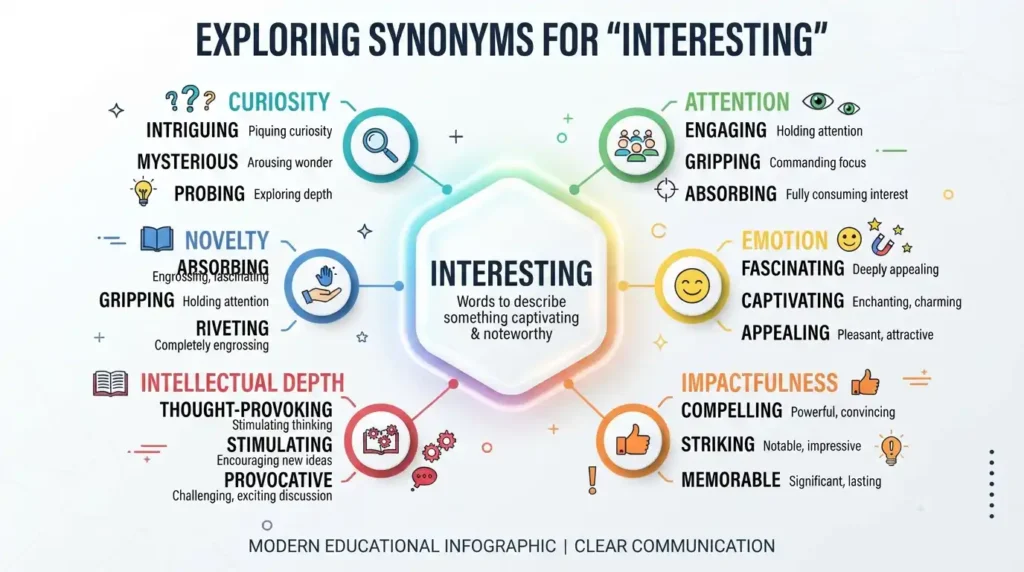
Most synonyms for “interesting” are not perfect replacements. Words like fascinating, engaging, and intriguing share the idea of attracting attention, but they highlight different reasons.
- Fascinating suggests curiosity and wonder.
- Engaging suggests active attention and involvement.
- Intriguing suggests mystery or questions.
- Compelling suggests strong influence or importance.
The right choice depends on the feeling you want to communicate.
Words Commonly Confused With Interesting
Important
Difference:
Something important has value or significance, but it may not be interesting.
Example:
Climate change is an important issue.
Fun
Difference:
Fun means enjoyable, while interesting means attention-grabbing.
Example:
The science experiment was fun and educational.
Good
Difference:
Good expresses approval but does not explain why something attracts attention.
Example:
She gave a good presentation with clear explanations.
Antonyms of Interesting
| Antonym | Simple Meaning | Example Sentence |
| Boring | Not interesting or enjoyable | The lecture was boring. |
| Dull | Lacking excitement or energy | The conversation became dull. |
| Ordinary | Normal and not unusual | It was an ordinary day. |
| Unremarkable | Not worth special attention | The building was unremarkable. |
| Tedious | Long and tiring because it is repetitive | The task became tedious. |
Common Phrases and Collocations With Interesting
Interesting idea — a thought or suggestion worth considering.
Example: She proposed an interesting idea during the meeting.
Interesting fact — a piece of information that attracts attention.
Example: Here is an interesting fact about human memory.
Interesting perspective — a unique way of viewing something.
Example: The author provides an interesting perspective on education.
Interesting conversation — a discussion with engaging content.
Example: We had an interesting conversation about travel.
Interesting discovery — a finding that creates curiosity.
Example: Scientists made an interesting discovery during the research.
Frequently Asked Questions
How do you say “interesting” in a good way?
Use stronger words such as fascinating, captivating, engaging, compelling, or impressive depending on the situation. “Fascinating” works well for ideas and discoveries, while “captivating” is better for stories and performances.
What is another word for very interesting?
Good choices include fascinating, captivating, absorbing, compelling, and extraordinary. The strongest option depends on whether you mean exciting, surprising, beautiful, or intellectually stimulating.
What can I say instead of “it’s interesting”?
You can say: “It’s fascinating,” “That’s intriguing,” “That’s a thought-provoking idea,” or “That’s a compelling point.” Each phrase gives a clearer impression.
What is an academic synonym for interesting?
Academic alternatives include significant, noteworthy, compelling, thought-provoking, and stimulating. Academic writing usually benefits from specific words rather than the general adjective “interesting.”
Is fascinating stronger than interesting?
Yes. “Fascinating” usually suggests a much higher level of interest. Something fascinating strongly attracts curiosity and attention.
Conclusion
Choosing the right synonym for “interesting” depends on the exact quality you want to describe. Fascinating emphasizes curiosity, engaging emphasizes attention, intriguing emphasizes mystery, and thought-provoking emphasizes deeper thinking.
Using precise alternatives helps your writing and speaking communicate not only that something attracts attention, but why it does.

About Sajjad Ahmed
Sajjad Ahmed is the author behind Guest Paster, where he writes about English vocabulary, synonyms, word meanings, and practical word usage.
His content is designed to help readers understand the differences between similar words, discover suitable alternatives, and use English vocabulary more effectively in everyday writing and communication.
Before publishing, Sajjad focuses on presenting word choices in a clear and easy-to-understand format, with relevant meanings, context, and examples where helpful.
Through Guest Paster, his goal is to make vocabulary learning simpler and provide useful language resources for students, writers, English learners, and anyone looking to expand their vocabulary.
Areas of Focus: English Vocabulary • Synonyms • Word Meanings • Word Usage • Language Learning
Author: Sajjad Ahmed
Website: Guest Paster