
Finding good control synonyms is harder than it looks, because control does several different jobs in English. It can mean running something day to day, as in “she controls the budget.” It can mean holding something back, as in “control your temper.” And as a noun, it can mean power itself, as in “the company lost control of the market.” Each job needs a different replacement, so one swap almost never works for every sentence.
The closest synonym for control is manage, it covers running something in an orderly way. When control means strict rules or force, regulate or command fits better. This guide sorts 18 control synonyms by meaning, so you can pick the right word.
Top 10 Control Synonyms at a Glance
| # | Synonym | Meaning Difference |
| 1 | Manage | To run something in an orderly, practical way (verb) |
| 2 | Regulate | To control by rules, limits, or standards |
| 3 | Direct | To guide people or work toward a goal |
| 4 | Govern | To rule or administer with formal authority |
| 5 | Oversee | To supervise work without doing every task yourself |
| 6 | Command | To be in charge, often with firm authority |
| 7 | Dominate | To hold the strongest position over others |
| 8 | Restrain | To hold back an action, feeling, or movement |
| 9 | Authority | The power or right to make decisions (noun) |
| 10 | Command (noun) | Control over people or a situation, as a noun |
Quick Facts About “Control”
- Part of speech: both a verb (control spending) and a noun (take control).
- Three core meanings: (1) run or direct something, (2) hold back or limit something, (3) power or authority over something.
- Register: neutral. Control works in business, science, government, and everyday conversation.
- Watch out: control can sound cold or strict. In friendly writing, manage or oversee often sounds kinder than control.
The Closest Synonym: Manage
Manage is the closest synonym for control because it covers the word’s most common job: keeping something running smoothly. When a teacher manages a classroom, a manager manages a team, or a driver manages a difficult road, the real action is control without drama. Things stay on track, problems get handled, and nothing falls apart.
Still, the two words are not identical. Manage suggests coping well and getting things done, even with limited time or money. Control suggests stronger authority, or a tighter grip. A pilot controls a plane in a storm, she does not merely manage it. A parent manages a busy morning, but a government controls a border. Use manage for everyday running, and keep control (or a stronger word below) when real authority or force is involved.
Finally, remember the noun trap. Manage is only a verb, so it can never replace control in “she took control of the project.” For that job, skip ahead to authority and command in Group 3 below.
Where “Control” Comes From (Etymology)
According to Etymonline, control began as a word about checking accounts. In the early 15th century, countrollen meant “check the accuracy of, verify, regulate.” It came from Anglo-French contreroller, “exert authority,” from Medieval Latin contrarotulus, “a counter register,” built from Latin contra, “against,” plus rotulus, a small roll or wheel. The picture behind it is a duplicate register: one list checked against another, so no error could slip through.
The sense of “dominate, direct, exercise control over” arrived by the mid-15th century. That history explains the word’s double nature today. Control still carries both ideas at once: careful checking, and firm authority. The noun sense of a device that operates a machine, like a remote control, and the scientific control group, attested from 1952, both grow from that same checking idea.
Can You Swap Them Freely?
In short: only inside the same meaning group. A running word collapses in a holding-back sentence, and a power noun collapses in a verb sentence:
- “She manages a team of twelve.” (verb, running something)
- “She restrains a team of twelve.” (restrain means hold back, not run, say manage or direct)
- “The new rules regulate online advertising.” (verb, rules)
- “The new rules are the authority of online advertising.” (authority is a noun, and the wrong job here, say regulate)
Before you substitute, ask one question: am I running something, holding something back, or naming power? Running takes a Group 1 word, holding back takes a Group 2 word, and naming power takes a Group 3 word.
Control Synonyms in Detail
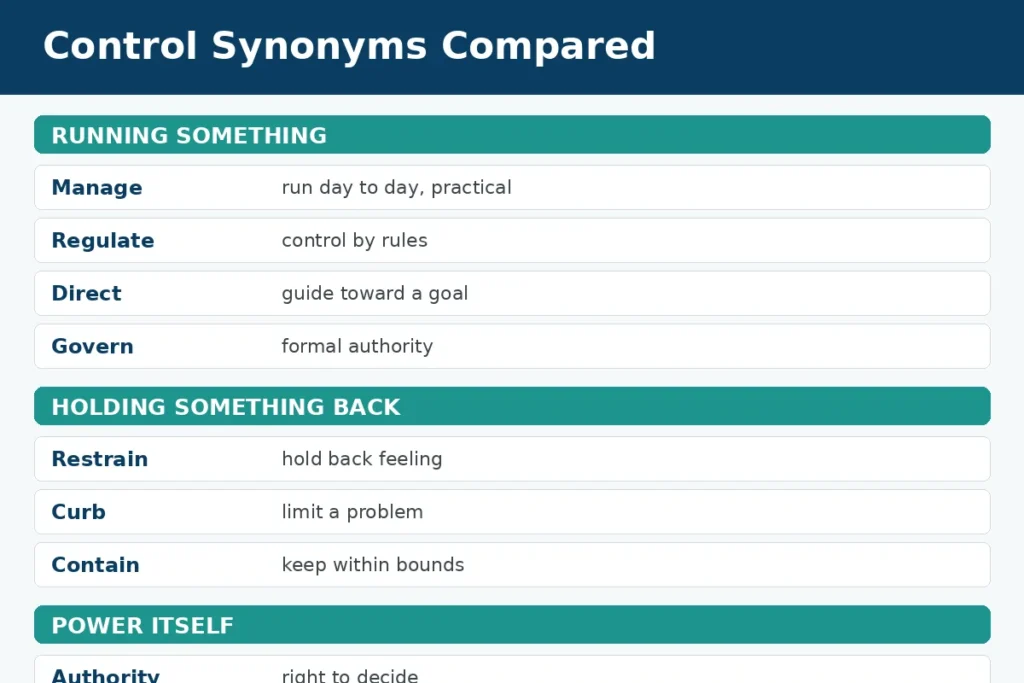
Group 1: Control as Running or Directing Something
1. Manage
- Meaning: To run a person, team, project, or situation in a practical, orderly way.
- Difference: The closest all-round match for everyday control. Manage stresses getting things done, not issuing orders.
- Best used for: Work, teams, budgets, schedules, daily life.
- Formality: Neutral, CEFR: B1, Frequency: Very common
- Example (Work): “She manages the store’s weekly schedule and stock orders.”
- Example (Everyday): “He managed the trip with two kids, one dog, and no phone signal.”
- When NOT to use it: For formal legal authority. A court does not “manage” a law, it enforces or regulates it.
2. Regulate
- Meaning: To control something by rules, limits, standards, or official decisions.
- Difference: Regulate is control through a system. It fits laws, markets, and safety rules, not people you supervise face to face.
- Best used for: Government, finance, health, safety, industry.
- Formality: Formal, CEFR: B2, Frequency: Common
- Example (Formal): “The agency regulates food labeling across the country.”
- Example (News): “New rules will regulate how apps collect location data.”
- When NOT to use it: For personal effort. You do not “regulate” your own temper, you restrain or control it.
3. Direct
- Meaning: To guide people, work, or attention toward a goal, often by giving instructions.
- Difference: Direct is control with a destination. A director points the way, a manager keeps the machine running.
- Best used for: Projects, films, traffic, questions, teams.
- Formality: Neutral, CEFR: B2, Frequency: Very common
- Example (Work): “She directs a team that builds training videos.”
- Example (Everyday): “Please direct all questions to the front desk.”
- When NOT to use it: For holding something back. Directing is forward motion, not restraint. (Note the overlap with coordination: directing a project well usually means coordinating the people in it.)
4. Govern
- Meaning: To rule, administer, or exercise formal authority over a place, group, or system.
- Difference: Govern is the official, institutional version of control. It implies laws, offices, and public responsibility.
- Best used for: Countries, states, institutions, formal writing.
- Formality: Formal, CEFR: C1, Frequency: Common
- Example (Formal): “The council governs planning decisions for the whole district.”
- Example (News): “Trade rules govern how the two countries exchange goods.”
- When NOT to use it: For small, everyday jobs. Nobody “governs” a household budget, they manage it.
5. Oversee
- Meaning: To supervise work or a project, checking progress without doing every task yourself.
- Difference: Oversee is lighter than direct. The overseer watches, advises, and steps in when needed, but the team does the work.
- Best used for: Management, construction, audits, volunteer projects.
- Formality: Neutral, CEFR: B2, Frequency: Common
- Example (Work): “He oversees safety checks at three factory sites.”
- Example (Everyday): “A parent volunteer oversees the school fair stalls.”
- When NOT to use it: When you are doing the job yourself. Overseeing means standing slightly above the work, not inside it.
6. Supervise
- Meaning: To watch over people or work and make sure it is done correctly.
- Difference: Supervise is closer to the ground than oversee. A supervisor is usually present, gives feedback, and answers questions on the spot.
- Best used for: Workplaces, schools, training, childcare.
- Formality: Neutral, CEFR: B2, Frequency: Common
- Example (Work): “She supervises six new staff members during their first month.”
- Example (Everyday): “Children must be supervised near the pool at all times.”
- When NOT to use it: For abstract systems. You supervise people, you regulate markets.
7. Administer
- Meaning: To manage the practical running of an organization, system, or program, often officially.
- Difference: Administer stresses process and paperwork: forms, funds, schedules, and rules, handled properly.
- Best used for: Offices, schools, hospitals, government programs.
- Formality: Formal, CEFR: C1, Frequency: Common
- Example (Formal): “The office administers grants for local charities.”
- Example (Work): “She administers the company’s pension plan.”
- When NOT to use it: In casual speech, where run or manage sounds far more natural.
8. Run
- Meaning: To be in charge of the day to day operation of something.
- Difference: Run is the plain, everyday twin of manage. It is shorter, warmer, and less formal, but means almost the same thing in practice.
- Best used for: Shops, clubs, households, small businesses, events.
- Formality: Neutral, informal, CEFR: A2, Frequency: Very common
- Example (Work): “He runs a bakery with his sister.”
- Example (Everyday): “Who runs the book club this month?”
- When NOT to use it: In formal reports, where manage or administer carries more weight.
Group 2: Control as Holding Back or Limiting Something
9. Restrain
- Meaning: To hold back an action, feeling, or movement, often with effort.
- Difference: Restrain is control turned inward or against force. You restrain anger, spending, or a crowd, you do not restrain a timetable.
- Best used for: Emotions, behavior, spending, physical force.
- Formality: Neutral to formal, CEFR: B2, Frequency: Common
- Example (Formal): “The report urges banks to restrain risky lending.”
- Example (Everyday): “She restrained herself from replying to the rude email.”
- When NOT to use it: For running a team. Restraining people is not the same as leading them.
10. Curb
- Meaning: To limit or reduce something unwanted, keeping it within bounds.
- Difference: Curb is restraint aimed at a problem: pollution, costs, appetite, inflation. It does not mean stopping something completely.
- Best used for: Policy, health, budgets, habits.
- Formality: Neutral, CEFR: B2, Frequency: Common
- Example (News): “The city hopes to curb traffic by adding bus lanes.”
- Example (Everyday): “He is trying to curb his late night snacking.”
- When NOT to use it: For people under your authority. You curb a trend, you manage a team.
11. Check
- Meaning: To hold something in check, to slow it, stop it growing, or keep it under control.
- Difference: Check keeps the original accountancy flavor of control: one thing measured against another, so it stays within limits.
- Best used for: Growth, prices, disease, emotions in writing.
- Formality: Neutral, CEFR: B1, Frequency: Very common
- Example (News): “Interest rate rises helped check inflation.”
- Example (Everyday): “She checked her excitement and waited for the results.”
- When NOT to use it: As a noun for power. “He has check” is not English for authority, use control or authority.
12. Contain
- Meaning: To keep something, often a problem or emotion, within limits so it does not spread.
- Difference: Contain pictures a boundary. A fire, a leak, or anger is kept inside its box.
- Best used for: Emergencies, health, emotions, costs.
- Formality: Neutral, CEFR: B2, Frequency: Common
- Example (News): “Firefighters contained the blaze before dawn.”
- Example (Everyday): “He could barely contain his laughter during the meeting.”
- When NOT to use it: For leading people. Containing a team sounds like trapping it, not guiding it.
13. Tame
- Meaning: To bring something wild, strong, or messy under control, gradually.
- Difference: Tame suggests a process: wild hair, a wild budget, or a wild garden slowly made orderly.
- Best used for: Nature, habits, data, unruly systems.
- Formality: Neutral, CEFR: B2, Frequency: Common
- Example (Everyday): “She finally tamed her inbox with two simple rules.”
- Example (Work): “The new software tames messy spreadsheets into clean reports.”
- When NOT to use it: In formal policy writing, where regulate or curb sounds serious and taming sounds playful.
Group 3: Control as a Noun (Power and Authority)
14. Authority
- Meaning: The power or right to make decisions and expect obedience.
- Difference: Authority is control made legitimate. A boss has authority because of a role, not just because of force.
- Best used for: Law, management, teaching, formal writing.
- Formality: Formal, CEFR: B2, Frequency: Very common
- Example (Formal): “Only the director has the authority to approve refunds.”
- Example (Work): “She speaks with real authority on food safety.”
- When NOT to use it: As a verb. Authority never replaces “control” in “she controls the budget,” use manage there.
15. Command
- Meaning: As a noun, control over people, a place, or a situation, often in the military or in a crisis.
- Difference: Command is firmer than authority. It suggests orders given and followed, not just a right to decide.
- Best used for: Military, ships, emergencies, strong leadership.
- Formality: Formal, CEFR: B2, Frequency: Common
- Example (Formal): “The captain took command of the ship at midnight.”
- Example (Work): “After ten years, she has full command of the subject.”
- When NOT to use it: For gentle, everyday leadership, where command can sound harsh.
16. Dominance
- Meaning: The state of being the strongest, largest, or most influential in a group or market.
- Difference: Dominance is control measured against rivals. One company dominates a market by beating the others, not just by running itself well.
- Best used for: Markets, sports, politics, ecology.
- Formality: Neutral to formal, CEFR: C1, Frequency: Common
- Example (News): “The firm’s dominance in search worries regulators.”
- Example (Work): “Their dominance of the local market lasted a decade.”
- When NOT to use it: For personal self control. Dominance is outward power, not inward restraint. (Note the overlap with power: dominance is one way power shows itself in a market.)
17. Grip
- Meaning: A firm hold on something, literal or figurative, that keeps it from slipping away.
- Difference: Grip is vivid and physical. Losing your grip on a project sounds more urgent than losing control of it.
- Best used for: Sports, stories, business, everyday speech.
- Formality: Neutral, informal, CEFR: B1, Frequency: Common
- Example (Everyday): “After the holiday, she lost her grip on the inbox.”
- Example (Work): “The new owners tightened their grip on costs.”
- When NOT to use it: In formal legal writing, where authority or control is cleaner.
18. Hold
- Meaning: As a noun phrase, a position of influence over something, as in “a hold over the market” or “keep a hold on spending.”
- Difference: Hold is softer than grip and wider than command. It covers influence that is steady rather than dramatic.
- Best used for: Markets, habits, attention, everyday writing.
- Formality: Neutral, CEFR: A2, Frequency: Very common
- Example (Work): “The brand still has a strong hold on young buyers.”
- Example (Everyday): “Try to keep a hold on your spending this month.”
- When NOT to use it: Alone as a direct noun for authority in formal writing. “She has hold” needs its phrase, “a hold on” or “a hold over.”
Words Commonly Confused With “Control”
These words sit close to control in lists of control synonyms, but each one fails the swap test in an important way:
- Controller, A person or device, not the action: a game controller, an air traffic controller, a financial controller. “She bought a controller” is shopping, not managing.
- Controllable, An adjective meaning able to be controlled. It describes a situation, but it cannot replace control in a sentence: “the controllable of costs” is broken English.
- Commandeer, To seize something officially, often for military use. It is far stronger and narrower than control, and it always involves taking, not running.
- Manipulate, To influence skillfully, often secretly or unfairly. Managing is open and legitimate, manipulating is not. The two must never be swapped casually.
- Dominate (verb) vs dominance (noun), Keep the forms straight. “Their dominate of the market” is wrong, “their dominance” is right, just as “she dominance the team” is wrong.
Best Alternatives by Context
The right choice among control synonyms depends on your situation, match yours to the row below:
| Your situation | Best word | Why it fits |
|---|---|---|
| Running a team day to day | Manage / Oversee | Practical, orderly, human |
| Setting rules for a market | Regulate | Control through a system of rules |
| Leading a project to a goal | Direct | Guidance with a destination |
| Ruling a district officially | Govern | Formal, institutional authority |
| Holding back anger or spending | Restrain / Curb | Inward or problem-focused limits |
| Keeping a fire or rumor from spreading | Contain | A boundary around the problem |
| Naming who has the right to decide | Authority | Legitimate power, not just force |
| Naming the strongest market player | Dominance | Power measured against rivals |
| A vivid phrase for losing track | Grip / Hold | Physical, urgent, everyday |
A final tip: if the control also feels like teamwork in action, say so directly. Good control rarely means doing everything yourself, it usually means the right people, the right rules, and the right checks, working together.
Which Control Synonym Should I Choose?
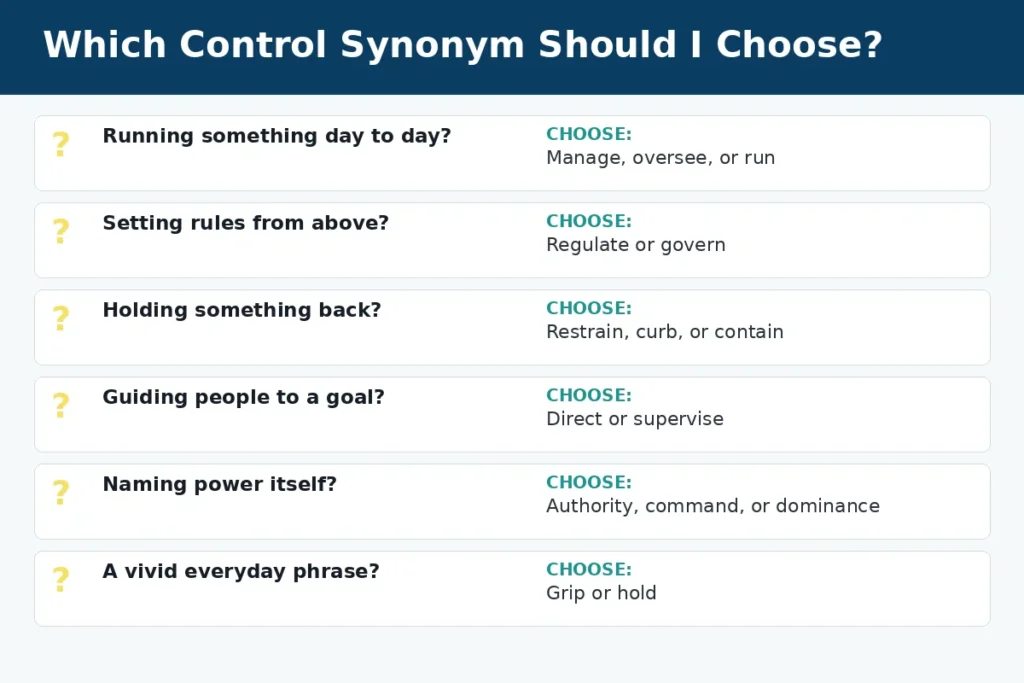
| Ask yourself | If yes, choose |
|---|---|
| Am I running something day to day? | Manage, oversee, or run |
| Am I setting rules or limits from above? | Regulate or govern |
| Am I holding something back? | Restrain, curb, or contain |
| Am I guiding people toward a goal? | Direct or supervise |
| Am I naming power itself? | Authority, command, or dominance |
| Is it a vivid, everyday phrase? | Grip or hold |
Antonyms of Control
Match the opposite to the sense you used, because the verb and the noun have different enemies:
Opposites of control (verb, to run or direct):
| Antonym | What it means |
|---|---|
| Neglect | To fail to look after something properly |
| Abandon | To give up responsibility for something |
| Mismanage | To run something badly |
| Ignore | To pay no attention to something that needs handling |
| Relinquish | To give up control voluntarily |
| Abdicate | To give up a position of authority formally |
Opposites of control (noun, power or authority):
| Antonym | What it means |
|---|---|
| Chaos | Complete disorder, with no one in charge |
| Anarchy | A state with no governing authority |
| Freedom | The absence of restriction or control |
| Powerlessness | Having no power or influence at all |
| Disorder | Lack of order or organization |
| Subordination | Being under someone else’s authority |
Collocations With “Control”
Finally, a short set of fixed phrases rounds out your control synonyms toolkit. These are the partners the word keeps in real writing:
- take control of a situation, “She took control of the meeting and set a clear agenda.”
- under control, “After a difficult week, spending is finally under control.”
- out of control, “The rumor spread fast and soon felt out of control.”
- lose control, “The driver lost control on the icy road.”
- control group, in science, the group left unchanged for comparison: “The control group received no treatment.”
- remote control, “He could not find the remote control for the television.”
One honest note: control has no single famous idiom of its own beyond these collocations. The phrases above are the word’s regular partners, and they are the ones worth memorizing.
Practice: Spot the Better Word
Now it is your turn. Each sentence below uses control where a sharper word exists. Pick the better word, then check the key. This format differs from a simple rewrite: you choose from a short list first.
- 1. The agency must ___ how factories label chemicals. (a) manage (b) regulate (c) tame
- 2. She could barely ___ her laughter during the serious announcement. (a) govern (b) contain (c) administer
- 3. Only the director has the ___ to approve refunds. (a) grip (b) authority (c) curb
- 4. He ___ a bakery with his sister, opening at six every morning. (a) runs (b) dominates (c) restrains
Answer key:
- 1. (b) Regulate, rules for an industry need a system of rules, not everyday management.
- 2. (b) Contain, laughter is kept within bounds, like something that might spill over.
- 3. (b) Authority, a formal right to decide, not a vivid grip or a limit.
- 4. (a) Runs, everyday operation of a small business, not market dominance or restraint.
FAQ
What is the closest synonym for control?
Manage is the closest synonym for the verb control, because both mean running something in an orderly, practical way. The catch is that manage is only a verb, and it is softer than control. When control means formal authority or firm power, regulate, govern, or command fits better, and when it is a noun, authority is the natural replacement.
What is another word for taking control of a project?
Take charge is the natural everyday phrase, and in formal writing, assume command or take over also work. For running the project day to day, manage or oversee is better than any power word. The best choice depends on whether you mean seizing authority, or simply running the work well.
What is the difference between control and manage?
Both verbs mean keeping something on track, but they carry different weight. Manage suggests coping well and getting things done, often with limited resources. Control suggests stronger authority, a tighter grip, or a system of checks. A manager manages a team, a regulator controls a market, and a pilot controls a plane.
Is manipulate a synonym for control?
No, not safely. Manipulate means influencing someone skillfully, often secretly or unfairly, while control and manage are open and legitimate. You can manage a budget without manipulating anyone. Swapping in manipulate changes the sentence from neutral leadership to something dishonest, so keep the two apart.
What is the opposite of control?
For the verb, the opposites are neglect, abandon, mismanage, and relinquish, words for failing to run something or giving up responsibility. For the noun, the opposites are chaos, anarchy, freedom, and powerlessness. English needs both sets because control itself carries running, restraining, and power meanings.
Which word works for controlling your temper?
Restrain is the most precise choice, because it means holding back a feeling with effort. Curb also works for a habit you want to reduce, as in curbing your temper over time. Contain fits a sudden outburst you keep from spilling over. Manage works too, but it sounds calmer and more long term than restrain.
Conclusion
Control rewards anyone who checks which of its jobs a sentence needs. If you are running something day to day, manage is your default, and oversee, direct, and supervise sharpen it for different levels of involvement. If you are holding something back, restrain, curb, and contain each name a different kind of limit.
And if you are naming power itself, authority and command carry the weight that everyday words cannot. In the end, choose by job, not by habit, and control synonyms will stop feeling like a guessing game, each replacement will say exactly what you meant, only sharper.

About Sajjad Ahmed
Sajjad Ahmed is the author behind Guest Paster, where he writes about English vocabulary, synonyms, word meanings, and practical word usage.
His content is designed to help readers understand the differences between similar words, discover suitable alternatives, and use English vocabulary more effectively in everyday writing and communication.
Before publishing, Sajjad focuses on presenting word choices in a clear and easy-to-understand format, with relevant meanings, context, and examples where helpful.
Through Guest Paster, his goal is to make vocabulary learning simpler and provide useful language resources for students, writers, English learners, and anyone looking to expand their vocabulary.
Areas of Focus: English Vocabulary • Synonyms • Word Meanings • Word Usage • Language Learning
Author: Sajjad Ahmed
Website: Guest Paster