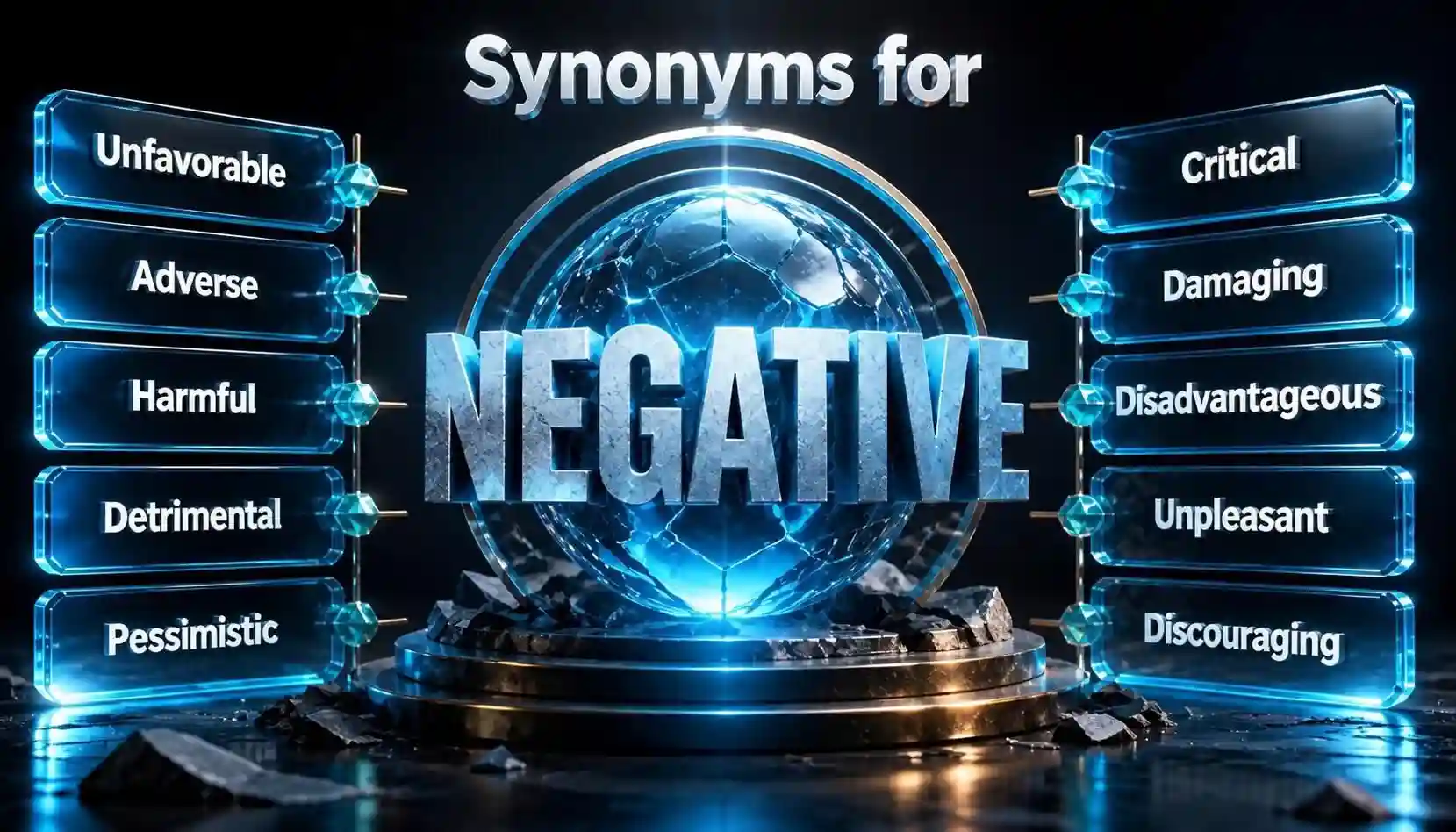
What Does Negative Mean?
The word negative means showing disagreement, refusal, criticism, lack of something or an unfavorable condition. Common synonyms for negative include unfavorable, adverse, harmful, pessimistic, critical, unfavorable, damaging and bad but the best replacement depends on the context.
For example a negative result in a medical test means an absence of a condition while a negative attitude describes an unwilling or pessimistic mindset. Choosing the right synonym requires understanding the exact meaning, tone and situation where the word is used.
Best Synonyms for Negative
| Synonym | Relationship | Swap Rating | Formality | Best Used For |
|---|---|---|---|---|
| Unfavorable | Near Synonym | Drop-in | Neutral | Conditions, opinions, outcomes |
| Adverse | Near Synonym | Drop-in | Formal | Effects, situations, circumstances |
| Harmful | Near Synonym | Minor Rewrite | Neutral | Effects, actions, consequences |
| Detrimental | Near Synonym | Minor Rewrite | Formal | Academic and professional writing |
| Pessimistic | Contextual Alternative | Minor Rewrite | Neutral | Attitudes, thoughts, personalities |
| Critical | Near Synonym | Minor Rewrite | Neutral/Formal | Reviews, analysis, judgment |
| Bad | Near Synonym | Drop-in (limited) | Informal | Everyday conversation |
| Opposed | Contextual Alternative | New Sentence Needed | Neutral | Opinions and disagreement |
Quick Facts About Negative
Word:
Negative
Part of Speech:
Adjective, noun, and verb
Simple Meaning:
Something unfavorable, harmful, disagreeing, lacking, or showing refusal.
Pronunciation:
NEG-uh-tiv
Syllables:
3 syllables (neg-a-tive)
Origin:
The word comes from Latin negare, meaning “to deny” or “say no.”
Other Word Forms:
- Negatively (adverb)
- Negativity (noun)
- Negation (noun)
Formality:
Neutral
Difficulty Level:
Beginner to Intermediate
Common Uses:
- Everyday conversation
- Academic writing
- Business communication
- Scientific contexts
- Emotional descriptions
Example Sentence:
The negative feedback helped the team improve the project.
Meaning and Usage of Negative
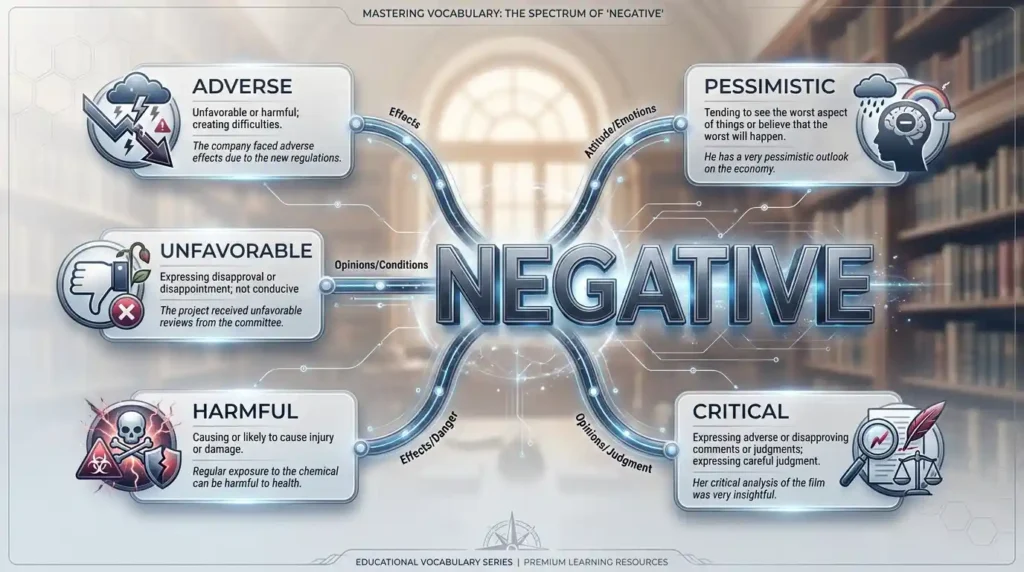
The word negative has several meanings, and the correct synonym depends on which meaning is intended.
Negative Meaning: Unfavorable or Harmful
In many situations, negative describes something that causes problems, disadvantages, or poor results.
Example:
- The company experienced negative effects after changing its policy.
Suitable synonyms:
- adverse
- harmful
- damaging
- unfavorable
Here, negative does not mean “saying no”; it describes an undesirable result.
Negative Meaning: Pessimistic or Critical
When describing people, emotions, or attitudes, negative often means focusing on problems rather than possibilities.
Example:
- His negative attitude affected the entire team.
Suitable synonyms:
- pessimistic
- gloomy
- critical
- discouraging
Negative Meaning: Showing Refusal or Opposition
Negative can describe disagreement or rejection.
Example:
- She gave a negative response to the proposal.
Suitable synonyms:
- opposed
- rejecting
- unwilling
- resistant
Negative Meaning: Zero, Absence, or Lack
In science and medicine, negative may mean that something is not present.
Example:
- The test result was negative.
Possible replacements:
- clear
- normal
- absent (depending on context)
Detailed Synonyms for Negative
1. Unfavorable
Relationship:
Near Synonym
Swap Rating:
Drop-in
Formality:
Neutral
Meaning:
Unfavorable means producing a poor result or not being helpful.
Difference:
Unfavorable is one of the closest replacements for negative when describing situations, opinions, or outcomes. It is usually less emotional than negative.
Best Used For:
- Results
- Conditions
- Reviews
- Decisions
Example:
The weather conditions were unfavorable for the outdoor event.
2. Adverse
Relationship:
Near Synonym
Swap Rating:
Drop-in
Formality:
Formal
Meaning:
Adverse describes something harmful, difficult, or damaging.
Difference:
Adverse is stronger and more formal than negative. It is commonly used for effects, reactions, and circumstances.
Best Used For:
- Medical writing
- Research
- Business reports
- Formal communication
Example:
The medicine may cause adverse side effects in some patients.
3. Harmful
Relationship:
Near Synonym
Swap Rating:
Minor Rewrite
Formality:
Neutral
Meaning:
Harmful means causing damage or injury.
Difference:
Harmful focuses specifically on causing harm, while negative can simply mean unfavorable without causing damage.
Best Used For:
- Actions
- Behaviors
- Effects
- Products
Example:
Too much screen time can have harmful effects on sleep.
4. Detrimental
Relationship:
Near Synonym
Swap Rating:
Minor Rewrite
Formality:
Formal/Academic
Meaning:
Detrimental means causing damage or making something worse.
Difference:
This word is stronger and more suitable for academic or professional writing than everyday speech.
Best Used For:
- Research papers
- Reports
- Formal arguments
Example:
Lack of preparation can be detrimental to academic success.
5. Pessimistic
Relationship:
Contextual Alternative
Swap Rating:
New Sentence Needed
Formality:
Neutral
Meaning:
Pessimistic describes expecting bad results or focusing on negative possibilities.
Difference:
Pessimistic only works when negative describes an attitude, mindset, or personality. It cannot replace negative in most situations.
Best Used For:
- People
- Opinions
- Thoughts
- Attitudes
Example:
His pessimistic view made him doubt the project’s success.
6. Critical
Relationship:
Near Synonym
Swap Rating:
Minor Rewrite
Formality:
Neutral / Formal
Meaning:
Critical means expressing judgment, finding faults, or pointing out problems.
Difference:
Critical can be a synonym for negative when talking about opinions, reviews, or comments. However, it does not always mean bad because criticism can also be helpful and constructive.
Best Used For:
- Reviews
- Analysis
- Feedback
- Opinions
Example:
The report was critical of the company’s environmental policies.
7. Bad
Relationship:
Near Synonym
Swap Rating:
Drop-in (limited)
Formality:
Informal
Meaning:
Bad means unpleasant, poor, harmful, or of low quality.
Difference:
Bad is a very common everyday replacement for negative, but it is less precise. It may sound too simple in academic or professional writing.
Best Used For:
- Daily conversation
- Simple descriptions
- Casual writing
Example:
The storm caused bad damage to several buildings.
8. Damaging
Relationship:
Near Synonym
Swap Rating:
Minor Rewrite
Formality:
Neutral
Meaning:
Damaging means causing harm, loss, or injury.
Difference:
Damaging focuses on the actual harm caused by something. Negative can describe something unpleasant even when no direct damage occurs.
Best Used For:
- Effects
- Actions
- Decisions
- Relationships
Example:
False information can be damaging to a person’s reputation.
9. Disadvantageous
Relationship:
Near Synonym
Swap Rating:
Drop-in
Formality:
Formal
Meaning:
Disadvantageous means creating a disadvantage or making success more difficult.
Difference:
This word focuses on situations where something puts someone in a weaker position. It is often used in formal discussions.
Best Used For:
- Business writing
- Strategy
- Comparisons
- Decisions
Example:
The new rules may be disadvantageous for small businesses.
10. Unpleasant
Relationship:
Contextual Alternative
Swap Rating:
Minor Rewrite
Formality:
Neutral
Meaning:
Unpleasant means causing discomfort, dislike, or discomfort.
Difference:
Unpleasant works when negative describes feelings, experiences, or situations. It does not replace negative when discussing harmful effects or scientific results.
Best Used For:
- Experiences
- Feelings
- Situations
Example:
The customer had an unpleasant experience at the restaurant.
11. Discouraging
Relationship:
Contextual Alternative
Swap Rating:
Minor Rewrite
Formality:
Neutral
Meaning:
Discouraging means causing someone to lose confidence, hope, or motivation.
Difference:
Discouraging is related to emotional impact. It is not a general replacement for negative.
Best Used For:
- News
- Feedback
- Situations
- Emotions
Example:
The disappointing results were discouraging for the research team.
12. Gloomy
Relationship:
Contextual Alternative
Swap Rating:
New Sentence Needed
Formality:
Neutral
Meaning:
Gloomy describes sadness, hopelessness, or a lack of optimism.
Difference:
Gloomy is more emotional and expressive than negative. It usually describes moods, predictions, or atmospheres.
Best Used For:
- Feelings
- Weather
- Predictions
- Writing
Example:
The gloomy forecast made people cancel their travel plans.
13. Hostile
Relationship:
Contextual Alternative
Swap Rating:
New Sentence Needed
Formality:
Neutral
Meaning:
Hostile means unfriendly, aggressive, or strongly opposed.
Difference:
Hostile is much stronger than negative. It describes active opposition or aggression rather than general negativity.
Best Used For:
- Attitudes
- Relationships
- Situations
Example:
The meeting became hostile after the disagreement.
14. Rejecting
Relationship:
Contextual Alternative
Swap Rating:
New Sentence Needed
Formality:
Neutral
Meaning:
Rejecting means refusing to accept, approve, or support something.
Difference:
Rejecting only works when negative means showing refusal or disagreement.
Best Used For:
- Responses
- Decisions
- Opinions
Example:
The committee gave a rejecting response to the proposal.
15. Opposed
Relationship:
Contextual Alternative
Swap Rating:
Minor Rewrite
Formality:
Neutral
Meaning:
Opposed means being against an idea, action, or person.
Difference:
Opposed is related to negative opinions but cannot replace negative in most contexts.
Best Used For:
- Arguments
- Opinions
- Debates
Example:
Many residents were opposed to the construction plan.
Best Synonyms by Context
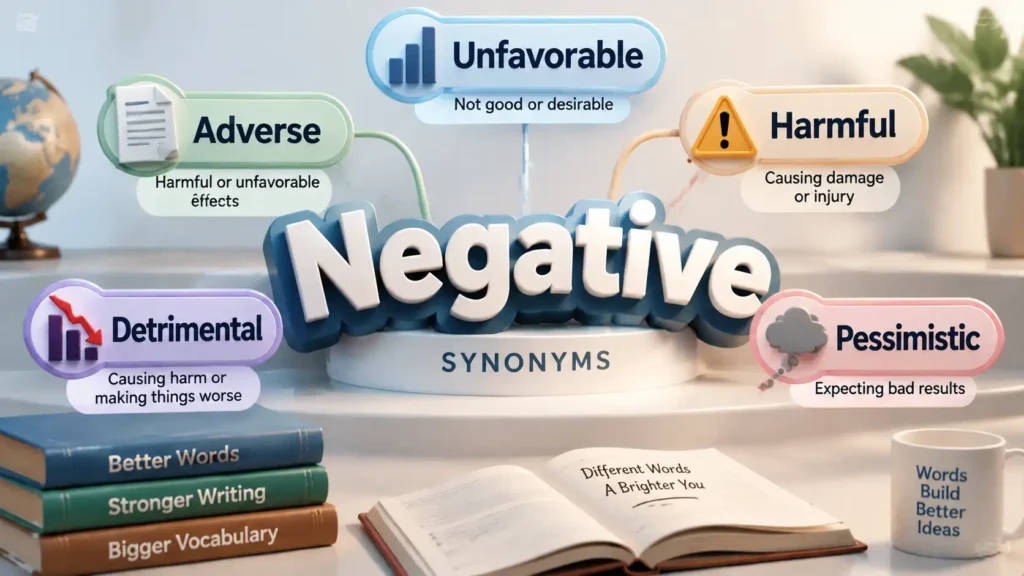
Best Words to Use Instead of Negative in Everyday Conversation
For casual speech, these words sound natural:
- Bad — simple and common for unpleasant things
- Unpleasant — for experiences and feelings
- Not good — informal alternative
- Problematic — when something creates difficulties
Example:
Instead of:
The situation is negative.
You can say:
The situation is problematic.
Best Words to Use Instead of Negative in Formal Writing
Formal writing usually needs more precise vocabulary:
- Adverse — for harmful effects or conditions
- Unfavorable — for poor outcomes or situations
- Detrimental — for serious harmful effects
- Disadvantageous — for situations creating weaknesses
Example:
Instead of:
The policy had negative effects.
Better:
The policy had adverse effects.
Best Words to Use Instead of Negative in Academic Writing
Academic writing often avoids vague words like “bad.”
Better choices include:
- Detrimental
- Adverse
- Unfavorable
- Harmful
- Undesirable
Example:
Instead of:
The method produced negative results.
Write:
The method produced unfavorable results.
Best Words to Use Instead of Negative for Attitudes and Personality
When describing someone’s mindset:
- Pessimistic — expects poor outcomes
- Gloomy — focuses on sadness or hopelessness
- Critical — focuses on faults
- Cynical — distrustful of motives
Example:
Instead of:
She has a negative attitude.
You can say:
She has a pessimistic attitude.
Best Words to Use Instead of Negative Emotions
When describing emotions:
- Unhappy
- Upset
- Sad
- Discouraged
- Frustrated
- Angry
The best choice depends on the exact emotion. Not every negative feeling means the same thing.
Exact and Near Synonyms: What Is the Difference?
Synonyms are rarely perfect replacements. Two words may share a similar meaning but differ in emotional strength, formality, or context.
For example, negative and adverse both describe unfavorable situations, but adverse sounds more formal and is often used for serious effects. Pessimistic is also related, but it only describes attitudes or expectations, not general problems.
Choosing the right synonym makes writing clearer. A student essay, business report, and casual conversation may all need different alternatives for the same word.
Words Commonly Confused With Negative
Positive
Difference:
Positive is the opposite of negative, not a synonym. It describes approval, benefits, confidence, or favorable conditions.
Example:
The feedback was positive and encouraging.
Neutral
Difference:
Neutral means neither positive nor negative. It describes a balanced position.
Example:
The journalist gave a neutral report of the event.
Pessimistic
Difference:
Pessimistic is a type of negative attitude, but it cannot replace negative in every situation.
Example:
He is pessimistic about the future.
Antonyms of Negative
Antonyms are words with opposite meanings. The best opposite of negative depends on the sense being used. For example, when negative means “harmful,” the opposite may be beneficial, while when it means “pessimistic,” the opposite may be optimistic.
| Antonym | Simple Meaning | Example Sentence |
|---|---|---|
| Positive | Favorable, helpful, or showing approval | The customer gave positive feedback about the service. |
| Beneficial | Producing good results or advantages | Regular exercise has beneficial effects on health. |
| Helpful | Providing support or improvement | Her advice was helpful during the difficult time. |
| Optimistic | Expecting good results in the future | He remained optimistic despite the challenges. |
| Constructive | Intended to improve something | The teacher provided constructive criticism. |
| Favorable | Showing approval or advantage | The company received favorable reviews. |
| Encouraging | Giving confidence or hope | The results were encouraging for the research team. |
Common Phrases and Collocations With Negative
| Phrase or Collocation | Meaning | Example Sentence |
|---|---|---|
| Negative impact | A harmful effect or influence | The decision had a negative impact on sales. |
| Negative effect | An undesirable result | Lack of sleep can have a negative effect on concentration. |
| Negative attitude | A pessimistic or unhelpful mindset | A negative attitude can affect teamwork. |
| Negative feedback | Comments that identify problems or weaknesses | The manager used negative feedback to improve performance. |
| Negative consequences | Bad results caused by an action | Poor planning may lead to negative consequences. |
| Negative emotions | Unpleasant feelings such as anger or sadness | Meditation can help manage negative emotions. |
| Negative thoughts | Unhelpful or pessimistic ideas | She learned to replace negative thoughts with realistic ones. |
Frequently Asked Questions
What does negative mean?
Negative means unfavorable, harmful, disagreeing, lacking, or showing refusal. The exact meaning depends on the situation. A negative attitude means pessimistic thinking, while a negative result may mean something is absent.
What is another word for negative?
Some common alternatives for negative include unfavorable, adverse, harmful, detrimental, pessimistic, critical, and bad. The best choice depends on whether you are describing an effect, opinion, attitude, or result.
What is the closest synonym for negative?
The closest synonym depends on the meaning. Unfavorable is one of the closest general synonyms because it can describe poor conditions, results, or opinions. For harmful effects, adverse may be more accurate.
Is negative formal or informal?
Negative is a neutral word used in everyday speech, academic writing, business communication, and technical fields. It is neither strongly formal nor informal.
Can I replace negative with bad?
Sometimes. In casual conversation, bad can replace negative, but it is less precise. In formal writing, words like adverse, unfavorable, or detrimental usually communicate the meaning more clearly.
What is the difference between negative and pessimistic?
Negative is a broad word that can describe problems, effects, opinions, and results. Pessimistic specifically describes a person or attitude that expects bad outcomes.
Conclusion
Choosing the right synonym for negative helps make communication clearer and more accurate. Words such as adverse, unfavorable, harmful, detrimental, and pessimistic may look similar, but each has a different use.
The best alternative depends on whether you are describing an effect, attitude, emotion, result, or opinion. Understanding these differences allows writers, students, and English learners to choose words that express exactly what they mean.

About Sajjad Ahmed
Sajjad Ahmed is the author behind Guest Paster, where he writes about English vocabulary, synonyms, word meanings, and practical word usage.
His content is designed to help readers understand the differences between similar words, discover suitable alternatives, and use English vocabulary more effectively in everyday writing and communication.
Before publishing, Sajjad focuses on presenting word choices in a clear and easy-to-understand format, with relevant meanings, context, and examples where helpful.
Through Guest Paster, his goal is to make vocabulary learning simpler and provide useful language resources for students, writers, English learners, and anyone looking to expand their vocabulary.
Areas of Focus: English Vocabulary • Synonyms • Word Meanings • Word Usage • Language Learning
Author: Sajjad Ahmed
Website: Guest Paster