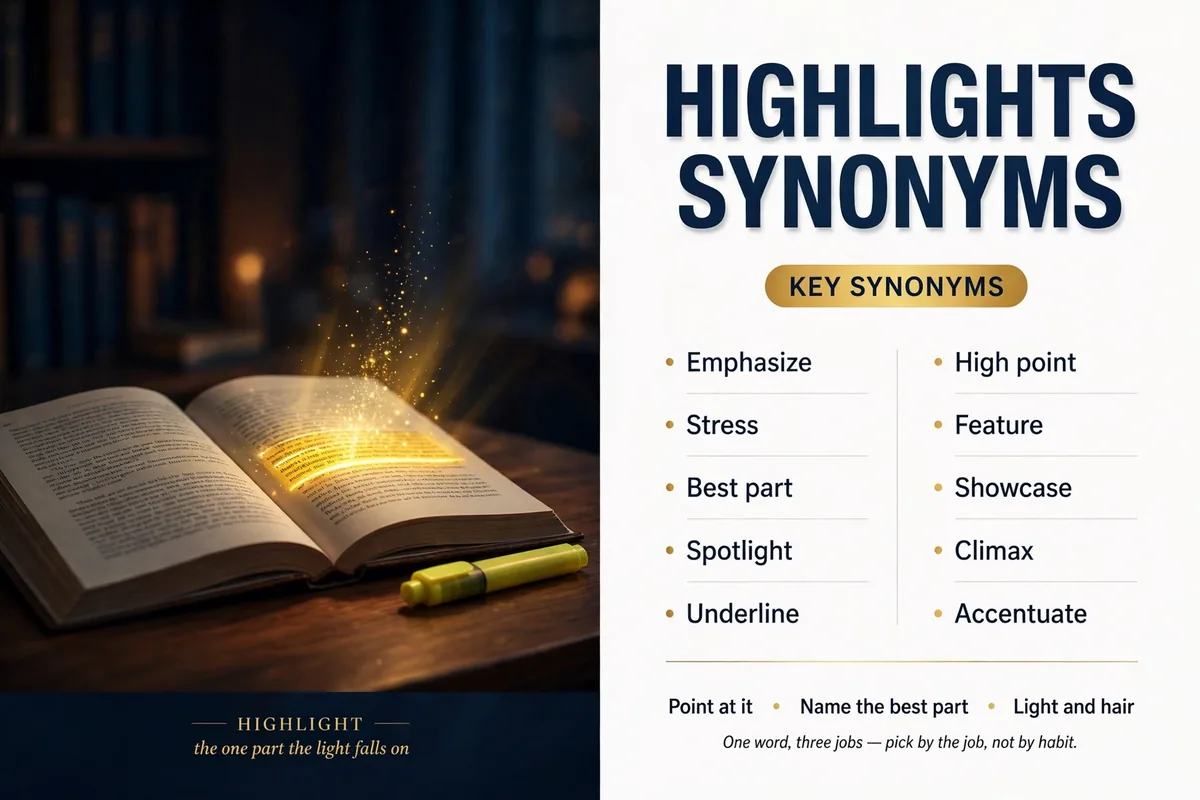
Looking for the best synonyms to highlight? The appropriate alternative will vary depending upon the context. As a verb, highlight is to emphasize, stress, feature or draw attention to something. When used as a noun it may refer to the main part of something, its principal attraction or most obvious feature. In addition it may describe lighter streaks of hair.
This article describes 18 different synonyms for “highlight” organized by meaning along with examples to assist you in selecting the correct word to use in any sentence.
Another Word For Highlights at a Glance
| # | Synonym | Meaning Difference |
|---|---|---|
| 1 | Emphasize | To give special importance to a point (verb) |
| 2 | Stress | To emphasize a point with urgency or pressure |
| 3 | Best part | The most enjoyable or important part (noun) |
| 4 | Spotlight | To put something in public focus, like a stage light |
| 5 | Underline | To emphasize, originally by drawing a line under text |
| 6 | High point | The best or most successful moment (noun) |
| 7 | Feature | To include something as a special, promoted part |
| 8 | Showcase | To display something at its best |
| 9 | Climax | The most exciting peak point of an event (noun) |
| 10 | Accentuate | To make a feature stand out more strongly |
Quick Facts About “Highlight”
- Part of speech: both a verb (highlight the risks) and a noun (the highlight of the show).
- Three core meanings: (1) draw attention to something, (2) the best part of an event, (3) light streaks in hair or the brightest area in a picture.
- Register: neutral and modern. Highlight works in reports, essays, news, and everyday conversation.
- Watch out: the plural highlights often points at hair or at sports clips (match highlights), two senses where almost no synonym fits.
The Closest Synonym: Emphasize
Emphasize is the closest synonym for highlight because it covers the word’s hardest-working sense: making sure people notice something and treat it as important. When a teacher highlights a rule, a report highlights a risk, or a speaker highlights a benefit, each time the real action is emphasizing, giving one point more weight than everything around it.
Still, the two words are not identical twins. Highlight began life in painting, and it keeps a visual flavor: it suggests shining a light on one spot while the rest stays dimmer. Emphasize, in contrast, is about weight and importance, with no picture behind it. As a result, highlight feels natural for presentations, documents, and media, while emphasize is the safer choice in formal academic writing.
Finally, remember the noun trap. Emphasize is only a verb, so it can never replace highlight in “the highlight of the party.” For that job, skip ahead to best part and high point in Group 2 below.
Where “Highlight” Comes From (Etymology)
According to Etymonline, highlight is a young word built from two old ones: high + light. It appeared in the 1650s as a painters’ term for “the brightest part of a subject”, the spot where light hits hardest. The figurative sense, “an outstanding feature,” is recorded by 1855, although it did not become common until around 1920.
The verb followed in 1861, first meaning “to add bright touches to a painting.” Its modern figurative meaning, “to give prominence to, to emphasize”, arrived by 1944. The hairdressing sense is newer still: highlights in hair appear in 1941, and the famous marker pen, the highlighter, was named in 1963.
That history explains the word’s three modern jobs perfectly. Every sense of highlight still means “the part the light falls on”, in a painting, in a presentation, or in your hair.
Can You Swap Them Freely?
In short: only inside the same meaning group. A verb synonym collapses in a noun sentence, and a noun synonym collapses in a verb sentence:
- ✅ “The report emphasizes the need for clean water.” (verb → verb ✔)
- ❌ “The emphasize of the concert was the final song.” (verb forced into a noun slot ✘, say highlight or high point)
- ✅ “The fireworks were the high point of the festival.” (noun → noun ✔)
- ❌ “Please high point the errors in this draft.” (noun forced into a verb slot ✘, say highlight or underline)
Before you substitute, ask one question: am I pointing at something, or naming the best part? Pointing takes a Group 1 word; naming takes a Group 2 word.
Highlights Synonyms in Detail
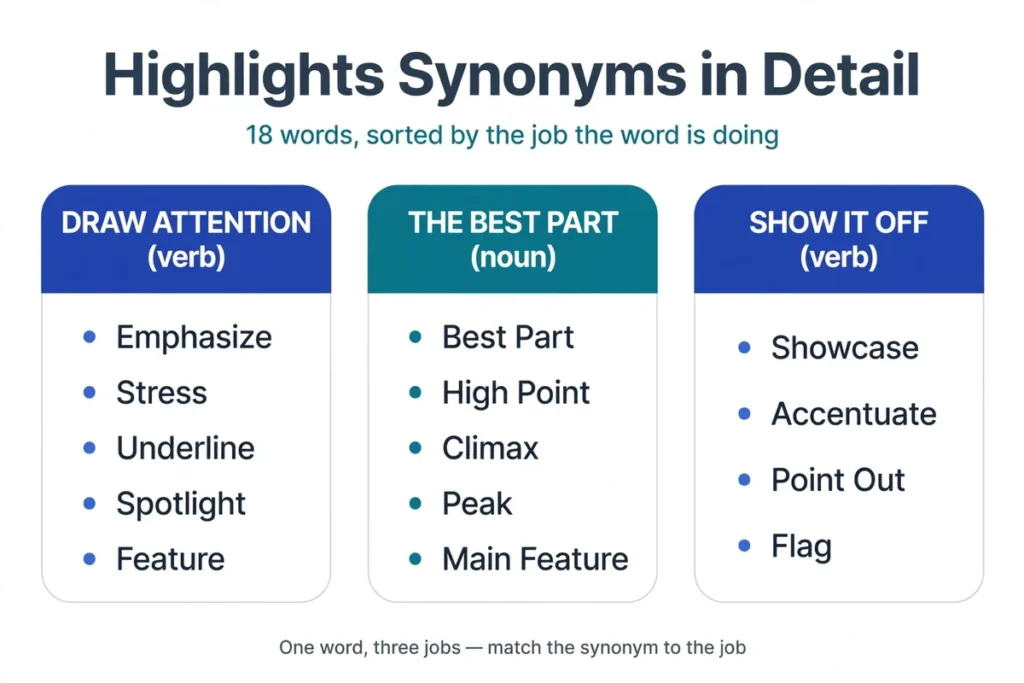
Group 1: Highlight as a Verb (Drawing Attention to Something)
1. Emphasize
- Meaning: To give special importance or weight to a point so people notice and remember it.
- Difference: The closest all-round match for the verb highlight. However, emphasize is purely about importance; it carries none of highlight’s visual, shining-a-light flavor.
- Best used for: Essays, speeches, reports, teaching, anywhere a point must stand out.
- Formality: Neutral to formal · CEFR: B2 · Frequency: Very common
- Example (Formal): “The minister emphasized that the policy would not change this year.”
- Example (Everyday): “Let me emphasize, the deadline is Friday, not Monday.”
- When NOT to use it: As a noun. “The emphasize of the show” is impossible English.
2. Stress
- Meaning: To emphasize a point strongly, often because it is urgent, risky, or easily missed.
- Difference: Stress adds pressure. You stress warnings, deadlines, and dangers; you merely highlight ordinary information.
- Best used for: Warnings, instructions, negotiations, exam advice.
- Formality: Neutral · CEFR: B2 · Frequency: Common
- Example (Work): “The doctor stressed the importance of finishing the full course of antibiotics.”
- Example (Everyday): “I can’t stress this enough, back up your files.”
- When NOT to use it: For cheerful, positive points. “Stress the benefits” sounds anxious; use emphasize or highlight.
3. Underline
- Meaning: To emphasize something, originally by drawing a line beneath written words.
- Difference: Underline keeps a physical echo, a line under text. Figuratively, it means “emphasize firmly,” especially in British English.
- Best used for: Writing about texts, speeches, and findings; formal British prose.
- Formality: Neutral to formal · CEFR: B2 · Frequency: Common
- Example (Formal): “The results underline the need for reform.”
- Example (Everyday): “She underlined the key sentence in her notebook.”
- When NOT to use it: In American business writing, where underscore is the more common twin.
4. Underscore
- Meaning: The American English twin of underline, to emphasize or confirm something clearly.
- Difference: Same job as underline, but underscore often adds a sense of proof: the facts underscore the claim.
- Best used for: American reports, journalism, data-driven writing.
- Formality: Neutral to formal · CEFR: B2 · Frequency: Common
- Example (News): “The latest figures underscore how fast the market is growing.”
- Example (Work): “His quick reply underscored his commitment to the project.”
- When NOT to use it: For literally marking a document, there, highlight (with a pen or cursor) is exact.
5. Accentuate
- Meaning: To make a feature more noticeable or prominent.
- Difference: Accentuate works on features, cheekbones, flavors, differences, rather than on points in an argument.
- Best used for: Fashion, design, cooking, physical descriptions.
- Formality: Formal · CEFR: C1 · Frequency: Uncommon
- Example (Style): “The belt accentuates her waist.”
- Example (Formal): “The new policy accentuates the gap between rich and poor districts.”
- When NOT to use it: For ideas in an essay. “Accentuate the conclusion” sounds odd; emphasize fits.
6. Spotlight
- Meaning: To shine public attention on a person, issue, or achievement, like a stage light picking out one performer.
- Difference: Spotlight is highlight with an audience. It implies media attention and public discussion, not just emphasis inside a document.
- Best used for: Journalism, campaigns, awards, social issues.
- Formality: Neutral · CEFR: B2 · Frequency: Common
- Example (News): “The documentary spotlighted the lives of night-shift nurses.”
- Example (Work): “This month’s newsletter spotlights our support team.”
- When NOT to use it: For quiet, internal emphasis, a private memo does not “spotlight” anything.
7. Feature
- Meaning: To include something as a special, prominent part of a show, product, or publication.
- Difference: Feature means “give it a place of honor inside something bigger.” The focus stays on the container, the magazine, event, or product.
- Best used for: Events, media, product descriptions, menus.
- Formality: Neutral · CEFR: B2 · Frequency: Very common
- Example (Media): “The festival will feature three local bands.”
- Example (Work): “The new phone features a brighter screen.”
- When NOT to use it: For arguments or warnings, you feature attractions, not risks. (Note the overlap with promote: featuring something special is one way of promoting it.)
8. Showcase
- Meaning: To display something at its very best, the way goods are arranged in a shop window.
- Difference: Showcase is more glamorous than feature. It promises display and admiration, not just inclusion.
- Best used for: Portfolios, exhibitions, product launches, talent events.
- Formality: Neutral · CEFR: B2 · Frequency: Common
- Example (Work): “The exhibition showcases the work of young photographers.”
- Example (Everyday): “The final match showcased his talent perfectly.”
- When NOT to use it: For neutral or negative information, nobody showcases a failure.
9. Point Out
- Meaning: To draw attention to a specific fact, often one that others have missed.
- Difference: Point out is surgical, it names one detail. Highlight covers a whole passage or theme.
- Best used for: Corrections, meetings, reviews, directions.
- Formality: Neutral · CEFR: B1 · Frequency: Very common
- Example (Work): “She pointed out that the budget had already been approved.”
- Example (Everyday): “He pointed out a spelling mistake on the menu.”
- When NOT to use it: When you mean visual marking of text, pointing out is verbal, highlighting can be physical.
10. Flag
- Meaning: To mark something for attention or later action, as you would stick a small flag in it.
- Difference: Flag is the modern office word, it means “notice this; it needs a decision or a fix,” not merely “this is important.”
- Best used for: Emails, project tools, audits, editing.
- Formality: Neutral (business) · CEFR: B2 · Frequency: Common and growing
- Example (Work): “Please flag any invoices that look unusual.”
- Example (Everyday): “I flagged the email so I wouldn’t forget to reply.”
- When NOT to use it: In formal academic writing, highlight or note sounds better there.
11. Draw Attention To
- Meaning: The plain, fully explicit phrase for making people notice something.
- Difference: Longer and more formal than highlight, but crystal clear. It also works when the thing noticed is a problem nobody wanted to see.
- Best used for: Formal reports, speeches, complaints, presentations.
- Formality: Formal to neutral · CEFR: B2 · Frequency: Common
- Example (Formal): “The report draws attention to a serious safety risk.”
- Example (Everyday): “I don’t want to draw attention to my mistake, but I should fix it.”
- When NOT to use it: When space is tight, highlight says the same thing in one word.
Group 2: Highlight as a Noun (The Best Part)
12. Best Part
- Meaning: The most enjoyable, valuable, or impressive part of something.
- Difference: The plainest, warmest replacement for the noun highlight. It sounds personal rather than promotional.
- Best used for: Trips, events, stories, everyday conversation.
- Formality: Neutral, friendly · CEFR: A2 · Frequency: Very common
- Example (Everyday): “The best part of the wedding was the dancing.”
- Example (Work): “The best part of the conference was meeting the other teams.”
- When NOT to use it: In formal writing, where high point carries more polish.
13. High Point
- Meaning: The best, most successful, or most memorable moment in a period or event.
- Difference: Slightly more formal than best part, and it suggests a peak in a timeline, a career, a season, a holiday.
- Best used for: Biographies, reviews, sports, careers.
- Formality: Neutral to formal · CEFR: B2 · Frequency: Common
- Example (Formal): “Winning the award was the high point of her career.”
- Example (Everyday): “The boat trip was the high point of our holiday.”
- When NOT to use it: For a physical bright spot in a picture, that is the painter’s original highlight.
14. Climax
- Meaning: The most exciting and decisive peak of a story, performance, or event.
- Difference: Climax is dramatic and earned, tension builds toward it. A highlight can be any good moment; a climax is THE moment everything led to.
- Best used for: Stories, films, speeches, sports finals.
- Formality: Neutral to formal · CEFR: B2 · Frequency: Common
- Example (Review): “The climax of the film left the audience silent.”
- Example (Everyday): “The fireworks were the climax of the evening.”
- When NOT to use it: For a merely pleasant moment, a nice lunch has a best part, not a climax.
15. Peak
- Meaning: The highest or strongest point of something, after which it declines.
- Difference: Peak implies a rise and a fall around it. A highlight can stand alone; a peak is measured against what came before and after.
- Best used for: Careers, prices, seasons, performance data.
- Formality: Neutral · CEFR: B2 · Frequency: Common
- Example (News): “Ticket sales reached their peak in July.”
- Example (Work): “He retired at the peak of his career.”
- When NOT to use it: For a single happy scene in an otherwise flat event, highlight or best part is warmer.
16. Main Feature
- Meaning: The most important or prominent part of a product, place, or event.
- Difference: Main feature is descriptive, not emotional. It names what something is known for, not the moment you enjoyed most.
- Best used for: Products, buildings, tourist attractions, software.
- Formality: Neutral · CEFR: B1 · Frequency: Common
- Example (Work): “The main feature of the update is faster search.”
- Example (Travel): “The old bridge is the town’s main feature.”
- When NOT to use it: For personal memories, your holiday’s main feature sounds like a brochure, not a feeling.
17. Focal Point
- Meaning: The central point of attention or interest, around which everything else is arranged.
- Difference: Focal point is about structure, the center of a room, a photo, or a discussion, rather than the “best” moment.
- Best used for: Design, photography, meetings, gardens.
- Formality: Formal to neutral · CEFR: B2 · Frequency: Common
- Example (Design): “The fireplace is the focal point of the room.”
- Example (Work): “Cost became the focal point of the negotiation.”
- When NOT to use it: For the most enjoyable part of an experience, focal point names the center, not the favorite.
Group 3: The Literal Senses (Light and Hair)
18. Streaks
- Meaning: Thin lines of a different color, in hair, the exact everyday replacement for highlights.
- Difference: Streaks describes the result you see. Highlights is the salon’s technical (and marketing) word for the same thing.
- Best used for: Hair, fur, painted lines, light effects.
- Formality: Neutral, everyday · CEFR: B1 · Frequency: Common
- Example (Everyday): “She added blonde streaks to her hair for the summer.”
- Example (Nature): “Streaks of light broke through the clouds.”
- When NOT to use it: In a salon price list, there, highlights is the service name and clients expect that word.
Words Commonly Confused With “Highlight”
These words sit close to highlight in lists of highlights synonyms, but each one fails the swap test in an important way:
- Highlighter, The tool, not the action: a fluorescent pen (named in 1963) or a makeup product that brightens the face. “She bought a highlighter” is shopping, not emphasizing.
- Highlight reel, A short video of the best moments from a game or event. It names one specific format, so it cannot replace highlight in ordinary sentences.
- Lighten, For hair, lighten describes the whole coloring process, while highlights are the individual lighter streaks. For text, “lighten the passage” means make it less heavy, the opposite direction entirely.
- Outstanding, An adjective meaning excellent. It describes the highlight, but it cannot be one: “the outstanding of the trip” is broken English.
- Lowlights, The salon opposite: darker streaks added to hair. Useful to know, dangerous to confuse, asking for the wrong one changes your hair, not your vocabulary grade.
Best Alternatives by Context
The right choice among highlights synonyms depends on your situation, match yours to the row below:
| Your situation | Best word | Why it fits |
|---|---|---|
| A report must make readers notice a risk | Emphasize / Draw attention to | Formal weight; the risk deserves focus |
| A warning nobody should miss | Stress | Adds urgency the plain verb lacks |
| A magazine is promoting a guest chef | Feature | A place of honor inside a bigger whole |
| A product launch wants admiration | Showcase | Display at its best, like a shop window |
| A colleague missed an error in a draft | Point out | One precise detail, named once |
| An email needs action later | Flag | Marks it for a decision, modern office style |
| Your favorite moment of a holiday | Best part / High point | Warm and personal, not promotional |
| The tense final scene of a novel | Climax | The peak everything built toward |
| The most interesting thing in a museum | Main feature / Focal point | What the place is known for, its center |
| A salon appointment for lighter hair | Highlights (keep it) | The service name, synonyms sound wrong |
A final tip: if the moment also felt extraordinary, English lets you say so directly, “the highlight of the year” plus one honest adjective beats a forced synonym every time.
Which Highlights Synonym Should I Choose?
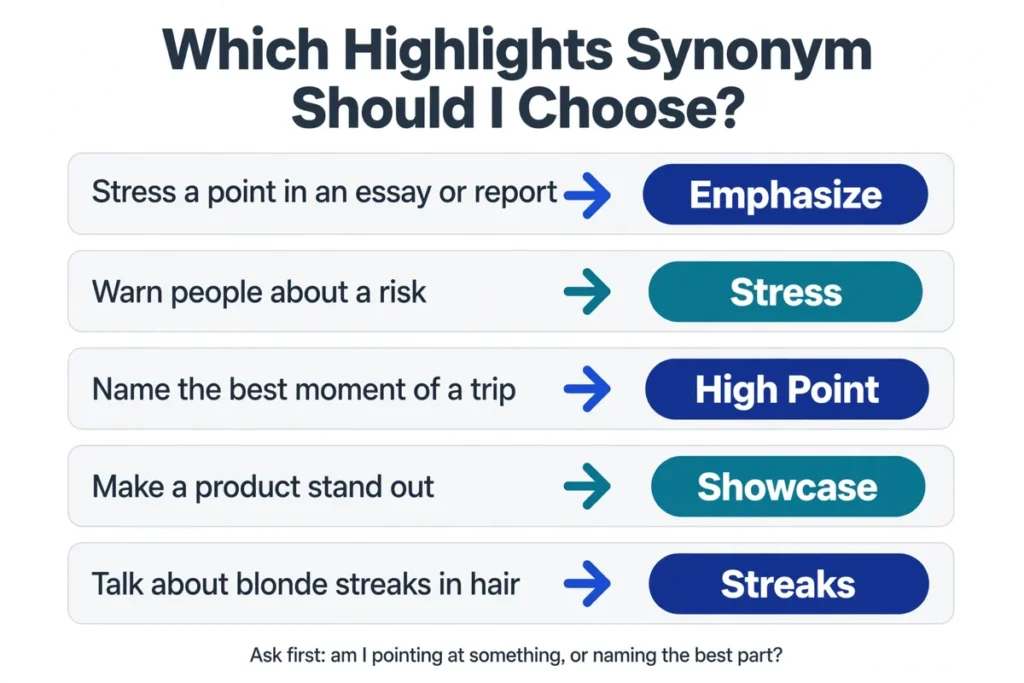
| Ask yourself | If yes, choose |
|---|---|
| Am I a verb in this sentence, doing the pointing? | Emphasize, stress, underline, or spotlight |
| Am I warning people, not just informing them? | Stress |
| Is there a real audience or media involved? | Spotlight or showcase |
| Am I naming the best moment of something? | Best part or high point |
| Did tension build up to this moment? | Climax |
| Am I talking about hair or a painting? | Keep highlight (or streaks for hair, informally) |
Antonyms of Highlight
Match the opposite to the sense you used, because the verb and the noun have different enemies:
Opposites of highlight (verb, to draw attention):
| Antonym | What it means |
|---|---|
| Downplay | To make something seem less important than it is |
| Understate | To describe something as smaller or weaker than reality |
| Minimize | To reduce something to the smallest possible importance |
| Obscure | To hide or make something hard to notice |
| Bury | To hide a fact deep inside other information |
| Gloss over | To treat a problem briefly so it seems unimportant |
Opposites of highlight (noun, the best part):
| Antonym | What it means |
|---|---|
| Low point | The worst or most disappointing moment |
| Anticlimax | A dull ending after a build-up of excitement |
| Letdown | Something disappointing after high expectations (informal) |
| Worst part | The most unpleasant part of an experience |
| Disappointment | A thing or event that fails to meet hopes |
| Nadir | The lowest point of all (formal, dramatic) |
Collocations With “Highlight”
Finally, a short set of fixed phrases rounds out your highlights synonyms toolkit. These are the partners the word keeps in real writing:
- the highlight of the trip / show / year, “The boat ride was the highlight of our trip.”
- a career highlight, “Signing her first book deal was a career highlight.”
- highlight a problem / need / risk, “The audit highlights a serious problem with the accounts.”
- match highlights, short clips of the best plays: “We watched the match highlights after dinner.”
- highlight reel, “His highlight reel convinced the scouts.”
- get highlights (hair), “She gets highlights every spring.”
One honest note: highlight has no famous idioms of its own, no “kick the highlight” or “highlight of the town.” The phrases above are collocations, the word’s regular partners, and they are the ones worth memorizing.
Practice: Fix the Sentence
Now it is your turn. Each sentence below uses highlight where a sharper word exists. Rewrite each one, then check the key.
- The teacher highlighted that homework must be finished by Friday, it was a strict warning.
- The highlight of the documentary was when it presented the oldest photographer’s life work for everyone to admire.
- Please highlight this email, I need to answer it tomorrow morning.
- The most exciting highlight of the match came in the final minute, after an hour of building tension.
Answer key:
- Stressed, a warning needs urgency: “The teacher stressed that homework must be finished by Friday.”
- Showcased, the moment displayed work for admiration: “…when it showcased the oldest photographer’s life work.”
- Flag, marking for later action: “Please flag this email, I need to answer it tomorrow morning.”
- Climax, tension built toward it: “The climax of the match came in the final minute…”
FAQ
What is the closest synonym for highlight?
Emphasize is the closest synonym for the verb highlight, because both mean giving one point more importance so people notice it. The catch is that emphasize is only a verb. When highlight is a noun meaning the best part of an event, the closest replacements are best part and high point instead.
What is another word for the highlight of a trip?
Best part and high point are the two natural choices. Best part sounds warm and personal, as in “the best part of our trip was the food market.” High point sounds slightly more polished and suits reviews and written accounts. If the moment was dramatic and everything built toward it, climax also works well.
What is the difference between highlight and emphasize?
Both verbs mean drawing attention to something important, but they carry different pictures. Highlight comes from painting and suggests shining a light on one spot, which suits documents, presentations, and media. Emphasize is about weight and importance rather than light, so it is the safer, more formal choice in academic and official writing.
Is a highlighter a synonym for highlight?
No. A highlighter is a physical tool, the fluorescent pen invented for marking text, named in 1963, or a makeup product used on the face. Highlight is the action or the best part itself. The pen takes its name from the verb, but a tool can never replace an action in a sentence.
What is the opposite of highlight?
For the verb, the opposites are downplay, understate, minimize, and obscure, words for making something seem smaller or harder to notice. For the noun, the opposites are low point, anticlimax, and letdown, the worst moment instead of the best. English needs both sets because highlight itself carries two opposite-prone meanings.
Which word works for highlights in hair?
In everyday speech, streaks is the natural word, “she added blonde streaks.” Inside a salon, however, keep highlights, because it is the name of the service and the word price lists and stylists use. Lighten is close but different: it describes the whole coloring process, not the individual lighter strands themselves.
Conclusion
Highlight rewards anyone who checks which of its three jobs a sentence needs. If you are pointing at something important, emphasize is your default, and stress, spotlight, and flag sharpen it further when urgency, audience, or follow-up action enters the picture.
If you are naming the best moment instead, best part and high point cover almost everything, with climax saved for the peaks that tension built toward. And if light or hair is involved, the original word usually wins. In the end, choose by job, not by habit, and highlights synonyms will stop feeling like a guessing game, each replacement will say exactly what you meant, only sharper.

About Sajjad Ahmed
Sajjad Ahmed is the author behind Guest Paster, where he writes about English vocabulary, synonyms, word meanings, and practical word usage.
His content is designed to help readers understand the differences between similar words, discover suitable alternatives, and use English vocabulary more effectively in everyday writing and communication.
Before publishing, Sajjad focuses on presenting word choices in a clear and easy-to-understand format, with relevant meanings, context, and examples where helpful.
Through Guest Paster, his goal is to make vocabulary learning simpler and provide useful language resources for students, writers, English learners, and anyone looking to expand their vocabulary.
Areas of Focus: English Vocabulary • Synonyms • Word Meanings • Word Usage • Language Learning
Author: Sajjad Ahmed
Website: Guest Paster