What Is the Best Synonym for Worry?
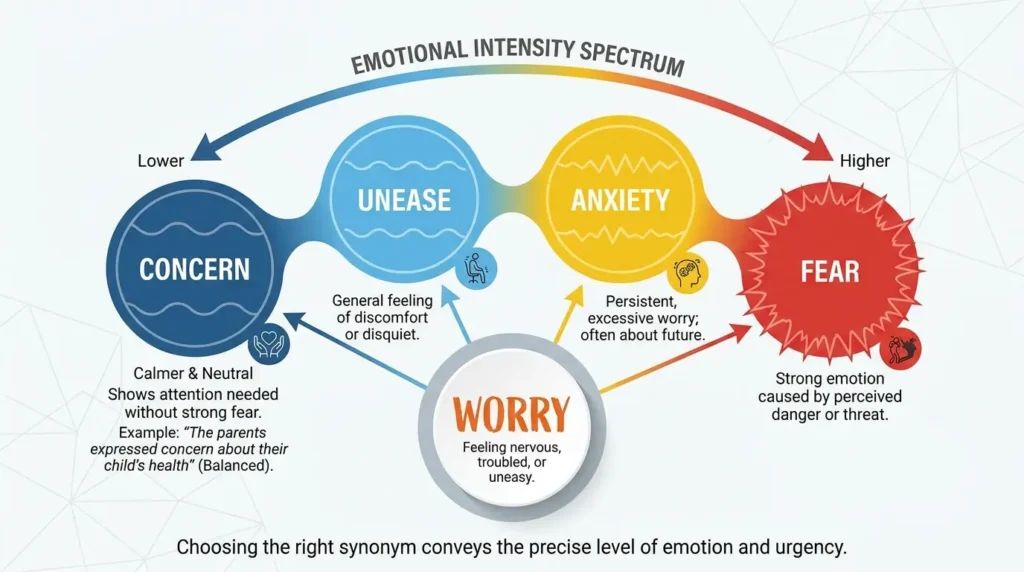
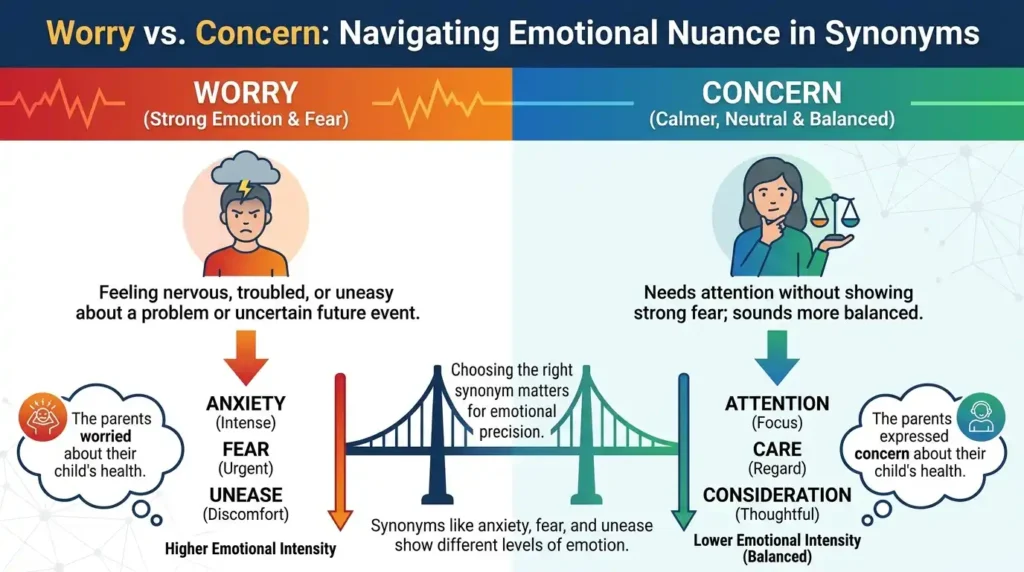
Concern is one of the closest synonyms for worry. Worry means feeling nervous, troubled, or uneasy about a problem, possible danger, or uncertain future event. Concern has a similar meaning, but it sounds calmer and more neutral.
Use concern when you want to show that something needs attention without showing strong fear. For example, “The parents expressed concern about their child’s health” sounds more balanced than “The parents worried about their child’s health.”
Choosing the right synonym matters because words like anxiety, fear, and unease show different levels of emotion.
Best Synonyms for Worry
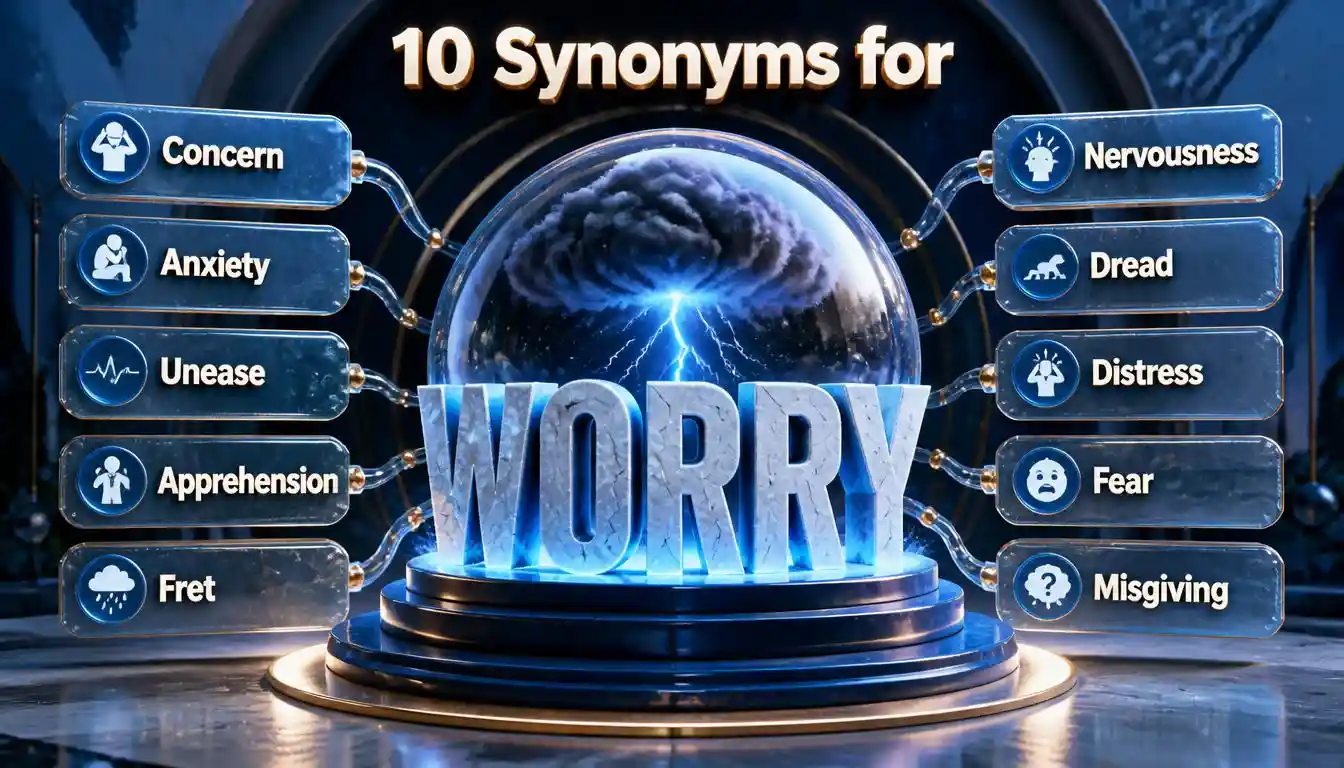
| # | Synonym | Relationship | Main Difference | Best Used For |
| 1 | Concern | Near Synonym | More neutral and controlled than worry | Problems, responsibilities, formal situations |
| 2 | Anxiety | Near Synonym | Stronger emotional stress or nervousness | Fear, pressure, uncertainty |
| 3 | Unease | Near Synonym | A mild feeling that something is wrong | Doubt and discomfort |
| 4 | Apprehension | Near Synonym | Fear about a future event | Upcoming situations and risks |
| 5 | Fret | Near Synonym | Repeated or unnecessary worrying | Casual conversation |
| 6 | Nervousness | Near Synonym | Temporary worry before an event | Tests, meetings, performances |
| 7 | Dread | Near Synonym | Strong fear about something expected | Unpleasant future events |
| 8 | Distress | Contextual Alternative | Serious emotional suffering | Painful or difficult situations |
| 9 | Fear | Near Synonym | Stronger feeling caused by danger | Threats and risks |
| 10 | Misgiving | Near Synonym | Doubt about a decision or situation | Uncertainty and hesitation |
Quick Facts About Worry
| Feature | Information |
| Word | Worry |
| Part of Speech | Verb and noun |
| Simple Meaning | To feel concerned, nervous, or troubled about something |
| Pronunciation | WUR-ee |
| IPA | /ˈwɝːi/ |
| Syllables | 2 (wor-ry) |
| Origin | Old English roots connected with troubling or struggling |
| Word Forms | worry, worries, worried, worrying |
| Formality Level | Neutral |
| Common Usage | Personal problems, future events, health, money, relationships, responsibilities |
Exact vs Similar Synonyms
Synonyms do not always have exactly the same meaning. Some words can replace worry in many sentences, while others only work in certain situations. Concern is close to worry but sounds more professional and controlled.
Anxiety is stronger and often describes deeper emotional stress. Unease is usually milder and describes a feeling that something is wrong. Dread and fear show stronger emotions connected with danger or unpleasant events.
The best word depends on the situation, the level of emotion, and the tone you want to create. Understanding these differences helps you choose more accurate words.
Meaning and Usage of Worry
Basic Meaning
Worry means feeling troubled or nervous because you think something bad, difficult, or uncertain may happen.
Examples:
- I worry about my exam results.
- She worries about her family when they travel.
Different Meanings of Worry
The word worry has two main uses.
1. Feeling Concerned
This is the most common meaning. It describes a person’s emotional response to a possible problem.
Example:
- He worries about losing his job.
2. Causing Someone to Feel Concerned
Worry can also describe something that creates stress or concern.
Example:
- The sudden storm worried the travelers.
How People Use Worry
Everyday Conversation
People commonly use worry when talking about personal concerns.
Examples:
- Don’t worry. Everything will be fine.
- I’m worried about tomorrow’s weather.
Formal Writing
Formal writing often uses concern instead of worry because it sounds more objective.
Example:
- The report raised concerns about public safety.
Academic Writing
Academic writers often use anxiety, concern, or stress depending on the topic.
Examples:
- Researchers studied student anxiety during examinations.
- Public concern about climate change has increased.
Creative Writing
Worry helps writers show emotions and create tension.
Examples:
- Her worry grew as the night became darker.
- A feeling of unease filled the empty room.
Synonyms and Alternatives for Worry
1. Concern
Relationship: Near Synonym
Meaning:
Concern means feeling that something is important, uncertain, or needs attention.
Difference:
Concern is calmer than worry. It focuses more on the issue than emotional stress.
Best Used For:
Professional situations, responsibilities, and serious discussions.
Examples:
- The manager expressed concern about the project delay.
- Her biggest concern was her family’s safety.
2. Anxiety
Relationship: Near Synonym
Meaning:
Anxiety means strong nervousness, fear, or stress about uncertain situations.
Difference:
Anxiety is usually stronger than normal worry and may continue for a longer time.
Best Used For:
Emotional stress, health discussions, and serious pressure.
Examples:
- Many students feel anxiety before exams.
- His anxiety increased while waiting for the decision.
3. Unease
Relationship: Near Synonym
Meaning:
Unease means a feeling of discomfort or that something is not right.
Difference:
Unease is usually weaker than worry and may not have a clear cause.
Best Used For:
Uncertainty, suspicion, or uncomfortable situations.
Examples:
- She felt unease when the door opened suddenly.
- A sense of unease spread through the room.
4. Apprehension
Relationship: Near Synonym
Meaning:
Apprehension means fear or nervousness about something that may happen.
Difference:
It usually focuses on future events.
Best Used For:
Formal writing and upcoming challenges.
Examples:
- He entered the interview room with apprehension.
- The new policy created apprehension among workers.
5. Fret
Relationship: Near Synonym
Meaning:
Fret means to worry repeatedly, often about small things.
Difference:
It often suggests unnecessary worrying.
Best Used For:
Informal conversations.
Examples:
- Don’t fret over small mistakes.
- She fretted about every detail.
6. Nervousness
Relationship: Near Synonym
Meaning:
Nervousness means feeling tense or worried before something important.
Difference:
It is often temporary and linked to a specific event.
Best Used For:
Tests, interviews, performances.
Examples:
- His nervousness disappeared after the first question.
- She felt nervousness before her speech.
7. Dread
Relationship: Near Synonym
Meaning:
Dread means strong fear about something unpleasant that may happen.
Difference:
Dread is much stronger than ordinary worry.
Best Used For:
Unpleasant events or difficult situations.
Examples:
- She dreaded the difficult conversation.
- He felt dread before opening the results.
8. Distress
Relationship: Contextual Alternative
Meaning:
Distress means severe emotional pain or suffering.
Difference:
Distress describes serious suffering, not normal worry.
Best Used For:
Emergencies and painful experiences.
Examples:
- The accident caused great distress.
- She was in distress after losing her home.
9. Fear
Relationship: Near Synonym
Meaning:
Fear means feeling afraid because you believe something harmful may happen.
Difference:
Fear is stronger and usually involves danger.
Best Used For:
Threats and serious risks.
Examples:
- He feared the storm would become worse.
- Her fear stopped her from moving forward.
10. Misgiving
Relationship: Near Synonym
Meaning:
Misgiving means doubt or worry about whether something is right.
Difference:
It focuses more on uncertainty than emotional stress.
Best Used For:
Decisions and choices.
Examples:
- She had misgivings about the agreement.
- His misgivings proved correct.
11. Trepidation
Relationship: Near Synonym
Meaning:
Trepidation means fear or nervousness about something uncertain or challenging.
Difference:
Trepidation is more formal than worry and often describes hesitation before an important event.
Best Used For:
Formal writing, serious decisions, and uncertain situations.
Examples:
- She accepted the new role with some trepidation.
- The travelers moved forward with trepidation.
12. Disquiet
Relationship: Near Synonym
Meaning:
Disquiet means a feeling of worry, disturbance, or lack of peace.
Difference:
Disquiet is more formal and often describes a general feeling among people.
Best Used For:
News reports, formal discussions, and public concerns.
Examples:
- The announcement caused public disquiet.
- There was a sense of disquiet after the incident.
13. Agitation
Relationship: Near Synonym
Meaning:
Agitation means nervousness, restlessness, or emotional disturbance.
Difference:
Agitation often appears through visible behavior, while worry can remain internal.
Best Used For:
Situations involving stress or emotional reactions.
Examples:
- The delay caused agitation among passengers.
- She showed signs of agitation during the meeting.
14. Restlessness
Relationship: Near Synonym
Meaning:
Restlessness means being unable to relax because of nervous thoughts or feelings.
Difference:
Restlessness describes the effect worry has on behavior.
Best Used For:
Physical signs of stress or discomfort.
Examples:
- His restlessness showed that something was wrong.
- She experienced restlessness before the important announcement.
15. Stress
Relationship: Contextual Alternative
Meaning:
Stress means pressure or strain caused by difficult situations.
Difference:
Stress is the pressure itself, while worry is the emotional reaction to possible problems.
Best Used For:
Work pressure, deadlines, and difficult responsibilities.
Examples:
- Work stress affected his sleep.
- She felt stress before the final deadline.
16. Tension
Relationship: Contextual Alternative
Meaning:
Tension means a feeling of pressure, nervousness, or conflict.
Difference:
Tension usually describes an atmosphere or situation rather than personal thoughts.
Best Used For:
Conflicts, relationships, and stressful environments.
Examples:
- There was tension between the two teams.
- The tension in the room increased.
17. Alarm
Relationship: Contextual Alternative
Meaning:
Alarm means sudden fear or concern caused by a possible danger.
Difference:
Alarm is usually immediate and stronger than ordinary worry.
Best Used For:
Emergencies and unexpected problems.
Examples:
- The strange noise caused alarm among residents.
- The warning raised alarm across the city.
18. Panic
Relationship: Contextual Alternative
Meaning:
Panic means sudden extreme fear that makes it difficult to think clearly.
Difference:
Panic is much stronger and faster than worry.
Best Used For:
Emergency situations and dangerous events.
Examples:
- People panicked when the fire started.
- Don’t panic; we still have time.
19. Foreboding
Relationship: Near Synonym
Meaning:
Foreboding means a strong feeling that something bad may happen.
Difference:
It focuses on a negative expectation about the future.
Best Used For:
Creative writing and serious situations.
Examples:
- A feeling of foreboding filled the old house.
- He had a strange foreboding before the journey.
20. Solicitude
Relationship: Near Synonym
Meaning:
Solicitude means deep concern and care for someone’s well-being.
Difference:
It often includes kindness and responsibility, not only fear.
Best Used For:
Formal or literary writing.
Examples:
- Her solicitude for her children was clear.
- The doctor showed great solicitude toward his patients.
21. Brooding
Relationship: Near Synonym
Meaning:
Brooding means thinking deeply and repeatedly about a problem in a negative way.
Difference:
Brooding focuses on repeated thoughts rather than the feeling of worry itself.
Best Used For:
Emotional descriptions and creative writing.
Examples:
- He spent the evening brooding over his mistake.
- Her brooding silence worried her friends.
22. Ruminating
Relationship: Near Synonym
Meaning:
Ruminating means repeatedly thinking about the same problem.
Difference:
It describes a mental process rather than only an emotion.
Best Used For:
Psychology, reflection, and personal writing.
Examples:
- She kept ruminating about the conversation.
- He was ruminating over past decisions.
23. Insecurity
Relationship: Contextual Alternative
Meaning:
Insecurity means feeling uncertain about yourself or your abilities.
Difference:
It focuses on self-confidence rather than general worry.
Best Used For:
Personal feelings and relationships.
Examples:
- His insecurity affected his choices.
- She struggled with insecurity after criticism.
24. Doubt
Relationship: Contextual Alternative
Meaning:
Doubt means uncertainty about whether something is true, correct, or successful.
Difference:
Doubt does not always involve fear or emotional stress.
Best Used For:
Decisions, beliefs, and uncertain outcomes.
Examples:
- She had doubts about the plan.
- I doubt that the answer is correct.
25. Perplexity
Relationship: Contextual Alternative
Meaning:
Perplexity means confusion or uncertainty.
Difference:
It focuses on not understanding something, not emotional worry.
Best Used For:
Confusing situations or unclear information.
Examples:
- He looked at the instructions with perplexity.
- The decision caused public perplexity.
26. Troubling
Relationship: Contextual Alternative
Meaning:
Troubling means causing concern, discomfort, or sadness.
Difference:
It describes something that creates worry rather than the feeling itself.
Best Used For:
Reports, discussions, and serious situations.
Examples:
- The report contained troubling information.
- The results were troubling for researchers.
27. Worrisome
Relationship: Contextual Alternative
Meaning:
Worrisome means causing worry or concern.
Difference:
It describes a situation or thing that creates worry, not the emotion itself.
Best Used For:
Describing problems or situations.
Examples:
- The drop in sales was worrisome.
- The symptoms were worrisome to the doctor.
28. Uneasiness
Relationship: Near Synonym
Meaning:
Uneasiness means a feeling of discomfort or nervous uncertainty.
Difference:
It is the noun form related to unease.
Best Used For:
Emotional descriptions and uncertain situations.
Examples:
- She felt uneasiness about the decision.
- The silence created uneasiness among the group.
29. Concernment
Relationship: Contextual Alternative
Meaning:
Concernment means a state of being affected or concerned.
Difference:
This word is rare and sounds unnatural in modern everyday English.
Best Used For:
Rare formal or historical contexts.
Examples:
- The matter was of great concernment to the community.
30. Trouble
Relationship: Contextual Alternative
Meaning:
Trouble means a problem, difficulty, or situation that causes concern.
Difference:
Trouble is usually the problem itself, not the emotional reaction.
Best Used For:
Everyday situations.
Examples:
- The company faced financial trouble.
- She was having trouble with her computer.
Best Alternatives by Context
Everyday Use
Best choices:
- Concern
- Worry
- Fret
- Nervousness
These words sound natural in daily conversations and personal situations.
Formal Writing
Best choices:
- Concern
- Apprehension
- Disquiet
- Solicitude
These words create a more professional and balanced tone.
Academic Writing
Best choices:
- Anxiety
- Concern
- Stress
- Apprehension
These words work well when discussing emotions, research, or social issues.
Business Communication
Best choices:
- Concern
- Apprehension
- Risk
- Tension
These alternatives communicate problems without sounding overly emotional.
Creative Writing
Best choices:
- Unease
- Dread
- Foreboding
- Distress
These words help create stronger moods and emotional scenes.
Words Commonly Confused with Worry
Fear
Difference:
Fear is a stronger emotional response to danger. Worry often involves possible future problems.
Example:
- She feared the dangerous animal.
- She worried about arriving late.
Stress
Difference:
Stress describes pressure caused by demands or problems. Worry describes concern about what may happen.
Example:
- The workload caused stress.
- He worried about finishing the work.
Care
Difference:
Care means feeling interest or responsibility. It does not always include nervousness.
Example:
- She cares about her family.
- She worries about her family’s health.
Doubt
Difference:
Doubt means uncertainty about something being true or correct.
Example:
- I doubt his explanation.
- I worry that his explanation may be wrong.
Trouble
Difference:
Trouble means a problem or difficulty, not the emotional response.
Example:
- They are facing financial trouble.
- They worry about financial problems.
Antonyms of Worry
| Antonym | Simple Meaning | Example Sentence |
| Calm | Feeling peaceful and relaxed | She stayed calm during the difficult situation. |
| Peace | A state of mental quiet and comfort | The quiet place gave him peace. |
| Confidence | Belief that things will go well | He answered the questions with confidence. |
| Assurance | A feeling of certainty or security | Her explanation gave everyone assurance. |
| Hope | Positive belief about the future | Hope helped them continue during hard times. |
| Trust | Belief that someone or something is reliable | She trusted the process and stayed positive. |
| Comfort | A feeling of safety and relief | His words brought comfort to the family. |
| Relaxation | A state without stress or tension | Reading helps her achieve relaxation. |
Common Collocations with Worry
| Collocation | Meaning | Example Sentence |
| Worry about | Feel concerned about something | I worry about my future. |
| Worry too much | Think excessively about problems | Try not to worry too much about small mistakes. |
| Constant worry | Continuous feeling of concern | Constant worry can affect your daily life. |
| Cause worry | Create concern or stress | The sudden change caused worry among employees. |
| Deep worry | Strong feeling of concern | His deep worry was clear from his expression. |
| Nothing to worry about | No reason to feel concerned | There is nothing to worry about now. |
| Worry less | Reduce feelings of concern | Good planning helps people worry less. |
| Worry over | Feel concerned about something | She worried over the final decision. |
Frequently Asked Questions
What does worry mean?
Worry means feeling nervous, troubled, or concerned about something that may happen. People usually worry about uncertain situations, future problems, responsibilities, health, money, or relationships.
What is another word for worry?
Another word for worry is concern. Other useful alternatives include anxiety, unease, apprehension, nervousness, and fret. The best choice depends on the level of emotion and the situation.
What is the closest synonym for worry?
Concern is one of the closest synonyms for worry because it works in many situations. However, concern usually sounds calmer and more professional, while worry often shows more personal emotion.
What is the difference between worry and anxiety?
Worry usually refers to thoughts about possible problems or future events. Anxiety is stronger and often describes deeper emotional stress, nervousness, or fear that may continue for a longer time.
Can I use synonyms for worry in every sentence?
No. Synonyms have different meanings and emotional levels. For example, fear is stronger than worry, while concern is calmer. The correct word depends on the context.
Is worry formal or informal?
Worry is a neutral word. People use it in everyday conversations, professional writing, academic discussions, and creative writing.
Conclusion
Choosing the right synonym for worry helps you express your feelings more clearly. Words like concern, anxiety, unease, and apprehension may have similar meanings, but they show different levels of emotion.
Understanding these differences improves your vocabulary and helps you communicate more accurately in speaking and writing.

About Sajjad Ahmed
Sajjad Ahmed is the author behind Guest Paster, where he writes about English vocabulary, synonyms, word meanings, and practical word usage.
His content is designed to help readers understand the differences between similar words, discover suitable alternatives, and use English vocabulary more effectively in everyday writing and communication.
Before publishing, Sajjad focuses on presenting word choices in a clear and easy-to-understand format, with relevant meanings, context, and examples where helpful.
Through Guest Paster, his goal is to make vocabulary learning simpler and provide useful language resources for students, writers, English learners, and anyone looking to expand their vocabulary.
Areas of Focus: English Vocabulary • Synonyms • Word Meanings • Word Usage • Language Learning
Author: Sajjad Ahmed
Website: Guest Paster