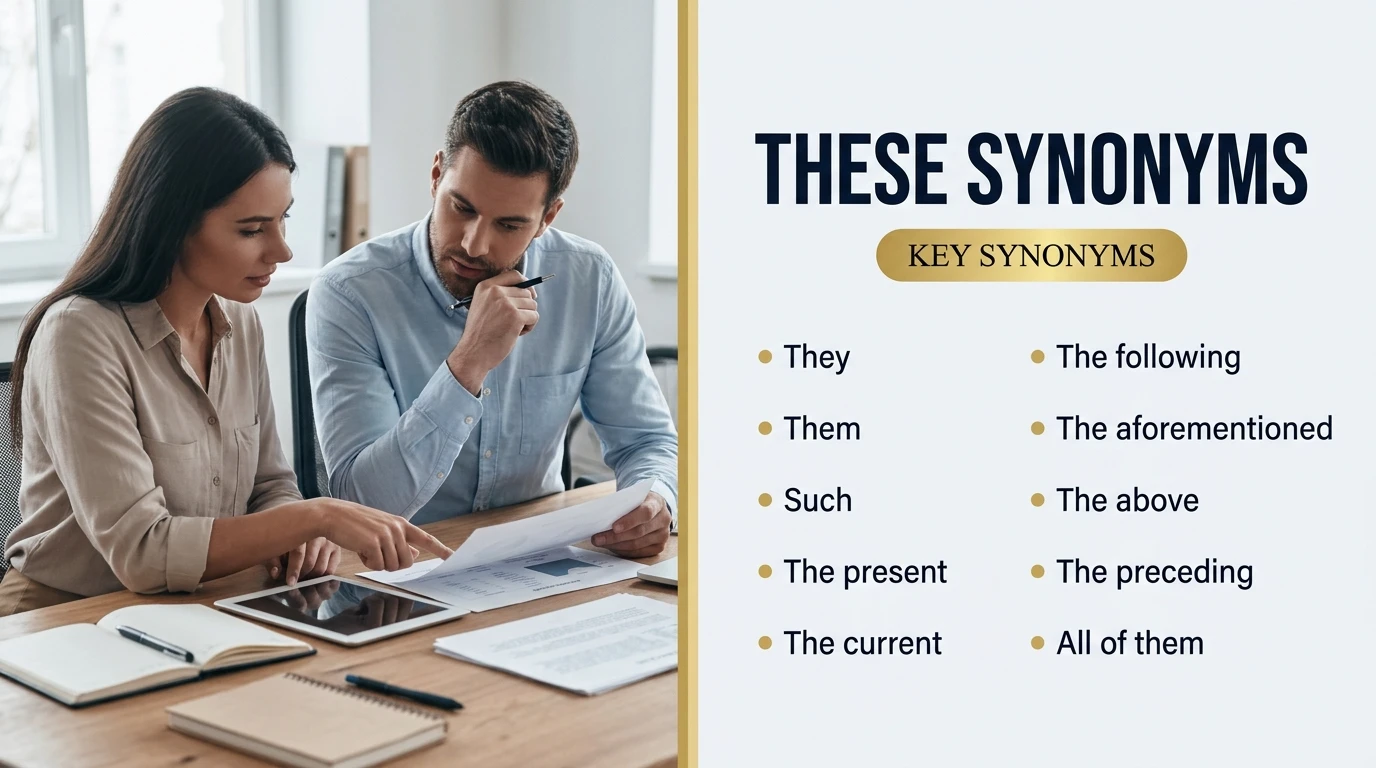
Stuck on “these” and want something different? Honestly, it depends on how you’re using it. Standing in for people or things, they or them usually does the job. In an essay or research paper, such findings or the points above read as more polished. And if you’re about to list something, just say the following.
There’s no one perfect swap, because “these” isn’t a normal descriptive word. It points at something. So check the sentence, think about your tone, and pick whatever fits.
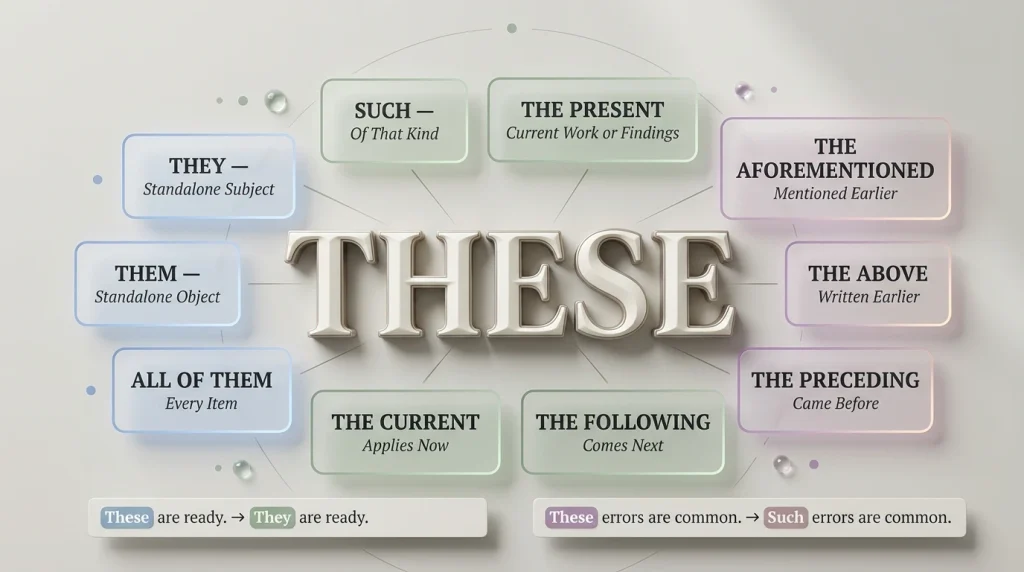
Top 10 Synonyms for These at a Glance
| Alternative | Best Use | Key Difference |
| They | Standalone subject | Refers back without pointing |
| Them | Standalone object | Used after verbs or prepositions |
| Such | Academic and general writing | Refers to things of that kind |
| The present | Research and formal writing | Refers to the work or findings at hand |
| The current | Current conditions or versions | Emphasizes what applies now |
| The following | Lists and upcoming information | Points forward |
| The aforementioned | Legal or highly formal writing | Points back to something already named |
| The above | Written information appearing earlier | Refers to position in a document |
| The preceding | Earlier sentences, sections, or examples | Emphasizes sequence |
| All of them | An entire previously identified set | Emphasizes every item |
Quick Facts About These
- Part of speech: Demonstrative determiner and demonstrative pronoun
- Meaning: Refers to two or more specific people, things, or ideas that are near in space, time, or context
- Pronunciation: /ðiːz/
- Syllables: One
- Singular form: This
- Distant plural counterpart: Those
- Formality: Neutral
- Common uses: These findings, these days, these people, these results, these are, all of these
- Best standalone subject alternative: They
- Best standalone object alternative: Them
- Useful academic alternative: Such + a specific noun, or the present + noun
- Best forward-pointing alternative: The following
What Is the Closest Synonym for These?
There is no universal synonym for these because the correct replacement changes with grammar and meaning.
When these stands alone as a subject, they is often the closest natural replacement:
These are ready for delivery.
→ They are ready for delivery.
When it functions as an object, them may replace it:
Please keep these.
→ Please keep them.
Before a plural noun in academic or formal writing, such can sometimes replace the idea expressed by these, especially when referring to a type or category:
These errors can affect the results.
→ Such errors can affect the results.
However, the meaning changes slightly. These errors identifies particular errors, while such errors means errors of the kind just described.
For research writing, the present is useful when referring specifically to the study or findings being discussed:
These findings support the hypothesis.
→ The present findings support the hypothesis.
So the better question is not simply What is a synonym for these? but What does these mean in this particular sentence?
What Does These Mean?
These is the plural form of this. It points to specific plural people, objects, ideas, periods, or pieces of information that are relatively near or immediately relevant.
It has two main grammatical roles.
These as a Determiner
It comes directly before a plural noun:
- These books are new.
- These results need further analysis.
- These problems require attention.
- These days feel unusually busy.
These as a Pronoun
It can also stand alone when the noun is already understood:
- These are mine.
- I prefer these.
- Are these available?
- These look better.
This difference is essential when choosing an alternative. They can replace standalone these in some subject positions, but it cannot replace these before a noun.
Correct:
These are expensive. → They are expensive.
Incorrect:
These products are expensive. → They products are expensive.
Can Synonyms for These Be Used Interchangeably?
Usually not.
Unlike many descriptive words, these performs a grammatical pointing function. Its alternatives can change the direction, emphasis, register, or grammatical structure of a sentence.
Consider three questions before replacing it:
Is the word standing alone or modifying a noun?
They works as a pronoun, but not as a determiner before a noun.
Are you pointing backward or forward in the text?
The aforementioned points backward, while the following normally points forward.
How formal is the context?
The aforementioned may work in a contract but sound unnecessarily bureaucratic in an everyday email.
The safest replacement is therefore the one that preserves both the intended reference and the grammar of the sentence.
Different Meanings and Functions of These
Understanding the function first makes choosing a synonym much easier.
Before a Plural Noun
Examples:
- these findings
- these conditions
- these problems
Possible alternatives include:
such, the present, the current, the preceding, the following, the listed, the specified
As a Standalone Subject
Example:
These are ready.
Possible alternatives:
they, these ones in some conversational contexts, or a more specific noun phrase.
As a Standalone Object
Example:
Keep these.
Possible alternatives:
them or all of them, depending on meaning.
To Describe a Type or Kind
Example:
These kinds of mistakes are common.
A more concise alternative may be:
Such mistakes are common.
To Introduce Upcoming Information
Example:
Consider these three reasons.
A natural formal alternative is:
Consider the following three reasons.
Synonyms for These with Meanings and Examples
1. They
Meaning: A plural subject pronoun referring to people or things already identified.
Best for: Continuing a reference without repeating a noun.
Formality: Neutral
Examples:
- The reports arrived this morning. They are on my desk.
- The new employees have completed training. They start work Monday.
Difference from these: They refers back to established people or things but does not retain the pointing or nearness expressed by these.
Avoid it: Before a noun. You cannot write they findings or they books.
2. Them
Meaning: The object form of they.
Best for: Replacing standalone these after a verb or preposition.
Examples:
- The documents are ready; please sign them.
- I found the missing keys and put them on the table.
Compare:
Please review these.
→ Please review them.
Avoid it: As the subject of a standard sentence. Write they are ready, not them are ready.
3. Such
Meaning: Of the type or kind just described.
Best for: Academic, analytical, professional, and explanatory writing.
Examples:
- Several errors appeared during testing. Such errors can affect reliability.
- The company experienced repeated delays. Such problems can damage customer trust.
Difference from these: These identifies specific items; such usually generalizes them as examples of a particular type.
Avoid it: When physically pointing to specific objects.
4. The Present
Meaning: Belonging to the study, document, investigation, or situation currently being discussed.
Best for: Academic papers, research reports, and formal analysis.
Examples:
- The present findings support earlier research.
- The present results reveal a significant difference between the groups.
This is particularly useful as an alternative to repetitive phrases such as these findings.
Avoid it: For ordinary physical objects.
5. The Current
Meaning: Existing, operating, or valid now.
Best for: Rules, prices, conditions, policies, versions, and situations that may change.
Examples:
- The current guidelines require additional verification.
- Under the current prices, delivery remains free.
Difference from these: Current adds a time-based meaning that these does not necessarily contain.
6. The Following
Meaning: The information or items that come next.
Best for: Lists, instructions, explanations, emails, and reports.
Examples:
- Please provide the following documents.
- Consider the following examples before answering.
Difference from these: The following explicitly points forward.
Do not use it when referring to information that has already appeared.
7. The Aforementioned
Meaning: Something explicitly mentioned earlier.
Best for: Legal documents, contracts, formal reports, and compliance writing.
Examples:
- The aforementioned conditions remain in effect.
- Payment for the aforementioned services is due within 30 days.
Difference from these: It points backward and has a much more formal tone.
Avoid it: In ordinary conversation, casual emails, or simple web copy.
8. The Above
Meaning: Information appearing earlier on a page, screen, form, or document.
Best for: Forms, reports, technical documents, and written instructions.
Examples:
- Please confirm that the above details are correct.
- Based on the above results, further testing is recommended.
Avoid it: In purely spoken contexts where there is no visible material above.
9. The Preceding
Meaning: Something that came immediately before the current point.
Best for: Essays, textbooks, reports, chapters, examples, and analytical writing.
Examples:
- The preceding examples illustrate the difference.
- As shown in the preceding sections, demand has increased steadily.
It is especially useful when replacing phrases such as these sentences or these examples after the material has already appeared.
10. All of Them
Meaning: Every member of a previously identified group.
Best for: Emphasizing that nothing in the set is excluded.
Examples:
- We reviewed ten proposals, and all of them met the basic requirements.
- The seedlings were checked, and all of them appeared healthy.
It can replace all of these when the items are already clear from context.
11. All of the Above
Meaning: Every item previously displayed or listed.
Best for: Reports, assessments, forms, summaries, and structured documents.
Example:
Rising costs, delayed shipments, and staff shortages affected production. All of the above contributed to the slowdown.
Use it only when readers can clearly identify the preceding list.
12. Both
Meaning: Two previously identified people, objects, or ideas considered together.
Best for: Situations involving exactly two items.
Examples:
- We tested the two designs, and both performed well.
- Sarah and Mia submitted proposals; both were approved.
Avoid it: For groups of three or more.
13. The Listed
Meaning: Items specifically included in a written list.
Best for: Forms, requirements, inventories, and administrative writing.
Examples:
- Bring the listed documents to your appointment.
- The listed charges include delivery and installation.
Use it only when an actual list exists.
14. The Specified
Meaning: Items or conditions precisely stated or defined.
Best for: Technical instructions, contracts, specifications, policies, and project requirements.
Examples:
- Submit the files in the specified formats.
- The equipment must operate within the specified limits.
This is more precise than these and should be used only when the requirements have actually been specified.
15. The Ones in Question
Meaning: The particular items currently being discussed or investigated.
Best for: Reports, disputes, investigations, and formal explanations.
Examples:
- The invoices in question were issued in March.
- The employees in question were interviewed separately.
It is useful when the focus is not physical nearness but the subject currently under discussion.
16. The Same
Meaning: Identical to something previously mentioned.
Best for: Repeated methods, objects, conditions, or comparisons.
Examples:
- Both experiments used the same methods.
- Return the files to the same folders.
This is not a direct synonym for these. It works only when identity or repetition is the intended meaning.
17. The Very
Meaning: The exact items being discussed, with added emphasis.
Best for: Persuasive writing, speeches, journalism, and storytelling.
Examples:
- The very policies designed to reduce costs created new delays.
- These are the very documents we were looking for.
It emphasizes exact identity rather than simply pointing.
Best Alternatives for These by Context
In Academic Writing and Essays
Academic writing usually benefits from precision rather than simply replacing one demonstrative with another.
Instead of:
These show that productivity increased.
Write:
These results show that productivity increased.
Or, when appropriate:
The present findings indicate that productivity increased.
Useful alternatives include:
- such findings
- the present findings
- the preceding examples
- the reported results
- the observed outcomes
- the available evidence
- the preceding points
Often the strongest solution is not a synonym at all—it is naming exactly what these refers to.
Another Word for These Findings
Good alternatives include:
- the present findings
- such findings
- these results
- the reported results
- the observed outcomes
- the available evidence
- the reported data
Choose according to meaning.
For example:
These findings support earlier research.
can become:
The present findings support earlier research.
But:
Such findings are uncommon in smaller studies.
changes the emphasis from these particular findings to findings of this kind.
Another Word for These Things
The phrase these things is often vague. Instead of replacing only these, replace things with the noun you actually mean.
Depending on context:
- these issues
- these factors
- these items
- these details
- these problems
- these elements
- these ideas
- these products
- such matters
Instead of:
These things affect performance.
Prefer:
These factors affect performance.
The second sentence tells the reader exactly what is affecting performance.
Another Word for These Sentences
Depending on their position in the text, you could use:
- the preceding sentences
- the sentences above
- the following sentences
- the quoted passages
- the examples above
- the selected sentences
For example:
These sentences demonstrate parallel structure.
may become:
The preceding sentences demonstrate parallel structure.
if the examples appeared immediately before the statement.
Formal Synonyms for These
Formal writing does not require replacing every occurrence of these. The word itself is perfectly acceptable in professional and academic English.
When greater precision is useful, consider:
- the present
- the current
- the preceding
- the following
- the aforementioned
- the listed
- the specified
- the ones in question
Choose the alternative for its meaning—not merely because it sounds more formal.
Which Synonym Should I Choose?
| Situation | Best Choice | Example |
| Standalone subject | They | They are ready |
| Standalone object | Them | Please review them |
| Type already discussed | Such | Such errors are common |
| Findings in your own paper | The present findings | The present findings suggest… |
| Rules applying now | The current | The current rules require… |
| Introducing a list | The following | Review the following items |
| Referring to earlier text | The above / preceding | The above examples show… |
| Highly formal back-reference | The aforementioned | The aforementioned clauses… |
| Exactly two items | Both | Both performed well |
| Entire known group | All of them | All of them passed |
| Items from a written list | The listed | The listed documents… |
| Precisely defined requirements | The specified | The specified conditions… |
Exact and Near Synonyms: What Is the Difference?
There is no perfect synonym for these in every context.
That is because these combines several functions at once. It indicates plurality, identifies particular referents, and can also signal nearness in space, time, or discourse.
Every replacement changes something.
They keeps the plural reference but loses the pointing effect.
Such connects the new statement to a previously described type rather than simply identifying particular items.
The present shifts attention toward the current document, study, or situation.
The following changes the direction of reference by explicitly pointing forward.
The aforementioned points backward and adds a highly formal register.
For that reason, these expressions are better understood as contextual alternatives and near-synonyms, not universally interchangeable synonyms.
Words Commonly Confused with These
This
This is singular.
Correct:
- This book
- These books
Incorrect:
- This books
- These book
Those
Those is the distant plural counterpart of these, not a synonym.
These shoes normally indicates shoes perceived as nearer or more immediate.
Those shoes indicates a more distant or less immediate set.
They
They can sometimes replace standalone these, but not these before a noun.
Correct:
These are useful. → They are useful.
Incorrect:
These tools are useful. → They tools are useful.
The
The identifies a known noun but does not preserve the pointing or proximity meaning of these.
These books and the books can therefore refer to the same objects in some contexts, but they do not communicate exactly the same thing.
Several and Many
These are quantity words rather than synonyms.
These books identifies a particular set.
Several books gives an approximate quantity.
Many books describes a relatively large quantity.
Common Mistakes When Using or Replacing These
Mistake 1: Using These with a Singular Noun
Incorrect:
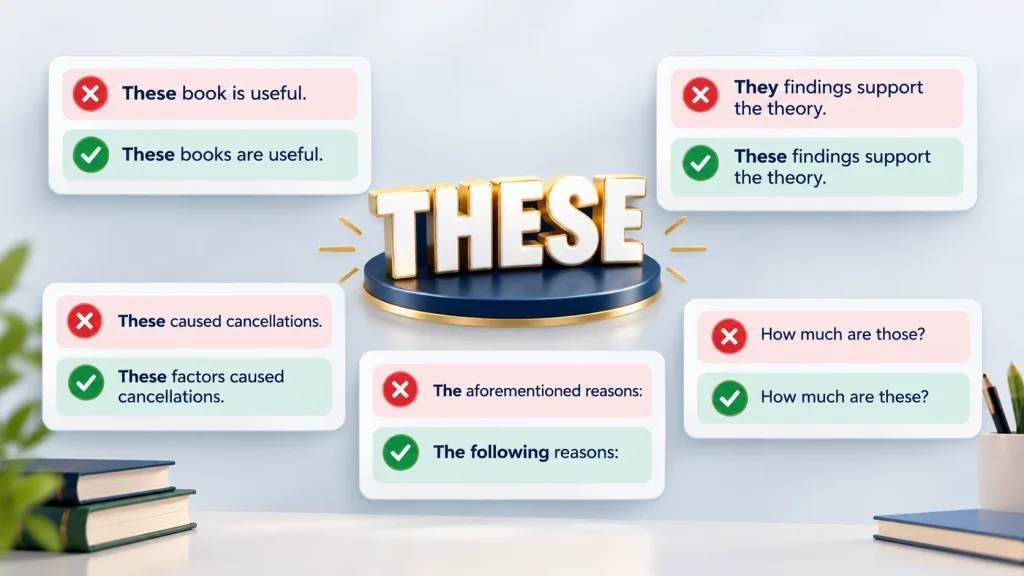
These book is useful.
Correct:
This book is useful.
or
These books are useful.
Because these is plural, it requires a plural noun when functioning as a determiner.
Mistake 2: Putting They Before a Noun
Incorrect:
They findings support the theory.
Correct:
These findings support the theory.
or
The present findings support the theory.
They is a pronoun, not a demonstrative determiner.
Mistake 3: Leaving These Unclear in an Essay
Weak:
Prices increased and customer support declined. These caused cancellations.
Clearer:
Prices increased and customer support declined. These changes caused cancellations.
Even better when appropriate:
These factors contributed to increased cancellations.
A reader should not have to guess what these refers to.
Mistake 4: Using The Aforementioned to Introduce a List
Incorrect:
We rejected the proposal for the aforementioned reasons: high cost, limited support, and poor scalability.
Better:
We rejected the proposal for the following reasons: high cost, limited support, and poor scalability.
Aforementioned points backward; following points forward.
Mistake 5: Using Legal Language in Casual Writing
Awkward:
I bought some cookies. Please put the aforementioned cookies on the table.
Natural:
I bought some cookies. Please put them on the table.
More formal does not automatically mean better.
Mistake 6: Confusing These and Those
If the items are perceived as near or immediately relevant, these is generally appropriate.
How much are these?
If they are farther away or less immediate:
How much are those?
Antonyms and Opposites of These
The clearest grammatical opposite of these is those.
| Word or Phrase | Relationship to These |
| Those | Distant plural counterpart |
| The others | Remaining items outside the selected set |
| Others | Different people or things |
| None | Excludes every member of a set |
The main contrast is:
these → near / immediate plural items
those → more distant plural items
The singular equivalent is:
this → that
These in American and British English
The basic grammar and spelling of these are the same in American and British English.
Both varieties commonly use expressions such as:
- these days
- these findings
- these results
- these people
- these conditions
- all of these
Formal alternatives can vary somewhat by document style and region, but for most writers, straightforward expressions such as the following, the preceding, the current, and a clearly named noun are safer than rare administrative or legal wording.
For general web, academic, and business writing, clarity should take priority over regional formality.
Common Collocations with These
These + Noun
- these days
- these findings
- these results
- these people
- these issues
- these factors
- these conditions
- these reasons
- these examples
- these problems
Quantifier + These
- all of these
- both of these
- some of these
- none of these
- one of these
- each of these
- either of these
Verb + These
- consider these
- compare these
- review these
- examine these
- keep these
- remove these
- try these
- address these
Prepositional Phrases
- in these cases
- under these conditions
- for these reasons
- among these
- between these two
- based on these
Common Phrases with These
These Days
Means nowadays or at the present time.
These days, many meetings take place online.
One of These Days
Means at some unspecified point in the future.
One of these days, I’ll finally organize those old files.
These Things Happen
An informal expression used to accept or reassure someone about a mistake or unfortunate event.
Don’t worry about the typo—these things happen.
In These Parts
Means in this particular area or region.
Heavy snowfall is unusual in these parts.
Practice Exercises
Fill in the Blanks
Choose from: they, them, such, the present, the following
- ______ findings support the original hypothesis.
- The packages have arrived; put ______ near the door.
- The new interns are here. ______ start training tomorrow.
- Please submit ______ documents: identification, proof of address, and the signed form.
- Several calculations contained rounding errors. ______ mistakes can affect the final result.
Answers
- The present
- them
- They
- the following
- Such
Quick Vocabulary Quiz
1. Which alternative works as the subject in “These are ready”?
a) Them
b) They
c) The current
d) Such findings
Answer: b) They
2. Which expression is best for introducing a list?
a) The aforementioned
b) The following
c) Them
d) Those
Answer: b) The following
3. Which is the distant plural counterpart of these?
a) This
b) They
c) Those
d) Such
Answer: c) Those
4. Which phrase works well for “these findings” in a research paper?
a) They findings
b) The present findings
c) Them findings
d) Those ones findings
Answer: b) The present findings
5. Which word should replace these in “Please keep these”?
a) They
b) Them
c) Such
d) Following
Answer: b) Them
Frequently Asked Questions
What is the best synonym for these?
There is no single replacement that works everywhere. They is often the closest alternative when these stands alone as a subject, while them works in object position. Before a noun, options such as such, the present, the current, or the following depend on the intended meaning.
What is another word for these in an essay?
In an essay, consider such, the present, the preceding, the following, or—often best of all—a specific noun phrase. For example, instead of writing These show a problem, write These results show a problem or The preceding results reveal a problem.
Can I replace these with they?
Only when these stands alone and functions as a subject referring to already identified people or things. You can change These are ready to They are ready, but you cannot change these findings to they findings.
Can such replace these?
Sometimes. Such works when you mean things of the type just described. For example, these errors may become such errors when referring to that kind of error. It is not appropriate when physically pointing to specific objects.
What is a formal synonym for these?
Depending on context, formal alternatives include the present, the current, the preceding, the following, the aforementioned, the listed, and the specified. The best choice depends on what the sentence is pointing to.
What is another word for these findings?
Useful alternatives include the present findings, such findings, the reported results, the observed outcomes, and the available evidence. Choose the phrase that accurately describes the information rather than changing words only to avoid repetition.
What is another word for these things?
Usually, the best solution is to replace things with a specific noun: these factors, these issues, these details, these items, these problems, these elements, or such matters.
What is the opposite of these?
Those is the direct distant plural counterpart of these. These normally refers to plural items perceived as near or immediate, while those refers to plural items perceived as farther away.
Conclusion
Finding the right synonym for these is less about swapping one word for another and more about making your reference clear. Use they or them when the items are already understood, such when referring to a type, the present for findings or work being discussed, and the following when introducing information that comes next.
In essays and professional writing, the strongest fix is often even simpler: name the noun. Instead of writing These prove the point, write These results prove the point. Precise references make sentences easier to understand, reduce repetition, and help readers follow your argument without guessing.

About Sajjad Ahmed
Sajjad Ahmed is the author behind Guest Paster, where he writes about English vocabulary, synonyms, word meanings, and practical word usage.
His content is designed to help readers understand the differences between similar words, discover suitable alternatives, and use English vocabulary more effectively in everyday writing and communication.
Before publishing, Sajjad focuses on presenting word choices in a clear and easy-to-understand format, with relevant meanings, context, and examples where helpful.
Through Guest Paster, his goal is to make vocabulary learning simpler and provide useful language resources for students, writers, English learners, and anyone looking to expand their vocabulary.
Areas of Focus: English Vocabulary • Synonyms • Word Meanings • Word Usage • Language Learning
Author: Sajjad Ahmed
Website: Guest Paster