
Deft is an adjective that describes someone as being proficient, effective, and quick in their actions with a neat and controlled manner. The term can be used to describe physical actions such as dexterous hands and feet and figurative abilities such as handling a difficult situation deftly.
In general terms, deft is the safest synonym for skilled. When precise hand or body movements are required, dexterous is usually more specific than adroit for clever or tactful handling.
The correct alternative is dependent upon what aspect of the person you want to emphasize: overall ability, manual coordination, quickness, precision or social/mindfulness skills.
Another Word for Deft
| # | Synonym | Meaning Difference |
|---|---|---|
| 1 | Skillful | Broadest equivalent |
| 2 | Dexterous | Near-identical for physical skill |
| 3 | Adept | Mastery of a specific thing |
| 4 | Adroit | More formal, often mental agility |
| 5 | Nimble | Stresses speed over expertise |
| 6 | Agile | Quickness and adaptability |
| 7 | Proficient | Tested competence, less grace |
| 8 | Clever | Mental sharpness, not hand skill |
| 9 | Handy | Casual, practical, less elegant |
| 10 | Masterful | Grander; total command implied |
Quick Facts About “Deft”
- Part of speech: Adjective (Cambridge Dictionary)
- Simple meaning: Neatly skillful and quick in movement or action
- Pronunciation: /dɛft/ — one syllable, rhymes with “left” (Collins)
- Syllables: 1
- Word forms: defter, deftest (comparatives); deftly (adverb); deftness (noun — the noun form, since “deft” itself is never a noun)
- Formality: Neutral to slightly formal
- Closest synonym: dexterous
- Best used for: Describing graceful, efficient physical skill or smooth management of tricky situations
What Is the Closest Synonym for “Deft”?
Dexterous. It means skillful in using the hands, body, or mind with ease and precision — which mirrors deft almost exactly. Both words describe ability that looks effortless: a dexterous surgeon and a deft surgeon are the same picture. The small gap between them is register and range.
Dexterous is slightly more formal and clinical, and it stretches further into mental agility (“a dexterous debater”), while deft keeps a stronger flavor of lightness and quickness. Yes, skillful is a synonym for deft too, and it’s the one you’ll reach for most often — but it’s broader.
A skillful accountant isn’t necessarily deft; a dexterous juggler always is. When in doubt between the two, pick skillful for general ability and dexterous when hands, movement, or neat execution are the point.
Word Origin & Etymology
Deft has a striking history. Etymonline traces the modern adjective — “apt or dexterous, subtly clever or skillful” — to the mid-15th century, from Old English gedæfte, which meant “mild, gentle, simple, meek.”
In Middle English the root splintered into different forms and senses, yielding both deft and its unlikely sibling : one branch drifted toward “foolish” (via the idea that meekness signals silliness), the other toward “skillful and neat.” So the word once described character, not competence — and its closest-looking relative now means roughly the opposite.
Can These Synonyms Be Used Interchangeably?
Usually: Skillful, dexterous, adept, and adroit replace deft smoothly when the sentence is about effective performance. “A deft incision” → “a skillful incision” loses almost nothing.
Sometimes: Proficient, expert, masterful, nimble, neat, clever, shrewd, and polished work when their particular nuance matches the sentence — but each adds or drops something (formality, speed, grandeur).
Rarely: Person-describing words like accomplished or virtuoso fit only where deft already describes a person (“a deft violinist”), not an action.
No: Words like impeccable, quick, graceful, and cunning overlap with aspects of deft but don’t independently carry its core meaning — they live in Section 10, not the synonym list.
Detailed Synonym Meanings and Examples

1. Skillful
Meaning: Having or showing practical ability built through training or experience.
Difference from deft: Broader — it covers any ability, while deft adds quickness and neatness of execution.
Best Used For: General writing, everyday contexts, the safest default swap.
Formality: Neutral
CEFR Level: B2
Frequency: Very Common
Examples:
- She’s a skillful negotiator who rarely loses her cool. [business]
- He’s skillful with power tools and finished the deck solo. [DIY/home]
When NOT to Use It: Don’t use it when the point is a light, quick physical touch — it sounds heavier than deft.
2. Dexterous
Meaning: Able to use the hands, body, or mind with ease, coordination, and precision.
Difference from deft: Nearly identical for physical skill; slightly more formal and clinical in tone.
Best Used For: Formal writing, medical, craft, and sports contexts.
Formality: Formal
CEFR Level: C1
Frequency: Uncommon
Examples:
- The surgeon’s dexterous fingers closed the incision in minutes. [medical]
- A dexterous point guard, she threaded every pass through traffic. [sports]
When NOT to Use It: Avoid in casual conversation — it can sound stiff at the dinner table.
3. Adept
Meaning: Highly skilled or proficient at one particular task or activity.
Difference from deft: Emphasizes mastery of a specific thing; deft emphasizes the graceful manner of doing it.
Best Used For: Professional profiles, formal writing, CVs.
Formality: Formal
CEFR Level: C1
Frequency: Uncommon
Examples:
- He’s adept at defusing tense meetings before they boil over. [business]
- She’s adept at Python and data visualization. [tech]
When NOT to Use It: Don’t use it for pure physical nimbleness — “adept fingers” sounds off.
4. Adroit
Meaning: Clever and skillful with the hands or mind, especially under tricky conditions.
Difference from deft: Very close in meaning but more formal and literary; leans toward mental and social agility.
Best Used For: Formal, academic, and literary writing.
Formality: Formal
CEFR Level: C2
Frequency: Rare
Examples:
- An adroit chairman, he steered the debate away from open conflict. [formal]
- Her adroit editing saved the documentary’s final act. [media]
When NOT to Use It: Too lofty for everyday conversation — it will sound showy.
5. Nimble
Meaning: Quick and light in physical movement or in thinking.
Difference from deft: Stresses speed and lightness more than trained skill; a nimble person may simply be fast.
Best Used For: Sports, dance, and descriptions of quick thinking.
Formality: Neutral
CEFR Level: B2
Frequency: Common
Examples:
- The winger’s nimble footwork beat two defenders. [sports]
- Nimble thinking saved the startup during the server outage. [business]
When NOT to Use It: Don’t use it when deep expertise matters more than speed.
6. Agile
Meaning: Able to move quickly and easily, or to think and adapt at speed.
Difference from deft: Like nimble, it leans toward quickness and flexibility rather than practiced craft.
Best Used For: Sports commentary, business, and tech contexts.
Formality: Neutral
CEFR Level: B2
Frequency: Common
Examples:
- The gymnast’s agile routine earned the day’s top marks. [sports]
- Agile developers shipped the security fix within a day. [tech]
When NOT to Use It: In business and tech it now strongly suggests the Agile methodology — potentially confusing outside that world.
7. Proficient
Meaning: Competent and skilled through training, meeting a solid, tested standard.
Difference from deft: Implies verified competence, not the effortless grace deft suggests.
Best Used For: CVs, formal reports, education.
Formality: Formal
CEFR Level: C1
Frequency: Uncommon
Examples:
- She’s proficient in three programming languages. [CV/tech]
- She became deft at spreadsheet automation within weeks. [workplace]
When NOT to Use It: Sounds bureaucratic when describing creative or physical flair.
8. Expert
Meaning: Possessing comprehensive knowledge or ability in a particular subject.
Difference from deft: About depth of knowledge — a person can be expert yet clumsy, while deft demands graceful execution.
Best Used For: General and formal contexts where authority matters.
Formality: Neutral
CEFR Level: B2
Frequency: Very Common
Examples:
- An expert witness explained how the signature was forged. [legal]
- Expert handling prevented the complaint from escalating. [customer service]
When NOT to Use It: Don’t use it for a single graceful action — “an expert flick of the wrist” is odd.
9. Masterful
Meaning: Displaying the complete command of a true master of the craft.
Difference from deft: Stronger and grander — it implies total dominance, not just neat skill.
Best Used For: Arts, reviews, and formal praise.
Formality: Formal
CEFR Level: C1
Frequency: Uncommon
Examples:
- Her masterful piano recital held the hall in silence. [music]
- A masterful redirect of the reporter’s question. [media/politics]
When NOT to Use It: Overkill for small everyday tasks — it will sound inflated.
10. Accomplished
Meaning: Highly trained and successful in a skill, art, or profession.
Difference from deft: Describes a person’s overall record; deft describes how something is done in the moment.
Best Used For: Biographies and formal introductions.
Formality: Formal
CEFR Level: C1
Frequency: Uncommon
Examples:
- She gave an accomplished performance of the difficult concerto. [music]
- He’s an accomplished trial lawyer with thirty jury wins. [legal]
When NOT to Use It: Don’t use it for a single quick action — “an accomplished catch” doesn’t work.
11. Clever
Meaning: Quick to understand things and to devise effective solutions; mentally sharp.
Difference from deft: Centers on intelligence rather than physical skill — “clever hands” is unusual.
Best Used For: Everyday conversation; describing ideas, people, and fixes.
Formality: Neutral
CEFR Level: B1
Frequency: Very Common
Examples:
- A clever workaround fixed the login bug overnight. [tech]
- A clever change of wording resolved the ambiguity. [editing]
When NOT to Use It: In American English it can hint at mere cunning — watch the tone.
12. Ingenious
Meaning: Cleverly inventive, showing original and effective problem-solving.
Difference from deft: About the inventiveness of the solution; deft is about smoothness of execution.
Best Used For: Describing inventions, designs, and plans.
Formality: Neutral
CEFR Level: C1
Frequency: Uncommon
Examples:
- An ingenious folding design fits the bike into a car boot. [design]
- The ingenious plot twist fooled the entire audience. [creative]
When NOT to Use It: Never use it for physical dexterity — “ingenious fingers” is simply wrong.
13. Shrewd
Meaning: Showing sharp practical judgment and business-like intelligence.
Difference from deft: Works where deft means skillful management, but carries a calculating edge.
Best Used For: Business, finance, politics, and negotiation contexts.
Formality: Neutral
CEFR Level: C1
Frequency: Uncommon
Examples:
- A shrewd negotiator, she secured the better payment terms. [business]
- His shrewd investments held up through the downturn. [finance]
When NOT to Use It: Avoid where warmth or honesty matters — it can imply slyness.
14. Resourceful
Meaning: Good at finding quick, clever ways to overcome difficulties with what’s available.
Difference from deft: About improvising under constraints; deft is about polished execution.
Best Used For: Describing problem-solvers, teams, and everyday heroes.
Formality: Neutral
CEFR Level: B2
Frequency: Common
Examples:
- A resourceful nurse ran the ward on half the usual staff. [workplace]
- Resourceful campers cooked dinner with a single pan. [outdoor]
When NOT to Use It: Don’t use it for refined, practiced technique — it suggests making do.
15. Neat
Meaning: Done with clean precision and tidy efficiency.
Difference from deft: Captures the tidiness but not the underlying skill; lighter and more casual.
Best Used For: Everyday conversation and casual compliments.
Formality: Neutral
CEFR Level: B1
Frequency: Very Common
Examples:
- That was a neat bit of reverse parking. [everyday]
- The striker used a neat touch to control the ball. [sports]
When NOT to Use It: Too casual for formal writing, and it doesn’t convey real expertise.
16. Slick
Meaning: Done smoothly and efficiently, with impressive surface polish.
Difference from deft: Shares the smoothness but can hint at superficiality or showiness.
Best Used For: Informal reviews, marketing copy, social media.
Formality: Informal
CEFR Level: B2
Frequency: Common
Examples:
- The app’s slick interface makes budgeting almost painless. [tech]
- A slick launch video introduced the new brand. [marketing]
When NOT to Use It: Avoid in formal contexts — the “superficial” undertone can backfire badly.
17. Polished
Meaning: Refined through practice until smooth, professional, and finished.
Difference from deft: Describes the finished quality of the result; deft describes the manner of doing it.
Best Used For: Performances, writing, and presentations.
Formality: Neutral
CEFR Level: B2
Frequency: Common
Examples:
- Her polished presentation won over the skeptical investors. [business]
- A polished serve kept him in the match. [sports]
When NOT to Use It: Don’t use it for raw physical quickness — it suggests rehearsal, not reflex.
18. Practiced
Meaning: Made skillful through repeated rehearsal and repetition.
Difference from deft: Points to the preparation behind the skill; deft points to how it looks in action.
Best Used For: Sports, music, and performance contexts.
Formality: Neutral
CEFR Level: B2
Frequency: Common
Examples:
- His practiced swing barely disturbed the grass. [sports]
- With practiced ease, she calmed the crying toddler. [everyday]
When NOT to Use It: Implies rehearsal — wrong for spontaneous cleverness.
19. Handy
Meaning: Conveniently skillful, especially with tools, gadgets, or practical tasks.
Difference from deft: Casual and practical; none of deft‘s elegance.
Best Used For: Everyday conversation and DIY contexts.
Formality: Neutral
CEFR Level: B1
Frequency: Very Common
Examples:
- He’s handy with a drill and fixed the shelves himself. [DIY]
- A handy app for tracking daily expenses. [tech]
When NOT to Use It: Too casual for formal writing — and since it also means “convenient,” it can confuse.
20. Delicate
Meaning: Requiring or showing fine, careful, gentle handling.
Difference from deft: Works where deft means a light, careful touch; it doesn’t cover speed or broad skill.
Best Used For: Describing touch, craftsmanship, and situations needing care.
Formality: Neutral
CEFR Level: B2
Frequency: Common
Examples:
- The manuscript restoration needed a delicate touch. [craft]
- A delicate approach saved the merger talks. [business]
When NOT to Use It: Implies fragility — wrong for forceful or rapid displays of skill.
21. Sure-handed
Meaning: Confident with the hands; unlikely to fumble or make clumsy mistakes.
Difference from deft: Narrower — it’s about steadiness rather than quickness or cleverness.
Best Used For: Sports, manual work, and adventure writing.
Formality: Neutral
CEFR Level: C1
Frequency: Rare
Examples:
- The sure-handed keeper claimed every cross in the rain. [sports]
- Sure-handed movers carried the piano down three flights. [everyday]
When NOT to Use It: Only ever physical — never use it for mental or social skill.
22. Artful
Meaning: Done with creative skill; also, cleverly indirect or cunning.
Difference from deft: Matches the skillfulness but can imply slyness or trickery.
Best Used For: Creative writing and descriptions of clever design.
Formality: Neutral
CEFR Level: C1
Frequency: Uncommon
Examples:
- An artful arrangement of mirrors doubled the room’s light. [design]
- His artful questions slowly revealed the truth. [journalism]
When NOT to Use It: Avoid where “sly” would insult — the double meaning is always lurking.
23. Virtuoso
Meaning: Showing exceptional technical mastery, originally in music performance.
Difference from deft: The highest register of skill — deft is modest by comparison.
Best Used For: Music, arts, and formal reviews.
Formality: Formal
CEFR Level: C2
Frequency: Rare
Examples:
- A virtuoso performance of the violin concerto. [music]
- Her virtuoso live-coding demos draw big crowds. [tech]
When NOT to Use It: Absurd for ordinary tasks — reserve it for genuine mastery.
Best Alternatives of Deft by Context
- Everyday Conversation: handy, clever, neat — natural, unforced, never stiff.
- Formal Writing: dexterous, adept, proficient — precise and respectable on the page.
- Academic Writing: adroit, proficient — both carry scholarly weight without sounding casual.
- Business Communication: adept, shrewd, resourceful — each fits a different business virtue (mastery, judgment, improvisation).
- Creative Writing: nimble, sure-handed, artful — vivid, physical, and full of texture.
- Social Media: slick, neat — punchy and informal; slick is the closest thing to a slang-adjacent synonym, though no true slang equivalent of deft exists.
Which Synonym Should I Choose?
| Situation | Best Choice | Why |
|---|---|---|
| General ability | Skillful | Broadest match |
| Hand movements | Dexterous | Emphasizes coordination |
| Difficult situation | Adroit | Adds tact |
| Learned specialty | Adept | Shows developed ability |
| Fast movement | Nimble | Adds speed |
| Professional competence | Proficient | Precise and neutral |
| Artistic mastery | Masterful | Strong praise |
| Practical repairs | Handy | Natural and informal |
Exact and Near Synonyms: The Difference
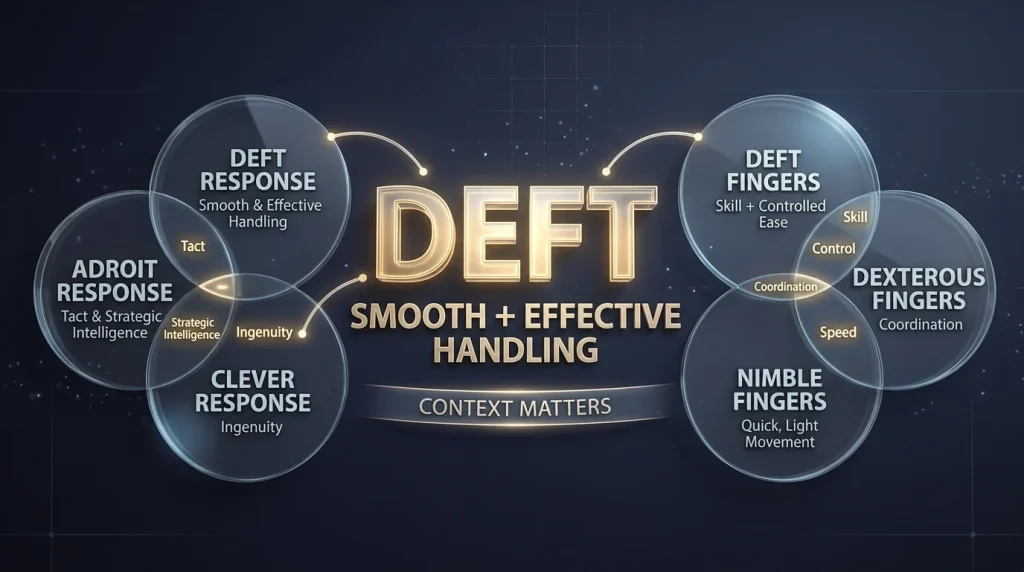
True synonyms — words interchangeable in every context — are vanishingly rare, and deft shows why. Each candidate overlaps with deft on a different axis: dexterous shares the physical ease, shrewd shares the clever management, neat shares the tidiness.
Shift the register or the scope and the meaning slides: slick keeps the smoothness but adds showiness; shrewd keeps the judgment but adds calculation. So treat this article’s list as a set of near synonyms, each perfect in its own lane, and let context — not the thesaurus — make the final call.
Words Commonly Confused with “Deft”
These words orbit deft but failed the substitution test, so they live here instead of the synonym list:
- Quick — speed without skill; a quick thief isn’t a deft one.
- Graceful — elegance of movement, not necessarily skill; a graceful fall is still a fall.
- Cunning — sly and crafty; deft admires, cunning suspects.
- Impeccable — means flawless, not skillful; an impeccable record shows no errors, not nimble hands.
- Elegant — about refined style, not about ability in action.
- Precise — about exactness; deft is about ease, and the two don’t always travel together.
- Light-fingered — literally nimble-fingered, but the dominant modern sense is thievish (pickpocketing).
- Experienced, competent, capable, talented, gifted — words for skilled people, not deft moments. “An experienced surgeon” describes background; “a deft surgeon” describes how she operates. Useful words, wrong category.
Common Mistakes
| Mistake | Better | Why |
|---|---|---|
| “a deft student” | “a bright student” | Deft needs skill in action |
| “his deft was impressive” | “his deftness was impressive” | Deft is never a noun |
| “deft” / swapped | Check the vowel | foolish — opposite effect |
| “slick” in a formal report | “proficient” or “adept” | Slick sounds unserious in formal prose |
| “cunning” as a compliment | “shrewd” or “clever” | Cunning implies slyness, not skill |
Antonyms of “Deft”
| # | Antonym | Why It’s the Opposite |
|---|---|---|
| 1 | Clumsy | Lacks physical grace and coordination |
| 2 | Awkward | Movement or handling feels ungainly |
| 3 | Inept | No skill where skill is needed |
| 4 | Unskillful | Direct negation of the core meaning |
| 5 | Maladroit | The formal mirror of adroit |
| 6 | Incompetent | Fails the basic ability standard |
| 7 | Ham-fisted | Crude, heavy handling of delicate work |
| 8 | Heavy-handed | Forceful where finesse was needed |
American vs British English
Deft itself is identical on both sides of the Atlantic, pronounced /dɛft/ in both (Cambridge). The difference that matters here is its top synonym: Americans write skillful, Britons write skilful — both correct within their region, so match your audience. Similarly, dexterous is the standard spelling everywhere, though you may meet the variant dextrous in older British texts.
Real-World Collocations & Phrases
Part A — Patterns
- Verb + deftly: handled deftly, managed deftly, sidestepped deftly, executed deftly
- Deft + noun: a deft touch, deft handling, deft footwork, deft fingers
- Adverb + deft: remarkably deft, surprisingly deft, characteristically deft
- Deft + preposition: deft at (deft at diplomacy), deft with (deft with a scalpel)
Part B — Set phrases
- A deft touch — the classic pairing; a light, skillful way of handling something delicate.
- Deft handling — smooth management of a tricky situation.
- Deft footwork — a sports-journalism staple for agile movement on the field or in the ring.
Practice Exercises
A. Fill in the blanks (choose from: dexterous, shrewd, nimble, slick, deftness)
- The watchmaker’s __________ fingers assembled the tiny gears.
- A __________ negotiator never reveals her bottom line early.
- The young gymnast is remarkably __________ on the beam.
- The startup’s __________ demo video went viral overnight.
- Years of practice gave his playing its effortless __________.
B. Rewrite these sentences, replacing the underlined word
- She gave a deft performance at the recital. (Use a formal synonym)
- He’s deft with a wrench. (Use a casual synonym)
- Their deft response to the crisis saved the company. (Use a business synonym)
C. Match the words (4 pairs)
| Word | Match |
|---|---|
| 1. adroit | a. casual, practical skill |
| 2. handy | b. formal, clever skill |
| 3. virtuoso | c. exceptional mastery |
| 4. maladroit | d. the opposite of skillful |
D. Vocabulary quiz
- Which word best describes quick, light footwork?
a) proficient b) nimble c) polished d) competent - Which is the closest synonym for physical hand skill?
a) clever b) dexterous c) shrewd d) neat - Which word can sound insulting because of a “sly” undertone?
a) artful b) polished c) capable d) agile - Which is NOT a real antonym of deft?
a) clumsy b) inept c) elegant d) awkward - According to Etymonline, the “skillful” sense of deft dates to:
a) the 13th century b) the mid-15th century c) the 1700s d) the 1900s
Answer key
- A: 1. dexterous, 2. shrewd, 3. nimble, 4. slick, 5. deftness
- B: 1. “She gave a masterful performance at the recital.” 2. “He’s handy with a wrench.” 3. “Their shrewd response to the crisis saved the company.”
- C: 1–b, 2–a, 3–c, 4–d
- D: 1–b, 2–b, 3–a, 4–c, 5–b
FAQ
What is another word for deft?
Skillful is the best all-purpose alternative; dexterous is closer when the skill is physical.
What does “deft” mean?
It means neatly skillful and quick in movement or action. It’s an adjective — “a deft chef,” “deft diplomacy.” (Cambridge Dictionary)
What are 5 strong synonyms for deft?
Skillful, dexterous, adept, nimble, and adroit.
What is another word for “deaf”?
That’s a different word entirely — it means unable to hear. The respectful alternative is “hard of hearing.”
Is deft a synonym or antonym?
Neither, on its own — it’s the headword. Skillful is one of its synonyms; clumsy is one of its antonyms.
What are 10 synonyms for deft?
Skillful, dexterous, adept, adroit, nimble, agile, proficient, clever, handy, and masterful.
Are there slang synonyms for deft?
No true slang equivalent exists. Handy works informally for practical skill, and slick overlaps in casual contexts — but slick can imply superficiality, so neither is an exact swap.
What is a good synonym and antonym pair for deft?
Skillful (synonym) and inept (antonym) make the cleanest pair. For physical coordination, use dexterous and clumsy.
Is “deft” a noun?
No — deft is an adjective. The noun form is deftness and the adverb is deftly (Collins).
Conclusion
Choosing a synonym well is not about finding the longest possible list of related words. It is about identifying which part of the original meaning matters in a particular sentence.
Use skillful when you need a broad, dependable alternative; dexterous when coordination and precise movement matter; adroit when tact or clever handling is central; and narrower alternatives such as nimble, proficient, or sure when their particular nuance improves the sentence.
That distinction keeps writing accurate, natural, and specific instead of turning synonyms into interchangeable labels.

About Sajjad Ahmed
Sajjad Ahmed is the author behind Guest Paster, where he writes about English vocabulary, synonyms, word meanings, and practical word usage.
His content is designed to help readers understand the differences between similar words, discover suitable alternatives, and use English vocabulary more effectively in everyday writing and communication.
Before publishing, Sajjad focuses on presenting word choices in a clear and easy-to-understand format, with relevant meanings, context, and examples where helpful.
Through Guest Paster, his goal is to make vocabulary learning simpler and provide useful language resources for students, writers, English learners, and anyone looking to expand their vocabulary.
Areas of Focus: English Vocabulary • Synonyms • Word Meanings • Word Usage • Language Learning
Author: Sajjad Ahmed
Website: Guest Paster