Horrible is an adjective meaning very bad, unpleasant, or shocking, and it is one of the most overworked negative words in English. Because it covers everything from stale coffee to a deadly crash, a more exact word usually communicates better.
For most everyday situations, choose terrible or awful. For events involving fear or harm, horrific is more precise, revolting suits disgust, and nasty suits unkind behavior. To decide, ask what made the thing horrible: poor quality, fear, disgust, or cruelty.
Another Word For Horrible
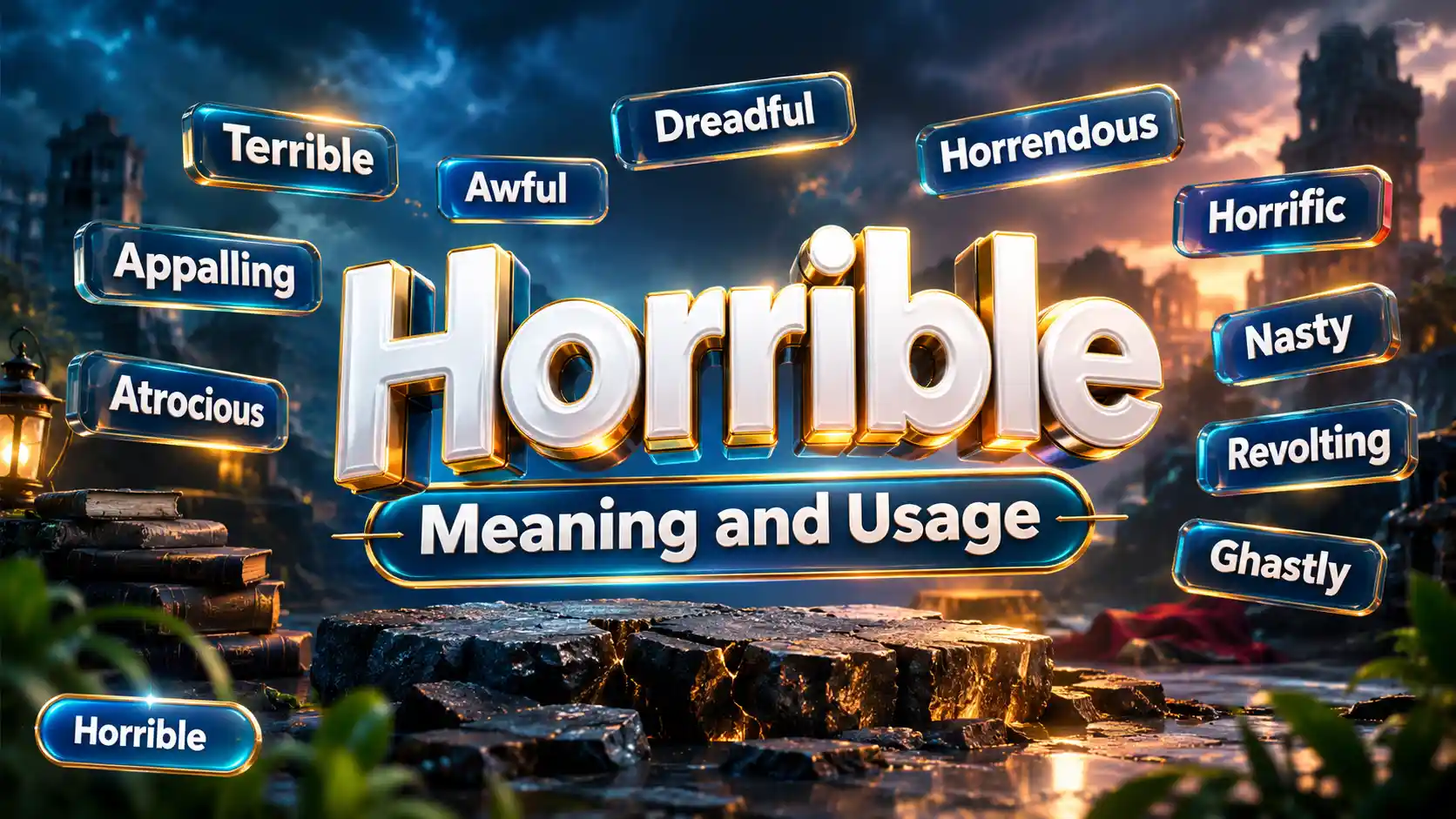
| # | Synonym | Meaning Difference |
| 1 | Terrible | Broadest match; stresses seriousness |
| 2 | Awful | Personal, everyday reaction |
| 3 | Dreadful | Slightly reserved; often British |
| 4 | Horrendous | Stresses scale of the problem |
| 5 | Horrific | Real horror, harm, or violence |
| 6 | Appalling | Adds outrage or disapproval |
| 7 | Atrocious | Harsh verdict on quality or conduct |
| 8 | Nasty | Meanness or physical unpleasantness |
| 9 | Revolting | Narrows to disgust |
| 10 | Ghastly | Dramatic, pale, grim edge |
Quick Facts About Horrible
| Fact | Detail |
| Part of speech | Adjective |
| Simple meaning | Arousing horror, or extremely bad |
| Pronunciation | UK /ˈhɒr.ə.bəl/, US /ˈhɔːr.ə.bəl/ |
| Syllables | Three: hor-ri-ble |
| Word forms | horribly, horribleness |
| Formality | Neutral to informal |
| Learner level | Roughly A2–B2; dictionaries differ |
| Closest synonym | Terrible |
| Best used for | Strong everyday negative reactions |
What Is the Closest Synonym for Horrible?
Terrible is the closest all-purpose synonym. It means extremely bad or severe, and like horrible it can describe weather, food, news, service, pain, or behavior. Compare “We had a horrible journey home” with “We had a terrible journey home”: the judgment barely changes.
The difference is one of emphasis. In typical usage, terrible leans toward seriousness and low quality (terrible news, terrible service), while horrible leans toward the reaction of the person experiencing it (a horrible taste, a horrible feeling). Both also work as intensifiers in their adverb forms.
Word Origin and Etymology
According to Etymonline, horrible entered English around 1300 meaning “dreadful, terrible.” It came from Old French horrible or orrible (12th century), which meant “horrible, repulsive, frightening.” That in turn comes from Latin horribilis, from the verb horrere, “to be terrified, bristle with fear, shudder.”
It shares this root with horror. From the mid-15th century, Etymonline records the word being used as a simple intensifier, which helps explain why it now covers both real terror and mere annoyance. Merriam-Webster independently dates the first known use to the 14th century.
Can These Synonyms Be Used Interchangeably?
Only partly. Register labels below are judgments based on typical usage, since dictionaries rarely grade formality.
| Level | Words | Condition |
| Usually | terrible, awful, dreadful | Same strength, everyday contexts |
| Sometimes | nasty, lousy, horrid, wretched, abysmal | Fits only certain subjects |
| Rarely | gruesome, hideous, foul, revolting, disgusting | Narrow focus: gore, looks, smell |
| No | heinous, dangerous, shocking | Different meaning entirely |
“Horrible service,” “terrible service,” and “awful service” all sound natural. Swap in gruesome and the sentence suddenly implies blood. Tone matters too: lousy suits a chat with a friend, while appalling suits a written complaint.
Multiple Meanings of Horrible
Merriam-Webster separates two senses, and each calls for its own word set. Words that appear in both lists work in either sense.
Sense 1: Arousing fear, dread, or horror (a horrible accident)
horrific, horrendous, gruesome, ghastly, frightful, appalling, dreadful, terrible
Sense 2: Extremely bad or unpleasant (horrible food, a horrible mistake, a horrible person)
terrible, awful, dreadful, lousy, abysmal, atrocious, wretched, nasty, horrid, foul, revolting, disgusting, vile, abominable
Detailed Synonym Meanings and Examples Of Horrible
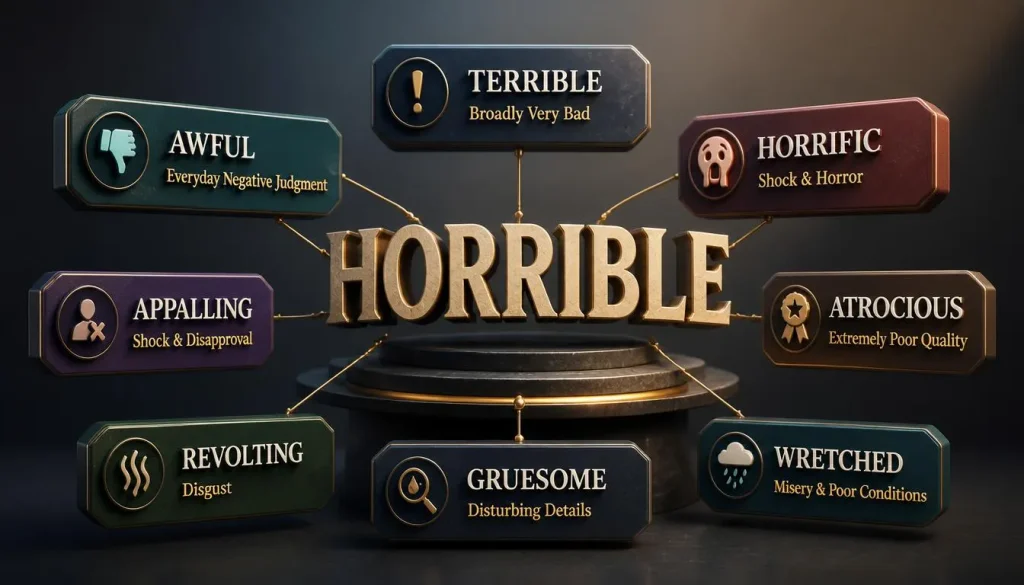
CEFR levels and frequency labels are approximate, based on typical learner-dictionary placement and general usage.
1. Terrible
Meaning: Very bad or serious in degree; the default all-purpose choice (full comparison above).
Difference from Horrible: Leans toward seriousness and low quality over sensory unpleasantness.
Best Used For: News, service, weather, performance, health.
Formality: Neutral
CEFR Level: A2
Frequency: Very Common
Examples:
- The hotel’s Wi-Fi was terrible, so I finished the report in the lobby café. — travel
- The manager apologized for the terrible mix-up with our booking. — customer service
When NOT to Use It: Skip it when you need to signal gore or real horror; horrific does that better.
2. Awful
Meaning: Very unpleasant or poor, often as felt by the speaker.
Difference from Horrible: More personal and emotional; very natural after “feel.”
Best Used For: Feelings, food, weather, apologies.
Formality: Neutral
CEFR Level: A2
Frequency: Very Common
Examples:
- I felt awful for missing Dani’s recital. — personal
- The cafeteria soup tasted awful, so I skipped lunch. — workplace
When NOT to Use It: Avoid it in formal reports, where a concrete description sounds more credible.
3. Dreadful
Meaning: Causing dismay or distress; also used loosely for poor quality.
Difference from Horrible: Sounds slightly more reserved and is more at home in British English.
Best Used For: Polite criticism, reviews, news of loss.
Formality: Neutral
CEFR Level: B2
Frequency: Common
Examples:
- The play was dreadful; half the audience left at the interval. — theater review
- Residents gathered after the dreadful accident on the bypass. — local news
When NOT to Use It: Skip it in brisk American chat, where it can sound stagey.
4. Horrendous
Meaning: Overwhelming in scale or severity.
Difference from Horrible: Stresses how big the problem is, which is why it pairs so often with costs and delays.
Best Used For: Traffic, bills, damage, ordeals.
Formality: Neutral
CEFR Level: C1
Frequency: Common
Examples:
- The tailback on the ring road was horrendous by 8 a.m. — commuting
- She opened a horrendous repair estimate for the roof. — home
When NOT to Use It: Avoid it for small annoyances, where it sounds exaggerated.
5. Horrific
Meaning: Provoking real horror, usually through violence, injury, or suffering.
Difference from Horrible: Far stronger and tied to harm rather than mere unpleasantness.
Best Used For: Crashes, attacks, disasters, injuries.
Formality: Neutral
CEFR Level: C1
Frequency: Common
Examples:
- Drivers stopped to help after the horrific pile-up on the highway. — news
- Survivors gave horrific accounts of the flood. — reporting
When NOT to Use It: Avoid it for bad service or food unless you are joking.
6. Appalling
Meaning: Bad enough to provoke dismay or outrage.
Difference from Horrible: Adds moral or professional judgment to the unpleasantness.
Best Used For: Conduct, conditions, standards.
Formality: Neutral
CEFR Level: C1
Frequency: Common
Examples:
- The inspection report described appalling hygiene in the kitchen. — public health
- Tenants called the delay in fixing the heating appalling. — housing
When NOT to Use It: Skip it when fear, not disapproval, is the main feeling.
7. Atrocious
Meaning: Outrageously poor, especially in quality or conduct.
Difference from Horrible: A sharper verdict on skill or standards.
Best Used For: Performance, writing, behavior, weather.
Formality: Neutral
CEFR Level: C1
Frequency: Uncommon
Examples:
- His handwriting is atrocious, so I always ask him to type his notes. — workplace
- Our defense was atrocious in the second half. — sports
When NOT to Use It: In casual talk it can sound theatrical; use it for quality, not fear.
8. Ghastly
Meaning: Disturbingly unpleasant, with a pale, grim edge.
Difference from Horrible: More dramatic and more British in flavor.
Best Used For: Storytelling, weather, sights.
Formality: Neutral
CEFR Level: C1
Frequency: Uncommon
Examples:
- The storm left a ghastly mess of broken branches across the lawn. — home
- The motel’s curtains were a ghastly shade of orange. — travel
When NOT to Use It: It can sound affected in plain American business English.
9. Abominable
Meaning: Deserving hatred or condemnation; in British use, simply very bad.
Difference from Horrible: Stronger, more formal, and slightly dated.
Best Used For: Treatment, conditions, serious criticism.
Formality: Formal
CEFR Level: C2
Frequency: Rare
Examples:
- The committee condemned the abominable treatment of the detainees. — policy
- Abominable weather forced the regatta to be cancelled. — sports
When NOT to Use It: In casual speech it sounds pompous.
10. Horrid
Meaning: Disagreeable, often in a childlike or old-fashioned tone.
Difference from Horrible: Softer, more dramatic, and more British.
Best Used For: People, petty unpleasantness.
Formality: Informal
CEFR Level: B2
Frequency: Uncommon
Examples:
- That horrid neighbor keeps parking across our driveway. — neighbors
- What a horrid little prank to play on your sister! — family
When NOT to Use It: Don’t use it for serious harm or in professional writing.
11. Nasty
Meaning: Unkind in manner, or unpleasant to taste, smell, or feel.
Difference from Horrible: Targets meanness or physical unpleasantness rather than shock.
Best Used For: Remarks, people, smells, cuts, surprises.
Formality: Neutral
CEFR Level: B1
Frequency: Very Common
Examples:
- Someone left a nasty comment under her photo. — social media
- There’s a nasty smell coming from the fridge. — home
When NOT to Use It: It understates tragedies, so avoid it for disasters.
12. Wretched
Meaning: Miserable, poor, or in pitiful condition.
Difference from Horrible: Adds a sense of misery and neglect.
Best Used For: Living conditions, nights, weather, health.
Formality: Neutral
CEFR Level: C1
Frequency: Uncommon
Examples:
- The hikers spent a wretched night in a leaking tent. — outdoors
- The shed was in wretched condition after years of neglect. — property
When NOT to Use It: It does not suit frightening events such as crashes or attacks.
13. Lousy
Meaning: Poor or disappointing, without drama.
Difference from Horrible: Much milder and distinctly informal.
Best Used For: Casual complaints.
Formality: Informal
CEFR Level: B2
Frequency: Common
Examples:
- I had a lousy night’s sleep before the interview. — personal
- That’s a lousy offer; ask for more. — negotiation
When NOT to Use It: Avoid it in formal writing or for serious harm.
14. Revolting
Meaning: So unpleasant it causes physical or moral revulsion.
Difference from Horrible: Narrows the reaction to disgust.
Best Used For: Smells, tastes, sights, behavior.
Formality: Neutral
CEFR Level: C1
Frequency: Common
Examples:
- The drain gave off a revolting smell. — home
- Reviewers called the sauce revolting. — food writing
When NOT to Use It: Skip it for poor quality that isn’t actually disgusting.
15. Disgusting
Meaning: Causing strong distaste or offense.
Difference from Horrible: Names disgust as the dominant reaction.
Best Used For: Food, hygiene, behavior, remarks.
Formality: Neutral
CEFR Level: B1
Frequency: Very Common
Examples:
- The staff-room fridge was disgusting after the holiday break. — workplace
- His remarks about the waiter were disgusting. — restaurant
When NOT to Use It: Avoid it when fear or poor performance is the main point.
16. Frightful
Meaning: Very bad or alarming, in a dated, expressive way.
Difference from Horrible: Sounds older and more theatrical.
Best Used For: Weather, noise, vivid description.
Formality: Informal
CEFR Level: C1
Frequency: Uncommon
Examples:
- The generator made a frightful racket all morning. — neighborhood
- We drove through frightful rain over the mountain pass. — travel
When NOT to Use It: It sounds dated in modern professional writing.
17. Gruesome
Meaning: Disturbing because of blood, death, or injury.
Difference from Horrible: Narrower; it points to physical gore.
Best Used For: Crimes, injuries, dark fiction.
Formality: Neutral
CEFR Level: C1
Frequency: Common
Examples:
- Detectives described the gruesome scene in the flat. — crime reporting
- The museum’s exhibit on medieval punishments was gruesome. — travel
When NOT to Use It: Never use it for poor quality; “gruesome service” sounds wrong.
18. Hideous
Meaning: Shockingly ugly or offensive to see or hear.
Difference from Horrible: Centers on appearance and sensory offense.
Best Used For: Designs, buildings, noises, injuries.
Formality: Neutral
CEFR Level: C1
Frequency: Common
Examples:
- The sofa came in a hideous orange velour. — housing
- A hideous grinding noise came from the gearbox. — cars
When NOT to Use It: Avoid it for non-sensory problems like delays, and avoid it for people’s looks.
19. Vile
Meaning: Morally repugnant or physically disgusting.
Difference from Horrible: Stronger revulsion, often with a moral edge.
Best Used For: Smells, remarks, acts.
Formality: Neutral
CEFR Level: C1
Frequency: Uncommon
Examples:
- A vile smell filled the stairwell. — home
- Moderators removed the vile messages from the forum. — online
When NOT to Use It: It is too strong for mild disappointment.
20. Foul
Meaning: Disgusting to smell, taste, or see; also very bad, as with weather or mood.
Difference from Horrible: Strongly sensory.
Best Used For: Odors, water, language, moods.
Formality: Neutral
CEFR Level: B2
Frequency: Common
Examples:
- Foul water had pooled behind the restaurant. — inspection
- She was in a foul mood after the cancelled flight. — travel
When NOT to Use It: Don’t use it for abstract failures such as poor results.
21. Abysmal
Meaning: So poor it seems to have no bottom.
Difference from Horrible: Judges quality or results and carries no sense of fear.
Best Used For: Results, standards, performance.
Formality: Neutral
CEFR Level: C2
Frequency: Uncommon
Examples:
- Customer satisfaction scores hit an abysmal new low last quarter. — business
- The team’s abysmal defense cost them the match. — sports
When NOT to Use It: Don’t use it to describe a person’s character.
Best Alternatives by Context
Everyday conversation: terrible, awful, nasty; add lousy for mild letdowns.
Formal writing: appalling, atrocious, or abominable, depending on whether the issue is conduct, quality, or condemnation.
Academic writing: Describe the measurable problem instead: severe, adverse, poor. These are not general synonyms, but they are more precise than any emotional word.
Business communication: Abysmal for results, appalling for conditions or conduct; otherwise a specific word such as unacceptable reads better.
Creative writing: ghastly, gruesome, wretched, frightful, and vile add mood.
Social media: awful, disgusting, horrendous, and nasty sound natural when the intensity fits.
Word Finder: Formal, Short, French, and “I” Words
- Formal: appalling, atrocious, abominable.
- 5 letters: awful, nasty, lousy.
- 6 letters: horrid.
- For a horrible person: nasty, vile, horrid, abominable (for conduct).
- French: horrible is spelled the same in French. Close alternatives include affreux, atroce, épouvantable, and effroyable.
- Starting with I: No “I” word replaces horrible across contexts. Infernal works only for annoying things like noise, and intolerable means unbearable; both are covered in the confused-words section.
Which Synonym Should I Choose?
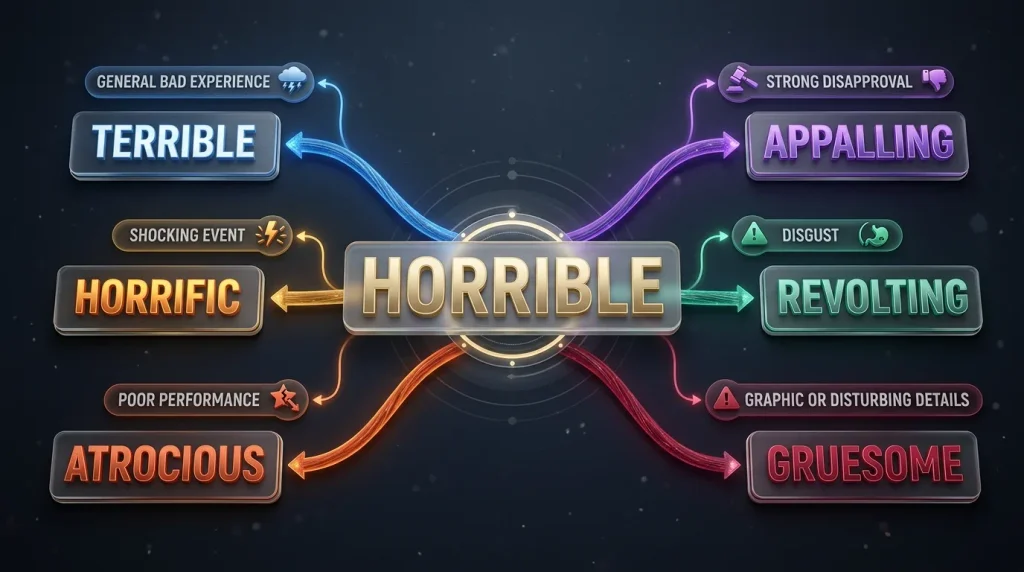
| Situation | Best Choice | Why |
| General bad experience | Terrible | Broad and natural |
| Personal reaction | Awful | Conversational |
| Serious crash or attack | Horrific | Signals real harm |
| Cruel remark | Nasty | Targets meanness |
| Very poor results | Abysmal | Judges quality |
| Inspection findings | Appalling | Formal, outraged tone |
| Bad smell or taste | Revolting | Focuses on disgust |
| Graphic crime scene | Gruesome | Implies gore |
| Ugly object | Hideous | Appearance-based |
| Miserable conditions | Wretched | Adds misery |
| Mild disappointment | Lousy | Low intensity |
| Offensive conduct | Vile | Moral condemnation |
Exact and Near Synonyms: Difference
True synonyms are rare because words differ in more than meaning. They differ in intensity, register, region, and the kind of thing they describe. Take one event and watch the focus shift: a horrible accident is broadly distressing, a horrific one is shocking, a gruesome one contains disturbing physical detail, and an appalling one suggests it should never have happened.
The ladder below is a general sense of usage, not a measured scale.
| Level | Words |
| Mild | lousy, nasty |
| Moderate | terrible, awful, dreadful, horrid |
| Strong | appalling, atrocious, abysmal, horrendous |
| Extreme or harm-linked | horrific, gruesome, abominable |
Words Commonly Confused with Horrible
These candidates failed the substitution test, so they are not true synonyms.
| Word | Why It Isn’t a True Synonym |
| Dire | Stresses grim consequences, not unpleasantness |
| Despicable | Moral contempt only |
| Shocking | Describes surprise, not badness |
| Infernal | Playful irritation; mostly noises |
| Intolerable | Means impossible to endure |
| Heinous | Only describes evil acts |
| Evil | Moral term, not a quality term |
| Cruel | Describes deliberate unkindness |
| Scary | Focuses only on fear |
| Ugly | Appearance only |
| Harmful | Means causing damage |
| Dangerous | Means likely to cause harm |
| Unacceptable | Means below a standard |
| Bad | Broader and much weaker |
Common Mistakes
| Mistake | Better | Why |
| gruesome service | terrible service | Gruesome implies gore |
| horrific coffee | awful coffee | Horrific implies real horror |
| I was horrible by the news | I was horrified by the news | Horrified names the feeling |
| harmful performance | atrocious performance | Harmful means causing damage |
| lousy tragedy | horrific tragedy | Lousy is far too casual |
Antonyms of Horrible
Sense 1: Arousing fear or horror
| # | Antonym | Why It’s the Opposite |
| 1 | Comforting | Eases fear instead of causing it |
| 2 | Reassuring | Reduces worry |
| 3 | Soothing | Calms rather than disturbs |
| 4 | Calming | Brings peace, not shock |
| 5 | Pleasant | Agreeable, not disturbing |
| 6 | Delightful | Brings joy, not dread |
Sense 2: Extremely bad or unpleasant
| # | Antonym | Why It’s the Opposite |
| 1 | Wonderful | Extremely good, not extremely bad |
| 2 | Excellent | Exceptional quality |
| 3 | Lovely | Pleasing and enjoyable |
| 4 | Superb | Outstanding standard |
| 5 | Delightful | Gives pleasure |
| 6 | Pleasant | Mildly good |
| 7 | Fantastic | Impressively good |
| 8 | Kind | Opposite of a horrible person |
American vs British English
- Spelling: Identical in both varieties.
- Pronunciation: UK /ˈhɒr.ə.bəl/, US /ˈhɔːr.ə.bəl/.
- Word preference: In typical usage, horrid, ghastly, dreadful, and abominable sound more British, while lousy is more at home in casual American English. Terrible and awful work naturally in both.
Real-World Collocations and Phrases
Part A: Common collocations
- Horrible + noun: horrible death, horrible mistake, horrible food, horrible accident, horrible smell, horrible weather, horrible noise
- Verb + horrible: feel horrible, look horrible, taste horrible, sound horrible, smell horrible
- Adverb + horrible: absolutely horrible, really horrible, truly horrible
- Horrible + preposition: horrible to (someone), horrible about (something)
Part B: Set phrases
Horrible has few genuine fixed idioms. Oxford Learner’s Dictionaries gives two well-attested patterns for the adverb: go horribly wrong and horribly aware.
Practice Exercises
A. Fill in the blanks (word bank: appalling, lousy, horrific, revolting, abysmal)
- The inspector was outraged by the ______ hygiene standards.
- I had a ______ night’s sleep, so I’m not at my best today.
- Customer satisfaction scores hit an ______ new low.
- Emergency crews reached the scene of the ______ crash.
- The fridge gave off a ______ smell after the power cut.
B. Rewrite the sentences (replace horrible with a more precise word)
- The service at the restaurant was horrible.
- He made a horrible joke about her accent.
- The quarterly results were horrible.
C. Match the words
| Word | Meaning | |
| 1. Gruesome | A | So poor it seems to have no bottom |
| 2. Foul | B | Miserable or in pitiful condition |
| 3. Abysmal | C | Disturbing because of blood or injury |
| 4. Ghastly | D | Disgusting to smell or taste |
| 5. Wretched | E | Shockingly unpleasant, often British |
D. Vocabulary quiz
- Which word best fits a crash with serious injuries? (a) lousy (b) horrific (c) nasty
- Which is the most informal? (a) abominable (b) appalling (c) lousy
- Which fits an unkind comment? (a) nasty (b) gruesome (c) abysmal
- Which word focuses on disgust? (a) wretched (b) revolting (c) abysmal
- Which is an antonym of horrible? (a) dreadful (b) foul (c) delightful
Answer Key
- A: 1. appalling, 2. lousy, 3. abysmal, 4. horrific, 5. revolting
- B (sample answers): 1. awful or dreadful; 2. nasty or vile; 3. abysmal
- C: 1-C, 2-D, 3-A, 4-E, 5-B
- D: 1-b, 2-c, 3-a, 4-b, 5-c
Frequently Asked Questions
What is the closest synonym for horrible?
The closest synonym for horrible is terrible. Both words describe something very bad, unpleasant, or distressing, and both fit everyday situations from weather to service. Choose awful for personal reactions, horrific when shock or harm is involved, and nasty for unkind behavior. Terrible is the safest all-purpose swap.
Can I use terrible and horrible interchangeably?
Usually, yes. Terrible, awful, and dreadful swap in smoothly for everyday complaints. Stronger words such as horrific or atrocious change the tone, and narrower ones such as gruesome, revolting, or hideous fit only specific situations. Check the intensity and the type of problem before swapping, or the sentence may sound exaggerated or oddly specific.
What does horrible mean?
Horrible is an adjective with two main senses. It can mean arousing fear, dread, or horror, as in a horrible accident, or extremely bad or unpleasant, as in horrible food. In conversation it often just means very bad, so its strength depends on the situation and the speaker’s tone.
Is horrible a formal word?
Horrible is neutral to informal. It works in conversation, emails, and general writing, but formal reports and academic papers usually prefer a more precise term, such as appalling for conduct, atrocious for poor standards, or horrific for shocking events. A specific word also sounds more credible than a general reaction.
How do I use horrible in a sentence?
Put horrible before a noun or after a linking verb: a horrible mistake, or the traffic was horrible. With feel, it describes a physical or emotional state, as in I feel horrible about it. Toward people, it takes to: she was horrible to him. Its adverb form, horribly, intensifies, as in the plan went horribly wrong.
What is the opposite of horrible?
Opposites shift with context. The usual one is wonderful. Others include excellent, lovely, delightful, and pleasant. Pick by meaning: use kind for a horrible person, and comforting or reassuring for something frightening. Wonderful and excellent suit experiences, service, and quality in everyday speech.
Conclusion
The right synonym turns a vague reaction into a precise one. A reader hears the difference between a lousy day and a horrific one, and between a nasty remark and a vile act.
Choosing carefully shows exactly how bad something was, how you felt about it, and how seriously to take it.

About Sajjad Ahmed
Sajjad Ahmed is the author behind Guest Paster, where he writes about English vocabulary, synonyms, word meanings, and practical word usage.
His content is designed to help readers understand the differences between similar words, discover suitable alternatives, and use English vocabulary more effectively in everyday writing and communication.
Before publishing, Sajjad focuses on presenting word choices in a clear and easy-to-understand format, with relevant meanings, context, and examples where helpful.
Through Guest Paster, his goal is to make vocabulary learning simpler and provide useful language resources for students, writers, English learners, and anyone looking to expand their vocabulary.
Areas of Focus: English Vocabulary • Synonyms • Word Meanings • Word Usage • Language Learning
Author: Sajjad Ahmed
Website: Guest Paster