The word “teached” is incorrect. The correct past tense of “teach” is “taught.” For example we say, “She taught me” not “She teached me.” The word “instructed” is a good synonym for “taught.” You can use it when talking about lessons, classes or learning new skills.
Educated suits formal schooling, trained suits a skill learned by practice and coached suits sport and performance. This guide gives you 15 taught synonyms with meanings, examples and honest limits, so the next lesson you describe lands exactly right.
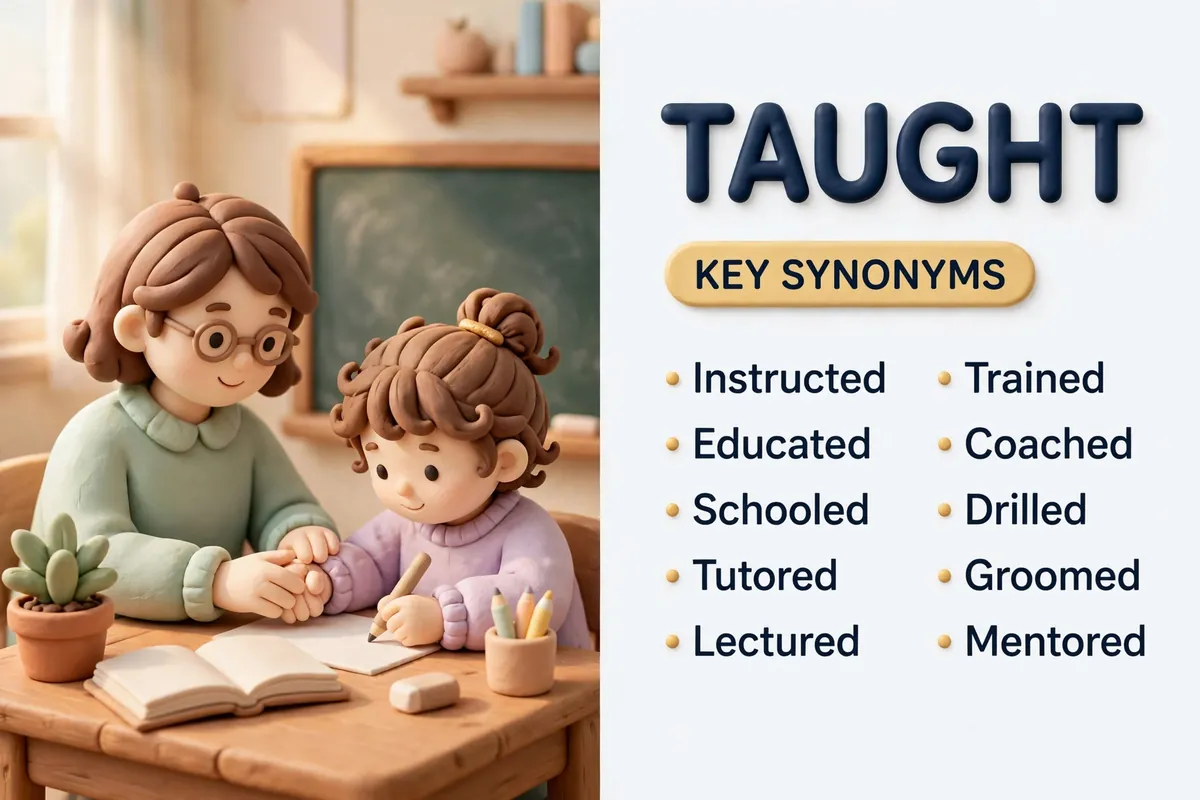
10 Another Word For Taught Synonyms
| # | Synonym | Meaning Difference |
|---|---|---|
| 1 | Instructed | Given lessons |
| 2 | Educated | Formal education |
| 3 | Schooled | Taught in school |
| 4 | Tutored | Taught one-to-one |
| 5 | Lectured | Taught by a talk |
| 6 | Trained | Taught by practice |
| 7 | Coached | Taught to perform |
| 8 | Drilled | Taught by repetition |
| 9 | Groomed | Prepared for a role |
| 10 | Mentored | Taught by a guide |
Quick Facts About “Taught”
- Part of speech: a verb, the past tense and past participle of teach. The noun is teaching.
- Core meaning: given instruction or training.
- Three main senses: (1) given lessons; (2) trained in a skill; (3) shown how something works.
- Register: neutral. Taught suits classrooms, workplaces, and everyday speech.
- Common mistake: writing “teached” as the past tense. The verb “teach” is irregular so its past tense is “taught,” not “teached.” For example, we say, “She taught me how to read.”
The Closest Synonym: Instructed
Instructed is the closest synonym for taught, because it covers the same ground in the most neutral way. A person who taught a subject was instructed in it. You can use “instructed” instead of “taught” in most formal sentences.”She taught the class to read a map” becomes “She instructed the class in map reading” with no loss of sense. “He taught me to swim” becomes “He instructed me in swimming,” though that sounds more formal.
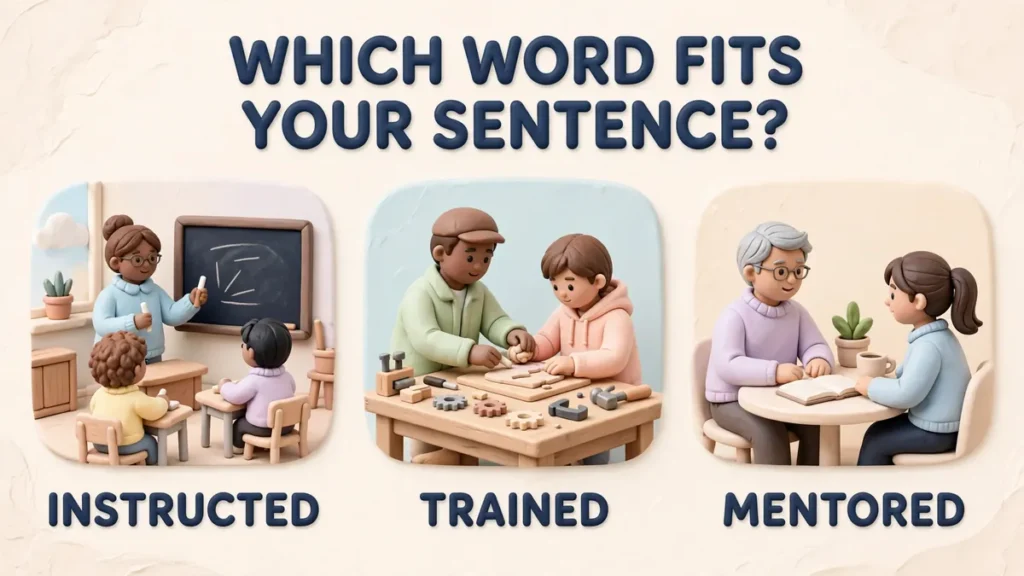
Instructed wins on range: classrooms, manuals, briefings, and official reports. Taught is warmer and more natural in speech. Choice test: a school lesson calls for instructed; a skill learned by doing calls for trained; a private lesson calls for tutored.
Where “Taught” Comes From (Etymology)
According to Etymonline, teach comes from Middle English techen, from Old English taecan (past tense taehte, past participle taeht), meaning “to show, point out, declare, demonstrate,” and “give instruction, train, assign, direct, warn, persuade.
The word comes from the old Germanic word taikijan, which means “to show.” It also comes from an older root word, deik-, which means “to show or point out.” The word first carried the idea of showing someone how to do something through information or instructions.
That root also gave Old English tacen, tacn, “sign, mark,” the source of modern token: teaching began as showing, and a sign is a thing that shows. By about 1200 it meant “indicate how something is to happen,” and by the mid-14th century, “disseminate a system of belief.”
The usual Old English word for “to teach, instruct, guide” was laeran, the source of modern learn and of lore). Merriam-Webster lists taught as the past tense and past participle of teach.
That history explains the shape of the word. Taught is irregular because it is old: its past form kept the vowel change of taecan to taehte instead of taking -ed, the same pattern as catch and caught, and bring and brought.
Can You Swap Them Freely?
In short: only inside the same meaning group, when the sense matches.
- ✅ “She was instructed in first aid before the trip.” (lesson given ✔)
- ✅ “She was taught first aid before the trip.” (same sense ✔)
- ❌ “She was lectured in first aid before the trip.” (a lecture is a talk, not training ✘, say instructed)
- ✅ “The team was coached by a former champion.” (guided to perform ✔)
- ❌ “The team was educated by a former champion.” (educated means schooling ✘, say coached)
- ✅ “He was shown how to change a tyre by his uncle.” (by demonstration ✔)
- ❌ “He was informed how to change a tyre by his uncle.” (informed gives facts ✘, say shown)
- ✅ “The recruits were drilled in marching every morning.” (by repetition ✔)
- ❌ “The recruits were mentored in marching every morning.” (mentoring is a relationship, not a drill ✘, say drilled)
Before you substitute, ask how the learning happened.
Taught Synonyms in Detail
Group 1: Taught in a Classroom or Course
1. Instructed
Meaning: Given lessons or directions by a teacher.
Difference: The most neutral formal swap; it records the teaching, not the method.
Best used for: Classrooms, manuals, and reports.
Formality: Neutral to formal · CEFR: B2 · Frequency: Very common
Example (School): “The class was instructed in first aid before the school trip.”
Example (Work): “New staff were instructed in the safety rules.”
When NOT to use it: For a warm lesson from a parent, use taught or shown.
2. Educated
Meaning: Given a broad formal education over years.
Difference: It implies schooling and knowledge, not one lesson.
Best used for: Biographies and formal writing.
Formality: Formal · CEFR: B2 · Frequency: Very common
Example (School): “He was educated at a small school in the hills.”
Example (Life): “She was educated in both medicine and law.”
When NOT to use it: For one lesson, use instructed or trained.
3. Schooled
Meaning: Taught in school, or trained thoroughly.
Difference: It carries the flavor of the classroom and of discipline.
Best used for: Sports writing and biographies.
Formality: Neutral · CEFR: B2 · Frequency: Common
Example (Sport): “The young keeper was schooled by the club’s veterans.”
Example (School): “They were schooled together in the same village.”
When NOT to use it: For gentle guidance, use mentored.
4. Tutored
Meaning: Taught one-to-one by a private teacher.
Difference: It stresses personal attention, not a full classroom.
Best used for: Exam prep and music lessons.
Formality: Neutral · CEFR: B2 · Frequency: Common
Example (Exam): “He was tutored in maths before the exam.”
Example (Music): “She was tutored on the piano by her grandmother.”
When NOT to use it: For a whole class, use instructed.
5. Lectured
Meaning: Taught by a formal talk to a large group.
Difference: Teaching flows one way; students listen while the teacher speaks.
Best used for: Universities and conferences.
Formality: Formal · CEFR: B2 · Frequency: Common
Example (University): “She was lectured in anatomy by a famous surgeon.”
Example (Conference): “The audience was lectured on climate policy.”
When NOT to use it: For hands-on training, use trained; note lectured can also mean scolded.
Group 2: Trained in a Skill
6. Trained
Meaning: Taught a skill by practice and repetition.
Difference: Practice is the point; knowledge alone falls short.
Best used for: Jobs, sports, and the military.
Formality: Neutral · CEFR: A2 · Frequency: Very common
Example (Job): “She was trained to operate the new machine.”
Example (Sport): “The team was trained to defend as a single unit.”
When NOT to use it: For book learning, use educated.
7. Coached
Meaning: Taught and guided in sport or performance, with feedback.
Difference: Personal, ongoing, and aimed at performance.
Best used for: Sports and public speaking.
Formality: Neutral · CEFR: B2 · Frequency: Very common
Example (Sport): “He was coached by a former Olympic swimmer.”
Example (Work): “She was coached through her first presentation.”
When NOT to use it: For a classroom subject, use tutored.
8. Drilled
Meaning: Taught by repetition until the action is automatic.
Difference: Repetition is the method; the word can sound strict.
Best used for: The military and language learning.
Formality: Neutral · CEFR: B1 · Frequency: Common
Example (Military): “The recruits were drilled in marching every morning.”
Example (Language): “We were drilled in verb forms until they stuck.”
When NOT to use it: For gentle learning, use guided.
9. Groomed
Meaning: Taught and prepared over time for a role.
Difference: Long-term preparation for a role, not one lesson.
Best used for: Careers and leadership.
Formality: Neutral to formal · CEFR: C1 · Frequency: Common
Example (Career): “She was groomed to lead the family business.”
Example (Politics): “The young aide was groomed for office.”
When NOT to use it: For a single lesson, use taught or shown.
10. Mentored
Meaning: Taught by a trusted, experienced guide.
Difference: The relationship comes first, the lesson second.
Best used for: Careers and creative work.
Formality: Neutral to formal · CEFR: C1 · Frequency: Common
Example (Career): “He was mentored by the firm’s senior partner.”
Example (Writing): “The young poet was mentored by an editor.”
When NOT to use it: For a formal class, use instructed.
Group 3: Shown How and Guided
11. Guided
Meaning: Taught by being led step by step.
Difference: The teacher stays beside the learner.
Best used for: Tours, crafts, and first tries.
Formality: Neutral · CEFR: B1 · Frequency: Very common
Example (Craft): “She was guided through her first turn at the pottery wheel.”
Example (Travel): “Visitors were guided around the old town.”
When NOT to use it: For formal study, use educated.
12. Shown
Meaning: Taught by demonstration, by letting the learner watch.
Difference: Seeing comes before doing.
Best used for: Practical skills and daily tasks.
Formality: Neutral · CEFR: A2 · Frequency: Very common
Example (Home): “He was shown how to change a tyre by his uncle.”
Example (Work): “New hires were shown the ropes.”
When NOT to use it: For theory, use lectured.
13. Grounded
Meaning: Taught the solid basics of a subject.
Difference: It promises the groundwork, not the finish.
Best used for: School subjects and music.
Formality: Neutral to formal · CEFR: C1 · Frequency: Less common
Example (Music): “She was well grounded in music theory.”
Example (Science): “The students were grounded in the basics of chemistry.”
When NOT to use it: For advanced study, use educated.
14. Informed
Meaning: Taught the facts someone needs to know.
Difference: Facts, not skills; the head, not the hands.
Best used for: Briefings and instructions.
Formality: Neutral to formal · CEFR: B2 · Frequency: Very common
Example (Work): “Staff were informed of the new rules by email.”
Example (Health): “Patients were informed about the risks before surgery.”
When NOT to use it: For a practical skill, use trained.
15. Enlightened
Meaning: Taught in a way that changed a worldview.
Difference: The grandest word here; it opens the mind.
Best used for: Philosophy and big ideas.
Formality: Formal · CEFR: C1 · Frequency: Less common
Example (Philosophy): “The lecture enlightened him about time.”
Example (Travel): “A year abroad enlightened her about other cultures.”
When NOT to use it: For an ordinary lesson, use taught.
Words Commonly Confused With Taught
Taught versus teached is the first fix in this guide. Teached does not exist in standard English. Teach is irregular, so its past tense is taught, the same way catch becomes caught and bring becomes brought. Learners who add -ed follow a real pattern, just the wrong one for this verb. Say “she taught me to read,” never “she teached me to read.”
Taught versus learned matters for who does what: the teacher taught, and the student learned. “My mother taught me to cook” is correct; “my mother learned me to cook” is not standard, though it survives in some dialects. Teaching gives the lesson, learning receives it.
Taught versus trained matters for the method. A lesson in a classroom is taught, while a skill built by repetition is trained. A driving instructor teaches the rules and trains the student to handle the car. Use taught for knowledge, trained for practice.
Taught versus showed matters for the channel. Showing is one way of teaching, through demonstration. A father who shows his daughter how to tie a knot has taught her by showing. Yet showed only fits when the learner watched something happen. A lecture cannot be shown; it can only be taught.
Substitution test failures: “She teached the class on Monday” fails, because teached is not a word, so say “she taught the class.” “The coach educated the team to defend” fails, because educated means broad schooling, so say “the coach trained the team.” “He was informed how to change a tyre” fails, because informed gives facts, not a skill, so say “he was shown how to change a tyre.”
Collocations and Idioms With Taught
Only combinations native speakers actually use:
- taught me a lesson: an experience that changed how someone behaves, as in “Losing that job taught me a lesson.”
- taught himself to: learned alone, without a teacher, as in “He taught himself to play the guitar.”
- well taught: having received good teaching, as in “The children were well taught and polite.”
- taught school: worked as a teacher, as in “She taught school for thirty years.”
- taught the ropes: shown how a job works, as in “An older sailor taught him the ropes.”
- teach an old dog new tricks: the saying that old habits resist change, as in “You cannot teach an old dog new tricks.”
- the school of hard knocks taught him: hard experience as the teacher, as in “The school of hard knocks taught him to check contracts.”
Best Alternatives by Context
Six cases, each with the best word.
Case 1: A teacher in a classroom. A class that sat through a formal lesson was instructed. The word fits reports and records, where the lesson matters more than the warmth. For a private lesson, switch to tutored.
Case 2: A coach on the training ground. A squad that learned by doing was trained, and a player who got personal feedback was coached. Trained covers the group; coached covers the one-to-one attention. For words that capture that standard, our guide to quality synonyms goes deeper.
Case 3: A mentor guiding a career. A young worker who learned from a senior colleague over years was mentored, not lectured. The word carries the relationship and the slow pace. Our guide to navigate synonyms covers the language of finding a way.
Case 4: A parent showing a child a practical skill. A child who watched first and then tried was shown. The word fits kitchens, garages, and gardens, where the lesson is in the hands. For theory, use instructed.
Case 5: A university lecture hall. Students who sat through a formal talk were lectured: one voice, many listeners. In the lab later, they were trained.
Case 6: A life lesson that changed someone. A person whose view of the world shifted was enlightened, and only that word carries the weight. For a smaller change, say taught a lesson.
Which Taught Synonym Should I Choose?
| Situation | Best pick | Why it wins |
|---|---|---|
| A formal lesson | Instructed | Neutral and exact |
| Years of schooling | Educated | The long view |
| Schooling | Schooled | The classroom flavor |
| A private lesson | Tutored | Personal attention |
| A formal talk | Lectured | One voice, many listeners |
| A skill by practice | Trained | Practice is the point |
| Sport with feedback | Coached | Personal and ongoing |
| Repetition until automatic | Drilled | The method is the word |
| Preparation for a role | Groomed | The slow build |
| A trusted guide | Mentored | The relationship |
| Step-by-step leading | Guided | The teacher stays close |
| Learning by watching | Shown | Seeing comes first |
| The solid basics | Grounded | The foundation |
| Facts to know | Informed | Facts, not skills |
| A changed worldview | Enlightened | The mind opens |
Taught Antonyms by Sense: Schooled, Trained, and Shown
For the classroom sense: when nobody teaches
| Opposite | How It Differs |
|---|---|
| Untaught | No lessons at all |
| Uneducated | Without formal schooling |
| Unschooled | Never sent to school |
| Self-taught | Learned alone |
| Ignorant | Lacking the knowledge |
Untaught is the cleanest opposite here. Uneducated and unschooled point at schooling, while self-taught is not quite an opposite: a self-taught person was taught by themselves. Ignorant describes the result, not the missing lesson.
For the trained sense: when practice never comes
| Opposite | How It Differs |
|---|---|
| Untrained | Never trained |
| Unskilled | Without the skill |
| Unprepared | Not ready for the task |
| Raw | New and unpolished |
| Green | New to the work |
Untrained is the direct opposite. Unskilled describes the outcome, and raw or green add the flavor of a beginner not yet shaped by practice.
For the shown sense: when guidance fails
| Opposite | How It Differs |
|---|---|
| Misled | Taught the wrong thing |
| Misinformed | Given the wrong facts |
| Unguided | Left without direction |
| Unshown | Never demonstrated |
| Left to guess | Forced to work it out |
Misled is the sharpest opposite here, because the teaching pointed the wrong way. Unguided fits a learner left alone, and misinformed fits wrong facts.
American vs British English
Taught is spelled and used the same in American and British English, and so are its synonyms here. Americans say “taught school” for working as a teacher, while British writers more often say “taught at a school.” British English also keeps “schooled” in the sporting sense a little more often. This article uses American spelling throughout.
Practice Exercises
Exercise 1: Choose the best synonym.
Pick from this word bank: instructed, coached, tutored, drilled, mentored.
- The new nurses were ___ in emergency procedures.
- The young striker was ___ by a former national captain.
- She was ___ in French for two years before the exam.
- The recruits were ___ in marching until the steps were automatic.
- The junior lawyer was ___ by the senior partner.
Exercise 2: Fix the mistake.
Each sentence has one error: a wrong past tense or a wrong synonym.
- My uncle teached me to fish when I was seven.
- The professor educated the team to defend as a unit.
- She was lectured how to change a tyre.
- The students were informed to swim by the lifeguard.
- He was mentored in verb forms until they stuck.
Answer key
1. Exercise 1: (1) instructed; (2) coached; (3) tutored; (4) drilled; (5) mentored.
2. Exercise 2: (1) taught, not teached: “My uncle taught me how to fish.” (2) trained, not educated: “The professor trained the team to defend.” (3) shown, not lectured: “She was shown how to change a tyre.” (4) taught, not informed: “The students were taught to swim.” (5) drilled, not mentored: “He was drilled in verb forms.”
Frequently Asked Questions
What is the best synonym for taught?
Instructed is the best synonym for taught in most sentences, because it covers lessons in any subject and passes the substitution test in formal writing. For a skill learned by practice, use trained, and for a private lesson, use tutored. Match the synonym to how the learning happened.
Is “teached” a word?
No, teached is not a word in standard English. Teach is irregular, so its past tense and past participle are both taught, the same pattern as catch and caught, and bring and brought. Say “she taught me to read,” never “she teached me to read.”
What is the difference between taught and trained?
Taught covers any lesson, while trained covers a skill built by practice. A teacher teaches the rules of the road, and a driving instructor trains the student to handle the car. Use taught for knowledge and trained for practice. The test is simple: if the learning came from repetition, the word is trained.
Can taught describe a person who learned alone?
Not quite. A person who learned alone is self-taught, a different word with its own meaning. Taught on its own suggests someone else did the teaching, so say “he taught himself to play the guitar” for the alone case. The hyphen marks the difference: self-taught means the learner was also the teacher.
What is the opposite of taught?
It depends on the sense. For classroom teaching, the opposite is untaught, and for schooling, uneducated or unschooled. For a skill, use untrained or unskilled. And for guidance that went wrong, use misled or misinformed. Pick the opposite from the same group.
Which synonym should students use in essays?
In essays, use instructed for formal lessons and educated for broad schooling, because both sound clear and academic. Use trained for skills learned by practice, and mentored for long guidance from a senior person. Save enlightened for a changed worldview, and keep taught as the safe default.
Conclusion
A teacher guiding a child’s hand is the whole story in one picture: someone showed, the child watched, then the child wrote alone.
Instructed fits the lesson, trained fits the practice, coached fits the feedback, mentored fits the years. Keep taught for the everyday sentence, and reach for the sharper word when the way the learning happened is the point.

About Sajjad Ahmed
Sajjad Ahmed is the author behind Guest Paster, where he writes about English vocabulary, synonyms, word meanings, and practical word usage.
His content is designed to help readers understand the differences between similar words, discover suitable alternatives, and use English vocabulary more effectively in everyday writing and communication.
Before publishing, Sajjad focuses on presenting word choices in a clear and easy-to-understand format, with relevant meanings, context, and examples where helpful.
Through Guest Paster, his goal is to make vocabulary learning simpler and provide useful language resources for students, writers, English learners, and anyone looking to expand their vocabulary.
Areas of Focus: English Vocabulary • Synonyms • Word Meanings • Word Usage • Language Learning
Author: Sajjad Ahmed
Website: Guest Paster