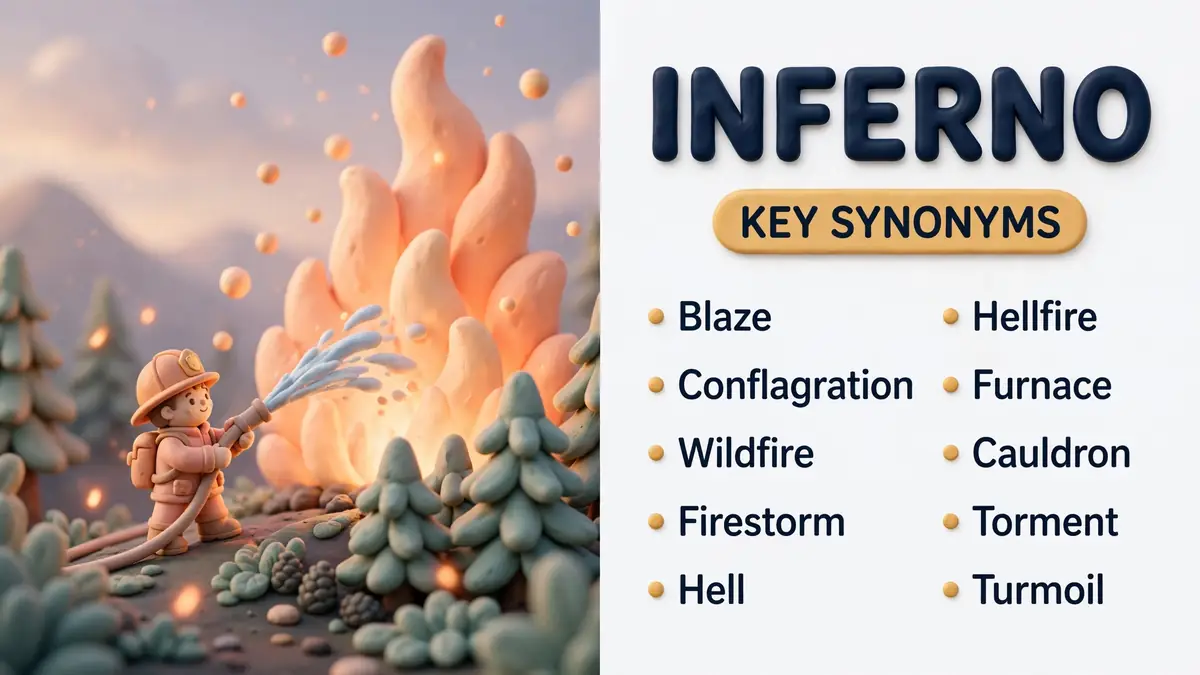
A warehouse fire made the evening news and the reporter called it an inferno. Blaze is the closest synonym, swapping cleanly into most sentences about a large fire while conflagration suits the formal report of a destructive blaze and hell suits the figurative sense of torment.
This guide gives you 15 inferno synonyms with meanings, examples and honest limits, so your next sentence names the exact kind of fire or suffering you mean.
Top 10 Another Word For Inferno
| # | Synonym | Meaning Difference |
|---|---|---|
| 1 | Blaze | A large, bright, burning fire |
| 2 | Conflagration | A large destructive fire, formal |
| 3 | Wildfire | A fire spreading fast outdoors |
| 4 | Firestorm | Intense fire plus chaos around it |
| 5 | Hell | A place or state of torment |
| 6 | Hellfire | The fire of hell, or fierce punishment |
| 7 | Furnace | A place of intense enclosed heat |
| 8 | Cauldron | A boiling pot, or a place of turmoil |
| 9 | Torment | Severe suffering, mental or physical |
| 10 | Turmoil | Violent confusion and disorder |
Quick Facts About “Inferno”
- Part of speech: a noun. The plural is infernos.
- Core meaning: a large, intense fire, or a state like hell.
- Three main senses: (1) a large, intense, destructive fire; (2) hell, or a place of torment; (3) figurative intense heat, passion, or turmoil.
- Register: dramatic and literary. Inferno fits news reports and novels, and it sounds heavy in a routine memo.
- Common mistake: using inferno for any small fire. A candle flame is not an inferno.
Where “Inferno” Comes From (Etymology)
According to Etymonline, inferno entered English in its Italian form in 1834, via Dante, as a name for Hell or things like it. The older adjective form dates from the late 14th century, meaning of or pertaining to the underworld, from Old French enfernal, meaning of Hell, and Late Latin infernalis, of the lower regions. That Latin word comes from infernus, meaning the lower world in classical Latin, a noun use of infernus, meaning lower or lying beneath, a variant of inferus, from infra, meaning below.
Pluto was infernus rex, king of the lower world, and Latin inferi meant the dead who lived there. The link to fire comes through the Christian conception of Hell as a place of burning. Merriam-Webster defines inferno as a place or a state that resembles or suggests hell, and gives the example of a fire growing into a raging inferno, with heat driving firefighters back. Its first known English use dates to 1834.
That history explains the double life of the word. It began below ground, in the realm of the dead, and only later took on flames, so it can name a real fire that looks hellish, or a situation that feels hellish.
The Closest Synonym: Blaze

Blaze is the closest synonym for inferno, because it covers the central fire sense in the plainest and most flexible form. Test the swap and it holds. “The warehouse became an inferno” becomes “The warehouse became a blaze” with the same picture in mind, and “Firefighters fought the inferno for hours” becomes “Firefighters fought the blaze for hours.” It works for a house fire, a forest fire, and a hearth fire, which gives it a wider range than the heavier Latinate options.
Blaze also carries the bright, visible side of fire that inferno implies: flames seen from a distance, light against the night, heat on your face. Conflagration runs second for the destructive sense, suiting formal writing where blaze sounds too plain, while hell runs second for the torment sense, since blaze cannot carry suffering.
Inferno Synonyms in Detail
Group 1: A Large, Intense, Destructive Fire
1. Blaze
- Meaning: A large, bright fire that burns strongly.
- Difference: The plainest swap for the fire sense of inferno.
- Best used for: House fires, forest fires, and open flames.
- Formality: Neutral · CEFR: B2 · Frequency: Very common
- Example (House fire): “The blaze spread through the roof.”
- Example (Forest): “Crews worked all night to contain the blaze.”
- When NOT to use it: For hell or torment, use hell or torment instead.
2. Conflagration
- Meaning: A large fire that destroys much in its path.
- Difference: Formal and heavy, with destruction built in.
- Best used for: News reports and official statements.
- Formality: Formal · CEFR: C1 · Frequency: Less common
- Example (City): “The conflagration destroyed three blocks.”
- Example (Report): “The inquiry blamed the conflagration on a faulty heater.”
- When NOT to use it: In casual speech, use blaze or fire instead.
3. Wildfire
- Meaning: A fire that spreads fast through woods, grass, or scrub.
- Difference: An outdoor fire that moves on its own.
- Best used for: Forest fires and fire-season news.
- Formality: Neutral · CEFR: B2 · Frequency: Very common
- Example (Hills): “The wildfire raced up the dry hillside.”
- Example (Season): “Crews prepare for wildfire season each spring.”
- When NOT to use it: For a fire inside a building, use blaze instead.
4. Firestorm
- Meaning: An intense fire that creates its own wind.
- Difference: Adds violent weather and panic.
- Best used for: War reporting and disaster writing.
- Formality: Neutral to formal · CEFR: C1 · Frequency: Less common
- Example (City): “The bombing left a firestorm that burned for days.”
- Example (Debate): “The speech set off a firestorm of replies.”
- When NOT to use it: For a small controlled fire, use blaze instead.
5. Bushfire
- Meaning: A wildfire in the Australian bush or scrub.
- Difference: The Australian word for a wildfire.
- Best used for: Australian news and rural reporting.
- Formality: Neutral · CEFR: C1 · Frequency: Common in Australia
- Example (Outback): “The bushfire crossed the highway at dawn.”
- Example (Warning): “Residents got a bushfire warning on their phones.”
- When NOT to use it: Outside Australia, use wildfire instead.
Group 2: Hell and a Place of Torment
6. Hell
- Meaning: A place or state of suffering like hell.
- Difference: The direct name for the torment sense.
- Best used for: Religion, literature, and suffering.
- Formality: Neutral · CEFR: A2 · Frequency: Very common
- Example (War): “Soldiers called the front line hell.”
- Example (Week): “That week of night shifts was hell.”
- When NOT to use it: For a literal fire with no suffering, use blaze instead.
7. Hellfire
- Meaning: The fire of hell, or fierce punishment like it.
- Difference: Fire and torment in one word.
- Best used for: Sermons, old literature, and warnings.
- Formality: Literary · CEFR: C1 · Frequency: Less common
- Example (Sermon): “The preacher warned the crowd of hellfire.”
- Example (Novel): “He called the burning city hellfire on earth.”
- When NOT to use it: In plain news writing, use blaze or fire instead.
8. Perdition
- Meaning: Eternal damnation, or ruin of the soul.
- Difference: Archaic, theological, heavier than hell.
- Best used for: Old texts and theology.
- Formality: Formal, archaic · CEFR: C2 · Frequency: Rare
- Example (Text): “The old tract warned of perdition.”
- Example (Poem): “She wrote of a soul sliding to perdition.”
- When NOT to use it: In everyday speech, use hell instead.
9. Abyss
- Meaning: A deep, dark pit, or hopeless depth.
- Difference: Depth and darkness, not flame.
- Best used for: Literature and vivid description.
- Formality: Literary · CEFR: C1 · Frequency: Common
- Example (Grief): “After the loss, he stared into an abyss.”
- Example (Cliff): “The path ran beside a dark abyss.”
- When NOT to use it: For a literal fire, use blaze instead.
10. Torment
- Meaning: Severe mental or physical suffering.
- Difference: The suffering, with no fire at all.
- Best used for: Pain, guilt, and waiting.
- Formality: Neutral to formal · CEFR: B2 · Frequency: Very common
- Example (Wait): “The wait for news was torment.”
- Example (Injury): “The burn left him in torment.”
- When NOT to use it: For a fire itself, use blaze instead.
Group 3: Figurative Heat, Passion, and Turmoil
11. Furnace
- Meaning: An enclosed chamber of intense heat.
- Difference: Enclosed, blasting heat, not open flame.
- Best used for: Factories, summer cities, and hot rooms.
- Formality: Neutral · CEFR: B2 · Frequency: Very common
- Example (Factory): “The steel mill ran its furnace all day.”
- Example (Summer): “By July the city was a furnace.”
- When NOT to use it: For a spreading outdoor fire, use wildfire instead.
12. Cauldron
- Meaning: A large boiling pot, or a seething place.
- Difference: Something bubbling, ready to boil over.
- Best used for: Politics, stadiums, and heated debate.
- Formality: Neutral to literary · CEFR: C1 · Frequency: Common
- Example (Stadium): “The stadium was a cauldron of noise.”
- Example (Politics): “The capital was a cauldron of rumours.”
- When NOT to use it: For a literal destructive fire, use blaze instead.
13. Maelstrom
- Meaning: A powerful whirlpool, or a violent confusion.
- Difference: Being pulled by forces beyond control.
- Best used for: Storms at sea and scandal.
- Formality: Literary · CEFR: C1 · Frequency: Less common
- Example (Scandal): “The minister faced a maelstrom of claims.”
- Example (Sea): “The boat spun toward the maelstrom.”
- When NOT to use it: For a fire itself, use blaze instead.
14. Turmoil
- Meaning: A state of great confusion, trouble, and disorder.
- Difference: The chaos, with no fire required.
- Best used for: Politics, markets, and upheaval.
- Formality: Neutral to formal · CEFR: B2 · Frequency: Very common
- Example (Market): “The market fell into turmoil.”
- Example (Home): “The house was in turmoil during the move.”
- When NOT to use it: For a literal fire, use blaze instead.
15. Crucible
- Meaning: A vessel for melting metal, or a severe test.
- Difference: Trial by fire, with change at the end.
- Best used for: War, training, and personal growth.
- Formality: Formal, literary · CEFR: C2 · Frequency: Less common
- Example (War): “The regiment was forged in the crucible of war.”
- Example (Training): “The course was a crucible for every recruit.”
- When NOT to use it: For a fire with no test or change, use blaze instead.
Best Alternatives by Context
A warehouse blaze and a week of torment both count as infernos, yet they ask for different words.
A news report about a fire that destroyed homes needs conflagration, since the word is formal and carries destruction in its meaning. A fire racing through dry grass needs wildfire, since it moves outdoors on its own. A novel about a character trapped in a burning city needs firestorm, since the panic matters as much as the flames.
A sermon about punishment needs hellfire, since the word joins flame and judgment in one breath. A memoir about a terrible year needs hell, since the suffering lasted for months with no fire involved. A loud, hostile stadium needs cauldron, since the crowd seethes like a boiling pot. Our guide to horrendous synonyms covers words for things that shock and appal.
A summer city that bakes its people needs furnace, since the heat is enclosed and inescapable. A market in chaos needs turmoil, since the disorder is the point. A young officer shaped by a hard campaign needs crucible, since the trial changed him. For the strength that survives such a trial, see our guide to power synonyms.
Collocations and Idioms With Inferno
Only combinations native speakers actually use:
- a raging inferno: as in “By the time help arrived, the fire had grown to a raging inferno.”
- an inferno of war: as in “The city became an inferno of war, and few streets survived.”
- the inferno of hell: as in “Medieval painters filled the inferno of hell with flames and chains.”
- an inferno of heat: as in “The foundry floor was an inferno of heat.”
- escape the inferno: as in “Families fled at dawn to escape the inferno.”
- a blazing inferno: as in “The blazing inferno lit the valley orange.”
- inferno of passion: as in “The novel describes an inferno of passion that consumes them both.”
Dante’s Inferno, the first part of the Divine Comedy, gives the word its most famous collocation. Writers still borrow it for a place that feels like a tour through suffering, as in “the Dantean inferno of the refugee camp.” Use it sparingly.
Words Commonly Confused With Inferno
Inferno versus blaze is the closest call in this guide. A blaze is any large, bright fire, from a campfire to a hearth fire, while an inferno is bigger, fiercer, and more destructive, or it borrows the idea of hell. Use blaze as the safe default, and save inferno for a fire that overwhelms everything around it.
Inferno versus hell matters for fire against suffering. Hell names the place or state of torment, and it needs no flame, while inferno often adds fire to the picture. A bad week at work is hell, while a burning building is an inferno. Our guide to harsh synonyms covers the colder words for cruel treatment.
Inferno versus wildfire matters for place. A wildfire spreads outdoors through woods or grass, moving with the wind, while an inferno can burn anywhere and stresses intensity rather than spread. A warehouse fire is an inferno, never a wildfire.
Inferno versus furnace matters for open flame against enclosed heat. A furnace holds its heat inside a chamber, and it can run for years with no visible flame, while an inferno is open, visible, and out of control. A hot summer city feels like a furnace, not an inferno, unless flames burn.
Inferno versus holocaust needs a clear warning. Holocaust is not a casual synonym for a big fire. In modern use it names the genocide of European Jews during the Second World War, and capitalised it refers to that event alone. Using it for a warehouse fire will offend readers and mislead them, so say blaze, conflagration, or firestorm instead.
Substitution test failures:
“The candle was an inferno” fails, because a candle flame is small and controlled, so say “a flame.” “The wildfire burned down the warehouse” fails, because a warehouse fire is indoors, so say “blaze” or “inferno.” “His holocaust of a summer” fails, because the word names a genocide, so say “furnace” for heat or “torment” for suffering. “The furnace spread through the forest” fails, because a furnace is enclosed, so say “wildfire.”
Can You Swap Them Freely?
In short: only inside the same meaning group.
- ✅ “The warehouse became a blaze.” (a large fire ✔)
- ✅ “The warehouse became an inferno.” (same sense ✔)
- ❌ “The warehouse became hell.” (hell is torment, not a fire ✘, say blaze)
- ✅ “The fire was a conflagration.” (large and destructive ✔)
- ❌ “The fire was a cauldron.” (a cauldron boils, it does not burn a building ✘, say conflagration)
- ✅ “That week was pure hell.” (torment ✔)
- ❌ “That week was a wildfire.” (a wildfire spreads outdoors ✘, say hell)
- ✅ “The city felt like a furnace.” (enclosed heat ✔)
- ❌ “The city felt like a bushfire.” (a bushfire is an Australian outdoor fire ✘, say furnace)
- ✅ “The market fell into turmoil.” (chaos ✔)
- ❌ “The market fell into perdition.” (perdition is damnation ✘, say turmoil)
Before you substitute, ask what you mean: fire, torment, or chaos.
Which Inferno Synonym Should I Choose?
| Situation | Best pick | Why it wins |
|---|---|---|
| A large fire in a building | Blaze | The plain word |
| A fire that destroys a district | Conflagration | Formal, and destruction is built in |
| A fire racing through dry grass | Wildfire | It moves outdoors on its own |
| A fire with its own wind and panic | Firestorm | The chaos matters too |
| A fire in the Australian bush | Bushfire | The regional word |
| A state of suffering | Hell | The direct name for torment |
| Fire joined to punishment | Hellfire | Flame plus judgment |
| A soul in damnation | Perdition | The theological weight |
| Hopeless depth and darkness | Abyss | The depth, not the flame |
| Severe suffering with no fire | Torment | The pain itself |
| Enclosed, blasting heat | Furnace | The heat is trapped inside |
| A seething, noisy crowd | Cauldron | It boils over |
| A violent, pulling chaos | Maelstrom | The pull is the point |
| Disorder with no flame | Turmoil | The confusion itself |
| A trial that shapes a person | Crucible | The change at the end |
The Cool Side of Inferno: Opposites That Douse the Fire
Against the fire sense:
- Ember: a small, dying glow, where a blaze once roared.
- Frost: cold that kills flame and bites the skin.
- Chill: a mild cold that calms heat rather than fighting it.
Against the hell and torment sense:
- Heaven: peace and reward, the opposite of punishment.
- Paradise: a place of delight, with no suffering in it.
- Relief: the moment torment lifts and breathing comes easy.
And Against the turmoil sense:
- Calm: still air after the storm has passed.
- Peace: order that holds, with no disorder pressing in.
- Serenity: a deep, quiet ease that turmoil cannot reach.
Heaven is the plain opposite for the torment sense, calm suits the chaos sense, and frost suits the fire sense. Pair the opposite with the same sense.
American vs British English
Inferno is spelled and used the same in American and British English, and so are its synonyms here. Bushfire is the Australian word, borrowed by American and British writers for Australian fires.
Wildfire is standard in American English, while British writers often say “forest fire” for a fire in British woods. This article uses American spelling throughout.
Practice Exercises
Exercise 1: Odd one out. In each set, one word does not belong. Name it.
- blaze, conflagration, wildfire, frost
- hell, torment, perdition, paradise
- furnace, cauldron, crucible, calm
- firestorm, maelstrom, turmoil, serenity
- bushfire, wildfire, blaze, heaven
Exercise 2: Replace with a sharper word. Each sentence uses inferno where a sharper synonym fits. Replace it and say why.
- “The inferno raced up the dry hillside by noon.”
- “The wait for news was a pure inferno.”
- “By July the city felt like an inferno.”
- “The stadium became an inferno of noise.”
- “The regiment was forged in the inferno of war.”
Answer key
- Exercise 1: (1) frost: the rest mean fire; (2) paradise: the rest mean torment; (3) calm: the rest mean heat or trial; (4) serenity: the rest mean violent chaos; (5) heaven: the rest mean fire.
- Exercise 2: (1) wildfire: the fire spreads outdoors through dry grass; (2) torment: the wait is suffering with no flame; (3) furnace: the heat is enclosed and inescapable; (4) cauldron: the crowd seethes like a boiling pot; (5) crucible: the war was a trial that shaped the regiment.
Frequently Asked Questions
What is the best synonym for inferno?
Blaze is the best synonym for inferno in most sentences about fire, because it covers a large, bright, burning fire in the plainest form. Conflagration fits formal reports of destruction, wildfire fits outdoor fires, and hell fits the sense of torment.
Is inferno the same as hell?
Not quite. Hell names a place or state of torment and punishment, and it needs no flame at all. Inferno can mean the same torment, and it often adds fire to the picture. A bad week is hell, while a burning building is an inferno.
Can inferno describe a feeling?
Yes, in figurative use. Writers use inferno for intense passion, anger, or turmoil that feels overwhelming, as in an inferno of passion or an inferno of jealousy. Keep the fire picture in mind, since the word still suggests heat and loss of control.
What is the difference between inferno and wildfire?
A wildfire is a specific kind of fire: one that spreads outdoors through woods, grass, or scrub, moving with the wind. An inferno is any large, intense fire, indoors or out, and it stresses size and destruction rather than spread. A warehouse fire is an inferno, never a wildfire.
Is holocaust a synonym for inferno?
No, and you should not use it that way. Holocaust names the genocide of European Jews during the Second World War, and capitalised it refers to that event alone. For a large fire, use blaze, conflagration, or firestorm instead, and leave holocaust out of fire writing entirely.
Which synonym should students use in essays?
In essays, use inferno itself for the dramatic claim, and blaze for plain description of a fire. Pick conflagration for formal reports of destruction, hell for figurative suffering, and turmoil for chaos with no flame. Save perdition, maelstrom, and crucible for literary writing, where their weight earns its place.
Conclusion
Stand at the edge of the ridge at dusk and watch the orange line climb the hill. The flames are a blaze, the destruction is a conflagration, and the fear in the valley is close to hell.
Three words, three kinds of fire. Pick the word that matches your kind of inferno, and the sentence will hold.

About Sajjad Ahmed
Sajjad Ahmed is the author behind Guest Paster, where he writes about English vocabulary, synonyms, word meanings, and practical word usage.
His content is designed to help readers understand the differences between similar words, discover suitable alternatives, and use English vocabulary more effectively in everyday writing and communication.
Before publishing, Sajjad focuses on presenting word choices in a clear and easy-to-understand format, with relevant meanings, context, and examples where helpful.
Through Guest Paster, his goal is to make vocabulary learning simpler and provide useful language resources for students, writers, English learners, and anyone looking to expand their vocabulary.
Areas of Focus: English Vocabulary • Synonyms • Word Meanings • Word Usage • Language Learning
Author: Sajjad Ahmed
Website: Guest Paster