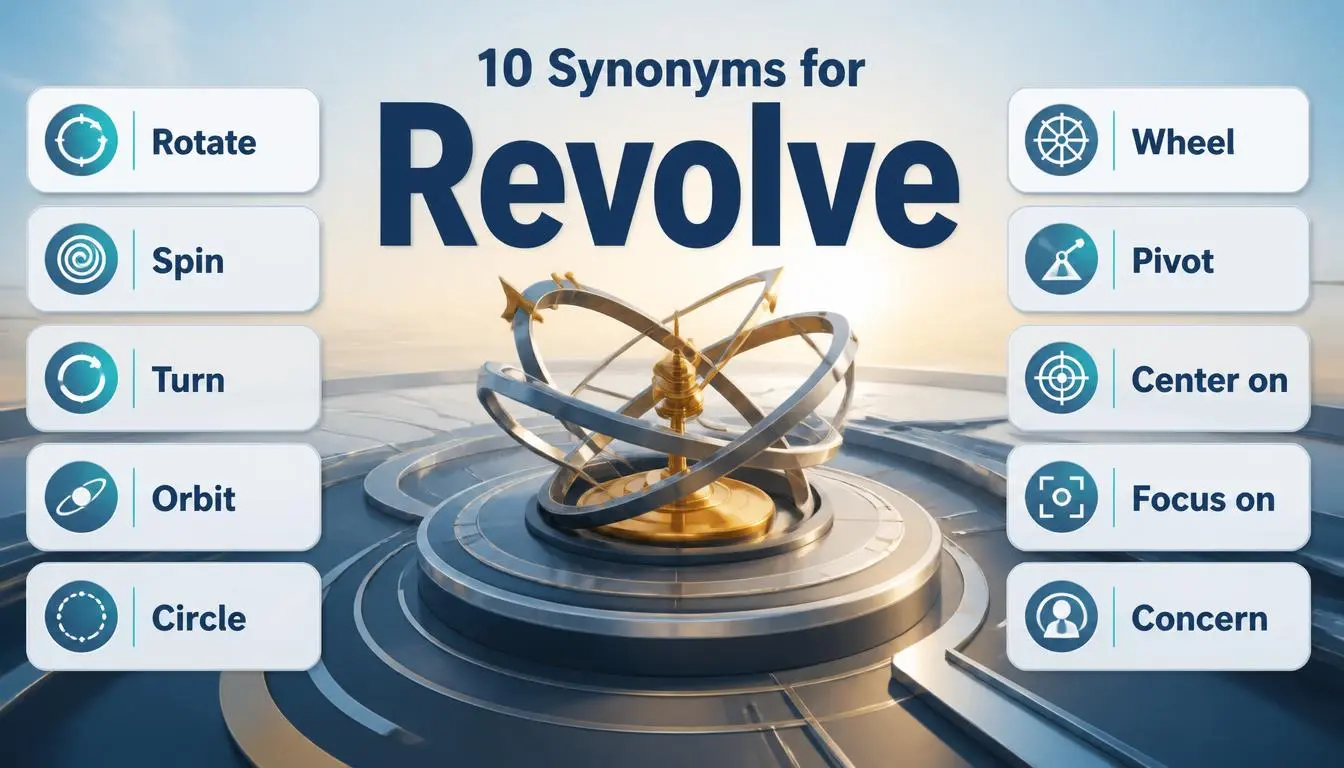
The best synonyms for revolve are rotate, spin, turn, orbit, circle, pivot, center on and focus on. Use orbit for movement around another object, rotate for turning on an axis, and center on or focus on when revolve around means be mainly about.
For example “The planets revolve around the Sun” can become “The planets orbit the Sun.” However “The discussion revolves around safety” is better rewritten as “The discussion centers on safety.”
10 Best Synonyms for Revolve and Their Meanings
| Synonym | Simple Meaning |
| Rotate | Turn around an axis or central point |
| Spin | Turn quickly around a center |
| Turn | Move around or change direction |
| Orbit | Travel around another object |
| Circle | Move around something in a curved path |
| Wheel | Turn or move around rapidly |
| Pivot | Turn around a fixed point |
| Center on | Have something as the main subject |
| Focus on | Give main attention to something |
| Concern | Be mainly about a particular subject |
Quick Facts About Revolve
Word: Revolve
Part of Speech: Verb
Simple Meaning: To move around a central point or to have something as a main subject
Pronunciation: /rɪˈvɑːlv/
Syllables: 2 — re-volve
Origin: From Latin revolvere meaning “to roll back” or “turn around”
Formality: Neutral; sometimes formal in figurative uses
Common Uses: Everyday conversation academic writing professional writing creative writing
Example Sentence: The debate revolves around how the new rule should be applied.
Revolve Meaning and Usage
The verb revolve has several closely related meanings. Understanding the intended sense is important because a synonym that works in one sentence may sound wrong in another.
1. To Move Around a Central Object
The most literal meaning of revolve is to travel in a circular or curved path around another object.
Example:
The Earth revolves around the Sun.
In this sense orbit is usually the closest alternative.
Natural alternatives: orbit circle move around
2. To Turn Around an Axis or Center
Revolve can also describe an object turning around its own center or a fixed point.
Example:
The platform revolves slowly.
In this sense rotate turn and sometimes spin are stronger choices.
The emotional tone is neutral. The word can sound slightly more technical than turn especially when describing machinery or scientific motion.
3. To Be Mainly About Something
The phrase revolve around often has a figurative meaning: to have a particular person, idea problem or subject as the main focus.
Example:
Most of the meeting revolved around the budget.
Here the best alternatives include center on focus on concern and deal with.
This figurative use is common in essays, academic writing, business communication and everyday speech.
4. To Treat Someone or Something as the Center of Attention
When people say that a person’s “life revolves around” another person’s activity or goal they mean that it receives most of that person’s attention.
Example:
His weekend revolves around soccer practice and matches.
Possible alternatives include center on focus on and be organized around. There is no single perfect one-word replacement in every sentence.
Detailed Analysis of Synonyms for Revolve

1. Rotate
Relationship: Near synonym
Meaning: To turn around an axis or central point.
Difference: Rotate usually describes turning in place while revolve can describe either turning or moving around another object.
Best Used For: Machinery science geometry physical movement.
Example: The fan blades rotate at a steady speed.
2. Spin
Relationship: Near synonym
Meaning: To turn rapidly around a center or axis.
Difference: Spin usually suggests faster or more energetic motion than revolve.
Best Used For: Wheels toys machinery rapid movement.
Example: The wheel began to spin faster as the bicycle moved downhill.
3. Turn
Relationship: Near synonym
Meaning: To move around a point axis or direction.
Difference: Turn is broader and more common in everyday English. It does not necessarily suggest a complete circular movement.
Best Used For: Everyday conversation and simple descriptions.
Example: Turn the handle slowly to open the valve.
4. Orbit
Relationship: Exact synonym in some contexts
Meaning: To travel around another object in a regular path.
Difference: Orbit specifically describes movement around another body and is especially common in astronomy and space science.
Best Used For: Planets moons satellites spacecraft.
Example: Several satellites orbit the Earth.
5. Circle
Relationship: Near synonym
Meaning: To move around something in a roughly circular path.
Difference: Circle emphasizes the path around an object rather than repeated rotation around an axis.
Best Used For: Birds aircraft vehicles people objects in motion.
Example: The hawk circled above the field.
6. Wheel
Relationship: Contextual alternative
Meaning: To turn or move around quickly in a circular way.
Difference: Wheel often suggests sudden or sweeping movement rather than steady mechanical motion.
Best Used For: Creative writing and descriptions of people, animals or groups changing direction.
Example: The flock wheeled across the evening sky.
7. Pivot
Relationship: Near synonym
Meaning: To turn around a fixed point.
Difference: Pivot usually describes a limited turn around one supporting point rather than continuous circular motion.
Best Used For: Physical movement mechanics business strategy.
Example: The door pivots smoothly on its central hinge.
8. Swivel
Relationship: Near synonym
Meaning: To turn around a fixed point while remaining attached.
Difference: Swivel is commonly used for chairs, joints, mounts and objects designed to turn from side to side.
Best Used For: Furniture equipment mechanical parts.
Example: The camera can swivel toward either side of the room.
9. Twirl
Relationship: Contextual alternative
Meaning: To turn around lightly or quickly.
Difference: Twirl often suggests graceful playful or repeated spinning.
Best Used For: Dance creative writing light objects.
Example: The dancer twirled across the stage.
10. Whirl
Relationship: Contextual alternative
Meaning: To spin or move rapidly around.
Difference: Whirl suggests fast energetic or sometimes uncontrolled movement.
Best Used For: Creative description and rapid motion.
Example: Dry leaves whirled across the sidewalk.
11. Gyrate
Relationship: Near synonym
Meaning: To move or rotate in a circular pattern.
Difference: Gyrate is more formal and technical than spin or turn and may suggest repeated circular motion.
Best Used For: Technical descriptions or formal writing.
Example: The device gyrates around its central support.
12. Roll
Relationship: Contextual alternative
Meaning: To move by turning over and over along a surface.
Difference: Roll combines rotation with forward movement so it cannot replace revolve in every context.
Best Used For: Balls, wheels cylinders moving objects.
Example: The ball rolled across the floor.
13. Cycle
Relationship: Contextual alternative
Meaning: To move repeatedly through a series or circular pattern.
Difference: Cycle emphasizes repetition rather than physical rotation alone.
Best Used For: Processes machinery systems repeated patterns.
Example: The machine cycles through three operating modes.
14. Circulate
Relationship: Contextual alternative
Meaning: To move continuously through an area or system.
Difference: Circulate suggests movement around or through a route rather than rotation around one fixed center.
Best Used For: Air water information people.
Example: Warm air circulates through the building.
15. Center On
Relationship: Exact synonym in many figurative contexts
Meaning: To have something as the main subject concern or focus.
Difference: Center on does not describe physical movement. Instead, it can replace ‘revolve around’ when the phrase means ‘to be mainly about something. ”
Best Used For: Essays reports academic writing professional communication.
Example: The report centers on changes in student attendance.
16. Focus On
Relationship: Near synonym
Meaning: To give the greatest attention to something.
Difference: Focus on emphasizes attention while revolving around suggests that the whole discussion activity or situation is organized around something.
Best Used For: Schoolwork business advice everyday speech.
Example: This chapter focuses on the causes of climate change.
17. Concern
Relationship: Near synonym
Meaning: To be about or relate to a particular subject.
Difference: Concern is more concise and formal than revolving around but it can sound less vivid.
Best Used For: Formal writing reports essays.
Example: The final section concerns workplace safety.
18. Deal With
Relationship: Contextual alternative
Meaning: To discuss an address or be about a subject.
Difference: Deal with suggests actively addressing a topic rather than simply having it as the central focus.
Best Used For: Everyday writing reports explanations.
Example: The article deals with several common study problems.
19. Relate To
Relationship: Contextual alternative
Meaning: To have a connection with something.
Difference: Relate to is broader than revolve around. A topic can relate to something without being centered on it.
Best Used For: General explanations and comparisons.
Example: These questions relate to the main theme of the book.
20. Be About
Relationship: Near synonym
Meaning: To have a particular subject or topic.
Difference: Be about is simpler and more conversational than revolve around.
Best Used For: Everyday speech and clear plain English.
Example: The documentary is about life in the deep ocean.
21. Be Based On
Relationship: Contextual alternative
Meaning: To use something as a foundation or main basis.
Difference: Be based on emphasizes the foundation of something rather than its main focus.
Best Used For: Academic professional and explanatory writing.
Example: The decision is based on evidence collected during the study.
22. Be Organized Around
Relationship: Near synonym
Meaning: To arrange activities or ideas around one central element.
Difference: This phrase is especially useful when revolving around describing schedules, systems or lifestyles rather than discussions.
Best Used For: Planning routines, organizations structured activities.
Example: The training program is organized around weekly practice sessions.
23. Hinge On
Relationship: Contextual alternative
Meaning: To depend mainly on one important factor.
Difference: Hinge on expresses dependence not merely central attention.
Best Used For: Arguments outcomes decisions formal writing.
Example: The team’s success may hinge on how well it prepares.
24. Depend On
Relationship: Contextual alternative
Meaning: To be determined or controlled by something else.
Difference: Depend on is appropriate only when revolving around implies that one factor strongly controls the situation.
Best Used For: Conditions, decisions , outcomes.
Example: The final schedule will depend on the weather.
25. Be Centered On
Relationship: Exact synonym in many figurative contexts
Meaning: To have one subject person or idea as the main focus.
Difference: Be centered on is more formal and often works better in academic or professional writing.
Best Used For: Essays research reports formal explanations.
Example: The course is centered on practical problem-solving.
Synonyms for Revolve by Context
Everyday Conversation
For natural everyday English the best options are turn spin be about focus on and center on.
- “The wheel revolves” → “The wheel turns.”
- “The conversation revolves around school” → “The conversation is about school.”
Formal Writing
For a more polished alternative to revolves around use:
- centers on
- is centered on
- concerns
- focuses on
Instead of:
“The report revolves around three major problems.”
Write:
“The report centers on three major problems.”
Academic Writing
In essays and research papers centers on focuses on concerns and is often clearer than revolves around.
For example:
“The argument revolves around the idea of social responsibility.”
A more academic version is:
“The argument centers on the idea of social responsibility.”
Business Communication
Useful professional alternatives include focus on center on concern, depend on and hinge on.
“The decision revolves around cost” may mean either:
- “The decision centers on cost” if cost is the main topic.
- “The decision hinges on cost” if cost will determine the outcome.
Creative Writing
For vivid physical motion writers may choose spin whirl twirl wheel circle or gyrate depending on the speed and style of movement.
“Leaves revolved in the wind” can become “Leaves whirled in the wind” for a more energetic image.
Exact vs. Similar Synonyms for Revolve
No synonym for revolve works in every sentence because the word has more than one meaning. For physical movement rotate is close when something turns around an axis while orbit is more exact when one object travels around another. Spin suggests faster turning and circle emphasizes movement along a curved path.
For the figurative phrase revolve around center on is often the closest formal substitute. Focus emphasizes attention while concern simply identifies the subject. Hinge on is different because it means that an outcome depends on something.
The safest synonym therefore depends on whether the sentence describes rotation, orbital movement, a central topic or dependence.
Revolve Antonyms
Because revolve has several meanings its antonyms also depend on context.
| Antonym | Meaning | Example Sentence |
| Stop | Cease moving | The wheel stopped after a few seconds. |
| Halt | Come to a complete stop | The mechanism halted unexpectedly. |
| Remain still | Stay without movement | The central support remains still. |
| Stand still | Stay in one position | The platform stood still during the test. |
| Ignore | Give no attention to | The discussion ignored the main complaint. |
| Disregard | Treat something as unimportant | The report disregards several minor issues. |
| Diverge from | Move away from a subject or direction | The conversation diverged from its original topic. |
| Be unrelated to | Have no meaningful connection with | The final chapter is unrelated to the main debate. |
Common Collocations With Revolve
| Phrase | Meaning | Example Sentence |
| Revolve around | Have something as the center or main focus | The story revolves around two childhood friends. |
| Revolve around a theme | Focus mainly on one central idea | The novel revolves around the theme of courage. |
| Revolve around a person | Make one person the main focus | Much of the plot revolves around the young inventor. |
| Revolve around an issue | Focus on a particular problem or question | The debate revolves around an issue of fairness. |
| Revolve around the Sun | Travel in an orbit around the Sun | Earth revolves around the Sun. |
| Revolve around an axis | Turn around a central line | The object revolves around its vertical axis. |
| Life revolves around | Give most time or attention to something | During the season her schedule revolves around practice. |
| Discussion revolves around | Have one topic as the main subject | Today’s discussion revolves around online safety. |
Frequently Asked Questions
What is a synonym for the word rotate?
Good synonyms for rotate include turn spin revolve pivot and swivel. The best choice depends on the motion. Spin often suggests fast movement while pivot means turning around a fixed point.
What are 5 strong synonyms for revolve?
Five strong synonyms for revolve are rotate spin turn orbit and circle. For the figurative phrase revolve around stronger alternatives may include center on and focus on instead.
What does revolve mean?
Revolve means to move around a central point or object or to turn around an axis. Figuratively revolve around means to have a particular subject person or idea as the main focus.
What is a synonym for “revolve around”?
When revolve around means “be mainly about” the closest alternatives are center on focus on concern and be centered on. In formal essays center on is often the clearest replacement.
What is a fancy word for spin?
Depending on the sentence more formal alternatives to spin include rotate and gyrate. Rotate is neutral and technical while gyrate describes circular movement and sounds more specialized.
What is the difference between revolve and rotate?
Rotate usually means to turn around an object’s own axis. Revolve often means to travel around another object. For example Earth rotates on its axis and revolves around the Sun. In everyday English however the two words sometimes overlap.
Conclusion
Choosing the right synonym for revolve makes writing clearer and more precise. Use rotate or spin for turning orbit for movement around another object and center on or focus on when something is the main topic.
Always match the synonym to the sentence’s exact meaning and tone.

About Sajjad Ahmed
Sajjad Ahmed is the author behind Guest Paster, where he writes about English vocabulary, synonyms, word meanings, and practical word usage.
His content is designed to help readers understand the differences between similar words, discover suitable alternatives, and use English vocabulary more effectively in everyday writing and communication.
Before publishing, Sajjad focuses on presenting word choices in a clear and easy-to-understand format, with relevant meanings, context, and examples where helpful.
Through Guest Paster, his goal is to make vocabulary learning simpler and provide useful language resources for students, writers, English learners, and anyone looking to expand their vocabulary.
Areas of Focus: English Vocabulary • Synonyms • Word Meanings • Word Usage • Language Learning
Author: Sajjad Ahmed
Website: Guest Paster