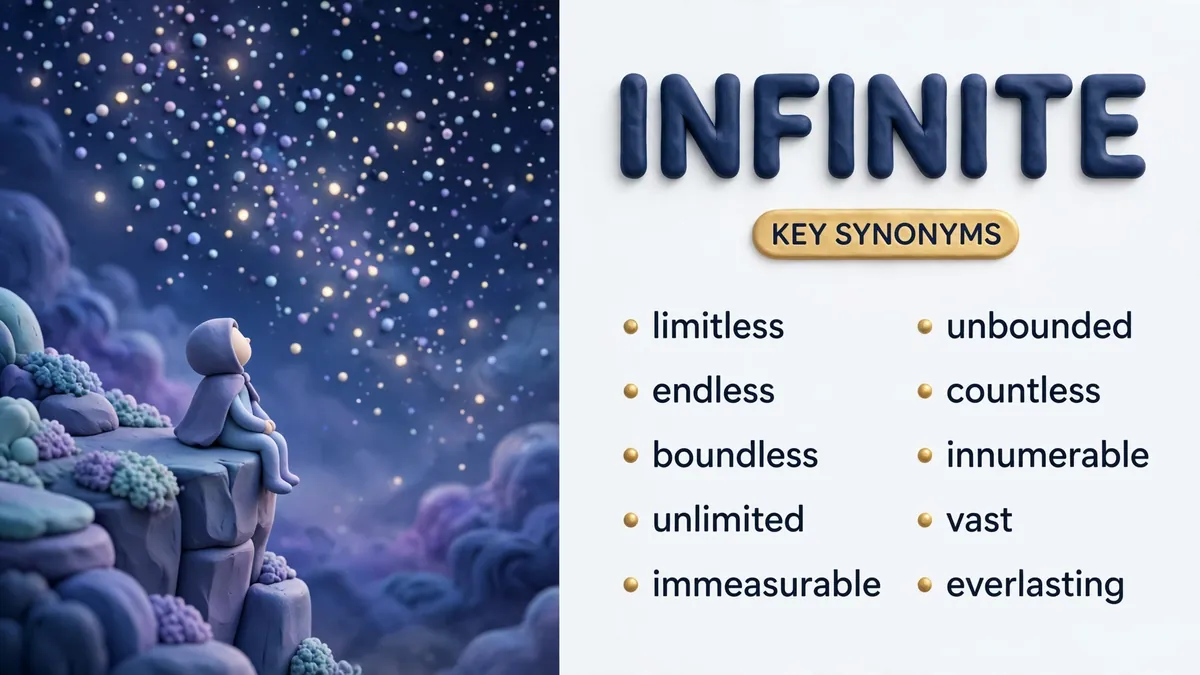
Infinite means without any limit and limitless is the closest synonym swapping cleanly into almost every sentence where infinite fits. Endless suits time that never seems to stop boundless suits space with no edge and countless suits numbers too big to count. The trap is reach.
Infinite promises no boundary at all, so vast only hints at size, and everlasting only speaks about time. This guide gives you 15 infinite synonyms with meanings, examples and honest limits so you can pick the word that truly has no end.
Top 10 Another Word For Infinite Synonyms at a Glance
| # | Synonym | Meaning Difference |
|---|---|---|
| 1 | Limitless | Without any limit at all |
| 2 | Endless | With no end in time |
| 3 | Boundless | With no edge in space |
| 4 | Unlimited | With no set cap or rule |
| 5 | Immeasurable | Too great to measure |
| 6 | Unbounded | Not held in by a border |
| 7 | Countless | Too many to count |
| 8 | Innumerable | Too many to be counted |
| 9 | Vast | Very great in size |
| 10 | Everlasting | Lasting forever in time |
Quick Facts About “Infinite”
- Part of speech: an adjective. The noun is infinity, and the adverb is infinitely.
- Core meaning: without limits or end; also, extremely great in number.
- Three main senses: (1) having no limits in space or time; (2) too many to count; (3) very great in amount or degree.
- Register: neutral to formal. Infinite suits maths, science, poetry, and essays.
- Common mistake: using infinite for anything merely big. A crowd is vast, not infinite, and a long meeting is endless, not infinite.
Where “Infinite” Comes From (Etymology)
According to Etymonline, infinite entered English in the late 14th century meaning “eternal, limitless,” and also “extremely great in number.” It came from Old French infinit, “endless, boundless,” and directly from Latin infinitus, “unbounded, unlimited, countless, numberless.” That Latin word joins in-, “not,” with finitus, “defining, definite,” from finis, “end.” The noun sense, “that which is infinite,” dates from the 1580s.
The word is built from a denial: take finis, an end, add in- to cancel it, and you get a word that refuses every edge. The related Latin phrase ad infinitum means “endlessly,” literally “to infinity,” and the English form “to infinity” is attested from the 1630s. Merriam-Webster records the same core senses, including the mathematical use for a quantity with no limit.
That history explains why infinite feels bigger than its neighbours: endless only denies an ending, while infinite denies the boundary itself.
The Closest Synonym: Limitless
Limitless is the closest synonym for infinite, because it carries the same claim of no boundary in the plainest form. Test the swap and it holds. “The infinite sky stretched overhead” becomes “The limitless sky stretched overhead” with no loss of sense. “Her infinite patience never ran out” becomes “Her limitless patience never ran out.”
Limitless wins on range and ease: it works for space, time, imagination, and feeling, while infinite sounds grander and suits maths and the universe. Endless runs second for time that drags, yet says nothing about space. Choice test: space calls for limitless; a count calls for countless; dragging time calls for endless.
Infinite Synonyms in Detail

Group 1: Without Any Limit
1. Limitless
Meaning: Having no limits of any kind.
Difference: The broadest swap for infinite, covering space, time, amount, and feeling.
Best used for: Space, imagination, and possibility.
Formality: Neutral to formal · CEFR: B2 · Frequency: Common
Example (Space): “The telescope revealed a limitless stretch of stars.”
Example (Life): “Her limitless curiosity led her into every subject.”
When NOT to use it: For a huge number, use countless.
2. Endless
Meaning: With no end, going on and on.
Difference: Endless stresses time and waiting, more than space.
Best used for: Journeys, summers, patience, and stories.
Formality: Neutral · CEFR: B2 · Frequency: Very common
Example (Travel): “The endless highway crossed the plain for hours.”
Example (Summer): “Those endless summer days felt like they would never fade.”
When NOT to use it: For space with no edge, use boundless.
3. Boundless
Meaning: With no boundary or edge.
Difference: Boundless suits space and feeling, and it sounds warmer than infinite.
Best used for: Oceans, skies, energy, and joy.
Formality: Neutral to formal · CEFR: B2 · Frequency: Common
Example (Sea): “The boundless ocean met the sky at every side.”
Example (Feeling): “His boundless energy kept the whole team moving.”
When NOT to use it: For a number too big to count, use countless.
4. Unlimited
Meaning: Without any set limit or restriction.
Difference: Unlimited often comes from a rule or an offer, not from nature.
Best used for: Offers, access, plans, and data.
Formality: Neutral · CEFR: B1 · Frequency: Very common
Example (Phone): “The plan includes unlimited data and calls.”
Example (Access): “Members get unlimited entry to the museum all year.”
When NOT to use it: For the universe, use infinite or boundless.
5. Unbounded
Meaning: Not held in by any border.
Difference: The formal cousin of boundless, common in maths and philosophy.
Best used for: Maths, space, and formal writing.
Formality: Formal · CEFR: C1 · Frequency: Less common
Example (Maths): “The graph rises along an unbounded curve.”
Example (Space): “She dreamed of unbounded skies beyond the hills.”
When NOT to use it: In everyday speech, use boundless or endless.
Group 2: Too Many to Count
6. Countless
Meaning: Too many to count.
Difference: Countless is about number only, not about space or time.
Best used for: Stars, grains of sand, and small acts.
Formality: Neutral · CEFR: B2 · Frequency: Very common
Example (Night): “Countless stars filled the sky above the desert.”
Example (Kindness): “Countless small kindnesses held the village together.”
When NOT to use it: For space with no edge, use boundless.
7. Innumerable
Meaning: Too many to be counted.
Difference: The formal twin of countless, for writing that needs weight.
Best used for: Essays, history, and formal speeches.
Formality: Formal · CEFR: C1 · Frequency: Less common
Example (History): “Innumerable ships crossed the sea in those years.”
Example (Nature): “Innumerable leaves covered the forest floor.”
When NOT to use it: In casual talk, use countless instead.
8. Immeasurable
Meaning: Too great to measure.
Difference: Immeasurable stresses that no tool or scale can hold the thing.
Best used for: Love, loss, and value.
Formality: Neutral to formal · CEFR: C1 · Frequency: Common
Example (Love): “She felt an immeasurable love for her child.”
Example (Value): “The old map had immeasurable value to the town.”
When NOT to use it: For a plain large number, use countless.
9. Incalculable
Meaning: Too great or too many to calculate.
Difference: Incalculable adds the idea of a sum no mind can finish.
Best used for: Damage, benefit, and odds.
Formality: Formal · CEFR: C1 · Frequency: Less common
Example (Cost): “The storm caused incalculable damage to the coast.”
Example (Benefit): “Good teachers do incalculable good over a lifetime.”
When NOT to use it: For space with no edge, use boundless instead.
10. Myriad
Meaning: A huge number, too many to count.
Difference: Myriad sounds literary, and it often comes before a noun.
Best used for: Poetry, essays, and nature writing.
Formality: Formal · CEFR: C1 · Frequency: Less common
Example (Nature): “A myriad of fireflies lit the field at dusk.”
Example (Life): “The city offers a myriad of small pleasures.”
When NOT to use it: As a plain adjective for space, use vast or boundless.
Group 3: Enormous in Scale or Time
11. Vast
Meaning: Very great in size or amount.
Difference: Vast only claims size, never the absence of limits.
Best used for: Deserts, oceans, and crowds.
Formality: Neutral · CEFR: B1 · Frequency: Very common
Example (Land): “A vast desert stretched beyond the last town.”
Example (Crowd): “A vast crowd gathered in the square by noon.”
When NOT to use it: For a claim of no end, use infinite.
12. Immense
Meaning: Extremely large in size or amount.
Difference: Immense adds force to vast, with a sense of awe.
Best used for: Scale, relief, and wonder.
Formality: Neutral to formal · CEFR: B2 · Frequency: Common
Example (Relief): “She felt immense relief when the call finally came.”
Example (Building): “The immense hall held a thousand people with ease.”
When NOT to use it: For time with no end, use endless.
13. Tremendous
Meaning: Very great in size, amount, or effect.
Difference: Tremendous often carries excitement or force.
Best used for: Success, effort, and change.
Formality: Neutral · CEFR: B2 · Frequency: Very common
Example (Effort): “A tremendous effort went into the rescue.”
Example (Change): “The new road made a tremendous difference to the town.”
When NOT to use it: For a calm claim of no limits, use infinite.
14. Everlasting
Meaning: Lasting forever, with no end in time.
Difference: Everlasting is about time only, while infinite covers space and amount too.
Best used for: Love, memory, and promises.
Formality: Neutral to formal · CEFR: B2 · Frequency: Common
Example (Love): “They spoke of an everlasting love that would not fade.”
Example (Memory): “An everlasting memory of that summer stayed with her.”
When NOT to use it: For space or numbers, use boundless or countless.
15. Perpetual
Meaning: Continuing without a break.
Difference: Perpetual describes a process that keeps renewing itself.
Best used for: Motion, noise, and habits.
Formality: Formal · CEFR: C1 · Frequency: Common
Example (City): “The perpetual hum of the city never quite stops.”
Example (Motion): “The river kept a perpetual flow through the valley.”
When NOT to use it: For a huge amount, use countless.
Words Commonly Confused With Infinite
Infinite versus endless is the first mix-up to clear. Endless describes time that feels like it never stops, so a wait, a road, or a summer can feel endless and still end. Infinite claims no boundary at all. A driver on a long road calls it endless; an astronomer describing the universe calls it infinite.
Infinite versus limitless is the closest call in this guide. The two overlap so much that limitless can replace infinite in most sentences. Limitless is the plainer twin, while infinite sounds grander and suits maths, space, and poetry. Use limitless as the safe default, and save infinite for the claim that truly has no edge.
Infinite versus unlimited matters for the source of the limit. Unlimited usually comes from a rule or an offer, like unlimited data, where someone chose not to set a cap. Infinite comes from the thing itself, like infinite space or infinite patience, where no cap could exist at all.
Infinite versus vast matters for honesty. Vast means very big, and a desert, an ocean, or a crowd can be vast and still end at a border. Infinite means no limit at all. A desert that ends at a border is vast, and a crowd of five thousand is large, not infinite.
Infinite versus countless matters for what you are counting. Countless is about number only, so countless stars means more stars than anyone could count. Infinite covers number, space, and time. Use countless when the point is the tally, and infinite when the point is the absence of a boundary.
Infinite versus eternal matters for the kind of forever. Eternal is about time without end, often with a sacred or solemn tone, as in eternal life. Infinite is about any limit, so infinite patience and infinite space are natural, while eternal space sounds wrong.
Substitution test failures:
“The infinite meeting finally ended at six” fails, because a meeting has an end, so say “endless.” “Her infinite patience ran out by noon” fails, because patience that runs out was never infinite, so say “great.”
“The infinite desert ended at the border” fails, because a desert with a border has an edge, so say “vast.” “An infinite number of tickets were sold, exactly 400” fails, because 400 can be counted, so say “400 tickets were sold.”
Can You Swap Them Freely?
In short: only inside the meaning group, when the sense matches.
- ✅ “The limitless sky stretched overhead.” (space with no edge ✔)
- ✅ “The boundless sky stretched overhead.” (same sense ✔)
- ❌ “The countless sky stretched overhead.” (countless is about number, not space ✘, say boundless)
- ✅ “Countless stars filled the night.” (too many to count ✔)
- ❌ “Unlimited stars filled the night.” (unlimited sounds like an offer ✘, say countless)
- ✅ “The plan includes unlimited data.” (no set cap ✔)
- ❌ “The plan includes infinite data.” (sounds grand, not contractual ✘, say unlimited)
- ✅ “A vast desert stretched beyond the last town.” (very great in size ✔)
- ❌ “An infinite desert stretched beyond the last town.” (a desert has an edge ✘, say vast)
Before you substitute, ask what has no limit: the space, the time, the count, or the size.
Best Alternatives by Context

Writing a science essay about the universe? Call the space boundless and keep infinite for the maths: “the boundless sky” fits the eye, while “an infinite number of points on a line” fits the proof.
Writing a novel about a long journey? Call the road endless, the word for the traveller’s feeling: hours that drag and a horizon that never arrives.
Writing a speech about a charity‘s reach? Call the volunteers countless. For words about generous plenty, our guide to bountiful synonyms covers that side of abundance in full.
Writing a business plan or a phone offer? Call the access unlimited, the word made for contracts, plans, and memberships, where someone chose not to set a cap.
Writing a poem about deep wisdom or the mind? Call the insight immeasurable, the word for what no scale can hold. Our guide to profound synonyms goes deeper on that side of depth.
Writing a history essay about a leader’s lasting force? Call the influence everlasting, and the drive behind it perpetual. For naming that force, our guide to power synonyms can help you pick the word that fits.
Collocations and Idioms With Infinite
Only combinations native speakers actually use:
- infinite patience: as in “She answered with infinite patience, every single time.”
- infinite variety: as in “Nature shows an infinite variety of forms.”
- infinite possibilities: as in “The new tool opened infinite possibilities.”
- infinite space: as in “The telescope peered into infinite space.”
- infinite loop: in computing, as in “The bug put the program in an infinite loop.”
- infinite regress: in philosophy, as in “The argument fell into an infinite regress.”
- infinite wisdom: often used with irony, as in “In their infinite wisdom, the committee chose to wait.”
- infinite number: in maths, as in “There is an infinite number of points on a line.”
- ad infinitum: a Latin phrase meaning endlessly, as in “He listed complaints ad infinitum.”
Which Infinite Synonym Should I Choose?
| Situation | Best pick | Why it wins |
|---|---|---|
| Space or feeling with no edge | Limitless | No boundary at all |
| Time that never seems to stop | Endless | The feeling of waiting |
| A sky or sea with no border | Boundless | The open space |
| An offer or plan with no cap | Unlimited | A chosen rule |
| Something no scale can hold | Immeasurable | Beyond measuring |
| A formal claim in maths | Unbounded | The precise term |
| Stars or acts too many to count | Countless | The tally |
| A formal tally in an essay | Innumerable | The weight |
| A sum no mind can finish | Incalculable | Beyond reckoning |
| A literary crowd of things | Myriad | The music |
| A desert or ocean, very large | Vast | Honest size |
| A scale that inspires awe | Immense | The force |
| An effort or change with impact | Tremendous | The energy |
| A love or promise beyond time | Everlasting | The duration |
| A flow that keeps renewing | Perpetual | The motion |
Infinite vs Finite: Opposites Paired With Their Synonyms
| Infinite synonym | Opposite | What changes |
|---|---|---|
| Limitless | Limited | A boundary appears |
| Endless | Finite | An end exists |
| Boundless | Bounded | An edge appears |
| Unlimited | Restricted | Rules set a cap |
| Immeasurable | Measurable | A scale can hold it |
| Unbounded | Confined | Walls close in |
| Countless | Few | The number is small |
| Innumerable | Countable | You can finish counting |
| Vast | Tiny | The scale shrinks |
| Everlasting | Temporary | It ends in time |
| Perpetual | Short-lived | It stops soon |
Limited is the plain opposite for everyday writing, while finite is the thinker’s opposite for maths or logic. Temporary suits the time sense, tiny suits size, and few suits number. Pair the opposite with the same meaning group: a finite sky has an edge, while a temporary love has a season.
American vs British English
Infinite is spelled and used the same in American and British English, and so are its synonyms here.
The Latin phrase ad infinitum appears in formal writing on both sides of the Atlantic and unlimited sells offers and plans in both countries too. This article uses American spelling throughout.
Practice Exercises
Exercise 1: Match the sentence to its best synonym.
Use this word bank: boundless, countless, endless, immeasurable, unlimited.
- The road ran on for hours with no turn in sight.
- The sky above the ocean had no edge at all.
- Stars filled the night, far too many to count.
- Her love for her child could not be measured.
- The plan gives you data with no cap.
Exercise 2: Correct the mistake.
Each sentence misuses a synonym. Say why it fails, then fix it.
- “The infinite meeting finally ended at six.”
- “The desert was infinite, so we crossed it in a day.”
- “Her patience was infinite, but it ran out by noon.”
- “An infinite number of guests came: exactly 200.”
Answer key
1. Exercise 1: (1) endless; (2) boundless; (3) countless; (4) immeasurable; (5) unlimited.
2. Exercise 2: (1) Fails: a meeting has an end, so say “endless”; (2) Fails: a desert you can cross in a day has an edge, so say “vast”; (3) Fails: patience that runs out was never infinite, so say “great”; (4) Fails: 200 can be counted, so say “200 guests came.”
Frequently Asked Questions
What is the best synonym for infinite?
Limitless is the best synonym for infinite in most sentences, because it carries the same claim of no boundary and works for space, time, amount, and feeling. Endless fits time that drags, boundless fits space with no edge, and countless fits numbers too big to count.
What is the difference between infinite and endless?
Endless describes time that feels like it never stops, so a wait, a road, or a summer can feel endless and still end. Infinite claims no boundary at all. Use endless for the feeling of waiting, and save infinite for the thing that truly has no edge.
Is infinite the same as unlimited?
Not quite. Unlimited usually comes from a rule or an offer, like unlimited data, where someone chose not to set a cap. Infinite comes from the thing itself, like infinite space, where no cap could exist at all. The two swap only when no rule is involved.
What is the Antonym of infinite?
It depends on the sense. For space or amount, the opposite is limited, which has a boundary, or finite, which has an end. For time, use temporary. And for size, use tiny, and for number, use few. Pair the opposite with the same meaning group, or the sentence will mislead.
Can infinite describe a number?
Yes, in maths, as in an infinite number of points on a line. In everyday writing, use countless or innumerable for a crowd too big to count, since a counted number cannot be infinite. A crowd of 400 people is large, not infinite, because the tally has an end.
Which synonym should students use in essays?
In essays, use limitless for space and possibility, and countless for numbers too big to count, because both sound clear. Use boundless for skies and seas, and endless for journeys and waits. Save unbounded and incalculable for formal or mathematical writing, where their precision earns its place.
Conclusion
Stand on the cliff edge and look up. The stars fade past the horizon into dark that never ends, and no word with an edge can hold that sky.
Limitless fits the space, endless fits the waiting, countless fits the stars. Pick the word that matches your kind of no-limit, and the sentence will hold.

About Sajjad Ahmed
Sajjad Ahmed is the author behind Guest Paster, where he writes about English vocabulary, synonyms, word meanings, and practical word usage.
His content is designed to help readers understand the differences between similar words, discover suitable alternatives, and use English vocabulary more effectively in everyday writing and communication.
Before publishing, Sajjad focuses on presenting word choices in a clear and easy-to-understand format, with relevant meanings, context, and examples where helpful.
Through Guest Paster, his goal is to make vocabulary learning simpler and provide useful language resources for students, writers, English learners, and anyone looking to expand their vocabulary.
Areas of Focus: English Vocabulary • Synonyms • Word Meanings • Word Usage • Language Learning
Author: Sajjad Ahmed
Website: Guest Paster