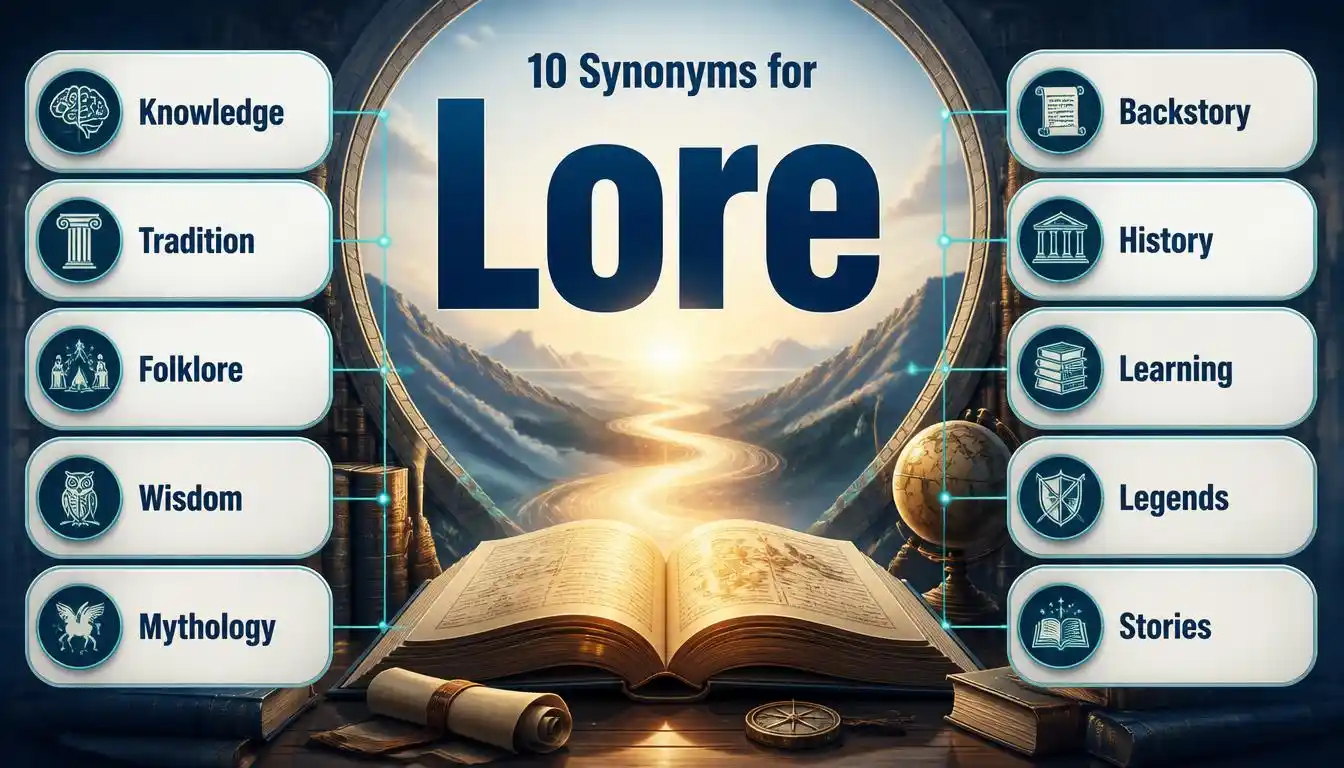
Synonyms for lore include knowledge, tradition , folklore , wisdom , mythology and backstory but the best choice depends on what lore means in the sentence. Lore usually refers to traditional knowledge stories, beliefs or information connected with a culture subject person or fictional world.
In modern online slang it can also mean someone’s personal history or backstory. For example “the lore of the ancient village” could become “the folklore of the ancient village” while “her personal lore” is closer to “her backstory.”
10 Best Synonyms for Lore and Their Meanings
| Synonym | Simple Meaning |
| Knowledge | Information or understanding about something |
| Tradition | Beliefs or practices passed down over time |
| Folklore | Traditional stories beliefs and customs |
| Wisdom | Knowledge gained through experience or tradition |
| Mythology | A collection of myths from a culture or fictional world |
| Backstory | The history behind a person character or situation |
| History | Events and information from the past |
| Learning | Knowledge gained through study or experience |
| Legends | Traditional stories about people places or events |
| Stories | Accounts of events real or imagined |
What Are Synonyms for Lore?
The best synonyms for lore are knowledge, folklore, tradition, mythology, wisdom, history, backstory, legends, heritage, and mythos.
The right synonym depends on whether lore refers to traditional knowledge, cultural stories, fictional history, or personal background.
Quick Facts About Lore
Word: Lore
Part of Speech: Noun
Simple Meaning: Traditional knowledge stories beliefs or background information
Pronunciation: /lɔr/
Syllables: 1
Origin: From Old English lār meaning learning, teaching or knowledge.
Formality: Neutral; sometimes literary
Common Uses: Everyday conversation academic writing creative writing gaming fandom discussions
Example Sentence: Local lore says that the old house once belonged to a famous explorer.
Lore Meaning and Usage
The basic lore meaning is a body of knowledge, beliefs , stories or traditions connected with a particular subject or group. Merriam-Webster defines its central sense as a particular body of knowledge or tradition while Cambridge emphasizes traditional knowledge and stories about a subject.
1. Lore as Traditional Knowledge
Lore often describes knowledge that has developed or been passed down over time.
Example:
The fishermen shared generations of sea lore with the younger crews.
Here lore is close to traditional knowledge, wisdom or tradition.
2. Lore as Traditional Stories and Beliefs
Lore can also refer to legends, stories , customs and beliefs connected with a community or place.
Example:
The mountain appears in many pieces of local lore.
In this sense folklore legends and sometimes mythology may work.
3. Lore in Literature Games and Fiction
In novels, fantasy series, movies and games lore usually means the background history rules characters, cultures , events and beliefs that make up a fictional world.
Example:
Fans study the game’s lore to understand why the two kingdoms became enemies.
Good alternatives include backstory history mythology mythos and background information depending on what part of the fictional world you mean.
4. Lore in Modern Slang
In current online slang lore can refer to a person’s personal history or the interesting stories that explain who they are. Merriam-Webster’s slang entry describes it as the history or backstory of a person, character or imagined world. The expression “lore drop” is also used for revealing previously unknown personal background.
Example:
That story about his first job added a surprising piece of family lore.
The tone of lore is usually neutral but can feel slightly literary mysterious , playful or dramatic.
Detailed Analysis of 30 Lore Synonyms
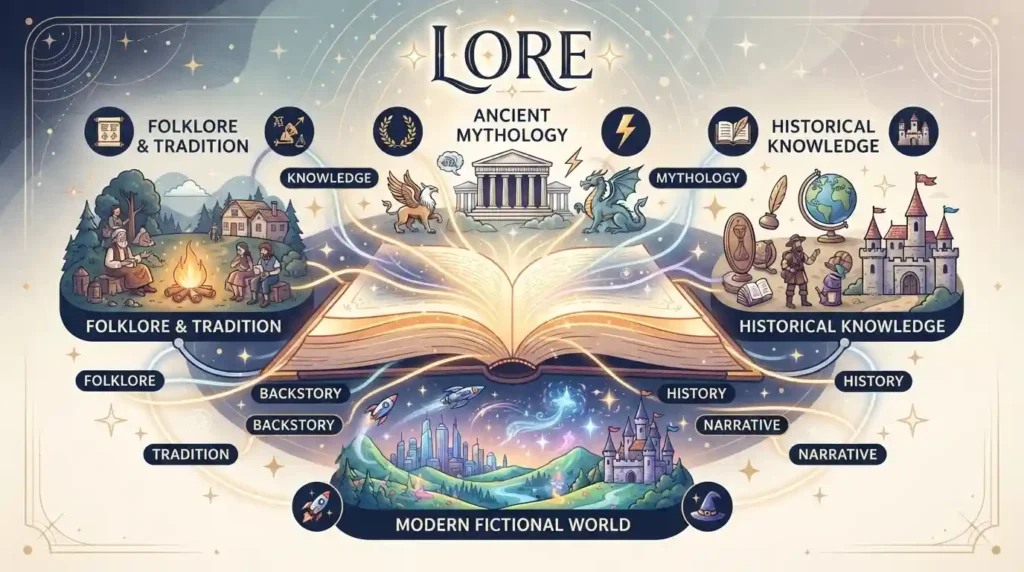
1. Knowledge a Synonym of Lore
Relationship: Exact synonym in the knowledge sense
Meaning: Information and understanding about a subject.
Difference: Knowledge is broader and does not suggest tradition or storytelling.
Best Used For: General educational or factual contexts.
Example: Her knowledge of local plants came from years of experience.
2. Tradition
Relationship: Near synonym
Meaning: Beliefs, customs or practices passed from one generation to another.
Difference: Tradition focuses more strongly on inherited practices and beliefs.
Best Used For: Cultural family and historical contexts.
Example: The festival is part of a centuries-old local tradition.
3. Folklore
Relationship: Near synonym
Meaning: Traditional stories beliefs customs and cultural traditions.
Difference: Folklore is more specifically connected with a community or culture.
Best Used For: Traditional tales, legends , customs and beliefs.
Example: The creature appears throughout regional folklore.
4. Wisdom
Relationship: Near synonym
Meaning: Valuable knowledge or judgment gained through experience.
Difference: Wisdom suggests insight and good judgment while lore may simply contain information or stories.
Best Used For: Practical or traditional knowledge.
Example: Farmers passed their weather wisdom to the next generation.
5. Learning
Relationship: Near synonym
Meaning: Knowledge gained through education, study or experience.
Difference: Learning emphasizes acquired knowledge rather than inherited stories.
Best Used For: Formal educational or older-style writing.
Example: His learning covered history, language and architecture.
6. Information
Relationship: Near synonym
Meaning: Facts or details about something.
Difference: Information is much broader and has none of the cultural or historical flavor of lore.
Best Used For: Neutral explanations and factual contexts.
Example: The guide provided useful information about the ruins.
7. Expertise
Relationship: Contextual alternative
Meaning: Deep knowledge or skill in a particular field.
Difference: Expertise usually comes from training or experience not shared tradition.
Best Used For: Professional or specialized knowledge.
Example: Her expertise in medieval architecture helped the research team.
8. Know-How
Relationship: Contextual alternative
Meaning: Practical knowledge about how to do something.
Difference: Know-how is practical and informal while lore can include stories and beliefs.
Best Used For: Everyday discussion of useful skills.
Example: The craft requires know-how passed down through generations.
9. Body of Knowledge
Relationship: Exact paraphrase in one sense
Meaning: The collected knowledge associated with a field or topic.
Difference: This phrase sounds more technical and less traditional than lore.
Best Used For: Academic professional and explanatory writing.
Example: Researchers have built a large body of knowledge about the region.
10. Traditional Knowledge
Relationship: Exact synonym in traditional contexts
Meaning: Knowledge preserved and passed through a community over time.
Difference: It is more precise and less literary than lore.
Best Used For: Cultural historical environmental or academic discussion.
Example: Traditional knowledge helped the community identify seasonal changes.
11. Folk Wisdom
Relationship: Near synonym
Meaning: Practical beliefs or advice traditionally shared among ordinary people.
Difference: Folk wisdom emphasizes advice and experience rather than stories.
Best Used For: Traditional sayings, practical beliefs and customs.
Example: Folk wisdom often links unusual animal behavior with changing weather.
12. Oral Tradition
Relationship: Near synonym
Meaning: Knowledge or stories passed from person to person through speech.
Difference: It describes a method of preserving culture rather than all lore itself.
Best Used For: Cultural and historical discussions.
Example: The story survived for centuries through oral tradition.
13. Cultural Knowledge
Relationship: Near synonym
Meaning: Shared understanding associated with a particular culture.
Difference: It is broader and more academic than lore.
Best Used For: Education anthropology and cultural discussion.
Example: The ceremony makes more sense with some cultural knowledge.
14. Teachings
Relationship: Contextual alternative
Meaning: Ideas, lessons or principles that are taught.
Difference: Teachings suggest deliberate instruction while lore may spread informally.
Best Used For: Religious philosophical or cultural contexts.
Example: The teachings were carefully preserved by later generations.
15. Beliefs
Relationship: Contextual alternative
Meaning: Ideas that people accept as true.
Difference: Beliefs can form part of lore but do not include all its stories or knowledge.
Best Used For: Cultural religious and social contexts.
Example: Many traditional beliefs developed around the changing seasons.
16. Customs
Relationship: Contextual alternative
Meaning: Traditional ways of behaving or doing things.
Difference: Customs are practices while lore can also include knowledge legends and explanations.
Best Used For: Cultural traditions and social practices.
Example: Visitors learned about the customs of the community.
17. Heritage
Relationship: Contextual alternative
Meaning: Cultural traditions, history and values inherited from the past.
Difference: Heritage is broader and can include objects, places , language and identity.
Best Used For: Cultural and historical writing.
Example: Storytelling remains an important part of the region’s heritage.
18. Legends
Relationship: Contextual alternative
Meaning: Traditional stories often connected with historical people or events.
Difference: Legends are individual stories or groups of stories; lore includes much more than legends.
Best Used For: Historical and traditional storytelling.
Example: Legends about the hidden city have survived for generations.
19. Myths
Relationship: Contextual alternative
Meaning: Traditional stories that may explain beliefs, origins , gods or natural events.
Difference: Myths are a type of story while lore can include both stories and factual knowledge.
Best Used For: Cultural and ancient storytelling.
Example: Ancient myths explained how the people understood the night sky.
20. Mythology
Relationship: Near synonym in myth-based contexts
Meaning: A collection or system of myths.
Difference: Mythology focuses specifically on myths while lore can include customs, facts , history and practical knowledge.
Best Used For: Ancient cultures, fantasy settings and religious stories.
Example: The novel borrows several ideas from Norse mythology.
21. Mythos
Relationship: Near synonym in literary contexts
Meaning: A connected set of myths, beliefs or ideas surrounding a subject or fictional world.
Difference: Mythos usually sounds more literary and emphasizes a larger symbolic system.
Best Used For: Fiction criticism mythology and worldbuilding discussions.
Example: The author created an elaborate mythos around the lost kingdom.
22. Tales
Relationship: Contextual alternative
Meaning: Stories especially imaginative or traditional ones.
Difference: Tales refers to narratives not the wider body of knowledge surrounding them.
Best Used For: Folklore children’s literature and storytelling.
Example: Travelers exchanged tales about strange events in the forest.
23. Stories
Relationship: Contextual alternative
Meaning: Accounts of events whether real or imagined.
Difference: Stories are much broader and more everyday than lore.
Best Used For: Casual conversation and general writing.
Example: Grandparents told stories about life in the old neighborhood.
24. Narrative
Relationship: Contextual alternative
Meaning: A connected account or interpretation of events.
Difference: A narrative normally has a clearer structure than a collection of lore.
Best Used For: Literary historical and analytical writing.
Example: The documentary builds a powerful narrative around the town’s history.
25. History
Relationship: Near synonym in background contexts
Meaning: Past events connected with a person, place , subject or group.
Difference: History usually implies actual past events while lore may include myths and beliefs.
Best Used For: Real people organizations places and fictional worlds.
Example: The museum explains the history of the settlement.
26. Backstory
Relationship: Exact or near synonym in modern fictional and slang usage
Meaning: Earlier events that explain a person’s character or current situation.
Difference: Backstory focuses specifically on what happened before the present story or situation.
Best Used For: Fiction games, movies , characters and personal slang.
Example: The final chapter reveals the villain’s backstory.
27. Background
Relationship: Near synonym
Meaning: Earlier information needed to understand someone or something.
Difference: Background is more neutral and factual than lore.
Best Used For: Professional academic and everyday explanations.
Example: You need some background to understand the conflict.
28. Background Information
Relationship: Near synonym
Meaning: Details that give context to a subject.
Difference: This phrase removes the mysterious cultural or storytelling tone often carried by lore.
Best Used For: Reports lessons articles and explanations.
Example: The first section gives background information about the ancient city.
29. Oral History
Relationship: Contextual alternative
Meaning: Historical memories and accounts preserved through spoken testimony.
Difference: Oral history generally aims to preserve people’s experiences while lore can include legends and beliefs.
Best Used For: Community history and historical research.
Example: The project recorded the oral history of longtime residents.
30. Legendarium
Relationship: Contextual alternative
Meaning: A collection or body of legends, especially one connected with a fictional or literary world.
Difference: Legendarium is much rarer and more literary than lore.
Best Used For: Fantasy literature and large fictional mythologies.
Example: The writer developed a vast legendarium for the imagined continent.
Synonyms for Lore by Context
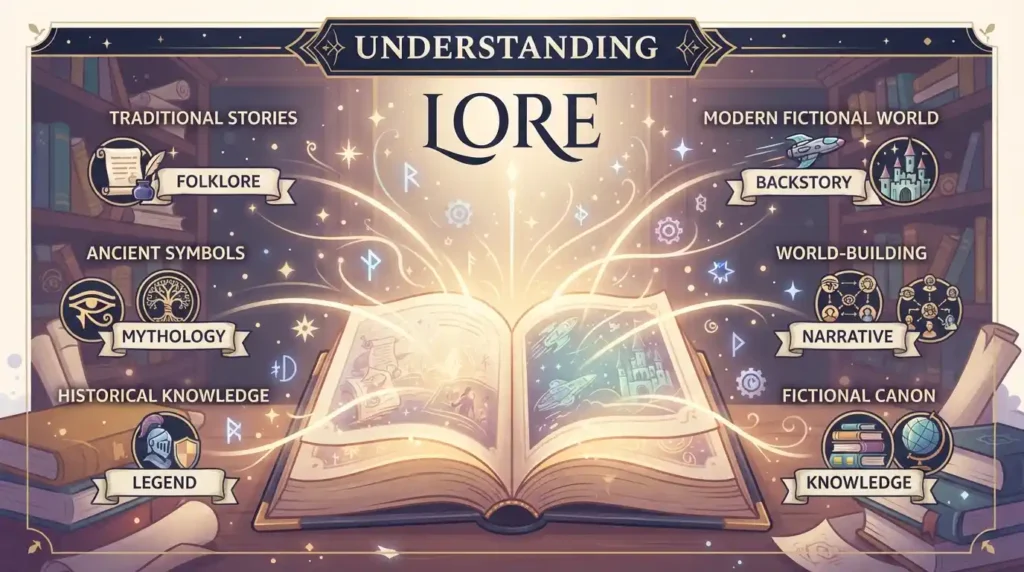
Everyday Conversation
Good choices include:
- Knowledge — when you mean information
- Stories — when you mean remembered accounts
- History — when you mean past events
- Background — when someone needs context
- Backstory — when discussing a person or character
Formal and Academic Writing
Better alternatives include:
- Traditional knowledge
- Cultural knowledge
- Oral tradition
- Body of knowledge
- Oral history
- Heritage
These choices are usually more precise than lore when the subject is being studied formally.
Creative Writing and Literature
Useful options include:
- Folklore
- Mythology
- Mythos
- Legends
- Tales
- Legendarium
- Backstory
For synonyms for lore in literature the right word depends on whether you mean traditional stories, a character’s past or the larger history and belief system of an imagined world.
Gaming and Fictional Worlds
Backstory history mythology mythos and background can sometimes replace lore. However lore is especially useful because it can cover all the information surrounding a fictional setting rather than only one character or event.
Lore vs Similar Words
| Lore | Folklore |
| Any accumulated knowledge | Mainly cultural stories |
| Can include fictional worlds | Usually real cultures |
| Broader term | More specific |
Mythology vs Lore
| Lore | Mythology |
| Includes all background information | Only myths |
| Used in games/books | Mostly gods, legends |
Lore vs Backstory
| Lore | Backstory |
| Entire world history | One character/person’s past |
Exact vs. Similar Synonyms for Lore
No synonym for lore works perfectly in every sentence. Knowledge is closest when lore means information about a subject but it lacks the traditional or storytelling feel. Folklore is closer when discussing inherited stories and beliefs although folklore is usually tied to a culture or community. Backstory works well for modern fictional or personal lore but focuses mainly on previous events. Mythology fits when the lore consists largely of myths.
Tone also matters. Lore can sound mysterious or literary while information sounds neutral, traditional knowledge sounds academic and backstory feels natural in fiction and informal conversation. The best synonym therefore depends on both meaning and setting.
Lore Antonyms
Lore has no single perfect opposite because it can mean knowledge, tradition , stories or background. The following words mainly oppose its knowledge sense.
| Antonym | Meaning | Example Sentence |
| Ignorance | Lack of knowledge | Ignorance of local history caused several mistakes. |
| Unawareness | Not knowing that something exists or happened | His unawareness of the custom led to confusion. |
| Unfamiliarity | Lack of knowledge or experience with something | Her unfamiliarity with the legend was understandable. |
| Inexperience | Lack of practical knowledge gained through experience | Inexperience made the task more difficult. |
| Nescience | Lack of knowledge | The formal essay contrasted learning with nescience. |
| Obliviousness | Failure to notice or know something | Their obliviousness to the town’s traditions surprised the guide. |
| Forgetfulness | Failure to remember known information | Years of forgetfulness weakened the community’s connection to the old stories. |
Common Collocations With Lore
| Phrase | Meaning | Example Sentence |
| Local lore | Stories or knowledge linked to a particular place | According to local lore a tunnel runs beneath the hill. |
| Ancient lore | Very old knowledge beliefs or stories | The library contained books about ancient lore. |
| Traditional lore | Knowledge and beliefs passed down over time | The practice comes from traditional lore. |
| Family lore | Stories repeatedly told within a family | According to family lore their grandfather once met the actor. |
| Game lore | Background history and information about a game world | Players spent hours discussing the game’s lore. |
| Character lore | Background information about a fictional character | The new episode revealed more character lore. |
| Deep lore | Obscure or detailed background knowledge | Only longtime fans understood the reference to deep lore. |
| Lore drop | A reveal of important or surprising background information | Her story about growing up overseas felt like a major lore drop. |
How to Choose the Right Synonym
How to Choose the Right Synonym for Lore
Use:
- Knowledge → when discussing facts
- Folklore → when discussing cultural stories
- Backstory → when discussing characters
- Mythology → when discussing myths
- Tradition → when discussing inherited customs
Frequently Asked Questions
What is lore in simple terms?
Lore means a collection of knowledge stories, traditions or beliefs connected with a subject, culture , person or fictional world. It often suggests information that has built up over time rather than a single fact or story.
What does “lore” mean in slang?
In modern slang lore often means a person’s history or backstory, especially unusual or interesting experiences that explain something about them. Someone may jokingly describe an old personal story as part of their “lore.”
What are some antonyms for “lore”?
Because lore often means accumulated knowledge, useful antonyms include ignorance, unawareness , unfamiliarity , inexperience and nescience. None is a perfect opposite in every context because lore can also refer to traditions, stories and fictional background.
What is an example of lore?
A town might have a traditional story claiming that a hidden tunnel lies beneath an old building. That story can be described as local lore because it is part of the knowledge and storytelling associated with the community.
What is lore in Gen Z slang?
In Gen Z and broader online slang lore can mean the personal experiences and background stories that help explain someone’s personality or life. Phrases such as “lore drop” describe revealing a previously unknown part of that backstory.
What is another word for “lore”?
The closest alternative depends on context. Use knowledge for information folklore for traditional stories and beliefs tradition for inherited customs mythology for collections of myths and backstory for the history behind a person character or fictional setting.
Conclusion
Choosing the right synonym for lore makes your meaning clearer. Knowledge, tradition , folklore , mythology , history and backstory overlap with lore but each emphasizes something different.
Consider whether you are describing facts, inherited traditions, stories , personal history or a fictional world before choosing the best word.

About Sajjad Ahmed
Sajjad Ahmed is the author behind Guest Paster, where he writes about English vocabulary, synonyms, word meanings, and practical word usage.
His content is designed to help readers understand the differences between similar words, discover suitable alternatives, and use English vocabulary more effectively in everyday writing and communication.
Before publishing, Sajjad focuses on presenting word choices in a clear and easy-to-understand format, with relevant meanings, context, and examples where helpful.
Through Guest Paster, his goal is to make vocabulary learning simpler and provide useful language resources for students, writers, English learners, and anyone looking to expand their vocabulary.
Areas of Focus: English Vocabulary • Synonyms • Word Meanings • Word Usage • Language Learning
Author: Sajjad Ahmed
Website: Guest Paster