What Does Farewell Mean?
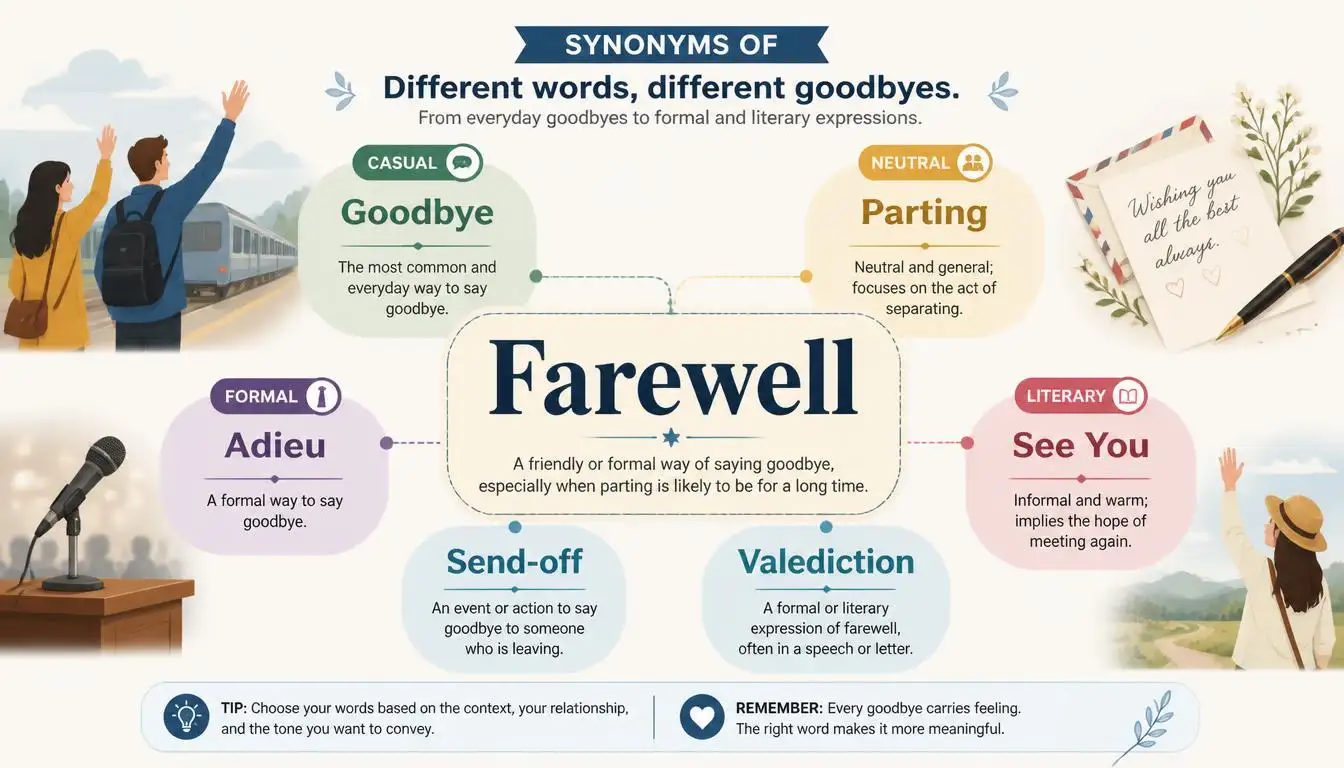
Farewell means goodbye or an expression of good wishes when people part. The closest synonyms for farewell include goodbye, parting, leave-taking, adieu, valediction and in certain contexts send-off. Dictionaries recognize farewell both as a parting expression and as a noun for the act or occasion of leaving.
The best replacement depends on context. Goodbye works in most situations while adieu sounds literary or dramatic and send-off usually refers to an event held for someone who is leaving. This guide focuses on modern American English usage.
For example: We said farewell to our teacher on the last day of school.
Best Synonyms for Farewell
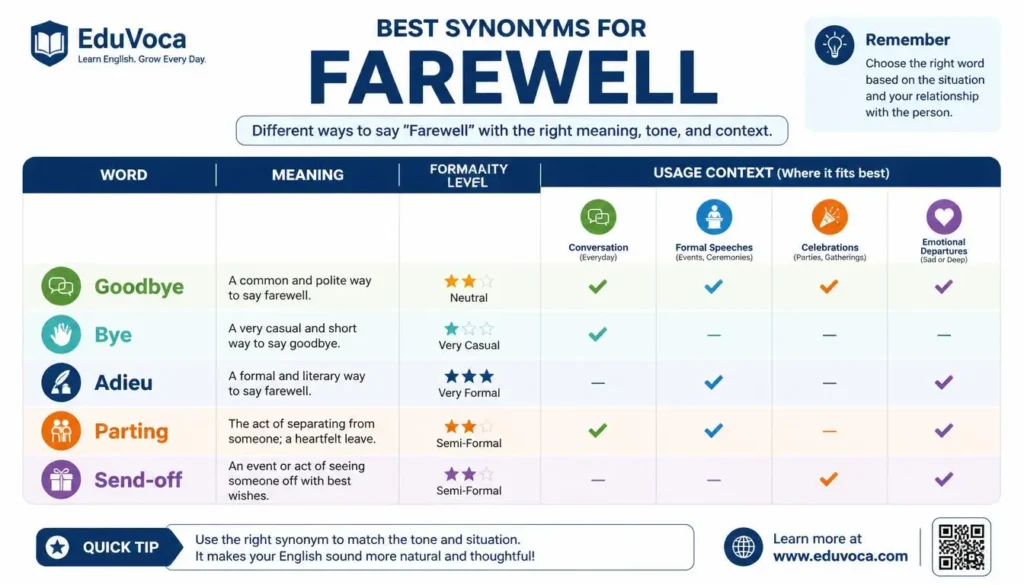
| Synonym | Relationship | Swap Rating | Formality | Best Used For |
|---|---|---|---|---|
| Goodbye | Exact Synonym | Drop-in | Neutral | Most everyday situations |
| Bye | Near Synonym | Drop-in | Informal | Casual conversation |
| Parting | Near Synonym | Minor Rewrite | Neutral | Departures and final moments |
| Leave-taking | Near Synonym | Minor Rewrite | Formal/Literary | Formal or descriptive writing |
| Adieu | Near Synonym | Drop-in | Literary/Formal | Dramatic or elegant goodbyes |
| Valediction | Near Synonym | Minor Rewrite | Formal | Farewell speeches or statements |
| Send-off | Contextual Alternative | Minor Rewrite | Neutral | Farewell parties and events |
| So long | Near Synonym | Drop-in | Informal | Friendly spoken goodbyes |
Quick Facts About Farewell
- Word: Farewell
- Part of Speech: Noun, interjection and attributive adjective
- Simple Meaning: Goodbye an expression or occasion marking a departure
- Pronunciation: fair-WELL
- IPA: /ˌferˈwel/ in American English
- Syllables: 2
- Origin: Farewell developed from the Middle English expression faren wel essentially wishing that someone would “fare well” after leaving. The parting expression dates to the late 14th century.
- Other Word Forms: farewells is the regular plural. Farewell can also modify another noun as in farewell speech. A verb use exists regionally but is not typical everyday American English.
- Formality: Neutral to formal
- Difficulty Level: Intermediate
- Common Uses: Conversation, speeches, messages, ceremonies, parties, business departures and creative writing
- Example Sentence: Her teammates gathered to give her a warm farewell.
Meaning and Usage of Farewell
Farewell as a Noun
As a noun, farewell can mean the act of saying goodbye the words spoken at a departure or an occasion organized for someone who is leaving.
Example: Their farewell was brief because the train was about to leave.
It can also refer to a farewell event:
Example: The office organized a farewell for the retiring manager.
Farewell as an Interjection
Farewell! can be spoken directly to someone who is leaving. In modern American conversation however it often sounds more formal, serious or dramatic than goodbye or bye.
Example: “Farewell everyone” the speaker said before leaving the stage.
Farewell as an Adjective
Farewell commonly appears before nouns to describe something connected with a departure.
Examples include:
- farewell party
- farewell dinner
- farewell message
- farewell speech
- farewell tour
In these combinations simply replacing farewell with another synonym may not always sound natural.
Detailed Synonyms for Farewell
The alternatives below are classified by how closely they match farewell and how easily they can replace it.
1. Goodbye
Relationship: Exact Synonym
Swap Rating: Drop-in
Formality: Neutral
Meaning: Goodbye is an expression used when people separate or leave one another.
Difference: Goodbye is the closest general-purpose synonym for farewell. It sounds more natural in everyday American speech while farewell can feel more ceremonial or final. Merriam-Webster treats goodbye as a parting remark or act and lists farewell as its direct synonym.
Best Used For: Everyday conversation, messages, letters, speeches and general writing.
Example: She waved goodbye before boarding the bus.
2. Bye
Relationship: Near Synonym
Swap Rating: Drop-in
Formality: Informal
Meaning: Bye is a short, casual form of goodbye.
Difference: Bye has essentially the same purpose as farewell when spoken, but its tone is much more relaxed. It would sound inappropriate in many ceremonial or highly formal contexts.
Best Used For: Conversations with friends, classmates, relatives and other familiar people.
Example: “Bye! See you tomorrow,” Carlos called from the doorway.
3. Parting
Relationship: Near Synonym
Swap Rating: Minor Rewrite
Formality: Neutral
Meaning: Parting refers to the moment or process in which people separate.
Difference: Parting emphasizes separation rather than the actual word or wish used to say goodbye. It often appears in phrases such as parting words, parting gift and at parting.
Best Used For: Descriptive writing, speeches, stories and discussions of departures.
Example: Her parting words encouraged the team to keep working together.
4. Leave-taking
Relationship: Near Synonym
Swap Rating: Minor Rewrite
Formality: Formal/Literary
Meaning: Leave-taking means the act of saying goodbye before departing.
Difference: Leave-taking is more literary and less common in everyday conversation. Unlike farewell it normally functions as a noun rather than a spoken goodbye.
Best Used For: Formal prose, historical writing, literary descriptions and storytelling.
Example: After a brief leave-taking, the guests continued their journey.
5. Adieu
Relationship: Near Synonym
Swap Rating: Drop-in
Formality: Literary/Formal
Meaning: Adieu is an expression of good wishes when someone leaves.
Difference: Adieu can directly mean goodbye, but in modern English it often sounds elegant, dramatic, playful, or old-fashioned. Merriam-Webster defines it as a parting expression and lists farewell as its synonym.
Best Used For: Creative writing, speeches, humorous dramatic effect and deliberately formal language.
Example: With a final wave, the actor bid the audience adieu.
6. Valediction
Relationship: Near Synonym
Swap Rating: Minor Rewrite
Formality: Formal/Literary
Meaning: A valediction is an act, statement, or expression of farewell.
Difference: Valediction is much more specialized than farewell. It is particularly suitable for a formal farewell message, statement, or speech rather than an ordinary spoken goodbye. Merriam-Webster defines it as an act of bidding farewell.
Best Used For: Formal speeches, literary analysis, ceremonies, and sophisticated writing.
Example: The final paragraph served as a thoughtful valediction to his readers.
7. Send-off
Relationship: Contextual Alternative
Swap Rating: Minor Rewrite
Formality: Neutral
Meaning: A send-off is an occasion or activity used to say goodbye to someone who is leaving.
Difference: Send-off does not usually replace farewell when farewell means the spoken word “goodbye.” It works best when farewell refers to an event.
Best Used For: Farewell parties, workplace departures, graduations and other leaving celebrations.
Example: Her coworkers arranged a cheerful send-off on Friday afternoon.
8. So Long
Relationship: Near Synonym
Swap Rating: Drop-in
Formality: Informal
Meaning: So long is an informal expression used to say goodbye.
Difference: So long is friendlier and more conversational than farewell. It may also have a slightly old-fashioned flavor in some contexts, but it remains recognizable as a goodbye expression. Merriam-Webster identifies it specifically as an expression of farewell.
Best Used For: Friendly dialogue, informal writing and conversational storytelling.
Example: “So long, everyone—I’ll see you next summer.”
9. See You
Relationship: Contextual Alternative
Swap Rating: Drop-in
Formality: Informal/Neutral
Meaning: See you is a casual expression used when leaving someone.
Difference: See you usually suggests that the people expect to meet again. Farewell does not necessarily carry that expectation, so the phrases differ slightly in emotional meaning.
Best Used For: School, work, family conversations and everyday social situations.
Example: “See you on Monday,” Priya said as she left.
Best Words to Use Instead of Farewell
In Everyday Conversation
Use goodbye, bye, see you, or so long.
Goodbye is the safest all-purpose choice. Bye and see you sound more relaxed, while so long adds a slightly distinctive conversational tone.
In Formal Writing
Use goodbye, parting, leave-taking, or valediction, depending on the sentence.
Valediction works especially well for a formal farewell statement while leave-taking describes the process of saying goodbye.
In Business Communication
Goodbye is usually clearer than unusually formal alternatives. For an employee who is leaving parting message or farewell message works naturally. If coworkers are holding an event send-off is a useful alternative.
In Creative Writing
Use adieu, parting, leave-taking or so long when the character and setting support the tone.
Adieu can sound dramatic or elegant while leave-taking is useful in descriptive prose.
For a Farewell Party or Dinner
When looking for synonyms for farewell party natural alternatives include:
- send-off
- going-away party
- goodbye party
For another word for farewell dinner, useful phrases include send-off dinner, going-away dinner, and goodbye dinner. These are alternatives to the complete phrase rather than universal synonyms for farewell itself.
Exact and Near Synonyms: What Is the Difference?
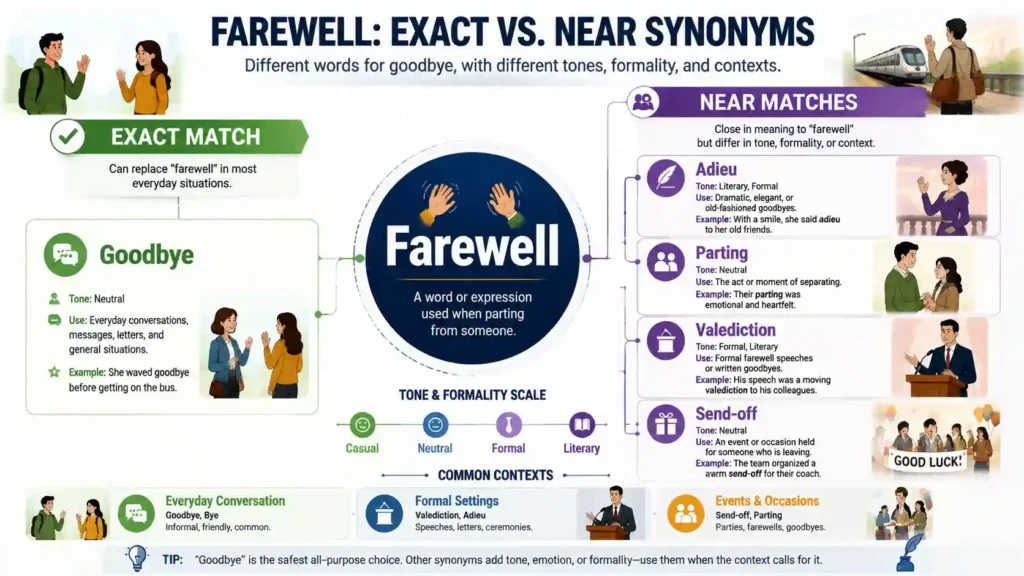
Very few synonyms are perfectly interchangeable in every sentence. Farewell and goodbye are extremely close when they refer to a parting expression, but their tone differs: farewell often feels more formal or ceremonial.
Parting is a near synonym because it focuses more on the separation itself. For example, parting words are words spoken just before leaving, but you would not normally shout “Parting!” instead of “Farewell!”
Send-off is even more context-specific. It can replace farewell when referring to an event—a farewell for the coach and a send-off for the coach—but not when someone simply says goodbye.
Words Commonly Confused With Farewell
Departure
Difference: A departure is the act of leaving. A farewell is usually the goodbye connected with that departure. Someone can depart without having a farewell.
Example: The flight’s departure was delayed until noon.
Bon Voyage
Difference: Bon voyage expresses good wishes to someone beginning a journey. It can accompany a farewell, but it specifically refers to traveling rather than every kind of goodbye.
Example: We wished the travelers bon voyage before their flight.
Valedictorian
Difference: A valedictorian is a graduating student who traditionally delivers a valedictory address. It is not another word for farewell.
Example: The valedictorian spoke during the graduation ceremony.
Antonyms of Farewell
The clearest farewell antonyms apply when farewell means a greeting used at parting. Dictionaries list words such as hello, welcome, and greeting as opposites or near opposites in this sense.
| Antonym | Simple Meaning | Example Sentence |
|---|---|---|
| Hello | A word used when meeting someone | She smiled and said hello to the new student. |
| Welcome | A friendly greeting for someone arriving | The principal gave the visitors a warm welcome. |
| Greeting | Words or actions used when meeting someone | They exchanged a friendly greeting at the door. |
| Salutation | A formal expression of greeting | The letter began with a polite salutation. |
Common Phrases and Collocations With Farewell
| Phrase or Collocation | Meaning | Example Sentence |
|---|---|---|
| bid farewell | Say goodbye | We gathered at the station to bid farewell to our friends. |
| fond farewell | A warm, affectionate goodbye | The class gave its teacher a fond farewell. |
| farewell message | A written or spoken goodbye message | She posted a short farewell message for her teammates. |
| farewell speech | A speech given before leaving | The director thanked everyone in his farewell speech. |
| farewell party | A gathering for someone who is leaving | They planned a farewell party for Friday evening. |
| farewell dinner | A meal held before someone leaves | The family shared a farewell dinner before the move. |
| farewell tour | A final series of appearances or performances | The group announced a farewell tour across several cities. |
| farewell gift | A present given to someone who is leaving | Her coworkers signed a book as a farewell gift. |
The expression bid farewell is a well-established construction meaning to say goodbye.
Frequently Asked Questions
How do you say goodbye in a fancy way?
For an elegant or formal goodbye, you can use adieu. In writing, valediction or leave-taking may also work, although they usually describe the farewell rather than function as a direct spoken replacement.
What is the best name for farewell?
If you mean the closest alternative word, goodbye is usually the best choice. If you mean a farewell event, send-off or going-away party is more natural. The right term therefore depends on whether you are describing words, an action, or an event.
What can you say instead of farewell?
You can say goodbye, bye, see you, so long, or adieu, depending on the tone. Goodbye is the most flexible. Bye and see you are casual, while adieu is more literary or dramatic.
What is a fancy word for goodbye?
Adieu is one of the best-known fancy alternatives to goodbye. Valediction is another formal word, but it usually refers to the act or statement of saying goodbye rather than being used as an everyday spoken goodbye.
How do Gen Z say goodbye?
There is no single goodbye expression that belongs exclusively to Gen Z, and youth slang changes quickly. In relaxed conversation, expressions such as bye, see ya, later, peace, or I’m out may be used, but these are informal expressions rather than precise generational synonyms.
How can you say farewell in a poetic way?
Depending on the mood, adieu is a natural poetic alternative. Writers can also use phrases such as a final parting or a fond goodbye. Poetic wording should match the scene rather than simply replacing farewell with the rarest possible word.
Conclusion
The best synonyms for farewell depend on what kind of goodbye you mean. Goodbye is the closest and most flexible replacement, while bye suits casual conversation and adieu creates a more literary tone. Words such as parting, leave-taking, valediction, and send-off work only in particular grammatical or social contexts.
By considering meaning, formality and situation, you can choose an alternative that sounds natural instead of treating every related word as interchangeable.

About Sajjad Ahmed
Sajjad Ahmed is the author behind Guest Paster, where he writes about English vocabulary, synonyms, word meanings, and practical word usage.
His content is designed to help readers understand the differences between similar words, discover suitable alternatives, and use English vocabulary more effectively in everyday writing and communication.
Before publishing, Sajjad focuses on presenting word choices in a clear and easy-to-understand format, with relevant meanings, context, and examples where helpful.
Through Guest Paster, his goal is to make vocabulary learning simpler and provide useful language resources for students, writers, English learners, and anyone looking to expand their vocabulary.
Areas of Focus: English Vocabulary • Synonyms • Word Meanings • Word Usage • Language Learning
Author: Sajjad Ahmed
Website: Guest Paster