What Is Omniscient?
Omniscient: Complete knowledge, unlimited knowledge, all, encompassing knowledge. The name derives from Latin: omni (all) and scire (to know) and literally means ‘the person who knows all’.
This term is frequently used in literature, philosophy and spirituality. An omniscient narrator is someone who has the ability to know everything about every person’s feelings, thoughts and experiences within a story.
Synonyms for the term omniscient, which depend on context may also include terms describing extensive knowledge, wisdom awareness intelligence or expertise.
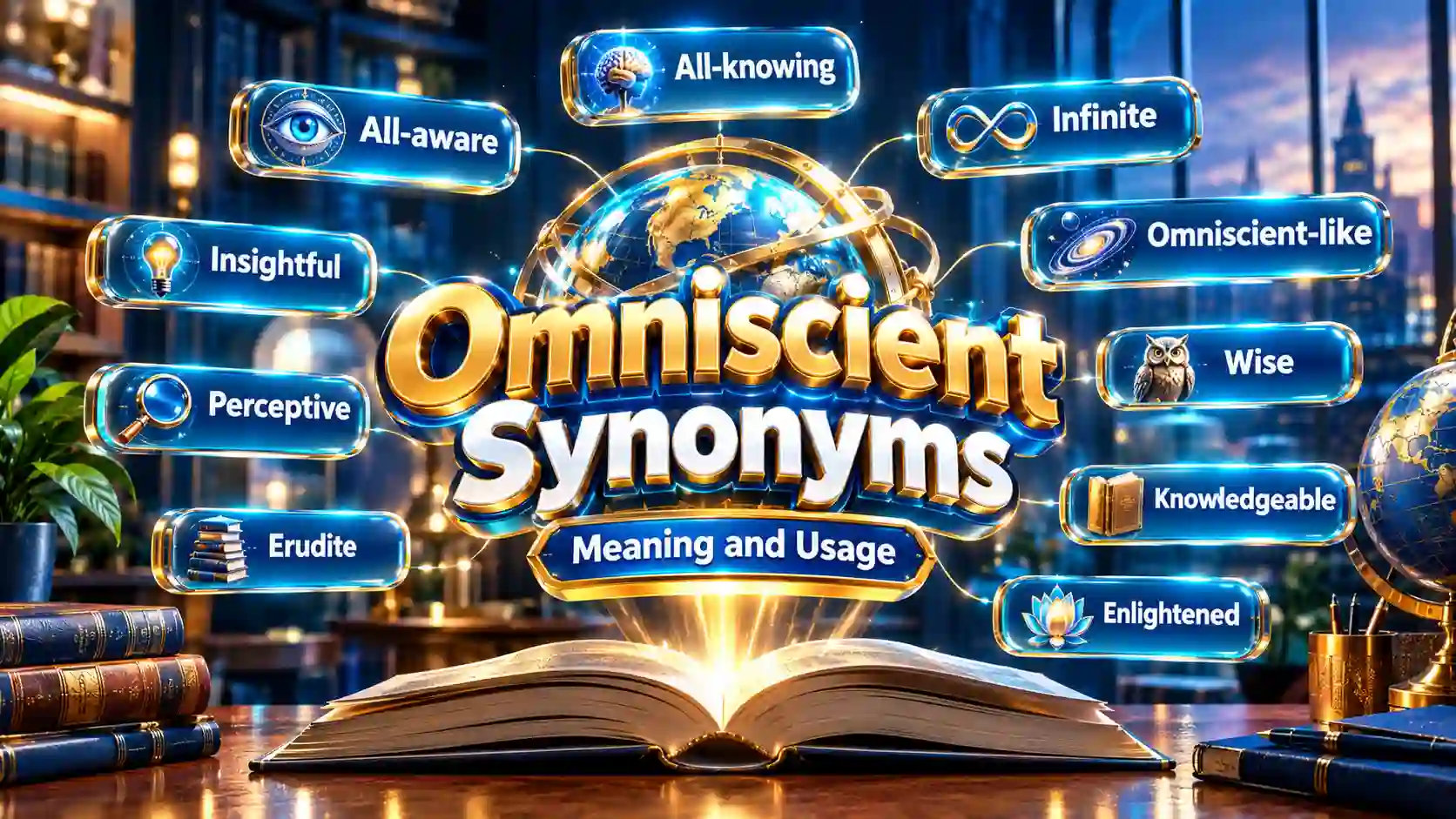
10 Best Synonyms for Omniscient
| # | Synonym | Meaning Difference | Best Used For | Formality |
| 1 | All-knowing | Having knowledge of everything | Religious, philosophical, general descriptions | Formal |
| 2 | Infinite | Unlimited in knowledge or ability | Abstract ideas, divine descriptions | Formal |
| 3 | Omniscient-like | Similar to knowing everything | Fictional or comparative writing | Neutral |
| 4 | Wise | Having great knowledge and good judgment | People, mentors, leaders | Neutral |
| 5 | Knowledgeable | Having a lot of information about a subject | Experts and professionals | Neutral |
| 6 | Enlightened | Having deep understanding or awareness | Spiritual, philosophical, personal growth contexts | Formal |
| 7 | All-aware | Conscious of everything happening | Literary and descriptive writing | Formal |
| 8 | Insightful | Showing deep understanding | Analysis, advice, opinions | Neutral |
| 9 | Perceptive | Able to understand things quickly | People, observers, writers | Neutral |
| 10 | Erudite | Showing extensive learning and scholarship | Academic writing | Formal |
Quick Facts About Omniscient
| Category | Details |
| Word | Omniscient |
| Part of Speech | Adjective |
| Simple Meaning | Knowing everything |
| Common Use | Describing unlimited knowledge, especially in literature, religion, and philosophy |
| Word Origin | Derived from Latin words meaning “all” and “knowing” |
| Syllables | 4 syllables (om-ni-scient) |
| Formality | Formal |
| Closest Synonym | All-knowing |
| Best Used For | Divine beings, narrators, fictional characters with complete knowledge |
Pronunciation: /ɒmˈnɪʃ.ənt/
Word Forms:
- Omniscience (noun) — complete knowledge
- Omnisciently (adverb) — in an all-knowing manner
What Is the Closest Synonym for Omniscient?
The closest synonym for omniscient is all-knowing.
Both words describe someone or something that possesses complete knowledge of everything. However, there is a slight difference in tone:
- Omniscient is a more technical and formal word often used in theology, philosophy, and literature.
- All-knowing is simpler and easier to understand in everyday language.
Examples:
Omniscient:
The novel uses an omniscient narrator who reveals every character’s hidden thoughts.
All-knowing:
Many religions describe God as an all-knowing presence.
Other close alternatives include all-aware, infinitely knowledgeable, and fully informed, but they may not always carry the same meaning of unlimited knowledge.
Can These Synonyms Be Used Interchangeably?
Not all synonyms for omniscient can be used interchangeably. While many words suggest knowledge or intelligence, they differ in how much knowledge they describe and the situations where they sound natural.
Usually Interchangeable
All-knowing and all-aware are the closest alternatives because they suggest complete awareness of everything. They work well when describing a divine being, fictional character, or narrator with unlimited knowledge.
Example:
- An omniscient narrator knows every character’s thoughts.
- An all-knowing narrator knows every character’s thoughts.
Both sentences have almost the same meaning.
Sometimes Interchangeable
Words like wise, knowledgeable, enlightened, and insightful can replace omniscient only in certain situations.
A wise person may have excellent judgment and experience, but they do not know everything.
Example:
❌ The wise scientist knew every event happening in the universe.
✅ The wise scientist understood complex problems better than others.
Rarely Interchangeable
Words such as erudite, educated, and perceptive describe intelligence, learning, or observation skills. They do not mean complete knowledge.
Example:
- An erudite professor has extensive academic knowledge.
- An omniscient being has unlimited knowledge.
The difference is the amount and scope of knowledge.
No — Not True Synonyms
Some related words are often confused with omniscient but have different meanings:
- Omnipotent = having unlimited power
- Omnipresent = being present everywhere
- Genius = having exceptional intelligence
- Expert = having advanced knowledge in one field
A person can be an expert without being omniscient.
Detailed Synonym Meanings and Examples
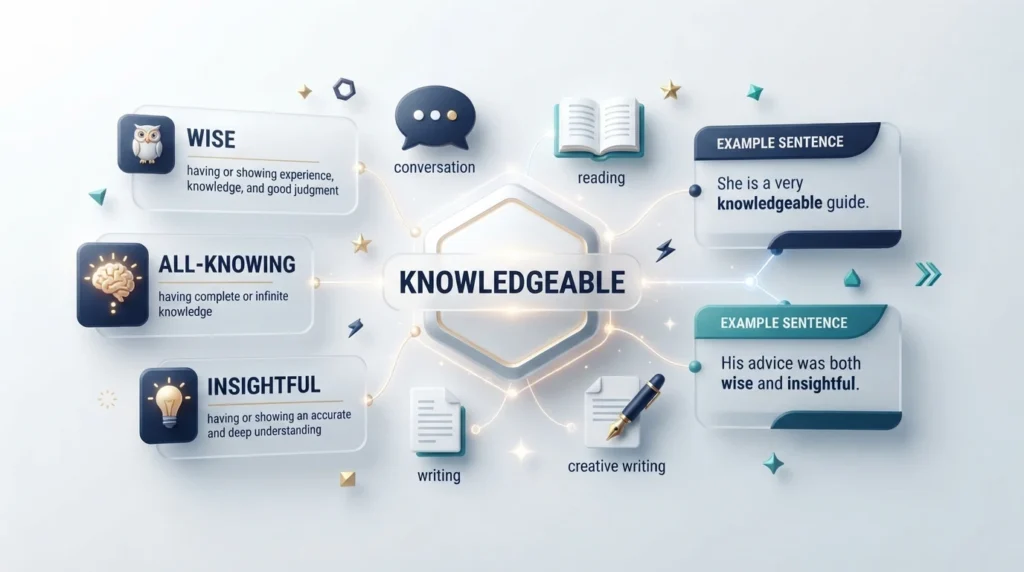
1. All-Knowing
Meaning:
Having complete knowledge of everything.
Difference from omniscient:
All-knowing is the simplest expression of omniscient. It is less technical but carries almost the same meaning.
Best Used For:
Religious writing, philosophy, storytelling, and general explanations.
Formality: Formal to neutral
Examples:
- Many cultures describe a supreme being as all-knowing.
- The story’s all-knowing narrator reveals secrets hidden from every character.
2. All-Aware
Meaning:
Being completely aware of everything happening around you.
Difference from omniscient:
All-aware focuses more on awareness and observation, while omniscient emphasizes unlimited knowledge.
Best Used For:
Literary descriptions and fictional characters.
Formality: Formal
Examples:
- The all-aware guardian noticed every change in the kingdom.
- The author creates an all-aware voice that understands every character’s emotions.
3. Infinite
Meaning:
Without limits or boundaries.
Difference from omniscient:
Infinite alone does not mean knowing everything. It requires context related to knowledge.
Best Used For:
Philosophical and abstract discussions.
Formality: Formal
Examples:
- The ancient text describes infinite wisdom beyond human understanding.
- Scholars debated whether knowledge could ever become infinite.
4. All-Wise
Meaning:
Having perfect wisdom and understanding.
Difference from omniscient:
Wisdom involves judgment and experience, while omniscience refers specifically to complete knowledge.
Best Used For:
Religious and philosophical writing.
Formality: Formal
Examples:
- The story portrays the king as an all-wise ruler.
- Ancient traditions often describe their creators as all-wise.
5. Knowledgeable
Meaning:
Having a strong understanding of information or a subject.
Difference from omniscient:
Knowledgeable people know a lot, but their knowledge is limited.
Best Used For:
Experts, teachers, professionals, and everyday conversation.
Formality: Neutral
Examples:
- She is knowledgeable about environmental science.
- A knowledgeable teacher can explain difficult concepts clearly.
6. Informed
Meaning:
Having access to useful facts and information.
Difference from omniscient:
Being informed means knowing relevant information, not everything.
Best Used For:
Business, education, and communication.
Formality: Neutral
Examples:
- An informed decision requires reliable information.
- The manager remained informed about market changes.
7. Enlightened
Meaning:
Having deep understanding, awareness, or wisdom.
Difference from omniscient:
Enlightened suggests spiritual or intellectual awareness rather than unlimited knowledge.
Best Used For:
Philosophy, spirituality, personal development.
Formality: Formal
Examples:
- The teacher shared an enlightened view of human nature.
- Many philosophers searched for an enlightened understanding of life.
8. Insightful
Meaning:
Showing deep understanding of situations or ideas.
Difference from omniscient:
Insightful people recognize hidden meanings but do not know everything.
Best Used For:
Reviews, analysis, leadership, writing.
Formality: Neutral
Examples:
- The article provides an insightful analysis of modern technology.
- Her insightful comments helped solve the problem.
9. Perceptive
Meaning:
Able to notice and understand things quickly.
Difference from omniscient:
Perceptive refers to strong observation skills, not complete knowledge.
Best Used For:
People, detectives, writers, and analysts.
Formality: Neutral
Examples:
- The detective was perceptive enough to notice small clues.
- A perceptive leader understands team concerns.
10. Erudite
Meaning:
Having extensive academic knowledge and learning.
Difference from omniscient:
Erudite describes someone highly educated, usually in scholarly areas.
Best Used For:
Academic writing and intellectual discussions.
Formality: Formal
Examples:
- The professor was known for his erudite lectures.
- Her erudite writing impressed academic readers.
11. Profound
Meaning:
Showing great depth of knowledge, thought, or understanding.
Difference from omniscient:
Profound describes deep understanding of a specific subject or idea, while omniscient means knowing everything.
Best Used For:
Academic writing, philosophy, reviews, and intellectual discussions.
Formality: Formal
Examples:
- The researcher made a profound discovery about human behavior.
- Her profound understanding of history shaped her writing.
12. Wise
Meaning:
Having good judgment gained through knowledge and experience.
Difference from omniscient:
A wise person makes excellent decisions but does not possess unlimited knowledge.
Best Used For:
People, mentors, leaders, and advice.
Formality: Neutral
Examples:
- The wise mentor guided students through difficult decisions.
- His wise words helped the team overcome challenges.
13. Expert
Meaning:
A person with advanced knowledge or skill in a particular field.
Difference from omniscient:
Experts have specialized knowledge, while omniscient beings have universal knowledge.
Best Used For:
Professional communication and workplaces.
Formality: Neutral
Examples:
- She is an expert in artificial intelligence research.
- The expert explained the technical problem clearly.
14. Learned
Meaning:
Having gained knowledge through study and education.
Difference from omniscient:
Learned people acquire extensive knowledge but remain limited to human understanding.
Best Used For:
Academic and historical contexts.
Formality: Formal
Examples:
- The learned scholar wrote several books on ancient civilizations.
- He was respected as a learned philosopher.
15. Intelligent
Meaning:
Having the ability to understand, learn, and solve problems.
Difference from omniscient:
Intelligence refers to mental ability, not complete knowledge.
Best Used For:
People, technology, and general descriptions.
Formality: Neutral
Examples:
- The intelligent student quickly understood the concept.
- Modern systems use intelligent algorithms to analyze data.
16. Brilliant
Meaning:
Exceptionally clever, talented, or impressive.
Difference from omniscient:
Brilliant describes outstanding ability rather than knowing everything.
Best Used For:
Creative work, achievements, and people.
Formality: Neutral
Examples:
- The scientist developed a brilliant solution.
- Her brilliant ideas changed the project direction.
17. Genius
Meaning:
A person with extraordinary intellectual ability.
Difference from omniscient:
A genius may understand difficult concepts but does not have unlimited knowledge.
Best Used For:
Exceptional talent and creativity.
Formality: Neutral
Examples:
- The inventor was considered a genius in engineering.
- His genius approach solved a complicated problem.
18. Understanding
Meaning:
Having the ability to comprehend ideas, situations, or people.
Difference from omniscient:
Understanding focuses on comprehension rather than complete awareness.
Best Used For:
Relationships, communication, and education.
Formality: Neutral
Examples:
- A good teacher is patient and understanding.
- Her understanding of human emotions improved her writing.
19. Aware
Meaning:
Knowing about something or recognizing its existence.
Difference from omniscient:
Awareness is limited to certain information, while omniscience covers everything.
Best Used For:
Everyday communication.
Formality: Neutral
Examples:
- The manager was aware of the upcoming changes.
- People should be aware of environmental issues.
20. Conscious
Meaning:
Having knowledge or awareness of something.
Difference from omniscient:
Consciousness means being aware, not having unlimited knowledge.
Best Used For:
Psychology, philosophy, and general communication.
Formality: Neutral
Examples:
- She became conscious of the impact of her actions.
- The writer was conscious of the audience’s expectations.
21. Observant
Meaning:
Quick to notice details and changes.
Difference from omniscient:
Observant people detect information through attention, but they do not know everything.
Best Used For:
Characters, detectives, analysis, and storytelling.
Formality: Neutral
Examples:
- The observant detective found important evidence.
- An observant reader can notice hidden themes.
22. Discerning
Meaning:
Showing good judgment and the ability to recognize differences.
Difference from omniscient:
Discerning refers to careful evaluation, not unlimited knowledge.
Best Used For:
Professional writing and decision-making.
Formality: Formal
Examples:
- A discerning customer chooses quality products.
- Her discerning eye improved the design.
23. Sage
Meaning:
A very wise person with deep knowledge and experience.
Difference from omniscient:
A sage is wise and experienced but not all-knowing.
Best Used For:
Literature, history, philosophy.
Formality: Formal
Examples:
- The village respected the old sage for his wisdom.
- The story introduces a sage who guides the hero.
24. Supreme
Meaning:
Highest in rank, quality, or importance.
Difference from omniscient:
Supreme describes superiority, not necessarily knowledge.
Best Used For:
Abstract, religious, or formal descriptions.
Formality: Formal
Examples:
- The story presents a supreme power beyond human understanding.
- The supreme authority made the final decision.
Best Alternatives by Context
Everyday Conversation
For normal conversations, avoid using omniscient because it sounds highly formal. Better alternatives include:
- All-knowing
- Wise
- Knowledgeable
- Expert
- Informed
Example:
Instead of:
My teacher is omniscient.
Use:
My teacher is extremely knowledgeable.
Formal Writing
For professional or formal writing, these alternatives work well:
- All-knowing
- Enlightened
- Erudite
- Profound
- Discerning
Example:
The philosopher explored the concept of an all-knowing creator.
Academic Writing
Academic contexts require accuracy. Use:
- Knowledgeable
- Learned
- Erudite
- Insightful
- Profound
Example:
The researcher provided an insightful analysis of human behavior.
Business Communication
Business writing usually avoids exaggerated terms like omniscient. Better choices:
- Expert
- Informed
- Experienced
- Insightful
- Knowledgeable
Example:
Our team provides expert guidance based on industry research.
Creative Writing
For fiction and storytelling, these words create stronger imagery:
- Omniscient
- All-knowing
- All-aware
- Sage
- Enlightened
Example:
The novel uses an omniscient narrator who reveals every hidden secret.
Social Media
For casual content, simpler words work better:
- Wise
- Expert
- Genius
- Knowledgeable
Which Synonym Should I Choose?
Choosing the right synonym for omniscient depends on what you want to describe. The word omniscient is very specific because it means having complete knowledge of everything. Many related words only describe a part of that meaning, such as intelligence, wisdom, awareness, or expertise.
Use these guidelines:
| Situation | Best Choice | Why |
| Describing a divine being with unlimited knowledge | All-knowing / Omniscient | Shows complete knowledge |
| Writing a novel with a narrator who knows everything | Omniscient | Standard literary term |
| Describing a highly educated person | Erudite / Learned | Focuses on study and education |
| Describing a professional | Expert / Knowledgeable | Shows skill in a specific field |
| Describing someone with good judgment | Wise / Sage | Focuses on experience and decisions |
| Describing deep analysis | Insightful / Profound | Shows understanding |
| Describing awareness of situations | Aware / Perceptive | Focuses on observation |
A useful rule:
- Use omniscient when the subject knows everything.
- Use knowledgeable when someone knows a lot.
- Use expert when someone knows one field deeply.
- Use wise when someone makes good decisions.
- Use insightful when someone understands hidden meanings.
Exact and Near Synonyms: Difference
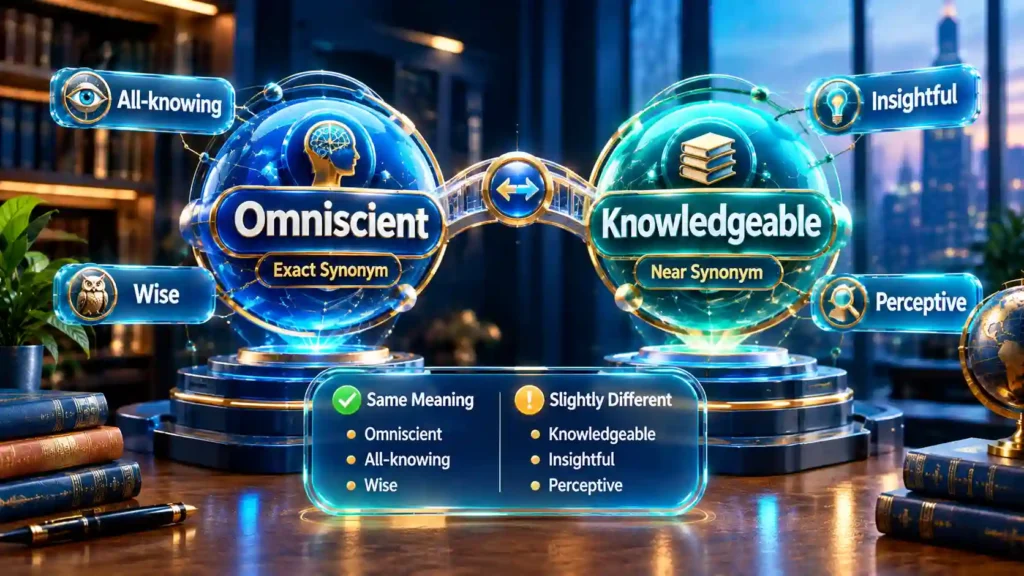
Synonyms are rarely perfect replacements. Words can share a similar meaning but differ in strength, emotion, or context.
Omniscient vs All-Knowing
These two words are almost identical.
- Omniscient: More formal and commonly used in philosophy, theology, and literature.
- All-knowing: Simpler and easier for general audiences.
Example:
The author created an omniscient narrator.
The story describes an all-knowing force.
Both work, but the first sounds more literary.
Omniscient vs Knowledgeable
These words are not equal.
Knowledgeable:
- Has a lot of information.
- Usually applies to humans.
- Limited to certain subjects.
Omniscient:
- Knows everything.
- Often describes fictional or divine beings.
Example:
A doctor is knowledgeable about medicine.
An omniscient being would know every fact about existence.
Omniscient vs Wise
Wisdom and knowledge are different.
A person can be wise without knowing everything. Wisdom involves judgment, experience, and understanding.
Example:
A wise leader makes thoughtful decisions.
An omniscient being possesses unlimited knowledge.
Omniscient vs Omnipotent
These words are often confused.
| Word | Meaning |
| Omniscient | Knowing everything |
| Omnipotent | Having unlimited power |
A being can be described as both omniscient and omnipotent, but the words refer to different qualities.
Omniscient vs Omnipresent
Another commonly confused pair:
| Word | Meaning |
| Omniscient | Present in knowledge |
| Omnipresent | Present everywhere |
Example:
- An omniscient being knows all events.
- An omnipresent being exists everywhere.
Words Commonly Confused with Omniscient
Omnipotent
Meaning: Having unlimited power.
Not a synonym because power and knowledge are different concepts.
Example:
The character is portrayed as omnipotent, able to control nature.
Omnipresent
Meaning: Existing everywhere at the same time.
Not a synonym because it refers to presence, not knowledge.
Example:
The story describes an omnipresent force across the universe.
Genius
Meaning: Someone with exceptional intelligence.
Not a synonym because even a genius has limited knowledge.
Example:
The scientist was a genius in physics but did not know everything.
Expert
Meaning: Someone highly skilled in a particular area.
Not a synonym because expertise is usually specialized.
Example:
She is an expert in cybersecurity.
Intelligent
Meaning: Able to learn, reason, and solve problems.
Not a synonym because intelligence does not equal complete knowledge.
Antonyms of Omniscient
The opposite of omniscient is a person or being that lacks complete knowledge.
Common Antonyms:
| Antonym | Meaning |
| Ignorant | Lacking knowledge |
| Unaware | Not knowing about something |
| Uninformed | Without necessary information |
| Limited | Restricted in knowledge or ability |
| Fallible | Capable of making mistakes |
| Unknowing | Having no knowledge of something |
| Naive | Lacking experience or understanding |
Examples:
- An omniscient narrator knows every secret.
- A limited narrator only knows what one character experiences.
Common Phrases with Omniscient
1. Omniscient narrator
A storytelling style where the narrator knows the thoughts, feelings, and histories of all characters.
Example:
The author uses an omniscient narrator to reveal hidden motivations.
2. Omniscient perspective
A viewpoint that provides complete information about events and characters.
Example:
The novel shifts from a personal viewpoint to an omniscient perspective.
3. Omniscient being
A being believed to possess unlimited knowledge.
Example:
Many philosophical discussions explore the idea of an omniscient being.
4. Omniscient knowledge
Complete awareness of all facts and events.
Example:
Humans cannot achieve omniscient knowledge.
5. Omniscient viewpoint
A literary technique where the writer knows everything happening in the story.
Example:
The omniscient viewpoint allows readers to understand every character.
Frequently Asked Questions
What is another word for omniscience?
The closest alternatives for omniscience are all-knowingness, complete knowledge, infinite knowledge, and universal awareness.
What is similar to omnipotent?
Words similar to omnipotent include all-powerful, almighty, supreme, and unlimited in power. These describe ability or power rather than knowledge.
What does omniscient mean?
Omniscient means knowing everything. It is usually used to describe a being, narrator, or concept with unlimited knowledge.
What is omniscient vs omnipotent?
Omniscient means having complete knowledge, while omnipotent means having unlimited power. One describes knowledge; the other describes ability.
What’s a synonym for omniscient?
The closest synonym for omniscient is all-knowing. Other alternatives include all-aware, infinitely knowledgeable, and enlightened.
What are 5 strong synonyms?
Five strong synonyms for omniscient are:
- All-knowing
- All-aware
- Infinite
- Enlightened
- All-wise
Conclusion
Selecting the correct synonym for omniscient enhances clarity and improves accuracy in writing. While words like ‘wise’, ‘knowledgeable’, ‘expert’ and ‘insightful’ may be associated with one another, they do not all convey a full understanding. The term ‘omniscient’ is generally reserved for the purposes of infinite awareness, typically in literature, philosophy and religious contexts.
For writing about ordinary things, alternative words like knowledgeable or wise may express the idea more naturally. For fictional universes, academic debate and formal descriptions omniscient and all-knowing are the best options.
Knowing the differences between these terms helps writers use the correct words to convey their intended meaning, tone and audience.

About Sajjad Ahmed
Sajjad Ahmed is the author behind Guest Paster, where he writes about English vocabulary, synonyms, word meanings, and practical word usage.
His content is designed to help readers understand the differences between similar words, discover suitable alternatives, and use English vocabulary more effectively in everyday writing and communication.
Before publishing, Sajjad focuses on presenting word choices in a clear and easy-to-understand format, with relevant meanings, context, and examples where helpful.
Through Guest Paster, his goal is to make vocabulary learning simpler and provide useful language resources for students, writers, English learners, and anyone looking to expand their vocabulary.
Areas of Focus: English Vocabulary • Synonyms • Word Meanings • Word Usage • Language Learning
Author: Sajjad Ahmed
Website: Guest Paster